
 Sunday, May 24, 2026
 Elder of Ziyon
There was once a major European Jewish community that lived under a regime where the local authorities spent twenty-five years systematically dismantling traditional Jewish life.
Teaching Torah to children was an indictable offense, punished by a fifty-florin civil fine. Religious teachers were banished from the city, and any caught attempting to instruct young Jews in Hebrew Bible or Talmud were hunted down — teachers and students hid in lofts, the hiding-places were discovered, and those who provided the means for these studies were prosecuted. The mikveh had been ordered sealed shut by official decree. A 50,000-florin bequest specifically intended for Jewish education was confiscated and suppressed. Two abandoned synagogues fell into ruin after a group of two hundred traditional Jews was denied permission to renovate them at their own expense.
Was this Christian Europe after the Black Plague? Spain after 1492? Germany when Martin Luther published On the Jews and Their Lies in 1543? Or perhaps in a Russian town during the pogroms?
No. This was Frankfurt am Main between roughly 1818 and 1843 — Frankfurt when it was the financial capital of central Europe, soon to host the 1848 National Assembly that would draft Germany’s first liberal constitution, one of the most progressive and cosmopolitan cities on the continent. Frankfurt prided itself on being at the leading edge of European Enlightenment.
And the people who created these antisemitic laws were not fanatical Christians. They were…Reform Jews.
The campaign was conducted by the Jewish Community Council of Frankfurt, which had passed under the control of Reform-aligned leadership and was using its civil authority — granted by German law over the internal affairs of every Jew in the city — to make traditional Jewish practice illegal. From 1817 through the 1830s, the Council was dominated by members of a Reform-oriented Masonic lodge. Whoever controlled the Council controlled everything that a Jew in Frankfurt could not opt out of: synagogues, schools, cemeteries, ritual slaughter, the mikveh, communal taxation, religious education. The Council used that authority, for a quarter-century, to do what no gentile authority in Frankfurt had attempted in living memory: criminalize traditional Jewish life in the city.
The documentation is extensive. Robert Liberles’s Religious Conflict in Social Context (Greenwood Press for the Leo Baeck Institute, 1985) is the standard academic monograph. Jacob Katz, the founding historian of modern Orthodoxy as a scholarly field, treats the Frankfurt period as the methodologically central case in A House Divided (1995 Hebrew, 1998 English). Rabbi Samson Raphael Hirsch published his own contemporary account in his 1854 pamphlet Die Religion im Bunde mit dem Fortschritt. The details have been in the standard literature for over a century.
We know what Christian anti-Jewish campaigns looked like. In some ways, this Jewish anti-Jewish campaign was worse.
The Council, in its official report to the Senate in 1838, declared in writing that the value of the Hebrew Bible was “doubtful.” Christians would not have said that.
The Council ruled that any Jew who continued to wear tefillin was ineligible for communal office. Tefillin had no role in Christian polemic; Christians had no stake in who served on a Jewish communal board.
A voluntary group of Jews, the “Tzitzith Society,” had gathered for many years on Shabbat afternoons in a private home to read Tanach and the Prophets together. The Council made this an indictable offense. A Christian regime would have applauded Jews studying the Old Testament.
The Council ordered the mikveh sealed. Mikveh use was unobjectionable from a Christian point of view because it did not compete with Christian sacraments. The Council went out of its way to invest institutional energy in preventing Jewish women from performing a ritual that affected no one outside the Jewish community. The mikveh did not threaten Reform principles. Reform women were not being compelled to use it. Its continued operation threatened nothing the Reformers needed. They sealed it anyway, because the existence of women using the mikveh contradicted their own framework.
The Council’s hostility to traditional practice was a premeditated ideological commitment.
A movement confident in its own framework does not need to suppress the alternatives. If the Reformers had genuinely believed they represented the inevitable, rational, modern future of Judaism, they could have left the traditional community alone and let it dissolve on its own through demonstration and example. The Orthodox were not a threat to Reform if Reform was correct; the Orthodox were a threat to Reform precisely because Reform was not correct, and on some level the Reformers knew it. Every Jewish woman using the mikveh, every child learning Talmud in a Frankfurt loft, every member of the Tzitzith Society reading the Prophets aloud in a private home was a piece of empirical evidence falsifying the Reform claim that the modern Jew had outgrown these practices. The Reformers didn’t want “emancipation” from religion for themselves — they regarded traditional Judaism as a threat to their very existence and philosophy.
This is the structural signature of antisemitism in every form it has taken from medieval Christian antisemitism through today. The very existence of Jews, or Judaism, or a Jewish state is seen as a threat to their philosophies. The framework varies. The mechanism does not.
This pattern does not stop at the Jewish-gentile border. Jews who adopt a universalist framework as their primary moral identity inherit the framework’s structural intolerance of Jewish particularity. They cannot tolerate Jews who remain particularist any more than gentile universalists can, and for the same structural reason. The continued existence of particularist Jews is a falsification of the framework they have made their identity around, and the framework demands the falsification’s elimination.
The Frankfurt Reformers were Jews who had adopted Enlightenment-era universalism as their primary moral framework. The contemporary version is Jews who have adopted postcolonial and anti-racist universalism as theirs. The parallels are eerie. The energy invested by Jews to suppress the opinions and even existence of other Jews shows how much the framework needs the falsifying evidence to disappear.
Jewish anti-Zionists today insist that they, as Jews, represent the real Judaism — prophetic, ethical, progressive — and that Zionist Jews are beyond the pale, complicit in genocide, unfit for inclusion in progressive Jewish spaces. They lobby to criminalize Zionism as a form of racism through “anti-Palestinian racism” frameworks designed to function as civil rights categories. They organize disruption of Jewish institutions. They sign open letters demanding that synagogues, federations, and Hillels renounce Zionism. They harass Jewish students on campuses, ally with movements that endanger fellow Jews, and frame all of this as moral seriousness against the embarrassing reactionary Zionism of the rest of Jewry. They created an entire philosophy fetishizing the Diaspora because they cannot square actual Judaism with their anti-Zionism.
The most direct parallel between the anti-Zionists of today and the malicious Reformers of Frankfurt is how they deal with the prayerbook itself. The German Reform program, formalized at the 1845 Frankfurt Rabbinical Conference and pushed to its endpoint in Holdheim's 1848 Berlin Reformgemeinde siddur, surgically removed every reference to Jewish peoplehood and national restoration from the liturgy, turning the central Amidah prayer into a parody of itself. Prayers for the return to Zion were deleted or rewritten as abstract spiritual aspirations. The petition to gather the exiles from the four corners of the earth was struck because the Reformers did not consider themselves exiles. References to Eretz Yisrael as the inheritance of the Jewish people were removed or recontextualized as spiritual rather than territorial. The Davidic messiah who would restore Jewish sovereignty was replaced with an abstract "messianic age" of universal human brotherhood with nothing specifically Jewish about it. The Tisha B'Av liturgy mourning the loss of Jewish sovereignty was softened or eliminated; Holdheim abolished the fast day entirely.
Here’s a bowdlerized Grace After Meals section of an 1845 Reform German prayerbook that removes three paragraphs of standard text about return to Zion and rebuilding Jerusalem.
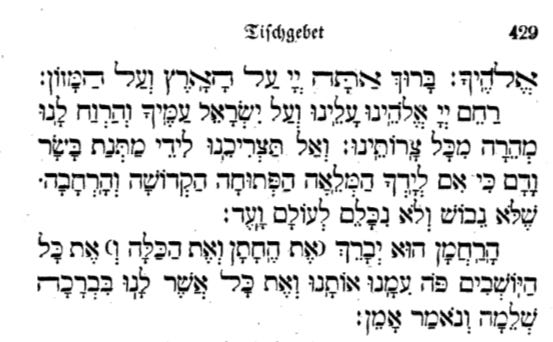
The contemporary anti-Zionist Jewish movement is running the same playbook on the same liturgy with the same goal. Anti-Zionist haggadot remove "Next Year in Jerusalem" and replace it with universalist liberation language. Prayers for the State of Israel are stripped from progressive siddurim. Tisha B'Av observances are reframed around the “Nakba” rather than the destruction of the Temple, mourning a different framework's preferred catastrophe instead of the Jewish one. References to Eretz Yisrael as the Jewish homeland are excised or recontextualized. The mechanism is identical because the structural problem is identical. Two thousand years of liturgy point in one direction. The framework requires the other. When the textual evidence contradicts the framework, the textual evidence has to be edited.
A movement confident in its own framework would not need to suppress the alternatives. If the anti-Zionist Jews genuinely believed they represented the real Judaism and that Zionism was a regrettable detour, they could leave Zionist Jews alone and let the framework demonstrate its truth through example. They do not do this. They cannot do this. Zionist Jews are not a threat to anti-Zionism if anti-Zionism is correct; Zionist Jews are a threat to anti-Zionism precisely because anti-Zionism is not correct, and on some level the anti-Zionists know it. The continued existence of a Jewish state and the continued attachment of most Jews worldwide to Jewish peoplehood and Jewish sovereignty is a piece of empirical evidence that the framework cannot absorb. So the evidence has to be eliminated, by whatever institutional power is available.
The Frankfurt Council had German civil law and police enforcement. Contemporary anti-Zionists have university administrations, professional associations, social media platforms, progressive Jewish institutions, and the soft power of social and reputational coercion. The toolset has modernized. The project is the same.
Samson Raphael Hirsch arrived in Frankfurt in 1851, twenty years into the suppression campaign, at the invitation of eleven men — the remnant of the city’s traditional Jewish community, organized as the Israelitische Religionsgesellschaft. He spent the next twenty-five years building parallel Jewish institutional infrastructure that the captured Council could not destroy: a separate community, a school, a synagogue, a publishing program, and most importantly an intellectual framework (Torah im Derech Eretz) that could defend traditional practice on its own terms against Reform critique. He did not try to reform the Council from within. He understood that institutional capture cannot be reversed from inside when the captors are committed to the framework that requires the suppression. Reasoning with them would not work, because their framework was definitionally anti-Jewish.
Just like today’s anti-Zionists, the Frankfurt Reformers presented themselves as the modern, enlightened, progressive Jews and depicted traditional Jews as the embarrassing past. They told anyone who would listen that they were on the right side of history. But people truly on the right side of history are not threatened by the people they believe are wrong - they let history take care of them.
Their direct ideological descendants are doing the same work today against Zionist Jews, for the same structural reasons, with the same self-presentation, with the same gap between their claimed confidence and the energy they invest in suppression. The framework-holders cannot be reasoned out of their framework, because the framework is constitutive of their identity. Institutional capture cannot be reversed from within, because the captors are committed to using available power against the Jews they oppose. The response that has worked, historically, is the Hirschian one: build parallel institutions that the captured ones cannot suppress, and fight for the legal and social conditions that let those institutions sustain themselves. Hirsch did it in Frankfurt. Zionism did it on the national scale. The Orthodox infrastructure, the day school system, the pro-Israel media ecosystem, and the alternative platforms that can carry Jewish voices outside captured legacy institutions are doing it now.
Every universalist framework that has tried to eliminate Jewish particularism has failed. The Jewish people have outlasted Christianity’s supersessionist campaigns, Enlightenment universalism’s demand for dissolution, Marxism’s class reclassifications, Nazism’s racial reclassifications at the cost of six million lives, and the various intermediate iterations. We will outlast the current one. The framework is wrong about us, as every prior framework was wrong about us, for the same structural reason: Jewish particularism is empirical, real, and continuous, and frameworks built on its denial cannot survive contact with the evidence.
The Reform movement, both in Germany and worldwide, now looks at the early Reformers with more than a little embarrassment. Their leaders steadily rolled back most of the excesses of their German founders over the next 150 years. They recognize that the passionate hatred of the early Reform movement was not Judaism but a pathetic attempt to destroy Judaism in its name.
That is what Jewish anti-Zionists today are. In fifty years, they will likely be universally recognized as just as bigoted, hateful and antisemitic as their Frankfurt Reformer forebears were.
|
Reclaiming the Covenant on America's 250th (May 2026) "He's an Anti-Zionist Too!" cartoon book (December 2024) PROTOCOLS: Exposing Modern Antisemitism (February 2022) |
 |
 Buy
Buy


