Sunday, May 31, 2026

  • Sunday, May 31, 2026
  • Elder of Ziyon


In 2021, I created a definition of antisemitism that I believe is both comprehensive and
precise — and short enough to fit in a tweet:

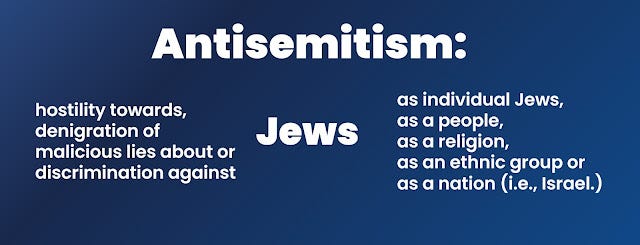
Antisemitism is
hostility toward,
denigration of,
malicious lies about, or
discrimination against

Jews

as individuals,
as a people,
as a religion,
as an ethnic group,
or as a nation (i.e, Israel.)

As I discussed in my last article, this defines its object first. Jews are not just a faith community. They are simultaneously a people, an ethnicity, a civilization, and a nation,
with Israel as the contemporary expression of that last dimension. Any attack on any of
those dimensions is antisemitism. The definition is exhaustive by construction: anything
not covered by it is, by definition, not antisemitism. No “context,” no “mights,” no
“mays” required. without defining what Jews are, you arrive at a mess of a definition of antisemitism.

Over the years, my definition has held up well. It has been quoted in at least one
scholarly book
on the topic and has been taught in an Ivy League school.

I recently realized, however, that there is a class of antisemitism it does not cover.

In November 2025, a man approached actress Helen Mirren and her husband Taylor
Hackford on the streets of London, filmed the encounter, and published it. He had done
his research. He was not targeting Mirren because she had played Golda Meir — he was targeting her for a 2023 interview in which she said Israel should exist because of the Holocaust and opposed cultural boycotts of Israeli artists. “An evil Zionist bitch,” he
told her as he backed away. Then, turning to Hackford: “fuck you and all.” The
Metropolitan Police, when the video resurfaced this week, described it as “
antisemitic
verbal abuse
.”

The police said what is obvious - attacking a non-Jew because of their support of Jews is antisemitic. But none of the definitions, including my own, would have included this
incident as antisemitism.

The missing category might be called second-order antisemitism: hostility toward, or
attacks on, non-Jews specifically because of their association with, defense of, or
solidarity with Jews.

This is not a minor edge case. It is a recognizable and recurring phenomenon. Arab
Zionists get attacked as if they were Jews. Non-Jewish attendees at Jewish events get
targeted. Allies who publicly defend Israel face the same harassment campaigns directed
at Jewish advocates.

Even though this could be termed second-order antisemitism: it is actually more severe
in some ways than direct attacks on Jews. If someone hates Jews enough to attack those
who merely defend them, the hatred of Jews themselves is beyond question. Second-
order antisemitism is a revealed preference — it shows that the hostility is not a reaction
to anything Jews have done or are, but a hatred of Jewish existence and Jewish solidarity as such. The non-Jewish defender becomes a target precisely because their support is
voluntary. They chose the Jews. The antisemite cannot tolerate that choice.

The logic is the classic a fortiori argument if they attack those who stand with Jews, all
the more so do they attack Jews.

There is even a third-order variant worth naming. Ritchie Torres, the congressman from
the Bronx, has been one of the most consistent and vocal defenders of Israel and the
Jewish community in the United States Congress. The attacks on him are not merely
second-order antisemitism.

Torres is, by every marker of progressive identity politics, supposed to be on the
attackers’ side. He is Black. He is gay. He represents a minority-majority district. His
support for Israel is experienced by the haters not just as defending Jews but as a
betrayal of his assigned political identity — a violation of the intersectional framework
that requires members of oppressed groups to stand against Israel. The rage directed at
him is compounded: attacked for defending Jews, and attacked again for refusing to be
the ally the haters assumed they owned.

This is antisemitism operating through the machinery of identity politics. The
assumption that Black, gay, or minority voices belong to the anti-Israel coalition — and
the fury when they don’t — reveals that the coalition’s anti-Zionism is not a political
position derived from principle. It is a tribal demand. Torres’s existence as a defender of
Jews is, to them, a category violation. The intensity of the response reveals the
assumption underneath.


So I need to slightly adjust my definition of antisemitism to be as complete as possible.
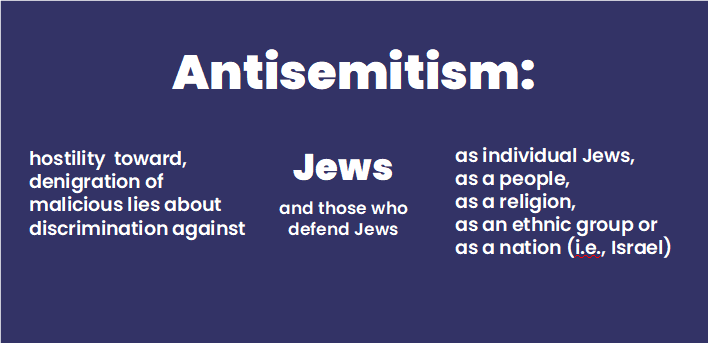
I added “and those who defend Jews” in the center column. If even the British police
recognize that as antisemitism, everyone does. A definition that does not cover that case
is not a good enough definition of antisemitism.

When the hatred extends beyond Jews to everyone who refuses to abandon them, what
you are seeing is not a political grievance that got out of hand. It is a hatred of the Jewish
covenant itself — of the idea that anyone, Jewish or not, might choose to stand with the
Jewish people.

That is antisemitism in its most elemental form.


Buy EoZ's books  on Amazon!

Reclaiming the Covenant on America's 250th (May 2026)

"He's an Anti-Zionist Too!" cartoon book (December 2024)

PROTOCOLS: Exposing Modern Antisemitism (February 2022)


From Ian:

Hen Mazzig: Giant
I went into Giant braced for a hit job, and I was wrong about that. Mark Rosenblatt does not put Roald Dahl in the dock and read out the charges against him. He gives him wit, a beautiful house in the country, a fiancée who adores him, and a new children’s book about to ship... And then he lets Dahl talk. John Lithgow plays him as charming, the kind of man you would want at your table. By the end you understand that the charm and prestige were doing the work the whole time. It was how the cruelty traveled.

Liccy, his fiancée, catches the contradiction before anyone else in the room. You keep telling me the Jews in Israel are violent monsters, she says, and yet you tell me the Jews here are weak. She cannot make the two fit together. She is not meant to. The Jew who is too powerful and the Jew who is too cowardly are the same invented Jew, convicted in both directions at once. The charges against him have never needed to agree with one another.

Then there is Tom, Dahl’s British publisher, who is Jewish and wants no part of any of it. “I’m British!” he proclaims. This has nothing to do with me. Yes, I was rolling my eyes too. Later he exclaimed that when his people do something good he feels a flicker of pride, or maybe not pride, maybe just relief at not having to be ashamed for once. When they do something bad, he is ashamed. It is the diaspora bargain, the hope that enough distance from Israel will buy you a pass. It does not. Dahl turns on him anyway and calls him a house Jew. A house Jew? The man who worked hardest to be left out of it gets the ugliest name in the room.

Dahl saves a stranger argument for Jessie Stone, the executive his American publisher sent to manage him. His real quarrel, he tells her, is with Ashkenazi Jews like her. Europeans, with no claim to the Middle East, unlike the “Arab Jews and the Ethiopian Jews.” The flattery is a weapon. It makes some Jews native so the rest can be called foreign. I hear the identical argument now, usually from people who have never read a line of Dahl. The Israeli becomes the white colonizer and the Mizrahi the real thing, and none of it is meant to honor anyone. It is a way to decide which Jews are allowed to belong where they already live. Dahl got there in 1983. The sorting is a pose, and it does not survive the afternoon. By the end he stops pretending any of them are the real ones. He hates all of us.

The play is funniest right before it is at its worst. Stone presses Dahl on Israel fighting a defensive war and asks what Britain would do if its own cities were bombed. We would never be as barbaric as you are to the Palestinians, he says. She gives him two words back. Dresden. Nagasaki.

Later, cornered, he turns to his cook and asks whether she would ever visit Israel, whether she would boycott an Israeli avocado. Does the avocado know that it’s Israeli, she asks, and the house laughed. The laugh matters. The whole logic of the boycott comes apart the moment a real piece of fruit is in your hand.

What lifts Giant above a period piece is that Dahl wrote the ending himself, in life, and Rosenblatt understood that.
No, ambassador: Israel's anger with France is not 'staged,' it is earned
The ambassador defends France’s stance on Lebanon, but he ignores the rhetoric that accompanied it. To hear Macron accuse Israel of “spreading barbarism in the region” as it fought to stop Hezbollah’s relentless rocket fire was a breaking point. It felt less like a strategic critique and more like a defense of France’s historical raison d’être in Lebanon at the expense of Israeli lives. To use the word “barbarism” against the victims of October 7 while they fight an Iranian proxy is an inversion of reality that no “friend” should utter.

Then came the diplomatic sucker punch: the announcement of an upcoming, unconditional recognition of a Palestinian state. By moving toward recognition then, without a negotiated settlement or the release of our brothers and sisters still rotting in Hamas tunnels, France effectively rewarded the October 7 massacre. This move did not advance peace; it actively derailed the delicate negotiations to free our hostages by signaling to Hamas that it need only wait for the West to hand it a victory.

To add insult to injury, France then moved to boycott Israeli defense companies at major exhibitions. How can a nation claim to support our “right to self-defense” while simultaneously banning the very tools we need to exercise that right? A diplomatic double standard

Ambassador Journès, you claim there is a “double standard” being applied to France. On the contrary, we are simply applying the same standard to you that you apply to us. We see the consistency with which France treats Israeli security as a secondary concern to its own Mediterranean grandstanding.

I am not a fan of the current Israeli government. I protest its policies and worry for our democracy. But being a critic of my government does not make me suicidal for my country. Loving France does not mean I must accept its gaslighting.

We don’t need “smooth conversations,” Mr. Ambassador. We need an ally that doesn’t treat our survival as a bargaining chip for its own regional relevance.

Our anger isn’t “staged.” It is the natural response of a people that expected more from the patrie of Liberty, Equality, and Fraternity.
Author Theo Baker says he feels more Jewish as a result of antisemitism at Stanford
Theo Baker describes himself as “an accidental journalist.” But at just 21, his writing has already sent shockwaves through the academic world.

As a freshman at Stanford University in 2022, he exposed then-President Marc Tessier-Lavigne’s decades-long pattern of manipulated data and research in scientific papers he co-authored or supervised, ultimately leading to his resignation. Baker, the son of New York Times reporter Peter Baker and New Yorker columnist Susan Glasser, became the youngest recipient of the George Polk Award for his reporting on Tessier-Lavigne.

During his sophomore year, Baker published a much-discussed essay in The Atlantic called “The War at Stanford,” exploring campus culture following the Oct. 7, 2023, terrorist attacks in Israel. He called college “a factory of unreason” and argued that anti-Israel demonstrations and rhetoric had created a pervasive climate of fear, accusing Stanford of failing to adequately condemn the attacks or protect Jewish students, all while training the next generation of tech and industry leaders.

Baker reflects on his turbulent college years in his new memoir and exposé, How to Rule the World: An Education in Power at Stanford University, published earlier this month. The book lays bare an elite university corrupted by Silicon Valley’s pursuit of power, all while Stanford saw a historic rise of antisemitism.

Whether it was navigating the release of ChatGPT or grappling with the impact of the Oct. 7 attacks, Baker said every year of his experience at the elite Palo Alto, Calif., university presented a unique challenge. Weeks away from graduation, Baker spoke with Jewish Insider about his past four years on campus, the role that technology plays in rising antisemitism — and what the future might hold for universities.

Jewish Insider: You’ve described yourself as coming from a home with “just a tiny bit of cultural Judaism.” How has covering antisemitism changed your Jewish identity? What about your relationship with Israel?

Theo Baker: In fall 2022, I went home for Thanksgiving and said, “There’s so much antisemitism at Stanford.” I was shocked by that. It’s not something I really countered growing up. As soon as I arrived at Stanford — even in the first week — someone asked me, “why are all Jews so rich?”

By the end of that year — and this is before Oct. 7 —- someone in my dorm, a kid who was Jewish, talked about being Jewish for the first time and someone put a bunch of swastikas and an image of Hitler on his door later that day.

So Jewishness is an identity and not one I would have placed much investment in prior to coming to college. It was something that I knew about myself but was not particularly salient. Certainly, I, like many college students in the last few years, have been made to feel more Jewish just by the circumstances around us. It was certainly interesting to be here on campus as a reporter when the biggest story happening was something that also intersected with my own background.

I have not taken trips to Israel [in college] but I lived in Israel briefly when my dad was the Jerusalem correspondent for The New York Times. I’ve tried to center my reporting on the things I have expertise on. Stanford is 7,000 miles away from Israel. It’s so fascinating that it became such an important issue for people, and then disappeared seemingly so quickly from the public conversation.

Saturday, May 30, 2026

From Ian:

The Joy of Hating Jews
Nazi Germany understood this with terrifying sophistication. Some of the most disturbing footage from the period is disturbing precisely because people appear cheerful. Crowds smiled during boycotts of Jewish stores and later acts of public humiliation and degradation. Book burnings resembled university festivals. Torchlit parades became raucous public celebrations. Looting, gathering, and watching flames together transformed hatred into public theater in which ordinary people could participate.

Today’s digital culture has monetized these pleasures. Online platforms are engineered to maximize engagement by maximizing emotional reward. Antisemitism is extraordinarily well suited to such systems. Platforms amplify the thrill of forbidden knowledge, insider language, memes, and collective outrage while making them instantly accessible and endlessly repeatable. The digital dogpile—coordinated mass attack on a single Jewish target—is the mob made digital. Like the analogue mobs that preceded them, these too are often gleeful and public. But unlike earlier forms, participation no longer requires gathering in the street or much physical effort at all. The mob no longer needs to gather, it simply needs to log on.

Flooding Jewish journalists’ social media feeds with Holocaust jokes and “oven” memes; defacing synagogues, menorahs, or Jewish community centers with swastikas—often timed to holidays; filming antisemitic taunts of visibly Jewish people and posting them online for laughs; turning classic antisemitic tropes into viral “ironic” content or remix videos—none of these are coherent responses to a supposedly sophisticated international cabal controlling the world’s economy, politics, media, migration, and satellites. They are rituals of humiliation. The point is not resistance. The point is pleasure.

Revelation, belonging, and moral framing explain much of antisemitism’s appeal and durability. They are pleasures that can disguise themselves as insight, solidarity, and justice. Each has a cover story. Together, they remove the ordinary societal restraints on cruelty. Once hatred feels righteous and collective, Jewish suffering itself becomes the pleasure. The sadism—pleasure in Jewish pain, fear, and humiliation for its own sake—has no disguise. The suffering itself is the reward.

One of the most difficult realities confronting Jews about antisemitism is that their outrage is part of the reward structure. It is part of the fun.

Antisemitism is rarely content merely to express itself. It seeks reaction. The shock, anger, fear, and public anguish it provokes are psychologically and socially rewarding to the antisemite. It heightens the drama. This helps explain why even wildly implausible accusations persist despite their absurdity. The accusations are not simply designed to persuade—they are meant to scandalize, provoke, and energize. Their very absurdity is part of the thrill. Jews have been accused of using Christian children’s blood to make matzo, of controlling the weather, of harvesting organs from Palestinian children, of training and deploying dogs as instruments of sexual assault, of operating secret space lasers. The accusations need not be coherent. They need only be energetic. The more absurd the allegation, the more satisfying the reaction it provokes.

This creates a peculiar bind. Antisemitism cannot be ignored. History punishes indifference again and again. But public Jewish distress feeds the very reward system sustaining it. Condemnation does not deter, it deliver the pleasure the antisemite wants.

If Jews protest loudly, it will be cast as Jews having something to hide. If Jewish organizations demand collective condemnation, it will be cast as Jews having the power to suppress criticism. If Jews stay silent, it will be cast as indifference, arrogance, or worse—tacit agreement. Confront the accusation publicly and Jews feed the spectacle. Ignore it and normalization spreads. Explain it carefully and with nuance and lose ground faster. Complexity will always be outrun by emotional simplicity and the vocabulary of moral crusade. In short, Jews become unwilling performers in someone else’s theater. The antisemite wins either way.

This is part of the exhaustion Jewish communities experience in the wake of antisemitic waves that followed Oct. 7 and have not abated. It is not only fear. It is the demoralizing recognition that every available response is both necessary and compromised.

Antisemitism is not a burden its adherents bear—it is a pleasure they seek. Antisemitic narratives are not the cause of antisemitism—they are its cover stories. Spectacle is not a byproduct of antisemitism—it is often the product. Sadism is not a side effect—it is what revelation, belonging, and moral righteousness make possible. Jewish outrage is not a deterrent—it is a reward. And all of this is because, while the antisemite often claims to be outraged by Jews, history shows he is—far more often than not—thrilled by them.
Seth Mandel: The CliffsNotes Guide to Anti-Zionist Brainwashing
The story of Taryn Thomas’s recovery from the intellectual isolation of pro-Palestinian activism provides a handy guide for anyone interested. Her quotes in her Telegraph profile are perfect as a CliffsNotes-style outline of the anti-Zionist movement in the West:

“People I know, whether it was activists or people I look up to, were already posting their thoughts.” This is Thomas reflecting on her social circle at Stanford after the massacres of October 7 but before Israel’s ground incursion in response. She didn’t know much about the conflict, but those around her had talking points ready to go to defend Hamas and indict Israel as soon as the attack happened. This is key to anti-Zionist activism: It isn’t grassroots or organic; it is pre-packaged and distributed to an army of propagandists.

“I never really understood why, but we were told that in order for us to be free, Palestine has to be free.” Thomas, who is black, was introduced to the pro-Palestinian cause at Black Lives Matter events. This is classic anti-Zionist media strategy: Co-opt someone else’s oppression and tell them that they are the victim of the Jews. Immediately making it about someone other than the Palestinians also frees one from the burden of the Palestinian share of blame for the state of the conflict.

“It seemed like everyone was a lot more educated than me and very certain and sure of themselves that this is a genocide. The only safe position was the more radical one in the encampment.” Once inside the activist wing of the mission, one quickly finds that the lazy river flows only in one direction. If you float along, you drift into increasingly more extreme territory; it is staying in one place or exploring moderate positions that require effort.
Seth Mandel: Heed This Rabbi’s Words
Rabbi Ammiel Hirsch, the senior rabbi at the Stephen Wise Free Synagogue in New York, gave a speech yesterday at a Reform Judaism conference that I predict will be studied, remembered, and referenced for the foreseeable future by his fellow rabbis.

The address should be watched, because Hirsch knows how to deliver a speech. And because often when there’s something you really need to hear, you need to literally hear it. The speech was a rousing call for Reform Judaism to wear its Zionism on its sleeve, to proudly embrace Jewish particularism, and to hold firmer than ever to its belief in Jewish peoplehood.

Because it is no surprise that I support Hirsch’s unapologetic love of Zion, I will comment on one specific aspect of the speech that I believe made it so profound. In organized American Jewry, just as in politics, an idea has taken hold: Because young people are wishy-washy on Zionism and Israel, institutions must either adapt to welcome their ideas or watch their membership crumble.

I won’t mince words: This is weaselly behavior. Which is why I’m not shocked to see it in politics, even as I find the self-debasement cringeworthy. But I have no patience at all for it in Judaism for one reason: Our clergy are our teachers.

Teaching, leadership, education—these are what saved Judaism after the destruction of the Second Temple and the ensuing exile. We argue endlessly about what our rabbis say and do and mean, but it is largely thanks to this system that we have something to argue about at all.

So if young people are straying from Jewish peoplehood, is it our responsibility to join them? Or to teach them?

One of the repeated explanations one hears from liberal Jews is that so many young people have never known a not-right-wing Israeli government. In political circles, this can make Israel advocacy difficult for Democratic officials.

Hirsch also shares this sentiment. He has many disagreements with the current Israeli government, and he does not shy from saying so. But he does not use this as an excuse:

“Given the growing hostility to Israel, especially in our circles, liberal and progressive spaces, it is not enough for us to proclaim our Zionist bona fides every now and again, often expressed defensively, and with so many qualifications, stipulations, and modifications that our enthusiasm for Zionism is buried under an avalanche of provisos. It is not enough to issue occasional press releases, or tweets, that we are a Zionist movement. We are the leaders. We must lead.”
From Ian:

How Benjamin Netanyahu transformed Israeli politics in 30 years
Shimon Peres, the world-renowned statesman who had served in multiple governments for an aggregate 24 years, was dethroned by a political novice nearly three decades his junior, the woefully inexperienced Benjamin Netanyahu, who had not been a minister for one day.

The electoral upset was explained by circumstances – a wave of terror attacks that followed, and mocked Peres’s peace promises. No one understood that a new era in the history of the Jewish state had just begun: the Bibi era, an epoch that has his name written all over it, and our future teetering under its weight.

What was this era about, what were its benefits, what were its costs, and what should follow its steadily approaching end?

Netanyahu’s finest hour came not during his aggregate 18 years as prime minister, but in between them, as Ariel Sharon’s finance minister.

With his first premiership having ended in a ringing defeat, Netanyahu set out to prove he could not only talk, but also do. What he thus did – massive cuts in social spending, sharp tax cuts, a set of privatizations, and a package of financial reforms – helped lead the Israeli economy to international stardom. It also showed that Netanyahu, unlike most politicians, had convictions.

Then again, that achievement was not the Bibi era’s main feature. His economic reforms accelerated, but did not launch, Israel’s journey from socialism to capitalism. That transition had been triggered by the 1985 Stabilization Plan. In fact, reforms mostly starred in Netanyahu’s rhetoric, but not in his deeds.

As prime minister, he delivered some infrastructure development – most notably the Jerusalem-Tel Aviv fast train – but when it came to complex structural problems, he avoided ambitious action. Yes, his open-skies policy cut flight prices, but more urgent issues, like the quality of the school system, the shortage of hospitals and doctors, the political system’s deformities, and the crime crisis in the Arab sector, were accepted fatalistically as fixtures of Israeli life.

As this column claimed already 15 years ago, by the time he returned to the premiership, Netanyahu had “lost his own reformist drive” (“Bibi the third’s failed premiership,” July 1, 2011).
Johnathan Tobin: Who should speak for Israel? The case for Caroline Glick
As far as Prime Minister Benjamin Netanyahu’s leftist critics are concerned, the last thing Israel needs is someone representing the country abroad who enthusiastically supports his policies, and is ready to do intellectual and verbal combat with the government’s opponents. If that doesn’t make sense, then welcome to Israeli politics.

That basic conundrum explains the firestorm that has greeted the floating of the idea that Netanyahu might name veteran journalist and current adviser Caroline Glick to the post of consul general in New York City. Glick was a senior contributing editor at JNS and hosted “The Caroline Glick” show on JNS TV before being named as Netanyahu’s international affairs adviser in February 2025.

In many ways, she is an ideal candidate for such a post. She was born, raised and educated (at Columbia and Harvard universities) in the United States. As a result, she speaks unaccented idiomatic American English, unlike most of Israel’s diplomats.

After making aliyah, she served in the Israel Defense Forces, where she worked as coordinator of negotiations with the Palestinian Authority during the period of the Oslo Accords. After becoming a journalist, she was embedded with the U.S. Army during the invasion of Iraq and worked as a frontline war correspondent. Since then—and outside of a brief stint running for the Knesset in 2019—she’s been covering and commenting on the issues that are at the forefront of Israeli public policy and diplomacy.

Moreover, as someone who worked with Netanyahu for a while in the 1990s and then again in the last year, she understands the prime minister’s views as well as anyone.
October 7 exposed the West’s dangerous illusion about Iran - opinion
October 7 was not merely a security breach; it was a fundamental turning point that shattered a global delusion. To understand why Israel was so catastrophically blindsided, we must examine the fact that for decades, the West and Israel operated under the comfortable delusion that money, prosperity, and the responsibilities of governance could “tame” an ideological movement.

This catastrophic error in Gaza, the belief that Hamas could be “bought,” was not just an Israeli failure. It is the exact same flaw currently poisoning the international approach to the Islamic Republic of Iran, particularly regarding its nuclear program.

The illusion of prosperity
Prior to October 7, Israel and the United States – operating under the assumption that economic prosperity could tame radicalism – approved the flow of vast amounts of capital into the Gaza Strip.

High-paying work permits were issued for Gazans to work in Israel, and the Strip saw the rise of modern shopping centres and palm-fringed boulevards.

The assumption was simple: If we give them a middle-class life, they won’t want to lose it. We believed that Hamas, burdened by the duties of statecraft and the management of a growing economy, would choose the survival of its “mini-state” over the bloody pursuit of its charter. We assumed they knew that a major attack would mean their total destruction, and that they feared that destruction.

The reality of the death cult
We were wrong. October 7 proved that jihadist forces do not view the world through the lens of material profit and loss. For them, this world is an “abode of passage,” a temporary and hollow stage. Prosperity is not a goal; it is a tactical lull used for “Taqiyya” (strategic deception) while they prepare for the only world that matters: the afterlife – as they see it.

In this ideology, life is not something to be protected; it is a currency to be spent.

When a movement views its own children as future martyrs, uses its civilians as human shields to gain divine and political merit, and values a glorious death over a comfortable life, traditional economic leverage is useless. You cannot deter those who perceive their own annihilation as a shortcut to paradise.

Friday, May 29, 2026

  • Friday, May 29, 2026
  • Elder of Ziyon


Antisemitism, etymologically and by definition, means being against Jews. Everyone agrees on that much. The problem is that before you can define antisemitism, you need to define what Jews are.

This seems obvious once you think about it. Yet none of the major definitions of antisemitism tackle this.

This is one reason every major definition is perpetually contested. The endless arguments about how to define antisemitism are, at bottom, arguments about how to define Jews — conducted by proxy, with neither side naming what they are actually arguing about.

The Jerusalem Declaration on Antisemitism, written in explicit response to IHRA, and structured to exclude most forms of anti-Zionism, has no independent, positive definition of Jewish identity. It defines antisemitism as hostility toward Jews as Jews — which simply assumes everyone already knows what Jews are. When the JDA then adjudicates which forms of anti-Zionism are or are not antisemitic, it is making implicit decisions about whether Jewish nationhood is a core dimension of Jewish identity or a separable political position. It never states that premise openly. It builds the conclusion into the framework and presents the result as analysis. But their language of “Jews as Jews” implies that Jews are not a people, not a nation, not a collective at all - just a faith and maybe a shared ancestry with little else in common. The definition constructs an implicit and fuzzy definition of Jews, quietly, by deciding which attacks on Jewish identity count.

The same problem runs through every major framework, at varying levels of severity.

The widely adopted IHRA working definition of antisemitism is better than most. It gets the Israel-related examples right but cannot derive them from first principles, because it never states the premise that makes them follow. Open the text and the hedging is immediate. Antisemitism is defined as “a certain perception of Jews, which may be expressed as hatred” — a certain perception, unspecified; may be expressed, not necessarily. The examples “may serve as illustrations.” Manifestations “might include the targeting of the state of Israel.” And the examples themselves apply only when they “could, taking into account the overall context,” constitute antisemitism. That’s four layers of qualification in the definition and its introduction alone. The drafters were not careless. The hedging is structurally required because without a stated account of what Jews are, IHRA cannot say confidently what attacks on Jews look like. Every “may” and “might” and “taking into account the overall context” is a door left open for someone operating from a narrower definition of Jews. Denying Jewish self-determination — well, in context, that might not be antisemitic. IHRA did not accidentally leave that door open. It had no foundation from which to close it.

The Nexus Document acknowledges Jewish nationhood but treats it as subject to moral constraints that other nationalisms are not. That asymmetry is load-bearing and also unstated — which means it also cannot be defended, only assumed.

Because all three fail to define what they are claiming to defend, they must fall back on examples as guidelines. IHRA has eleven. The JDA has fifteen. The Nexus Document runs to several thousand words. None of it resolves the ambiguity, because examples cannot substitute for a definition — they can only multiply the surface area available for dispute. Every new case becomes an argument about whether it fits a specific example rather than an argument from first principles. The debates are endless by structural necessity, not by accident.

In reality, Jews are simultaneously an individual identity, a people, a religion, an ethnic group, and a nation — with Israel as the contemporary political expression of that last dimension. These are not alternative descriptions of the same thing. They are distinct, all of them real, all of them historically continuous, and all of them targets of anti-Jewish hostility at various points in history and in the present. Indeed, each new type of antisemitism carefully distinguishes itself from previous ones because it defines Jews differently - Christian antisemites attacking the Jewish religion, racial antisemites defining Jews as a race and claiming to be more scientific, Protocols pretending that they are only against shadowy Jewish manipulators but not the entire population, and the current versions denying Jewish peoplehood and therefore their right to self determination. After all, religions do not require self determination - a people does.

Jews are a people, with a religion, a civilization, an ethnicity, and a have a historical attachment to a specific land that predates the modern state by three millennia. Denial of any of those aspects is itself antisemitic. Arabs argue that Jews are European because that protects their claim to the land of Israel; white supremacists insist Jews are Middle Eastern because their racial theories must categorize Jews as inferior to their Aryan ideal. No single theory of antisemitism can work without recognizing this wide divergence of hate.

Some will object that identifying Israel with the Jewish nation conflates two distinct things — that am Yisrael, the Jewish people, is not identical to medinat Yisrael, the Israeli state. The theological and demographic distinction is real, but in this case it is a distinction without a practical difference. Israel is the only state in the world that defines itself as Jewish; it is home to nearly half the world’s Jews already; 80% of its population is Jewish and a constitutional Law of Return that treats Jewish immigration as a national right rather than a bureaucratic privilege. Israel is the most visible manifestation of Jewish peoplehood, and more often than not those who are anti-Zionist also deny Jewish peoplehood and attachment to the land. If the Jews are a people they have the right to self determination in their ancestral lands; those who want to deny the latter inevitably end up denying the former.

A few years ago, I created a definition of antisemitism that addresses this gap.

Antisemitism is hostility toward, denigration of, malicious lies about or discrimination against Jews — as individuals, as a people, as a religious community, as an ethnic group, or as a nation.

This formulation does not pick one dimension of Jewish identity and protect only that. It enumerates all of them, which means it cannot be gamed by reducing Jews to any single one. Indeed, denying the existence of any of these dimensions of Jewish people is antisemitic itself., which means that the anti-IHRA definitions that deny Jewish peoplehood are not only bad definitions but part of the problem. They don’t want to say explicitly that they believe Jewish peoplehood is a fiction, or that three thousand years of continuous attachment to a land does not constitute an indigenous relationship, or that the only legitimate Jews are those who have stripped their identity down to private religious observance. Yet those are the actual claims required to make the narrow definitions work. Stated plainly, they are recognizable as anti-Jewish positions.

In fact, because my definition defines Jews as well as antisemitism, it is exhaustive. Any act or language that fails my definition is not antisemitism. There is no need for "context” or “mays” or “mights.”

The arguments about antisemitism definitions are arguments about what Jews are. Define Jews first, and the arguments have to be conducted honestly.


Buy EoZ's books  on Amazon!

Reclaiming the Covenant on America's 250th (May 2026)

"He's an Anti-Zionist Too!" cartoon book (December 2024)

PROTOCOLS: Exposing Modern Antisemitism (February 2022)


AddToAny

Printfriendly

EoZTV Podcast

Podcast URL

Subscribe in podnovaSubscribe with FeedlyAdd to netvibes
addtomyyahoo4Subscribe with SubToMe

search eoz

comments

Speaking

translate

E-Book

For $18 donation


Sample Text

EoZ's Most Popular Posts in recent years

Search2

Hasbys!

Elder of Ziyon - حـكـيـم صـهـيـون


This blog may be a labor of love for me, but it takes a lot of effort, time and money. For 20 years and 40,000 articles I have been providing accurate, original news that would have remained unnoticed. I've written hundreds of scoops and sometimes my reporting ends up making a real difference. I appreciate any donations you can give to keep this blog going.

Donate!

Donate to fight for Israel!

Monthly subscription:
Payment options


One time donation:

Follow EoZ on Twitter!

Interesting Blogs

Blog Archive