Monday, May 18, 2026


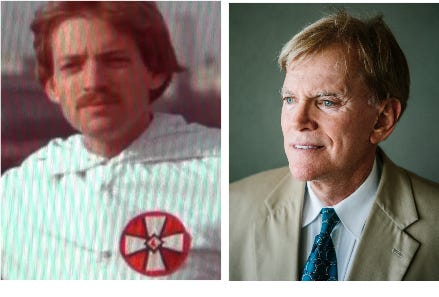
In October 2008, NPR’s Tell Me More invited David Duke on air to discuss the approaching Obama election. The host introduced him carefully — former grand wizard of the Ku Klux Klan, former Louisiana state representative, president of something called the European American Unity and Rights Organization — and warned listeners that what followed might be offensive. Then she asked him how he felt about being called a white supremacist.

Duke rejected the label immediately.

First, I should say that I am not a white supremacist. I don’t think any race should be supreme or rule over another. I do believe in equal rights for all. I just think today that European-Americans face a racial discrimination called affirmative action and the European-Americans have the same right to defend their heritage and their perceived interest as black people do in NAACP, which is not the National Association for the Advancement of People. It’s the National Association for the Advancement of Colored People, that Mexicans do in La Raza, which means The Race, and the advancement - and of course, there are hundreds of organizations that defend and support the perceived interest of the Jewish community, in fact, the foreign nation of Israel.

I would say, I was a white civil-rights activist.

I think that I’ve got the same right to preserve my heritage and my rights that black people have, that Jewish people have and all the groups that work for Jewish interest, that Mexicans have. And I think unless we stand up and do that, we’re going to lose our rights and we are losing our rights in this country.

He was careful about terminology throughout. He did not say “white people,” he said “European-Americans” — a construction that mirrors “African-Americans,” “Mexican-Americans,” or “Asian-Americans.” Every other hyphenated group had organizations, advocacy, institutions. Why not his? He said he was not asking for supremacy. He was asking for parity, for the same rights every other group already had. He had no objection to black schools oriented toward black students, black neighborhoods, black institutions. He simply wanted the same freedom for white communities — to associate, to organize, to define what their community looked like without being called racist for it. People naturally chose to associate with their own kind, he observed. Look at any cafeteria. This was not pathology. It was human nature.

In this way, Duke pre-empted the usual objections to his beliefs. If you call him a racist: he has already rejected that label on principled grounds and invited you to explain what principle distinguishes him from the NAACP. If you say his organization is hateful: he responds that he supports the same freedom of association for every group. Invoke his KKK history: he will note that what he advocates now is equal rights.

Now you are on a debate stage opposite David Duke. He has just said all of this. The camera is on you. Can you refute him? How?

Your disgust at him is not an argument. Duke was arguing dispassionately. How can you respond?

The sad fact is that most people are not equipped to answer Duke’s argument on their own. This should alarm us.


The Duke example is worth examining carefully.

Notice that almost every individual claim he made is defensible on its face. The NAACP does advocate specifically for black Americans. La Raza does mean The Race. Affirmative action does produce outcomes in which some qualified white candidates are passed over on the basis of race. People do tend, voluntarily, to socialize with others like themselves. These statements y are, in the main, true.

And yet the conclusion those facts are being assembled to support — that a former Klan leader running an organization called the European American Unity and Rights Organization is simply doing what the NAACP does — is not just wrong. It is a conclusion that, if accepted, would require us to abandon almost everything we understand about what racism is and how it operates.

How does that happen? How does an argument built substantially on true claims arrive at a conclusion that is repugnant to almost everyone who hears it? Something is happening between the facts and the conclusion. Something is doing work that the facts alone are not doing. The argument is a structure — a framework — and the structure itself is where the problem lives. But identifying that a problem exists is not the same as being able to locate it, name it, and answer it.

Most people who heard Duke that day could not do that. They felt the wrongness clearly. They could not articulate it. And feeling something is wrong, without being able to say why, is not an argument. It is a reaction. Duke knew the difference, and he was counting on it.


Now consider who is listening to arguments like this one today.

The people who heard Duke on NPR in 2008 mostly had an advantage: they had lived through or grown up in the shadow of the civil rights movement. They remembered, or had parents who remembered, what the language of “heritage” and “community rights” and “freedom of association” had been used to defend within living memory. They had emotional and historical context that functioned as a partial defense, even when it could not be articulated as an argument.

That advantage is expiring. The audience that matters most now — people in their teens and twenties who formed their understanding of the world through social media — did not grow up with that context. For many of them, the civil rights movement is as distant as the First World War. They do not have the emotional baggage. They encounter the argument cold, on its stated terms.

And the argument has gotten more sophisticated. Duke is not the threat. The threat is the twenty-five-year-old with a large following on a short-video platform who has never heard of David Duke, who does not think of herself as racist, who genuinely believes she is talking about fairness and equal treatment and the right of every community to advocate for itself. You can point out that Duke has a history of racist statements as a partial rebuttal, but you don’ thave that ammunition against the TikToker today. She uses the same framework Duke used, without the biography that triggers the alarm. She is articulate. She sounds reasonable. She invokes principles her audience already believes in. She is reaching millions of people who have no idea they are hearing an argument with a history.

What do we expect them to say in response? If we — adults who know the history, who feel the wrongness viscerally — cannot articulate what is wrong with the argument, why would they be able to? What exactly are we expecting them to do with the disgust they are supposed to feel but were never taught to explain?

The honest answer is that we are expecting them to absorb the correct conclusion from the culture around them, to feel what we feel, and to suppress the argument unexamined because the person making it has been socially discredited. That has been the substitute for thinking. It worked, imperfectly, as long as the gatekeepers of social credibility were functioning. The gatekeepers are no longer functioning. The argument circulates without the biography attached, in formats and on platforms designed to reward engagement over scrutiny, to a generation that has every reason to be skeptical of the authorities telling them what to feel.

This is the situation. The argument is out in the world. The tools to answer it — really answer it, in terms that hold up — are not widely distributed. The gap between those two facts is not a political problem. It is a thinking problem, and it exists on every subject, right wing or left wing, not just this one.


This series is about the gap.

It does not argue that any particular political position is correct. It does not tell you what to conclude about affirmative action, or immigration, or any of the other subjects Duke raised. What it does is give you the equipment to examine arguments yourself — to see what a framework is doing, to ask what work is being performed between the facts and the conclusion, to identify what a claim requires to be true before you decide whether it is true.

These are not instincts: they are skills. They can be taught. But before you can develop them, it helps to understand exactly what you are up against..


Let’s start with something trivial. There is no meaningful difference between most branded toothpastes and their generic equivalents. The active ingredients are identical. The fluoride concentration is regulated. The whitening agents are the same compounds at the same concentrations. And yet the branded version costs twice as much and outsells the generic by a wide margin, because a century of advertising has attached feelings — of confidence, attractiveness, professional success — to the brand name, and those feelings arrive before any reasoning about ingredients begins. Nobody sits down and consciously thinks, “I will pay extra for this toothpaste because a beautiful person smiled while holding it in the ad.” The persuasion happens below that threshold. Most reach for the familiar brand, and always have.

This is the least consequential example of a problem that runs through nearly everything you consume.

Edward Bernays — Freud’s American nephew, who built the modern public relations industry and was comfortable calling what he did propaganda — understood in the 1920s that the most effective persuasion never announces itself as persuasion. It does not make arguments you can evaluate. It shapes the environment in which you form preferences, so that by the time you make a choice, the choice feels like yours. He famously helped a cigarette company expand its market by hiring women to smoke publicly in a suffragette parade, framing cigarettes as “torches of freedom.” He did not argue that women should smoke. He attached smoking to a value his audience already held, and let the association do the work.

The industry he founded has had a hundred years to refine these techniques, and it has had access to tools he could not have imagined.

The news you read is shaped by what keeps the publication financially viable, which is advertising revenue, which depends on audience size, which rewards stories that generate strong emotion — outrage, fear, tribal solidarity — over stories that generate careful thought. It is an incentive structure, and it operates whether or not any individual journalist is aware of it. A story that makes you angry keeps you reading. A story that makes you uncertain sends you elsewhere. Uncertainty does not monetize.

The universities that produce the experts quoted in those stories are increasingly funded by foreign governments, corporations, and ideologically committed donors, each of whom has views about which research conclusions are welcome and which are not. The funding does not usually purchase specific results. It purchases environments in which certain questions get asked and certain questions do not, in which certain scholars thrive and certain scholars find their grants dry up. The bias is structural and largely invisible to the people inside it.

The movies and television shows you watch as entertainment are, in part, extended commercials. Product placement is now a significant revenue stream for major studios — Apple, Ford, luxury brands — and the integration is designed to be imperceptible. The hero drives a specific truck. The laptop on the coffee table faces the camera at a consistent angle. You are not watching an ad. You are watching a story in which certain products appear so naturally that your brain files them under “things that belong in a good life” rather than “things someone paid to put in front of me.”

Social media is the most sophisticated version of all of this. The platforms are not neutral conduits for information. They are attention extraction businesses, and their product is your time. Every design choice — the infinite scroll, the autoplay video, the notification, the algorithmic feed — is engineered to keep you engaged as long as possible, because engagement is what they sell to advertisers. They have behavioral data on hundreds of millions of people and machine learning systems that have identified, with extraordinary precision, what content keeps each user’s thumb moving. You have almost certainly experienced the result: you watched one video, and then another appeared that was slightly more extreme, slightly more enraging, slightly more impossible to look away from, and an hour later you were somewhere you did not intend to be, having consumed content no one would have described as your choice.

The algorithm did not ask what you wanted to think about. It asked what would keep you watching. These are not the same question, and the algorithm is very good at answering the one it actually asked.

Step back from the individual examples and the scale of the situation becomes clear. Nearly all the information that reaches you arrives with an attached agenda — to sell you something, to hold your attention, to confirm what your tribe believes, to make you feel something specific. The agenda is usually invisible. It operates through the framing, the selection, the emphasis, the emotional register of what is shown to you, not through explicit argument you can evaluate and reject.

You did not choose most of what you know. You absorbed it from an environment that was itself shaped by interests that had nothing to do with your ability to understand the world accurately.

The information environment has always been imperfect, always been shaped by power and money and ideology. Newspapers, pamphlets and books from the 18th century also pushed political agendas. What has changed is the scale and the precision.

The tools that shape what you think are more sophisticated than they have ever been. The tools available to resist them have not kept pace.

That asymmetry is why David Duke’s approach works — and why it is the least of our problems.

Duke understood something that the most effective persuaders always understand: the most durable influence does not fight against your values. It borrows them. He did not ask his audience to abandon their commitment to equal rights. He assumed it, invoked it, and redirected it. He knew that his listeners had been raised to believe that every community deserves to celebrate its culture, that civil rights language belongs to the dispossessed, that consistency is a virtue. So he built an argument from those bricks, in that language, toward a conclusion those values would normally forbid. The argument was designed to make your own principles work against your judgment.

The devil can cite Scripture for his purpose. Countering that requires something more than knowing the Scripture. It requires understanding how frameworks are built, what they assume, what work they are doing beneath the surface of what they say out loud.

That is what thinking is. Thinking is the active examination of what an argument is actually doing: where it came from, what it requires, what it leaves out, why it is reaching you in this form at this moment. It is the difference between being moved and understanding why you are being moved.

It is hard work. It gets easier with practice. And there is no version of self-governance — personal or political — that does not require it.

This series will give you tools to recognize the persuasion methods and understand how falsehood can be smuggled into things that sound true. Each tool addresses a specific way that arguments fail, or a specific way that our own thinking fails when we encounter them. Together they constitute a method for doing something to what you read rather than having it done to you. It is easy to let a rally or a song or an article or a novel wash over you and influence your thinking. It is easy to go along with the crowd. It is difficult to recognize how you are being manipulated in real time.

The tools are only useful if you apply them without exemptions — to your own side’s arguments as rigorously as to the opposition’s. That is harder than it sounds, because we all have biases.

Thinking is hard. But it is very rewarding.

Let’s start.


Buy EoZ's books  on Amazon!

Reclaiming the Covenant on America's 250th (May 2026)

"He's an Anti-Zionist Too!" cartoon book (December 2024)

PROTOCOLS: Exposing Modern Antisemitism (February 2022)


  • Monday, May 18, 2026
  • Elder of Ziyon

Many newspapers in May 1876 published an article with the headline "The Vitality of the Jews"

It went through a number of statistics: 

The Jews are the healthiest and longest lived people on the face of the earth. Their immunity from diseases of all forms is remarkable. Even the great epidemics pass them by with the infliction of much lighter scourge than falls upon other races. It is declared that the cholera never chose one of them for its victims, and, in fact, the deaths from this malady have been so few as almost to bear out the assertion. Suicide is seldom practiced among them. It has been computed, from statistics returned in certain provinces of Austria and Germany, that in a population of 1,000,000 the proportion of suicides between the Jews and the mixed white races was as one to four.
From data carefully studied Hoffman found that between the years 1823 and 1840 the number of stillborn among the Jews in Germany was as one in thirty-nine, and among other races as one in forty. Mayer ascertained that in Fürth the proportion of Jewish children who die between the ages of 1 and 5 years is 10 per cent., and of Christian children of same age it is 14 per cent. M. Neuville, calculating from the statistics of Frankfort, shows even a greater disparity existing among the children of the Jews. He also finds from his data that the average duration of the life of a Jew is 36 years and 9 months, while of the Christian it is 36 years and 11 months. “In the total of all ages half of the Jews born reach the age of 58 years and 1 month, while half of the Christians born attain the age of 36 years only.” One fourth of the Jewish population live beyond 71 years, but the same proportion of the Christian population live no beyond 59 years and 10 months. The official returns of Prussia give the Jews a mortality of 1.61 per cent. and the whole kingdom 2.62 per cent. While the Jews double their numbers in forty-one and one half years others require a period of fifty-one years.
In 1849 there was in Prussia one death for every 3140 Jews and one death for every thirty-two of the remaining population.
A Dr. Richardson writing in Diseases of Modern Life  "ascribes the high vitality of the Jews to their sober way of living."
"The Jew drinks less than his ‘even Christian;’ he takes, as a rule, better food; he marries earlier; he rears the children he has brought into the world with greater personal solicitude; he tends the needy more thoughtfully; he takes better care of his poor; and he takes good care of himself. He does not boast to-morrow, but he provides for it, and he holds tenaciously to all he gets. To our Saxon eyes and Celtic eyes he carries these virtues too far; but thereby he wins, becomes powerful, and, scorning boisterous mirth and passion, is comparatively happy.”


Buy EoZ's books  on Amazon!

Reclaiming the Covenant on America's 250th (May 2026)

"He's an Anti-Zionist Too!" cartoon book (December 2024)

PROTOCOLS: Exposing Modern Antisemitism (February 2022)


From Ian:

John Spencer: Absurd Claims of Dog Rape and Genocide
I see a correlation between those who believe absurd claims like dogs were trained to rape Palestinians and those who insist Israel committed genocide in Gaza. Both claims collapse under scrutiny and under mountains of contrary evidence. One ignores biology and basic science, including the reality that dogs cannot rape humans in the way being alleged. The other disregards the legal definition of genocide, which requires demonstrable intent to destroy a people as such. That accusation runs directly against repeated public statements by Israeli political and military leaders after October 7 that the war was against Hamas, not the people of Gaza. It also requires evidence of actions taken to fulfill genocidal intent. Instead, the easily obtained facts show Israel facilitating historic aid deliveries, establishing evacuation corridors, warning civilians before operations, moving populations from combat zones, numerous other civilian harm mitigation measures, and even vaccinating Gaza’s population during active combat under conditions no military has ever faced.

The accusation also collides with another uncomfortable reality. Even critics of Israel’s military campaign have acknowledged civilian-to-combatant casualty ratios that are historically low for dense urban warfare against an entrenched enemy operating from within civilian areas. Using even Hamas-led Gaza Health Ministry figures, the available numbers suggest ratios somewhere between roughly 1.5:1 and 1:1 depending on the methodology used. Those figures compare favorably to many major urban battles and wars, including Manila, Seoul, Mosul, the Iraq War, and the Korean War just to name a few of many.

None of this removes the tragedy of civilian death. War remains brutal even when fought within the law. Yet casualty figures of this kind directly undermine the assertion that Israel’s campaign reflects an organized effort to destroy the Palestinian people.

Public debate around war increasingly turns statistics into instruments of persuasion rather than tools of understanding. Numbers are pushed into headlines before definitions are clarified. Casualty counts circulate globally detached from methodology, sourcing, combatant status, age distributions, or the conditions under which the data was collected. Large numbers create emotional reactions on their own. Most audiences have little ability to independently evaluate how those figures were generated or whether the institutions producing them have political incentives embedded within the process.

Sociologists who study statistics have long recognized that numbers are social products shaped by the organizations and people who produce them. Activists use statistics to elevate causes. Governments use them to defend policy. Media institutions amplify the figures that generate the strongest emotional response and reinforce existing narratives. In wartime, numbers often become ammunition. Selective statistics gain power through repetition long before they survive rigorous scrutiny. Figures themselves do not lie, but people routinely use figures dishonestly. As the old saying goes, “Figures don’t lie, but liars figure.”

The genocide accusation survives largely because many people begin with the conclusion and work backward from it. Evidence that contradicts the accusation is ignored, minimized, or reframed. Actions that would normally weigh against genocidal intent are treated as irrelevant. Legal definitions become elastic only in Israel’s case. Standards applied to every other military confronting enemies that openly disregard the laws of armed conflict, deliberately embed within civilian populations, and treat civilian suffering as a strategic asset often disappear when Israel is involved.

That dynamic resembles what Natan Sharansky describes as the “3Ds” that distinguish legitimate criticism of Israel from antisemitism: Demonization, Double Standards, and Delegitimization.

One of the major double standards applied to Israel is the way the laws of armed conflict are removed from their actual legal framework and replaced with emotional accounting built almost entirely around casualty numbers. Civilian deaths are presented without operational context, without discussion of the target, the enemy’s tactics, the precautions taken, or what commanders reasonably understood when the action or strike was approved or taken. The numbers themselves become treated as proof of illegality.

The law of armed conflict does not function that way. Military decisions are judged based on what commanders reasonably knew before an operation or action occurred, not through hindsight after the outcome is already known. Legal analysis examines whether the target was a lawful military objective, whether commanders conducted a proportionality assessment to determine that the anticipated civilian harm would not be excessive compared to the concrete and direct military advantage expected from the attack, and whether feasible precautions were taken to mitigate civilian harm under the circumstances at the time.

Much of the public discussion surrounding Gaza reverses that process entirely. Casualty figures are frequently treated as the beginning and end of legal judgment. Civilian deaths become automatic evidence of criminality regardless of the military objective, warnings issued, evacuation measures attempted, intelligence available at the time, the reliability of assessments distinguishing civilians from those actively participating in hostilities, or the enemy’s deliberate integration into civilian infrastructure. Hamas’s use of homes, schools, mosques, hospitals, tunnel systems, and dense residential areas for military purposes is often pushed to the margins of the discussion even though it shaped nearly every operational decision Israel faced.
Jonathan Turley: Why Israel’s lawsuit against Times over ‘blood libel’ has a chance
Does the “Gray Lady” have a “longstanding Jewish problem“?

That question may soon be answered in a Manhattan courtroom as the New York Times stands accused of an alleged attack piece on Israel. This week, Israeli Prime Minister Benjamin Netanyahu announced that he would sue the paper and columnist Nicholas Kristof for defamation over the publication of what he called a “blood libel.”

The latest controversy emerged after the Times ran a Kristof column alleging widespread sexual abuse and torture of Palestinians, including the use of dogs to rape prisoners. The government denounced the column as “one of the most hideous and distorted lies ever published against the State of Israel in the modern press.”

The Israelis allege that the column was intentionally posted ahead of the release of an independent Israeli report that found Hamas had systematically used sexual violence in the onslaught of October 7, 2023.

It is unclear whether the lawsuit will be filed on behalf of individuals, groups, or the nation as a whole. Regardless of the framing, the defamation action could allow Israel to delve into the paper’s journalistic practices and alleged bias.

Under the higher “actual malice standard,” Israeli counsel would likely need to prove that Kristof and the Times acted with knowledge of the allegation’s falsity or in reckless disregard of the truth.

The Times has been accused of such malice for years. A newspaper with an overwhelmingly Democratic and liberal readership, critics have accused the paper of pandering to its increasingly anti-Israeli base.

According to recent polls, two-thirds of Democrats (67%) now support Palestinians over Israel (17%).

The newspaper has been repeatedly called out for slanted and sometimes false reporting on the Israeli-Palestinian conflicts. For example, after Israel attacked Gaza in response to the October 7th massacre, the Times reported on an alleged Israeli strike that destroyed part of the Al-Ahli hospital. The Times seemed to rush to get the allegation into print, with little supporting evidence.

The story was based on sources associated with the terrorist group Hamas, which is notorious for disseminating propaganda and false stories. It took a week before the Times retracted the claim. (It turned out to be a misfired Palestinian rocket that hit a parking lot).

The Times has been forced to make a series of retractions and apologies for such coverage. After the newspaper ran a column that it later admitted was antisemitic, Times columnist Bret Stephens wrote that “The Times has a longstanding Jewish problem … continuing into the present day in the form of intensely adversarial coverage of Israel.”

In May 2021, a front-page story contained multiple factual errors and biased elements, including the portrayal of a Hamas militant as a civilian child. It also used a stock image of a girl to claim that she was a dead Palestinian child.
New Report Warns WHO Health-Attack Data Is Being Weaponized Against Israel
A May 2026 policy paper by the Center for Medical Integrity argues that the World Health Organization’s Surveillance System for Attacks on Health Care is being used in international forums in ways that turn a public-health monitoring tool into a political instrument against Israel. The report says SSA collapses analytically distinct categories of incidents under the single label “attacks on health care,” allowing obstruction, intimidation, and direct violence to be cited together without the legal context needed to assess culpability.

The issue matters now because Gaza hospital cases remain central to diplomatic, legal, and media narratives about the war, while evidence and intelligence assessments regarding Hamas and PIJ exploitation of medical infrastructure are often treated as secondary or omitted altogether.

A Broad Database With a Loaded Label
The report explains that WHO defines an attack on health care as “any act” of verbal or physical violence, obstruction, or threat that interferes with health services during emergencies. Its own examples include heavy-weapons violence, psychological intimidation, obstruction to care, armed searches, denial of services, and “militarization of health care facility.”

That breadth may make sense for emergency monitoring. But CMI argues the word “attack” gives operational data the appearance of a legal finding. WHO has also acknowledged that both high-impact events, such as bombings, and lower-impact incidents, such as verbal threats, are included in the same framework.

The concern, CMI argues, is not merely semantic. Under WHO’s SSA methodology, certainty levels indicate confidence that an incident occurred, but they do not resolve disputed questions about perpetrator identity, legal culpability, intent, proportionality, or whether a facility had previously been used for military purposes. WHO separately says it does not collect or verify perpetrator information and that its objective is to raise awareness of attacks on health care, not to pursue accountability.

How Counts Become Accusations
The sharpest allegation in the report concerns the way WHO-linked data travels through international institutions. According to CMI, at WHO’s 158th Executive Board session in February 2026, WHO’s Eastern Mediterranean regional office cited SSA data to claim that “almost 1,000 people” had been killed in documented attacks by Israel, with nearly half that figure deriving from the disputed October 2023 Al-Ahli Hospital explosion.

CMI’s broader concern is that WHO-linked health data can omit battlefield context relevant to legal assessment. U.S. officials said in November 2023 that Hamas and Palestinian Islamic Jihad used Al-Shifa Hospital and tunnels beneath it to support military operations and hold hostages. A later declassified U.S. assessment, reported by AP, said American intelligence was confident the groups used the Al-Shifa complex to house command infrastructure, exercise command-and-control activity, store some weapons, and hold at least a few hostages.

Human Rights Watch later found that the Al-Ahli blast resulted from an apparent rocket-propelled munition of a type used by Palestinian terror groups, while saying a full investigation was still needed. HRW also said it could not corroborate the Gaza Health Ministry’s reported death toll of 471, calling it significantly higher than other estimates and out of proportion with visible damage.

The case illustrates the report’s central warning: an early battlefield claim can enter a health database, continue circulating with institutional authority, and later be folded into diplomatic accusations against Israel even after key facts are contested.

Israel itself told WHO’s Executive Board that the body was in “dire need of reform” and accused the session of fueling “yet another politicized discussion” while ignoring facts on the ground.

Sunday, May 17, 2026

  • Sunday, May 17, 2026
  • Elder of Ziyon

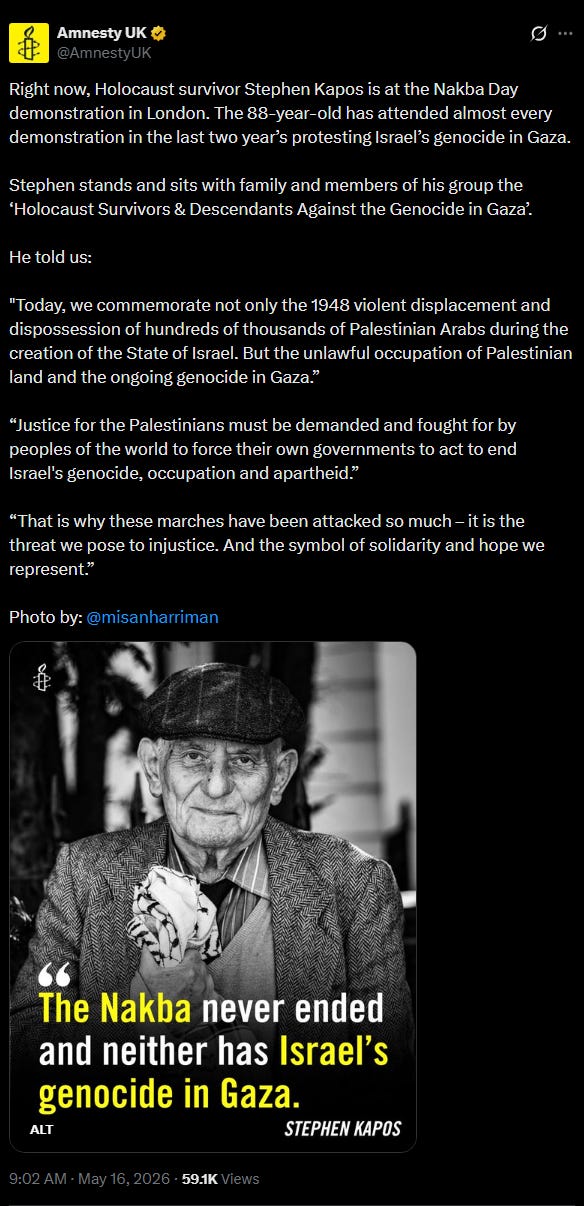
Amnesty UK tweeted this:

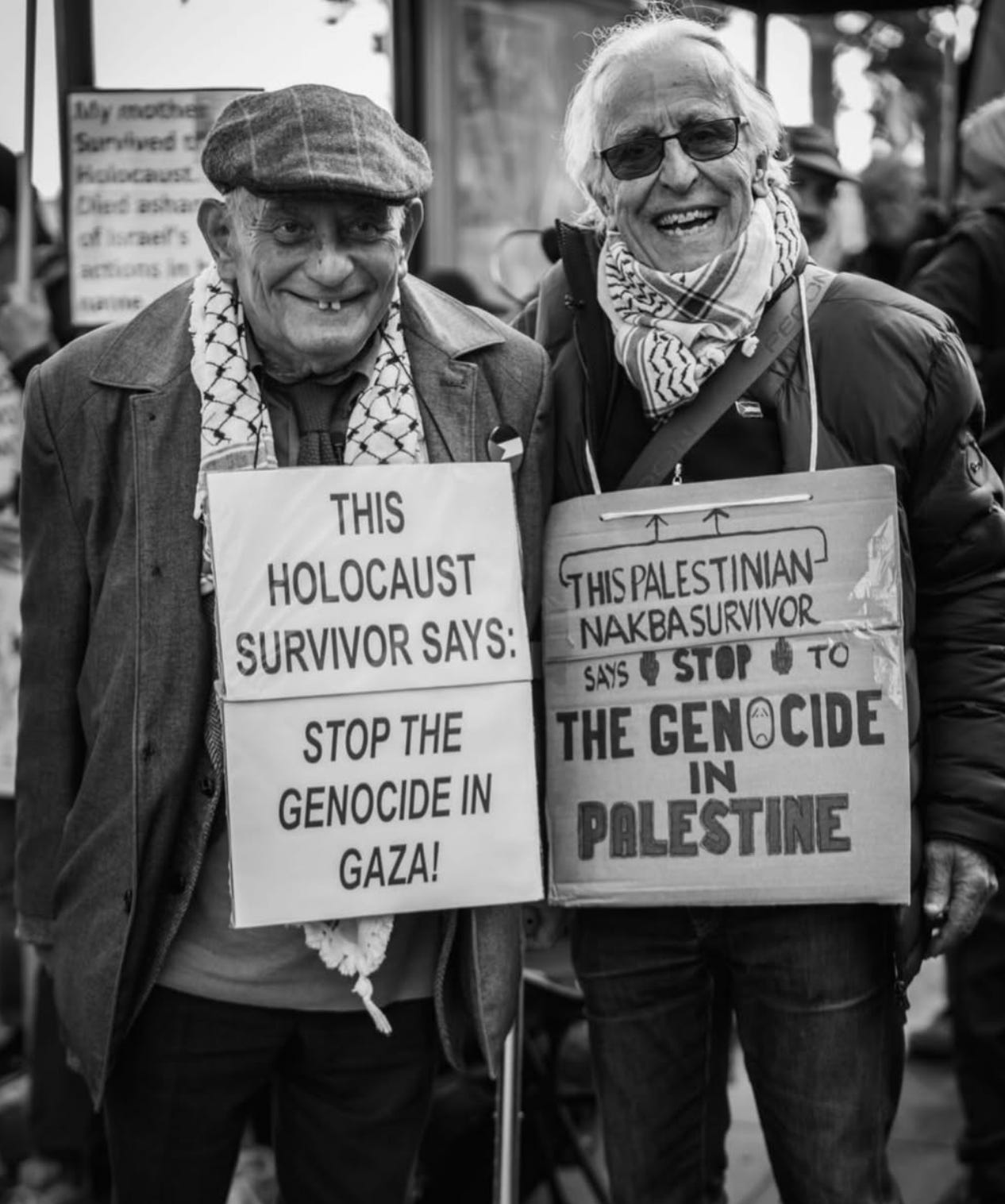
Here’s another picture of Mr. Kapos laughing as he equates the Holocaust to the “Nakba.”

Amnesty-UK is publicizing a child Holocaust survivor who marches in anti-Israel demonstrations, calling the Gaza War a “genocide.” The only reason they want to promote him is to make the point that as a Holocaust survivor, Kapos knows what genocide is and has a particular moral authority to be able to describe Israel’s actions as the most heinous war crimes.

But if Holocaust survivors have a unique perspective on genocide - and they do, having survived the paradigm of all genocides - then what about the 99.9% of living Holocaust survivors who support Israel, and who recognize Hamas and October 7 as being the closest modern equivalent to Nazis? If Holocaust survivors have an important perspective on the matter, why is Amnesty ignoring the feelings of nearly all of them and promoting a fringe figure among them?

Clearly Amnesty doesn’t consider most Holocaust survivors’ opinions to be important.

This means two things:

  1. Since Amnesty says that those who support Israel and its war against Hamas to be advocating genocide, that means that Amnesty is calling the people who escaped the gas chambers, and whose parents and siblings were murdered in a real genocide, to now be supporting genocide themselves. They found a “good” Holocaust survivor, but all the rest are the genocidal Zionists who love to see civilians killed, in Amnesty’s interpretation of a war on a terror group. To accuse Holocaust survivors of supporting genocide is as antisemitic as possible., but there is no other way to explain Amnesty’s position.

  2. Their choice to elevate this one survivor as a paradigm of virtue while ignoring or disparaging the vast majority reveals that they don’t actually respect Stephen Kapos.. They are using him as a prop, not as someone that should be seriously listened to. If they cared what Holocaust survivors really thought, they would be quoting their opinion of Hamas, of Iran, of Hezbollah, of the Houthis, and of all the modern terrorists who want to finish Hitler’s job.

All Holocaust survivors remember when the word “Palestinians” meant “Jews.” When they were growing up, there was next to no Palestinian nationalism - there was Arab nationalism. Syria and Jordan were competing to be the leaders of the Levant Arabs in the years after 1948; no one was interested in a Palestinian state - not even the Arabs who lived under the Palestinian mandate themselves.

Holocaust survivors experienced a world before the myth of an ancient Arab Palestine took hold. They know the truth. This is why Amnesty disrespects them - they know too much.

To Amnesty, the Holocaust is not a lesson for them to learn from. It is only a lesson for its victims and their descendants. It wasn’t a genocide, exactly, but a giant classroom for Jews to learn to behave themselves and not act like Nazis. The rest of the world, the world that let the Holocaust happen, are now the judges that determine whether Jews fighting for their lives are crossing the line or need to be taught Remedial Holocaust 102. To Amnesty, the Holocaust is a prop meant to be trotted out when it is convenient for them to hurl the most hateful accusations against Jews and then use fringe, mentally ill Jews as a cover to protect themselves from being accused of antisemitism.

No one else can be compared to the Nazis but Jews, in Amnesty’s universe.

This tweet, alone, exposes the cynicism and hypocrisy of this supposedly “human rights” organization. And, yes, the implications of this tweet are pure Jew-hatred.


Buy EoZ's books  on Amazon!

Reclaiming the Covenant on America's 250th (May 2026)

"He's an Anti-Zionist Too!" cartoon book (December 2024)

PROTOCOLS: Exposing Modern Antisemitism (February 2022)


  • Sunday, May 17, 2026
  • Elder of Ziyon
On Friday, New York  Mayor Mamdani tweeted out a video for "Nakba Day."

Here is a screenshot of his tweet and a frame from the video:


Notice the difference in wording?

Mamdani quoted from this screen of the video, but erased the words "and displacement."  The video was careful to include it because Palestinians know very well that most of them left their homes expecting to return; they wanted to avoid the war but they were not expelled. 

Mamdani made this decision to change the text to make it sound like the Zionists had ethically cleansed 700,000 Palestinians. In reality the number that left was closer to 600,000 and the vast majority never saw a soldier. 

If the mayor of New York is deliberately even less honest than Palestinian propaganda, how much can anyone trust him for anything?


Buy EoZ's books  on Amazon!

Reclaiming the Covenant on America's 250th (May 2026)

"He's an Anti-Zionist Too!" cartoon book (December 2024)

PROTOCOLS: Exposing Modern Antisemitism (February 2022)


Saturday, May 16, 2026

From Ian:

Why does Jerusalem belongs to the Jews? Because history says so
Facts do not cease to exist simply because anti-Israel ideologues seek to erase them.

Nor should anyone forget what happened when Jerusalem was divided between 1948 and 1967 under Jordanian rule.

During those 19 years, Jews were completely barred from accessing the Western Wall and the Jewish Quarter of the Old City, despite explicit guarantees in the 1949 armistice agreements. Fifty-eight synagogues in the Jewish Quarter were destroyed or damaged by the Jordanians. Ancient gravestones on the Mount of Olives, some dating back centuries, were desecrated and used for roads, military camps, and even latrines.

The city’s reunification in 1967 ended 19 years of Jordanian control of eastern Jerusalem, with the Hashemite Kingdom’s annexation having been recognized by only two countries.

Yet, somehow it is Israel that now stands accused of restricting religious freedom.

The truth is precisely the opposite.

Since reunifying Jerusalem in June 1967, after Jordan joined the Six Day War, Israel has safeguarded access to holy sites for all faiths. Muslims pray freely at al-Aqsa Mosque. Christians maintain churches and institutions throughout the city. Jerusalem, under Israeli sovereignty, has become one of the few cities in the Middle East where Jews, Christians, and Muslims all have genuine religious freedom protected by law.

The city itself reflects that vitality.

Today, Jerusalem is home to nearly one million residents, making it Israel’s largest city. It boasts well over 1,000 synagogues, hundreds of churches, and dozens of mosques. It is the seat of Israel’s parliament, Supreme Court, and national institutions. It is a living, thriving capital, not a relic of ancient memory.

And that is ultimately what Jerusalem Day represents.

It is not merely the anniversary of a military victory. It is the celebration of an ancient people returning to its historic heart after centuries of dispersion and longing.

When Israeli paratroopers reached the Western Wall in June 1967, commander Motta Gur famously declared, “The Temple Mount is in our hands.” At that moment, Jewish history came full circle.

Jerusalem was not conquered in 1967. It was liberated and reclaimed.

At a time when lies about Israel spread with alarming speed across campuses, social media, and international forums, it is more important than ever to stand unapologetically for truth.

Jerusalem is the capital of the Jewish people because history says so. Archaeology says so. Demography says so. And 3,000 years of uninterrupted Jewish memory say so.

The facts are there for anyone willing to see them.
The Covenant and the Wooden Box
Jews in Britain are not a peripheral concern of that threat. They are a primary one. Jewish faith schools in north London closed their doors in October 2023, citing security fears. The phrase “Globalize the intifada” is chanted openly at marches through the capital, month after month, without prosecution. After two men were killed at the Heaton Park Synagogue in Manchester in October 2025, the prime minister told the House of Commons that anti-Semitism was not a new hatred, that Jewish buildings, Jewish lives, and Jewish children required extra protection, and that he would do everything in his power to guarantee their safety. Then he did next to nothing. The IRGC remained unproscribed. The marches continued. The files stayed closed.

On April 29, 2026, as Sadiq Khan, the Mayor of London, sat in Madrid discussing Gaza with the Spanish prime minister, a man ran along Golders Green Road armed with a knife, hunting Jews. He stabbed two—a man of 34 and a man of 76. He had been referred to Prevent—the government’s counterterrorism program designed to identify and steer individuals away from radicalization—in 2020. His file was closed the same year. The prime minister visited Golders Green the day following the attack and was met with chants of “Keir Starmer Jew Harmer.”

“Anti-Semitism is an old, old hatred,” Starmer said. “History shows that if you turn away, it grows back.” He was right. Perhaps this time the words will be followed by action, but the word “perhaps” is doing a lot of work here. The record does not encourage hope. And the record matters because of what it confirms: This was not managed ignorance—the filed report, the averted gaze, the truth quietly administered out of existence. It showed something much worse: explicit knowledge, explicit condemnation, explicit promise—and then nothing.

This is the strategic cost—the final destination of the managerial habit that brought about the auction listing for Nelson Street and the conduct of council offices of Rotherham, that wound through the corridors of Broadcasting House, arrived at the gilded antechambers of Buckingham Palace, and came, finally, to the streets of Golders Green. Writing in The Origins of Totalitarianism, Arendt argues that the decline of the nation-state and the loss of political self-knowledge were not merely cultural tragedies but the preconditions for totalitarian penetration. A society that cannot know itself cannot defend even its most vulnerable children. Britain has not produced totalitarianism. But it has produced, with patient institutional thoroughness, exactly the condition Arendt identified as its precursor: a governing class that has lost the will to know what it is, what it values, and what it owes to those in its care. The Chinese Communist Party understands this with the clarity of a predator that has studied its prey. It targets the gap between what British institutions know and what they have decided, for reasons of procedural calm, to pretend they do not know. That gap—patiently widened over decades by a managerial class that chose comfort over conscience—is now a strategic aperture through which a hostile foreign power has walked into the heart of the British establishment.

Americans reading this would be wise to resist the comfortable assumption that what is described here is a foreign pathology—a peculiarly British failure of nerve from which the New World is naturally immune. It is not. The pipeline that rewards ideological conformity with credentials and institutional authority operates on both sides of the Atlantic. The universities that incubated the assumptions that made Rotherham possible sent their graduates into British newsrooms, council offices, and police commands; their American counterparts sent theirs into the FBI, the Department of Justice, the prestige press, and the administrative apparatus of every major American city. The same spirit of iconoclasm that came for Churchill’s statue came for Washington’s and Jefferson’s, too—pulled down by crowds in Portland in 2020 while city administrators placed them in storage and commissioned reports on whether they deserved to stand at all. A committee reporting to the mayor of Washington, D.C., formally recommended removing or relocating the Washington Monument and the Jefferson Memorial.

The same willingness to brand truth-tellers as extremists—which destroyed Sarah Champion’s career for stating the obvious about Rotherham—was visible in the treatment of every American official, journalist, or academic who raised questions that the managerial consensus had decided were impermissible. Britain did not fail because it was uniquely weak. It failed because its governing class lost the will to know itself—and the consequences of that loss, once set in motion, proved impossible to contain. America’s governing class is further along that same road than it yet knows. The wooden box, in America, has not yet been built. But the administrators who would build it, if asked, are already at their post. The question is not whether it is being constructed. It is whether enough people—in Britain and in America—will recognize the lumber being assembled before all the nails go in.

In the summer of 1940, when every counsel of prudence pointed toward negotiation, one man looked into the abyss and refused to blink. He had spent decades preparing for that moment, honoring a covenant older than the war itself: declaring his support for a Jewish homeland in Palestine, fighting the White Paper that would have closed Palestine’s gates to Jews fleeing extermination, prosecuting at the cost of everything the war against the regime whose explicit purpose was to end Jewish life in Europe. He understood that the Lord deals with the nations as the nations deal with the Jews—that England’s fate and the fate of the Jewish people were bound together in a moral order that transcended any government or generation. That conviction did not make him perfect. It made him, at the moment of maximum cost, faithful. He turned down a dukedom.

Those who have inherited stewardship of the covenant—the politicians, police, and civil servants—are failing it right now, if not betraying it outright, in the streets of Golders Green, in the halls of Parliament, in the lecture halls and council offices and police commands where the custodians made the same choice—managed truth over honest reckoning. What remains of that moral order, in the hands of those now charged with keeping it, is not easy to say. It endures—but not in the institutions, which have failed it, or in the bronze, which has been spray-painted, or for much longer in the synagogue, which has all but been sold. It endures in Leon Silver, who could not bear to let go of a building half a mile from where he was born.

It endures in Henry Glanz, who blew the shofar every year for the children who never reached England. It endures in Sarah Champion, who said the plain thing and paid the price for it. “The outside is very plain,” Leon Silver said of the building constructed from its first brick to be a synagogue but that’s now being stolen away to become a symbol of Islam’s triumph over Britain’s Jewry. “But people say the inside is beautiful, which I think so too.” The moral truth Silver might not even have known he was echoing with his words—“the inside is beautiful”—endures in everyone who has named what the governing class could not bring itself to name and everyone who refused to look away from what the governing class chose not to see. The moral truth endures—because covenants of that depth do not dissolve when institutions fail them. They wait.
Nicole Lampert: Why doesn’t Starmer make a video warning about far-Left hate marches?
On Friday night, Sir Keir Starmer took time out of being knifed by his Labour colleagues to warn of an impending threat in a statement posted on social media. He couldn’t have looked more serious; the sinews of his neck were taut. He used his hands in his best headmaster mode to drum home his points.

Soft music, with just a hint of menace, played in the background.

There was going to be a march in London, he warned, organised by people who were “peddling hatred and division, plain and simple”. The march, he added, was “a reminder of what we are up against in a battle of our values”.

Writing on X Deputy Prime Minister David Lammy, also emphasised the danger of this march, warning, “if protest turns violent, we will act swiftly, with extra court capacity in place.”

Hallelujah! Could it really be that our political leaders had, after the stabbings in Golders Green, the arson on synagogues and Jewish ambulances, the deadly attack in Manchester, finally woken up to the horror of the “pro-Palestine” hate marches and the anti-Semitic, violent, pro-terrorist, genocidal rhetoric they endorsed?

Of course not.

They were talking about the march with the Union flags, not the ones with flags of Palestine and the Islamic Republic of Iran. If you want to know just how upside down our world has become, we need to look at today: which march was deemed hateful and which one they tried to ignore.

AddToAny

Printfriendly

EoZTV Podcast

Podcast URL

Subscribe in podnovaSubscribe with FeedlyAdd to netvibes
addtomyyahoo4Subscribe with SubToMe

search eoz

comments

Speaking

translate

E-Book

For $18 donation


Sample Text

EoZ's Most Popular Posts in recent years

Search2

Hasbys!

Elder of Ziyon - حـكـيـم صـهـيـون


This blog may be a labor of love for me, but it takes a lot of effort, time and money. For 20 years and 40,000 articles I have been providing accurate, original news that would have remained unnoticed. I've written hundreds of scoops and sometimes my reporting ends up making a real difference. I appreciate any donations you can give to keep this blog going.

Donate!

Donate to fight for Israel!

Monthly subscription:
Payment options


One time donation:

Follow EoZ on Twitter!

Interesting Blogs

Blog Archive