This has huge ramifications on the future of the university. As Nelson describes it, the very places that are meant for free enquiry have betrayed their core values.
Nelson is a previous president of the American Association of University Professors, and he looks on with dismay how the AAUP has been hijacked by anti-Israel leaders and is now passing resolutions that go against the basics of academic freedom.
His last book was completed right before October 7, and this one centers on everything that has happened since. It is a very ugly picture. The attacks on Zionist faculty, students and ideas are relentless, and they are succeeding in ridding entire academic fields of proud Jews. Students used to study fields, now too many of the fields have become nothing more than advocacy and the only things that are studied are what is acceptable to say.
What used to be anomalous, like a professor refusing to write a letter of recommendation to a student who wants to join an academic program in Israel, is now widespread and largely unreported: Israeli universities are reporting a silent boycott, where papers are rejected unread and no one wants to partner with them. It isn't s principled BDs stance, rather it is a result of no one wanting the hassle of dealing with campus agitators.
The overwhelming feeling one gets is that while many fields in many universities have been completely subverted, a great deal more have been notable for their cowardice.
Nelson makes an excellent point about how identity has become a minefield for students who enter college and are trying to define themselves. They may have their own personal identity already defined by the time they enter a university, but there are also social identity (who they identify with,) identity ascribed to them by others, and identity as formulated in identity politics. These latter types threaten to hurt students psychologically when they are slotted in categories that they do not see themselves as belonging to. Worse, in today's charged environment, everyone is encouraged to identify as victims to gain sympathy - students do not have any identity they can be proud of, only competing to who can be the most oppressed. Who knows the long term effects that this does to teenagers?
Nelson also has horror stories, both on his own campus and outside. He knows one person who had good reviews and was on track to reach tenure. His speaking out against Hamas actions on October 7 destroyed any chance he may have had to gain tenure. Colleagues who privately supported him now urged he be fired.
Nelson has some recommendations, but they feel like too little, too late. I'm afraid that soon Jews will have to respond to antisemitism in the university the way that they responded to antisemitism in the medical and other fields over a century ago: Create their own parallel system.
I don't think we are there yet. Nelson doesn't mention it but there are several excellent schools, mostly in the Midwestern US, that have reputations of being very welcoming to Jewish students. If the smartest Jewish students abandon the universities with active Students for Justice in Palestine chapters, this may become a self-correcting problem over time as recruiters will look elsewhere for the best and the brightest.
The book was completed right before October 7, and while in some ways it has been overtaken by events, it is invaluable in its analysis of the intersection of academic freedom and limiting antisemitism on campus.
Cary Nelson is an expert on both. He was the president of the American Association of University Professors from 2006 to 2012 and he helped write policies on academic freedom in higher education. He is critical of decisions the AAUP has made since his tenure there.
When it comes to academic freedom, Nelson is as close to an absolutist as one can be. While he emphasizes that university can reject candidates for positions for any valid reason including antisemitic statements, once they are hired their application for tenure is pretty much the only time to review their records and decide whether they deserve to achieve that level.
His problem with antisemitism is not so much with the speech of professors who may spout bigoted opinions of Jews - but the effect that they have on the academic freedom of Jewish students who must navigate a university environment where their own expression of their Jewishness, which often is tightly tied to Israel, is severely limited.
Nelson points out, that when the National Women's Studies Association or various ethnic studies associations issue anti-Zionist statements, they effectively exclude any Zionists in that field of study. A department-level statement against Israel does not foster academic freedom but inhibits it.
The most egregious example he brings, to my mind, is the statement of the University of California Press (apparently since taken down) that said
We want to recognize the powerful expansion of international solidarity with Palestinians in their fight for liberation and stand with them. We support scholarship that confronts all forms of settler colonialism, US racial formations including Islamophobia, and prioritize pedagogies that reflect intersectional, anti-colonial, anti-racist action. As a university press, it is our responsibility to disseminate scholarship that challenges dominant narratives and makes understanding these injustices possible.
This means that an academic press will be highly unlikely to ever publish any Zionist opinions, an astonishing statement of choosing a political side and silencing any opposing viewpoints under the aegis of the University of California.
Individual academics and students have great latitude in saying their opinions, but not departments with the imprimatur of the university itself on the letterhead of their statements. When entire fields have been co-opted by political positions like anti-Zionism, in Nelson's words, "the line between advancement of knowledge and promotion of political convictions...has been obliterated."
Nelson also tackles topics such as whether a prospective academic hire or tenure candidate's social media posts should be considered when making decisions about their positions in the academy. The AAUP says no, Nelson says that is absurd, certainly when the posts fall within the candidate's field of expertise. Social media has a much bigger reach and more influence than most academic papers do.
Other topics covered include professors instituting "micro-boycotts," penalizing students for their Zionist opinions, most infamously the case of John Cheyney-Lippold who refused to write a recommendation letter for a student who wanted to go to Tel Aviv University for a year, even after he told her he would (and ruined her chances for finding an alternate source for a letter.)
Nelson is a true academic. When he sees a claim he checks it out and does his own research, something that he notes does not happen as often as it should in academia. So, for example, he dedicates a chapter to the "Word Crimes" issue of the journal Israel Studies, where specific terms that have been hijacked by the anti-Israel crowd like "Apartheid" or "Colonialism" are examined as to what they really mean. The issue was mercilessly attacked yet most of the critics hadn't even read the journal. Nelson read it and critiques it, not agreeing with every article but proving that it has scholarly value and that many critics were not acting in good faith. I respect Nelson's desire to take every charge seriously (speaking as someone who spent too much time researching "fart spray" when Israelis at Columbia were accused of a chemical weapons attack on campus.)
Nelson is a strong proponent of the IHRA Working Definition of Antisemitism, and examines that definition along with the "Jerusalem Declaration" as well as a reference to my own, which I appreciate.
One other theme that carries over many of the book's chapters is that the accusations that Zionists are silencing opponents have no merit. Nelson looks at the specific examples and finds than none of them hold water - in practically every case, the supposed silencing never happened and the planned anti-Zionist event or speaker was not blocked by the institution. Too many anti-Israel academics cannot distinguish between criticism and censorship, perhaps because they know they often cannot answer real criticism coherently.
As with Nelson's earlier book Israel Denial, he makes clear that he does not support settlements and has derision for Israel's right wing government. In this case, it makes his arguments stronger, since Nelson cannot be dismissed as a right-wing fanatic; he is a liberal in every sense.
It is a shame that the book is relatively expensive ($150 hardcover, $45 paperback and $34 Kindle from Amazon) Hate Speech and Academic Freedom deserves a larger audience than just the academics it appears to be aimed at.
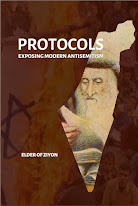
Buy the EoZ book, PROTOCOLS: Exposing Modern Antisemitism today at Amazon!
Or order from your favorite bookseller, using ISBN 9798985708424.
Unlike what BDS activists claim, the problem is not Israel.
For this book, Nelson has expanded one chapter of his masterful Israel Denial book into this comprehensive treatment of the subject of how Palestinian students have no academic freedom at all, at least when it comes to political speech about Israel and Palestinian leaders.
He describes how the (very) few Palestinian scholars who are moderate in wanting dialogue with Israel have been threatened and nearly killed, noting that pro-Hamas academics are also threatened in the West Bank.
Palestinians like to claim that the annual elections of student bodies at their universities are proxies for regular elections that haven’t been held for 17 years and show how important democratic processes are to them. In fact, these elections are accompanied with intimidation, threats, violence and even armed interference by the Palestinian Authority (and, by proxy, Hamas) to push their own student groups to lead the campus.
Palestinian academia is a fun-house mirror of American liberal campuses. If a professor says something that makes students uncomfortable, he or she can be threatened by students much more directly and physically than today’s cancel culture.
In Gaza, the idea of academic freedom is a sad joke. All students at Islamic University of Gaza must take one full year of Islamist indoctrination courses.
One amazing section of the book shows an IUG literature class dissecting a humorous children’s poem by British poet Roger McGough called The Cat’s Protection League about a feline protection racket. The students are prompted and encouraged to interpret the poem in the most outrageous antisemitic ways, such as assuming that the cats represent Jewish gangsters. Antisemitism pervades academia in Gaza, and no one can oppose that without facing real world consequences.
That is only the tip of the iceberg. West Bank universities compete as to which of them have had students kill the most Jews. Universities are the ideological homes of terrorism, and often the physical homes as well –weapons labs have been built in Gaza universities and one of them held kidnapped Israeli soldier Gilad Shalit for a time. Many terrorists during the second intifada came from West Bank universities, including Ahlam Tamimi who helped bomb the Sbarro pizza shop.
The universities also often praise terrorism. The most infamous case was the exhibit, complete with bloody body parts, of the same Sbarro attack at An Najah University: The same university more recently displayed mock-ups of a man stabbing a religious Jew and a bloody model of a car running over Jews.
Nelson does point out times that Israel interfered with campus curricula, but that all ended at the end of the first intifada. Palestinian government control and intimidation continues on campus today, to the point that students and professors are self-censoring to stay out of trouble. (He does talk about Israel’s relatively rare raids on campus since then, which are understandable when there is an imminent terror threat but often could be more effective by detaining students at home.)
Nelson also shows how other claims by BDS, that Israel blocks students from going abroad or foreign instructors to come to teach, are exaggerated – Israel does not have any more strict restrictions on those movements than most Western democracies.
Small details in the book are illuminating. For example, Nelson points out that while Israel is roundly castigated for administrative detention, the Palestinian Authority detains hundreds of people without charge as well, although they are not as forthcoming with the statistics as Israel is. (I follow Palestinian media closely and have never seen any mention of this.)
Another section has a footnote that mentions that Norman Finkelstein actually defended Hamas’ policy of murdering “collaborators” with Israel.
This is the sort of hypocrisy exposed in Not in Kansas Anymore. The boycotters’ pretense of caring about Palestinian academic freedom is clearly just an excuse to attack Israel as they ignore the far worse crimes that Palestinian students and professors are subject to every day from their own leaders and peers.
Nelson is a professor of Liberal Arts and English at the University of Illinois and Urbana-Champaign. His liberal arts background gives him an uncommon insight into the worst part of anti-Israel and antisemitic attitudes on college campuses today.
The centerpiece of the book is four chapters that each take on the writings of one of the four major intellectual leaders of the anti-Israel movement: Judith Butler, Steven Salaita, Saree Makdisi and Jasbir Puar.
In each of these chapters, Nelson methodically destroys their arguments, one by one. He doesn't just prove that, say, Jasbir Puar is a liar in her claims that Israel purposefully maims and stunts the growth of Palestinian children - he goes through their entire written record on the topic of Israel and shoots down their arguments, one fact at a time.
Nelson's audience seems to be fellow academics who can be convinced by the arguments of these BDS supporting, Israel hating professors. Nelson has spent several years visiting Israel and the territories and has done an admirable amount of original research as well as in compiling the facts that prove these academics are wrong. He is careful not to accuse anyone of using antisemitic arguments unless the evidence is overwhelming.
Nelson even admits being an admirer of Butler's work on gender, but that doesn't stop him from going through her almost unreadable prose, extracting her main argument (that Jews are naturally disposed to be forever in the Diaspora and it is actually anti-Jewish to want to live as free, independent people in the Land of Israel) and then demolishing it.
If that was the entire book, it would be worth reading (although the sheer amount of fact checking gets overwhelming after a while.) But Cary Nelson also takes a larger view. He provides a critical analysis of the entire BDS movement and its philosophy, and shows that its claims to non-violence are specious (as their plan for a binational state could never come about without war) and that their claims to only be against Israeli institutions and not individuals are absurd. He brings example after example of BDS intimidation on campus, and highlights how universities are ill equipped to protect students and professors who are the victims of BDS campaigns.
Yet Nelson remains intellectually honest and consistent - he is a champion of free speech and academic freedom, and he explains exactly what and what is not acceptable on campus while adhering scrupulously to those principles. A professor can teach a class in as biased a manner as he wishes, but he cannot intimidate or punish students who disagree. The book brings a number of examples of cases of extremely biased courses, based on student reports, syllabi and required reading lists.
Nelson also goes behind the scenes on the campaigns by BDS to take over major academic disciplines and associations, often using underhanded methods. He notes how BDS has exposed the shaky foundations of the liberal arts and how a now second generation of anti-Israel academics have turned entire disciplines into the opposite of what academia should be. He highlights how difficult it would be for any Zionist to survive in this academic environment which has been so thoroughly politicized. Most of all, he shows that the embrace by academia of "scholars" who literally make up lies to support their arguments endangers entire academic disciplines that end up looking foolish or worse by allowing these lies to go unchallenged.
After showing that Israel is a bastion of academic freedom and that Arabs are not discriminated against in Israel, one of the most important chapters deals with the little reported lack of Palestinian academic freedom. This chapter involved significant original research and Nelson spent time talking with Palestinian professors and students, describing in harrowing terms how intimidated students are by the political forces on campuses in the West Bank and Gaza. One professor who dared bring students on a trip to visit Auschwitz was not only fired but he was nearly assassinated by terrorists who booby trapped his car to explode when it warmed up from being driven - the car exploded prematurely on an unusually hot day.
The hypocrisy of the BDSers who claim to care about Palestinian academic freedom while there is so little of it in the territories is clear, and has never been described as well before.
Nelson, quixotically, describes a number of things that Israel and the Palestinians could do unilaterally to create an atmosphere where he believes a two state solution can be successful. Nelson did enormous amounts of research into the issue, speaking with lots of Israelis and Palestinians who want peace and who have practical ideas (many of which have merit.) I believe that his wishful thinking, combined with his conviction that a two state solution is the only possible solution, has given him some rare blind spots about exactly how rejectionist and antisemitic the Palestinian people and leaders have become, and how most of them look at a two state solution as only a stage towards their own version of a one state solution. He addresses many of the concerns as far as he can but I don't think he quite gets that there is no solution possible with today's Palestinians, and the only thing to do is to manage the conflict, and not pretend to end it. His ideas for peace are useful in the context of the rest of the book, however, because he can credibly show that the BDS groups who pretend to want peace have no interest in any type of two state solution, and there are no comparable peace plans on that side.
The other part that bothers me about the book is Nelson's obvious antipathy both towards Israeli settlers, who he tends to dismiss as religious fanatics, and the Likud government that dominated Israeli politics of the past decade. Nelson insults Benjamin Netanyahu as a racist while at the same time emphasizing how much Israel has been working to improve the lives of its Arab citizens - exactly during Netanyahu's premiership. He praises Israel's Supreme Court for scrupulously protecting equality of all citizens under the law - but he implies that demolitions of terrorist homes or of illegally built Arab structures are a serious human rights violation, ignoring that the same Supreme Court has allowed that to occur in most cases.
My last nitpick is that Nelson, while fully supporting Israel's right to exist, does not seem to understand the importance of the heartland of Eretz Yisrael - of Hebron, Bethlehem, Shiloh, Bet El - to the very souls of Jews. His desire for a two state solution seems to force him to minimize the importance of the holy places, which he seems to understand intellectually but not viscerally. Israel without the Biblical cities is just another secular nation. We don't need a Jewish Singapore. The very reason that the Arabs insist on ownership of the most holy places in Judaism is because they understand how separating Jews from their ancestral lands and sacred places is the most effective way to destroy the very heart of Israel.
Nelson, who is an expert in poetry, has a chapter on how colleges could improve their teaching about the region by suggesting a course in comparative poetry between Jewish and Palestinian writers. It is certainly an appropriate topic for a college course. Poetry can illustrate the feelings (and myths) of a people better than most other mediums. Yet the poets Nelson chooses to stand in for Israel are all secular, all against the "occupation." If Nelson wants to tell the stories of people through poetry, he should include the works not only of the Israeli superstar poets but also the burgeoning number of religious and settler poets who write of their love of the land in a much different style than the secularists. Given that he wants everyone to empathize with the others' feelings, settlers are no less human than secular Israelis and Palestinians. It is necessary to humanize the settlers, something that hardly happens. Whether one agrees with them or not, they choose to put their lives on the line every day to walk in the footsteps of their ancestors and to hold on to that right. That is the stuff of poetry.
I apologize for spending too much of the review on the small parts that bother me (I have that habit.) I don't want to dissuade anyone from reading this book. Israel Denial is an epic response to BDS and its pseudo-intellectual underpinnings. The book is a huge challenge to the liberal arts academic community to respond to this attack on their very foundations.
Israel Denial is a model of what academic scholarship in the liberal arts should look like.
We have lots of ideas, but we need more resources to be even more effective. Please donate today to help get the message out and to help defend Israel.
This blog may be a labor of love for me, but it takes a lot of effort, time and money. For 20 years and 40,000 articles I have been providing accurate, original news that would have remained unnoticed. I've written hundreds of scoops and sometimes my reporting ends up making a real difference. I appreciate any donations you can give to keep this blog going.
Are the JOOS coming back to Iraq?
-
Now that Iraq has paved the way to encouraging foreign investment,
antisemites are panicking that the Jews will be back. Substack column by
Lyn Julius: E...
Changing Times
-
Here is a Dry Bones cartoon from 2014 on "Changing Times" in Gaza.
Wishing you a peaceful Shabbat Shalom from Sali and Dry Bones
*Thank you so much al...
Music Video: Blame it on the Zionists
-
[image: Music Video: Blame it on the Zionists]
Introducing my latest music video for everyone who thinks the "Zionists"
are responsible for literally EVERY...
Now What?
-
Today, Jews cannot walk down the street in North America, Europe, or even
Australia without the possibility of being spat on, beaten, or even
murdered. Cou...
Closing Jews Down Under Website
-
With a heavyish heart I am closing down the website after ten years.
It is and it isn’t an easy decision after 10 years of constant work. The
past...
‘Test & Trace’ is a mirage
-
Lockdown II thoughts: Day 1 Opposition politicians have been banging on
about the need for a ‘working’ Test & Trace system even more loudly than
the govern...

 Monday, March 24, 2025
 Elder of Ziyon


 Buy