Israel's latest challenge, Netanyahu to Biden: Here are 800 new war-crime settler homes. What are you going to do about them. https://t.co/gEIcrTDrMK pic.twitter.com/lFQ6DkWFgg
— Kenneth Roth (@KenRoth) January 11, 2021
Monday, January 11, 2021
Kissinger: Return to Iran deal could spark Middle East nuclear arms race
The new US administration should not return to the spirit of the Iran deal, which could spark an arms race in the Middle East, former US secretary of state Henry Kissinger said Monday at a Jewish People Policy Institute online conference.New CIA nominee Burns widely respected in US, pro-Iran nuke deal
He criticized the 2015 Iran deal, which President Donald Trump left in 2018. President-elect Joe Biden seeks to return to it if Iran agrees to comply again with the agreement’s limitations on its nuclear program.
“We should not fool ourselves,” the 97-year-old diplomat, consultant and author said. “I don’t believe that the spirit [of the Iran deal], with a time limit and so many escape clauses, will do anything other than bring nuclear weapons all over the Middle East and therefore create a situation of latent tension that sooner or later will break out.”
The current leaders in Iran “don’t seem to find it possible to give up this combination of Islamist imperialism and threat,” Kissinger said. “The test case is the evolution of nuclear capacities in Iran, if these can be avoided.”
“I do not say we shouldn’t talk to them,” he added.
Dennis Ross, a former adviser to presidents George H.W. Bush, Bill Clinton and Barack Obama, interviewed Kissinger at the JPPI farewell event for its founding director, Avinoam Bar-Yosef.
Ross asked Kissinger what he would advise Biden and his administration to do to take advantage of the Abraham Accords, in which four Arab states normalized ties with Israel.
“We should not give up on what has recently been achieved in these agreements between the Arab world and the Israeli world,” he said. “I would tell the incoming administration that we are on a good course.”
The accords “have opened a window of opportunity for a new Middle East,” Kissinger said. “Arab countries understood that they could not survive in constant tension with parts of the West and with Israel, so they decided they had to take care of themselves.”
His initial choice, former CIA acting director Michael Morrell, had been vetoed by some US Senate Democrats for defending the CIA against allegations of post 9/11 torture of terrorist detainees.
Instead, Biden appears to have picked Burns due to his expertise on Russia and an impression that he will rally respect and legitimacy both to the CIA and in the intelligence community’s relationship with other parts of the government.
He served as ambassador to Jordan during the Clinton administration and as ambassador to Russia during the George W. Bush administration. Burns was significantly involved in the Obama-era negotiations toward the Iran nuclear deal.
He has criticized President Donald Trump for pulling out of the deal and for the “maximum pressure campaign.” He has expressed doubts about the assassination of IRGC Quds Force commander Qasem Soleimani.
In a January 2020 op-ed for the Carnegie Endowment for International Peace, where he has been serving as president, Burns and incoming National Security Advisor-designate Jake Sullivan wrote: “As we’ve argued before, we’re at this dangerous juncture because of Trump’s foolish decision to withdraw from the nuclear deal, his through-the-looking-glass conception of coercive diplomacy, and his willing hard-line enablers in Tehran.”
#BillBurns was the lead U.S. negotiator and architect of the secret American talks that paved way to the disastrous JCPOA #Iran deal. This does not exactly create confidence in his capacity to lead #CIA in this time. https://t.co/U9CNmAcp9v
— Arsen Ostrovsky (@Ostrov_A) January 11, 2021
David Halbfinger’s Weird David Friedman Interview Ends Up Appearing More on Twitter than in the New York Times
The outgoing New York Times bureau chief in Jerusalem, David Halbfinger, interviewed the outgoing American ambassador to Israel, David Friedman — and the result, which appeared in Sunday’s print newspaper, was just weird.
Halbfinger’s 1,500-word dispatch included two paragraphs from the hard left Foundation for Middle East Peace, the Alexander Soros Foundation-funded vehicle that supports the anti-Zionist New York Times opinion page contributing writer Peter Beinart. It includes another two paragraphs from “Husam Zomlot, who headed the Palestinian diplomatic mission in Washington.”
The third-party comments took so much space that there wasn’t room for much of Halbfinger’s actual interview with Friedman. Rather than publish a fuller version to the Times’ website, Halbfinger took to newly Trump-free Twitter — which is outside the paper’s paywall — and published two threads, totaling 44-tweets, of remarks from the outgoing-David-on-outgoing-David interview. Strung together, the tweets ran longer in accumulated word-count than the New York Times article, and were more informative, sticking more closely to Friedman’s comments.
As for the Times article reporting on the interview, it was inaccurate and tendentious. Halbfinger writes, “The Trump administration said it wanted to achieve peace. It will leave office this month as far away from that goal as ever.” Actually, it’s closer than ever to that goal: it succeeded, with the Abraham Accords, in advancing normal relations between Israel and the United Arab Emirates, Bahrain, Morocco, and Sudan.
Halbfinger also writes, “It was Mr. Friedman, 62, who drove the radical overhaul of White House policy toward the Israeli-Palestinian conflict, dreaming up the seemingly endless list of political giveaways that President Trump bestowed upon Prime Minister Benjamin Netanyahu and his supporters on the Israeli right.”
There was nothing “radical” about the Trump administration’s Israel policy. US-Israel relations have a strong bipartisan foundation based on mutual interests and shared values that transcends any particular presidential administration. Rather than characterizing American actions as “political giveaways,” the Times news article might have more accurately described the policies — such as moving the American embassy to Israel’s capital — as righting historical injustices, fulfilling long-made promises, and adhering to laws like the long-ignored Jerusalem Embassy Act. When the Obama administration provided $150 billion in cash and sanctions relief to the terror-supporting, genocide-pursuing Iranian government, the Times described it not as a “political giveaway” but rather as an exchange “in return for nuclear concessions.”
Monday, January 11, 2021
Elder of Ziyon
For more than two decades, Gesher has turned to film as a powerful media to reach the masses to promote a shared Jewish future. In partnership with the AVI CHAI Foundation, The Gesher Multicultural Film Fund (GMFF) has funded and produced of over 500 broadcast hours of cinema and television, including award winning feature films, drama series’ and documentaries. The GMFF supports the production of films and television programs that reflect the diversity of Israeli culture and correct the stereotypical images of minority segments of society. The fund provides grants and editorial guidance to veteran film-makers, and scholarships and training for promising young scriptwriters, producers, and directors emerging from minority segments of the population.The Gesher Multicultural Film Fund’s Jerusalem Brew, Ushpizin and Shtissel are just a few of the top-rated television shows and movies that have demonstrated a large-scale impact on Israeli Society.
The movie “Red Cow” 2019, directed by: Tsivia Barkai Yacov, talks about a lonely girl (Benni) who lives with her father in a settlement in Silwan, East Jerusalem. Reconstructing the Third Temple: (Benni) takes care of and raises the red cow until it grows and the Jews build the temple in Jerusalem.There are crude references to religious references, texts and myths that deny the Palestinians of their place. Benni falls in love with Yael, who works in the army, and with the intensification of tension between the Palestinians and the settlement residents, and a sense of danger between them, she decides to search for her for a common future with her family.The film focuses on the settlers' relationship with the Torah land and promotes all their lies about it. It also fabricates many lies about what they calls “Palestinian terrorism” against the rights of the Jews.
Monday, January 11, 2021
Elder of Ziyon
COVID-19
As many around the world with the privilege of decision, autonomy and movement are debating whether or not to take the COVID-19 vaccine when it becomes available to them, for others the issue is not when they will receive it but if and how the vaccine will be made available to them.Such is the case for the people of Gaza.
It is one thing to blockade a people for supposedly security purposes, as Israel has done with respect to Gaza since 2007, which is already an inhumane act with little justification, but it is another level of deplorable behavior to then deny those who are occupied and blockaded a life-saving vaccine during a once-in-a-century pandemic that has killed over 1.9 million people worldwide.
New Zealand Prime Minister Jacinda Ardern has secured enough vaccines to ensure that everyone living in the Pacific Island nations will be covered. Australia has also made plans to ensure access to the vaccine in the Pacific Islands – and neither New Zealand nor Australia are engaging in a military occupation of these Pacific Island countries.
Every New Zealand citizen will receive the vaccine for free. The excess doses will be distributed in the states within the New Zealand Realm—Tokelau, Niue, and the Cook Islands. New Zealand will also offer the vaccine to neighboring states Tonga, Samoa, and Tuvalu. These nations may choose to accept the vaccine.
The Australian Government has also entered into Advanced Purchase Agreements with Astra Zeneca-Oxford and CSL-University of Queensland for over 84 million units of vaccines, which Australia is able to donate to partners in the Pacific and Southeast Asia, should these vaccines prove safe and effective, and units are available above domestic needs.
Monday, January 11, 2021
Elder of Ziyon
Sunday, January 10, 2021
Elder of Ziyon
David Halbfinger of the New York Times held a long interview US ambassador David Friedman. It was too long for his article so he created two threads on Twitter to fill it out.
While Halbfinger’s bias shines through – especially with the comments he chose to highlight on Twitter – it is a very worthwhile interview to read.
I edited it somewhat to make it more readable.
---------------------------
Thanks to @USAmbIsrael David Friedman for his time: The interview ran more than 2 hours. Lots of important/interesting stuff didn’t make it into piece. But for students of the conflict, it’s worth setting down some of that here.
Straining credulity, he insisted there’d been no pressure campaign vs. the Palestinians. “I would call it minimal accountability, not maximum pressure,” he said — “holding them accountable to sort of basic norms of conduct.”
E.g., after PA President. Mahmoud Abbas defied Congress and urged the the International Criminal Court to prosecute Israelis, allowing the PLO mission to remain in Washington would have required the administration to defy Congress, too. “None of us wanted to shut down the mission,” Friedman said.
Similarly, he argued that attacking UNRWA was not tantamount to harming the Palestinians, it was about defunding a “corrupt, decidedly unhelpful” agency that “perpetuates rather than relieves” suffering.
“Almost every single thing that was adverse to the Palestinians by way of aid was completely avoidable” had they conformed to U.S. laws, he said: “These were all unforced errors on their part.”
A product of the 5 Towns, he saw Palestinians through a lens refracted by having lived through periods of great tension in NYC.
Arguing that people mistakenly saw Israel as the “stronger party” with the “greater demands,” vs. the “poor and underrepresented” Palestinians, he called that “nonsense.”
“I mean, Israel's militarily stronger. If they weren't, they wouldn't exist. But from a perspective of the world, I mean, [the Palestinians] had this scheme going for a generation, of kind of holding the Arab street hostage throughout the world and people had to, you know, kind of show and pay homage in order to — it reminded me a lot of what @TheRevAl Sharpton used to do, where he would go threaten boycotts of various industrial companies unless they would hire him to teach the companies diversity programs. He'd get paid a lot of money, and then he wouldn't do a boycott. It's a great scam. And that's the way the Middle East used to work. And that just had to be broken.”
Another LI-NYC reference: Despite what many have called the unworkability of the Trump map, Friedman said: “We spent months working on ways to achieve contiguity. You can drive from Hebron to Nablus and never see an Israeli.” He recalled that when he worked in Manhattan, “I used to take the Midtown Tunnel to work every day. If you tell me that there's a river, that I go under a river, I don't know that. I never saw the river once. I drove under that thing for 30 years, never saw a river. So I take it on faith that there's an East River. I'm just saying that we created enough contiguity so that Palestinians could go throughout the West Bank without ever coming face-to-face with the Israelis.”
He said Israeli officials did not help write the Trump peace plan, though they were consulted about it often. “The editorial control was always ours,” he said. “This was entirely authored by us and almost entirely conceptualized by us.”
Having clashed with Tillerson, he clicked with Pompeo, and worked for a year on the overhaul of settlements policy later dubbed the “Pompeo doctrine.” Peace talks would only gain traction with the Israeli right, he said, if Israel could come to the table “without the accusation that somehow it’s a thief and being asked to return things that it stole. Israel will not and should not come to the table on the basis of being an illegal occupier of stolen land.”
He said it was pointless for U.S. to ask Israel for a settlement freeze, “because for them, I think a freeze of construction is the acknowledgment that the land doesn’t belong to them.”
Still, he denied there was a U.S. interest in expansion of settlements with one exception: “It’s important to send a message to the Palestinian terror apparatus that their efforts will fail” by “expanding a settlement in a place where they commit an act of terror,” he said. “That’s a very specific message that I endorse.”
He said history had shown that, contrary to the arguments of critics of the occupation, “the status quo is not unsustainable, but I think the status quo is suboptimal and should be.”
(NB: "Suboptimal" is a signature word.)
Yet, Friedman said that endless subjugation of the Palestinians posed no threat to Israeli democracy. “I don’t think it has anything to do with Israel’s democracy because Israel’s democracy is the function of the citizens, and these are not citizens of Israel.”
Some Israeli critics have faulted him for outflanking Netanyahu from the right, e.g., by endorsing maximalist Israeli positions on refugees and Jerusalem without the caveats that Israeli officials usually add to preserve maneuvering room. This, they warn, may have created unrealistic expectations among the Israeli public about what can be achieved. Friedman did not dispute this: “That may have been an unintended consequence” of articulating what he thought were “achievable compromises,” he said.
He acknowledged denouncing Palestinian violence often, and Israeli violence rarely, but said this was because Palestinian acts of terrorism were “rewarded” by Palestinian leaders. Jewish terrorism, he asserted, was condemned by the Israeli government. (Condemnation of attacks on Palestinians is actually quite rare.) But he expressed confidence in the Israeli justice system to prosecute Jewish attackers: “I’m not looking to put my finger on the scale,” he said.
On the Temple Mount/Haram al-Sharif, the Trump peace plan held a contradiction: The status quo — Muslim prayer only, other faiths can visit but not pray — should “continue uninterrupted” and be “preserved”; but “people of every faith should be permitted to pray” there. Last year, Friedman clarified that the White House hoped this would happen by agreement, but wouldn't impose it. But then UAE and Bahrain peace deals stated that Muslims may pray “at al-Aqsa Mosque, and Jerusalem’s other holy sites should remain open for peaceful worshippers of all faiths.”
Careful readers like @DanielSeidemann noted this could reduce Muslim exclusive to the mosque, but leave rest of Temple Mount open to Jewish prayer — shattering status quo and fulfilling longstanding Muslim fears. I asked @USAmbIsrael if he disagreed with that reading.
“No,” he said, “but I think it remains aspirational. But I don’t disagree with the language.” He went on to acknowledge the “sensitivities." "Aspirationally, we would like to get to a place of greater openness. But we’re not there yet. We’re not going to force it.”
Asked if he favored giving the Saudis a role on the Temple Mount as an incentive to normalize with Israel, he said he had “never thought of that at all,” acknowledged that would pose a threat to Jordan and said “I have no interest in picking a fight with anybody.”
Trading annexation for normalization was a “no-brainer” because it was only suspended. A more permanent abandonment of the idea, he would not have supported, he suggested, making clear his views of land-for-peace:
“I don’t think it would’ve been appropriate for Israel to, especially without the consensus of the Israeli population, to just give up territory permanently for any agreement with another country,” he said.
He volunteered no mistakes. Despite having been outlasted now by Abbas, and had no dialogue with the P.A., he did not second-guess the decision to close Jerusalem consulate and downgrade U.S. mission to the Palestinians. He said it ended the situation of “two missions essentially in the same country reporting back to Washington with conflicting views, with no obligation that they reconcile those things.” Now, that was done inside the Embassy, he said, and “I don’t put my thumb on the scale. You know, I want to hear all the views that I would sort of reflexively disagree with. If I’m missing something, I want to hear it.”
He had an interesting take on this 2010 friction (nytimes.com/2010/03/10/wor…) between Biden and Netanyahu over a settlement announcement:
“The reality here is whenever under the last administration somebody of significance came to visit, the Israeli left would immediately publicize whatever they could find in terms of settlement expansion, to create that friction," he said. “I mean, there was an attempt to create that friction. It was strategic friction. Our view is this doesn’t help, we don’t need to have this.”
Instead, he said, he agreed with the Israelis that they should build “from the inside out” — to expand settlements “with the least amount of damage to the overall footprint. And that’s how they’ve been operating over the last four years.”
He lavished praise on Netanyahu, singling out his ability to “compartmentalize” and maintain “disciplined, objective, strategic thinking in times of stress.” But said he would have worked as closely with another PM, even a lefty.
“I have deep disagreements with the Israel left, but I have deep respect for the Israel left because I think that the Israel left, you know, they put their money where their mouth is: They send their kids to the army, they pay their taxes, they live in this area, they take the risks. They have a view as to how the Zionist dream should be actualized and they’re entitled to it. Very different than I have a view of the American left, who I think really are not sufficiently educated on the subject and aren’t willing to take the risks.So, I mean, if the American left is wrong, they don’t suffer.”
Finally, there's talk of his forming an Israel-based pro-settlement group. He hinted: “I will stay in the space somehow, but I just don’t know how,” he said. “I’ll try to maintain a voice. I mean, it’s a huge drop-off when you no longer have access to the president.”
Sunday, January 10, 2021
Elder of Ziyon
While some considered the inclusion of Hebrew culture in school curricula during the 2020-2021 season as an unprecedented measure, at Musa Ibn Maimon [Maimonides] High School, this been in place for a long time. At the study desks at the educational institution in Casablanca, Jewish and Muslim students have been studying side by side for more than 60 years.Within this institution, which was established in 1950, students learn Hebrew and Arabic, and celebrate Jewish and Islamic religious holidays. What makes this institution unique in Morocco is that about 90 percent of the students, today, are Moroccan Muslims.Perhaps this atmosphere of harmony is not alien to Morocco, which has always been in the forefront of preserving Jewish memory.The director of Musa Ibn Maimon High School, Shimon Cohen, said in a statement to MAP that the institution is affiliated with the International Israeli Union Network, which carried the name “The Union” after the independence of Morocco, and used to run dozens of schools in Morocco, the first of which was opened in Tetouan in 1862.He said that the number Muslim pupils when they opened this high school did not exceed between 5 and 10 percent.Mr. Shimon Cohen considered that the influx of Moroccan Muslim students to high school is due to the common values and strong relations that bind them to the adherents of the Jewish religion. He added that the dealings with Moroccan Muslims "reveal a set of virtues such as humility and human warmth, which are priceless feelings that our Muslim brothers express whenever we see them or talk to them."He stressed that "these virtues must be taught and preserved, and I seek to make this institution a model for the rest of the educational institutions, here and anywhere else."Besides the rigor, quality of teaching and the standard of teachers, which is the key to the success of the institution, a family atmosphere prevails among the approximately 400 pupils.It is a model for coexistence and education between Jewish children and their Muslim peers who share the classroom and the recreation area and play. Rather, these links extend outside the walls of the institution to the point of friendship between families.And Mr. Cohen considered that "these efforts may be just a drop in the ocean, but each one of them must do what he can and contribute, albeit a little, in order to consolidate the mutual respect between Muslims and Jews."
What Amnesty International gets wrong about Israel’s vaccine programme
Meanwhile, the Ramallah administration was lagging behind. Having squandered sackfuls of public money over the years on everything from mansions for its leaders to payments for terrorists, while propped up by billions of aid dollars, its finances were not in good shape. And it suffered from a fundamental lack of coordination between different arms of the government.The Media’s New Anti-Israel Slander — Vaccines
Corruption, factionalism, a lack of proper elections – Mahmoud Abbas is currently 16 years into a four-year term – and incompetence had resulted in a government that often struggled to meet the basic needs of its citizens.
Speaking off-the-record as Israel moved towards vaccinating a million-and-a-half people, a senior PA official said earlier this week that given the sluggish progress, he would not rule out asking the Jewish state for help. When asked whether he had done so already, he paused before muttering: ‘yes and no’.
In truth, Palestinian liaison officials had already quietly contacted Israel’s Coordination of Government Activities in the Territories (COGAT) department to request the vaccine. The Israelis had agreed to help. Assisting the Palestinians made sense, since it was vital to maintain a degree of goodwill in coordination between the two sides on the West Bank.
According to Israel’s state broadcaster, ‘dozens’ of doses were then secretly delivered into Palestinian hands, enough for the most prominent members of the leadership – though exactly who received the jabs remains unknown. The operation was shrouded in secrecy. Partly, this was due to Palestinian shame at going cap-in-hand to Israel. Partly, it was to avoid appearing nepotistic and incompetent to ordinary Palestinians who were waiting with mounting frustration for news about the vaccine.
The Palestinian Ministry of Health had no idea about the secret delivery. In a statement, it denied that the episode had taken place. Then, in a sign of the confusion at the heart of government in Ramallah, it conceded that Israel had made an ‘informal’ offer of 20 doses on a trial basis – though it claimed that the Palestinians had turned the proposal down.
Seen in this light, the picture bears little resemblance to the narrative pushed by the likes of Amnesty International. The Palestinians neither expected nor requested help from Israel. They held no sense of grievance, even as hand-wringing commentators from overseas sought to stir up resentment by reporting that a great injustice had been done.
Palestinians appear to be seen by some as an infantilised people in need of Western intervention. But this is certainly not how they see themselves.
Israel’s extraordinary success in speedily vaccinating its population has been lauded globally. As of this writing, almost 13% of Israelis have already received the first COVID-19 vaccine — well over a million people in just a couple of weeks.Amb. Alan Baker: Is J Street Misrepresenting Its Real Mission?
However, while many in the media are looking at Israel’s vaccination drive as an example to be followed, others are using it as one more excuse to bash the Jewish state.
Media outlets including the Washington Post, NPR, and the notoriously anti-Israel British paper The Guardian have run spurious and arguably libelous headlines asserting that Israel is preventing Palestinians from being vaccinated. “Palestinians excluded from Israeli Covid vaccine rollout as jabs go to settlers” read one Guardian headline.
Unfortunately, due to the media’s obsession with proving Israel’s bad faith and the Palestinians’ victimhood, they cannot praise Israel without a backhanded snipe at the Jewish state.
However, the truth of the matter is that this story about Israel supposedly withholding coronavirus vaccines is simply another malicious media attack.
First, regardless of all the good that Israel does in the world, inevitably the haters step forward to paint Israel as evil. They cannot afford for Israel to receive credit, because it will demolish the fallacious anti-Israel foundations they have built.
Former Knesset member Einat Wilf put it best on Twitter when she wrote: “Israel advances status of GBTQ? ‘Pinkwashing.’ Israelis lead world as vegans? ‘Veganwashing.’ Israel sets up first mobile hospital in devastated Haiti? ‘Harvesting organs.’ Israel is global vaccination leader? ‘What about Palestinians?’”
According to its website, the Congressional lobbying organization calling itself “J Street” was established “to serve as the political home and voice for pro-Israel, pro-peace Americans” through “organizing pro-Israel and pro-peace Americans to promote U.S. policies that embody our deeply held Jewish and democratic values and that help secure the State of Israel as a democratic homeland for the Jewish people.”
In its founding aims and principles, J Street declares its overriding aim as “reshaping political perceptions of what it means to be pro-Israel.”
The first and evidently central provision of J Street’s basic principles acknowledges that Israel faces enemies, and J Street expresses support for Israel to defend itself and live in security and peace within internationally recognized boundaries.
However, J Street’s political manifesto detailed on its website would appear to run counter – and even to undermine – any such sentiments.
On the one hand, J Street presents itself and is perceived by many naïve elements within the Jewish and non-Jewish communities as a genuine lobbying organization with the veneer of supporting Israel and expressing concern for its welfare. But, on the other hand, one can nevertheless see, behind the misleading platitudes and sweeping statements in its manifesto, that J Street’s substantive political viewpoint is openly radical and partisan, identifying itself clearly with the Palestinian narrative, and aligning itself with other openly critical-of-Israel organizations such as the Israel Policy Forum, Brookings, and the International Crisis Group. J Street has failed to welcome and promote the normalization agreements between Israel and Arab states, apparently because they downgrade the urgency J Street feels for a Palestinian state. The organization has actively lobbied against military aid to those Arab states that normalized relations.
Sunday, January 10, 2021
Elder of Ziyon
Over the weekend, Rep. Alexandria Ocasio-Cortez and Senator Ted Cruz got into a Twitter argument over which side was more antisemitic:
They wore Auschwitz shirts, erected gallows, and tried to hang the Vice President.
— Alexandria Ocasio-Cortez (@AOC) January 9, 2021
Your continued excusal and denial of Wednesday’s Neo-Nazi presence is abhorrent and dangerous.
The most healing and unifying thing *you* can do is take responsibility for your actions and resign. https://t.co/TlhLkkLPJy
Epic hypocrisy. Facts:
— Ted Cruz (@tedcruz) January 9, 2021
1) Nazis are evil bigots.
2) You & your anti-Israel pals blocked a resolution condemning antisemitism—which I passed unanimously in the Senate. https://t.co/kYQGO4zVVU
3) Unless they are genocidal, calling your political opponents Nazis is atrocious. https://t.co/ZV5dhUDRzD
Not true. The “record” you cite is the show vote on the watered-down House resolution AFTER you BLOCKED the resolution condemning antisemitism. See: https://t.co/CHlYTvFEDf
— Ted Cruz (@tedcruz) January 9, 2021
You support BDS. And you demand candidates promise NOT to visit Israel: https://t.co/6aKBDKUtAy https://t.co/Z7Kc4zfQ5D
Your GOP colleague in the House praised Hitler this week. A Confederate flag was hung outside the Museum of Jewish Heritage. Yet you continue to deny this clear connection in the aftermath of Wednesday’s violence.
— Alexandria Ocasio-Cortez (@AOC) January 9, 2021
You disgrace yourself and your office further every day. Resign.
Does any of this make Jews feel more secure as American citizens?
On the contrary. Both sides are using Jews as a political football. Neither of them are expressing support for Jews, but using charges of antisemitism to smear their opponents.
And the Jews are stuck in the middle.
This is not the way to do makes Jews feel comfortable with your messages. The way to do it would be to fight the antisemites who are ostensibly on your side.
It shouldn’t be hard for Cruz or other Republicans to unequivocally condemn the antisemitism that we saw in Washington last week or the attack on the Jewish museum. There is a serious amount of Jew-hatred among Trump supporters and that must be condemned from the Right more than it is. I didn’t see anyone screaming at the guy wearing the “Camp Auschwitz” T-shirt. (And saying “Nazis are evil” is hardly brave.)
It shouldn’t be hard for AOC to condemn the antisemitism that we see on the Left from BDSers, from people who follow Louis Farrakhan, and from Arab antisemites. If the Left wants to show they are serious about antisemitism, they should accept the IHRA working definition and stop lying that it suppresses legitimate criticism of Israel.
Only when you risk losing your own antisemitic fanbase will we believe you really care about Jews and that you are sincere in fighting antisemitism. Until then, please, don’t use Jews to score political points.
We aren’t pawns and – except for those of us whose political ideologies are extreme - we can sense when we have true allies as opposed to people who are trying to use us.
Sunday, January 10, 2021
Elder of Ziyon
COVID-19
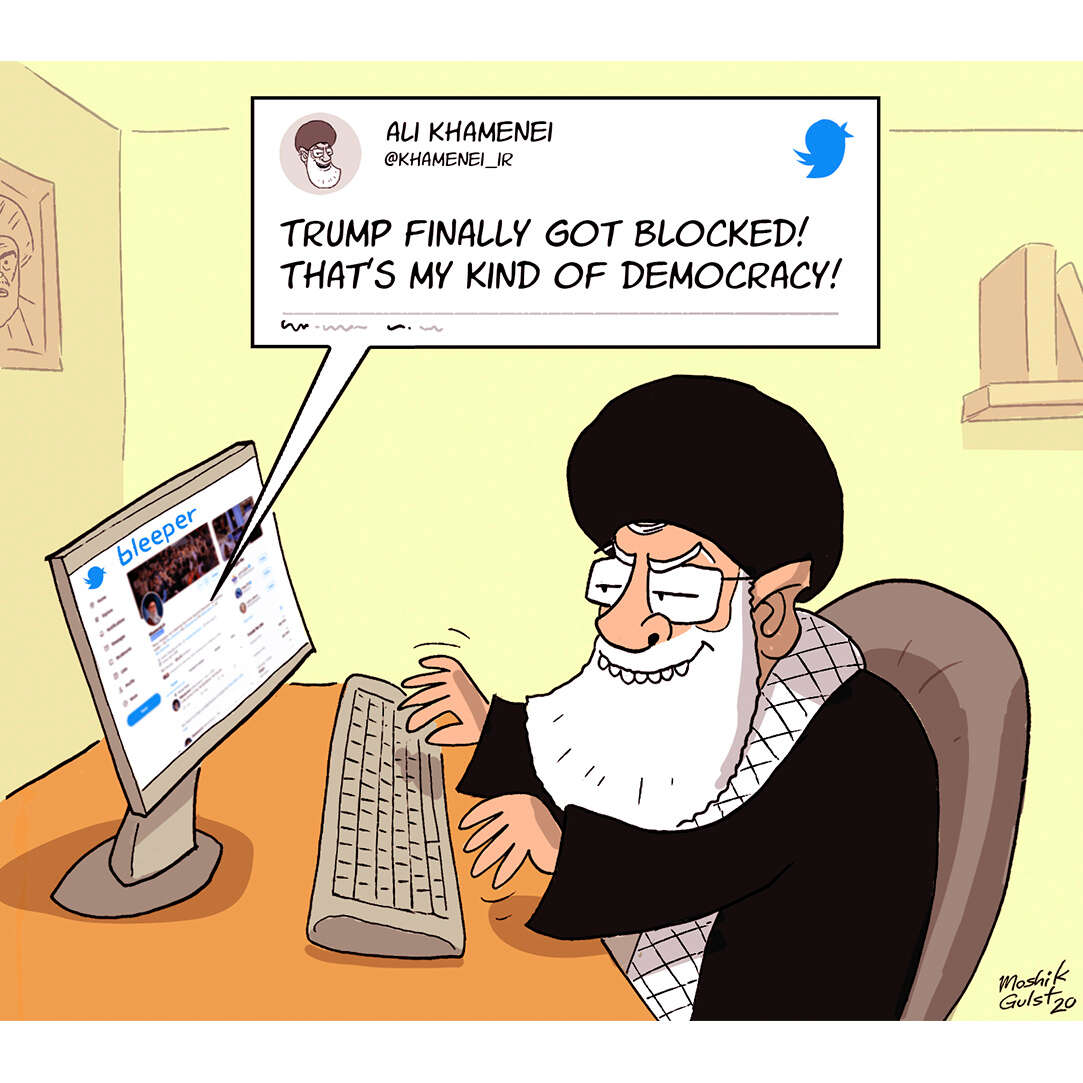
Iran's Supreme Leader, Ayatollah Ali Khamenei, said in a live television broadcast on Friday that he has told the government to reject British and American-made vaccines."Imports of US and British vaccines into the country are banned. I have told this to officials and I'm saying it publicly now," Khamenei said.
Sunday, January 10, 2021
Elder of Ziyon
book review
Not in Kansas Anymore: Academic Freedom in Palestinian Universities, by Cary Nelson, is a book-length research paper that exposes the true threats to academic freedom in Palestinian territories.
Unlike what BDS activists claim, the problem is not Israel.
For this book, Nelson has expanded one chapter of his masterful Israel Denial book into this comprehensive treatment of the subject of how Palestinian students have no academic freedom at all, at least when it comes to political speech about Israel and Palestinian leaders.
He describes how the (very) few Palestinian scholars who are moderate in wanting dialogue with Israel have been threatened and nearly killed, noting that pro-Hamas academics are also threatened in the West Bank.
Palestinians like to claim that the annual elections of student bodies at their universities are proxies for regular elections that haven’t been held for 17 years and show how important democratic processes are to them. In fact, these elections are accompanied with intimidation, threats, violence and even armed interference by the Palestinian Authority (and, by proxy, Hamas) to push their own student groups to lead the campus.
Palestinian academia is a fun-house mirror of American liberal campuses. If a professor says something that makes students uncomfortable, he or she can be threatened by students much more directly and physically than today’s cancel culture.
In Gaza, the idea of academic freedom is a sad joke. All students at Islamic University of Gaza must take one full year of Islamist indoctrination courses.
One amazing section of the book shows an IUG literature class dissecting a humorous children’s poem by British poet Roger McGough called The Cat’s Protection League about a feline protection racket. The students are prompted and encouraged to interpret the poem in the most outrageous antisemitic ways, such as assuming that the cats represent Jewish gangsters. Antisemitism pervades academia in Gaza, and no one can oppose that without facing real world consequences.
That is only the tip of the iceberg. West Bank universities compete as to which of them have had students kill the most Jews. Universities are the ideological homes of terrorism, and often the physical homes as well –weapons labs have been built in Gaza universities and one of them held kidnapped Israeli soldier Gilad Shalit for a time. Many terrorists during the second intifada came from West Bank universities, including Ahlam Tamimi who helped bomb the Sbarro pizza shop.
The universities also often praise terrorism. The most infamous case was the exhibit, complete with bloody body parts, of the same Sbarro attack at An Najah University: The same university more recently displayed mock-ups of a man stabbing a religious Jew and a bloody model of a car running over Jews.
Nelson does point out times that Israel interfered with campus curricula, but that all ended at the end of the first intifada. Palestinian government control and intimidation continues on campus today, to the point that students and professors are self-censoring to stay out of trouble. (He does talk about Israel’s relatively rare raids on campus since then, which are understandable when there is an imminent terror threat but often could be more effective by detaining students at home.)
Nelson also shows how other claims by BDS, that Israel blocks students from going abroad or foreign instructors to come to teach, are exaggerated – Israel does not have any more strict restrictions on those movements than most Western democracies.
Small details in the book are illuminating. For example, Nelson points out that while Israel is roundly castigated for administrative detention, the Palestinian Authority detains hundreds of people without charge as well, although they are not as forthcoming with the statistics as Israel is. (I follow Palestinian media closely and have never seen any mention of this.)
Another section has a footnote that mentions that Norman Finkelstein actually defended Hamas’ policy of murdering “collaborators” with Israel.
This is the sort of hypocrisy exposed in Not in Kansas Anymore. The boycotters’ pretense of caring about Palestinian academic freedom is clearly just an excuse to attack Israel as they ignore the far worse crimes that Palestinian students and professors are subject to every day from their own leaders and peers.
Saturday, January 09, 2021
Richard Goldberg and Mark Dubowitz: Why Biden’s Plan to Rejoin the Iran Deal Makes No Sense
Iran has decided to escalate tensions with the West by publicly confirming the production of enriched uranium at an underground nuclear facility and seizing a South Korean oil tanker transiting the Persian Gulf. This escalation may be designed to put additional pressure on President-elect Joe Biden to rejoin the 2015 Iran nuclear deal—a move that would give extensive sanctions relief to a regime under enormous economic stress. But if Biden were to give in to nuclear extortion and abandon sanctions, he would surrender his most important leverage against Tehran and never achieve his stated goal of negotiating a longer-lasting, better agreement.The end of the Gulf crisis is big news — but Middle East sands always shift
Five years ago, nearly every Republican in the U.S. Congress—and many leading Democrats including Senators Charles Schumer, Bob Menendez, and Joe Manchin—opposed the Iran deal for good reasons. The agreement set expiration dates on key restrictions, ruled out on-demand inspections, and let Iran maintain its nuclear enrichment capabilities. It didn’t address the regime’s accelerating missile program, gave Tehran the financial resources to sponsor regional aggression and terrorism, and ignored its egregious abuse of human rights.
Hinting at these flaws, Biden recently said he wants to build on the 2015 deal with a new agreement to “tighten and lengthen Iran’s nuclear constraints, as we address the missile program.” During the presidential campaign, he also promised to confront Iran’s human-rights record and its “destabilizing activities, which threaten our friends and partners in the region.” But the president-elect maintains that the only way to negotiate a new framework is by first returning to the old one.
There’s one big problem with that logic. Since rejoining the original nuclear deal requires Washington to lift its most punishing sanctions, the economic leverage against Tehran that Biden inherits from his predecessor will evaporate the moment sanctions are relaxed.
Congress had worked for years to enact tough sanctions to force the Iranian regime to abandon its malign activities. Indeed, former President Barack Obama credited these sanctions with bringing Iran to the negotiating table in the first place.
The obvious question, then, is this: If Obama contends U.S. sanctions pressure was necessary to produce an agreement as deeply flawed as the Iran nuclear deal, how could Biden ever negotiate far more restrictions on Iran with far less economic leverage?
Biden’s retreat from sanctions in the face of Iran’s threats to expand its enrichment-related activities, kick out international inspectors, and build additional nuclear reactors—in effect, giving in to a nuclear extortion racket—would also send a clear message to the mullahs: They can wait out a Biden administration in negotiations because he will never reimpose sanctions out of fear Iran might again expand its nuclear activities.
It appears that the Gulf crisis is over. The schism between U.S. allies Saudi Arabia, the United Arab Emirates (UAE), Bahrain and Egypt, on the one hand, and Qatar, on the other, is ending today in a flurry of Arab robes and face-masked embraces at a desert air strip in northwest Saudi Arabia.MEMRI: A Second Chance For Sudan
This being the Middle East, the wording must be cautious and it’s wise to include a “probably” or “perhaps” somewhere. But there is no doubting the potential significance of the news. An often absurd tiff between Washington’s allies has been taken off the front burner. The significance is arguably bigger than Israel’s recent “normalization” agreements with the UAE and Bahrain. And, given the attendance in the desert today of White House adviser and presidential son-in-law Jared Kushner, it’s hard not to recognize it as an achievement of outgoing President Trump.
That success must be balanced against the president’s role in starting the crisis in May 2017, when he attended the Riyadh Arab summit on his first foreign trip. Emir Tamim of Qatar was also there, but his delegation knew something was going wrong when it found itself seated near the kitchens at the banquet. Within days, the Qatar news agency had been hacked to show fake pro-Iranian messages and Saudi Arabia, the UAE and Bahrain had broken relations with Qatar. A tweet by President Trump had suggested Qatari support for terrorism. Qatar’s Arab neighbors instituted an “embargo” — in effect, a blockade, cutting the land border and banning air traffic — complaining of Doha’s support for radicals and Islamic extremists.
On a reporting trip to the Gulf a few weeks later, I searched for answers on what had happened and why. Perplexed local diplomats were doing the same. The accepted wisdom was that it was a power play by MbZ and MbS, the up-and-coming personalities of Crown Prince Mohammed bin Zayed of Abu Dhabi, the lead emirate of the UAE, and Mohammed bin Salman, who became the Saudi crown prince in June 2017 after forcing the abdication of his predecessor. Irritated by their once-irrelevant Qatari neighbor, now striding the region and even the world flush with natural gas revenues, they wanted to put it in its place.
With one exception, the Trump administration certainly did not distinguish itself when it comes to Africa.[1] But that exception, Sudan, is an important one. Through a bulldozer intensity focused on helping make peace between Israel and its Arab neighbors, through seemingly crude pressure and clumsy creativity, the administration came through with three great deliverables for Khartoum's transitional government: removing Sudan from the State Sponsors of Terrorism List, restoring Sudan's sovereign immunity for past complicity with terrorist acts, and providing both bilateral and IMF debt relief that will make Sudan able to more easily tap international assistance for very poor countries. Khartoum in return has to move forward with normalizing relations with Israel.[2]
I am one of those who criticized the administration for pressing too hard to get Sudan's fragile transitional government to agree on Israel – even though I support normalization – but in the end, it worked and, like the other agreements between Israel and Arab states over the past few months, this is a solid, respectable diplomatic achievement.
Sudan, after 30 years of brutal dictatorship, has been given a second chance. That chance has been principally won by the Sudanese people themselves, who in 2018 and 2019 rose up against the Omar Al-Bashir regime and, with the help of key parts of the Sudanese military establishment, brought the regime to an end. But certainly, the international community also played a helpful secondary role. And second chances in the Arab world are nothing to look down upon, as we see several countries – Lebanon, Syria, Iraq, Yemen – in deep, seemingly intractable existential crises. Sudan is also in crisis, and yet one can only compare it to the situation in Lebanon and see real hope and the possibility of progress on the banks of the Two Niles.
Sudan's most immediate problem is economic. Inflation ran at over 200% in 2020, exacerbating already widespread poverty and hunger. Supplying fuel, food, medicine, and electricity are major challenges. GDP in 2020 decreased even more than it had the past two years as a result of the coronavirus pandemic. Almost half of all Sudanese between the ages of 15 and 64 suffered from malnutrition as children. And with freedoms won by the Sudanese Revolution comes the right to demonstrate and complain, loudly. Expectations and frustrations are very high. Sudan's biggest challenge over the next two years is finding a way to show tangible forward motion towards a better life for its people. According to the country's Charter for the Transitional Period, democratic elections are to be held by late 2022; these would be the first fully free elections in Sudan since 1986.
The second, no less daunting, challenge that Sudan faces is that of civilian-military relations, specifically how to rein in a sprawling military establishment accustomed to both economic and political privilege. In Sudan, there are two military entities, the Sudanese Armed Forces (SAF) and the Rapid Support Forces (RSF), the paramilitary forces built up by the previous regime out of the Darfur conflict and used as a type of Praetorian Guard by Bashir in his last years. Both SAF and RSF are mentioned by name in the Transitional Charter as "national military institutions that protect the unity and sovereignty of the nation." SAF's Abdel Fattah al-Burhan and RSF Commander Muhammad Hamdan Dagalo (AKA "Hemeti") are, respectively, chairman and vice-chair of Sudan's Sovereignty Council.
Elder of Ziyon