
 Friday, February 04, 2022

From Ian:
Caroline Glick: The Anti-Defamation League and Amnesty International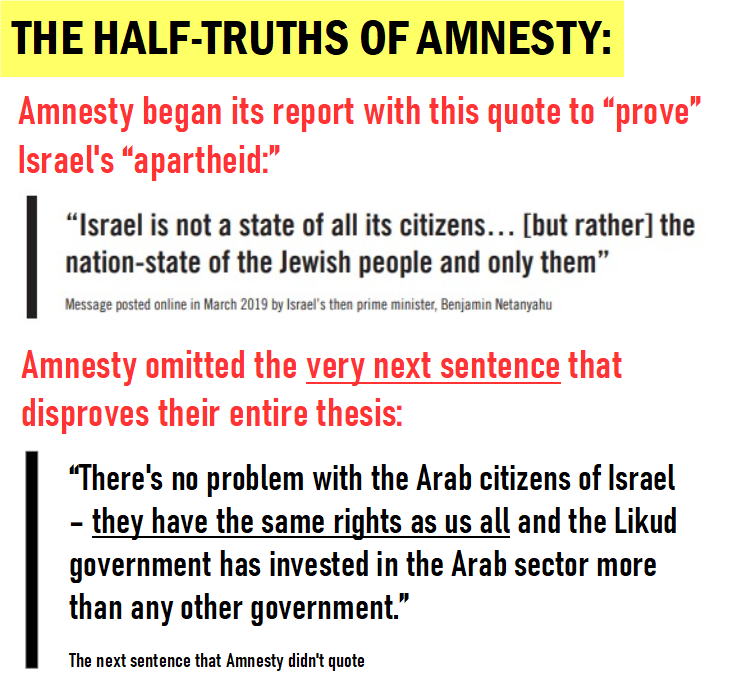
David Collier: Where are the real journalists? 15 questions for Amnesty
Abe Foxman: Amnesty's Lies About Israel Only Hurt Its Own Credibility
Caroline Glick: The Anti-Defamation League and Amnesty International
In October 2020, then Secretary of State Mike Pompeo announced his plan to list Amnesty, Human Rights Watch and Oxfam as anti-Semitic organizations due to their efforts to advance the anti-Semitic boycott, divestment and sanctions campaign against Israel. Pompeo’s plan was in keeping with the Trump administration’s overall policy for fighting anti-Semitism. In December 2019, then President Donald Trump signed an Executive Order that provided civil rights protection to Jewish students persecuted by BDS campaigns on their campuses.
Given the central role Amnesty and other phony human rights groups play in the political war for the destruction of the largest Jewish community in the world, Pompeo’s planned move was not just reasonable, it was imperative. But rather than applaud him for his resolve, the ADL attacked Pompeo and his plan.
When word broke that Pompeo was about the designate the three groups as anti-Semitic, the ADL released a statement aimed at undermining and blocking his move. The statement declared, “We oppose broadly applying the anti-Semitism label to these human rights organizations; doing so is neither accurate nor helpful to the fight against anti-Semitism. Rather, this move would politicize the fight against anti-Semitism.”
A month later Pompeo made it the official policy of the State Department to treat organizations that support BDS as anti-Semitic groups. But by that time, Trump had lost his reelection bid, and the wind had come out of the sails. Pompeo’s statement did not mention which specific groups were anti-Semitic. So thanks in large part to the ADL, Amnesty and its anti-Semitic comrades dodged the bullet.
On the surface, the ADL’s condemnation of the Amnesty report could have been written by the Zionist Organization of America. But a close look at the ADL’s response makes clear that the organization which is supposed to lead the struggle against anti-Semitism, hasn’t changed its position since it defended Amnesty from Pompeo’s charge of anti-Semitism.
The ADL had a great deal of criticism over Amnesty’s report, but it engaged in circus-style contortionism to avoid saying the plain truth: Amnesty’s report was anti-Semitic.
As the ADL put it, Amnesty’s report was “an effort to demonize Israel and undermine its legitimacy as a Jewish and democratic state. In an environment of rising anti-Jewish hate, this type of report is not only inaccurate but also irresponsible and likely will lead to intensified anti-Semitism around the world.”
So the report wasn’t anti-Semitic per se. It was simply irresponsible. Amnesty didn’t factor in how its blood libels might be interpreted by people who (unlike Amnesty) actually hate Jews.
The ADL statement maintained its line – that Amnesty was irresponsible, not bigoted against Jews — through to the end. The statement concluded, “Amnesty International’s rhetoric is irresponsible. These are not simply abstract words but the kind of spurious charges that, time and again, have placed Jews in danger around the world.”
David Collier: Where are the real journalists? 15 questions for Amnesty
1. One of the key figures behind your attacks on Israel – and indeed one of those leading the press conference on the report – used to have Facebook profile pictures of PFLP and Islamic Jihad terrorists. How can you possibly believe he is fit for purpose when it comes to reporting on Israel?
2. Your Deputy Director for the MENA region, which covers dozens of states, is a Palestinian who spends over 99% of his time only talking about Israel. Given the state of human rights in the Middle East and North Africa – how can this be justified?
3. We have seen Amnesty employees support terrorist attacks or give advice to terrorists. Looking through who you employ, there is a distinct pattern. Amnesty has chosen to employ several people who were visibly active anti-Israel careerists. They promoted full BDS, believed Israel is an Apartheid state, worked on campaigns to delegitmise Israel, often spread fake news and so on – long before they started working for Amnesty. All this must have been on their CVs. If you deliberately employ anti-Israel activists such as this – and send them out to write your reports on Israel – what do you expect the result to be?
4. A clear example. In 2017 Amnesty employed an anti-Israel activist named Alli Jarrar (McCracken). Jarrar came from Codepink, an extremist group that has even supported Iran’s weapons program. Before she arrived at Amnesty, Jarrar worked on a Code Pink campaign to boycott Airbnb. Shortly after her arrival – Amnesty engaged in a well-funded campaign to boycott Airbnb. How much of your activity is driven by the obsessions of those you employ?
5. Going back in time – we often see names of authors on Amnesty reports. The authors are anonmyous in your Apartheid report. Why – is there something you are trying to hide?
6. In your latest report you called Israel an Apartheid state. It obviously isn’t. Can you explain why Amnesty wasted enormous resources, changing every definition of all the words neccessary – in order to try to squeeze Israel into a box it clearly does not belong inside?
2/5 On her left is director of @alhaq_org Shawan Jabarin. Jabarin has been arrested multiple times and has been convicted on terror charges. Israel’s Supreme Court labeled him “Dr. Jekyl and Mr. Hyde” for hiding his terror connections behind “human rights” activism.
— NGO Monitor (@NGOmonitor) February 4, 2022
Abe Foxman: Amnesty's Lies About Israel Only Hurt Its Own Credibility
It is a mark of Amnesty's incredible shrinking credibility that the anti-Israel narrative it peddles, seeming to want to divert attention from the internal dissension that has recently come to light inside the organization, has less and less traction in the Middle East itself, where Amnesty appears to have "lost the room." In the last two years, a series of Arab nations have moved to normalize relations with Israel, among them the United Arab Emirates, Bahrain and Morocco. More are close behind.
And it isn't only Israel's Arab neighbors who are telling Amnesty "No thanks." Last year, Israel's Arab party joined the most diverse government Israel has ever had, and is part of the coalition governing the country. "We have two hats," said the party's leader, Mansour Abbas. "On the one side we are Arab Palestinians. But we are also Arab citizens of Israel."
Mansour's significant role in leading the Middle East's only democracy, one which protects workers, women, members of the LGBT community and religious minorities, is unhelpful to Amnesty's line that Israel is an apartheid state. The same is true of the role that Israeli Arabs play on the country's Supreme Court, where an Arab justice presided over a trial adjudicating a national Israeli election.
Buffeted by an array of grave and downright existential challenges that no other country on the planet faces, beset by an over-abundance of complexity, Israel is no more perfect than the United States is. But the kind of over-the-top proclamations by agenda-driven organizations like Amnesty do less damage to Israel's reputation than to their own.


