
 Tuesday, October 06, 2026
 Elder of Ziyon
A First Response to “The Muslim Question”
The topic is important. Accuracy is paramount.
Aug 20, 2026
I debunk conspiracy theories for a living, more or less, so
when I published “The
Muslim Question“ and promised a response, I was concerned that it
leaned much of its argument on a documented “100-year plan” for the Muslim
Brotherhood to conquer North America. This sounded too conspiratorial for my
taste. So I did what I always do - try to debunk it.
The claim comes from a November 2025 ISGAP
report, and from ISGAP’s director, Dr. Charles Asher Small, who told
reporters “we are now fifty years into the Brotherhood’s 100-year plan to
entrench themselves into key institutions in the United States and other
Western societies.” Every subsequent citation of the 100-year plan — the Fox
News piece, the syndicated wire copy, the essay that started this —
traces back to that single quote. ISGAP’s own report cites two documents as its
evidence: a 1982 internal Brotherhood strategy paper known as “The Project,”
seized by Swiss authorities from a Muslim Brotherhood financier in 2001, and a
1991 memo by a Brotherhood official named Mohamed Akram, seized by the FBI in
2004 and entered as evidence in the Holy Land Foundation terrorism-financing
trial. I read both documents. Neither one discusses a “100-year plan.” ISGAP’s
own report concedes this, saying the document “timelines and step-by-step
approach clearly expect” long-term transformation.
But the contents of the files are just as concerning as any
conspiracy theory would be.
Both texts are real, in the ordinary evidentiary sense:
seized from people with documented Brotherhood ties, authenticated in a federal
courtroom in the Akram memo’s case, and never disowned as forgeries by anyone
in a position to know. The Project lays out twelve “points of departure” for a
worldwide Islamic strategy — build institutions, avoid needless confrontation,
cooperate tactically with movements you don’t actually agree with, keep the
long-term goal of “the establishment of the global Islamic State wherever it
is” in view at every stage. The Akram memo applies that logic to North America
specifically, calling the mission “settlement” — making Islam “a part of the
homeland it lives in” rather than a foreign transplant — and naming twenty-nine
organizations, several of them still major institutions in American Muslim
life, as the “seeds” of that project.
I cannot know if these plans were accepted by the
Brotherhood as a whole or were just memos written by individuals in the
organization. But from what I can tell, they are completely consistent with the
Brotherhood ideology and larger strategy since it was founded nearly a century
ago.
Worse, they seem consistent with the things that have
happened since they were written.
From the eleventh point of The Project:
To adopt the Palestinian cause as part of a worldwide Islamic plan, with the policy plan and by means of jihad, since it acts as the keystone of the renaissance of the Arab world today.
a-Elements:
...To prepare the community of believers for jihad for the liberation of Palestine.
To create a modest nucleus of jihad in Palestine, and to nourish it in order to maintain the flame that will light the road toward the liberation of Palestine, and in order that the Palestinian cause will endure until the moment of liberation.
...
c-Suggested Missions:
To conduct studies on the Jews, enemies of Muslims, and on the oppression inflicted by these enemies on our brothers in occupied Palestine, in addition to preaching and publications.
To fight against the sentiment of capitulation among the Ummah, to refuse defeatist solutions, and to show that conciliation with the Jews will undermine our Movement and its history.
To conduct comparative studies on the Crusades and Israel, and [the victory that will be that of Islam].
To create jihadi cells in Palestine, and support them in order that they cover all of occupied Palestine.
To create a link between the moujahadin in Palestine and those throughout the Islamic world.
To nourish a sentiment of rancor with respect to the Jews and refuse all coexistence.
Yes, antisemitism is part of the strategy and there is no difference between anti-Zionism and antisemitism. Which is what we are seeing today, 44 years later.
The other document, on North American strategy, is chilling both in its scope and in the scale of implementation since it was written in 1991:
4- Understanding the role of the Muslim Brother in North America:
The process of settlement is a “Civilization-Jihadist Process” with all the word means. The Ikhwan must understand that their work in America is a kind of grand Jihad in eliminating and destroying the Western civilization from within and “sabotaging” its miserable house by their hands and the hands of the believers so that it is eliminated and God’s religion is made victorious over all other religions. Without this level of understanding, we are not up to this challenge and have not prepared ourselves for Jihad yet. It is a Muslim’s destiny to perform Jihad and work wherever he is and wherever he lands until the final hour comes, and there is no escape from that destiny except for those who chose to slack. But, would the slackers and the Mujahedeen be equal.
5- Understanding that we cannot perform the settlement mission by ourselves or away from people:
A mission as significant and as huge as the settlement mission needs magnificent and exhausting efforts. With their capabilities, human, financial and scientific resources, the Ikhwan will not be able to carry out this mission alone or away from people and he who believes that is wrong, and God knows best. As for the role of the Ikhwan, it is the initiative, pioneering, leadership, raising the banner and pushing people in that direction. They are then to work to employ, direct and unify Muslims’ efforts and powers for this process. In order to do that, we must possess a mastery of the art of “coalitions”, the art of “absorption” and the principles of “cooperation”.
Now, let’s look at the so-called “Red-Green Alliance” between socialists and Islamists. It isn’t an alliance. Watching the last decade of campus and municipal politics, it is a one-directional trade. The socialist side has moved: absorbing “decolonization” framing, treating anti-Zionism as settled progressive doctrine, going quiet on gender and sexuality commitments that would otherwise put it at odds with religiously conservative coalition partners. I can’t point to the reverse — an Islamist-aligned organization publicly revising its own positions on gender, sexuality, or religious authority to accommodate its socialist allies. The accommodation runs one way, and “useful idiot,” a phrase coined for exactly this kind of one-sided coalition, has acquired an uncomfortable second meaning: the people who used to deploy it as an insult may now be describing themselves without knowing it.
Again, I have no solid proof that the Muslim Brotherhood is
employing this precise strategy in the US today. But since 2000, we have seen
9/11, wars against Al Qaeda and ISIS, and yet Islamist thinking is more
embedded in the US than ever before. Muslim candidates are cool while Jewish
candidates are suspect of “Zionism.” New York was the site of the deadliest
jihadist attack in American history. Twenty-four years later, New York
magazine’s cover story is ‘Habibi City’ — not because violence won, but because
the Akram memo’s other kind of jihad, the ‘Civilization-Jihadist Process’ of
settlement and institution-building, did. Muslims are running and winning
elections as socialists, a worldview the Islamists certainly do not believe in,
but one that shares their goal of “eliminating and destroying the Western
civilization from within.” This doesn’t happen by itself; whether this is the
actual plan or a general strategy, it is visible to anyone willing to see.
When you have a well defined revolutionary ideology, you
don’t need a conspiracy to carry it out. You just need enough people willing to
do whatever it takes to implement it. While these documents seem largely
consistent with what we have been seeing, there may be other memos superseding
them , or there may be none. We do not need a central organization to tell
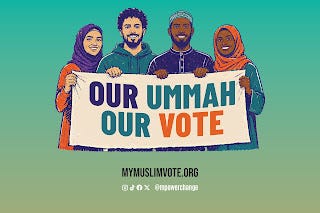
Linda Sarsour to promote Muslim political power while pretending it is
consistent with socialist principles as her “MPower Change” organization claims.
“The Muslim Question” essay is terrifically important. But
equally important is the presentation. If there is any overreach, anything that
can be disproven, if the language is perceived as discriminatory, then the
project fails. I’ve only just begun to deeply analyze it, but we have already
established that the danger is real and Islamist organizing is the best
explanation for much of what we see nowadays, It is critical that the project
does not claim anything beyond what can convince a skeptical person.
There are plenty of real concerns. Anyone who cares about
the future of America, and of Jews in America, needs to take the contents of
these memos seriously because those plans are being implemented, explicitly or
implicitly.
Response to “The Muslim Question,” Part 2
If we don’t define the issue properly, we cannot escape the echo chamber
Aug 26, 2026
Last week I published a guest post, provocatively titled “The Muslim
Question,” that marshalled evidence that the Muslim Brotherhood was in the
midst of a 100-year plan to subvert North America. I wrote an initial
response pointing out that the 100-year plan was a theory, not backed up by
the evidence provided, and that accuracy is of paramount importance when
broaching this topic.
My response looked at the documents behind the claim of a
100 year plan - a 1982 internal Brotherhood strategy paper known as “The
Project,” and a 1991 memo by a Brotherhood official named Mohamed Akram. They
do describe a plan of Islamic takeover, one for the world and one for America,
respectively. But we cannot know if they were official working documents, or
part of a set of potential plans; even if they are official, operative MB memos
we cannot know if they have been replaced or rescinded. The “Muslim Question”
essay asserts that it appears that the strategies described are coming true,
and in a broad sense they are, but as I pointed out, we need to be precise in
our claims.
It turns out that recent evidence supports the idea that the
memos reflect a real plan.
On August 5th, the Senate Judiciary Committee took
testimony from three witnesses on this exact question. One of them, Lara
Burns, is a retired FBI Special Agent who spent 22 years on counterterrorism
and led the Holy Land Foundation investigation herself. Her testimony and the
two witnesses alongside her supply what we had lacked: a paper trail connecting
the 1991 memo’s stated intentions to a documented institutional record spanning
three decades.
In October 1993, FBI wiretaps captured a meeting in
Philadelphia of leaders from the Holy Land Foundation, the Islamic Association
for Palestine, and related organizations, discussing how to respond to the Oslo
Accords and to growing law-enforcement scrutiny. On the recording, a man named
Omar Ahmad raises the idea of a new Washington organization, one with a cleaner
public image, and worries aloud about staffing it: “Do we have hidden faces we
now bring up to light? We have what we have.” Months later, Ahmad co-founded
CAIR.
A 1988 internal leadership chart, entered into evidence,
lists Mohamed Akram — the 1991 memo’s author — in a formal Brotherhood role.
Reporting since traces him collaborating with the Qatar-based International
Union of Muslim Scholars as recently as 2020, alongside its current
Secretary-General, who has publicly endorsed Hamas. Individuals named on a 1991
internal roster of the U.S. Brotherhood’s “Palestine Committee” turn up decades
later heading unrelated-sounding advocacy and civic organizations.
None of that proves a single plan executing on schedule. But
it does establish that the same people, trained in the same 1990s network, kept
reappearing in leadership of new organizations for thirty years.
The Muslim American Society is the cleanest example. A 2004
Chicago Tribune investigation and a senior MAS official’s own on-record
statement describe Brotherhood members founding MAS in 1992 and put current
Brotherhood membership among MAS activists at roughly 45 percent.
Recent litigation matches the 1982 document’s language. The
Project counsels “the art of the possible... without abusing basic principles,”
and avoiding “disproportionate confrontation” with adversaries. Across the Boim
wrongful-death litigation and a Minnesota defamation suit brought by a former
CAIR employee, the pattern is consistent: resist discovery, contest every
request, settle rather than produce donor lists or foreign-funding records that
would resolve the underlying question either way. A federal magistrate in the
Boim case ordered fees against one defendant in 2024 specifically for “baseless
discovery disputes.” That’s not proof of any particular funding source. It’s
the institutional discipline the 1982 document describes as a virtue: don’t hand
adversaries a fatal blow, don’t invite the confrontation you can avoid.
In summary, we have a named set of individuals and
organizations, identified in a Brotherhood-internal document in 1991, whose
personnel and institutional descendants can be traced through court records,
tax filings, and their own public statements into the present, exhibiting
behavior consistent with the “settlement” strategy that document described.
That’s implementation evidence; not proof but a strong indication that there is
a consistent strategy of entryism that has been happening for decades and continues
to happen today.
There is one other issue with “The Muslim Problem” that
needs to be addressed. The Muslim Brotherhood is a specific organization, one
that is quite important, but it does not necessarily represent Islam. If we are
to ask “The Muslim Question” we need to look at a bigger scope than just North
America.
There are other Muslim groups and countries who aspire to a
global Islamist power. Iran’s “Axis of Resistance” is one obvious one.
Erdoğan’s Turkey wants to resurrect an Ottoman-style caliphate. Hizb ut-Tahrir
is in many ways Europe’s Muslim Brotherhood although their goals and beliefs
diverge from the MB. If we are to define The Muslim Question accurately, we
need to understand the commonalities and differences. We also need to
understand Islam as a whole: can the Western-style religion be separated from the
medieval-style global political aspirations? If there is a danger from Islam to
the world, which is the uncomfortable question The Muslim Question seeks to
answer, we must be much clearer on the exact nature and scope of the danger. If
we aren’t careful in our words, and if we make sloppy errors of fact, then the
battle can be lost before it is begun. And before it is begun it must be
clarified.
These are the questions we will attempt to answer next.
Response #3 to The Muslim Question
Is the question really about Islam, or is it about tolerance?
Aug 30, 2026
In parts one
and two
of my response to The Muslim
Question I examined the claims of the original essay and found that while
some claims didn’t add up, the specific problem with the Muslim Brotherhood in
America is real and even understated in the original essay.
But the title isn’t “The Muslim Brotherhood Question,” it is
“The Muslim Question,” and the real question is Islam itself, or perhaps a
significant subset. Is there a Muslim Question that requires answering on that
level?
And what is the answer? Awareness is important but it is
hardly a solution, and any solution that targets Muslims as a whole is almost
certainly problematic as well.
So we need to first dig deeper into the definition of the
question, or problem if you prefer, and then see where we end up.
As indicated in the end of the last essay, there are at
least four major streams of Islamic political philosophy that are often at odds
with each other but share a Muslim supremacist viewpoint: the Brotherhood,
Iran’s Axis of Resistance, Erdogan’s Turkey and Hizb ut-Tahrir which in many
ways is as politically active in Europe as the MB is in North America.
These four disagree on many major issues. Iran and Turkey
backed opposite sides in Syria for over a decade. The Brotherhood and Iran have
clashed repeatedly over Gulf politics. Hizb ut-Tahrir calls Brotherhood
gradualism a betrayal. Anyone who treats them as one movement doesn’t
understand any of them.
But they share a root. Classical Sunni jurisprudence spent
about a thousand years treating a single caliphate as a religious obligation.
When Ataturk abolished the Ottoman caliphate in 1924, he didn’t change the
desire for one; very few Islamic figures argued against the idea (Egyptian
scholar Ali Abd al-Raziq was one of the few exceptions and he was blacklisted
as a result.) Modern Sunni Islamism is reviving an idea that never really went
away
Iran runs on a different theology entirely. Ayatollah
Khomeini created the idea of religious leaders being given broad political
power only in 1970 and it had not been accepted by most Shiite thinkers — but
it is what runs Iran’s government.
In all these cases, Islam is not and cannot be separated
from politics.
And in reality, this applies to Islam altogether. While many
or most Muslims live within Western society and pragmatically accept the
separation of church and state, there has never been an Islamic reform movement
that made that separation official the way Christianity eventually did after
hundreds of years of war. The attempts by Islamic scholars to enforce such a
separation have failed; Turkey’s forcible secularization for much of the 20th
century was largely successful but it is being rolled back by Erdogan today; I
am not in a position to tell whether the average Turkish citizen supports this
reversion or not. The point is that even outside the explicit supremacist
streams of Islam, the separation from politics is essentially non-existent. A
2013 Pew poll found support for sharia as the “official law of the land” for
84% of Muslims in South Asia, 77% in Southeast Asia, 74% in the Middle
East/North Africa, and 64% in sub-Saharan Africa. I don’t know how many Muslims
in the West share the same views but the differences are more likely to be
pragmatic, not doctrinal. And sometimes even those Muslims cross the line when
they feel that they have reached the power to do so.
While Jews in the West might ask for institutions to provide
kosher meals for them, many Muslims in England demand that public schools with
a Muslim majority no longer serve non-halal products altogether even to
non-Muslims. This is a political demand, not a religious one.
The line between the explicitly political goals of some of
these groups and the larger number of Muslims who passively want to see more
power for their group is fuzzy. Every defined group in the West wants more
political representation; that is not inherently a problem. So we still need to
define The Muslim Question with more precision.
These four aren’t ordinary political organizations asking
for a bigger seat at the table. A political party wants more power for people
who already have equal standing. What the Brotherhood, Hizb ut-Tahrir, and
their allied states have organized for, consistently, is a legal order in which
non-Muslims and dissenting Muslims don’t have that standing to begin with.
The clearest evidence comes from blasphemy. From 1999 to
2010, the Organisation of Islamic Cooperation, a bloc of 57 states, brought a
“Defamation of Religions” resolution to the UN Human Rights Council year after
year, seeking to make criticism of Islam an internationally recognized human
rights violation rather than protected speech. It followed the Rushdie affair
and the 2005 Danish cartoons, and its own founding declaration called for
Islamic states to “coordinate their efforts, based on Sharia, to effectively
combat blasphemy against Islam.” Western governments eventually blocked it. But
what the OIC asked for, for over a decade, at the UN, in writing, was the right
not to be offended, applied one direction only. Nobody organized a parallel OIC
campaign asking the UN to protect Christians, Hindus, or atheists from
Muslim-majority states’ own blasphemy laws, several of which carry a death
sentence.
So there is a Muslim question in the sense that there does
not seem to be a religious requirement to treat non-Muslims equally. Islamic
blasphemy and other laws apply to non-Muslims as well as Muslims, and the
asymmetry is a problem mainstream Islam has not addressed and, living inside a
non-Muslim-majority world, has not had much reason to. But the problem isn’t
personal religious practice. It’s when that practice, or the display of it,
starts requiring non-Muslims to accommodate a claim on public space that nobody
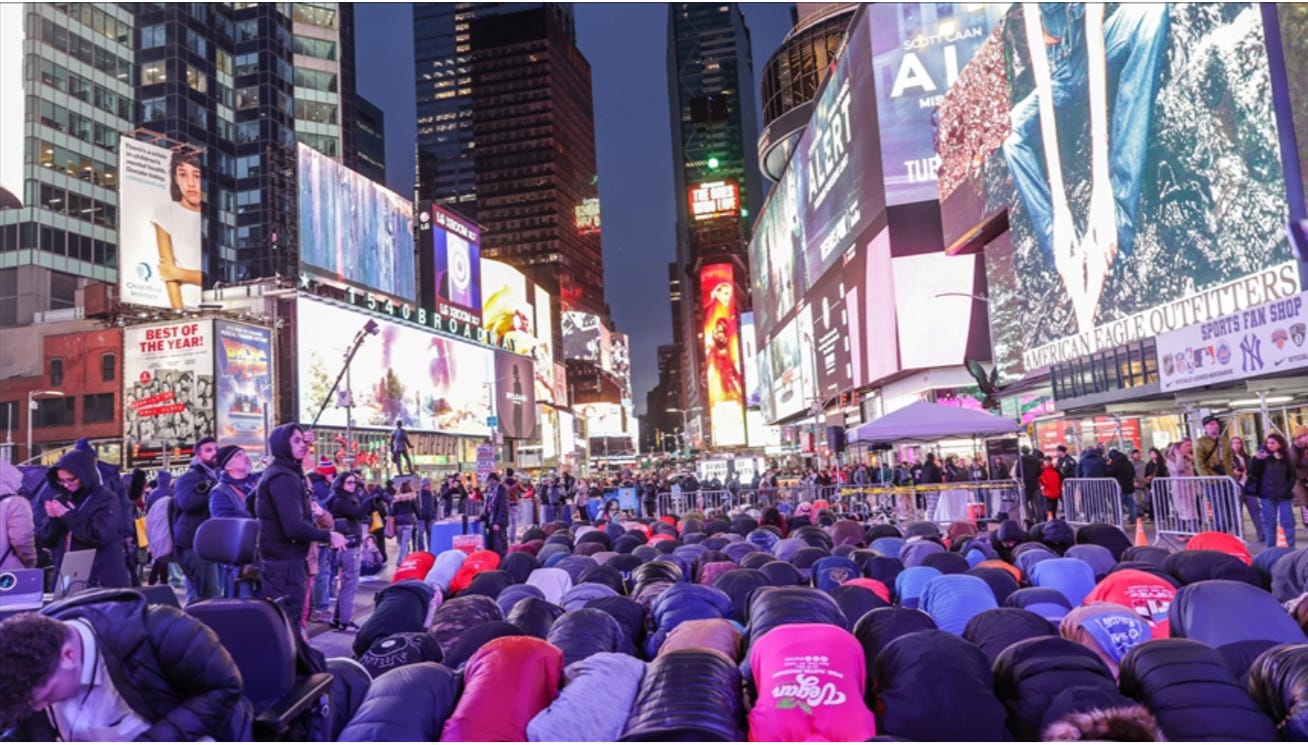
else gets to make. When thousands of Muslims pray in the middle of Times
Square, is that a religious requirement, or is it a demonstration that a group
has grown large enough to take over one of the most visible public areas in
America and make everyone else route around it?
In 1945, the philosopher Karl Popper wrote a footnote that
turned into one of the most cited passages in political philosophy. He called
it the paradox of tolerance: a society that tolerates everything, without
limit, eventually tolerates the destruction of its own tolerance. If a movement
uses the openness of a free society to gain power and then closes that openness
once it has it, unlimited tolerance hasn’t protected anyone. It’s handed the
intolerant exactly the tool they needed.
This is the real problem that needs solving, and it isn’t a
specifically Muslim question. It’s the question of how a tolerant society deals
with movements that don’t reciprocate its tolerance. Organized groups like
CAIR, the Brotherhood’s other American affiliates, and Hizb ut-Tahrir are part
of that problem, and one of the reasons the problem seems difficult is because
Westerners tend to give more tolerance to religious groups than others. That
tolerance is exactly what these groups take advantage of, labeling any
perceived insult as “Islamophobic.”
The asymmetry is the problem. Tolerance for those who want
to destroy you and your society is stupidity, not liberalism. And this applies
to Islamists, socialists, communists, white supremacists and any other
extremist group.
In the end, my problem with “The Muslim Question” is that it
is really a subset of the real question, and any answer cannot be limited to
Muslims who are intolerant but to anyone who demands rights they deny others. A
Muslim-only answer, by definition, would be bigoted. We need an answer where
all groups, all organizations, all philosophies must be treated equally: the
rules must be the same and it is up to the groups themselves to truly change to
accommodate Western standards or be sidelined.
Popper’s paradox of tolerance usually gets flattened into a
rule: a tolerant society must be intolerant of intolerance. That rule has a
real problem. It requires someone to decide what counts as intolerant, and that
decision tends to expand to fit whoever is inconvenient at the time. West
Germany actually built this rule into law after Weimar, allowing bans on
parties that undermine the “free democratic basic order.” Political scientists
call this militant democracy. Germany has used the power twice: against a
neo-Nazi party in 1952 and the Communist Party in 1956. Both required a court
to judge belief, but that is not the proper place to make a decision, because
it can itself be politicized.
We need a better set of rules. I think I might have built at
least the outline of those rules, which I have been describing in a separate
series here.
A good set of rules would solve The Muslim Question — and
many others. That’s what I will attempt to tackle next.
Response #4 to The Muslim Question
Enforce transparency for non-profits to identify and stop potential
terror-supporting organizations
Sep 10, 2026
To recap where we are at: The Muslim Brotherhood’s presence
in America is real, documented across decades, and the recent Senate testimony
makes it worse than originally thought. But “The Muslim Question” was never
really about one organization. At least four streams of political Islam, mostly
hostile to each other, share a root that most Islamic jurisprudence never
separated from politics the way the West eventually did. A meaningful part of
that current explicitly claims authority beyond Muslim-governed societies, over
people who never agreed to it. And the four rivals set every other disagreement
aside on exactly one point: hostility to a sovereign, secular, non-Islamic
Israel sitting in the middle of the territory each of their visions would need
to encompass.
So there is a real danger. But the actual problem underneath
it isn’t a specifically Muslim problem. It’s an old problem in liberal
political theory: how does a tolerant, free-speech society deal with
organizations that use its openness to gain power that would not be tolerant?
Karl Popper named this in 1945 and called it the paradox of tolerance.
Unlimited tolerance eventually tolerates its own destruction. But Popper’s own
answer, suppress the intolerant once persuasion fails, hands enormous power to whoever
gets to decide a group has crossed that line, and that power gets abused by
definition, because it has no fixed edge.
We noted early on how uncomfortable it is to specify Islam
as the problem. We mostly answered that issue, but there is a related problem:
the defense must not be Muslim-specific or even Islamist-specific, because any
values that can legitimately combat the intolerance of political Islam must be
universal values that can apply to anything.
We live in a liberal society. Free speech means CAIR and
Hizb ut-Tahrir get to say whatever they want as long as it doesn’t cross the
line into incitement of violence. This also applies to Marxist front groups as
well as white nationalist groups. How do we treat groups that we cannot trust
and maintain our liberal standards?
I’ve been building a separate framework for exactly this
over on my continuing Ethoskeleton
series. Any trustworthy and ethical organization must adhere to eight
architectural principles as a prerequisite for gaining that trust. They are
transparency, corrigibility, reflexive ethics (holding yourself to your stated
standards), epistemic humility, value override logic, dialogical engagement,
relational integrity, and temporal integrity. These allow different groups to
interact without agreeing on specific values or value hierarchies, as long as
basic ethics like human dignity are preserved.
The Ethoskeleton works quite well in an organization that is dealing with other Ethoskeleton-compliant organizations. But what happens when an ethical, trustworthy organization — or government — needs to deal with a group that is not trustworthy, and does not use the Ethoskeleton?
We cannot just declare such a group illegal, or else we are
jeopardizing our own principles. But what we can do, and what the US already
does to a large extent, is to deny such groups official legitimacy in the sense
of offering them loans or grants, giving them credentials, publicizing them,
giving them the tax benefits of non-profits, or treating them as the legitimate
voice of their community. All of these are discretionary on the part of the
government; none of them are rights.
Some of these rules exist. They need to be tightened.
501(c)(3) tax-exempt status requires surprisingly little
governance disclosure at this time. The IRS asks, on the annual Form 990,
whether an organization has a conflict-of-interest policy, a whistleblower
policy, an independent board, whether the full board reviewed the return before
filing. Answering no to all of it does not affect the tax-exempt status of the
organization. This is a real gap. The government must make basic transparency
and governance, things that can be independently audited, part of the
requirements for such organizations. It’s sort of crazy that this isn’t a
requirement today. Tax-exempt status is worth a lot of money and takes away a
lot of revenue from the state, and there is no reason not to ensure that
organizations that get that benefit follow some fairly basic rules that every
organization should follow anyway.
The Supreme Court has ruled that forcing charities to
disclose their donors to the government generally violates the First Amendment,
because compelled donor disclosure chills people’s willingness to give to
causes, even lawful and popular ones. That makes sense. But if we want to know
whether fundraising is doing anything unethical, we can add a requirement that
all non-profits keep and produce a record of their own fundraising pitches,
what they actually say to raise money. This applies in a parlor meeting in a
private home as well as on a billboard. If the fundraising invokes hate or
compulsion, for example, that needs to be publicly known. The government might
not be able to shut down the group’s tax-deductible status over it alone, but
reporters and whistleblowers can see and publicize if an organization is being
racist or antisemitic when making their pitch or promotional materials. This is
a recordkeeping duty on their own words, the same kind broadcasters already
have for political ads and lobbyists already have for private meetings.
Property and governance control is the third piece. Many
non-profits use a larger shell organization to fundraise while their own
activities stay opaque. This is one way terror-supporting groups have managed
to legally fundraise in the US. That needs to stop. There’s real movement in
this direction already: House Ways and Means Chairman Jason Smith called on the
IRS in January 2026 to investigate nonprofits supporting terrorism, part of a
broader oversight push that has already produced eleven revocation referrals,
and a Wall
Street Journal proposal from Tal Fortgang in December 2025 would tighten
“fiscal sponsorship” arrangements specifically, the mechanism that lets an
unaccountable group raise money under an established nonprofit’s tax-exempt
umbrella without being independently accountable for it.
In the same vein, an organization whose deed, whose board,
or whose founding process runs through another entity that has itself already
been found by a court to have supported a designated terrorist organization
must also be scrutinized. The Treasury Department has used this approach for
twenty-five years against al-Qaeda and ISIS internationally, and it worked. A
Commentary piece by Tod Lindberg laid the record out clearly: OFAC’s
terrorist-designation list grew from a few hundred names after 9/11 to over
three thousand, and “Know Your Customer” banking rules and FinCEN reporting
choked off the informal channels terror financing used to run through. These
are, again, transparency and disclosure requirements, enforced consistently,
that starve bad actors of the operating room they need without anyone having to
ban a single idea. The tools already work. They’ve mostly just never been
pointed at the domestic entryism network with the same seriousness.
Representation is the fourth weapon against unearned
terrorist-adjacent legitimacy. No organization should get treated by government
or media as the voice of a community without being able to show the community
actually chose it. This wouldn’t be a new legal standard. It’s closer to
existing truth-in-advertising principles already used against nonprofits in
state charitable-solicitation law, applied to the specific claim of being
representative.
Using this checklist against CAIR, it would not be able to
stand.
On property and governance, it fails outright. CAIR’s own
headquarters, per public deed filings, has a forty-five percent stake held by
the North American Islamic Trust, an entity a federal court found ample
evidence to name as an unindicted co-conspirator in the largest
terrorism-financing prosecution in American history, and NAIT holds a
contractual veto over what happens to the rest of the building. This is on the
record.
On representation, it fails by default, because nobody has
ever verified the claim. CAIR calls itself America’s largest Muslim
civil-rights organization and gets treated accordingly by media and government.
No audit exists showing the population it claims to speak for actually
delegated that role to it.
On its own fundraising and governance transparency, the
pattern across three separate pieces of litigation, Boim, Saroya, and the
Virginia Attorney General’s civil investigative demand, is consistent: resist
discovery, contest every request, settle before producing the records a court
ordered produced. An organization that fights this hard, this many times,
specifically to avoid disclosing exactly the kind of information a binding
transparency requirement would ask for up front is the exact reason we need to
enforce transparency rules.
Run CAIR through a properly built version of this framework
and the outcome isn’t complicated. It loses federal grant eligibility until it
discloses what every other 501(c)(3) applying for the same money has to
disclose. It loses its immigration-accreditation status, which lets it
represent people before federal courts, until its governance and property
control are actually transparent. None of that touches its right to exist, to
organize, to advocate, or to speak. CAIR can still say anything it wants tomorrow.
It just doesn’t get to say it with a federal grant and an accreditation the
government hands out on trust it hasn’t earned.
Again, this must not be a Muslim-only test. It should be run
against any and every non-profit organization. As a side benefit, it could save
the government many millions of dollars in currently lost tax revenue.
Tax-exempt status is a privilege, not a right.
There is more the government can do. We will continue on
with more ideas in the next article in the series.
Response to The Muslim Question, part 5
Strengthen existing laws while protecting liberal values
Sep 15, 2026
In the previous
article in
this series we started discussing how the US government can tighten up
transparency requirements for non-profits that would expose malign actors
trying to use our system to their advantage.
It might seem that these suggestions are a little far in the
weeds, but in fact, after 9/11, the US did do a great deal to stop radical
Islam from taking root, maintaining rights and trying to avoid Muslim-only
solutions which would endanger the entire effort. The government deserves
credit for all it did. These ideas are attempting to make things still more
secure while being both legal and moral.
One example where I think the US did not use its own tools
correctly was the case of Mahmoud Khalil, the Columbia graduate student and
green-card holder arrested in March 2025 over his role as negotiator for
Columbia University Apartheid Divest. The government’s first theory was
Secretary of State Rubio’s personal determination that Khalil’s presence
carried “potentially serious adverse foreign policy consequences,” under a
statute that lets the Secretary of State make that kind of judgment. A federal
judge found that use of the law likely unconstitutional, because it targeted
Khalil’s speech and protest activity directly, not anything he’d done. I can’t
disagree with the court ruling: any tool we use has to be universal and
logical, not trampling on our existing rights.
There was a better tool sitting in the same legal code the
whole time. Federal law already makes a noncitizen deportable for being a
representative of a group that “endorses or espouses terrorist activity.”
Khalil was CUAD’s negotiator and public spokesman by his own conduct, on video,
repeatedly. CUAD itself praised the October 2023 shooting attack in Tel Aviv as
“resistance” and distributed material glorifying Hamas. That’s not a judgment
about Khalil’s own beliefs. It’s a statutory test that fires on documented
representative status plus an organization’s own public conduct, the same
conduct-not-belief standard this whole framework has been built on. Whether or
not Khalil personally agreed with a word of it doesn’t matter under the
statute: the test doesn’t need to read his mind, only his role and his
organization’s own record.
The case eventually moved forward on a third ground
entirely, undisclosed employment on Khalil’s own green-card application, the
cleanest of the three, because lying on a federal form is about as
viewpoint-blind a test as exists. This is three different legal theories for
the same case: one struck down as unconstitutional for targeting speech, one
sitting in existing law and never fully tested, one resting on a simple,
symmetric fact. The point is that we do not want to live in a society where the
Secretary of State can deport any green card holder arbitrarily, which can
easily be abused. But we do want to live in a country that says that
association with organizations who openly support terror has consequences.
Texas is running the identical mistake against CAIR itself,
and it’s about to prove the point the hard way. In November, Governor Abbott
issued a proclamation declaring CAIR and the Muslim Brotherhood “foreign
terrorist organizations” and “transnational criminal organizations.” In
February, Attorney General Paxton sued in state court to have a judge affirm
that designation and ban CAIR from Texas outright: no property, no fundraising,
no recruiting members. It may be emotionally satisfying but it seems legally
unsupportable. A state governor has no legal authority to designate a foreign
terrorist organization; that’s an exclusively federal power. Abbott’s
proclamation is a state inventing a power it doesn’t have, and Paxton is now
asking a state court to ban an organization’s existence on the strength of that
invention. CAIR’s countersuit calls this what it is, and it’s likely right.
This makes the people who want to combat the real threat of Islamist extremism
look like bigots or fools, and it does not help the cause at all. As we’ve
previously mentioned, there already exists enough tools to go after CAIR
legally: the NAIT deed, the discovery-obstruction pattern, and the
wiretap-versus-denial gap were already sitting in the record, sufficient to
strip CAIR of federal grants and accreditation without anyone having to pretend
a state has federal designation power it doesn’t hold.
Overreach doesn’t just risk losing in court. It hands CAIR a
real win to point to, and lets it recast every legitimate finding in this
series as part of the same “political stunt.” It entrenches CAIR more.
A second potential weapon is to rethink the boundary where
free speech ends and incitement begins.
Right now that line sits far toward speech, and the reason
is that the government had abused the previous looser tools. The concepts of
“clear and present danger” and “bad tendency” doctrine were used for decades to
imprison people over an antiwar speech, to break labor organizing, and to
prosecute civil rights protesters under vague breach-of-peace theories. The
Supreme Court tightened the standard in Brandenburg v. Ohio specifically
because “this speech tends toward violence eventually” had proven endlessly
abusable by whoever held power at the time. Any loosening of the standards
today to go against Islamist radicals can be used tomorrow against others.
But maybe the existing standard has more room in it than
current practice uses.
It is perfectly legal to advocate an idea. Identifying a
target is not so clear. “Sharia should govern this country” is advocacy, ugly
as I think it is, and stays protected, the same as “capitalism should be
abolished” or “Israel shouldn’t exist” stay protected. Naming a specific person
or group as something to be attacked is a different category of speech, and
existing law already treats it differently: true-threats doctrine reaches
language a reasonable listener would take as a serious expressed intent toward
a specific target, without needing the imminence Brandenburg requires
elsewhere; the material-support statute reaches speech actually coordinated
with a designated organization; targeted harassment of identifiable people is
separately actionable, including under Title VI. None of that requires touching
incitement doctrine’s core.
What does need to change is how seriously courts and
universities weigh context, because Brandenburg itself has never asked only
what words were spoken. It asks who said them, to whom, and against what
backdrop. A chant at an isolated rally is weak evidence on its own. The
identical chant, from an organization that has also, on the record, praised a
named shooting attack as “resistance,” sits in a completely different
evidentiary posture. That’s not a new legal theory; it’s the same
surrounding-circumstances analysis the doctrine already requires, applied
honestly instead of reflexively waved off as “just a slogan.” The gap here
isn’t in the law. It’s that prosecutors and university disciplinary offices
have mostly declined to build that contextual case.
It is tempting and wrong to note that in a country of 300
million people, some non-trivial number will take a slogan like “eat the rich”
as an instruction, saying that’s reason enough to restrict it. That is too
broad; nearly any impassioned political slogan can be interpreted by a small
number of people as a call to action. We want to protect true free speech.
But there might be other angles.
Publicly declaring a specific, named person guilty of
blasphemy may be interpreted by a significant population as a demand for
murder. This could be considered solicitation. The question is whether a
reasonable listener, inside the specific community the speaker is actually
addressing, would understand “this person is a blasphemer” as a serious command
rather than a theological opinion. That’s not speculative. Salman Rushdie was
stabbed nearly to death in upstate New York in 2022, by an American attacker prosecutors
say was radicalized in part by a thirty-three-year-old fatwa issued on another
continent. The declaration didn’t need to be imminent or local to function as a
live order once it reached someone who already understood what it meant. That’s
the actual distinction from “eat the rich” or “down with the police”: those
slogans have no defined community that shares a specific interpretive
convention under which the words become a targeted command with a known lethal
referent. A blasphemy accusation, inside a community where that word carries
exactly that history, does.
“Down with Zionism” and “Down with Zionists” deserve the
same test. The first attacks a political position, protected the way any
political position is. The second names people, and the question is identical
to the blasphemy case: does this language function, inside the specific
community actually being addressed, as a command with a known target, or is it
generic political rhetoric with no defined referent. “Zionist” has a long,
well-documented history of functioning as a stand-in for “Jew” once it’s stripped
of its actual political content, which is exactly what an
antisemitism-detection framework exists to test: does the word, in this
speaker’s actual usage and actual context, carry its stated political meaning,
or has it collapsed into an ethnic label wearing a political disguise. That’s a
case-by-case, evidence-based question.
Other potential tools include transparency for foreign
university funding. Universities are already required to disclose foreign
entanglement, but the requirement is chronically unenforced, badly designed, or
both. Section 117 of the Higher Education Act has required colleges to report
foreign gifts and contracts over $250,000 since 1986, prompted at the time by
concern over a Middle Eastern government funding a Georgetown Arab studies
center. A 2019 Senate investigation found up to seventy percent of covered
institutions weren’t complying at all. Qatar alone has put well over a billion
dollars into American universities, much of it unreported until outside
researchers cross-checked the numbers against public records by hand, because
the government’s own system doesn’t do that work.
The $250,000 figure has no principled basis behind it that
anyone can point to. It reads like an ordinary compliance-burden number, set to
keep the paperwork manageable, not a figure derived from any actual study of
how much money moves a department’s hiring or curriculum. And it resets every
calendar year, so a funder giving $200,000 annually, indefinitely, never
triggers disclosure once no matter how many years or how many millions
accumulate. There’s a bill in the Senate right now, the DETERRENT Act, that
would cut the general threshold to $50,000 and drop it to zero, meaning to
disclose everything, for a specific list of “countries of concern,” China,
Russia, Iran, North Korea. That’s real progress, but it also reveals the bill’s
own blind spot: Qatar isn’t on that list.
The deeper flaw is that the $250,000 figure does not account
for how such gifts actually work. Section 117 aggregates gifts from a single
foreign source within one institution. It has no mechanism to see across
institutions at all. A funder who gives $200,000 a year, earmarked for a named
Middle East Studies chair, at each of fifty different universities, stays under
every single school’s threshold and injects ten million dollars a year into an
entire academic field with zero disclosure anywhere, because no filing ever
gets compared to any other filing.
Even worse, the $250,000 is an arbitrary number that feels
like it might be enough to change university policy. But in reality, these
gifts are often given to specific departments, not universities as a whole.
Earmarked gifts should be reported against the department or center they’re
earmarked for: a Middle Eastern Studies department or a philosophy department
would be affected by a much lower sum, and the current laws don’t see that. If
a gift from a foreign country is for a specific department, every donation
should be reported.
Popper’s paradox of a tolerant society dealing with the
intolerant doesn’t have a clean solution. This is a battle that has to be
fought in the weeds; in the existing laws and by strengthening laws in ways
that keep liberal values while not rewarding intolerant values. Judge the
architecture, not the belief, and apply it to everyone the same way.
The legal answer to The Muslim Question must be laws that
apply to everyone equally. But their own actions must have consequences, no
matter who they are.
There is still one more topic to cover in this series: how
Islamist philosophy, or any illiberal philosophy, should be taught in a liberal
environment.
The Muslim Question, Part 6
How to criticize Islam or Muslim institutions without being a bigot
Oct 01, 2026
We’ve established that there’s a real problem with political
Islam and saying so doesn’t require bias against Muslims. But we need to
answer: how can we discuss something this serious without being, or feeling,
bigoted?
As we have been trying to emphasize, the answer cannot be
Muslim-centered. Creating rules that target only Muslim-flavored issues that do
not generalize to all ideologies or religions or ideas is still, by definition,
discriminatory, no matter how carefully worded. But Islamism, in its various
versions, is an unusually clear example of how free speech, a very real
requirement for a liberal democracy, can be compromised by concerns over
violating rules that may or may not be real on their own.
We will be looking at answering the question over four
domains that are critical for free speech: the classroom, the newsroom,
politics and normal social interaction.
The classroom. Liberal education’s strength is
supposed to be teaching dangerous ideas well. A student who reads Qutb in a
real seminar, taught seriously, should come out knowing his strengths and
weaknesses, and the same goes for Marx and Mawdudi.
A seminar depends on disagreement being legitimate and
evidence being able to move a position, with the professor’s own authority
staying open to challenge. This is not happening nearly as much as it should.
The test should be, does the course engage the strongest version of the
opposing case, or exclude and caricature it? Is dissent treated as disagreement
or as evidence of bias? Does the program disclose who funds and governs it?
Would its own advocates accept the identical scrutiny applied to a program they
oppose?
Confucius Institutes, Chinese-government-funded centers,
were embedded in over 100 American universities at their peak. A 2019 Senate
investigation found nearly 70 percent of schools receiving over $250,000 from
Hanban hadn’t properly reported it. Faculty at the University of Chicago closed
their own institute in 2014 after more than 100 of them signed a petition
arguing that Hanban’s role in hiring subjected the university’s program to the
political constraints specific to the Chinese government. That’s an institution
auditing itself, which every college should. Unfortunately, what actually
closed over a hundred Confucius Institutes was Congress conditioning
discretionary funding on not hosting one.
Run this same test against Islamism already documented in
this series. The 1993 Philadelphia meeting wiretap has Brotherhood-linked
leaders discussing infiltrating “media outlets, research institutions, and
universities” as an explicit goal. Qatar has put over a billion dollars into
American universities, much of it under Section 117’s threshold or unreported.
The pattern reaches beyond higher ed, too: CAIR’s own state chapters have
distributed 9/11 curriculum to public school districts instructing teachers to
avoid the phrase “radical Islamic terrorism” and framing the attacks as a
predictable response to American foreign policy, reaching students years before
they have the context to evaluate it critically.
A university’s job is teaching students why the method
itself — open inquiry, disagreement without punishment, evidence that can move
a conclusion — is worth defending, not treating it as an apologetic Western
habit. And the test isn’t built for one target: a creationist program that
structurally excludes evolutionary biology rather than teaching it and arguing
against it fails the identical test from the right, and a program that treats
one conclusion in critical theory as settled and forecloses market-economics
counterarguments fails it from the left. The test isn’t biased, but it will
produce results that bring academia closer to what it was always meant to be.
The newsroom. A newsroom can report on Islamism
seriously and skeptically, the way it reports on any organized political
movement. Just because it is based on religious principles doesn’t make it less
political.
Avoiding the phrase “radical Islamic terrorism” isn’t
neutrality. The test is simple: would the outlet describe an equivalent act of
political violence, by an equivalent organization, with equivalent precision,
if the ideology behind it were something other than Islamism?
A major problem is quoting CAIR as a neutral “civil rights
group” on a story where its own documented record — the NAIT deed, the
discovery-obstruction pattern in Boim and Saroya — is directly
relevant, and never disclosing it.
The Muhammad cartoon controversy is the real test of the
free-speech line.
Let’s compare that with another episode of art and criticism
of religion: Serrano's "Piss Christ," a 1989 photograph of a crucifix
submerged in the artist's urine. The controversy prompted photos of the piece
reproduced across major American papers and magazines. Cartoons mocking
Muhammad, arguably bigger news stories between the February 2006 publication by
Jyllands-Posten and the coverage of the 2015 Charlie Hebdo murders, were not
published by the vast majority of American media, which used various excuses to
justify that position.
Additionally, if there are threats against a news outlet
when it publishes something that is offensive to a group, those threats should
become the story. Otherwise, the lesson is that threats work. It is a shame
that this is indeed the lesson of the Mohammed cartoons.
The newsroom’s job goes beyond fixing its own habits
defensively. It means treating entryism as its own story, actively reporting on
how movements exploit press access and civil-liberties protections. The media
should not act like all outlets are part of a club with an unwritten rule not
to investigate and criticize each other. Self-censorship is completely
unacceptable for media, and if such an organization practices it, then its
competition should call it out.
Politics. Political speech isn’t just expression.
It’s a commitment device that previews and justifies state action.
Secretary Rubio’s first claim against Mahmoud Khalil, a
green-card holder and Columbia protest negotiator, was his own determination
that Khalil’s presence carried “potentially serious adverse foreign policy
consequences,” under a statute a federal judge found likely unconstitutional
because it targeted speech. A better tool was available in the same code:
federal law already makes a noncitizen deportable for being a representative of
a group that “endorses or espouses terrorist activity,” and Khalil’s own
organization had praised a named shooting attack as “resistance.” That’s a
conduct-based test, not a belief-based one.
Texas ran the identical mistake against CAIR itself:
Governor Abbott issued a proclamation declaring CAIR a “foreign terrorist
organization,” a designation only the federal Secretary of State can legally
make, and Attorney General Paxton sued to enforce it — a power the state was
never granted, in a case CAIR’s own countersuit is likely to win. Neither case
needed inventing. Everything already documented — the NAIT deed, the
discovery-obstruction pattern — was sufficient to strip CAIR of federal grants and
accreditation without anyone pretending a state has authority it doesn’t.
Overreach doesn’t just lose in court; it hands the target a real win to point
to.
The state must also enforce what already exists rather than
dramatizing its absence. Treasury’s OFAC and FinCEN tools worked against
al-Qaeda and ISIS for twenty-five years, growing the designation list from a
few hundred names to over three thousand, because they were applied with real
institutional discipline. The domestic gap isn’t a missing statute. It’s
non-enforcement.
Additionally, symmetry must be applied to the officeholder,
not just the argument. No assessment is credible unless the official applying
it would accept the identical finding turned on a favored actor. An attorney
general using transparency tools against an Islamist-linked organization needs
to be willing to run the same test, publicly, against a domestic actor of a
different ideology with a comparable record, and sloppy identity-based language
can retroactively doom an otherwise legitimate action — a self-interested
reason to get this right, not just an ethical one, since population-level
rhetoric attached to a conduct-based case can boomerang.
Equal citizenship doesn’t bend for anyone’s religion or
origin. Freedom of conscience includes the freedom to leave a faith, marry
outside a community, or say a religion is wrong, protected by the state for
every resident against whatever community objects. Civil law is supreme over
religious law in civil matters, for everyone — the same standard already
applied to a Hasidic beth din or a Catholic tribunal that tries to override a
civil court applies identically to a politician’s response to a Christian-nationalist
push to write specific theology into civil law. Free speech includes the right
to blaspheme. None of that requires naming a religion or a civilization,
because it isn’t a claim about any group. It’s a claim about what the state
owes and demands of every person inside it, said the way a right is stated, not
the way a fear is confessed.
Bush’s line at the Islamic Center of Washington days after
9/11 — “the face of terror is not the true faith of Islam” — needed an
additional clause. Islam, like every group and every faith in America, is fully
welcome on the condition that it accepts equal citizenship, free conscience,
and civil law as non-negotiable. When they become intolerant they may be legal
but are not to be celebrated. That’s what Bush should have said in the
aftermath of the terror attack: we celebrate pluralism but we do not celebrate
those who take advantage of this gift. Political violence and institutional
capture attempted in the name of any cause, socialist, Christian nationalist,
or Islamist, must be held to the identical standard, in public, before applying
it to whichever one is currently convenient.
Ordinary conversation. This is the hardest example,
because there’s no institution to hold accountable — just a person trying to
say something true without staying silent or going too far. Being concerned
about a specific, documented thing — an organization’s donor secrecy, an imam’s
own recorded statements — isn’t bigotry and doesn’t need to fear the label,
because it’s about conduct on the record. Being wary of an individual Muslim
you don’t know anything else about, based on a population-level statistic, is a
different thing and deserves the caution it gets, because a group attitude poll
tells you nothing about the specific person in front of you.
Perhaps the best example would be a Jewish one. Metzitzah
b’peh is direct oral suction customary during ritual circumcision in some
Jewish communities. Antisemites use it to claim Jewish sexual abuse of infants,
although there is nothing sexual about it; criticizing it on that basis is
indeed antisemitic. But the practice has been linked by the CDC to a
3.4-times-higher risk of neonatal herpes, with documented cases in New York
running into the dozens since 2000, including infant deaths. New York required
informed consent because the risk is real and documented — not a ban, since
most Orthodox and ultra-Orthodox mohels already use a sterile tube instead,
satisfying the same customary religious requirement without the risk. There is
nothing wrong with debating the practice from a medical perspective.
Child marriage and polygamy, practiced under classical
interpretations of Islamic law and still legal in some Muslim-majority
countries, deserve identical treatment: name the practice, cite the harm,
credit that Tunisia banned polygamy in 1956 and Morocco raised its marriage age
in 2004, note reform already happening from inside the tradition. Child
marriage is dangerous for children, arguing that polygamy is sexist is not
Islamophobic and it applies to Mormons as well as Muslims.
Followers of Christ, a fundamentalist Christian sect in
Oregon, has been prosecuted repeatedly after documented child deaths from
faith-healing in place of medical care. Again, criticizing this is appropriate
and sweeping it under the rug is irresponsible.
The test is the same across all religions. Name the specific
practice, cite the documented harm, credit the internal reform where it exists.
Equal citizenship and freedom of conscience aren’t
negotiable for anyone. The standards for criticism must be the same for
everyone. The symmetry, that one would raise the identical concern about one’s
own group or one that the person likes, is what actually distinguishes a real,
defensible concern from prejudice.
In the end, the Muslim Question is that any criticism of
Islam or Muslims must follow the same rules as criticism of any other group.
Those rules are what this series has been trying to build. No one should let
off the hook, but no one should be immune from criticism, either.


