Tuesday, May 03, 2022

From Ian:
‘Arguments fall silent in cemeteries’: Herzog calls for unity at Memorial Day speech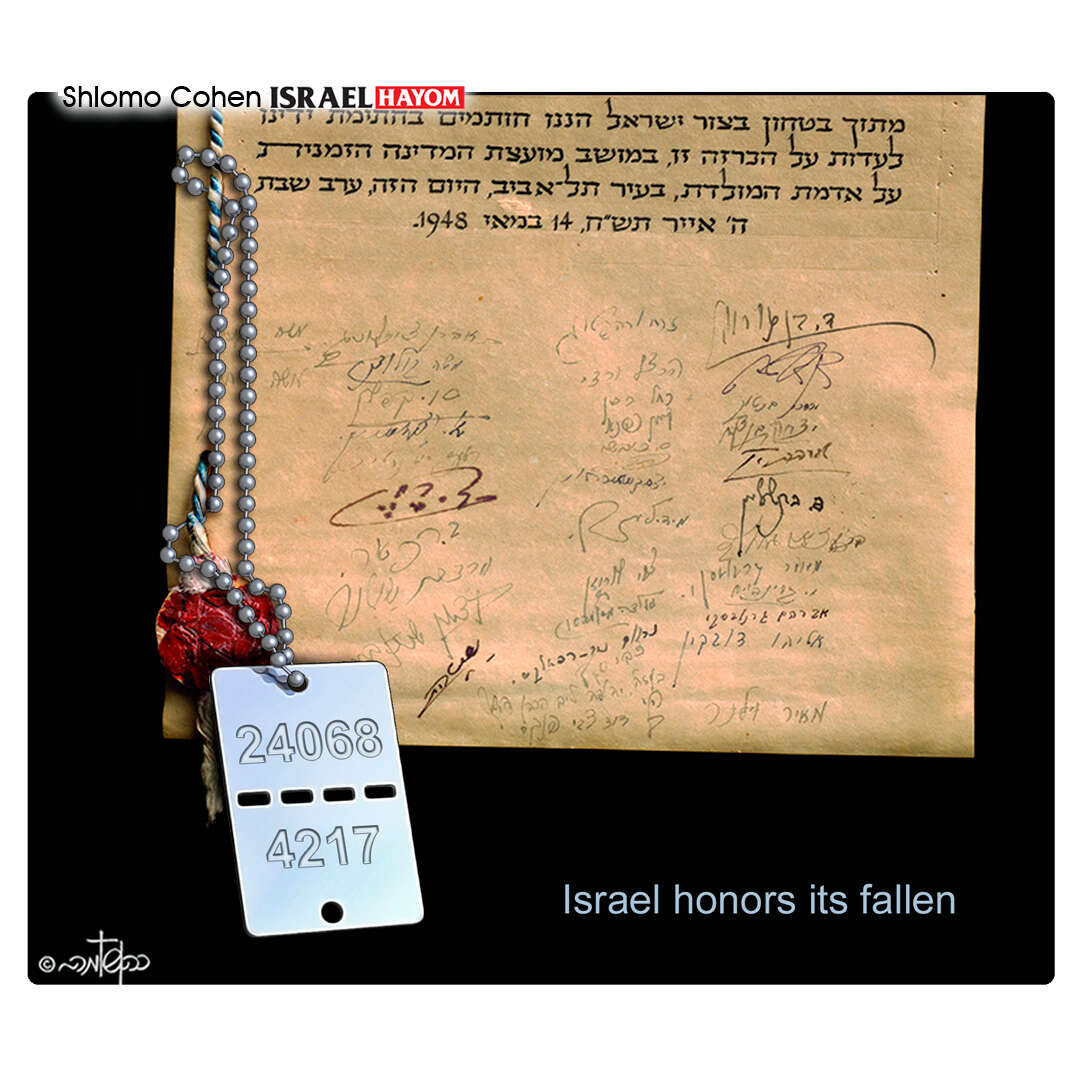
‘Arguments fall silent in cemeteries’: Herzog calls for unity at Memorial Day speech
Israel on Tuesday evening mourned the country’s fallen soldiers and terror victims as sirens sounded nationwide at 8 p.m. to mark the start of Memorial DayRemembering Israel's fallen: Hero after hero
The sirens brought Israel to a halt for a full minute, as people stood in somber silence on the streets, inside homes and on balconies. Traffic too came to an abrupt halt, as vehicle occupants exited their vehicles to stand beside them.
The day’s official opening ceremony was held at the Western Wall in Jerusalem’s Old City, with President Isaac Herzog giving an address in which he urged Israelis to continue developing the country in a spirit of unity.
“Our sons and daughters, who fell in defense of our state, fought together and fell together. They did not ask, nor did anyone ask them, who was right-wing and who was left-wing. Who was religious. Who was secular. Who was Jewish and who was not Jewish,” he said.
“They fell as Israelis, defending Israel. In cemeteries, arguments fall silent. Between the headstones, not a sound. A silence that demands that we fulfill, together, their single dying wish: the resurrection of Israel. The building of Israel. United, consolidated, responsible for each other. For we are all sisters and brothers,”
Herzog acknowledged a recent series of terror attacks that have left 16 people dead, bringing violence and death to city streets.
“Even today, our enemies rise up against us with hateful terror, and as always they find us ready and determined, with one hand holding a weapon and the other extended in dialogue and peace,” he said.
“It is precisely in these heart-breaking moments, escorting our heroes and heroines on their final journeys, together with their beloved families, whose pain instantly becomes our own — precisely in these moments, we discover the sheer power of our wonderful and marvelous nation, a nation that knows how to overcome any obstacle.”
Herzog called on the bereaved to not forget the continued goal of building the State of Israel and urged future generations to persevere in the duty of building a cohesive nation.
“This is our duty to the fallen, our duty to you, and our duty to future generations: to sustain a strong and prosperous Jewish and democratic state, a state built of a dazzling mosaic of communities,” he said.
Growing up in America, I never experienced a personal connection to any soldier killed in Vietnam, didn’t know anyone who fell in action, didn’t even know anyone who did, as does every Israeli who grows up here. But after living in Israel for 30 years and experiencing too many wars and military actions, the stories of the soldiers who fell in those operations have become personal. And they are everywhere.Israel to usher in Memorial Day for soldiers, terror victims with 8 p.m. siren
Last week I went to Mount Herzl for the memorial service of Shmuel Weiss, the 20th anniversary of his death in combat during Operation Defensive Shield.
The deadliest battle of that operation took place April 9, 2002, in a refugee camp in Jenin. An IDF reservist force that entered the narrow streets and alleys was hit by explosives, and the soldiers sent in to extract the wounded met an ambush with heavy crossfire. Thirteen soldiers died.
Some call it the hardest day of the war. For Zipporah and Arye Weiss, the hardest day was the day before. Their 19-year-old son, Shmuel, was also in Jenin, serving as a medic with the Third Platoon, 51st Battalion, of the Golani Brigade. When platoon-mate Matanya Robinson got hit in an ambush in the refugee camp, Shmuel rushed to attend his wounds. Shmuel got hit. Robinson and Weiss both died.
Shmuel Weiss is not a famous soldier, except to his family, their friends, the soldiers with whom he served, and the soldiers who currently serve in that same platoon who come to the yahrzeit service every year. To all of them, he is their hero.
He’s mine, too. Shmuel Weiss became my hero because his father has been a close friend for 55 years, since we were classmates in high school in Skokie, Illinois. I had known Shmuel since I made aliyah, when he was nine. His death was personal.
Weiss is buried in Area D, Section Six, a plot of land no different than in any of the country’s 52 military cemeteries: row after row of hero after hero.
Over the years, when I would go to Shmuel's yahrzeit ceremony, I started looking around at the other plots surrounding where he is buried, and discovered that I knew more soldiers.
Israelis will bow their heads at 8 p.m. Tuesday for a minute of silence as sirens sound throughout the country in remembrance of the country’s fallen soldiers and terror victims.
Fifty-six soldiers died during their military service since Israel’s last Memorial Day. Another 84 disabled veterans died due to complications from injuries sustained during their service.
The numbers brought the total of those who have died during service to the country since 1860 to 24,068.
The nationwide ceremonies for Israel’s Memorial Day, which begins at sundown, started in the afternoon with a commemoration event at the Yad Lebanim memorial for fallen soldiers in Jerusalem.
Prime Minister Naftali Bennett and Knesset Speaker Mickey Levy took part in the ceremony, as well as top army brass and families of fallen soldiers.
In his speech, Bennett recalled his time serving as a commando in southern Lebanon during the 1990s and mentioned several soldiers he knew who were killed while fighting there.
“We were there in Lebanon, all of us together. Kibbutzniks and city kids, secular and religious, from Beersheba and Haifa, right-wing and left-wing, Jews with non-Jews,” he said in an appeal for unity, as his disparate coalition fights to stay afloat after losing its parliamentary majority last month.
“There, in the bases of southern Lebanon, I fell in love with our wonderful nation,” the premier continued. “Many friends remain there… They were 19 or 20 years old and didn’t return.
“I can’t speak in their name, but I believe if they could, they would ask of us: Keep living together. Don’t allow disagreements to tear you apart from within.”
He warned that internal divides could threaten Israel’s security, saying: “If we allow anger and hatred to grip us, our enemies will take advantage of this to harm us.”