Wednesday, May 13, 2026

From Ian:

Dr. Yuval Steinitz: Technological Superiority Led to Israeli Victory in Iran War
Dr. Yuval Steinitz, chairman of Rafael Advanced Defense Systems, told a Jerusalem Center for Security and Foreign Affairs briefing on Monday that "40,000 rockets and missiles were launched at Israel from Lebanon and Gaza alone. Iron Dome intercepted the overwhelming majority of them with a success rate close to 99%."

Without Iron Dome, Israel's major cities would have faced massive civilian casualties, economic paralysis, and severe disruption to daily life and military operations. "There is no parallel technology in the world," Steinitz said, describing Iron Dome as the only system capable of intercepting short- and medium-range rockets, mortar shells, and artillery fire at this scale.

Steinitz described the phases of Israel's Iran campaign, beginning with the elimination of senior Iranian military leadership. Nearly 40 top commanders from the Revolutionary Guards and the regular Iranian army were killed "in less than 10 seconds." "The speed was critical. If it had taken 10 minutes instead of 10 seconds, commanders would have escaped to bunkers and the achievement would have been impossible."

The second phase focused on achieving air superiority over Iran within 36 hours, allowing the Israeli Air Force to operate freely against nuclear and missile infrastructure while defending Israel against ballistic missile attacks.

"For the first time in history, two countries fought each other directly from distances of 1,000 to 3,000 km....The main factor was scientific and technological superiority," he said, noting that while Iran rapidly adapted and improved its systems during the war, "we ran even faster, and the end result is very clear....I don't know a better example of a crystal-clear victory in the modern world than the war between Israel and Iran....The regime was dramatically weakened."

Regarding the impact of strikes against Iran's nuclear program, Steinitz said: "We destroyed most of the enrichment sites and almost all of the weaponization infrastructure." While Iran still possesses enriched uranium stockpiles and the scientific knowledge to enrich further, key components of the nuclear weapons program were severely damaged, including testing facilities, conversion infrastructure, and personnel involved in weaponization.

In his assessment, before the war Iran could have reached a nuclear weapon within months. "Now, it will take them between two to four years to rebuild everything and produce a real nuclear weapon."
Jason Greenblatt: The Gulf Countries Are Building a Middle East that Iran Cannot Tolerate
For decades, Iran's leadership has opposed the direction much of the Gulf has taken politically, economically and diplomatically. Today, that opposition is increasingly being expressed through direct attacks on the states' infrastructure and way of life. Since Feb. 28, the Iranian regime has launched 549 ballistic missiles, 29 cruise missiles and 2,260 drones at the UAE.

The Iranian regime presents its model as the only legitimate form of Islamic governance. Yet, Gulf states have demonstrated that economic growth, global engagement, and religious life can develop together without the same degree of state control.

The UAE also made a decision to establish formal relations with Israel, altering a long-standing regional dynamic and showing that countries in the Middle East can pursue different paths, grounded in national interest and the pursuit of long-term stability and prosperity. It also introduced a precedent that runs directly against Iran's effort to organize the region around confrontation and war.

Iran's conflict with the Gulf extends beyond military confrontation. The UAE stands in direct opposition to Iran's broader ambitions. A country that represents economic openness, stability and independent decision-making challenges the narrative that the Iranian regime promotes about how the Middle East must function. What Iran is trying to damage has not broken under sustained attack, and I do not believe it ever will.
Trump says stopping Iran's nuclear program outweighs Americans' economic pain
US President Donald Trump said on Tuesday that Americans’ financial struggles are not a factor in his decision-making as he seeks to negotiate an end to the Iran war, saying that preventing Tehran from acquiring a nuclear weapon is his top priority.

Asked by a reporter to what extent Americans’ financial situations were motivating him to strike a deal, Trump said: “Not even a little bit.”

"The only thing that matters, when I’m talking about Iran, they can’t have a nuclear weapon," Trump said before departing the White House for a trip to China. "I don’t think about Americans’ financial situation. I don’t think about anybody. I think about one thing: We cannot let Iran have a nuclear weapon. That’s all. That's the only thing that motivates me."

Trump's remarks are likely to draw scrutiny from critics who argue the administration should balance geopolitical objectives with the economic impact on Americans, particularly as cost-of-living concerns remain a top issue for voters ahead of the November midterm elections.

Asked to elaborate on the president's comments, White House Communications Director Steven Cheung said that Trump's "ultimate responsibility is the safety and security of Americans. Iran cannot have a nuclear weapon, and if action wasn’t taken, they’d have one, which threatens all Americans."

Trump is under growing pressure from fellow Republicans who fear economic pain caused by the war could spark a backlash against the party and cost it control of the House of Representatives and possibly the Senate in November.
From Ian:

Seth Mandel: The End of Our Illusions
We try to avoid imagining that our ideological opponents are morally inferior. But it can be just as dangerous to convince ourselves that our declared antagonists want the same things we want and hold to values that approximate our own.

That is part of the reason for the pained reaction to Nick Kristof’s opinion column yesterday, in which he claimed (without evidence, obviously) that Israel has instituted a state policy of militaristized bestiality.

Today, a meticulous, harrowing report was released on Hamas’s systematic rape and sexual violence toward Israelis on and after October 7. The commission that undertook this investigation “has examined over 10,000 photographs and videos of the attack totaling more than 1,800 hours of visual analysis.”

We want to believe that Nick Kristof and all the people who defended and shared his article are just like us—believers in honesty, men and women of integrity, a community of truth-seekers with a baseline sense of human decency. We want to believe this in part because of that very sense of human decency.

But we are making a massive error. Kristof’s named sources not only provided no evidence for his lurid bestiality fantasies but themselves were also people with massive credibility deficits.

Conversely, the documentation of sexual violence by Palestinians who invaded Israel on October 7, 2023—the total number of infiltrators was several thousand that day—took years, even though we all watched videos of Palestinians dragging the unclothed bodies of Israeli women through the streets of Gaza, and even though Hamas documented many of their crimes, and even though Hamas members admitted to raping women that day. All of that is what is known as evidence—apologies to Kristof and his readers for using such technical, obscure SAT words—and evidence needs to be compiled, examined, analyzed, and used as the jumping-off point for additional investigation.

That is what Israeli officials did, and that is what those who support the Jewish state’s existence did, and what they called for others to do, because that is what is done when the goal is to obtain the truth. To the anti-Zionist collective, the truth is to be avoided like the plague, and therefore what is rewarded is not evidence but creativity and imagination.

And that is what was on display in the New York Times. We want Kristof and his defenders to be like us. But they are not like us—and they punish us for our good faith.
Israel Is the Weapon By Abe Greenwald
Via Commentary Newsletter, sign up here.
There’s increasing overlap between the left and right dupes on all these issues. The point is that anti-Semites merely used Israel to turn them into their anti-Jewish foot soldiers. They’ve been recruited to dehumanize Jews online, disrupt Jewish events, and attack Jews around the world. Not Israel—Jews.

Because the aim of the information war is not merely to turn public opinion against Israel—although it’s certainly done that. The idea is to alchemize anti-Zionism into kinetic Jew-hatred in the real world, to instigate a war against the Jews of the Diaspora parallel to the one that Hamas launched against the Jews of Israel.

Many American Jews say that Israel should do a better job fighting the information war—without understanding that war was declared against them. Israel has done an astounding job of fighting its war. We are the ones who’ve been under attack from anti-Israel propaganda this whole time.

We still are, and it’s getting ever worse. No longer do the propagandists bother to sprinkle meager crumbs of credibility over their work. There’s no incentive for them to cover their tracks and every incentive to prevaricate. Photographs of the Gaza famine that never happened earn Pulitzer Prizes. The New York Times now publishes horror stories about Israel that are not only impossible to verify but impossible period—literally impossible. When Nicolas Kristof writes a story about IDF-trained rape-dogs, he’s sending the mob after all of us—including those liberal American Jews who then denounce Israel. What they don’t realize is that accusing Jews of committing impossible crimes is the oldest, most primitive category of anti-Semitic propaganda. It takes us out of the realm of the human, no matter where we are on this planet.

It would be hard for a famous journalist simply to assert that Jews, as a people, have dark powers that defy the laws of nature. But when Israel is your weapon, you never hold your fire.
Honest Reporting: Why They Deny The Crimes of October 7
When Jewish Suffering Becomes Inconvenient
For many people invested in a worldview in which Israel represents absolute evil and Palestinians represent absolute victimhood, acknowledging the sexual crimes of October 7 creates tension. Jewish women cannot be permitted to exist as victims because their reality complicates the narrative. Israeli suffering becomes ideologically intolerable. And so it must be doubted, obscured, minimized, or erased altogether. This is why so much October 7 denialism focuses specifically on the sexual crimes.

Sexual violence carries a specific moral weight in contemporary society. To acknowledge that Hamas terrorists and their collaborators committed widespread and systematic acts of rape, mutilation, and sexual torture would require many activists to confront a reality: that individuals and movements they have celebrated, romanticized, excused, or sanitized committed acts of extraordinary brutality.

We should also recognize the profoundly anti-Jewish nature of this phenomenon. Jews are uniquely subjected to suspicion toward their suffering in ways that have become normalized across political and cultural life. The distrust of Jewish testimony has become so deeply embedded that many people no longer even recognize it as prejudice.

The Crime Continued Through Erasure
The tragedy is not only the crimes themselves, but what their denial reveals about the world Jews inhabit. After the Holocaust, many believed humanity had learned something: that there existed a moral obligation to listen to victims, document atrocities honestly, and ensure genocidal violence could never again be erased through propaganda and denial. Yet within hours of October 7, that promise began collapsing in real time.

The lesson of Holocaust denial should have taught us that evidence alone is never enough against ideologically motivated hatred. There will never be enough footage, enough testimony, enough witnesses, enough forensic evidence, or enough reports for those who have already decided that Jewish suffering does not count.

That is the real connection between Holocaust denial and the denial of October 7. Both ultimately rest upon the same underlying premise: that Jews are uniquely unworthy of belief, uniquely suspect in their suffering, and uniquely undeserving of moral sympathy.

Ultimately, when these crimes are denied, minimized, relativized, or erased, the victims are violated a second time. The murdered are stripped not only of their lives, but of the truth of what was done to them. The raped are stripped not only of bodily autonomy, but of the dignity of having their suffering acknowledged. Denial is never neutral. It is the continuation of the crime through erasure.

That is why speaking clearly about October 7, including the systematic sexual crimes perpetrated against women and girls, matters so profoundly. We cannot bring back those who were murdered. We cannot undo the horrors inflicted upon the victims. But we can refuse to abandon them to silence, distortion, and denial. We can bear witness. We can speak plainly. And we can ensure that those who suffered are not erased by a world that too often finds Jewish suffering uniquely difficult to acknowledge.

Tuesday, May 12, 2026

  • Tuesday, May 12, 2026
  • Elder of Ziyon

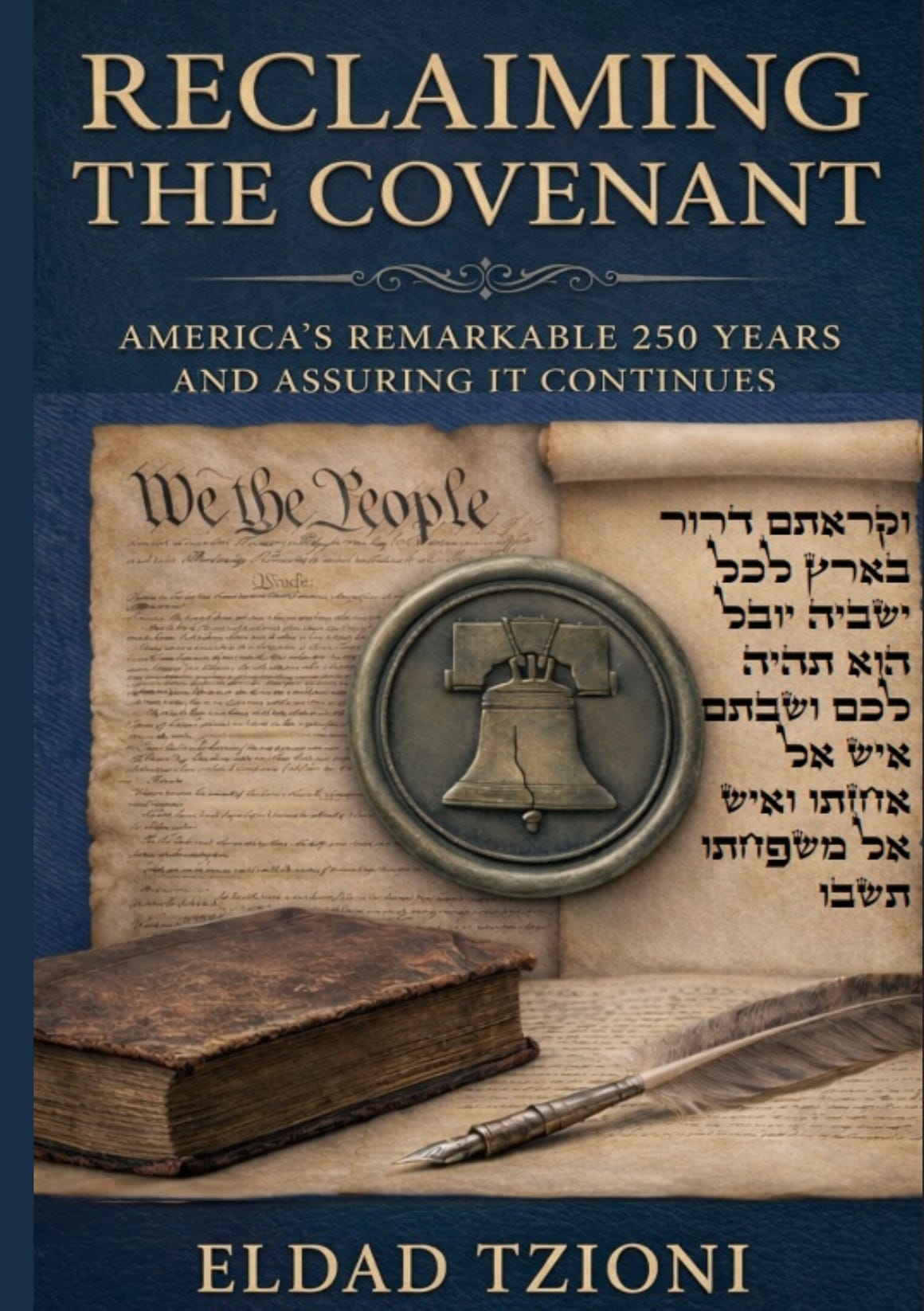
This is an excerpt from Part 8 of my new book, Reclaiming the Covenant. you can buy the print version now on Amazon..)

The covenant has survived 250 years. It has survived a civil war that killed 620,000 Americans, a Great Depression, two world wars, the assassination of presidents, the betrayals of Watergate, and the trauma of September 11. In each case the threat came, the covenant held, and the republic continued. This record is genuinely remarkable and should not be minimized.

Survival is not the same as health. A body can survive repeated illness while accumulating damage that makes the next illness more dangerous. The covenant’s current threats are not external — no foreign adversary can destroy it, though many would like to — they are internal, and they are particularly insidious because they operate in the covenant’s own language. The republic is not being attacked by people who hate America. It is being eroded by people who are certain they love it.


Part 4 established the covenant’s dignity foundation — the floor, grounded in the Declaration and operationalized in the Fifth, Fourteenth, and Eighth Amendments, from which every right derives and against which every political act must be measured. The question that floor poses is not: does this help my side? It is: does this treat every person as a being with inherent dignity the covenant requires me to respect? Five distinct threats are currently answering that question wrongly, and they are doing so from multiple directions simultaneously.

The first two were developed at length in Part 5. Faux patriotism — tribal loyalty dressed in covenant language — defines membership by identity rather than covenant acceptance, failing Washington’s Newport test immediately and denying dignity to every American it categorizes as insufficiently authentic. Its mirror image — the use of legitimate grievances to declare the covenant itself fraudulent — is self-defeating for the reason we identified: every powerful argument for justice in American history has derived its authority from holding the covenant to its own terms, not from rejecting them. Both are covenant-exit positions. Both produce the same outcome: Americans who feel no obligation to Americans they have categorized as opponents.

Single-issue tunnel vision is the most widespread and the least recognized as a covenant problem. It takes one genuine covenant failure — racism is the most prominent current example, though the structure applies to any single axis — and makes it the interpretive lens through which every institution, every historical figure, every policy question must be evaluated. The problem is that a single-axis lens cannot hold multiple values in tension simultaneously — the equality principle coexisting with the free speech guarantee, with reserved powers, with property protections — and the genuine tensions among them can only be navigated through mature reasoning. Single-issue tunnel vision substitutes predetermined conclusions for that reasoning. It is, in the precise sense Part 4 established, a failure of corrigibility: the refusal to remain open to being wrong.

The fourth threat is covenant language capture — the systematic redefinition of the covenant’s vocabulary to serve factional interests. Part 4 developed the rights taxonomy in full: the distinction between genuine rights (constitutive commitments the covenant cannot revoke without ceasing to be itself), entitlements (real policy commitments above the rights floor, restructurable through legitimate argument), and faux rights (policy preferences dressed in covenantal language). The inflation of “rights” to include contested policy goods does two things simultaneously: it acquires the moral force of covenantal language for positions that have not earned it, and it strips the term of the precision that protects genuine rights. Rights inflation forecloses the democratic argument the covenant’s framework requires, because you cannot argue democratically against what has been declared a right. That foreclosure is the attack — conducted almost always by people who believe they are defending the covenant rather than eroding it. The same dynamic applies when “freedom,” “equality,” “democracy,” and “patriotism” are redefined to mean agreement with my tribe’s positions rather than the covenant’s terms.

The fifth threat is practiced by people who understand perfectly well that it is wrong and do it anyway: the systematic exploitation of majority power to entrench dominance against the covenant’s explicit design. The constitutional grounding for majority restraint is not ambiguous — the Bill of Rights constrains majorities, the Senate equalizes state representation, the amendment supermajority requirement prevents passionate simple majorities from foreclosing future consensus, judicial review and the presidential veto check legislative dominance. Madison in Federalist No. 10 was explicit: the founders did not trust majorities. The entire architecture is designed to force consensus rather than permit domination.

Gerrymandering is one example. There are plenty of others — pressuring lawmakers to vote with their party and against their consciences in order to get legislation passed turns Congress into a collection of robots instead of thinkers and representatives. When the value of staying in power overrides moral values, the system is in danger. All of this is technically legal, but Jefferson and Madison would have recognized it immediately as the thing they were most afraid of.

Running beneath all five threats is the distinction Part 4 named and Part 5 illustrated through the civil rights movement: the difference between positions that disagree within the framework and positions that attack the framework itself. The test is always procedural. Any political philosophy that pursues its goals through argument, accepts democratic outcomes including losses, maintains the dignity of opponents, and remains open to being wrong is a legitimate participant in the covenant’s framework — however radical its substantive positions. What the framework cannot accommodate is the methodology that rejects these conditions: that claims the right to override democratic outcomes, suppress opposing argument, dehumanize opponents, or treat the covenant’s mechanisms as obstacles to destroy when they produce unwelcome results. The content of the ideology is irrelevant to this judgment. A revolutionary vanguard that suppresses dissent to achieve economic justice and an authoritarian movement that bypasses elections to restore cultural order are committing the same structural violation, from opposite directions, for opposite reasons. Citizens who have internalized this distinction can do what the current environment makes nearly impossible: take seriously the difference between opponents whose positions they find dangerously wrong and opponents whose conduct attacks the preconditions for having the argument at all.


Understanding the threats is the easier part. The harder question is why the covenant is losing ground to them now, in ways it has not before — why national pride is collapsing, why the sense of shared American identity is fracturing, and where the fracture lines actually run.


Buy EoZ's books  on Amazon!

Reclaiming the Covenant on America's 250th (May 2026)

"He's an Anti-Zionist Too!" cartoon book (December 2024)

PROTOCOLS: Exposing Modern Antisemitism (February 2022)


  • Tuesday, May 12, 2026
  • Elder of Ziyon
It is refreshing to see someone with principles.

From WESA (Pittsburgh):

Pennsylvania state Supreme Court Justice David Wecht, who was reelected to a second 10-year term as a Democrat last fall, says he has left the party, in which he says “hateful anti-Jewish invective and actions are minimized, ignored, and even coddled.”

“Acquiescence to Jew-hatred is now disturbingly common among activists, leaders and even many elected officials in the Democratic Party,” said Wecht in a statement distributed from a state court system email account Monday afternoon.

“I can no longer abide” the tide of rising antisemitism, he said. “So, I won’t. I am no longer registered within any political party.”
America's political system needs a third party that condemns the extremes of both major parties and makes its stand on issues based on morality rather than partisanship. and power.

What would such a party's platform look like? Glad you asked! This is the kind of thing I've been thinking about. 

The Covenantal Party: A Platform

A society survives not through laws and incentives alone, but through morally trustworthy relationships between citizens, institutions, and truth itself. That is the center of gravity of this platform.

Rights protect individuals. Obligations sustain civilization.

Citizens owe duties — to family, to community, to truth, to future generations, to institutions, and to the nation itself. A political movement that speaks only of rights while ignoring obligations has already conceded the ground on which free societies stand. The deepest unit of civilization is the relationship, not the individual and not the state — and a platform that ignores that has misread what it is trying to protect.

Human dignity is non-negotiable.

Anti-dehumanization norms, criminal justice reform oriented toward rehabilitation where possible, strong disability protections, anti-corruption laws, and ethical AI governance all follow from the same root: people are not reducible to demographics or economic units. The party rejects cruelty as entertainment, ideological purges, mob humiliation culture, and any system that strips individuals of their irreducible worth. Dignity is not a progressive talking point or a conservative tradition — it is the precondition for everything else.

Truth and moral transparency are civilizational commitments.

Institutions collapse when they lose moral credibility, and the process of losing it is usually invisible until it isn't. The platform makes transparency a defining issue: radical government transparency, independent institutional audits, anti-propaganda standards, strong whistleblower protections, mandatory disclosure of political funding sources, and public reasoning requirements for major administrative decisions.

That transparency mandate extends fully into the technology sector. Social media platforms, search engines, and content recommendation systems exercise extraordinary influence over what citizens see, believe, and feel — and they exercise it invisibly. Algorithm disclosure requirements, public audits of content amplification systems, and anti-manipulation regulations apply across all major platforms, not just AI systems. Users have a right to know how their information environment is being shaped, and platforms that profit from manipulating attention bear a corresponding obligation to account for how they do it. Institutional opacity is a civilization-level threat whether the institution is a government agency or a technology company.

Fair elections require fair maps.

Gerrymandering is legalized political corruption — the manipulation of district boundaries to predetermine election outcomes regardless of voter preference. The platform supports algorithm-defined redistricting, drawing district lines through transparent, auditable computational processes optimized for compactness, contiguity, and equal population — with no partisan data as input. Independent oversight commissions verify the output. The legitimacy of representative democracy depends on voters choosing their representatives, not representatives choosing their voters.

Family stability is infrastructure.

The party treats family stability as seriously as highway maintenance or grid reliability — because it is. Policies include pro-family tax reform, meaningful child tax credits, parental leave, housing affordability initiatives, marriage counseling incentives, and community-based childcare. Unlike some traditionalist movements, the framework avoids punitive moralism; it orients toward repair, aspiration, and reintegration rather than permanent exile. Strong families are not a culture-war decoration — they are the load-bearing structure of social cohesion.

Relationships are the foundation of the civic order.

Responsibility for other citizens begins at home and radiates outward — to neighbors, to community institutions, to the nation, to future generations. This platform centers relationships rather than transactions. The neighbor you check on during a storm, the community organization you give three hours a week to, the civic association that maintains the park, the volunteer fire department — these are not quaint remnants of an earlier era. They are the connective tissue without which no law, no policy, and no government program can substitute. Volunteerism and civic participation are not lifestyle choices; they are the active expression of what citizenship means. A platform serious about civilization will treat the cultivation of civic participation as a policy goal in its own right — supporting volunteer infrastructure, incentivizing community service, and measuring social capital alongside economic indicators.

Pluralism with principles.

A covenantal society is not a monoculture. It holds together diverse communities — religious and secular, traditional and progressive, urban and rural — under a shared framework of basic obligations rather than a shared set of cultural preferences. Any community that adheres to those basic principles — human dignity, rule of law, non-coercion of members, civic participation — has wide latitude to organize its own internal life according to its own values. Orthodox communities, secular humanist communities, religious minorities, immigrant communities maintaining distinct cultural identities: all of them belong within the covenant as long as they honor the floor that makes coexistence possible. The framework does not demand uniformity; it demands accountability to shared minimum standards. Pluralism without that floor is not tolerance — it is the gradual dissolution of the common ground on which all communities stand.

Markets are tools, not moral authorities.

The economic framework is market-friendly, anti-oligarchic, anti-extractive, and committed to the dignity of labor. Policies include regulated capitalism, vigorous anti-monopoly enforcement, worker ownership incentives, vocational education, industrial policy for strategic resilience, discouragement of predatory finance, and strong social safety nets tied to reintegration and contribution. The party rejects both libertarian hyper-individualism and centralized technocratic socialism — the economy should serve human dignity, and when it stops doing that, the framework for correcting it must already exist.

National cohesion without ethnonationalism.

The platform strongly emphasizes national preservation, sovereignty, and cultural continuity while rejecting racial nationalism, supremacism, and xenophobic politics. Policies include strong border enforcement, civic integration into constitutional and covenantal norms, controlled immigration, national service programs, and the construction of a shared civic identity. Obligations to citizens come first; strangers are still treated ethically. A nation is a covenant with its own people — that priority is not a moral failure, it is a moral structure.

Peace through strength.

Foreign policy is restrained realism: seek peace first, maintain overwhelming defensive capability, avoid humiliation politics in diplomacy, reject utopian interventionism, and refuse to appease violent actors. The platform is skeptical of ideological empire-building in both its neoconservative and progressive humanitarian forms. Deterrence works; naïveté kills.

Ethical technology and AI governance.

The same values driving the transparency agenda — dignity, accountability, corrigibility — apply directly to AI governance. The party advocates AI transparency standards, explainability requirements, human accountability for automated decisions, protections against algorithmic social fragmentation, digital privacy rights, and limits on surveillance capitalism. The technology sector does not get a separate moral framework just because its tools are new.

Education for moral formation and civic responsibility.

The platform rejects value-neutrality in education as the illusion it is. A democracy that produces technically skilled but morally unformed citizens has not educated its people — it has processed them. Policies include robust civics as a core graduation requirement at every level, ethical reasoning, media literacy, dialogue skills, history taught with genuine complexity, anti-fragility education, and vocational dignity.

Civics education in particular is treated as nation-building infrastructure. Students learn how government works, how to evaluate evidence and argument, how civic institutions depend on citizen participation, and what obligations come with the rights they inherit. The goal is not the production of any particular political viewpoint — it is the production of citizens capable of self-governance, which is something distinct from, and more demanding than, the ability to cast a ballot.

Environmental stewardship without apocalypticism.

Conservation, sustainable energy, long-term stewardship, anti-waste culture, and genuine ecological responsibility — all grounded in the obligation to future generations rather than in anti-human ideology. The platform rejects degrowth ideology and civilizational self-hatred alongside environmental recklessness. Stewardship means caring for something you intend to pass on — that is a conservative impulse, a progressive commitment, and a human obligation simultaneously.

What makes this different.

Unlike progressivism, this platform is less utopian, more obligation-centered, more institutionally skeptical, more committed to family and national cohesion, and less identity-essentialist. Unlike conservatism, it is less market-fundamentalist, more communitarian, more committed to robust social safety nets, and more explicitly moral-structural in its reasoning. Unlike libertarianism, it rejects radical atomized individualism as a social philosophy. Unlike populism, it is suspicious of demagoguery and moral simplification — which means it will never be the easiest platform to sell, but it may be the most honest one.

The platform in three words: Rights require responsibility. 

And civilization requires the willingness to say so.


Buy EoZ's books  on Amazon!

"He's an Anti-Zionist Too!" cartoon book (December 2024)

PROTOCOLS: Exposing Modern Antisemitism (February 2022)


From Ian:

John Podhoretz: Abe Foxman, 1940-2026
The “Jews who care” were the ones Abe Foxman, the most important and probably the most beloved American Jewish communal leader of his day, spoke for. He knew the difference between the Jews who care and others in his kishkes, based on his own extraordinary life story of the century. Born to Polish Jews in Belarus, his parents left him as a baby in the care of his nanny while they were sent to a ghetto.

He was given a false name and baptized as a Catholic. Miraculously, his mother escaped, returned to Vilnius, and herself posed as a local Catholic so she could provide money for Abe’s care. Then his father was liberated and came back after the war—at which point the nanny would not give him up, believing that she had saved his soul through his baptism and that he should remain in her care as a Catholic. Custody battles ensued, which the Foxmans finally won before making it to America in 1950. Abe was 10. He went to City College and then got a law degree before beginning to work as a Jewish activist. Abe made reference in many speeches to “the day I took off the cross.” And yet he and his parents remained grateful to the nanny and helped her until her passing. As they remained grateful to be Jews, in spite of having been targeted for death for being so. They raised Abe Orthodox, sent him to yeshiva, and while he attained a law degree and could have assimilated into the larger American melting pot to put the trauma of his first 10 years behind him, an Orthodox Jew he remained until his passing on Sunday at the age of 86.

The point here is that he saw his mission and obligation in the defense of Jews against the scourge of anti-Semitism. If that anti-Semitism came from the right, he attacked it. If it came from the left, he attacked it. If it came from white people, he attacked it. If it came from black people, he attacked it. If it was hidden inside anti-Zionism, he attacked it. If it was hidden in conversations about rapacious capitalists, he attacked it. He was utterly consistent. His mission was his mission and he pursued it unfailingly.

Which is why, in one of the more shameful moments in communal Jewish organizational history, he was coup’ed out of the ADL—simply because he wasn’t helpful enough to the cause of Jewish liberalism. His replacement, Jonathan Greenblatt, spent years muddying the institution’s mission and letting leftists off the hook by prioritizing liberal apologia until October 7 woke even Greenblatt up to the undeniable fact that the predominant threat is from the left. Had Abe been there, the clarity would not have been that hard to achieve.
I’m a Democrat. My Party Has a Double Standard on Antisemitism.
In 2017, Democratic leaders denounced the white supremacists who marched in Charlottesville chanting “Jews will not replace us.” In 2022, Democrats took Donald Trump to task for having dinner with Nick Fuentes, an antisemite and a white supremacist. Across the Democratic Party’s ideological spectrum, right-wing hate is consistently condemned.

But today, too many Democrats are noticeably and shamefully silent when antisemitism comes from the far left — at a moment when the Anti-Defamation League is reporting a surge of antisemitic incidents in the past three years.

It’s a glaring double standard.

Consider the response to — really, the embrace of — Hasan Piker, a prominent left-wing commentator with millions of online followers. He referred to Orthodox Jews as “inbred” and said “America deserved 9/11,” both statements he halfheartedly walked back. He said that Hamas — a designated terrorist organization that has killed Americans and taken Americans hostage — is “a thousand times better” than Israel, America’s ally, which he called a “fascist settler colonial apartheid state” — a statement he stands by. None of this should be waved away as mere edgy commentary. Mr. Piker traffics in antisemitic and anti-American extremism that has been met by silence from many on the Democratic left.

Sadly, we’ve seen several prominent Democrats appear on his show and even campaign with him, granting his views legitimacy.

I’ve spoken to congressional colleagues who have privately told me that many things Mr. Piker has said are disgusting. Yet they’ll say nothing about it in public, even as they rightly rush to condemn President Trump for his unending barrage of offensive comments and social media posts. I understand that speaking up isn’t easy — if you do, there are many on the left who will heckle you in public and troll you online. But whether we’re elected officials, candidates, organizers or activists, we should remember that our constituents don’t expect us to take the easy path. It takes far more courage to stand up to those who have long claimed to be in your corner than to oppose your political opponents. That’s what principled leadership is all about. But we’re not always seeing it.

At their recent party convention, Michigan Democrats nominated a candidate to run for a seat on the University of Michigan’s Board of Regents who had shared a social media post praising the former leader of Hezbollah as a martyr and another post that invoked age-old antisemitic tropes by referring to Israelis as “demons” who “lie, steal, cheat, murder and blackmail.”

Last month, most Senate Democrats voted for two measures that would have blocked sales of military equipment to Israel, with some arguing that among the reasons for their votes was their assessment of Israel’s human rights record. Is this turnabout a legitimate departure from decades of American foreign policy? Or — more likely — is it a politically convenient stance that coincides with a small but vocal and growing segment of the political left making opposition to support for Israel a new litmus test?
Seth Mandel: Journalism Succumbs To Its Wounds
The famous saying attributed to Jean-Paul Sartre holds that “the anti-Semite doesn’t accuse the Jew of stealing because he actually believes he stole. He accuses the Jew of stealing because he enjoys watching the Jew empty his pockets to prove his innocence.”

That is no doubt as true today as ever, regardless of the quote’s origins. And it immediately comes to mind when watching, in real time, the evolution in the latest in a long line of accusations about the nefarious trained militarism of Zionist animals. Whereas many of these rumors—my favorite being the griffin vulture that Arab governments claimed had been trained as a Mossad spy—had an air of levity about them, the new one most certainly does not. And that is the idea that Zionist dogs are trained to rape Arabs.

The anti-Zionist activists who started or popularized the rumors have made clear that there is no evidence in their favor. That didn’t stop the sick-minded anti-Israel protesters from adopting the talking point, as demonstrators did in London. From there, however, it has moved to the pages of the New York Times, where Nicholas Kristof repeats it.

I watched other sensational “reports” of Israeli perfidy circulate among people who treated them as fact recently and thought about how the question of whether Western journalism will ever recover from its alliance with the machinery of Hamas propaganda appears to have been answered. No.

I saw a video of a woman wearing a “PRESS” vest in Southern Lebanon, (though her bio lists no affiliation) and proceed to read a list of talking points off of a card and then say “I just received a heartbreaking report”—please note the wording—of an Israeli drone following a girl riding a scooter and shooting at her until she was mortally wounded.

Usually the reporter reports. But when it comes to Israel, activists costumed as journalists “receive” reports and then continue the game of telephone. “Somebody told me” is not reporting, but you can report out what somebody told you. Reporters know the difference, or should.

Monday, May 11, 2026

From Ian:

David Collier: Dear BBC News – Just When Will You Stop Shilling For Terrorists?
The journalist behind this particular mess is Nawal Al-Maghafi. Her timeline is full of clear anti-Israel bias, non-factual commentary, Hamas propaganda presented as news, and retweets of Gaza-based activists whom no respectable journalist should be seen amplifying.

In this latest case, either she did not bother to dig for the truth of the Hezbollah affiliation at all, or chose to turn a blind eye to it.

Why is it that these Arabic journalists are given carte blanche to piggyback on the BBC’s name and spend money from the British licence fee promoting such a blatant anti-Israel agenda?

The truth is this: Hezbollah is a proscribed jihadist terror group that seeks to wipe Israel off the map. Funded, armed, and often directed by the Iranian regime, it has exported its violence to arenas such as the Syrian civil war. Hezbollah chose to attack Israel on 8 October 2023, and again at the start of the latest round of violence. Israel has no territorial dispute with Lebanon – and without Hezbollah’s religious fundamentalism in the south, there would be no conflict. All of Lebanon’s woes stem from the refusal of the Shia in the south to abandon their jihadist aims.

So why is there not a single BBC article that lays out this context clearly for its audience? Those who support Hezbollah – including this man’s own community – have brought devastation to both Lebanon and Israel.

Isn’t it about time that the BBC took away the pen from those journalists who clearly hate Israel and defunded its anti-Israel agenda? More importantly, when will the BBC stop shilling for terrorists?
Khaled Abu Toameh: Erdogan's Turkey: The NATO Member That Sponsors Terrorism
New revelations emerging from Israeli security investigations have shattered any illusion that Turkey's relationship with Hamas is limited to "political support" or "diplomatic engagement." The evidence increasingly points to a situation far more alarming: Turkey has become a primary operational, logistical, and financial hub for Hamas's global terror infrastructure.

Countries that enable terrorism cannot at the same time be treated as indispensable partners in the fight against terrorism.

By allowing Hamas members to develop drone capabilities on Turkish soil, Ankara is deliberately grooming terrorists for future wars against Israel.

Turkey, rather than simply hosting Hamas officials, is willfully cultivating the next generation of Hamas terrorists and making sure that the geographical reach of Iran's jihadist axis continues to expand.

Turkey's pivotal financial role is especially significant because it provides Hamas with access to the international financial system through the territory of a NATO member state. That reality should deeply alarm both Washington and European capitals.

Ideologically -- as well as militarily and financially -- Erdogan has openly embraced Hamas leaders. He has repeatedly refused to designate the group as a terrorist organization... and characterized its members as "resistance fighters" and "liberation group" warriors fighting to protect Palestinian lands.

Erdogan's alignment with Hamas seems rooted in his broader ideological affinity with the Muslim Brotherhood movement and other Islamist groups. His government has consistently supported radical Islamist groups in Egypt, Libya, Syria, and other countries.

For years, Western governments have clung to the fiction that countries such as Turkey and Qatar can serve as neutral mediators between Hamas and Israel. That assumption has always been deeply flawed.

Qatar, meanwhile, continues to try to undermine the United States by donating, over decades, many billions of dollars to influence education from K-12 through graduate schools throughout America. Cornell University has received $10 billion over the years; Carnegie Mellon "just under $2 billion"; Texas A&M University "over $1 billion" (which gave Qatar full ownership of more than 500 research projects in fields such as nuclear science, artificial intelligence, biotech, robotics and weapons development); and Georgetown University $971 million. Why do Qatar and Turkey continue embracing Hamas while demanding the trust of the US and the West? Why does the West keep accepting this duplicity?

The Trump administration faces a crucial test. If Washington is genuinely serious about dismantling the infrastructure of Hamas and confronting the Iranian regime, it cannot continue overlooking Turkey's commitment to doing the exact opposite: safeguarding and supporting Hamas.

A NATO member state, Turkey, is facilitating the activities of an Iranian-backed terrorist group responsible for the mass murder of civilians, including many Americans.
European sanctions on Israelis won’t succeed in pressuring Jewish state, Sa’ar says
Israeli Foreign Minister Gideon Sa’ar said on Monday that the European Union’s attempt to impose political views on Jerusalem through sanctions on Jews living in Judea and Samaria “is unacceptable and will not succeed.”

Israel “firmly rejects” the E.U. decision, describing it as “arbitrary” and “political,” Sa’ar said.

The Israeli official decried the “outrageous” comparison between Israeli citizens and Hamas terrorists. “This is a completely distorted moral equivalence,” he stated.

The E.U. foreign policy chief Kaja Kallas stated earlier that her organization “just gave the go-ahead to sanction Israeli settlers over violence against Palestinians.” She added that it had “also agreed new sanctions on leading Hamas figures.”

“It was high time we move from deadlock to delivery,” Kallas said. “Extremisms and violence carry consequences.”

“Israel has stood, stands and will continue to stand for the right of Jews to settle in the heart of our homeland,” Sa’ar responded. “No other people in the world has such a documented and longstanding right to its land as the Jewish people have to the Land of Israel.”

“This is a moral and historical right that has also been recognized by the law of nations, and no actor can take it away from the Jewish people,” he stated.

Earlier on Monday, Ireland’s national public service broadcaster reported that according to E.U. officials, “seven settlers or settler organizations” were set to be blacklisted, and that the bloc was also preparing sanctions against representatives of the Palestinian terrorist group Hamas.

Israel Gantz, head of the Binyamin Regional Council and chairman of the Yesha Council, also strongly condemned the E.U.’s decision to impose sanctions on organizations and residents in Judea and Samaria, calling it a “shameful decision” and “the height of hypocrisy and double standards.”

Placing sanctions on Israeli citizens in the same framework as measures against Hamas terrorists represents “an unprecedented moral low,” he said.

The E.U. is unfairly targeting Israelis who are “on the frontlines of the struggle against Palestinian Authority terrorism,” while ignoring the P.A.’s role in rewarding violence, Gantz said.

The Psyops of Palestine

The war to erase the Jews did not end — and your mind is being used as a weapon of war

By Forest Rain

What do you do if your enemy cannot be vanquished through direct conflict? You change the framework of the battle, moving it from the battlefield to the mind.

Psychological warfare targets the mind, attempting to weaken the enemy from within. Shatter the spirit, and victory can be achieved with minimal waste of lives and ammunition.

This form of warfare is subtle, cumulative, and highly effective precisely because people prefer to believe their ideas are their own, rather than seeds carefully planted by external forces.

Psyops function as a feedback loop: plant an idea, normalize it through repetition, reinforce it through trusted institutions, and eventually the target internalizes the manufactured perception as reality itself. Repeated often enough, circulated through authoritative channels, and fused with fragments of truth, the constructed narrative begins to feel self-evident, becoming socially and psychologically embedded.

That methodology is now being used to replace Israel with “Palestine.”

The children’s story The Emperor’s New Clothes revolves around an emperor who is persuaded that he is wearing magnificent garments when, in reality, he is wearing nothing at all. The deception succeeds because everyone around him participates in maintaining the illusion. The tailor, his assistants, the court, and the crowd all reinforce the same falsehood until the emperor subjugates his own perception of reality to the authority of the masses and changes his behavior accordingly.

We are conditioned to conform to the consensus around us. When enough external signals suggest that reality differs from what we understand it to be, many people will abandon their own logic, memory, and direct observation in order to align with the crowd — especially when those signals come from sources perceived as authoritative, authentic, and unbiased.

This principle lies at the heart of the psyops of Palestine: an attempt to alter reality itself because direct conflict could not achieve the objective of “wiping Israel off the map.”

The first challenge is teaching the public that a country that never existed is real.

Historically, there never was an Arab country called Palestine. The term itself was part of a Roman attempt to sever the connection between the Nation of Israel and the Land of Israel by renaming the country and, in doing so, symbolically wiping Israel off the map. This occurred in the second century CE after the Romans crushed the revolt of Shimon Bar Kokhba in 132 CE, when the Jews attempted to free their ancestral homeland from foreign occupation.

“Palestine” was a name invented and imposed by the Romans to punish the Jews.

It didn’t work.

Changing the name could not change the psychology of a nation whose identity is inseparable from its land. Nor did it erase the understanding of the Western world, whose religion, culture, and morality stand on the foundations of Jewish civilization. For centuries, “Palestine” remained widely understood as a geographic reference to Zion — the Jewish homeland. Even under the British Empire, the official designation reflected this reality: British Mandate Palestine – Eretz Yisrael — the Land of Israel.

The modern era has brought us the psyops of Palestine – the revival of the Roman technique, designed to erase the Jews, applied in a new way.

The idea is clever. As it is nearly impossible to erase something the world knows has existed for thousands of years, do not deny the reality of its ancient existence. Instead, deny ownership, replacing the framework we know as Israel — the Jewish homeland — with a new framework: an Arab state called Palestine.

Hamas, the Palestinian Authority, and other terrorist organizations routinely depict maps in which all of Israel is labelled as Palestine, signalling that the entirety of the Jewish state is Arab — or should become so.

Maps are powerful symbols. So are flags. National colors and emblems create the impression of an established people rooted in a sovereign homeland.

Facts become secondary when symbols evoke emotions strong enough to make something feel unquestionably true.

There is no historic sovereign Arab nation called Palestine. What does exist, however, is a vast network of symbols, institutions, labels, and international recognition mechanisms designed to create the impression that such a nation has always existed.

The psyops of Palestine: building blocks in a war of erasure, designed to eliminate Jewish history in order to destroy the Jewish future.

Conquering the mind, moving it to the new framework, is done by a cumulative effect: participation in the Olympics under the Palestinian flag, representation in international pageants, observer status at the United Nations, international media terminology, and “Made in Palestine” labels on products. Each example may appear insignificant in isolation, but together they form a psychological architecture designed to establish legitimacy through repetition and familiarity.

The strategy is effective precisely because it relies on tangible markers people instinctively associate with nationhood: flags, maps, diplomatic institutions, sporting delegations, even merchandise and packaging.

Each one reinforces the illusion.

I recently found a discarded bottle on a street in Haifa. I have found others like it before — products not officially sold in Israel but bearing the same label: “Made in Palestine.”

This particular bottle originated from a company in Hebron.

Hebron is not a mythical or disputed abstraction. It is a real and ancient city with a documented history stretching back thousands of years. It is the burial place of the Patriarchs and Matriarchs of the Jewish people and is considered second in holiness only to Jerusalem in Jewish tradition. Today, Hebron is divided into sections: approximately 80 percent falls under Palestinian Authority control, while the remainder is under Israeli security control and includes both Jewish and Arab residents.

These are verifiable realities supported by history, archaeology, biblical record, and modern political agreements.

“Palestine,” however, is different. There is no historical or modern sovereign state corresponding to that label.

That is why bottles like this matter.

The label itself functions as a political instrument — a small but deliberate building block in a campaign of psychological warfare. It does not reflect historical truth or political reality, but within effective propaganda, truth is often secondary to repetition.

Repeated exposure conditions people to accept the implication embedded within the label. Familiarity becomes assumption, and assumption gradually hardens into legitimacy.

The true power of propaganda is not that people consciously choose to believe a lie. It is that constant repetition, reinforced by institutions and everyday symbols, slowly teaches them to stop questioning it altogether.

Have you ever thought about how your mind is being used in this war?

The psyops of Palestine are a potent tool in the war against the Jews, and yet, when you learn to recognize the building blocks in this weapon of war, the psyops crumble. 

The psyops of Palestine are effective only so long as the illusion goes unchallenged. Once you recognize the mechanism — the repetition, the symbols, the manufactured familiarity — the illusion bursts.

The emperor has no clothes. We are Zion, home to stay. 


Buy EoZ's books  on Amazon!

"He's an Anti-Zionist Too!" cartoon book (December 2024)

PROTOCOLS: Exposing Modern Antisemitism (February 2022)


  • Monday, May 11, 2026
  • Elder of Ziyon


For over twenty years I've been writing about Israel, Judaism, and antisemitism. But I just released a book about America ahead of its 250th birthday.

The topics are not as different as they might appear.

Reclaiming the Covenant: America's Remarkable 250 Years and Assuring it Continues is both a love letter to America and a warning. 

The Jewish experience — three thousand years of covenantal thinking, of building communities defined by shared obligation rather than shared ancestry — turns out to be the most precise lens available for understanding both what is so exceptional about America and what threatens it today.

Most nations throughout history have defined membership by what you are — your blood, your soil, your tribe, your religion. America's founders defined it differently: by what you accept. Membership in the American republic has always been open to anyone willing to take on the obligations of self-government, regardless of ancestry or origin. That is the covenant — and it traces directly to the Hebraic tradition the founders themselves drew on.

They were not subtle about it. The founders quoted the Hebrew Bible in their pamphlets and sermons more than any other source. When Benjamin Franklin and Thomas Jefferson were asked to design the Great Seal of the new nation, both independently proposed similar Biblical images of the Israelites crossing the sea and traveling toward a promised land governed by law. When George Washington wrote to the Hebrew Congregation of Newport in 1790, he told them that "it is now no more that toleration is spoken of, as if it was by the indulgence of one class of people, that another enjoyed the exercise of their inherent natural rights." He was not extending a courtesy. He was describing the structural logic of the republic itself: in a covenantal nation, Jewish belonging requires no majority's permission.

This is why Jewish history illuminates American history so precisely. Both traditions define membership through covenant — through acceptance of shared obligations — rather than through ethnicity or origin. America's genius was to apply that ancient Hebraic model to a modern republic, creating something the world had not seen before: a nation where you could be fully yourself and fully American at the same time. European states were turning liberal, but America is both liberal and pluralistic - and that is a difference that is not commonly noticed.

That architecture is now under serious pressure. The left has been claiming that groups who are considered oppressed have a superior claim on rights than other citizens, a politics of identity. From the right, a politics of exclusion has been defining the nation by ancestry and culture rather than by shared obligation. Both abandon the founding logic, and both make Jewish life in America more precarious — because Jewish safety has always depended on the health of the covenant, on a republic that protects minorities through principle rather than through the majority's goodwill. And history shows that where Jews aren't safe, neither are anyone else. 

The Founding Fathers could not have anticipated the technological and social changes of the 21st century. But the genius behind the American experiment applies to us as well. We just need to recover what America really means and adapt it to today.

Reclaiming the Covenant is available now in print and ebook on Amazon, and wherever books can be ordered. I have been serializing it on my America at 250 Substack, where non-paying subscribers can read roughly half of each chapter.

Daniel Pipes writes: "The pseudonymous author of this remarkable book pays tribute to the United States’ semiquincentennial by undertaking three tasks: identifying the country’s successful ‘founding design,’ locating current threats to that design, and recommending methods to sustain it. Focused on what he calls the American covenant, Eldad Tzioni argues that, based on a Hebrew antecedent, this defined membership in an unprecedented and inspired way: not via a person’s identity but via full acceptance of a citizen’s shared obligation."

Andrew Pessin, Professor of Philosophy at Connecticut College and Founding Director of the Institute for the Critical Study of Antizionism, calls it "a penetrating account of America as a covenantal nation — one grounded not in identity, but in shared commitment. Provocative, erudite, and timely."

Reclaiming the Covenant  is available on Amazon as a paperback and an ebook,  You can order it from your favorite bookstore, ISBN 979-8-985708-48-6 . 


Buy EoZ's books  on Amazon!

"He's an Anti-Zionist Too!" cartoon book (December 2024)

PROTOCOLS: Exposing Modern Antisemitism (February 2022)


AddToAny

Printfriendly

EoZTV Podcast

Podcast URL

Subscribe in podnovaSubscribe with FeedlyAdd to netvibes
addtomyyahoo4Subscribe with SubToMe

search eoz

comments

Speaking

translate

E-Book

For $18 donation


Sample Text

EoZ's Most Popular Posts in recent years

Search2

Hasbys!

Elder of Ziyon - حـكـيـم صـهـيـون


This blog may be a labor of love for me, but it takes a lot of effort, time and money. For 20 years and 40,000 articles I have been providing accurate, original news that would have remained unnoticed. I've written hundreds of scoops and sometimes my reporting ends up making a real difference. I appreciate any donations you can give to keep this blog going.

Donate!

Donate to fight for Israel!

Monthly subscription:
Payment options


One time donation:

Follow EoZ on Twitter!

Interesting Blogs

Blog Archive