Wednesday, December 25, 2019

From Ian:
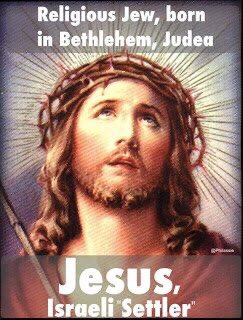
Honest Reporting: Jesus Was a Jew, Not a Palestinian
JPost Editorial: A Christian crisis in Gaza and the West Bank
Honest Reporting: Jesus Was a Jew, Not a Palestinian
A variation of this claim, that Jesus was actually a Philistine, also features as a staple of anti-Israel propaganda, including the roundly debunked notion that Palestinians are actually Canaanites.
The idea that Palestinians are Philistines is equally false.
Unlike modern day Jews and Palestinians, the Philistines were an ancient, non-Semitic, sea-faring people, whose form of worship was unconnected to the Abrahamic religions of Judaism, Christianity and Islam.
In other words, the Philistine ethnicity, culture and religion are all entirely different from that of modern day Palestinians.
The Philistine connection to the Israelites began when the former invaded and occupied a portion of the Kingdom of Israel in about 1000 BCE, but were later defeated by ancient Israel’s King David.
In roughly the seventh century CE, the Philistines were conquered by the Kingdom of Babylonia and subsequently wiped out as a distinct culture.
In other words, in addition to being culturally, ethnically and religiously unrelated to Jews or Palestinians, the Philistines no longer exist.
However you look at it, the truth is in no doubt: Jesus was a Jew.
According to this @nytopinion piece, there was an "Ottoman province of Palestine."
— HonestReporting (@HonestReporting) December 25, 2019
Only problem is, it never existed. Palestine was a term given to the land by Europeans. It was never used by the Ottomans. pic.twitter.com/T9ehwcba7w
JPost Editorial: A Christian crisis in Gaza and the West Bank
In the Gaza Strip, the Christian population has plummeted from about 3,000 a decade ago to an estimated 1,000 today, most of them Greek Orthodox.No Sign of Christmas in Gaza
On Sunday, the Coordinator of Government Activities in the Territories (COGAT) reversed a decision made earlier this month, making the welcome announcement that in accordance with “security orders,” Gaza Christians would be allowed to travel to the holy cities of Jerusalem and Bethlehem, and elsewhere in Judea and Samaria, for Christmas.
The situation of Christians in Bethlehem, the birthplace of Jesus, has deteriorated dramatically in the last century, and especially since the PA took control of the city in 1995. In 1947, Christians comprised about 85% of the city’s population, but that figure had plunged to 16% by 2016, and is estimated since then.
Bethlehem’s mayor at the time said that, “Due to the stress – either physical or psychological – and the bad economic situation, many people are emigrating: either Christians or Muslims, but it is more apparent among Christians because they already are a minority.”
A study by the Pew Research Center found that the decline in the Arab Christian population was both a result of a lower birth rate among Christians compared to Muslims and the fact that Christians were more likely to emigrate than any other religious group. A statistical analysis of the Christian exodus cited a lack of economic and educational opportunities among a community known for its middle-class status and higher education.
Christianity is the world’s largest religion, with an estimated 2.4 billion adherents (almost a third of the world’s 7.8 billion people). While it may seem ironic that the only place in the Middle East where Christians are thriving is the Jewish state, it is also a cause for concern. We wish our Christian readers a happy Christmas – and pray along with them for those undergoing persecution for practicing their faith.
Out of 3,000 Christians who lived in Gaza in 2007 when Hamas seized power, no more than 700-800 remain, among 1.8 million Muslims. Gazan Christian Khalil Sayegh told me, "The Christians are suffering from the current situation in Hamas-controlled Gaza....They cannot hold government jobs. But, in addition...Christians in Gaza have to tolerate being harassed in the streets just for being Christians."
"While Hamas claims to protect Christians, its presence in Gaza has empowered Islamist radicals who harass Christians and even physically attack them....There have been several attempts to bomb Gazan churches."
I asked Khalil if there are any Christmas decorations in Gaza. He explained that a YMCA facility is decorated, but only inside the building. Otherwise there's no sign of holiday festivity in the streets. The authorities "reject any indication of Christian celebration." The writer is an adjunct fellow at Hudson Institute's Center for Religious Freedom.