Continuing my series of recaptioning cartoons....

We have lots of ideas, but we need more resources to be even more effective. Please donate today to help get the message out and to help defend Israel.


 Wednesday, December 23, 2020
 Elder of Ziyon
 cartoon of the day, humor
Acceptance of the isolation of Israel and erasure of Jewish history in the Middle East has been an open wound afflicting the whole region. It should never have happened. Israel and some Arab countries fought a war in 1948, and there are legitimate reasons that Palestinians and their supporters opposed Israel's policies. But similar terrible wars, such as that between India and Pakistan in 1948, didn't result in dozens of countries not recognizing India or pretending that Hindus don't exist. Normalization and the presence of diplomatic relations are the most basic geopolitical norms throughout the world. Yet so many politicians, like former U.S. Secretary of State John Kerry, who pushed for engagement with Iran, blindly accepted the fact that so many countries did not normalize ties with Israel.Understanding the Abraham Accords inside and out - opinion
The whole nature of the conversation about Israel over the last decades has been tainted by accepting as normal a situation that was inherently abnormal. It became normal in Western universities to debate the very existence of Israel, and to advocate for a "one-state" solution without even consulting the eight million people in Israel and millions of Palestinians. In no other instance in the world do American college students blithely decide that they will erase countries and shoehorn them into new "one-state" solutions, like recreating Yugoslavia or Czechoslovakia without first asking people in Slovakia and Kosovo. Only when it comes to Israel was it taken for granted that people will debate its very existence itself. This semi-genocidal debate, like the erasure of Jewish history in countries like Iraq, places from which the Talmud was created, is a brutal assault on both history and international norms.
Now, long years of this abuse are being corrected with the new era of relations between Israel, Morocco, the UAE, Bahrain and Sudan. The usual predictions of doom and gloom have not come true. Israelis can be safe in these countries. Instead of the ingrained anti-Semitism and ways in which Jewish holidays have been made to seem controversial if celebrated in most countries across the region, we now see how countries are embracing Jewish culture and history. The Crossroad of Civilizations Museum in Dubai, for instance, now has brochures in Hebrew. Kosher food is now offered at the Ritz-Carlton in Manama. These are symbolic changes that speak volumes about a new normal that is banishing the intolerance of the past. It feels like a revolution is happening in the Middle East.
The Abraham Accords signify a potential paradigm shift in the Middle East, one that moves away from rejectionism and toward normalization. In a historic pivot, Arab states, once committed to an ideology embodied by the 1967 Khartoum Conference and its “three No’s,” have normalized relations and moved to a paradigm where country after country – the United Arab Emirates, then Bahrain, Sudan and Morocco – have shifted toward the “three Yeses,” declaring yes to recognition, yes to negotiation, and yes to peace.Israel calls 4th election in 2 years as Netanyahu-Gantz coalition collapses
While “negotiation” and “peace” are perhaps more intuitive to understand, the fundamental step of “recognition” is the most essential; without it, the additional processes are impossible to embark upon. To understand the precondition of recognition, we must identify what it was, or is, that is being rejected. Indeed, the very legitimacy of the State of Israel as Jewish and democratic to exist was, and remains, the hurdle for some. Only when Israel as both Jewish and democratic is recognized by its neighbors is it possible to move toward negotiation, ultimately enabling peace.
The imperative for recognition must be acknowledged, even and especially in the euphoria surrounding the Abraham Accords. While headlines focusing on business opportunities and transactions dominate the press, and though this is part of the historic process, it is secondary to the monumental acceptance of a Jewish and democratic Israel as an equal and legitimate partner by the UAE. In this regard, the fact that the UAE inculcated its children with “tolerance” of religious differences for years is far more ground-breaking than what military technology may be sold or shared.
Similarly, Israeli business leaders and tourists flocking to the UAE, anxious to grab a piece of this peace, must not take for granted the fundamental step of recognition. By focusing solely on interests and implications, we might miss the monumental potential of applying the transformative framework of “three Yeses” internally, to achieve internal recognition, internal negotiation and internal peace.
The 23rd Knesset officially dispersed as the clock struck midnight on Tuesday night and the deadline to approve a 2020 budget expired, sending Israelis to the polls for the fourth time in less than two years. Elections were automatically called for 90 days from now, namely March 23, 2021, though that date could yet be changed by vote.
The failure to pass a budget came just seven months after the swearing-in of the “unity government” between Likud and Blue and White. The two parties, which had fought each other bitterly in three indecisive elections, agreed to form a power-sharing government with a rotating premiership between Prime Minister Benjamin Netanyahu and Blue and White leader Benny Gantz in May.
But despite pledges to put aside their differences in order to fight the coronavirus pandemic, the political turmoil followed them into government, with both leaders soon claiming the other was breaking their coalition agreements.
Unlike the previous three elections, when Netanyahu’s chief rival was Gantz and his centrist Blue and White alliance, the prime minister’s main challengers this time are set to come from his own right wing of the political spectrum. A former Likud minister, Gideon Sa’ar, has set up a new party, New Hope, dedicated to ousting Netanyahu, and the right-wing/Orthodox Yamina party leader Naftali Bennett is also aiming to try to supplant him. Both Sa’ar and Bennett are seen as more hawkish than Netanyahu on issues relating to the Palestinians and the settlements.
Netanyahu, 71, has held power uninterrupted since 2009, and also served a term as prime minister from 1996-1999, making him Israel’s longest-serving leader. He remains in office as head of the transitional government until the elections are held and a new coalition is formed.
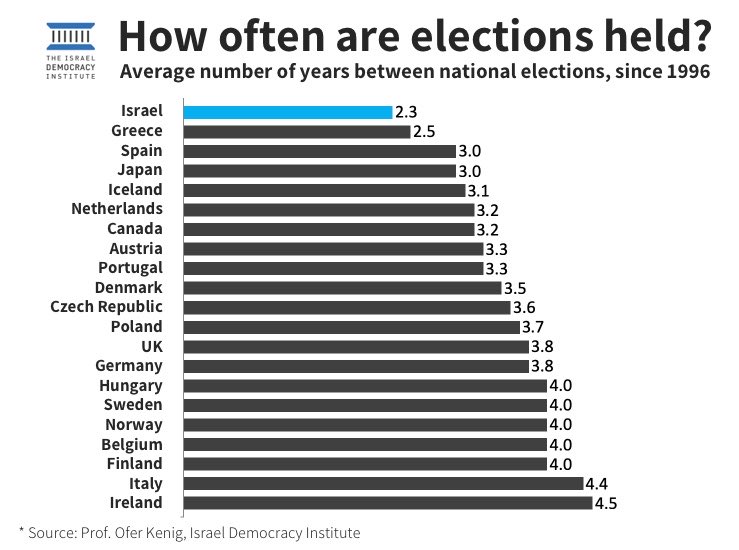
#Israel might be going into our 4th election in two years, but Mahmoud Abbas of the #Palestinian Authority is going into the 16th year of his 4 year term.
— Arsen Ostrovsky (@Ostrov_A) December 23, 2020
At least the Israeli people have a say in free and fair elections. pic.twitter.com/2ogMRZ1ocy
Wednesday, December 23, 2020Elder of ZiyonThis week United States Congress passed the Nita M. Lowey Middle East Partnership for Peace Act, historic legislation delivering unprecedented levels of funding for peacebuilding in Israel and Palestine. This follows over a decade of advocacy by the Alliance for Middle East Peace – ALLMEP – toward the creation of an International Fund for Israeli-Palestinian Peace.The law provides $250 million over five years to expand peace and reconciliation programmes in the region as well supports projects to bolster the Palestinian economy.Spearheaded by House Appropriations Committee Chairwoman Nita M. Lowey (D, NY-17), Congressman Jeff Fortenberry (R, NE-01), Senate State and Foreign Operations Appropriations Subcommittee Chairman Lindsey Graham (R-SC) and Senator Chris Coons (D-DE), the law contains language that encourages international co-operation. It prioritises peacebuilding and reconciliation programming to disrupt growing polarisation and dehumanisation in the region over the long term.
NITA M. LOWEY MIDDLE EAST PARTNERSHIP FOR PEACE ACT OF 2020SEC. 8002. Congress finds the following:(1) Economic development in conflict settings has been shown to support stabilization by empowering entrepreneurs, growing the middle class, and mitigating unemployment.(2) In 2018, unemployment in the Palestinian territories was 32.4 percent. Gross Domestic Product (GDP) growth in the Palestinian territories declined from 2017 to 2019, and it is projected to further decline in 2020.(3) According to the World Bank Ad Hoc Liaison Committee’s April 2019 Economic Monitoring Report, ‘‘to achieve sustainable economic growth, in the Palestinian territories, growth and job creation going forward will need to be private sector driven’’.(4) According to the 2018 Joint Strategic Plan of the Department of State and the United States Agency for International Development, ‘‘assistance can help prevent new recruitment to terrorist organizations, reduce levels of violence, promote legitimate governance structures that strengthen inclusion, and reduce policies that marginalize communities’’.(5) Although economic development is an important tool for stabilizing conflict-prone settings and establishing connections between communities, economic development by itself will not lead to lasting peace. People-to-people peace-building programs further advance reconciliation efforts by promoting greater understanding, mutual trust, and cooperation between communities.(6) While the United States and its international partners continue to support diplomatic and political negotiations between the representatives of the parties to the Israeli-Palestinian conflict, such efforts require broad popular support among the people on the ground to succeed.(7) Achieving sustainable, high-level agreements for lasting peace in the Middle East must come through, and with the support of, the people who live there, and the United States and its international partners can help the people of the region build popular support for sustainable agreements for lasting peace.SEC. 8003. It is the sense of Congress that—(1) building a viable Palestinian economy is central to the effort to preserve the possibility of a negotiated settlement leading to a sustainable two state solution with the democratic, Jewish state of Israel and a demilitarized, democratic Palestinian state living side-by-side in peace, security, and mutual recognition;(2) United States and international support for grassroots, people-to-people efforts aimed at fostering tolerance, and building support for such solution, can help counter extremist propaganda and the growing issue of incitement;(3) strengthening engagement between Palestinians and Israelis, including through people-to-people peace-building programs can increase the bonds of friendship and understanding;14) investing in the development of the Palestinian economy and in joint economic ventures can advance multiple sectors to the benefit of local, regional, and global parties; and(5) Congress encourages cooperation between Palestinian, American, and Israeli business sectors in order to benefit the Palestinian, American, and Israeli peoples and economies.PEOPLE-TO-PEOPLE PARTNERSHIP FOR PEACE FUNDSEC. 8004. Chapter 4 of part II of the Foreign Assistance Act of 1961 (22 U.S.C. 2346 et seq.) is amended by adding at the end the following:SEC. 535 PEOPLE-TO-PEOPLE PARTNERSHIP FOR PEACE FUND.(a) ESTABLISHMENT.—Beginning on the date that is one year after the date of enactment of this section, the Administrator of the United States Agency for International Development is authorized to establish a program to provide funding for projects to help build the foundation for peaceful co-existence between Israelis and Palestinians and for a sustainable two-state solution. The program established under this subsection shall be known as the ‘People-to-People Partnership for Peace Fund’ (referred to in this section as the ‘Fund’)....
Wednesday, December 23, 2020Elder of Ziyon Wednesday, December 23, 2020Elder of ZiyonCOVID-19
In the second half of the year, a series of Arab states added to our collective misery by announcing their decision to normalise their relations with Israel. By effectively abandoning their supposed commitment to supporting Palestinian self-determination for money, weapons and a few short-term political gains, they sent us a clear message that our suffering and struggle for the most basic human rights no longer matter to them.
The arrival of hundreds of Emiratis in Israel to enjoy the historic sites of Jerusalem and pray at the Al-Aqsa Mosque was a slap in the face for us. After all, millions of Palestinians living in the West Bank and Gaza, just two dozen kilometres away from Al-Aqsa, can only dream about stepping foot in the mosque that is the third holiest site in Islam.
Of course, we Palestinian Jerusalemites were already used to seeing Muslim pilgrims from Turkey, Malaysia, Indonesia or other non-Arab Muslim-majority countries at Al-Aqsa. Over the years, Palestinians rarely had any problem with these visitors, as they overwhelmingly believe this holiest of mosques should not be monopolised by any subset of Muslims, even under the devastating conditions of an occupation.But the Palestinian Jerusalemites were not as accepting of Emirati tourists as others.
An exhibition that is currently running at the Wiener Holocaust Library in London reveals that in every European country that fell under Nazi control, there were Jews who mobilized and formed underground resistance organizations while also participating in armed uprisings. Their heroism was also displayed through cultural resistance. Risking their own lives, they held clandestine religious gatherings, established underground schools, and helped smuggle important documents out to be preserved by history. Even in the face of unspeakable terror, Judaism was not viewed as an inconvenience.EU court prioritizes animals over Jews and Muslims in backing ritual slaughter ban
Today, for some Jews, our religion is primarily being redefined by our entrenchment in social activism. We have become so deeply embedded in promoting tikkun olam, that we ignore instances of antisemitism when they come from sources claiming to represent social justice.
This past summer, the horrific and criminal killing of George Floyd ignited months of social unrest in this country. As was the case during the 1960s civil rights movement, many Jews sprang into action and were quick to attach ourselves to the largest and most popular civil rights organization of our time, the Black Lives Matter (BLM) movement.
Yet with Martin Luther King, Jr. at its helm, the civil rights movement of the 1960s does not mirror some of the ideals currently espoused by the BLM movement. And while everyone can agree that all Black lives matter, there is a difference between that sentiment and some formal organizations affiliated with BLM.
Dr. King’s protection and love of the Jewish people was shown through numerous speeches he made, including one at Harvard in 1967, where he remarked: “When people criticize Zionists, they mean Jews. You’re talking antisemitism.”
The Zionist tenets encompassing Dr. King’s movement contradict one BLM platform, which labeled Israel an “apartheid state” and accused it of perpetrating a “genocide” against the Palestinian people. (This version was later retracted.)
In May, a BLM rally in an Orthodox Jewish neighborhood in Los Angeles resulted in the defacement of Jewish institutions and businesses, with participants yelling anti-Israel obscenities. While the violence was never called for by BLM, there was hardly any repudiation or rejection of it.
Without question, Thursday’s ruling stands in stark contrast to Europeans’ preferred image of themselves as open-minded and tolerant. Insisting that Jews and Muslims adapt religious laws, which seek to minimize animals’ pain, simply to suit contemporary sensibilities is anything but that. European Christians might also note this decision overturns the logic of Genesis, with Muslims and Jews no longer “rul[ing] over the fish in the sea and the birds in the sky, over the livestock and all the wild animals, and over all the creatures that move along the ground.”Bob Dylan’s ‘Neighborhood Bully’ Gets Memory-Holed
This decision will also have tangible consequences. As Benizri foreshadowed to me in a July exchange, this ruling not only “matters as a [legal] precedent. It also matters in terms of the security of the supply chain, and we know from the current sanitary crisis that we cannot rely solely on imports." He went on, "Some damage has been done, but the Brussels region may be tempted to adopt similar rules if the Walloon and Flanders laws are upheld, and other countries might follow suit.”
In other words, this ruling won’t be contained. Kosher meat, which is already expensive, will likely become even harder to obtain in a growing number of countries. Further, this ruling is likely to encourage political extremists who would relish making life inhospitable for their countries’ Jewish and Muslim minorities.
Reflecting from abroad, Rabbi Mendy Chitrik, president of the Alliance of Rabbis in Islamic States, which represents rabbis in 12 Muslim countries, told me, “It seems at times that Rabbis in Muslim countries are more respected and enjoy more religious freedom than their counterparts in Europe. We have been able to practice our Judaism without interference or disturbance for thousands of years. Kosher slaughter is done in many Muslim countries.” Chitrik continued, “The ruling of the European Court should also serve as a reminder that Jews and Muslims are facing similar religious struggles in Europe and elsewhere, and it is high time for Jews and Muslims to confront together both Islamophobia and antisemitism.”
Europe’s hostility toward religious outsiders is a centuries-old tradition. It appears that it will always find a way to justify bigotry.
I wanted to hear the Bob Dylan song “Neighborhood Bully” off his 1983 record Infidels. That’s how I discovered that YouTube won’t let you hear the song. It turns out that this man Bob Dylan, so beloved by the American cultural establishment and winner of the 2016 Nobel Prize in literature, is guilty of hate speech. Sooner or later, they all are.
I wanted to hear “Neighborhood Bully”—a jaunty four-and-a -half minute rock ‘n’ roll number—but I can’t remember why. The song has its charms, including a driving three-chord electric guitar, but it’s nowhere near Dylan’s best and I’m not some kind of fanatic who enjoys wallowing in the master’s obscurities. The impulse might have come to me while I was trying to Google something else, and the search results triggered the association.
I can assure you that Googling “Neighborhood Bully” was in no way intended by me as a political statement or gesture. “Neighborhood Bully” is assumed to be a song about Israel being singled out and maligned among the world’s nations, but Dylan has rejected this interpretation just as he always denied narrow political readings of his work. “I’m not a political songwriter, he told an interviewer shortly after the record came out. “‘Neighborhood Bully,’ to me, is not a political song, because if it were, it would fall into a certain political party. If you’re talkin’ about it as an Israeli political song—in Israel alone, there’s maybe 20 political parties. I don’t know where that would fall, what party.”
The neighborhood bully been driven out of every land He’s wandered the earth an exiled man Seen his family scattered, his people hounded and torn He’s always on trial for just being born He’s the neighborhood bully
My intentions were not to make trouble. It's not as if I started off the day seeking out banned materials and deviant songs. It's just that one thing led to another. You know how it is: The links start thinking for themselves, the minutes turn into hours, and you end up watching some YouTube video with no connection to whatever you’d been looking for in the first place, hazily trying to recall how you got there like a drunk guy who’s woken up in a strange room. Only, I was brought up short. I couldn’t listen to “Neighborhood Bully” because the song wasn’t there. It had vanished. (h/t Yerushalimey)
 Tuesday, December 22, 2020Elder of Ziyoncartoon of the day, humor
 Tuesday, December 22, 2020Varda Meyers Epstein (Judean Rose)Judean Rose, Opinion, Varda
 |
| Esther Horgan, HY"D |
Esther Horgan went for a run in the forest, as she was wont
to do on nicer days. The air would be crisp and pine-scented, and she loved the
feel and smell of being free in such a beautiful part of Eretz Yisrael. Here she could sing as loud as she wished, with only
the clouds to hear. It felt good to stretch her limbs.
No doubt she came here often to run and to think, to
exercise and stay in shape, while pondering life’s issues, large and small.
There was bound to be always something to think about and resolve. After all, Esther
Horgan was a mother of six and an immigrant who sought refuge in Israel from
France, a European country that has seen more than its share of violent
antisemitism over the past decade or so. Here in Israel, Esther might have
thought, one can worry about things like where to send a daughter to high
school or a son’s religious studies, instead of worrying that a child might be killed, God forbid, in the halls of a Jewish school, for the crime of being
Jewish.
And that might have been true. And Esther Horgan may have
been safer in that forest in Samaria, in the heart of Eretz HaKodesh, except that evil exists and infiltrates everywhere.
Even in the Jewish State, or perhaps especially so. For many are the Arab
terrorists who covet our beautiful land and want it, Jew-free, for themselves.
And the thing is, Esther Horgan wasn’t stupid. She knew that
Arab terrorists might be anywhere, looking for opportunities to kill Jews. But
the forest where her children were robbed of their mother was not just a
random, isolated wood, but a nature preserve, a protected Jewish tourism site.
The Israeli government invested here in bike paths and signage. It should have
been safe.
It should have been safe for Esther Horgan to run and think and stretch her limbs in this part of the ancient Land of Israel. There should have been no danger to breathing in the pine-scented air of a forest whose name means “fragrant basil"—to bask in the glorious freedom of being alive in the Jewish State and of “coming home” to live in Tal Menashe in Samaria, indigenous Jewish territory for thousands of years.
But it wasn't safe. Eitan Melet, a field coordinator at Regavim posted about it on Facebook with this stunning 360 degree photo of the Reihan Forest, where Esther was murdered:
(photo credit: Eitan Melet/Regavim)
Eitan Melet tells us that while the forest is beautiful, and the Israeli government has invested in developing the nature reserve, there's absolutely no police or army presence there, and it's become a shooting gallery and a dangerous hangout for all the Arabs of the area—from Umm el Fahm and Reihan and the entire area—who do unspeakable things there. Melet was there only recently—a fully-armed, combat-trained male—and he was very uncomfortable.
And still, Esther Horgan went out of her home that morning, as she always did, seeking nothing but the peace of the forest. Nothing had ever happened to her before. But this one time, when she didn't come home, they found her dead, with signs of violence on her body.
From the Jerusalem Post:
"We walked together for 30 years and yesterday you went and did not return. How can a few words describe the depth and breadth of your beauty and goodness?" said Esther's husband, Benyamin. "You built both a physical house and a spiritual house – everything – and it was supposed to be just the beginning. There were so many more plans.”

Nothing had ever happened before, but she was a small thing. You can see it in the pictures. She may have been fit, but she was no match for a brutal murderer, filled with lust for Jewish land soaked with Jewish blood. It shouldn't have happened, but it did.
And still, if Esther Horgan could speak, she would tell you how much better it is to run in the forest, to die as a Jew in the Land of Israel, than to die on the foreign soil of a France that never loved us. She would tell you to keep running in all the forests and beautiful parts of our indigenous territory, land that God gave us alone, to build on and live in. Land where we might someday run, free of any danger from the enemy within.
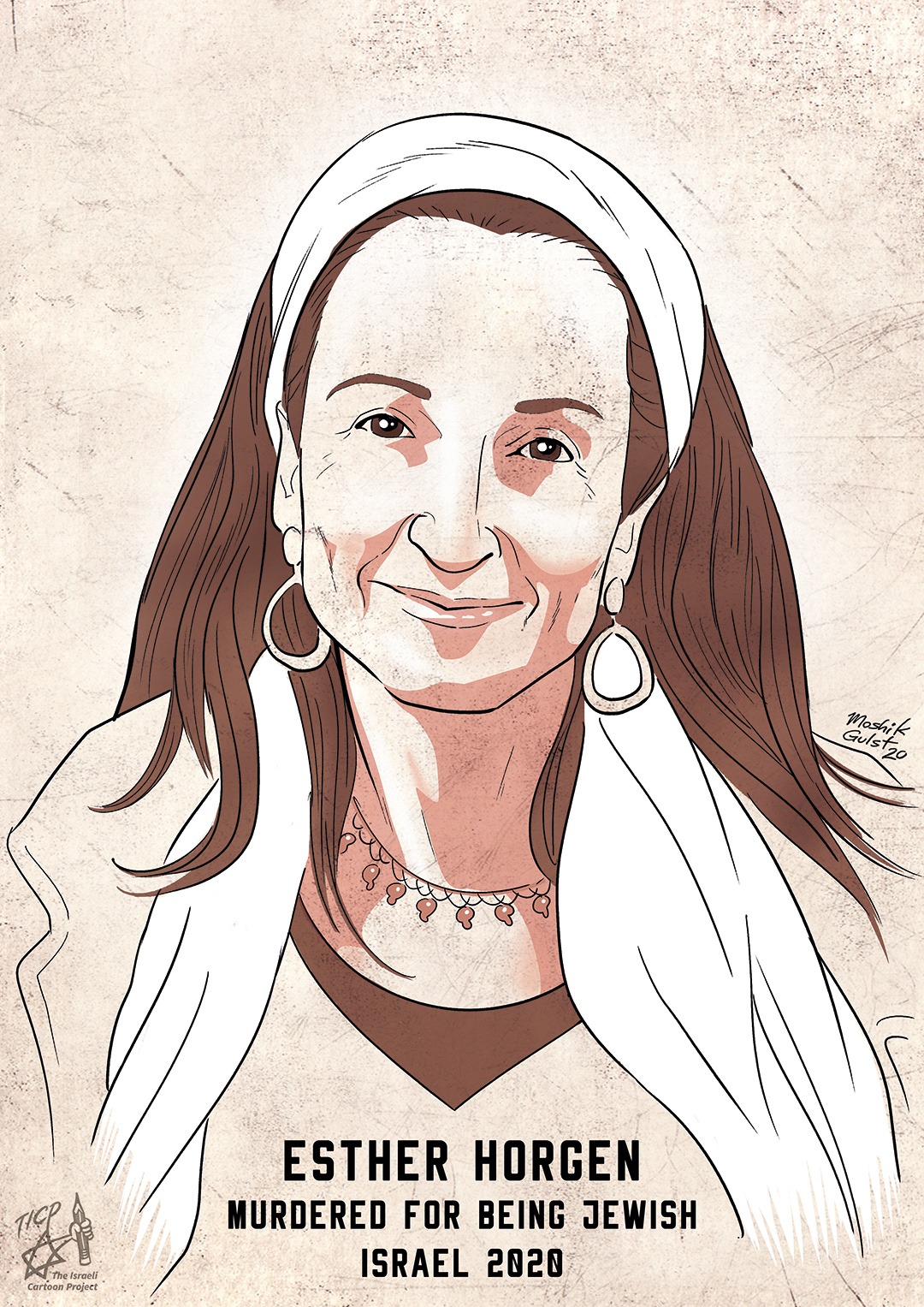
Esther Horgen, who was found dead in a northern West Bank forest in an apparent terror attack, was eulogized for her love of life as she was buried on Tuesday morning.
“For 30 years we walked together, and two days ago you went for a walk and didn’t return,” said her husband Benjamin. Horgen’s body was found a day after she went for a run in a forest near their West Bank home.
“How can a few words manage to express the depth of your heart and your generosity, your joy for life and love for others?” he said.
Esther’s daughter Odelia mourned the loss of her mother and expressed pain that she would not be at her future wedding.
“My mother is my best friend. She came to visit me at the end of the world, in Australia. Where are you now, mother?” said Odelia. “I am sorry that you will not dance at my wedding.”
Dozens of mourners attended the funeral including Settlements Minister Tzachi Hanegbi.
Community leader Rabbi Reuven Uziel said that Horgen’s killer would not be able to “sully” Israel.
“On Friday we sat together at a Shabbat meal. Not for a second we did not think this was the last time we would meet. You were a person of love and lightness, of joy and a smile,” Uziel said. “The murderers will not be able to sully the land of the Land of Israel, which will remain blessed and holy, and you will remain blessed and pure.”
In an interview on Tuesday morning, Benjamin said that his wife had lived life to the full.
“She lived every moment of her life. She had so much to give,” Benjamin Horgen told the Kan public broadcaster. “I trust the defense establishment to do their job, they have updated [us] that things are progressing.”
There were 20 years of silence. And then, last week, Trump announced that Morocco and Israel would be resuming diplomatic relations. In a tweet afterwards, the President reminded the world that Morocco was the first country to recognise the United States as a nation, in 1777 and, simultaneously, urged for an international recognition of Moroccan sovereignty over Western Sahara.How Moroccans are Reacting to Normalization with Israel
Good news is flowing from the region: the Jewish state, also at the behest of Trump has established ties with Bahrain, the UAE and Sudan. Of course, the most recent news did not please everyone. Some frowned upon the fact that the US released the information before Morocco or Israel; others criticised the power imbalance between Morocco and Israel on one hand, and Palestine and Western Sahara on the other. The latter has been waging a war of independence against Morocco for several decades, led by a socialist separatist group with Islamist ties.
Hamas, naturally, is outraged and denounced the Moroccan treachery; while in its customary partiality against the Moroccan monarchy, the French media — both mainstream, such as Le Monde, and more independent sites such as Mediapart — quickly attacked both Trump and King Mohammed VI of Morocco for an agreement in which both Palestinian and Sahraoui self-determination was jeopardised.
This grumbling contrasts with the elation and relief felt by many Jewish families around the world as the first candle of the Menorah was lit, and by many Muslims in Morocco who can recall what things were like before the 1960s. Having grown up in Morocco, and with a father who remembers those happier times of coexistence, I was moved to tears by the sight of Israelis dancing in the street to traditional Moroccan song, waving flags of both countries and pictures of the King Mohammed.
Almost a million people in the Jewish state are of Moroccan descent, from families who were exiled six decades ago, a mere blip in time compared to the thousands of years they’d spent in the Maghreb. For them, as well as Jewish North African communities in France and increasingly in London, the deal is a hugely welcome Hanukkah gift during a difficult year.
United Arab Emirates, Morocco, Bahrain and Sudan. The list of countries of the Arab-Islamic world that have made peace with Israel in recent months is impressive.
A Tunisian singer thought it was time to put this atmosphere of normalization into music. So, on December 13, Noamane Chaari uploaded a video of a song he had just recorded with an Israeli musician. The song, in Arabic, speaks of dreams of peace, of olive trees, of the sea, of Tunis, of Jerusalem. Chaari recorded it with Ziv Yehezkel, an Iraqi Jew. An invitation to build bridges between Jews and Arabs.
In the supposedly most moderate country in the region, the only "Arab Spring" of any success, it is still a crime to sing peace with the Jews. Host of a broadcast of the famous radio station Mosaïque Fm, the young musician was the subject of death threats. Stressing that the author of the lyrics, a Yemeni poet, remained anonymous so as not to risk beheading in his country, host Hedi Zaiem asked: "What will happen to the man who sang it?".
Threatened with death, fired by his employer, Channel 1 of public television, Noamane Chaari now tells L’Obs: "I have been accused of espionage and treason. Some media have deliberately tried to antagonize Tunisian public opinion, invoking the violence against me ".
Thus, in the supposedly most moderate country in the region, the only "Arab Spring" of any success, it is still a crime to sing peace with the Jews. Conservative president Kaïs Saïed speaks of a "Zionist entity", like the Iranian ayatollahs. And the Ugtt union, which won the Nobel Peace Prize, has put back on the table the idea of a law that criminalizes the establishment of diplomatic relations with the Jewish state. The union of music professionals, affiliated precisely with the Ugtt, condemned Chaari's "provocation against the Tunisian people and all the Arab people".
The singer had also traveled to Israel with an Arab delegation. His "fault" is also that of having written the song with a Jew of Iraqi origin and a Moroccan mother, while images of Baghdad appear together with those of Tunis in the music video.
Tuesday, December 22, 2020Elder of Ziyon
SEC. 9026. Of the amounts appropriated in this title under the heading ‘‘Operation and Maintenance, Defense Wide’’, for the Defense Security Cooperation Agency, $250,000,000, to remain available until September 30, 2022, shall be available to reimburse Jordan, Lebanon, Egypt, Tunisia, and Oman under section 1226 of the National Defense Authorization Act for Fiscal Year 2016 (22 U.S.C. 2151 note), for enhanced border security, of which not less than $150,000,000 shall be for Jordan.
Of the funds appropriated by this Act under the heading ‘‘Economic Support Fund’’, not less than $125,000,000 shall be made available for assistance for Egypt, of which $40,000,000 should be made available for higher education programs, including not less than $15,000,000 for scholarships for Egyptian students with high financial need to attend not-for-profit institutions of higher education in Egypt...
Of the funds appropriated by this Act under the heading ‘‘Foreign Military Financing Program’’, $1,300,000,000, to remain available until September 30, 2022, should be made available for assistance for Egypt.
JORDAN.—Of the funds appropriated by this Act under titles III and IV, not less than $1,650,000,000 shall be made available for assistance for Jordan, of which: not less than $845,100,000 shall be made available for budget support for the Government of Jordan; not less than $10,000,000 shall be made available for programs and activities for which policy justifications and decisions shall be the responsibility of the United States Chief of Mission in Jordan; and not less than $425,000,000 shall be made available under the heading ‘‘Foreign Military Financing Program’’.
 Tuesday, December 22, 2020Elder of Ziyon
Chehaibi went on to say that during his visit to Israel he was impressed by the urban and economic development of this country, and was very impressed by the way in which cultural and religious pluralism was managed there.He says that he understood through his visits that “this country really deserves to be a role model,” and that “many of the things that we see in the media are false and ideological,” adding that “Morocco's political and economic rapprochement with Israel can benefit everyone."
Tuesday, December 22, 2020Elder of Ziyon
A terrorist attack took place in Jerusalem's Old City on Monday evening, Israel Police reported.Police reported a shooting incident at the Lion's Gate in the Old City between an armed terrorist and police officers who were on the scene.The suspect, reportedly a 17-year-old Palestinian from Qabatiya in the northern West Bank, was armed with a Carlo-type submachine gun according to police, and shot at a police post before being neutralized by Border Police officers.
....that the commando operation in the occupied city of Jerusalem proves the continuation of the Palestinian youth uprising and is increasing its flame, flare up and quality day after day, and attempts to abort it or conspire against it "will not succeed."The PFLP blessed the heroic Jerusalem operation to the Palestinian people, considering that it came within the framework of responding to the crimes of the occupation and the settlers ’assault against our people and our holy sites in Jerusalem and the occupied homeland.The PFLP stressed that the blood of the martyrs and martyrs who died in defense of Palestine will remain a beacon that will light the way for us; Until the return and liberation of all Palestinian soil from the filth of the occupiers.
Today, martyrdom weddings are held in homes for the sake of Al-Aqsa and in defense of it."...the blood of martyrdom at Bab Hatta is a message to extremists and settlers who storm Al-Aqsa and try to perform their Talmudic rituals. ... The Bab Hatta operation is a message to everyone who chose normalization, bypassing the rights of our people and our nation in the Al-Aqsa Mosque. "
Maybe one day Palestinians can end their obsession with martyrdom and death.
Buy EoZ's books!
PROTOCOLS: EXPOSING MODERN ANTISEMITISM


