Wednesday, March 02, 2022

From Ian:
Menachem Begin continues to shape Israel's Zionist vision
Menachem Begin continues to shape Israel's Zionist vision
Although Menachem Begin died 30 years ago, he continues to shape Israel – and inspire many of us.Media, Take Note: It’s Not Israel Vs. Iran, It’s Iran Vs. Most of Middle East
Before 1977, when the Labor Party dominated Israeli politics and the American Zionist imagination, I was born into one of New York’s few Beginite households. My father, Bernard Dov Troy, had been involved in the Betar Zionist youth movement since his youth on the Lower East Side. We worshiped Israel’s longtime opposition leader, and David Ben-Gurion’s nemesis, Menachem Begin. I even invited him to my bar mitzvah.
We were among the few who rejoiced on the night of the “mahapach,” the Reversal, in May 1977, when Begin ended his three-decade futility streak and became prime minister. Most American Jews mourned, lamenting what Israel was becoming, devastated that Israel disappointed them, worried about the growing gap between Israel and American Jewry. Sound familiar?
Begin proved them wrong. Two months ago, working with Jerusalem’s Menachem Begin Center, Adam Bellos and the Israel Innovation Fund convened a panel discussion: “Hadar: Begin’s Lesson of Jewish Pride.”
I couldn’t resist such a speaking invitation, because “hadar” may be my father’s favorite word. Begin and my father followed Ze’ev Jabotinsky, whose resurrection of Jewish dignity began with hadar. Though not easily translated, the word connotes glory or splendor, meaning “outward beauty, respect, self-esteem, politeness, faithfulness” in “every step, gesture, word, action and thought.”
I started by saluting Begin for acting with “hadar” and making it contagious, bringing pride back to the name “Jew.” I hailed him as The Fighting Jew, the Holocaust survivor who led “The Revolt” before 1948 – articulating the new Zionist ethos, refusing to be cowed, of being militant when necessary but never unnecessarily militarist. “The Fighting Jew,” Begin proclaimed, “loves books, loves liberty and hates war. But he is prepared to fight for liberty.”
As prime minister, Begin followed that formula. He defied expectations by making peace with Egypt in 1978, then defied the world by bombing the Iraqi nuclear project, Osirak, in 1981, and attacking the PLO state-within-a-state in southern Lebanon in 1982.
As world powers and Iran appear to be on the verge of reviving the 2015 deal aimed at curbing the Islamic Republic’s nuclear program, major news organizations are depicting developments in Vienna through a narrow lens (see here, here, here, here, and here). The broader regional threat posed by Tehran is regularly downplayed by media outlets that instead seem to be promoting a false narrative that essentially equates offensive actions by Iran — the “world’s largest state sponsor of terrorism” — with the defensive maneuvers of the Middle East’s only democracy: Israel.Biden Calls Ukrainians ‘Iranian People,’ No mention of Israel in State of the Union Address
The resulting coverage not only effectively calls into question the Jewish state’s right to defend itself against a genocide-preaching regime, but also diminishes the gravity of Iran’s campaign of expansionism and terror and the threat it poses to Sunni states across the Middle East.
Iran’s Long Game: Regional Hegemony
The following quote from a recent New York Times article titled, US and Allies Close to Reviving Nuclear Deal With Iran, Officials Say, is a typical example:
One key issue is how Israel will respond. It has continued its sabotage campaign against Iran’s facilities, blowing up some of them and, at the end of the Trump administration, assassinating the scientist who led what American and Israeli intelligence believe was Iran’s bomb-design project.”
What goes unmentioned is that Israel is far from being the only country in the Middle East that opposes the restoration of the Joint Comprehensive Plan of Action, more commonly referred to as the Iran nuclear accord. For while Jerusalem has consistently expressed opposition to the agreement, it has likewise caused grave concern in the Arab world, many of whose leaders believe that keeping the pressure up on Tehran is the correct course of action.
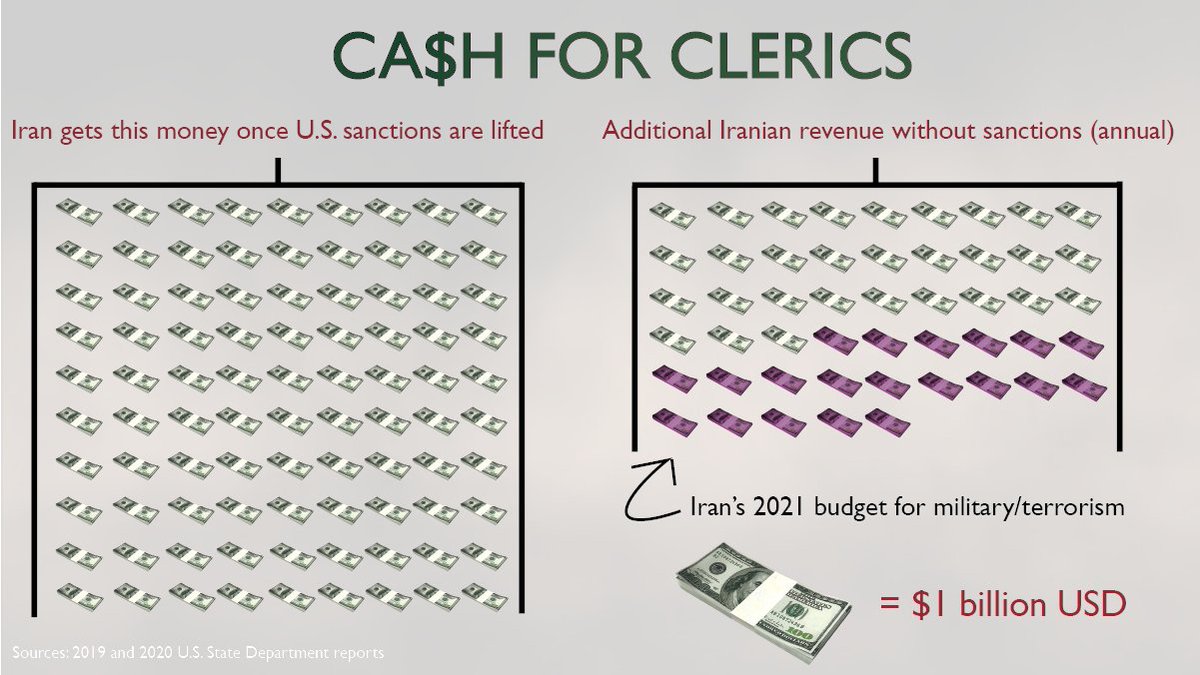
Indeed, Iran continues to invest heavily in its ballistic missile program and building a network of terrorist proxies that cause havoc and destruction throughout the region in order to destabilize countries such as Lebanon, Syria, Iraq and Yemen. Tehran seeks to project power so as to essentially turn these nations into clients states.
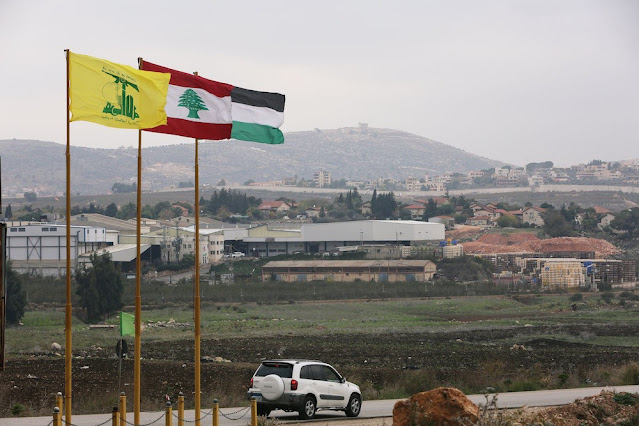
This policy has produced what Iran has dubbed the “axis of resistance,” an amalgamation of Tehran-sponsored militias and full-blown terrorist outfits such as Hezbollah and Hamas. This radical alliance threatens Gulf states and Israel alike. For example, Iranian-backed Houthis in Yemen have attacked both Saudi Arabia and the United Arab Emirates using Iranian-made drones and missiles. Meanwhile, Hezbollah and Tehran-supported terror groups in the Gaza Strip fire their huge arsenal of rockets at Israeli cities.
Accordingly, the Middle East is today a battleground between those entities and nations within Iran’s sphere of influence and more moderate capitals such as Riyadh and Abu Dhabi.
The Islamic Republic’s regional interventionism is seemingly being used as a parallel way to advance its nuclear program. As Iranian aggression increases, so too does its atomic program.
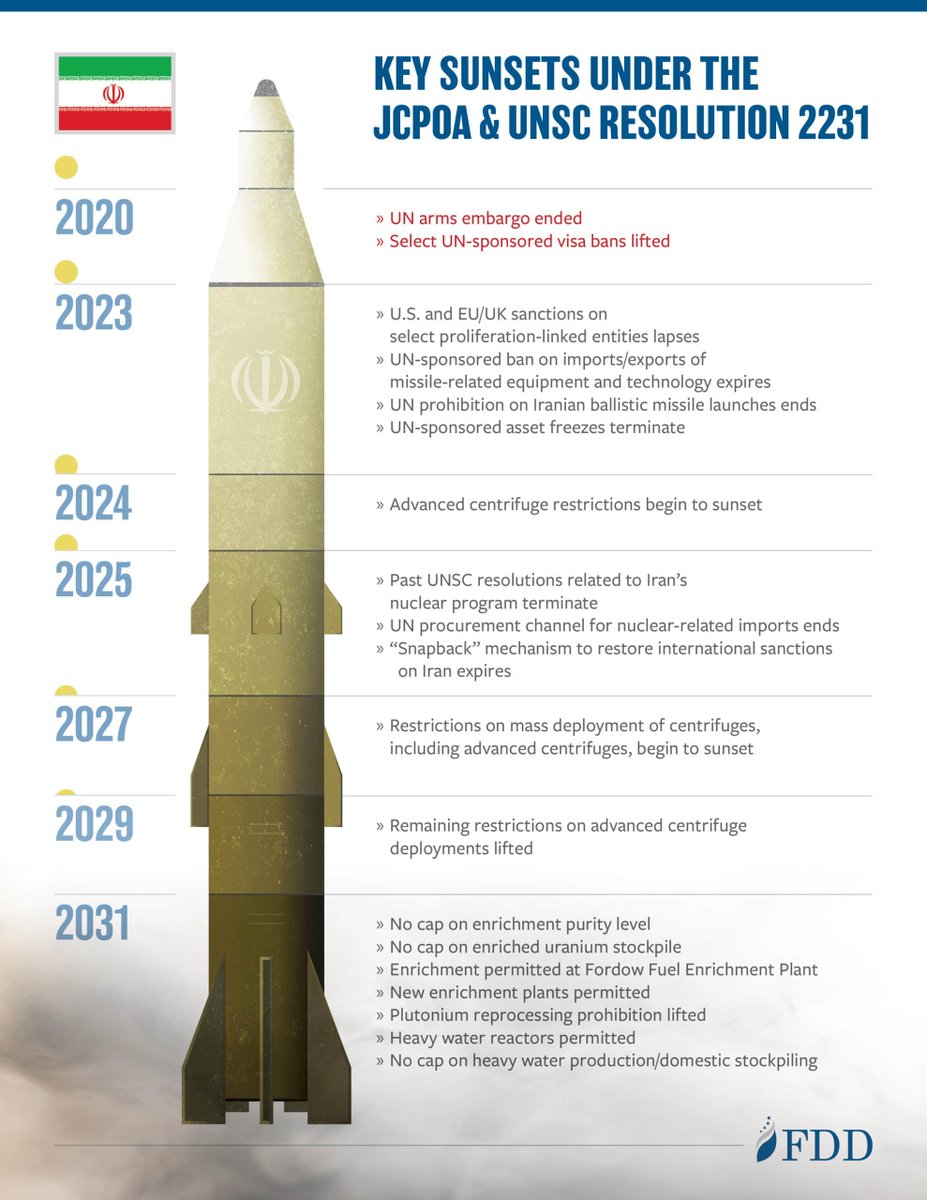
In fact, it was reported last May that Iran had enriched uranium to 63 percent purity — a short technical step away from weapons-grade 90 percent — and way beyond the 3.67 percent threshold permitted under the 2015 nuclear deal. At the same time, Tehran has from the get-go opposed the inclusion of Arab countries in the nuclear talks, not wanting to deal with their concerns over Iranian-led proxy wars and the Islamic Republic’s development of ballistic missiles and other conventional weaponry that can reach their territories.
These security threats are shared by Israel and in part helped pave the way for the Abraham Accords — a series of US-brokered deals that normalized diplomatic relations between Israel, the United Arab Emirates, Bahrain, Sudan, and Morocco.
In response to these rapprochements, some experts maintain that Tehran is now pushing to enhance ties with its Mideast terrorist proxies.
The first thing I do before starting to analyze a State of the Union address for this news site is plug in the name “Israel,” to see how many times the US president has mentioned it. Good news: on Tuesday night, President Joe Biden mentioned Israel zero times.
I then plugged in “Iran” and got a very strange response. Here it is, his second-to-last line about the war in Europe: “Putin may circle Kyiv with tanks, but he’ll never gain the hearts and souls of the Iranian people.”
Huh? Yes, folks, it was a Joe Biden mental typo. He meant the Ukrainian people. Otherwise, there was zero mention of the Islamic Republic or the hearts and souls of its people.
Here’s a summary of what the president had to say about what America is doing for Ukraine:
Six days ago, Russia’s Vladimir Putin sought to shake the very foundations of the free world, thinking he could make it bend to his menacing ways. But he badly miscalculated. He thought he could roll into Ukraine, and the world would rollover. Instead, he met a wall of strength he never anticipated or imagined.
He met the Ukrainian people.
From President Zelensky to every Ukrainian, their fearlessness, their courage, their determination, literally inspires the world.
Groups of citizens blocking tanks with their bodies. Everyone from students to retirees to teachers turned soldiers defending their homeland.
In this struggle, as President Zelensky said in his speech to the European Parliament, “light will win over darkness.”
The Ukrainian ambassador to the United States is here tonight, sitting with the first lady.
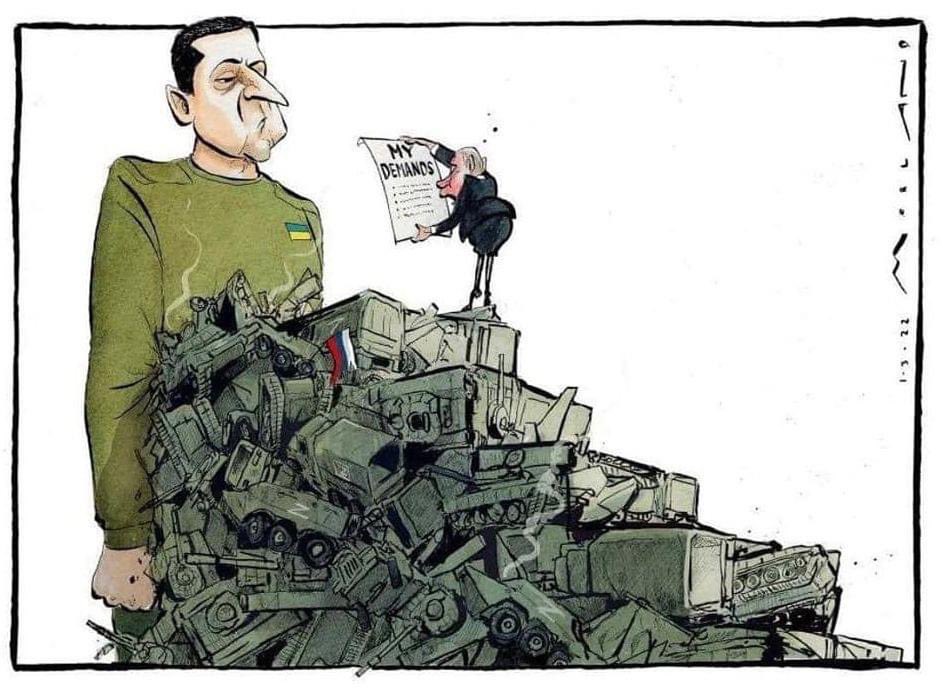
But while it’s always nice to hear an American president who is ready to fight to your last drop of blood, the situation on the ground is decidedly not in favor of the brave people: The Ukrainian army reported Wednesday morning that Russian airborne forces have landed in Kharkov and attacked a local hospital, and a major battle ensued; and the Russian army is operating in Kherson, the mayor sent an urgent appeal to President Zelenskyy: “Help us evacuate hundreds of bodies from around the city.”
Light may win over darkness, but darkness is not a pushover.