Friday, July 12, 2019

From Ian:
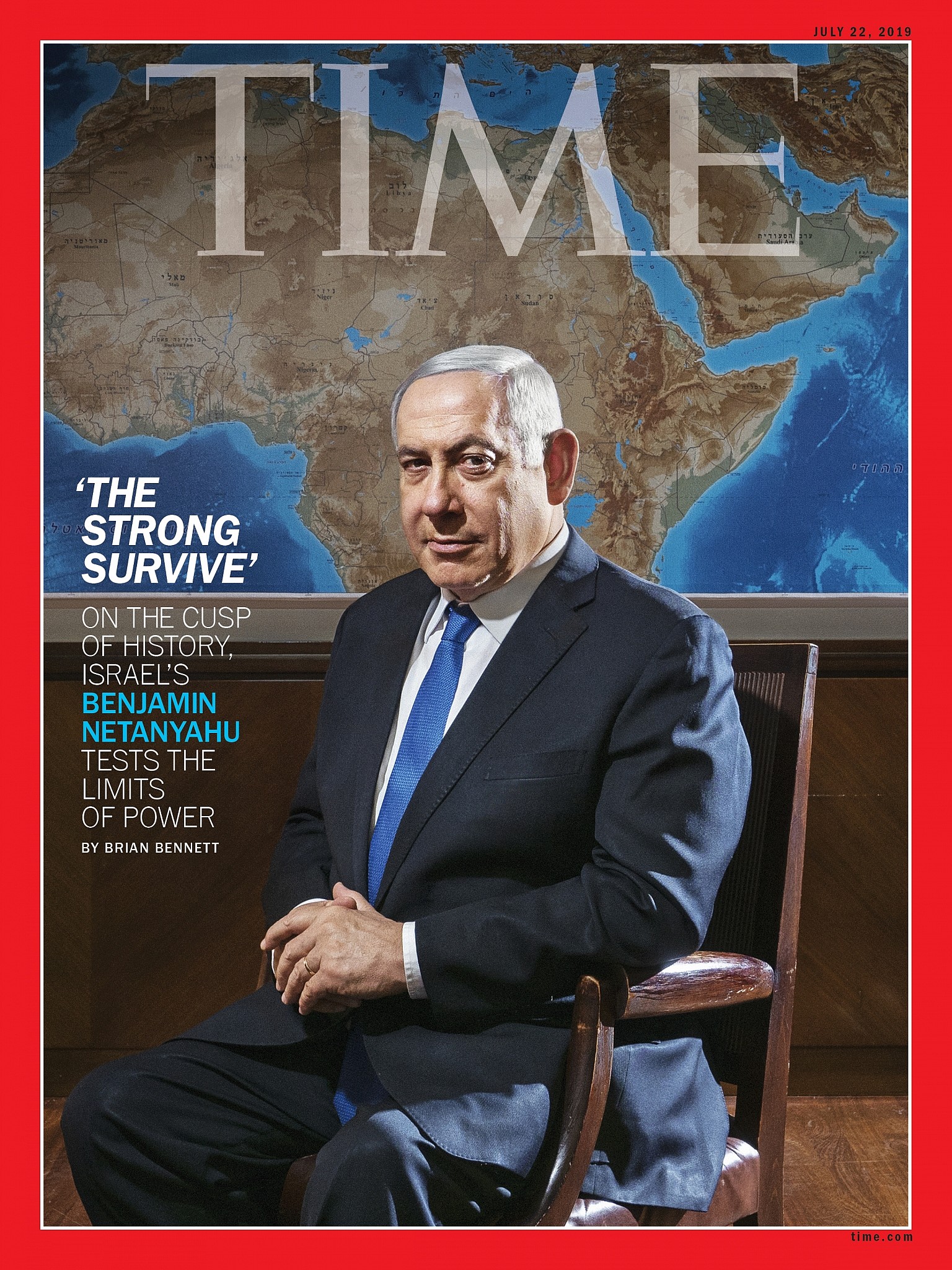
Time puts Netanyahu on the cover, says he ‘tests the limits of power’
Abe Greenwald: The Magical Misery Tour
Time puts Netanyahu on the cover, says he ‘tests the limits of power’
Time magazine has once again put Prime Minister Benjamin Netanyahu on its cover for its upcoming July 22 edition.
Noting that Netanyahu on July 17 will “surpass David Ben-Gurion, the closest thing Israel has to a founding father, to become the longest-serving Prime Minister in the country’s history,” the interviewer, Brian Bennett, writes that the Jewish state’s future “remains mortgaged to Netanyahu’s approach to power.”
The article is less flattering than the last time Netanyahu was on Time’s cover, in a mostly sympathetic 2012 interview that branded him “King Bibi.”
“Inside the country, many Israelis have been alarmed by Netanyahu’s efforts to remain in power,” Bennett tells his readers. “The moves compound the impression, already articulated by critics, that Israel’s Prime Minister has embraced the same populist authoritarianism rising elsewhere around the world.”
Time has occasionally put Israel on the cover in recent years, usually to criticize it. A September 2010 cover story was headlined, “Why Israel doesn’t care about peace.” An August 2012 edition looked at a battle for control over a Jerusalem neighborhood.
The latest cover story follows a similar line, citing “a growing chorus of critics” who “condemn Netanyahu not for any personal indulgences but for undermining Israeli democracy itself.”
It depicts the upcoming September 17 election as a referendum pitting “the Prime Minister’s self-declared role as Israel’s protector, ‘indispensable Netanyahu,’ against ‘Bibi fatigue,’” in the words of former US ambassador Dan Shapiro.
Abe Greenwald: The Magical Misery Tour
On and on it goes, the students were treated to tales of Israel’s razing homes, harassing Palestinians, and restricting their freedom of movement. All of it seemingly without the context of the Palestinians’ unending war on Jews.In NY Times Coverage of J Street, Advocacy Journalism for Anti-Israel Advocates
Finally, Halbfinger relays how students on the trip were turned off by Israel and Zionism: “By dinnertime, two participants said they were reconsidering their belief in a Jewish state.” He quotes one: “I came in here a very ardent Zionist . . . You never know when a Holocaust might happen again. Yet, coming here, I’m starting to doubt whether a two-state solution is possible—and whether Zionism is even worth pursuing anymore.”
This is, of course, the goal of the entire undertaking. It’s not about painting a nuanced picture of the conflict or moving toward peace. It’s about Jews showing other Jews what a terrible and misguided place Israel has become. Increasingly, that’s J Street’s mission. Despite its denials, the group has supported the boycotting of Israel on college campuses and targeted pro-Israel activists. Now, it’s packaging the supposed evils of the Jewish state for students to see up close.
Birthright, for the record, doesn’t ignore the Israeli-Palestinian conflict. It just operates with an understanding that Israel is more than its efforts to combat terrorism. And those efforts are overwhelmingly noble.
The good news is that J Street has taken only 28 kids on a single trip. Put that against Birthright’s estimated 650,000. It will take a lot of David Halbfingers to make up the difference.
Later, the lens turns to Israel: “While the Israeli government and news media usually say the same things in Hebrew and English, Palestinians and Israeli critics say they also do little to promote the idea of a Palestinian state.”
Then there is the rationalization: “Some explain the overheated language [by Palestinians] as a natural expression of such a long-running conflict, and say that any real education in the language of peace is unlikely to come before negotiators resolve the core issues.”
And again, skepticism of the critics: “Some Israelis struggle with the practice of monitoring the Palestinian news media, acknowledging the importance of knowing what is being said in Arabic, yet disturbed by how its dissemination is exploited by those not eager to see Israel make concessions.”
It would be one thing if this were how the Times reports on critics of both Israel and the Palestinians. But as the J Street story reminds us, the newspaper’s standards are shifty. There is no commentary about J Street and their fellow critics looking to score “propaganda points.” No “arguable” interpretations. No “natural expression” of the conflict. No “exploitation” by anti-Israel extremists. The journalistic skepticism and right of reply that was seemingly important when reporting on Palestinian Media Watch disappears entirely in the report on J Street.
This isn’t impartial, hard-hitting journalism. It’s advocacy for anti-Israel advocates. And despite repeated promises of fairness, the paper can’t seem to avoid such partisan reporting.