Showing posts sorted by relevance for query Palestinian currency. Sort by date Show all posts

Tuesday, March 13, 2012

  • Tuesday, March 13, 2012
  • Elder of Ziyon
From PMW:
A Judean Shekel coin from the year 66 CE, the first year of the Jewish rebellion against Rome, was sold for $1.1 million this past week at an auction in New York. The words in Hebrew "Shekel of Israel [Year] 1" are printed on the front of the coin, and "Jerusalem the holy" appears on the back. [New York Post, March 10, 2012]

The official Palestinian Authority daily in writing about the auction described the Hebrew coin from the Second Temple period as an "ancient Palestinian coin" and as being part of the "Palestinian cultural tradition."

The article adds that the Jews' "political agenda" takes advantage of the sale of ancient Hebrew coins. The PA, which does not recognize Israel's right to exist, and only at times acknowledges that the state does exist, categorizes any archeological evidence of Israel's ancient past in the land as a "political agenda":

"It [the sale] is an opportunity for Jewish and Western scholars to use the Jewish revolt against the Romans in Palestine for a political agenda, and to connect this local revolt with the establishment of the Israeli occupation state."
Yeah, why would Jews be interested in an ancient Jewish coin from Judea that documents a Jewish revolt at the time that Jews had their own nation? Obviously, it is political!

Which brings up the question: if the coin is such a beautiful example of Palestinian heritage, why are no Palestinians bidding for it?

In a similar vein, a Jordanian named Gasser Anani gave a lecture last week about the supposed Judaization of Jerusalem, and he also talked about shekels, saying that they were realy an ancient Palestinian currency called "Shakla" and Israel "stole" them.

Of course, there is no such thing as an "ancient Palestinian currency." There would have had to be a Palestine for that to have been created. The first Palestinian currency was created by the British in 1927, and it had Hebrew on it.


In fact, the shekel is a unit of weight that was around since the Akkadian Empire and that morphed into a currency as it was usually used for silver. Jews never claimed that it was a Jewish invention; it is mentioned in the Bible as an already existing standard weight of silver in Abraham's time (Genesis 23) when he paid 400 shekels for what was to become the Tomb of the Patriarchs.

(h/t Stan)

Friday, May 12, 2017

  • Friday, May 12, 2017
  • Elder of Ziyon
Many years ago, Dry Bones published this cartoon:


Nada Elia at Middle East Eye claims to demolish this argument - and fails spectacularly.

She believes that the questions themselves are illegitimate to begin with, but pretends to show that they make no sense even within its own context. She does this by purposefully misunderstanding English.

The questions in the cartoon reveal a surprisingly shallow knowledge of history, plagued by utter disrespect for chronology and logic. I particularly like #9, which asks us to choose “any date in history” and give the exchange rate of the “Palestinian currency against the US dollar”.
What if I chose a date before 1792, when the US dollar was first created?  But let’s not go so far back in history - the Deutsche Mark itself did not come into existence until 1948.
And if picking a date in history and comparing one country’s currency rate to another’s is proof that the country has historical legitimacy, what if I chose the year 1937, and asked how the Israeli currency compared to the Japanese Yen then? And if I came up blank, would that mean that neither country can lay claim to historical existence?
The phrase "choose any date in history" means that the people who claim to have a state can choose any date that the nation supposedly existed to prove their nationhood, not that they can choose a date  when the state didn't exist.

Obviously there is a United States and a Japan and a Germany, and currencies are one way of showing nationhood. The Palestinian Arabs cannot point to any date in history that they had one.

This is obvious and Elia's attempt to misunderstand what the cartoon is saying shows her dishonesty.

But this isn't her main point. After quoting Zionist figures in history to prove that they were colonialist (as if they didn't also speak passionately about rebuilding Judah and Israel of old) she makes her only real point, which proves the exact opposite of what she intends:
The Zionist logic, that we did not exist because we did not have a currency, national boundaries, etc, would also deny that Native Americans existed, because they did not have nation states recognisable to the Europeans. And indeed, that is how the colonisation of the Americas happened - violently, and hinging on genocide, but above all, grounded in racism.
No one denies that Native Americans exist and existed. And no one denies that they were a set of tribes. However, no one could call them a nation. While the Incas and the Aztecs had vast empires, Native North Americans never reached that level.  So, while the Incas and Aztecs could not answer all of the Dry Bones questions, they could answer enough of them to show that they were nations - they had leaders, borders, their own languages; they had a central government, they controlled territory.

The Palestinian Arabs had none of those things. None of the questions can be answered.

And Elia never tries to say what her concept of a nation is that can be twisted to allow the Palestinians to be called one. She spends her entire essay trying to prove that those who say Palestine was never a nation are wrong or Eurocentric in their logic, but she cannot come up with a single example that would put Palestinians on par with, say, the Abbasids who had a flourishing culture or the Rasulids who controlled Yemen and issued currency in the 13th century. Even in Eurocentric thinking, those Middle Eastern dynasties had the features of nationhood.

There was never a Palestinian nation, a Palestinian people, or a Palestinian political entity. Nada Elia can give her own definition of nationhood if she wants. She doesn't, because she knows that Palestinians aren't and never have fit any definition of nationhood, no matter how expansive.

The truth is, the Palestinian Arabs weren't a nation or even a people by any definition, European or Middle Eastern. And she knows she cannot prove their peoplehood so she obfuscates the truth and fails at answering the main argument - of a cartoonist.


We have lots of ideas, but we need more resources to be even more effective. Please donate today to help get the message out and to help defend Israel.

Tuesday, November 26, 2013

From Ma'an, by Alex Shams:
In markets across historic Palestine, tourists can buy old coins and bills emblazoned with the phrase "Palestine pound."

The bills often catch visitors off guard, a stark reminder of a world that existed prior to the partitioning of the Palestinian homeland in 1948.

Indeed, the Palestine pound gives lie to the oft-repeated Zionist mantra that Palestine was a "land without a people for a people without a land" as it demonstrates the existence of a shared currency used throughout the British Mandate of Palestine for nearly 30 years by Muslims, Christians, and Jews alike.

The Palestine pound is an inconvenient reminder for many Israelis that a cosmopolitan and tolerant society thrived in Palestine before its dismemberment and exile by the emerging Israeli state.

But the creation of the State of Israel on the majority of mandate Palestine and the forced displacement of hundreds of thousands of Palestinians, alongside the occupation of the West Bank and Gaza by Jordan and Egypt respectively in response, put an end to the currency's usage.

After Israel occupied the West Bank and the Gaza Strip in 1967, all of historic Palestine came under the rule of the Israeli lira (and later the shekel), while the Jordanian dinar and eventually the US dollar circulated alongside.

One Palestinian researcher, however, is determined to bring the Palestine pound back, this time as the currency of the newly emerging State of Palestine.
This is the illustration of the Palestine Pound used in the Ma'an article:


Would the revived Palestine Pound include Hebrew?

Now, let's look at the bank name. Hmmm. "The Anglo-Palestine Bank Limited." What is the history of that bank?

It was formed in 1902 - as a subsidiary of the Jewish Colonial Trust, created at the Second Zionist Congress in 1899. Wikipedia notes "The bank opened its first branch in Jaffa in 1903 under the management of Zalman David Levontin. Early transactions included land purchase, imports and obtaining concessions. Branches were opened in Jerusalem, Beirut, Hebron, Safed, Haifa, Tiberias and Gaza. The Anglo-Palestine Bank offered farmers long-term loans and provided loans to the Ahuzat Bayit association which built the first neighborhood in Tel Aviv....During World War II, the Anglo-Palestine Bank helped to finance the establishment of industries that manufactured supplies for the British army. After the founding of the state of Israel, the bank won the concession to issue new banknotes. In 1950, the bank was renamed Bank Leumi Le-Israel (National Bank of Israel). "

The note illustrating the article is in fact the first currency of Israel, used for four years before the Israeli lira was established to replace it. It was not used by Palestinian Arabs who fled to Jordan.

The earlier Palestine Pounds, issued by the British - never by the Arabs - also featured Hebrew. This one had the Kever Rochel - an indisputably Jewish shrine - on the front:

The initials after the Hebrew "Palestine" stand for "Eretz Yisrael."

The adoption of a specifically Palestine currency was pushed not by Arabs, but by Jews, as early as 1917. Arabs complained when the first Palestine Pound notes were issued in 1927 and they wanted to continue to use the Egyptian Pounds that they were used to.

Indeed, the history of the Palestine Pound is nothing but a recent history of the Jews of Palestine, and it is what became the Israeli currency while Palestinian Arabs rejected it.

Alex Shams is a propagandist. The truth about the pound shows a slice of the history of Zionism, not of a "Palestinian people."

UPDATE: Shams is also the author of the bogus "Ukrainian girl claims to have killed kids as an IDF soldier" story. Ma'an must be proud to have hired him.

UPDATE 2: What a surprise - Ma'an silently changed the photo of the Palestine pound away from the one that was used in the new state of Israel and rejected by Palestinian Arabs.

Erasing history is par for the course for Palestinian Arabs. Literally.

They pretend they want to bring back "historic Palestine" but the Palestine they are talking about only thrived because of Zionists! Yes, Zionists created their sports leagues, orchestras, newspapers, tourism initiatives,  and a pavilion at the World's Fair all proudly named after Palestine. 

Monday, April 26, 2010

  • Monday, April 26, 2010
  • Elder of Ziyon
If there is any Palestinian Arab politician who is regarded as untouchable by the Western media, it is PA prime minister Salim Fayyad. Article after article praises him as an economic reformer who is untouched by terror and who is tirelessly working towards an independent Palestinian Arab state using Western and Gandhi-type methods.

Avi Trengo in YNet bursts the Fayyad balloon, in a two-part article:
Fayyad is not a military leader. He is building himself up as a political leader, yet there is no better way to judge his actions than to examine his deeds on the economic front, thereby exposing the immense gap between his words and intentions.

Had his intention indeed been to be the Palestinian Ben-Gurion, he would have been acting for the sake of economic independence and the building of an infrastructure for the state in process. Instead, Fayyad dedicated the huge funds he’s been receiving from the world to paying salaries, in a bid to boost his support. He remembers well that the party he established years ago won less than 2% of the vote in the elections. Just like any politician, this is what truly interests him: building a support base.

Recently, he started rewarding not only the 150,000 employees of the Palestinian Authority and its security arms. Fayyad established a fund (seemingly for development purposes) that hands over funds directly from donor states to salaries in more than 500 city halls and local councils established in the PA. In the past 16 years, these grew fivefold.

The Palestinian prime minister boasts of being an economic reformer, yet in practice the growth we have seen under his leadership originates in greater international aid, which has been growing as result of a promise he has not delivered on: Minimizing Palestinian government bureaucracy.

He also wants us to continue serving as his excuse for not investing the funds at his disposal in development – each report he submits to the World Bank is replete with excuses as to why the development funds had not been fully used. Would you like to guess who he blames?

Had Palestinian Prime Minister Salam Fayyad possessed real plans for independence, he would already be starting to prepare an infrastructure for independent Palestinian currency. A state that wants to develop a private sector and the ability to reward exports cannot do it by a clinging to the shekel – the currency of a modern and highly developed economy like Israel’s.

As an economist who worked for the International Monetary Fund, Fayyad knows well that the ability to carry out currency depreciation is the most important capacity demanded by the IMF from any independent state, yet this is apparently unfit for “Palestine.”

This is clear proof that he does not intend to promote real independence. He wants to continue relying on us and remain in an undefined state of half-occupation and half “independence” until demography plays its part. What Hamas is trying to do militarily, and what Arafat attempted to do diplomatically, Fayyad seeks to do economically.
Read the whole thing.

Monday, January 13, 2014

  • Monday, January 13, 2014
  • Elder of Ziyon
Mea culpa.

Years of historical research on this blog has been rendered utterly useless by a concise yet brilliant post on Mondoweiss - by Mondo himself.  Here it is in its entirety:


I had no idea there was a coin that said "Palestine" on it! That proves that today's Palestinians had a free and independent nation in 1927!

Now, some residents of Palestine did not like the idea of a Palestinian currency and their leaders called to boycott it and to keep using the Egyptian pound - but, luckily, other Palestinians who were more forward thinking supported the idea, and it became the official currency of Palestine.

Further research into the issue, once my eyes were no longer blinded by propaganda, shows that these forward-thinking Palestinians didn't just stop there in their quest to build their nation. No, they built up other Palestinian institutions.

For example, the Palestine international soccer (football) club, recognized by FIFA, played five international games in the 1930s. Unfortunately, they only won one, against Lebanon, 5-1. Goals in that game were scored by Palestinian players Herbert Meitner (2), Avraham Schneiderovitz, Gaul Machlis and Werner Kaspi.

Time magazine in 1937 had a feature story on the inaugural performance of the Palestine Symphony Orchestra. The article starts off with "As a full Palestine moon rode one evening last week over Tel Aviv... thousands ... began to move toward the Levant Fair Grounds. There they packed the Italian Pavilion to capacity to hear great Arturo Toscanini lead Palestine's first civic orchestra through its first performance." Yes, the Palestinians of 1937 were cultured and were lovers of classical music. A Palestinian opera was even performed in New York in 1934.

There were, of course, Palestine stamps as well. This one shows an ancient Palestinian holy site in Bethlehem. (Unfortunately, it is not visible today, because there is an ugly tall wall that turned it into a fortress.)


Palestinians worked hard to attract tourists to Palestine so they could proudly show off their country.


The same Palestinians also created regional fairs to show off their products and to trade with their Arab neighbors:


Palestinians even exhibited at the World's Fair in New York in 1939.


There was a Palestine Post newspaper, as well as the earlier Palestine Bulletin, written by the most prominent Palestinian journalists of the day.

My research found that Palestinians were not only active in the 20th century, but they had been there through the millennia. This entry from an encyclopedia describes a stunning and encyclopedic work of Palestinian scholarship from the 4th and 5th centuries CE, written by hundreds of the brightest people in Palestine, known as the Palestinian Talmud. This work has been referred to by Middle Eastern and European scholars throughout the ages. That one work alone shows how strong the ties are between Palestinians and their land.


There are plenty of other examples of scholarship researching the ancient culture of Palestine. Here. for example, is a 19th century book about the customs and traditions of Palestine over the ages.

All in all, there is a massive amount of evidence and literature that all proves that throughout the centuries, there has been a people living in Palestine as well as their kin who longed to return to Palestine from their diaspora. In the 20th century, they became known to the Western world as Palestinians. These people ranged from the ordinary to the clerical to the political, always trying to improve the land of their ancestors which they held sacred. They never forgot Palestine and when they were given the chance, they jumped at building their nation in the land of Palestine.

There are outsiders who invaded Palestine, though. They came in waves. Some settled there, some moved on, but none of them have been there as long as the Palestinians who were there originally. They often persecuted the people who identified as Palestinians, both the natives of Palestineand their cousins who came to rejoin them. They never identified as Palestinian themselves in the era of the coins, stamps, and orchestras. Yet this other group, which used to call themselves Southern Syrians or simply Arabs, makes claims today that they are the real Palestinians!

Of all the peoples of the world, the Palestinians who deserve most to live there are the ones who have the strongest ancient historic ties to the land as well as the people who worked hardest to build a modern state in Palestine in the first half of the 20th century - against the wishes of the invaders.  These Palestinians have an unbroken chain of history and culture from their ancestors living there in ancient times through today.  The Palestinian people who worked to rebuild their nation are the ones who deserve to live there the most, from a historical, legal and moral perspective.

Every modern, liberal person must support the human rights of these indigenous Palestinian people to live, in peace and security, in the land that they have lived in and longed for throughout the ages.

Yes, there was a geographical area called Palestine for 2000 years. It might not have been the original name, but the residents who identified with it the most throughout that time are the ones who are the real Palestinian people.

(h/t Max)


Tuesday, April 14, 2020

From Ian:

Will the coronavirus outbreak change the world forever?
The coronavirus global pandemic will have a lasting impact upon interpersonal, national, and inter-state dynamics long after it subsides.

The first area that has, and will continue to be shaken is the interpersonal web of relations among people. After the pandemic dies down, many will experience conflicting drives: After weeks or more in isolation, they will be hungry for company, for meeting and socializing. But they will also be keenly aware of the risk of close contact. A longing for the contact of others will clash with the wariness of being infected. It will be a time of contradictions.

The coming adjustment period may serve as a basis for hope that relationships, from people to states, will be more cordial and based more upon common understandings as a result of the shared, global trauma.

But the most dramatically affected sphere is the economy, of course. So many have lost their sources of income and customer base; particularly small business owners. The recovery period will be lengthy and painful.

Customers and clients of local businesses will be disappointed to discover that places familiar to them will have shuttered. For the businesses that do survive, a general worldwide restart will be required.

Internationally, many issues that appeared pressing prior to the pandemic will likely recede in prominence once the world begins its recovery.

Israel and annexation
In the Middle East, for example, the issue of Israeli annexation of West Bank territory, which was a highly divisive topic prior to the virus's spread, is now destined to take a back seat. The State of Israel will not be in a position to deal with the annexation issue in the coming six months. Every government ministry will be fully engaged with implementing a coronavirus exit strategy.

All non-coronavirus issues will be pushed aside, including former diplomatic hot topics that occupied the minds and the agendas of politicians and political parties busy in the pre-COVID-19 era.

A change can also be expected in the conduct between governments. The common global fate, an outgrowth of the pandemic, will create a new sense of worldwide identification; not only because of a shared experience, but also because of the mutual assistance that will be required. The experience of tragedies that have rocked countries such as the US, Spain and Italy may well change how international relations are conducted.
Could the coronavirus bring peace among Israelis and Palestinians?
In a region infamous for its sectarian tension, the coronavirus has catalyzed an unlikely alliance between the Israeli and Palestinian governments. Last Tuesday, the Palestine branch of the UN Office for the Coordination of Humanitarian Affairs praised “unprecedented cooperation on efforts aimed at containing the epidemic” between Israeli and Palestinian authorities in their preliminary emergency situation report. The respective governments of the Jewish State and Palestinian territories, in a seemingly eternal state of conflict, find themselves united for the first time as they battle against a common enemy.

Despite perpetual tension, the economies of Israel and Palestine are closely intertwined. Both rely heavily on international tourism to their world-famous historic and religious sites. 2019 was a record-breaking year for both economies' tourism industries; Israel welcomed 4.55 million tourists, the highest number to date, adding 23 billion shekels to the economy, while Palestine also saw record-breaking numbers, surpassing 3 million visitors. Millions of tourists travel to the countries’ holy sites each year, making a pilgrimage to Israel’s Jerusalem and Palestine’s Bethlehem, where Jesus is said to have been born. Just a few kilometers apart, these two cities have been the hardest hit in the region during the pandemic. Numbers of confirmed cases in Jerusalem are over 1,700, while Bethlehem has over 150, with much higher numbers of unconfirmed cases feared by both governments.

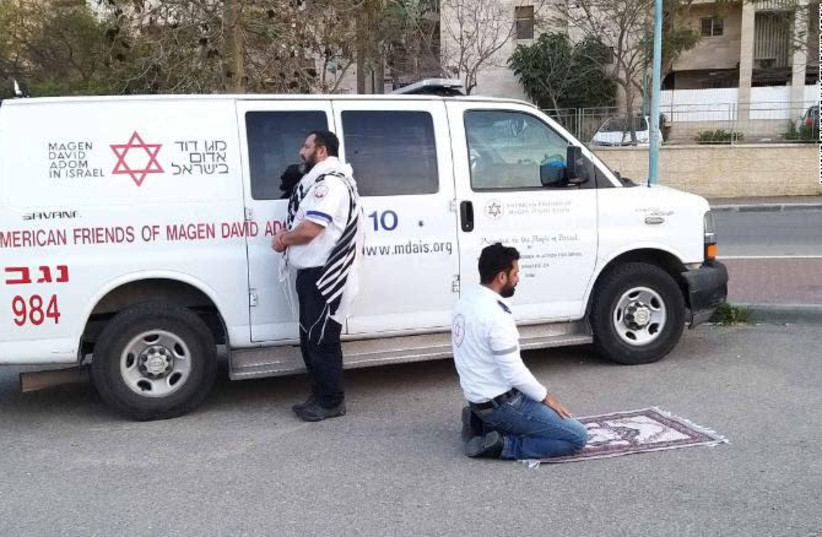
“Little is known about the collaboration of Israeli and Palestinian tour operators,” says Yossi Orbach, CEO of Israel’s leading tour operator, Tourist Israel, “we stay in close touch with our Palestinian partners and support them during these hard times. This crisis has many Israelis realizing now that we have much more similarities with Palestinians than differences.” Tourist Israel operates a daily Jerusalem, Dead Sea, & Bethlehem tour and an annual Christmas Eve in Bethlehem tour in close collaboration with a local Palestinian operator. Tourist Israel’s founder, Ben Julius, is proud to welcome tourists to experience the Israel and Palestine that the media doesn’t highlight. He points to the viral photograph of two Magen David Adom volunteers, one Jewish and one Muslim, taking a break from saving lives to pray together. “This photo is so moving and has rightfully attracted a lot of attention, but for many people, this is life in Israel. There is a lot of coexistence and interconnectedness that the rest of the world doesn’t see. The tourism industry has played a vital role in promoting collaboration between Israelis and Palestinians, and can serve as an example for other sectors as well”.

Economic cooperations are vital in other sectors as well: approximately 120,000 Palestinian laborers work in Israel in the fields of construction, agriculture and services. The travel restrictions imposed to fight the coronavirus have forced Israeli and Palestinian government officials to work together to find solutions aimed at reducing the risk of cross-border transmissions while trying to minimize disrupting the jobs and labor that both economies rely on. To achieve this, Israel approved for the first time ever for tens of thousands of Palestinian day workers to stay overnight within its borders and even assists in arranging housing solutions for them.

Latma 2020 Episode 4 for Passover under Corona clouds - Let this virus go


Monday, November 27, 2006

  • Monday, November 27, 2006
  • Elder of Ziyon
A British website named Palestine-info is associated with Hamas, so it is a good English resource to see exactly how they think when the wishful thinkers are saying otherwise.

On that site they have a handy-dandy almanac of important dates in Palestinian history. Since I am always willing to learn new things, I re-ordered the imporant dates to go by year rather than by month, so we can see all the important dates in Palestinian history, according to Hamas.

I was always wondering about that rich Palestinian Arab history that we hear has been there since time immemorial, so I expected that many gaps of Western knowledge of the history of the land would be filled by a news organization.

Once the almanac is sorted, here are the first entries:
8/12/636The Romans were defeated by the Muslims in Al Yarmouk Battle, so Palestine has been a part of the Islamic State since then.
7/15/1099The Crusaders occupied Jerusalem and killed more than 70,000 Muslims around Al Aqsa.
10/2/1187Saladin restored Jerusalem from the Crusaders.
9/6/1260The Mamlouks defeated Tattar in Ein Jalout Battle in north Palestine.
4/20/1779Napoleon called for the Jews all over the world to join his forces so they could enter Palestine easily.
2/7/1799The French expedition led by Napoleon was initiated in order to invade and occupy Palestine.
5/2/1799The end of the French expedition after Napoleon had failed to conquer Akka.
8/29/1897The first Zionist conference was held in Basl, Switzerland, presided by Haim Hertzl, who had chosen Palestine as a homeland for the Jews.
4/27/1909Sultan Abdel Hameed was dethroned by the Turkish Society members, which marked the end of the Islamic Caliphate because he prevented the Jews from entering Palestine in 1900.
5/16/1916Sicous-Picot agreement was signed by Britain and France to divide Palestine.
11/2/1917Britain issued the Balfour Promise to establish the Jewish State in Palestine.
12/9/1917The British General Allenby occupied Jerusalem.
1/7/1919The first Palestinian conference was held and Palestine was considered a part of Syria.

It seems a little sparse, perhaps, in the years before 636 and there are some pretty huge gaps between 636 and the Crusades, and from 1260 to Napoleon.

I also don't see any mention of famous Palestinian Arab poets, writers, artists or even warriors. Seems strange.

I'm also surprised - in 1919, Palestine was considered by Arabs to be a part of Syria? For a land with such supposed significance in Arab history? (See here for another example of Palestine being considered a part of Syria - in the 10th century.)

Anyway, the entire fictionalized history of the area is just too good not to share, so forgive me for this long post but if you want to see how thoroughly distanced the Palestinian Arabs are from the truth, this gives a very good indication. I highlighted some items of interest, like massacres disguised as "rebellions" but everyone will certainly find some gems here. I am sure that some other bloggers will have their own comments on this twisted look at history, both by what is highlighted as well as what is missing.


8/12/636
The Romans were defeated by the Muslims in Al Yarmouk Battle, so Palestine has been a part of the Islamic State since then.
10/2/1187
Saladin restored Jerusalem from the Crusaders.
7/15/1099
The Crusaders occupied Jerusalem and killed more than 70,000 Muslims around Al Aqsa.
9/6/1260
The Mamlouks defeated Tattar in Ein Jalout Battle in north Palestine.
4/20/1779
Napoleon called for the Jews all over the world to join his forces so they could enter Palestine easily.
2/7/1799
The French expedition led by Napoleon was initiated in order to invade and occupy Palestine.
5/2/1799
The end of the French expedition after Napoleon had failed to conquer Akka.
8/29/1897
The first Zionist conference was held in Basl, Switzerland, presided by Haim Hertzl, who had chosen Palestine as a homeland for the Jews.
4/27/1909
Sultan Abdel Hameed was dethroned by the Turkish Society members, which marked the end of the Islamic Caliphate because he prevented the Jews from entering Palestine in 1900.
5/16/1916
Sicous-Picot agreement was signed by Britain and France to divide Palestine.
11/2/1917
Britain issued the Balfour Promise to establish the Jewish State in Palestine.
12/9/1917
The British General Allenby occupied Jerusalem.
1/7/1919
The first Palestinian conference was held and Palestine was considered a part of Syria.
1/10/1919
The peace conference was held in Paris to lay out the new charts of the world after the First World War.
6/10/1919
King-Krine committee began its operations in Palestine to find out about the good intentions of the Arab States.
4/4/1920
The rebellion of Al Nabi Mousa or the rebellion of the Twenty broke out.
4/26/1920
San Remo conference was held to confirm the Balfour Promise for the Jews to establish their State.
7/1/1920
The British Mandate was started in Palestine by appointing Herbert Samuel as the first Supreme Deputy in Palestine.
10/20/1920
Herbert Samuel, the British supreme deputy in Palestine, began his efforts to encourage the Jews to buy more land and estates.
1/15/1921
The British ministry of settlements took over the authority in Palestine from the foreign affairs ministry.
5/1/1921
Jaffa rebellion broke out when the British supported the Jews against the Palestinians.
6/5/1921
The Palestinian conference was held in Jerusalem to send a delegation to London to explain the Palestinians' attitude toward the Balfour Promise.
7/6/1921
The UN approved the British Mandate in Palestine.
7/3/1922
The British government issued the second "White Book" to interpret the Balfour Promise and to assure the Arabs of their good intentions by their Prime Minister Winston Churchill.
7/24/1922
The UN approved the British Mandate in Palestine.
8/10/1922
The British government issued the Palestinian constitution preceded by a statement of the Balfour Promise.
8/14/1922
Herbert Samuel became the first British Supreme Deputy in Palestine.
9/29/1923
The British Mandate in Palestine went into effect.
8/2/1926
The British Minister of Settlements issued new Palestinian currency, and created a currency committee.
2/21/1927
The British minister of settlements announced that the Palestinian currency would replace the Egyptian.
8/16/1929
The rebellion of Al Buraq broke out.
9/13/1929
The British government appointed a committee presided by the chief judge Walter Shaw and three other members to investigate the reasons behind Al Buraq rebellion.
6/17/1930
Three heroes of Al Buraq rebellion were executed
10/31/1930
Another "White Book" was issued by the British minister of settlements, Lord Basfield, limiting the number of emigrant Jews to Palestine.
12/7/1931
The Islamic conference was opened in Al Aqsa to defend and protect the Holy Shrine in Jerusalem.
10/10/1933
The great Jerusalem demonstration broke out to protest the miserable conditions in Palestine.
10/27/1933
Mr. Mousa Kathem Al Husseini was shot down as a martyr in the great demonstration in Jaffa.
1/25/1935
The first conference of the Palestinian scholars was held and was presided by Al Haj Ameen Al Husseini.
11/19/1935
Sheikh Ezzul Deen Al Qassam was shot down as a martyr at Ya'bad woods.
4/15/1936
The great rebellion broke out throughout Palestine and ended in October.
7/7/1936
Bill British Committee recommended dividing Palestine into an Arab and Israeli State.
10/12/1936
The end of the great rebellion.
11/11/1936
A Royal British committee, "Bill committee", arrived in Palestine to investigate the reasons behind the great rebellion.
10/2/1937
The second great rebellion broke out and lasted till 1939.
11/28/1937
Sheikh Farhan Al Sa'ady was executed by the British when he was 80 years old and while he was fasting. He is the comrade of Sheikh Ezzul Deen Al Qassam.
1/4/1938
The British deputy in Palestine was notified by the minister of the settlements that the latter had sent a delegation to Palestine to consider the feasibility of the division resolution.
1/6/1938
A massacre was carried out by the Israeli forces in the village of Atteel where several women and children were killed, mosques were violated, and copies of the Holy Qur'an were torn up.
10/7/1938
An Arab-Islamic conference was held by an Egyptian committee in Cairo to condemn and decry the Balfour Promise.
2/7/1939
The Round Table Conference was held in London between some Arab delegations and a Jewish delegation.
3/27/1939
The leader of the Second Great Rebellion, Abderraheem Al Haj Mohammed was martyred, and the British soldiers saluted him even though he was dead.
5/17/1939
The British government issued the White Book in which they divided Palestine into three regions
7/1/1942
The British minister of settlements declared that the Jewish defense organizations are the same as the National Guard in Britain.
4/5/1945
The American president Roosevelt announced that the USA would not take any political procedures without referring to the Arab States, and the USA would not be against the Arabs in the Palestinian question.
8/30/1945
The American president Harry Truman asked for permission to allow hundreds of thousands to enter Palestine.
11/13/1945
An Anglo-American committee was formed to investigate the conditions of the Jews who were persecuted by the Nazis in Europe, and to find out about their socio-economic and political conditions in Palestine.
5/10/1946
The American secretary of state deputy Dean Etchison was sent to five Arab States to assure them that the USA would not take any decisions concerning the Anglo-American investigating committee without referring to both Arabs and Israelis.
5/28/1946
A conference was held by the Arab leaders in Anshasi, Egypt, to discuss the Palestinian question.
7/22/1946
King David Hotel in Jerusalem was blown up by the Argon gangsters result in the killing of 95 Arabs and Jews.
2/14/1947
The British government announced that the Palestinian question "cause" would be referred to the United Nations.
4/2/1947
The British government asked the Secretary General of the UN to include the Palestinian question in the agenda of the General Assembly meeting.
5/21/1947
A group of Al Hagana terrorists attacked a coffee shop at Faja near Btah Tekfa, killing a Palestinian and injuring 17 others; they also put explosives all over the area.
8/14/1947
The American president Harry Truman put forward his proposal to the British. The proposal was approved at the Zionist conference in Paris, and it granted the Jews the International Zone according to Bill Proposal, in addition to Al Naqab.
8/31/1947
The UN special committee completed its report about Palestine and presented it to the General Assembly of the UN.
9/10/1947
The first conference about Palestine was held and attended by Arab and British delegations except the Palestinians.
11/13/1947
The British representative at the UN declared that Britain would have to withdraw from Palestine by May.
11/29/1947
The UN voted on the division resolution of Palestine
12/18/1947
The Supreme Arab Board was formed at the conference held in Bloudan, Syria.
12/25/1947
The Holy War Troops (Al Jehad Al Muqades) were formed in Palestine presided by the leader Abdel Qader Al Husseini.
1/1/1948
Another massacre was committed by the Israeli forces in Safad.
1/25/1948
The arrival of the first troops of the Rescue Army led by Fawzy Al Qaweqjy.
3/3/1948
Haim Weisman was promised by the American president Harry Truman that the latter would help the Jews to establish their State with full recognition.
3/11/1948
Anthon David, a young Palestinian working as a driver for the American ambassador, bombed the Jewish Agency killing 36 and injuring hundreds.
3/19/1948
The UN Security Council approved an American proposal to abolish the division resolution.
4/9/1948
Deir Yassin massacre was committed by the terrorist Menachem Begin and his gangsters. More than 250 Palestinian were killed, mainly old people, women and children.
4/9/1948
The great leader Abdel Qader Al Hussien was martyred.
4/17/1948
The General Assembly of the UN agreed on the truce resolution between the Israelis and the Arabs after the 1948 war.
4/20/1948
The executive committee of the Zionist movement elected David Ben Gurion as president and defence director to replace the British.
4/23/1948
A conference was held in Amman by several Arab ministers and prime ministers to approve the participation of the Arab armies in the 1948 war or the Rescue War in Palestine.
5/9/1948
The Arabs adopted the truce treaty with the Israelis.
5/14/1948
The temporal state council of Israel declared the new Israeli State.
5/15/1948
The Arab armies, known as Rescue Army, entered Palestine.
5/15/1948
The USA recognized the new Israeli State.
5/18/1948
The USSR also recognized the new Israeli State.
6/11/1948
The first truce treaty was signed by the Arabs and the Israelis after the 1948 war, which was considered as recognition of the new Israeli State.
9/17/1948
The Zionist gangsters shot down the UN peace mediator, Count Folk Bernadot.
10/1/1948
Palestine was declared independent by the supreme Arab Board.
1/25/1949
David Ben Gurion became the first Prime Minister of Israel.
3/10/1949
The Israeli forces occupied the village of Um Al Rashrash (Elat) after they had occupied Al Naqab.
5/11/1949
Israel was accepted as a member of the United Nations.
5/12/1949
Lozan Protocol was signed by Israel and some Arab States such as Egypt, Jordan, Lebanon and Syria.
12/8/1949
The UN formed UNRWA to look after and employ the Palestinian refugees in the neighbouring countries.
12/16/1949
David Ben Gurion, the Israeli Prime Minister, declared Jerusalem as the unified capital of Israel.
4/24/1950
The two Banks of the Jordan River were unified in one State in a conference held in Jericho.
9/1/1951
Sea navigation was prohibited through the Suez Canal.
10/14/1952
The Israeli forces committed a massacre in the village of Qebya west of Ramallah, and killed 42 people and destroyed 41 houses.
6/26/1953
The Israelis transferred the property of the absentees to the department of development and reckoned its price as a loan.
2/28/1955
The Israeli forces attacked the Gaza Strip and shot down 38 martyrs and injured countless others.
1/1/1956
Al Azhar Mosque issued a fatwa considering peace with the Israelis illegal and taboo.
3/14/1957
The Israeli forces completely withdrew from the Gaza Strip after the Triplex invasion against Egypt.
3/9/1959
The Arab League suggested a conference to recognize Palestine as a united entity and nation.
9/19/1963
Mr. Ahmed Al Shuqeiry was appointed as a Palestinian representative for the Arab League.
5/28/1964
The first National Palestinian Council was held in Jerusalem to establish the Palestinian Liberation Organization (PLO).
11/4/1966
The joint defense treaty was signed by Egypt and Syria against Israel.
11/13/1966
The Israeli forces attacked Al Samou', a village near Hebron, and killed 18 people, injured 54 people and destroyed 125 houses.
6/5/1967
The Israeli fighters raided ten Arab air bases in Egypt, as well as Jordan, Syria and Lebanon.
6/7/1967
The Israeli forces occupied the West Bank, the Gaza Strip, the Sinai Peninsula and the Golan Heights.
6/27/1967
The Israeli Parliament decided to annex East Jerusalem and authorized the government to carry out this order.
6/28/1967
The Israeli minister of interior declared the annexation of some parts of Jerusalem to unify the whole city.
11/22/1967
The Security Council issued resolution No. 242 in which Israel was called upon to withdraw from the territories occupied in the June war of 1967.
11/29/1967
The UN delegate Yaring began his 15-round peace initiative to settle down the Arab-Israeli conflict.
3/21/1968
Al Karameh battle took place when both Jordanian and Palestinian forces repelled and defeated the Israeli forces incurring great losses.
3/8/1969
The Attrition War between Israel and Egypt began on the Suez Canal front.
4/9/1969
The end of UN Deputy Yaring's initiative. Hoever, he failed to solve the Arab-Israeli conflict.
8/21/1969
Al Aqsa Mosque was set on fire by the Australian tourist Michael Rohan, urged by the Israelis.
8/8/1970
The attrition war between Egypt and Israel was stopped.
9/19/1970
The conflict between the Palestinian forces and the Jordanian army broke out, known as Fitneh.
10/6/1973
Ramadan War broke out against Israel on the Syrian and Egyptian fronts.
10/17/1973
Oil was used as a weapon against the West by the Arabs in Kuwait by decreasing the production 5% monthly.
10/22/1973
The Security Council issued its resolution No. 338 to confirm a cease fire between the Arabs and the Israelis asking them to abide by resolution No. 242.
11/5/1973
The American Secretary of State Richard Nixon began his peace initiative to disengage the Syrian, Egyptian and Israeli forces after the Ramadan war.
11/27/1973
The PLO was recognized as the sole legal representative of the Palestinians at the Arab Summit Conference in Algeria.
12/21/1973
The peace conference was held in Geneva, Switzerland, by the Arabs and the Israelis, patronized by the USA and the USSR.
1/18/1974
The forces separation agreement was signed as a result of the Ramadan War.
5/6/1974
The Israeli forces began shelling the Palestinian camps in Lebanon.
10/14/1974
The General Assembly adopted resolution No. 3210 inviting the PLO to take part in the debate.
10/28/1974
Al Rebat Summit Conference was held and the PLO was recognized as the legal representative for the Palestinians.
4/13/1975
The civil war began in Lebanon between the Christians and the Muslims.
5/22/1975
Yasser Arafat announced that he had not had any hostility toward Israel, and he is keen on establishing a democratic State for both Arabs and Israelis.
11/10/1975
The General Assembly of the UN adopted resolution No. 3379, which considers Zionism a racial movement.
2/8/1976
An Israeli court allowed the Jews to pray on the mountain of Al Haykal in the Holy Shrine of Jerusalem.
8/12/1976
The massacre of Tel Al Za'ater was committed by the Christian Militia in collaboration with the Israeli forces.
11/19/1977
The Egyptian president Anwar Sadat was the first Arab leader to enter Israel since it was founded.
9/18/1978
Camp David peace treaty was signed by the Egyptian president Anwar Sadat and the Israeli Prime Minister Menachem Begin under the patronage of the USA president Jimmy Carter.
3/26/1979
The peace treaty between Israel and Egypt was signed by President Anwar Sadat and Israeli Prime Minister Menachem Begin in Washington, Camp David, under the patronage of the United States of America.
4/19/1979
The women of Keryat Arba'a occupied Beit Hadassa in Hebron to revive the Jewish quarters in the city.
9/16/1979
The Israeli government allowed the Jews to buy the Arab land and estates.
7/30/1980
The Israeli Parliament declared Jerusalem the unified capital of Israel.
9/22/1981
The Palestinian occupied territories were ruled by the Israeli civil laws.
11/1/1981
The application of civil management in the West Bank and Gaza Strip presided by Menachem Milson.
6/6/1982
The Israeli forces began attacking south Lebanon to destroy the infrastructure of the PLO installations.
8/6/1982
The Israeli forces entered west Beirut.
9/17/1982
Sabra and Shatilla massacre was carried out by the Israeli forces aided by the Christian militia.
2/7/1983
Kahan committee submitted a report on the massacre that took place at Sabra and Shatilla indicating that Sharon was responsible for it, so he resigned from the ministry of defense but he remained in the cabinet.
5/20/1985
The Israeli forces released 1,145 Palestinian captives for releasing three Israeli soldiers that had been confined by the members of the People's Front--the Headquarters, in Al Jaleel operation.
8/2/1985
The Israeli forces adopted the steel-fist policy against the Palestinian protests.
12/9/1987
The starting of the Palestinian Blessed Intifadah.
12/14/1987
The Islamic Resistance Movement (HAMAS) was declared by issuing its first manifestation "statement" about the Intifadah.
1/21/1988
Issa'ac Rabin, the Israeli minister of defense, announced his policies of violence and beating against the Palestinian Intifadah.
2/2/1988
The Israeli forces closed the Palestinian schools and university.
4/10/1988
Several members of the Palestinian police in Gaza and the West Bank resigned.
4/16/1988
Mr. Khaleel Al Wazeer (Abu Jehad) was assassinated by the Israeli special force led by Yahoud Parak in Tunis.
7/31/1988
King Hussein of Jordan declared the legal disengagement between the two Banks after a 38-year consolidation.
8/18/1988
The Charter of the Islamic Resistance Movement (HAMAS) was declared.
11/15/1988
The Palestinian State was declared by the National Palestinian Council held in Algeria. This State consists of the West Bank and Gaza Strip, and Jerusalem is its capital. The declaration is an implicit recognition of the Israeli State comprising the rest of Palestine.
12/14/1988
The USA decided to take up a dialogue and debate with the PLO.
5/15/1989
The Israeli forces arrested Sheikh Ahmed Yassin, accusing him of establishing the Islamic resistance movement "HAMAS".
10/8/1990
More than 30 Muslims were shot down as martyrs and 115 were injured by the Israeli forces around Al Aqsa.
3/6/1991
The USA drew up a peace initiative to solve the Arab-Israeli conflict.
10/30/1991
Madrid peace conference was held by the Arabs and the Israelis, patronized by the USA and the USSR.
12/17/1992
Four hundred and fifteen members of HAMAS were deported by the Israeli forces to Marj Al Zuhour in South Lebanon.
9/13/1993
Oslo Principles Treaty was signed by the Israelis and the Palestinians.
11/24/1993
Mr. Emad Aqel, a prominent member of HAMAS, was shot down as a martyr in a confrontation with the Israeli forces.
2/24/1994
Israeli terrorist Goldstein massacred worshippers performing Friday dawn prayers at the Ibrahimi Mosque in Hebron with the help of Israeli police forces.
5/4/1994
Israel and the PLO signed in Cairo the Palestinian autonomy agreement in Gaza and Jericho.
5/18/1994
The first troops of the Palestinian police entered Gaza and Jericho.
5/23/1994
The first crime of murder committed by the Palestinian police forces against a Palestinian citizen.
7/1/1994
Yasser Arafat, the PLO chief, entered Gaza as president of the Palestinian Authority.
7/5/1994
The members of the Palestinian Authority took a legal oath in front of Yasser Arafat in Jericho.
8/14/1994
The Palestinian Authority forces arrested several Palestinians who opposed the peace process along with members of HAMAS.
10/26/1994
The peace treaty was signed by the Israelis and the Jordanians under the patronage of the American president Bill Clinton.
11/18/1994
The Palestinian police killed 12 Palestinians and wounded 200 in a protest after Friday's prayers in Gaza.
2/7/1995
The first State security court was established by Yasser Arafat, the chief of the Palestinian Authority.
4/2/1995
Kamal Khaleel, the leader of Ezzul Deen Al Qassam Brigades, was assassinated in Gaza.
4/11/1995
The Palestinian minister of justice, Freih Abu Madein, decided to disarm the Palestinians in order to weaken the Islamic resistance.
7/24/1995
The American authorities arrested Dr. Mousa Abu Marzook, the chief of the political wing of HAMAS, at JFK in New York, USA.
9/24/1995
Taba transitional treaty was signed by Yasser Arafat and Shamon Perez in Cairo about the execution of the National Authority in the occupied territories.
10/26/1995
Mr. Fathi Al Sheqaqy, the chief of the Islamic Jehad, was shot down as a martyr in Malta by the Israeli Intelligence agents.
11/4/1995
Mr. Ishha'ac Rabin, the Israeli ex-Prime Minister, was assassinated by the extremist Yegal Amir. This was the first politically-driven assassination in Israel.
1/6/1996
Engineer Yahya Ayyash, the leader of the martyr troops of Ezzul Deen Al Qassam Brigades, was assassinated, after a four-year chase, by Al Shabak agents. They detonated an explosive in his mobile phone.
3/12/1996
A conference was held in Sharm Al Sheikh to condemn all forms of terrorism, and considered the daring martyr operations against Israeli forces as terrorist acts. They also decided to chase and suppress the resistance movements all over Palestine.
4/24/1996
The National Palestinian Council was held in Gaza to abolish the items of the National Charter that are against Israel.
5/29/1996
Israeli Likud Party presided by Netanyahu took over authorities in Israel.
1/15/1997
A partial agreement was signed by both Israelis and the Palestinian Authority regarding the deployment of forces in Hebron after it had been divided between the two sides.
9/25/1997
Mr. Khaled Misha'al, the chief of the political wing of HAMAS, escaped an assassination attempt planned by the Israeli Intelligence agents in Amman.33 members supported it, 13 opposed, and 10 were neutral. An international committee was formed to take over the British authorities in Palestine.
10/1/1997
Sheikh Ahmed Yassin was released by the Israeli forces.
10/6/1997
Sheikh Ahmed Yassin came back home after having been hospitalized in Amman.

Tuesday, January 04, 2005

Palestinian Word Games
By Daniel Pipes, January 4, 2005

New York Sun*
January 4, 2005

We read that "Prime Minister" Mahmoud Abbas is running in the elections on Sunday to succeed Yasser Arafat as "president" of "Palestine."

Excuse me, but prime minister, according to the Encyclopedia Britannica, means the "head of the executive branch of government in states with a parliamentary system." Despite tens of thousands of references to Mr. Abbas as prime minister, he in not a single way fits this description.

Oh, and there is also the matter of there being no country called Palestine. Arab maps show it in place of Israel. The U.N. recognizes its existence. So too do certain telephone companies – for example, France's Bouygues Telecom and Bell Canada. Nonetheless, no such place exists.

One can dismiss use of these terms as symptoms of the same unrealism that has undermined Palestinian Arab war efforts since 1948. But they also promote the Palestinian cause (a polite way of saying, "the destruction of Israel") in a vital way.

In an era when the battle for public opinion has an importance that rivals the clash of soldiers, the Palestinian Arabs' success in framing the issues has won them critical support among politicians, editorial writers, academics, street demonstrators, and NGO activists. In the aggregate, these many auxiliaries keep the Palestinian effort alive.

Especially in a long-standing dispute with a static situation on the ground, public opinion has great significance. That's because words reflect ideas – and ideas motivate people. Weapons in themselves are inert; today, ideas inspire people to pick up arms or sacrifice their lives. Software drives hardware.

Israel is winning on the basic geographic nomenclature. The state is known in English as Israel, not the Zionist entity. Its capital is called Jerusalem, not Al-Quds. Likewise, Temple Mount and Western Wall enjoy far more currency than Al-Haram ash-Sharif or Al-Buraq. The separation barrier is more often called a security fence (keeping out Palestinian suicide bombers) than a separation wall (bringing to mind divided Berlin).

In other ways, however, the Palestinian Arabs' wording dominates English-language usage, helping them win the war for public opinion.

*

Collaborator means someone who "cooperates treasonably" and brings to mind the French and Norwegian collaborators who betrayed their countries to the Nazis. Yet this term (rather than informant, mole, or agent) universally describes those Palestinian Arabs providing Israel with information.
*

Refugee status normally applies to someone who, "owing to a well-founded fear of being persecuted . . . is outside the country of his nationality," but not to that person's descendants. In the Palestinian case, however, children, grandchildren, and great-grandchildren of refugees also merit refugee status. One demographer estimates that more than 95% of so-called Palestinian Arab refugees never fled from anywhere. Nonetheless, the term continues to be used, implying that millions of Palestinian Arabs have a right to move to Israel.
*

A settlement is defined as a small community or an establishment in a new region. Although some Jewish towns on the West Bank and in Gaza have tens of thousands of residents and have existed for nearly four decades, settlement, with its overtones of colonialism, is their nearly universal name.
*

Occupied territories implies that a Palestinian state existed in 1967, when Israel captured the West Bank and Gaza. That was not the case, making these areas legally disputed territories, not occupied ones.
*

Cycle of violence, a term President George W. Bush has adopted ("the cycle of violence has got to end in order for the peace process … to begin"), implies a moral equivalence between the killing of Israeli civilians and Palestinian Arab terrorists. It confuses the arsonist with the fire department.
*

The peace camp in Israel – a term that derives from Lenin's usage – refers to those on the left who believe that appeasing mortal enemies is the only way to end Palestinian aggression. Those in favor of other approaches (such a deterrence) by implication constitute the "war camp." In fact, all Israelis are in the "peace camp" in the sense that all want to be rid of the conflict; none of them aspires to kill Palestinian Arabs, occupy Cairo, or destroy Syria.

Arabs may have fallen behind Israel in per capita income and advanced weaponry, but they lead by far on the semantic battlefield. Who, a century back, would have imagined Jews making the better soldiers and Arabs the better publicists?

Thursday, April 10, 2014

From Ian:

The Crisis in the Peace Talks Was Pre-Planned by the Palestinians
Although Abbas repeats the mantra of a “peaceful struggle” in tandem with the diplomatic campaign, in practice terror continues, including attempts to murder both Israeli civilians and security forces. Furthermore, the PA signals unequivocal support for terror by demanding the immediate release of all the Palestinian prisoners, many of whom were sentenced to lengthy prison terms for their role in terror attacks and the murder of Israeli civilians, including suicide bombings. These terrorists are treated as heroes by the PA, which also provides them a very generous basket of economic and social benefits; their average salary while in prison is even higher than that of members of the security forces.
The PA revealed its true face when it officially requested the Islamic terrorist organizations, Hamas and Islamic Jihad, to participate in a meeting of the Palestinian National Council, which is supposed to elect a new Palestinian leadership to serve as a temporary government of the Palestinian state. The PA does not view Hamas and Islamic Jihad as terrorist organizations but, rather, as legitimate political groups that can be part of the Palestinian government.
The PA is preparing the ground in stages for de facto international recognition of a Palestinian state along the 1967 lines that is under “Israeli occupation,” and all that will remain is the official declaration of the state’s establishment.
The demand for full Palestinian sovereignty along the 1967 lines also entails Palestinian control over the border crossing between the West Bank and Jordan, with likely major implications for the stability of the Hashemite Kingdom, which has a Palestinian demographic majority. Paradoxically, Israel’s accommodation under the presence circumstances of the Palestinian demand for sovereignty over the border with Jordan would likely prompt U.S., European, and, of course, Jordanian pressures on Israel to avoid such a transfer of authority and maintain its military presence in the West Bank.
Respond Firmly to Palestinian Blackmail
Unilateral measures and threats should be answered in kind. After all, Israel is the stronger party and can inflict much greater pain on the Palestinians than the PA can inflict upon Israel. Perhaps the PA needs to be reminded of this. Raw power politics is what everybody understands in the Middle East. In this region, fear is a better political currency than compassion and fairness.
The Palestinian threats to challenge Israel at the UN and in international organizations are empty. Nothing can change the reality on the ground without the acquiescence of Israel. For example, the acceptance of Palestine by UNESCO did not change the lives of the Palestinians one iota. Israel should also stop fearing Palestinian accusations at the International Criminal Court. Regular concessions to the Palestinians for not taking this course of action expose Israel to continuous blackmail. It is time to call the Palestinian's bluff and make the PA face the consequences.
Hopefully, Israel's government will kick the habit of paying the Palestinians for their participation in sham peace talks. Rather it is high time to remind the Palestinians that decisions in Jerusalem, to a large extent, determine their fate, and that only real negotiations and compromise with Israel can give them the state they desire. (h/t Bob Knot)
Peace process peters out
Blessed are the peacemakers. But don't confuse peacemakers with peace processors. The latter think they can persuade the lion to lie down with the lamb. The former are realistic enough to grasp how perilous that is unless the lion has just had a big dinner and a couple of stiff drinks.
Sad to say, Secretary of State John Kerry has proven to be a peace processor, one loath to acknowledge that the latest round of Palestinian-Israeli peace talks have come to a very dead end. Actually, they never moved off the starting blocks.

Wednesday, October 05, 2016

From Ian:

It is time to break up the Quartet
For different reasons, each of the four Quartet members is unqualified to negotiate an Israeli-Palestinian agreement.
• The EU: when not involved in promoting the Boycott, Divestment and Sanctions (BDS) movement, attempting to sanction Israeli citizens, or labeling food from Israel (all the easier to boycott), the European Union (an increasingly oxymoronic term) is busy negotiating its own continued existence. It has never been a neutral arbiter in Israeli-Palestinian negotiations.
Jennifer Rubin noted three years ago that the EU “strives for relevance but its anti-Israeli tendencies make it particularly unsuited to play any constructive role in the Israeli-Palestinian conflict.” The EU was also instrumental in the UN’s International Court of Justice’s (ICJ) denunciation as illegal Israel’s wall that ended the wave of successful Palestinian suicide bombers. Its statement on November 18, 2003, declared that: “Palestinian land has been confiscated to build the wall.” Fortunately the ICJ’s rulings are non-binding, including the order for Israel to compensate the Palestinian people for inconveniences the wall had caused.
• The UN: like the EU, the UN has been reliably in favor of the Palestinians and opposed to Israel ever since it voted to divide the former British Mandate into two nations. Since then it has denounced Israeli “occupation” 2,342 times and “settlements” 256 times, as compiled by Eugene Kontorovich and Penny Grunseid.
Meanwhile, it ignores or rationalizes Palestinian terrorism. In January of this year, UN Secretary General Ban Ki-moon excused Palestinian terrorism by noting that “it is human nature to react to occupation.”
• Russia: the nation that in the past decade has invaded Ukraine and Georgia, and annexed Crimea, has no moral standing in negotiations over which territories will comprise a Palestinian state. Historically, Russia has supported Palestinian terrorism. Palestinian Authority President Mahmoud Abbas earned his PhD in Holocaust denial at a Russian university. And Russia is an avowed ally of Israel’s enemies – Iran and Syria especially.
• The US: once upon a time the fourth member of the Quartet could be relied upon to defend Israel from attacks at the UN, but not under this president. Obama feigned outrage over the Russians interfering in the US election, but did little to conceal his interference in the Israeli election, sending his own campaign pros and spending American taxpayer funds in an attempt to ensure the defeat of Benjamin Netanyahu. Many interpreted the line about “building a wall” in Obama’s final speech to the UN as a shot at Trump, but it seems more likely a shot at Israel.
According to its mandate, the Quartet was created “to help mediate Middle East peace negotiations and to support Palestinian economic development and institution-building in preparation for eventual statehood.”
The problem is that the Palestinians have refused statehood repeatedly for one reason: it could not coexist with a State of Israel. Yasser Arafat’s insistence on a “right of return” that would flood a nation of eight million Jews with twice as many Muslims ended the 2000 Camp David talks. The stated purpose of the Quartet is untenable until the Palestinians change. As Golda Meir purportedly said: “We will only have peace with the Arabs when they love their children more than they hate us.”
The only redeeming value of the Quartet (and the real miracle of the past eight years) is that Obama didn’t turn it into a Quintet by installing Iran as the fifth member.

Khaled Abu Toameh: Europe's "Good Terrorists": Because They Might Destroy Israel?
Hamas spokesman Sami Abu Zuhri would like the Europeans to understand that they need not worry about terrorism by the Islamist movement because the attacks will be directed only against Israel.
The European Court of Justice (EJC) is sending the message to Hamas that Europeans see no problem with Hamas's desire to destroy Israel and continue to launch terrorist attacks against Jews. This message also undermines those Palestinians who still believe in a peace with Israel.
The EJC recommendation to remove Hamas from the EU's terrorism blacklist comes at a time when countries such as Egypt, Jordan, the United Arab Emirates and even Saudi Arabia, as well as the Palestinian Authority, are doing their utmost to weaken Hamas.
Appeasing terrorists is a dangerous game: it has already backfired on its foolhardy players and will continue to do so. This is exactly how Muslims conquered Iran, Turkey, North Africa and much of Europe, including Hungary, Greece, Poland, Romania, and the Balkans -- countries that still recall a real "occupation," an Islamist one, and abundantly want none of it.
The EU and the ECJ need to be stopped before they do any more harm to Palestinians, Christians and Jews -- or to Europe.

Tuesday, May 16, 2023

From Ian:

The tragedy of the Palestinians
More recently, Iran has come to play more of a role in the Palestinian tragedy. Its aim is to bolster its regional presence at the expense of Israel. So it has provided substantial backing to the heavily armed Hezbollah militia of Shiite Muslims in Lebanon as a way of threatening Israel. It has also supported Islamist terrorist groups among the Palestinians, such as Hamas and Palestinian Islamic Jihad.

These Palestinian Islamist groups, as I have previously argued, do not support Palestinian self-determination. On the contrary, they share the Islamist goal of creating a transnational Islamic order. They are hostile to national self-determination. The Palestinians are being used to lead a fight for an Islamist order that transcends national borders.

Finally, there is the UN itself. It has a special organisation, the United Nations Relief and Works Agency (UNRWA), formed in 1949, charged with dealing with the large number of Palestinians still deemed as refugees in the West Bank, Gaza and the surrounding countries. This is separate from the UNHCR, which deals with refugees around the world.

The problem with the UNRWA is that it helps perpetuate the refugee status of many Palestinians. There are now not only first-generation refugees, but also those deemed second- and third-generation and beyond. Rather than encourage the Palestinians to integrate with the local populations, the UNRWA works to keep them separate. In Lebanon, many Palestinians are forced to live in UNRWA-run refugee camps, attend UNRWA-run schools and rely on meagre handouts from the agency.

The conflict between Israel and the Palestinians has proven to be extremely intractable. But a precondition for its resolution is for numerous outside forces to stop interfering. Presenting Israel as a universal oppressor inevitably promotes a crass narrative, with Israel cast as a fount of evil. Pushing the Palestinians into the role of universal victim is arguably even worse. It has proved to be another catastrophe for the Palestinian people.
Jordanian Journalist Voices Unusual Position: West Bank Is Part Of Jordan; Palestinian Authority Is Artificial Entity That Must Cease To Exist; We Should Seriously Discuss Reuniting The Two Banks Of The Jordan River
In a recent article in the daily Al-Ghad, Jordanian media figure Malik Al-'Athanmeh voices an unusual opinion, calling to seriously consider the option of reuniting Jordan and the West Bank. He criticizes the Arab states for refusing to recognize Jordan's annexation of the West Bank in 1950 and for recognizing the PLO as the sole legitimate representative of the Palestinian people.[1] Al-'Athamneh, a Jordanian who resides in Belgium and writes a regular column in Jordan's Al-Ghad, notes that the West Bank was part of the kingdom of Jordan from 1950 until1967, and that the Arab League initially opposed Jordan's annexation of this territory. However, it ultimately accepted this fact, and the UN later recognized it as well. He laments the fact that the "obsessive pan-Arabism" and "false delusions of heroism" of Gamal 'Abd Al-Nasser, president of Egypt at the time, swept Jordan and Syria into the 1967 war, in which all three countries lost territory to Israel and Jordan lost the West Bank.

According to Al-'Athamneh, the Arab League's recognition of the PLO as the sole legitimate representative of the Palestinian people, which was affirmed at the 1974 Arab League summit in Rabat, was a significant and "despicable" act that undermined the historical and geographical reality, namely that the West Bank is part of Jordan. Calling the PA an "artificial" entity that should cease to exist, he contends that the Jordanians should start talks with a "real and active" Palestinian partner about the option of reuniting the two banks of the Jordan river, which would benefit both sides.

It should be mentioned that Al-'Athanmeh disregards the decision taken by the Jordan's King Hussein on July 31, 1988, in which he severed the connection between Jordan and the West Bank, i.e., renounced any claim to Jordanian sovereignty over this territory and severed all legal and administrative ties with it, except for Jordan's custodianship over the Muslim holy sites in Jerusalem. With this move King Hussein relinquished his dream of forming a federation between Jordan and the West Bank, and affirmed Jordan's support for the establishment of an independent Palestinian state.

"In practice, the West Bank of the Jordan river used to constitute one half of the Hashemite Kingdom of Jordan, and all the debates about how to describe what happened at the Jericho Congress,[3] whether it was 'annexation' or 'unification,' will not change the geographical and historical [facts that prevailed] after April 24, 1950 [Jordan's official annexation of the West Bank]. On that [day], two years after the establishment of the state of Israel in 1948, the West Bank and its inhabitants became part of Jordan. In December 1949 the inhabitants of the West Bank had already been granted the right to apply for Jordanian citizenship.

"The Arab League opposed the unification of the two banks, and some Arab countries even demanded to expel Jordan from the [league for this]. In 1955, after Jordan joined the UN, the latter recognized the unification of the two banks, or the annexation of the West Bank. But the Arab League had already announced, on June 12, 1950, that the annexation was [merely] a practical and temporary measure and that Jordan would hold [the territory] in trust until [some other] arrangement could be made regarding it – a naïve statement that sought to rescue the self-respect of those who had opposed the reality [of Jordan's annexation of the West Bank].

Friday, February 03, 2012

  • Friday, February 03, 2012
  • Elder of Ziyon
Ban Ki Moon's speech at Herzliya was not a terrible speech by any means, but it was far from a good one.

Filled with cliches and UN boilerplate, it did not break any new ground.

It is strange that he completely glossed over the most important issue, Iran, and spent the bulk of the speech talking about Palestinian Arab aspirations and frustrations.

And when he did, although he thinks that he tried to take into account Israel's viewpoint, his words show that he misses the point.

A couple of examples:

The United Nations helped bring the State of Israel into this world. It did so in the name of peace, not war. Yet the Israeli-Palestinian conflict is entering its seventh decade.
No, the Israeli-Arab conflict is in its seventh decade. The Zionist-Arab conflict is now in at least its 14th decade. To call it the "Israeli-Palestinian" conflict is to completely misunderstand history, and how Arab nations have been using Palestinian Arabs as pawns since 1948.

So has the UN, via UNRWA, since at least 1960, as it has abandoned all pretext of solving the "refugee" problem and instead works to perpetuate it.

The current peace process began in Madrid more than 20 years ago. It raised high hopes - but delivered two decades of delay, mistrust and missed opportunities.
There are two reasons that the peace process has failed.

One is because the Palestinian Arab leadership has made a conscious decision that peace is less important than their pride, and they are unwilling to compromise over what they believe are their "rights" - and the UN is partially to blame, by giving them false hope for decades based on its one-sided resolutions supporting them again and again even when they were responsible for the most heinous crimes.

The other is because of a small thing called the Second Intifada, that was organized and led by Israel's so-called "peace partners." Moon is suggesting that they be rewarded for their reign of terror only a few years ago, and that they should gain more concessions than beforehand from the victims of that terror. The UN is not supposed toreward aggression, but this is what Moon is doing in this speech.

The creation of functioning and well-governed Palestinian institutions is clearly a strategic Israeli interest. Yet these advances are at risk. Why? Because the politics is not keeping pace with developments on the ground.
Here's a key point.

There is no doubt that the PA has made great progress in security and in some institution building. And there is no doubt that this helps Israeli, and Palestinian Arab, interests.

But if those gains are threatened by the lack of progress in negotiations, then that shows that there is a fundamental problem. It means that Palestinian Arab self-interest is not enough to concretize these gains. It means that the underlying Palestinian Arab psyche is not mature enough to build up and keep their own gains on the ground, and are willing to throw it away when they don't get what they demand.

It is not a stretch to say that this indicates that Palestinian Arab hate towards Israel is stronger than their own self-interest.

Failure of negotiations should have nothing to do with whether the PA keeps an effective security force, or creates its own currency, or opens up new markets for goods and services. They have areas that they govern themselves, they have areas that they secure themselves, and how they act within those areas is not affected one bit by the success and failure of negotiations.

Can you imagine Moon saying that Palestinian Arab actions - in refusing to negotiate, or in their continuing incitement against Israel and Jews on their TV programs and school textbooks, or in their disregarding signed agreements - might cause Israelis to turn to violence against them? It is absurd. yet he is saying that Israel is responsible for any possible negative acts that Palestinian Arabs might do!

Moon has bought the biggest lie of all - that Palestinian Arabs are, fundamentally, children whose own actions and decisions are byproducts of outide influence rather than their own, mature choices.

In these circumstances, Israel must think carefully about how to empower those on the other side who wish for peace.
The reverse of this statement is nonsensical - that Moon would tell Palestinian Arabs "how to empower those on the other side who wish for peace." Because every Israeli wishes for real peace.

Unfortunately, the same cannot be said for the other side.

The stunts like the UN bid are not meant to create peace, but to avoid negotiations and compromise. They are games. They show that there is no seriousness on the Palestinian Arab side.

If Ban Ki Moon wants peace, he should not be lecturing Israelis. He should be lecturing those who seem to act - as his own words indicate - as if peace is merely a tactic and not a goal.

(h/t Dan)

Wednesday, August 02, 2017

  • Wednesday, August 02, 2017
  • Elder of Ziyon


Today, August 2, is the anniversary of the Palestine Currency Law, which in 1926 established the Palestine pound as the legal tender for the area of British Mandate Palestine.

What I didn't realize is that the Palestine pound was the only legal currency in Transjordan as well until 1949!

So Transjordan used Palestinian currency until Israel was founded, and possibly for a year afterwards (when the Palestine pound was issued by the Anglo-Palestine Bank, owned by the Jewish Agency!)


 Arabs in Palestine objected to using the currency at the time, wanting to keep the Egyptian pound as their official currency.

So when Palestinians claim that the Palestine pound was "their" currency that they want to recreate, are they also claiming sovereignty over Jordan which used that currency as well?


We have lots of ideas, but we need more resources to be even more effective. Please donate today to help get the message out and to help defend Israel.

Sunday, May 14, 2017

From Ian:

The unexpected death of BDS
That bastion of the Boycott Divestment and Sanctions movement the Electronic Intifada recently leaked a copy of a report co-written by the Anti-Defamation League and the Reut Institute. If the authors of the report had taken a look at the BDS movement in the UK they would have realised that we are watching the movement in its death throes.
People in the United Kingdom are tired. They’re tired of hypocrites saying they’re against occupation by occupying their lecture theatres. They’re tired of hypocrites campaigning for rights for Palestinians by depriving Jews of theirs. They’re tired of hypocrites claiming to be in favour of free speech while insisting Zionists be silenced. They’re tired of hypocrites telling them what they can and can’t buy or where they’re allowed to eat by holier than thou activists using Israeli made products to preach their message. Examples of this hypocrisy are everywhere.
Kamal Hawwash the Vice Chair of the Palestine Solidarity Campaign was recently in the news for being denied entry to Israel. The rights and wrongs of Israel’s new law notwithstanding how can one of the most outspoken advocates of BDS really display righteous indignation that he’s not allowed to visit the very country he’s calling on others to boycott?
Malia Bouattia the outgoing president of the National Union of Students may have eleven and a half thousand followers on Twitter but scraped only 270 votes in her failed bid to hold onto her position for another year. David Ward the one time Member of Parliament who was recently called an antisemite in the House of Commons has been sacked by the head of his party and Ken “Hitler” Livingstone the former Mayor of London can look forward to nothing more than infamy for the rest of his career. The fact that the Labour Party refused to expel him simply contributed to Britons finding the party unfit for government.
Macron expected to support two-state solution, says BDS is antisemitic
A succession of ceremonies marked the inauguration of Emmanuel Macron as France’s eighth president under the Fifth Republic. Outgoing president François Hollande received his successor at the Élysée Palace on Sunday morning and the two men spoke in private for more than an hour, after which Hollande left en route for the Socialist Party headquarters.
Guided by rigid French protocol, Macron’s day was still very much in his image. Similarly to his long walk on election evening, when he walked for several minutes, alone, across the Louvre Museum courtyard until he reached the stage, Macron walked alone on Sunday on the red carpet at the Élysée court toward his former boss and mentor Hollande.
The speech Macron delivered an hour later was sober, with the new head of state saying he is “fully aware of the high expectations of the French citizens.
“The French people has chosen hope and a spirit of achievement over a spirit of division and breaking away from the global market,” he said, adding that he now carries the responsibility of convincing French citizens that their country has all the resources necessary to once again be a leading country within the family of nations.
Anti-Semitic politician taken off En Marche ticket
The party of French President-elect Emmanuel Macron withdrew from its parliamentary elections ticket a politician who made statements deemed anti-Semitic.
Christian Gerin, a journalist, was taken off the En Marche ticket Friday, a day after he was nominated to represent the party in next month’s elections for the French parliament, in connection with messages he wrote in 2013, throughout last year and this year on Twitter.
In one tweet, flagged as “anti-Semitic” by the LICRA watchdog against anti-Semitism and racism, he wrote: “When will there be a separation between CRIF and state?”
CRIF is the umbrella group of French Jewish communities, whose critics say wields too much influence over French politicians.
He also wrote that Manuel Valls, a former prime minister under outgoing President Francois Hollande, is “virulently Zionist, racist and an Islamophobe.”
Gerin also wrote on Twitter: “The only solution: BDS.”
Daphne Anson: Brats & Braves (videos)
For anyone who has not yet seen them in all their infantile shame, Israel-hating brats at the University of California at Irvine use bully boy tactics to disrupt a meeting and silence a speaker. The totalitarian Left in action once again.
In Toronto, a chanting kid on a grown-up's back leads the anti-Israel protest. Pro-Israel demonstrators face the mob, with its obscene and very telling cries of "From the River to the Sea ..."
A brave Englishman's delicious satire on Islamofascism and its totalitarian leftists allies:


AddToAny

Printfriendly

EoZTV Podcast

Podcast URL

Subscribe in podnovaSubscribe with FeedlyAdd to netvibes
addtomyyahoo4Subscribe with SubToMe

search eoz

comments

Speaking

translate

E-Book

For $18 donation


Sample Text

EoZ's Most Popular Posts in recent years

Search2

Hasbys!

Elder of Ziyon - حـكـيـم صـهـيـون


This blog may be a labor of love for me, but it takes a lot of effort, time and money. For 20 years and 40,000 articles I have been providing accurate, original news that would have remained unnoticed. I've written hundreds of scoops and sometimes my reporting ends up making a real difference. I appreciate any donations you can give to keep this blog going.

Donate!

Donate to fight for Israel!

Monthly subscription:
Payment options


One time donation:

Follow EoZ on Twitter!

Interesting Blogs

Blog Archive