I recently attended a very pretty funeral and was surprised to discover that it felt wrong to me. Living in Israel has changed my perspective on so many things, it turns out that I have developed a new way of seeing funerals too.
A mother of a neighbor died. She had a long good life although her youth was marred by the horrors of the Holocaust that never really left her. Her son arranged her burial in the cemetery where his father had chosen to be buried, a private cemetery where he could have a non-religious funeral.
The Holocaust caused his father to develop a problem with religion.
The funeral was in a private cemetery in a kibbutz near Haifa. The location is beautiful. The graves are spaced out, each with its own unique style.
Unlike the municipal cemeteries run by the Hevra Kadishah who also conduct the funeral ceremony according to Jewish tradition, in the private cemetary you can have any kind of ceremony you want. Some of the people who choose this route are not Jews. Some are Jews who for whatever reason developed a distaste for the religious. Others simply like the freedom of choice and the prettier location.
In general Israelis are horrible at ceremonies. Pageantry takes timing, care of details and “prettifying” reality – Israelis don’t do that.
The first Israeli funeral I went to shocked me to the core. I was in 10th grade and the brother of a girl in my class died in a training accident in the army. The first thing that struck me was the ambulance waiting outside the cemetery in case, in their anguish, any of the relatives collapsed and needed medical care. Then came the gut-wrenching howls from some of the women of the family. Then the father saying Kaddish for his son, crying and asking God why the natural order of the world had been flipped on its head, why he had to say Kaddish for his boy when it was the boy who eventually should have said kaddish for him.
Raw, gut-wrenching pain I will never forget.
I have been to many different funerals since. Too many. The way the families react is different. When and how much they choose to speak is different. The funeral ceremony itself is very spartan. The area where family and friends gather before the funeral is usually an empty, unadorned space, designed to fit large crowds. The body is brought out, wrapped in a shroud. There is no coffin (unless it’s a military funeral).
The body wrapped for burial usually looks much smaller than the person seemed in life.
It is considered a mitzvah to escort the dead to their final resting place. It’s considered a mitzvah to take part in the actual activity of burying the dead. While most of the ceremony consists of prayers for the deceased, at the end of the ceremony a direct request is made from the soul of deceased, asking for forgiveness if any offense was caused, with an explanation that if something was done that disturbed the body, it was done out of respect and in accordance with the traditional methods of preparing the deceased for their final journey. Before leaving attendees place a stone on the grave, symbolizing the permanence of memory.
It’s a utilitarian ceremony with no real thought given to beauty or comfort.
Municipal cemeteries tend to be overcrowded and unattractive, even when they are in beautiful locations (as is Haifa’s cemetery). There is none of the charm of an old cemetery you might find in the USA or Europe. This private cemetery was different. It was tranquil and pleasant.
And it felt wrong.
The place created for families to speak before the ceremony was lovely. It had a podium and pews to sit in. The deceased was brought out in a coffin, covered in a cloth that made it look more like a table than a body prepared for burial.
(The family did choose to have a Rabbi conduct the service so that part was like in standard funerals.)
My internal conflict surprised me. On one hand my natural desire for beauty and peacefulness was answered. The environment provided everything I had previously felt lacking in other funerals I attended. On the other hand, it felt wrong to me.
Israeli funerals aren’t prettified because death isn’t pretty. Other people might have customs designed to make it easier for the bereaved, to distance the living from death - such as not having anything to do with the physical act of burying the deceased or even leaving before the coffin is placed in the ground. Our funerals aren’t designed to disguise the ugliness of grief. The bereaved often have intense emotions clawing at their guts and the funeral is the place to let it out – and however it comes out, it’s ok.
It surprised me how much the coffin disturbed me. It seemed fake, artificial, an unnecessary, unwanted barrier between the deceased and the land that is a living player in the eternal love story of the Nation of Israel. Does that seem strange? It must…
Living in this land has changed me. I will always love the beautiful but I have learned to understand the beauty of truth and truth is often unpleasant, messy and even harsh.
We have lots of ideas, but we need more resources to be even more effective. Please donate today to help get the message out and to help defend Israel.
Jamal
Khashoggi became hot topic in the media when he disappeared on October 2 after
visiting the Saudi consulate in Istanbul. After days of incessant media
coverage, the story suddenly dropped out of the news cycle. Recently it has
made a tentative reappearance but the question is – why?
Most of us
had never heard of Jamal Khashoggi until the media began discussing his
disappearance. We learned that he entered the Saudi consulate in Istanbul but
did not leave it. Later it seemed that he was removed, in pieces, in the
luggage of the Saudi hit team who came to get rid of him.
Western
media seems to view this story as a Hollywood thriller - and that’s where the
focus on facts ended and narrative began.
The most
popular narrative reads like a movie synopsis: “The
revolutionary, brave journalist went to the embassy to get documentation that
would enable him to live happily ever after with the woman of his dreams, only
to disappear, setting off an investigation that reveals international
involvement with the evil regime that led to his brutal murder. The corruption
goes to the highest levels of government, including the US government.”
·Mohammad Bin
Salman, Crown Prince of Saudi Arabia and his hit team
·Recep Tayyip
Erdoğan, President of Turkey, the location of the murder
·The media
There are
also “silent players” those who are not “on stage.” They are the audience this
story is designed to influence. Can you guess who they are?
The good
guy:
Every
Hollywood thriller has a good guy. The narrative presented by the media says
that Jamal Khashoggi was the good guy - but is that true?
Even
without knowing all the details, asking the most basic questions cause the
narrative to begin to unravel.
Western
values uphold freedom of the press so we assume the abused journalist must be
the “good guy” but did the media make the same fuss for Daniel Pearl (kidnapped
and murdered for being Jewish) or James Foley (kidnapped and murdered by ISIS
for being American)?
Has the media focused similar amount of time on the Yazidi genocide (by ISIS)?
The oppression in Iran? The slave trade in Libya?
No? Why?
Much has
already been written about Khashoggi and who he really was. Anyone interested
can easily find online the information about his connections to Osama Bin
Laden, his membership and vocal advocacy of the Muslim Brotherhood (a terrorist
organization that gave birth to Hamas and eventually Al Qaeda).
Personally,
as someone who enjoys her western freedoms and also happens to be Jewish, I
cannot categorize a member of the Muslim Brotherhood, openly and loudly
advocating for Sharia and the Caliphate as the “good guy”. This is a man who
belonged to a terrorist organization, an avid Islamist and a spokesperson for
the destruction of our way of life. Nope. Not good.
So, does
that mean Mohammad Bin Salman is the “good guy”? Before this murder occurred, the media
portrayed him as a great reformer, democratizing Saudi Arabia. This is “good”
right?
The
problem is that “democratizing” was also a media narrative. Salman passed reforms
that loosened some restrictions on the population of Saudi Arabia however these
have nothing to do with democracy and everything to do with creating a
strategic balance to retain power, so that the young people in his country will
not rebel. There is no actual freedom involved, just a little less oppression.
So why has
the media expressed such shock over the murder of Khashoggi? Is it some
big surprise that Saudi Arabia is an oppressive regime with little (if any)
regard for human rights? Mohammad Bin Salman, has disappeared members of
his own (extended) family. They usually don’t die but go on extended
“vacations” they can’t return from… What’s Khashoggi, a Saudi dissident, in
comparison to family loyalties, particularly in a tribal society like Saudi
Arabia?
The
reality is that in the Middle East (and in all dictatorial countries),
disappearing political enemies is standard practice. Murder, torture and abuse
is common. In the history of humankind freedom and democracy are an aberration,
not the norm.
This is
also true for Turkey and Recep Tayyip Erdoğan. The sudden demand for
justice for Khashoggi is laughable in the face of Erdoğan’s own abuse of human
rights, jailing of journalists and disappearance of political adversaries.
The victim
was an avid Islamist and terrorist sympathizer. The perpetrator is a
dictatorial abusive regime. The country crying out in shock and outrage for
what occurred on their soil has no better a track record.
None of
these players are “good guys”.
The
conflict between the facts and the narrative presented in the media raise
disturbing questions:
·Why did the
media so enthusiastically embrace Jamal Khashoggi, a known avid terrorist
sympathizer, a member of a terrorist organization himself, as an innocent
journalist?
·Why did the
media first uphold Mohammad Bin Salman as some great reformer democratizing
Saudi Arabia and now try to push for his removal?
·Why is there a
huge push for America to impose sanctions on Saudi Arabia when the same people
violently resisted sanctions on Iran?
·Why the demand
to dissolve the $110 billion dollar arms deal Trump made with the Saudis? What
lies in the balance? Prosperity and jobs for more Americans and arms for the
Saudis to protect themselves from Iran vs some sudden awakening that the Saudi
government is not democratic and doesn’t care about human rights?
Even without knowing all the details behind these obviously contradictory
positions, they raise more questions than answers. That is the point when it is
time to begin asking: who benefits from this narrative? What agenda is being
furthered by this type of reporting?
Israel
Recently
the Khashoggi story has reentered the news-cycle, this time with a new angle.
Supposedly the technology the Saudis used to track Khashoggi was created by an
Israeli company. This seems to be a tacit way to imply that Israel can be
blamed as an accessory to this murder. Because Israel is always to blame. Or
something.
Not my
circus, not my monkeys
As much as
the media might imply and insinuate, this story, thank God, is not our circus,
not our monkeys. This story isn’t about Israel. It’s not about Jews. It’s not about
America or Europe either. This is a story about Islamism and the internal war
within Islam. This is about dictators and the way things are done in places
that are not free.
The
problem is that what is being presented as a Hollywood screenplay, is not. Real
lives are at stake as is the balance of power among nations. When Middle
Eastern countries are destabilized the “circus” does not stay “over there,” the
“monkeys” stop being amusing and become very dangerous to people all over the
world.
WE are the
silent players in this show, the audience it is designed to influence. But why?
Who benefits from this narrative? What agenda is being furthered?
We have lots of ideas, but we need more resources to be even more effective. Please donate today to help get the message out and to help defend Israel.
There
seems to be a lot of confusion about Hanukah - to the point where it appears to
be deliberate.
Let’s
begin with what it’s not about.
1)It’s not a Jewish Christmas
In many
circles Hanukah seems to have become an imitation Christmas – a holiday of
food, lights, decorations and gifts. This is a sad considering that although
both holidays fall in December, Hanukah has nothing to do with Christmas and
perhaps even more ironically, without Hanukah, Christmas would not exist at all.
All
Jewish holidays feature food, but the food is only a symbol, a reminder of the
miracle of the holiday.
Hanukah
is a holiday of lights but that too is a symbol, to help us remember and
proclaim the miracle of the holiday.
Gift
giving on Hanukah is not a Jewish tradition at all, only a habit adopted by
Jews living near Christians, so that their children would not become jealous of
the gifts Christians receive on their holiday. Giving children Hanukah “gelt”(=money)
is a Jewish tradition. There are different explanations for this. The Rambam
discusses the need to incentivize children to do what will be expected of them
as a grown up thus it is appropriate to provide children an example of giving
in order to teach them to give to those who have less. Additionally, as the
Greek oppressors took Jewish property, giving children money is a symbolic way
to celebrate that we have the freedom to choose what to do with what is ours
(with the emphasis on using money to support spiritual causes rather than
selfish gain). Another explanation is that as even the poorest Jew is supposed
to have candles to light for the holiday, in order to prevent shame from
children begging for their families, it became a tradition to give money to all
the children in the community. Whatever explanation is the correct one (and
possibly all are correct to some extent), the goal of Hanukah gelt is the
antithesis of the Hellenistic desire towards personal enrichment, but rather
being enriched spiritually by using money well.
2)Which miracle?
On
Hanukah children play with dreidels marked with letters designed to remind them
of the miracle of the holiday. This teaching tool differs depending on
location. In the diaspora the dreidels are marked with four letters that say: “A
great miracle happened there.” In Israel the last letter is different,
signifying that: “A great miracle happened HERE.”
As an
American child I didn’t really comprehend
the significance. I knew the word “miracle” from storybooks. I knew
that “there” meant Israel, a place I had visited as a child. But “there” was
far away and had very little to do with my American life.
Without
a concrete explanation of what we were commemorating the symbols of the holiday
loomed larger than the message they are designed to convey. This opens the door
to many unfortunate misunderstandings.
On the
Jewish educational site Judaism 101 it says about Hanukah: Note
that the holiday commemorates the miracle of the oil, not the military victory:
Jews do not glorify war.
Excuse
me?
Of
course, the miracle of the oil is center to Hanukah but that could not have
occurred without the military victory. War isn’t something to be glorified - it’s
ugly, painful and results in grief and anguish but from there to the idea that
Hanukah doesn’t celebrate the military victory is a huge leap.
From
Josephus we learn that the first years following the victory of the Maccabees
there were Hanukah celebrations that did not including Hanukah lights. The
celebration was of victory – of the small band of warriors against the
powerful Greek army, of the small stubborn tribe who clung to their traditions
and religion and did not succumb to the compelling allure of the predominate
Hellenistic culture.
The Hanukah miracle is the miracle of warriors of the body and spirit
who refused to give up their identity and, in their stubbornness, won. THAT is
glorious!
The
miracle of light, the oil that burned for eight days when it only should have
sufficed for a single day is a symbol for the miracle of
retaining identity against all odds - a physical manifestation of the victory
of body and faith over the powers of assimilation.
When the
light of our People should have died out, through faith and hard work,
determination and willingness to suffer for a greater good, it did not. The
light is important because it is a testament to Jewish faith and that, in
return, God grants us miracles. Light without faith would not exist. Light
without the military victory would only be a dramatic folk story, easily
dismissed and quickly forgotten.
It is
the combination of light and victory that makes the miraculous story of Hanukah
complete.
3)Without God there is no victory
Matitiyahu,
father of the Maccabees, was a Cohen, a priest in the Temple. He was also a
warrior, as were his sons.
In an
attempt to erase Jewish culture and ensure the dominance of the Greek culture,
Antiochus erected a statue to Zeus in the Temple in Jerusalem and demanded the
sacrifice of pigs on the altar. It was Matitiyahu, the priest, who set the
standard of unwavering Jewish faith. When the Seleucid Greek government
demanded the sacrifice to the Greek gods, Matitiyahu not only refused to do so,
but slew with his own hand the Jew who had stepped forward to do so. He then
killed the government official that required the act. It was his sons who led
the revolt against the oppressing government and, against all odds – regained
Jewish sovereignty and religious freedom.
Faith is
not a sentiment that can remain in the realm of theory, it calls for action.
Similarly, victory does not occur due to the actions of man, alone.
In the
Torah, before battle, the priest is supposed to tell the Nation (Deuteronomy -
Chapter 20):
"Hear, O Israel, today you are approaching the battle
against your enemies. Let your hearts not be faint; you shall not be afraid,
and you shall not be alarmed, and you shall not be terrified because of them.
Jewish
faith says that God walks with us into battle, to fight for us
and save us. This is not a figurative description but a very literal one. The
Maccabees must have heard this prayer before battle as do IDF soldiers today. This
clip is from Israeli News (Channel 2) at the time of Operation Cast Lead (Gaza
Dec 27, 2008 – Jan 18, 2009). It opens with the IDF Chief Rabbi Rontzki
reciting the prayer before battle.
The
Hanukah song, Maoz Tzur, acknowledges this truth as it appears over and over
throughout Jewish history. In the time of the Maccabees, the exile to Babylon,
from Haman’s attempt at genocide and slavery under Pharaoh – each time the
Jewish people were in danger of being wiped out, physically or through cultural
extermination (assimilation) and each time, in different ways, God saved us
from our enemies.
Without
God there is no victory. Miracles are not a thing of religious fantasy, they
are a tangible experience, the deciding factor between life and death, a nation
victorious or a nation lost.
4)Holiday, not a holy day
Part of
the confusion surrounding Hanukah is that it is a holiday but not a holy day.
The story of Hanukah is that of an event in Jewish history and is not part of
the Torah. The ritualistic elements of Hanukah center around the Hanukah lights,
how they are lit, what prayers are said, not working during the time they are
burning and not doing actions connected with mourning.
Hanukah
is a celebration of Jewish nationalism (which does not exist without God) and
not a holiday of religious holiness although there are some prayers that are
specifically associated with Hanukah. It similar to celebrating Israel’s
Independence Day which also commemorates the victory of a tiny group of
stubborn Jews fighting for sovereignty and freedom, against an enemy much more
powerful and well equipped and – by the grace of God – WINNING.
5)The fight for Judea
King
Arthur and Camelot are part of a glorious but fictitious story about a King
creating a better, kinder reality for England. In contrast, the Maccabees were real
people who fought for Jewish freedom and the sanctity of the Temple on the
Temple Mount in the heart of Jerusalem.
The
Maccabees lived and died in the land which gave the Jewish People our name –
Judea.
Today
the Jewish fight for Judea continues, it is only the methodology and field of
battle that have changed. It is no longer a conquering army but a battle fought
with terminology designed to create a new reality, attempting to influence
public perception in order to affect political policy. International
organizations, companies like Airbnb, the BDS movement and individual Jew-haters
call Judea the “West Bank”, a term that is not geographical but political in
nature (it would be similar to calling Texas, “North Mexico”). - designed to
associate that area of land with Jordan, disconnecting Judea from Zion, as if
Zion would exist without Judea.
Modern
day fiction cannot change Jewish history however it can change Jewish future.
Forgetting our roots enables the fictitious to root itself and become
“alternative facts” which are already being used to wipe us off the map –
literally.
Jews are
from Judea. (And Arabs are from Arabia). It really is that simple.
6)Two front war
The
Maccabees fought a battle on two fronts:
·The physical battle against the army of
Antiochus who tried, by force, to eliminate Jewish identity – occupying the
land, refusing its occupants the right to live and worship as Jews, defiling
the Temple in the heart of Jerusalem.
·The spiritual battle against assimilation,
necessitating confrontation even with other Jews who found Hellenistic culture
alluring and were willing to give up Judaism, to assimilate with the Greeks,
forgetting Jewish uniqueness for the ease of becoming like everyone else.
What
difference is there between the battle of the Maccabees and the fight of Jews
today, particularly Israeli Jews? Today, as in the time of the Maccabees, it
seems it would take a miracle to retain Jewish identity and freedom in the face
of the modern forces hell-bent on eliminating the Jewish State and Jewish
willingness to assimilate in the hope of becoming “like everyone else.”
In a
time when many view nationalism, borders and uniqueness to be evils that must
be expunged from the world, it is convenient to forget what Hanukah is all
about. It is less threatening when Hanukah becomes a trivial imitation of
Christmas, a holiday of lights and doughnuts.
Over the
centuries fear has led Jews to put their heads down and weather the storm of
whatever discrimination or violence was directed at the community: “We survived
Pharaoh, this too shall pass.” Living under oppression led Jews to turn within,
to focus on spirituality, rituals and theories. Destruction of the Temple,
exile and disconnect from the land which gave us our name led Jews to set aside
the physicality of Jews life.
We
forgot that we come from a nation of warriors.
The
re-establishment of the Jewish State led Jews around the world to once again
raise their heads in pride. In theory this was pride in prophesy actualized. In
actuality this was pride in Jewish identity once again becoming complete. The
spiritual Jew, reconnected with the physical Jew. The warrior once again, free
in the land from which our people sprang.
This, of
course, revived an even greater wave of Jew-hate and subsequent Jewish fear. It
is easy for the world to accept the meek Jew, to go through the motions of
sympathy for the dead Jew. Strong Jews who can reach their arm across the globe
to pluck Jews out of the hands of their enemies are a completely different
story. Warrior Jews who refuse to give up, refuse to die and refuse to become
like everyone else are threat to a world that demands that all nations
relinquish identity, uniqueness and borders.
Frightened
Jews, still believe that returning to meekness will appease the haters. If only
the Jewish State was less Jewish maybe the hate would die down. If only
individual Jews would set aside their Jewish identity, they could become like
everyone else and no longer be hated… Fear
makes people irrational and unable to learn from the past.
Hanukah
is the story of Jewish nationalism. An indigenous people, fighting for their
ancestral homeland and tribal rights AND WINNING.
This is
the same Jewish nationalism that was objected to when the Jewish State was
declared in 1948. The same nationalism that was recently defined by the Nation
State law, defining that the Jewish People are the only People who have the
right to self-determination as a nation within the State of Israel. All
citizens have the right to individual self-determination but only the Jewish
Nation has the right to the Jewish State.
No
wonder the Hanukah is being minimized and trivialized. Nothing is scarier than
a Maccabee.
We have lots of ideas, but we need more resources to be even more effective. Please donate today to help get the message out and to help defend Israel.
Scorpion by Nature: PTSD and other labels What do a tattoo artist, an IDF wounded warrior and a scorpion have in
common? by Forest Rain www.inspirationfromzion.com
Brilliant blue eyes
and smile lines etched in his face could not diminish the horror of the event
he was describing. Possibly it was this inherent charm, his almost apologetic
leaning towards me as he spoke, as if subconsciously pleading for
understanding, that evoked in me an intense reaction to what he described so
calmly:
“It was in 2000. On
the way home from the army, the car I was in was ambushed by terrorists. The
soldier next to me was shot. I was shot too. I got out, returned fire and
killed two terrorists. We drove off but they had already spread the news and
before we got much further a lynch mob was waiting for us. I was shot again, in
the chest. I killed two more terrorists and then we got away. They told me
later I had been mortally wounded.”
Ambushed. Shot
twice. Surviving the first ambush only to end up in a much worse situation.
Battling for his life. Struggling to protect himself and the other passengers
in the car while he was bleeding out. How is it possible to do something so
amazing?!
A man like Yossi
would probably answer: “How is it possible not to? What other choice did I
have? Death by lynch mob is much worse than death by bullets and there were
other people with me.”
I say probably
because I didn’t ask. That’s just what people like Yossi say.
I have lived in Israel
long enough to learn that no real hero will call himself a hero or be
comfortable with other people giving him that title. He will tell you about the
people he didn’t save. He will tell you about others who deserve grand titles
more than he does. He will tell you he did his best, that he wishes he could
have done better. That he just did what needed to be done.
“Just.” Such a small
word…
What comes to mind
when you hear the term “hero”? Do you think of a Superman, a comic-book
superhero? Someone with big muscles and a loud voice? Strong and self-assured?
How would you label
someone like Yossi?
For many it is
difficult to understand that the scars left by bullet holes that almost killed
you can be negligible compared to the trenches extreme trauma can dig into your
psyche. Physical wounds usually heal. It is the wounds of the soul that cause
the worst damage.
Quietly, not
searching for sympathy, just as an explanation, Yossi told me that because of
his PTSD he cannot work indoors, in a typical job so he works outside, in
construction, volunteering to help others who are suffering. When he was
injured, after the physical wounds healed, there was no one who could really
help him with the emotional burden. Now he helps other soldiers who have been
through traumatic experiences.
Who would ever
imagine that it would be a tattoo artist from South Africa who would step up to
help Yossi?
Nicholas Mudskipper
is a nice guy.
Nick came to Israel as part of a group of
tattoo artists of an international caliber participating in a unique program
called Healing Ink. The goal of the program is to utilize the art of tattooing
to bring psychological and emotional support to people suffering from trauma
and Post Traumatic Stress Disorder (PTSD). The tattoo serves as a type of
talisman for the recipient, a permanent piece of artwork to transform an ugly
experience of violence and hate into a conscious choice of beauty. The act of
choosing the tattoo empowers the recipient who did not choose to experience the
traumatic event. Sometimes recipients choose tattoos that covers physicals
scars, incorporating them into the art created. Others choose symbols of things
they need to be reminded of when the darkness of remembered trauma overwhelms
them, a kind of light to hold on to when everything else seems too
overwhelming.
Historically Jews
have an aversion to tattoos – due to the practice being explicitly forbidden in
the Torah and the more recent memory of our parents and grandparents being
forcibly tattooed with dehumanizing numbers by Nazis. Today the practice is
becoming more socially acceptable in Israel. Heavily tattooed people are not
common in Israel but people who have one or two tattoos are no longer a rarity.
In Israel, seeing
someone like Nick, covered as he is in tattoos, is unusual. The question is,
would you stop to talk to him and learn about his art or would the tattoos on
his arms (and legs) distract you? Would you see the man or the paintings on his
skin?
To me it seems that
most tattoo artists must reject labels. It takes guts to decorate your skin
with permanent art and disregard what others might think as a result.
Coming from South
Africa to Israel, to help IDF wounded warriors must not have been an easy
thing. I can’t imagine that in the country that would rather go without water
than accept
Israeli technology that would solve the crisis, many would find the
concept of offering support to one of our soldiers acceptable.
But Nick didn’t see
the labels so many others put on Israelis. He saw people, individuals he could
help, just by being himself, doing what he does best. This wasn’t about
supporting a political cause or a “side”, this was about recognizing human pain
and using art to minimize suffering.
Like I said, Nick is
a nice guy.
Most people find it
difficult to understand
PTSD. Often negative or traumatic experiences are conflated with
PTSD. This is similar to people saying: “I forgot where I put my keys, I must
have Alzheimer’s Disease!” Many people have had traumatic experiences. These
leave a residue of negative memory. This is nothing like PTSD that repeatedly
pulls the sufferer back into the horror in a full sensory experience that is
not a memory but the experience relived. Over and over and over. (Read this
to get a better understanding of PTSD).
One of the biggest
challenges for someone suffering from PTSD is recreating their relationship
with the label: “normal”. Imagine yourself in Yossi’s shoes. Would you ever be
able to shake the fear of being trapped in a situation that could kill you? Can
you imagine doing something normal like getting in a car to drive home? What
would it be like to suddenly be caught in a traffic jam, cars piling up and no
way to get out?
Interestingly it was
Nick’s open mind and heart that brought normality to Yossi. For the time they
spent together, Yossi wasn’t a label: IDF soldier, hero, injured, PTSD… he was
just a guy.
They discovered that
both were interested in the same sports. Both are MMA fighters and do similar
workout routines. That was enough to create an instant connection. It was easy
to overcome the differences in language and life experiences because they
weren’t divided by labels.
It was the scorpion
that threw me for a loop. I watched Nick and Yossi excitedly discuss the story
they were both familiar with about the scorpion and the frog:
A scorpion and a
frog meet on the bank of a stream and the scorpion asks the frog to carry him
across on its back. The frog asks, "How do I know you won't sting
me?" The scorpion says, "Because if I do, I will die too."
The frog is
satisfied, and they set out, but in midstream, the scorpion stings the frog.
The frog feels the onset of paralysis and starts to sink, knowing they both
will drown, but has just enough time to gasp "Why?"
Replies the
scorpion: "It’s my nature..."
Yossi wanted Nick to tattoo a big
scorpion on his back, next to the scars left from the bullet holes. At first
the choice seemed incomprehensible. Why would Yossi want to brand himself with
the scorpion that stings even when he knows it will kill himself? Why did Nick
feel this was a cool and positive choice to make? What was I missing?
When I came back at
the end of the session and saw the final tattoo, it’s meaning began to dawn on
me.
Yossi straightened
himself, to stand proud, his body no longer apologetic. The scars are still
visible but it is the scorpion that draws the eye – his choice, not what was
inflicted on him.
The scorpion is
dangerous, it stings, it can kill. Knowing this, Yossi chose to put that on his
back. He did not choose the ambush. He did not choose the PTSD that changed his
life forever. His desire to carry the scorpion on his back is an acceptance of
his “new normal” and a bold statement of power and freedom.
It is a declaration
that being fully aware of the difficult, harsh and sometimes damaging nature of
this new normal, he is strong enough to carry it.
We have lots of ideas, but we need more resources to be even more effective. Please donate today to help get the message out and to help defend Israel.
Great people walk amongst us every day, so
common, so ordinary, that they’re usually taken for granted and rarely thanked.
Who notices when we pass a nurse, a storekeeper or a guard in the entrance to a
supermarket?
I would like to thank these everyday
heroes: The men and women of the army and security services that protect
us. The citizens who have tackled armed terrorists with their bare hands
without a thought for their own safety. All the people who have
stepped closer to suicide bombers to shield others from the
explosions. The doctors, nurses and paramedics who see the dead and the wounded
again and again while working tirelessly to save lives. The amazing Zaka
volunteers who come after every attack to clean up the pieces.
Every person who, just to fulfill their daily
routine, has to pass places where people they loved were murdered – shopkeepers
who go to work, children whose parents or relatives were murdered in their own
home, people who live their regular lives in places where bombs fell, bullets
flew and terrorists exploded. The children whose clear thinking saved their
younger brothers and sisters are heroes. The mothers and fathers who raise
their children in happiness and joy, knowing that when they are eighteen, they
will have to go to the army and possibly to war and horror. The children who
grow up with the news of dead soldiers, bereaved parents and memories of the
funerals they attended and still are full of motivation to work hard, serve the
country and protect us all.
Sometimes going to a club, café or party is
an act of heroic defiance. The people who refuse to be cowed by terrorism and
insist on living their lives to the fullest. The people who rather than
being consumed by hate and trauma strive to make the world a better place, full
of compassion, even for our would-be murderers –
All of
you are the source of my strength and hope.
In Israel we live under the shadow of death,
of current and remembered horrors. Suicide bombing must be one of the
most evil things invented by man. Turning kites and balloons, children’s toys,
into weapons of destruction and terror is a diabolical level of creativity. Again,
and again we are surprised by the depths of depravity but, BUT we must remember
that the other side of greatest evil is greatest good.
We see this awe inspiring good in our everyday
heroes. These courageous, stubborn, compassionate, good people are OUR people,
the Maccabees of today, the heroes of tomorrow.
Most people don’t recognize the heroism of
the everyday Israeli. Maybe it’s because we don’t make a big deal out of it.
After all, what choice do we have? Lay down and die? Be miserable? But the
thing is that this is a big deal. And for that I say: Thank you. All of you.
We have lots of ideas, but we need more resources to be even more effective. Please donate today to help get the message out and to help defend Israel.
A wave of sadness hit me and, with a sigh, I sat down next
to the grave of Lt. Col M., tears welling up in my eyes.
The fresh grave was piled with flower wreaths, bright and beautiful,
a silent testament of the grief of those who truly understood the enormity of
the loss. To them he was not anonymous – a son, husband, father, friend, colleague
and mentor who touched countless lives, influenced organizations and helped
shape the country we have today.
This man, who must remain anonymous for national security
reasons and for the safety of his own family, dedicated his life to our
country, knowing that he would never get public credit or glory. Heroism,
unsung.
On Nov 11th, we learned of a special operation
happening inside Gaza that developed into a gun fight between IDF soldiers and
Hamas terrorists. The reporting that night ended with the information that 7
Hamas terrorists were killed, including one of their regional military leaders.
We were told that all the IDF soldiers returned to Israeli territory.
No one reported what condition they were in.
The next day we learned that M. had been killed and another
soldier had been injured. Later the media released some details of the heroism
of that night – how M drew fire to himself, giving the other soldiers the time
needed to react to the threat. How the injured soldier tried to save M. How the
IAF pilot rescued the soldiers from the midst of a full-blown firefight.
Hollywood creates blockbuster films from the stories of
lesser deeds.
During my years in Israel I learned that real heroes don’t
like to be given that label. In their minds, they just did what needed to be
done. Often, their focus will be on what was not accomplished, feeling
uncomfortable and upset that they did not do more.
Lt. Col M. was an Israeli hero. He died heroically but more
than that, he lived heroically. He was an example and an inspiration to
those who knew him, a friend who listened more than he spoke, always there,
always ready to help.
The results of his unsung deeds (and those of others like
him) are living Israelis, people who would otherwise be dead.
I am glad I had the opportunity to speak with his parents
and wife. It is such a small thing… there is no real way to repay such an
enormous debt or to provide solace for such depths of grief.
To his parents I said: “The people of Israel know that we
owe him so much but we can’t thank him so I came to thank you for raising your
son to become who he was.”
His father’s response was: “We all owe so much to this
country. We need to do everything possible for each other.” His mother thanked
me and expressed what many bereaved parents before her have said: “I hope that
he will be the last one. That no other mother will have to feel this.” How many
mothers have said that before her? How many will say that after?
When I saw his wife, my heart cracked. Straight and small,
she had tissues balled up in her hands. She cried, almost silently. I gave her
a hug. Relatives and friends surrounded her, supporting her, strained to hear
what we were saying.
What could I say?
Nothing can really comfort when your foundation is suddenly
shattered, ripped out from underneath you. How do you reconcile the fact that
your husband had two loves, your family and your country, and that his
dedication to one resulted in him being taken from the other?
I told her: “I know this doesn’t help but maybe it will make
things a little less terrible to know that there are people all over the
country and even around the world who don’t know your name but know about your
sorrow and are praying for you, that you will have strength and comfort. That
your children will be okay. That knowing that their daddy was a hero will help.
Please hug them knowing this. Knowing that many, many people care.”
Softly she responded: “Thank you. I will hug them a lot.
Give them many, many hugs.”
True heroism isn’t in glory. It is modest and quiet. Unsung.
We have lots of ideas, but we need more resources to be even more effective. Please donate today to help get the message out and to help defend Israel.
Ryan Ashley is like a
long cold drink on a hot summer day. Cool, confident and extraordinarily
talented. She made history as the first woman to win Ink Master after
eight seasons of the tattooing reality tv show competition which led to her
participation in the spin-off show Ink Master: Angels – and despite her
prominence in a male dominated industry, she seems to have no arrogance in her.
Ryan is not the kind of woman you would expect to find in
Israel. Her visit becomes even more extraordinary when you know its purpose –
to use her art to help IDF wounded warriors heal.
I am very glad I had the opportunity to watch Ryan at work.
A natural born artist, she began her career as a fashion designer and when she
fell in love with tattooing, flesh became her canvas.
I, who am incapable
of drawing a straight line with a ruler, was flabbergasted when she showed me
the tattoos on her leg and said nonchalantly: “The cat I did myself,
upside-down.” For her, many of her tattoos
are drawings she just felt like doing, as others might doodle on paper in their
free time, Ryan creates permanent art for herself and others.
Israel is becoming more open to tattooing although once it
was an absolute taboo. Tattooing is explicitly forbidden in the Torah (Leviticus
19:28): “do not tattoo yourself”. The verse comes in a section of laws that
explain how Jews are supposed to live. This verse refers to two practices
common to other nations of the time that are both forbidden to Jews as pagan
customs are not to be emulated. Modern day Jewish aversion to tattoos was
strengthened by Nazis forcibly tattooing Jews with numbers during the
Holocaust.
Today it is becoming more and more socially acceptable to
get a tattoo. Sometimes parents and their teenage/twentysomething children get
tattoos together. Sometimes grandparents get tattoos of the names of their
grandchildren.
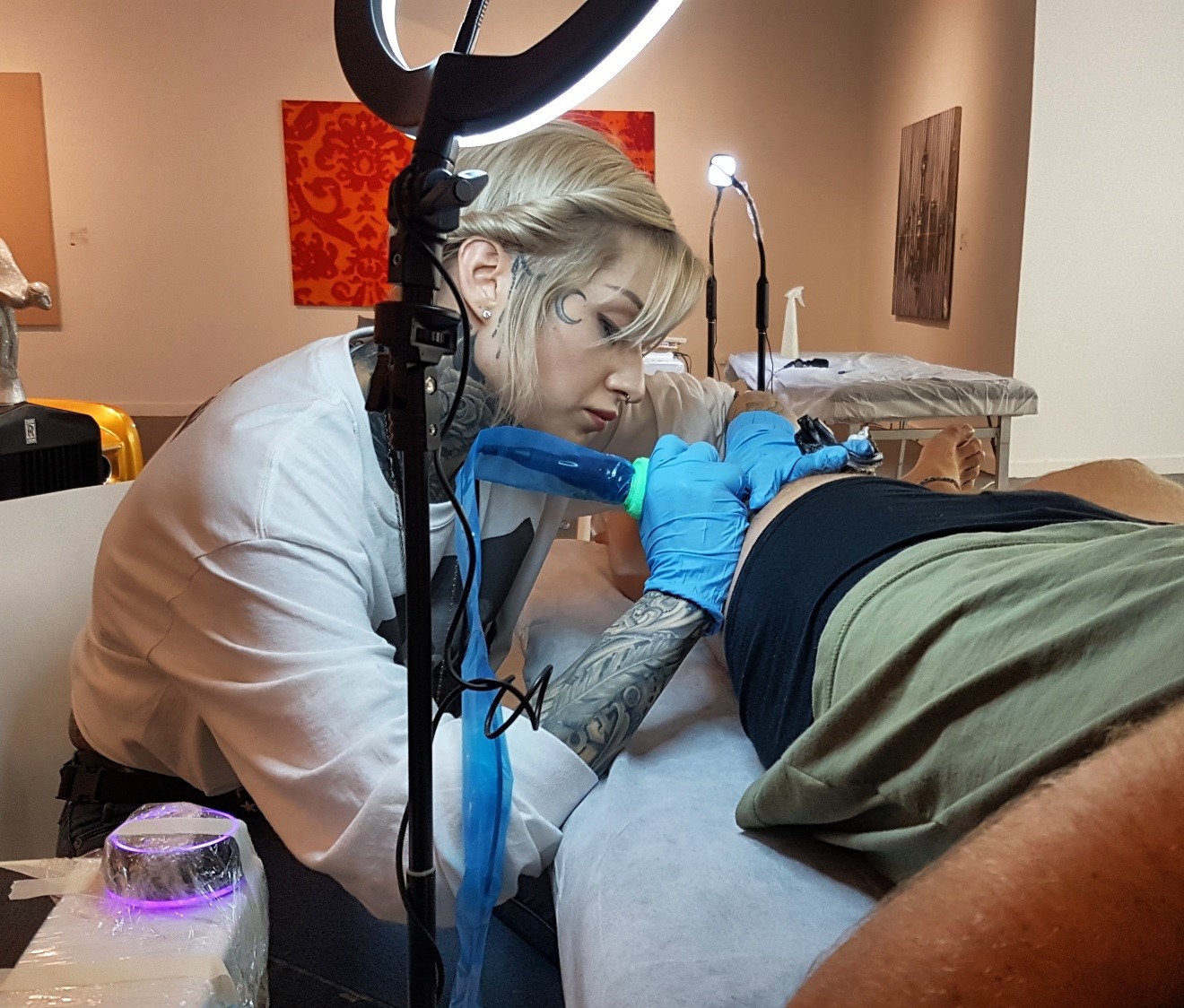
Healing Ink brings tattoo artists of an international
caliber to Israel, to give tattoos to selected survivors of terrorism and war. The
session that took place in Haifa’s Museum of Modern Art was dedicated to IDF
wounded warriors. At first tattooing and healing might seem like a strange
combination but when it’s understood that extreme trauma changes the body and
the mind, it makes sense to take back a feeling of control by choosing to
tattoo yourself with an empowering symbol or image.
Some of the tattoo recipients choose to cover physical scars
with beautiful imagery, turning the ugliness inflicted on them into something they
can love. Others choose symbols of strength, freedom and being able to leave
the past behind. It is about choice and control over what happens to your own
body.
Ryan, like the other tattoo artists in the group, came to
Israel to use art to heal, to lessen trauma with kindness. There was no
political agenda involved. Most of the artists who came were not Jewish and had
no knowledge of Israel. Their interest was not in politics or an agenda but
simply in humanity.
We Israelis are rarely given this kind of human
consideration.
Haifa’s Museum of Modern Art had arranged a day for this
special tattoo event. The artists, recipients and museum visitors became living
art. Tomer, the man Ryan tattooed was not talkative. He obviously felt a little
uncomfortable at being an “exhibit” but Ryan’s calm confidence created a
peaceful bubble in which he too could relax.
Unlike some of the
other recipients, he was reluctant to speak of the trauma he experienced. He
was willing to say that it was in one of the Gaza wars and that he hoped the
dream catcher Ryan was creating would help. Looking at him no physical injury
was visible. Possibly all that is left is trauma to the soul.
It is not often that one can feel the caliber of a person
just by being in their presence but, despite his few words, the quality of
character was obvious. When the event was over, I asked him how it felt to have
such a special woman come across the ocean, just for him. His eyes sparkled and
a huge smile lit up his face. In a typical Israeli understatement, it was his
expression that gave meaning to the words: “It’s something! Really
something!”
As a people, we more often than not, feel very alone in the
world. For those carrying the weight of trauma, this feeling is even more
extreme. Now, every time Tomer looks at his leg he will see Ryan’s art and know
that someone cared about him enough to fly halfway across the world, to give
him a piece of herself, just to make him feel better.
That is very powerful.
Hate is very strong. It steals our lives, ruins families,
breaks bodies and bends the psyche, damaging the soul but sometimes, art can
overcome.
We have lots of ideas, but we need more resources to be even more effective. Please donate today to help get the message out and to help defend Israel.
This blog may be a labor of love for me, but it takes a lot of effort, time and money. For 20 years and 40,000 articles I have been providing accurate, original news that would have remained unnoticed. I've written hundreds of scoops and sometimes my reporting ends up making a real difference. I appreciate any donations you can give to keep this blog going.
Anti-Zionism in Parliament, 1923
-
On June 21, 1923, Lord Islington, among others, spoke in the British House
of Lords to move to reconsider the Mandate over Palestine.
One of his points w...
Iranian jews have ‘mixed emotions’ about war
-
In this report by CBS News, it is instructive that Jews living in Iran are
displaying ‘mixed emotions’ about the war, and do not feel the need to act
as...
White House Dem Hopefuls Bow to Sharpton
-
When Al Sharpton celebrated the 35th anniversary of his hate group and
shakedown operation, the National Action Network, which has been linked to
the kil...
Happy Yom HaAtzmaut (Israel Independence Day)
-
*Happy Yom HaAtzmaut (Israel Independence Day)*
Dry Bones Cartoon from 2017, Posted by Sali the LSW
Wishing you health and happiness, prosperity and pea...
Elder fraud rises as scammers use AI
-
Similar to how scammers are using artificial intelligence (AI) to
impersonate CEOs to defraud businesses, they’re also mimicking regular
people to prey on ...
Now What?
-
Today, Jews cannot walk down the street in North America, Europe, or even
Australia without the possibility of being spat on, beaten, or even
murdered. Cou...
Closing Jews Down Under Website
-
With a heavyish heart I am closing down the website after ten years.
It is and it isn’t an easy decision after 10 years of constant work. The
past...
‘Test & Trace’ is a mirage
-
Lockdown II thoughts: Day 1 Opposition politicians have been banging on
about the need for a ‘working’ Test & Trace system even more loudly than
the govern...

 Thursday, February 07, 2019
 Elder of Ziyon