Wednesday, March 30, 2022

Weekly column by Vic Rosenthal


Last week, after a terrorist attack in Beer Sheva that took four lives, I (rhetorically) asked our leadership if they had a plan to deal with Arab terrorism, something more long-range than beefing up the police presence over Ramadan. Since then, there have been two more attacks, one in Hadera and one in Bnei Brak, bringing the total number of murder victims to eleven in one week.

The Beer Sheva terrorist was a Bedouin Arab, a citizen of Israel. The Hadera murderers were also Israeli citizens, from Umm al Fahm in the “Arab triangle” east of that city, who identified with the Islamic State. The terrorist who murdered five on Tuesday in Bnai Brak was from the Jenin area in the Palestinian Authority. He was in Israel illegally, working on a construction project. Some reports say that he was associated with Fatah, the party of PLO/PA leader Mahmoud Abbas. Diversity in terrorism.

Three of the murdered and one of the seriously injured victims were policemen. And of those, one was a Druze and another was a Christian Arab.

These terror attacks are the tip of an iceberg. Part of the rest of it showed itself last May, when during a war that was provoked by Hamas rocket attacks, we experienced a murderous uprising by Arab citizens:

In little more than a week, Arab rioters set 10 synagogues and 112 Jewish residences on fire, looted 386 Jewish homes and damaged another 673, and set 849 Jewish cars on fire. There were also 5,018 recorded instances of Jews being stoned. Three Jews were murdered and more than 600 were hurt. Over 300 police officers were injured in disturbances in over 90 locations across the country.


That wasn’t a peaceful demonstration. It wasn’t even a riot. It was a rebellion, an attempt to open a second front during a war. And it wasn’t “clashes between Arabs and Jews”:

By contrast, although some commentators have push [sic] the ‘both sides’ line, no mosques were damaged, one Arab home was firebombed (by Arabs that mistook it for a Jewish home), 13 Arab homes and cars were damaged, and 41 Arab bystanders were hurt by hurled stones. There were also two attacks by Jewish extremists against Arab bystanders, in Bat Yam and Herzliya. Bat Yam saw a large and violent demonstration by far-right Jews.


More of the iceberg, which has been growing for years while Israelis and their leaders have kept their eyes shut, has recently become visible. That is the astonishing fact that a great deal of the Negev and the Galilee have become no-go zones, controlled by Bedouin crime gangs:

Residents of the Negev (and parts of the Galilee) have felt, for years, that the government has abandoned them to the violence and crime of the Bedouin community. According to some estimates, some 100,000 acres of Israeli land have been ceded to the Bedouin—security forces will not or cannot exercise control in those areas, and the Bedouin have, some say, created a state within a state. … today the amount of weapons that the Bedouins in the Negev have right now … they have more weapons than two divisions of the IDF right now in the middle of the Negev. They smuggle weapons and drugs of more than 4 billion shekels a year between the Negev and Egypt …


Israel has very strict firearms laws. An Israeli citizen generally cannot possess a rifle, and must demonstrate a need (living in a dangerous area, a job as a security guard, etc.) to obtain a permit for a pistol. The amount of ammunition one can have is also limited. Yet the Bedouins and the criminal gangs in Israeli Arab towns are armed to the teeth with weapons stolen from the IDF, smuggled from Egypt or Lebanon, or even homemade. The murder rate among Israeli Arabs reflects this, being 12 times greater than that of Israeli Jews. Possibly the next time there is an uprising like the one last May, these guns will be turned against the Jews.

The trends are not encouraging. Our Muslim Arab citizens increasingly believe that the State of Israel is illegitimate, built on land “stolen” from them, and is a temporary edifice that will soon be liberated and replaced by an Arab state. Although it is true that only a small minority would engage in terrorism,

According to statistics published by Professor Sammy Smooha of Haifa University, 77.1 per cent of Israeli Arabs view Zionism as a colonial and racist movement, and demand that Israel be replaced with a binational state. 70.5 per cent of Israeli Arabs demand the right of return of Palestinian refugees, a move that would turn Israeli Jews into a minority. According to a 2017 study carried out by Smooha, Arab-Jewish relations have deteriorated since the previous survey done in 2015. In 2017, only 58.7 per cent of Israeli Arabs recognized Israel’s right to exist, as opposed to 65.8 per cent in 2015. In 2017, 44.6 per cent accepted Israel’s legitimacy as a Jewish state as opposed to 60.3 per cent in 2015. The acceptance of Israel retaining a Jewish majority declined from 42.7 per cent in 2015 to 36.2 per cent in 2017. …

The perpetrators of … violence operate in a society that is to a large extent sympathetic or supportive of their goals, if not always their methods.


The above is true not only of the “Arab in the street,” but especially so of their representatives in the Knesset and their academic intellectuals.

This situation has arisen because of a basic misperception of who we are – or rather, who we must be – in order to survive as a Jewish nation in the Middle East. The same misperception also weakens us in our relations with other nations, both our “friends” in Europe and North America, and our enemies. Israel cannot continue to survive as a “villa in the jungle,” in the words of Ehud Barak. We cannot establish a Scandinavian country here. Israel is part of the Middle East. We must put limits on who can live here and who can have political power.

In the Middle East, religion and ethnicity, tribal characteristics, are of great – no, overwhelming – importance. The idea that these can be ignored and a democratic and egalitarian state maintained here, given the demographic reality of today’s Israel, is delusional.

As everyone knows, in a non-totalitarian state, most people don’t obey laws because of fear of the police. They do so because they accept the principle that laws exist for the common good, and the legitimacy of the state that enforces them. If this were not the case, there would need to be almost as many police as citizens (as was close to the truth in communist East Germany). But most members of the Muslim Arab minority in Israel do not accept these propositions. Although we need to act with greater harshness against terrorism – a good start would be a death penalty for terrorist murder – we would need to become a police state like East Germany before we could suppress what is a genuine popular movement among one-fifth of the population. And keep in mind that this popular movement also has a great deal of external support (as well as help from the masochistic, autoantisemitic Left within the country).

We will not convince the acolytes of the Palestinian Movement to turn around and support the Jewish state. No amount of money or benefits to this segment of the population, or the participation of their representatives in the government will help (indeed, they have had the opposite effect). The only way to defeat this movement is to remove its supporters from the country. It would be good if this could be a gradual, nonviolent process effected by incentives, as suggested by Martin Sherman. But if that is impossible, then we must force them to leave.

Either we will face these facts and deal with them head-on, or we will not survive in the region.

From Ian:

Five killed in Bnei Brak shooting as Israel enters 'new wave of terror'
Five people were killed by a Palestinian terrorist in a shooting attack in the haredi (ultra-Orthodox) city of Bnei Brak on Tuesday night.

The shooting was first reported around 8:00 p.m. on HaShnaim Street. One person was found lifeless in a car and two other people were shot dead on a nearby sidewalk. A video later circulating on social media showed the attacker yelling in Arabic, shooting bystanders with an assault rifle on a residential street.

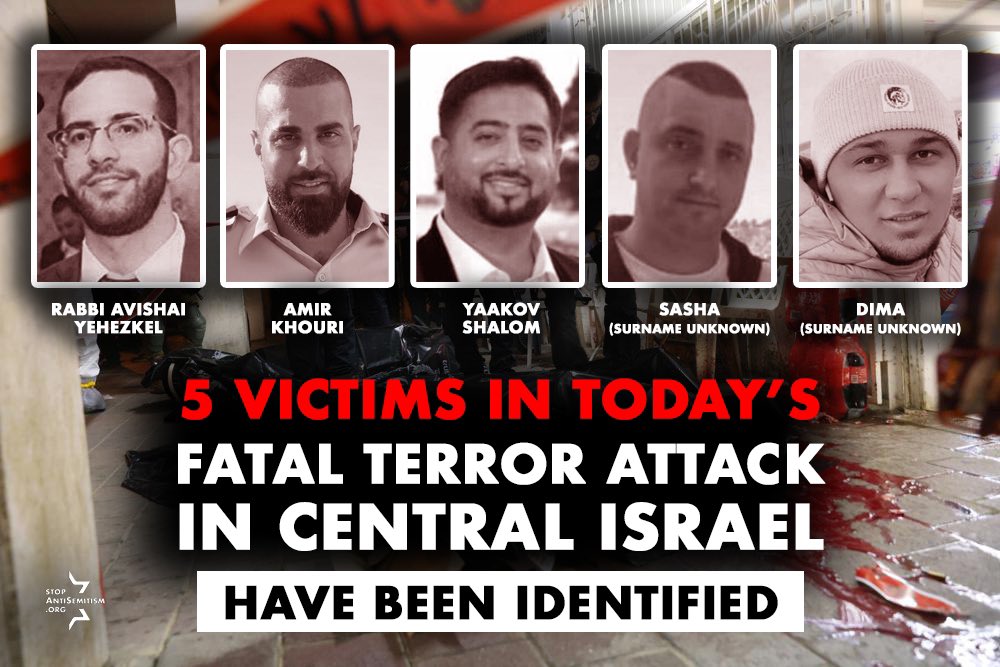
Another Israeli was found dead on Herzl street, perpendicular to HaShnaim Street. Yaakov Shalom, a Bnei Brak resident and father of five, and rabbi Avishai Yehezkeli, a yeshiva teacher and father of two, were identified as two of the five people killed in the attack. Victor Sorokopot, 38, and Dimitri Mitrik, 23, two workers from Ukraine, were also identified as victims of the attack.

The shooter was later shot dead by a police officer who arrived at the scene on a motorcycle. The officer, 32-year-old Arab Christian Amir Khouri, was evacuated to Rabin Medical Center-Beilinson Campus in critical condition and died from his wounds soon after, making him the fifth victim.

The shooter was identified as Dia Hamarsha, 27, from the village of Ya'bad in the northern West Bank near Jenin. He was jailed for six months in 2015 for dealing in illegal firearms and affiliation with a terrorist group, and had worked illegally at a Bnei Brak construction site.

Another person was arrested at the scene and investigated on suspicion of assisting the shooter, and a third person was arrested later on Tuesday night further east on Jabotinsky Street.

Prime Minister Naftali Bennett met with Defense Minister Benny Gantz, Public Security Minister Omer Bar Lev, IDF Chief of Staff Lt.-Gen. Aviv Kohavi, Israel Police chief Kobi Shabtai and Shin Bet head Ronen Bar to discuss the attack and rule on Israel's response.

In the meantime, Israel Police was put on its highest alert level for the first time since Operation Guardian of the Walls in May 2021. Shabtai decided that the police will focus on visible public security and will put more officers on the streets and in crowded areas. The IDF also announced that it was also sending reinforcements to the West Bank.
Victims of Bnei Brak terror attack: 2 local fathers, Christian Arab cop, 2 Ukranians
Authorities early Wednesday identified three of the five victims of a deadly terror shooting spree in Bnei Brak the previous night, including two young fathers and a police officer who helped kill the gunman.

The victims were named as officer Amir Khoury, 32, a Christian Arab; and local residents Yaakov Shalom, 36, and Avishai Yehezkel, 29.

The two other victims were foreign workers from Ukraine who had not been identified by Wednesday afternoon.

Khoury, an Arab Israeli from the northern town of Nof Hagalil, served on the Bnei Brak police station’s motorcyclist responders team.

Khoury was part of a team of two motorcycle officers who caught up with the gunman and killed him, ending the deadly shooting spree.

Khoury was hit in the exchange of fire and later died after being rushed to the Beilinson Medical Center, officials said.

Israel Police Commissioner Kobi Shabtai spoke later with Khoury’s father, Jarris. The father told Shabtai that they are a police family and that he was a veteran of the Tel Aviv police department.

Shabtai said his son’s death, confronting the attacker, was “a great tragedy for the police.”

“Alongside the tragedy, it is important for me to tell you that your son saved the lives of many civilians,” Shabtai says. “His actions will become a legacy and memory of heroism for the whole country.”

Khoury leaves behind his parents and two sisters.


'Israel is dealing with a new wave of terrorism' - Bennett
In a video statement released after the Bnei Brack attack, Bennett said that Israel is "currently facing a new wave of terrorism.”

"After a period of quiet, there is a violent eruption by those who want to destroy us, those who want to hurt us at any price, whose hatred of Jews, of the State of Israel, drives them crazy," Bennett said in a short video address Wednesday morning.

"They are prepared to die – so that we will not live in peace," he added.

Israel has already pushed to thwart what it feared would be outbreaks of Palestinian violence, similar to what sparked a Gaza war last May and a wave of ethnic Jewish-Arab riots within sovereign Israel.

"What we witnessed less than a year ago in Operation Guardians of the Walls, the terrorism and the violence, from within Israel and inside Israel, was the first sign," Bennett said.

"This is a great and complex challenge for the IDF, the ISA and the Israel Police that requires the security establishment to be creative and for us to adapt ourselves to the new threat and read the tell-tale signs of lone individuals, sometimes without organizational affiliation, and to be in control on the ground in order to thwart terrorism even before it happens," he explained.

"The security forces of the State of Israel are the best in the world. They are up to the task and, as in the previous waves, we will prevail this time as well," he added.

He sent his condolences to the families of the victims, wished a speedy recovery to the wounded and thanked the civilians and police officers who helped end the attacks for their heroism.

"I stand by the civilians and police officers who shot the terrorists in the various locations. I have spoken with some of them and thanked them on behalf of all of us. These are heroes of Israel who, thanks to their courage, have saved lives," he said.

"We face a challenging period. We have experience in dealing with terrorism, from the very beginning of Zionism. They did not break us then and they will not break us now," Bennett said.

"The secret of our existence is the mutual responsibility among us and our determination to maintain the home that we have built – at any price," he explained, adding that "citizens of Israel, we will prevail this time as well."
No, it's not the Third Intifada - analysis
A generation of both Israelis and Palestinians who grew up in the midst of suicide bombings do not want to see a repeat of such a scenario. Both sides understand the catastrophe that they lived through during those violent years.

Because of that, Israel’s defense establishment only last week increased the number of work permits for Gazans to 20,000, in an attempt to reduce the tensions that have been bubbling under the surface.

Officials from Israel, the Palestinian territories, Jordan, Egypt and Qatar are also working to reduce the flames-holding an unprecedented number of meetings in public. Those meetings came as Israel tried to differentiate between terrorism from the West Bank and Gaza and terrorism carried out by Arab-Israelis.

Nonetheless, despite the rush of diplomatic meetings and doubling of troops in flashpoint areas, 27-year-old Dia Hamarsheh was still able to illegally cross into Israel through a hole in the security fence and open fire on unarmed civilians with a military-grade assault rifle, just mere minutes from Tel Aviv.

In order to prevent future attacks, including copycat attacks, security forces and Bennett’s government have a lot of work to do.

One issue that should top their list is to fix the holes in the security fence through which thousands of Palestinians cross to Israel daily – including the mornings after each deadly attack this past week.

Security forces must also ramp up their operations in combating the trend of illegal weapons that have flooded into Arab communities and continue to be smuggled in from Lebanon, Egypt and Jordan.

Combating the ideologies of the Islamic State and other terrorist groups like Hamas and Palestinian Islamic Jihad is a struggle that will continue for years, and will be harder to deal with as long as Palestinians and Arab-Israelis feel they have nothing to lose.

Israel’s military does not want Defensive Shield 2.0 2022. But in order to prevent that, the IDF, Shin Bet and Israel Police must get the situation under control.

They can no longer afford to play catch-up.
  • Wednesday, March 30, 2022
  • Elder of Ziyon
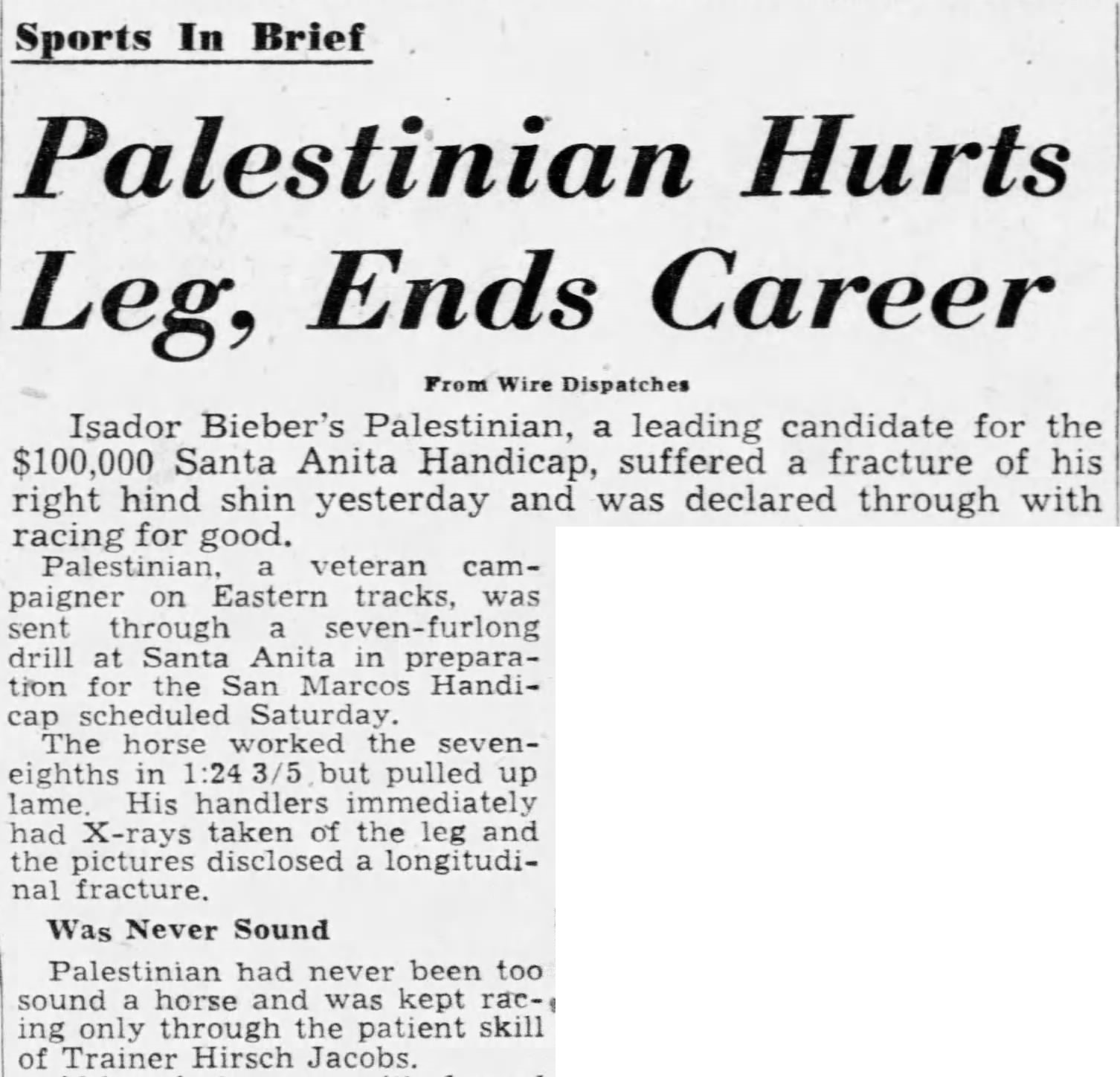
Isidor Bieber was a successful owner and breeder of racehorses during much of the 20th century. He worked closely with trainer Hirsch Jacobs who had an uncanny ability to pick talented horses and work with them.

Bieber, who was born in the Warsaw suburb of Vasloveck, liked to name horses after causes he was passionate about. He was anti-smoking and named horses Puffaway Sister, Kansirette, Shedontsmoke and Burnt Lips. Other horses were named Hail to Reason, Hate War, Reason Is One.

He was also a passionate Zionist who  named horses Promised Land, Forgotten Ally. and Humane Leader in honor of David Ben-Gurion.

And Palestinian, born in 1946.


Palestinian won this exciting race in San Francisco in 1951:


Unfortunately, Palestinian had to be put out to pasture when he was injured the following year.


Palestinian was only successful as long as he relied on Jews for his welfare. 


Buy the EoZ book, PROTOCOLS: Exposing Modern Antisemitism today at Amazon!

Or order from your favorite bookseller, using ISBN 9798985708424. 

Read all about it here!

  • Wednesday, March 30, 2022
  • Elder of Ziyon
As documented by Joe Truzman, here is a list of Palestinian groups that praised the terror attack in Bnei Brak yesterday:

Palestinian Islamic Jihad
PFLP
DFLP
PFLP-GC
Mujahideen Brigades
Popular Resistance Committees
Popular Resistance Movement

This is besides Hezbollah.

Mahmoud Abbas' half-hearted condemnation of the attack reportedly came after Israel sent a strong message to him to do so.  As far as I can tell, this is obvious to the Palestinian media, none of which have condemned the attack, even the media that slavishly echoes the official Palestinian position. 


Buy the EoZ book, PROTOCOLS: Exposing Modern Antisemitism today at Amazon!

Or order from your favorite bookseller, using ISBN 9798985708424. 

Read all about it here!

  • Wednesday, March 30, 2022
  • Elder of Ziyon
Celebration in Beirut of Bnei Brak attack

Al-Araby, which is based in London, and Egyptian Al Masry al-Youm, both briefly mention that "Following the attack, mosques in the West Bank and Gaza Strip raised the takbir, to celebrate the operation in Tel Aviv."
"Raising the takbir" means publicly praising Allah, usually in the form of "Allah hu-Akbar."

Imagine the outcry if a synagogue of any denomination would blast out of loudspeakers (or publish in its weekly newsletter)  joy and praise at the murder of civilians. It would be a major news item. The foremost critics would be Jews themselves. 

And rightly so.

Yet, today, it isn't only Palestinian youths celebrating the murders of five people. It is their mosques - mosques that are run by older, respected men. 

Where is the outrage from Muslims worldwide? Where is the horror at sacred mosques being used as places to celebrate terror? Where are the hand-wringing articles, in any language, saying that the Muslims who use Islam to celebrate death aren't "real Muslims?" Where are the social media posts that show disgust from religious Muslims at their faith being hijacked by immoral worshipers of death?

This is not to say that there are no Muslims horrified at these attacks - there certainly are. But the fact that no one expects any denunciations of the use of Islam to celebrate the most heinous crimes shows that the bar of expected behavior from Muslims, even Western Muslims,  is very, very low. 

Think about it: Can you even imagine that the Council on American-Islamic Relations would ever criticize fellow Muslims for supporting terror and using Islam to justify it? It is pure fantasy. But everyone would expect major Jewish organizations to forthrightly condemn any Jews doing anything remotely resembling this. 

Part of the reason for Islamic terror is because it is so thoroughly justified and celebrated among so many Muslims without any pushback from their leaders - or from Western media and politicians who are cowed into worrying that any criticism will be labeled Islamophobic or result in death threats. 

Arab and Muslim media today are romanticizing the attacks, or at best ignoring them - but they are emphatically not condemning them. This creates an environment where such heinous attacks are all but inevitable. 


Buy the EoZ book, PROTOCOLS: Exposing Modern Antisemitism today at Amazon!

Or order from your favorite bookseller, using ISBN 9798985708424. 

Read all about it here!

Tuesday, March 29, 2022

  • Tuesday, March 29, 2022
  • Elder of Ziyon


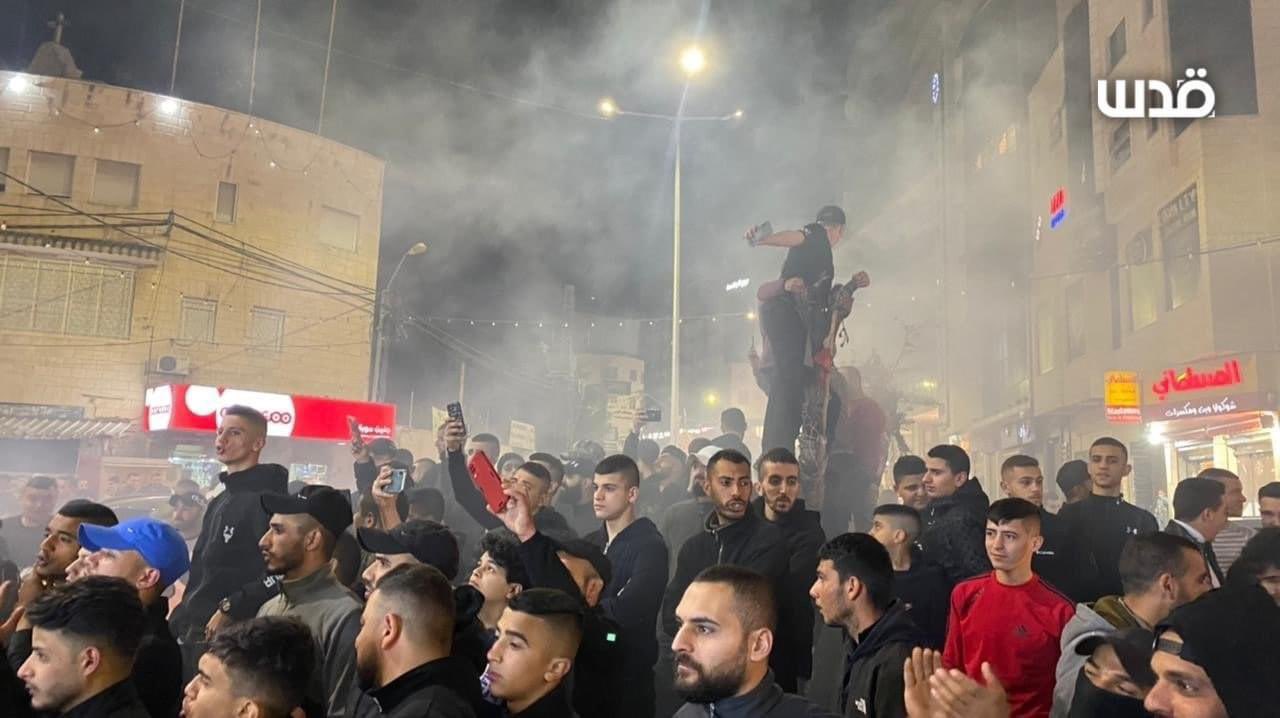
Here is how Al Quds described the celebrations in the hometown of the terrorist who murdered 5 Israelis on Tuesday:

Jenin, its camp and the town of Yabad witnessed, this evening, Tuesday, massive rallies to express pride in the perpetrator of the Bnei Brak operation near Tel Aviv, the martyr Diaa Hamrasha.

Our correspondent in Jenin stated that the celebrations included the distribution of sweets in celebration of the operation, and that as soon as the occupation announced that the martyr Hamrasha a was from the town of Ya'bad, hundreds of the town's residents went to his house.

They staged a sit-in in front of the martyr's family's house and congratulated them, while calls and statements of Hamrasha's death were broadcast via loudspeakers and praised his operation, and confirmed the continuation of the resistance approach. 

In the city and camp of Jenin, hundreds celebrated the operation, with massive rallies during which sweets were distributed. According to Palestinian sources, the Hamrasha family did not receive any official notification about the death of their son, which was published by the Hebrew media.

It is reported that Diaa is a freed prisoner and was arrested on charges of belonging to the Fatah movement and currently owns a shop that sells cellular devices in his town of Ya'bad, where mourning was declared.
Note that in this mainstream Palestinian newspaper, the murderer is referred to as a "martyr."

I'm not going to say that 100% of Palestinians support these terror attacks. But zero percent of Palestinian media says anything negative about them, or about the celebrations. Never is there an op-ed denouncing the culture that celebrates death.  

Even the reports that mention Mahmoud Abbas' half-hearted condemnation - probably strongly suggested by Western leaders - do not give any indication that they agree with the condemnation.

Western media shies away from describing this aspect of Palestinian society, as if it is vaguely Islamophobic to point out that an entire people largely supports or condones murdering Jewish people. 

A major lesson from the Abraham Accords is that it doesn't have to be this way. This hate isn't an inherently Arab thing. It is a Palestinian thing. Only Palestinians reward terrorists with jobs and cash rewards. Only Palestinians regard the worst mass murderers as heroes. Only Palestinians hold wild celebrations when one of them successfully murders Jews. 

It is an immoral society. 


Buy the EoZ book, PROTOCOLS: Exposing Modern Antisemitism today at Amazon!

Or order from your favorite bookseller, using ISBN 9798985708424. 

Read all about it here!

From Ian:

Five killed in Bnei Brak terrorist shooting
Five people were killed in a shooting spree in Bnei Brak on Tuesday evening.

The shooting was first reported around 8:00 p.m. on HaShnaim Street. One person was found killed in a car and two other people were killed on a sidewalk nearby.

Another person was found dead on Herzl Street, perpendicular to HaShnaim Street. A fifth victim, a police officer, was evacuated to the Rabin Medical Center-Beilinson Campus in critical condition and died from his wounds soon after.

The shooter's body was found on Jabotinsky Street after he was shot by a police officer who arrived at the scene on a motorcycle.

Another person was arrested at the scene and investigated on the scene on suspicion of assisting the shooter, and a third person was arrested later on further east on Jabotinsky Street.

The terrorist was a 27-years-old man affiliated with Fatah, from the village of Ya'bad in the northern West Bank. He was jailed for half a year in 2015 for illegal arms dealing and belonging to a terrorist group, and had worked illegally at a building site in Bnei Brak.
Roman Abramovich, Ukrainian negotiators poisoned in Kyiv talks - WSJ report
Russian-Israeli oligarch Roman Abramovich and three Ukrainian negotiators in the ceasefire talks were allegedly poisoned during a meeting in Kyiv in early March, Netherlands-based open-source intelligence group Bellingcat confirmed a Wall Street Journal report on Monday.

Abramovich and the three members of the Ukrainian delegation, led by chief negotiator Mykhailo Podolyak, reportedly suffered from symptoms of poisoning after the Kyiv meeting held some time in February, shortly after Russia invaded Ukraine, WSJ reporter Max Colchester reported, citing people familiar with the matter.

Sources claimed they were poisoned by Russian hardliners who want to sabotage ceasefire negotiations between Moscow and Kyiv, the report stated. A source close to Abramovich, however, said that it was not clear who targeted the oligarch and the Ukrainian delegation.

The condition of the Russian-Israeli oligarch and the Ukrainian negotiating team has since improved and their lives are not in danger, though it was reported Abramovich lost his vision for several hours.

Experts who have looked into the poisoning incident claimed it was hard to determine whether a chemical or biological agent or some sort of electromagnetic radiation, was used, WSJ noted in its report.

In late February, The Jerusalem Post broke the news that Abramovich is attempting to assist in the talks between Russia and Ukraine at the request of Kyiv.


Tom Gross: The oligarchs can't overthrow Putin, the only real threat to his power may be from FSB hardliners

Tom Gross: The first part of this interview is here: Zelensky is no Havel or Mandela, but he is media savvy, whereas Putin is old school & doesn’t care

Ukraine’s most famous director ostracized for unflinching film on Babyn Yar pogrom
If you live in New York City and are attuned to the programming schedules of local arts cinemas, there is a man who is noticeably having a moment: 57-year-old Sergei Loznitsa.

The fact that Ukraine’s most celebrated film director has so many projects coming to theaters right now is only partially due to the circumstances in his home country. (The IFC Center near New York University, for example, is offering a mini-retrospective.) The other reason is that Loznitsa, who works in both documentary and narrative film, is incredibly prolific, and the ebb and flow of international distribution sometimes makes for a logjam.

The prestigious Museum of the Moving Image just hosted the New York debut of “Mr. Landsbergis,” a four-hour documentary about post-Soviet Lithuania, and his surrealist tragic-comedy about war and disinformation, “Donbass,” which won a directing award at Cannes in 2018, will finally make its way to New York theaters on April 8.

On April 1, however, Film Forum in Manhattan will present “Babi Yar. Context,” a documentary crafted from seldom-seen archival reels concerning a terrible chapter in Ukrainian history wherein close to 34,000 Jews were killed during the Holocaust in just a few days. (In early March, it was believed that Russian bombs damaged the contemporary memorial there, but this turned out not to be the case.)

No recordings were made of the actual killings at the Babyn Yar ravine (though still photos — in color — of the aftermath were taken), but Loznitsa’s film has that second word, “Context,” in its title. What he has sculpted, without voice-over and just a few title cards, is a fly-on-the-wall look at the social changes in Ukraine during the Nazi occupation.

From the first tanks rolling in through Lviv to Soviet infrastructure literally covering up the spot where so many Jews were executed, Loznitsa, adding sound to mostly silent footage, shows what happened — and some of it (e.g. a lot of Ukrainians seemingly eager to welcome the Nazi regime) isn’t exactly going over so well at home.

Which brings us to the next topical point. Last week Loznitsa, a six-time winner at the Ukrainian Academy Awards, was summarily dismissed from the Ukrainian Film Academy. Reasons cited include the accusation of being “too cosmopolitan.” Loznitsa, whose previous work includes “Maidan,” a celebration of Ukrainian independence in the face of corruption and Russian interference, commented in an open letter that the choice of words had an antisemitic aspect to it. (As far as I know, Loznitsa is not Jewish. I asked him directly, but he and his interpreter didn’t really respond, as you’ll read below.)
  • Tuesday, March 29, 2022
  • Elder of Ziyon
By Twitter user @mike_bomb


On Twitter Monday, in response to the Negev Summit, veteran peace-processor Aaron David Miller re-upped his September 23, 2020 Washington Post op-ed  in which he purported to review old assumptions about the Israeli-Palestinian peace process. Re-reading the piece illustrated for me how much he—along with the rest of the peace-processors—still gets wrong.

He mentions a few of the old assumptions, the first of which is that “The status quo is unsustainable.” He correctly notes that it very possibly is sustainable, but his reasoning that “The parties themselves have been willing to manage the status quo, however grim it may be, because changing it required more political risk than either side was willing to accept…” is flawed. Israel has time and again demonstrated that it is willing to take the political risk to change the status quo, offering peace plans to the Palestinians who never accept and never come back with a counter-offer. In the absence of a Palestinian leadership willing to take political risk, Israel has no choice but to manage the status quo, regardless of their own political risk tolerance.

It has to be reiterated: the Palestinian side has never made a serious peace proposal or a counter-offer to an Israeli proposal. Most often, they simply refuse to negotiate. At one point, they claimed that they would not negotiate unless there was a settlement freeze. Israel responded by freezing settlement construction, and they still refused to negotiate.

Another thing that Miller gets wrong about the status quo and American efforts to change it is that he claims “America’s special relationship with Israel prevented bringing serious pressure to bear on Israel.” That’s wrong in three ways:

1.       America has often brought serious pressure to bear on Israel, regardless of the “special relationship.”

2.       America doesn’t need to bring that much pressure to bear on Israel to make peace. Israel has been trying to make peace with its neighbors for its entire existence. It has concluded peace agreements with every Arab polity that has been serious about peace with it, even when doing so was at great cost in terms of land, as with Egypt.

3.       The focus of the peace-processors is always bringing pressure to bear on Israel to make concessions for the sake of peace. No peace-processor ever speaks about bringing pressure to bear on the Palestinians to make peace. No peace-processor ever actually brings any pressure to bear on the Palestinians to make peace, to make any concessions toward peace—to do anything, really, toward making peace with Israel.

Miller also mentions “…resolving the Israel-Palestinian conflict on terms any Palestinian leader could accept.” This is another of the peace-processors’ major flaws in understanding. Why is Israel expected to accept any peace terms, while the Palestinians are only expected to accept terms that preserve their maximalist ambitions? The Palestinians turn down every peace offer, looking for more. A good negotiator would say, “This is the best offer you are getting. Take it now, because tomorrow’s offer will be significantly less.” Instead, the peace-processors say to the Palestinians, “You didn’t like that offer? We’ll press Israel to offer you more.”

It seems to me that the peace-processors understanding of the Israel-Palestinian conflict is fundamentally flawed. The only real thing at issue between Israel and its Palestinian neighbors is this: the Palestinians have to be willing to make peace with Israel, to accept that Israel is there to stay, in some defined borders, whatever their final configuration. That is the actual roadblock in the peace process, and it is completely mystifying to me how all the peace-processors overlook it.


Read all about it here!

  • Tuesday, March 29, 2022
  • Elder of Ziyon

The latest poll from the Palestinian Center for Policy and Survey Research (PCPSR) shows that while Hamas' popularity is decreasing, that isn't indicating any less support for violence.

Fatah's popularity reached the levels it had before the May war, which was very popular among Palestinians. Surprisingly, part of that may be because the people are approving of the "confidence building measures" that Israel has agreed to with the Palestinian Authority, like increasing family unification and allowing the PA to access more cash. 63% approved of those measures.

Even so, 67% support the suspension of the PLO recognition of Israel and 61% support the decision to end the implementation of agreements with Israel including security coordination.

When asked what strategy they support going forward,  52% supported return to armed confrontations and a violent intifada. When asked specifically what the most effective means of ending the "occupation" and building an independent state, a plurality of 44% chose "armed struggle, "far ahead of 25% for negotiations and 24% for "popular resistance." This is a small increase supporting violence compared to the last poll three months ago.

As far as which side they are on in the Ukraine invasion, things are fairly split. 43% blame Russia for starting the war with Ukraine while 40% blame Ukraine. 


Buy the EoZ book, PROTOCOLS: Exposing Modern Antisemitism today at Amazon!

Or order from your favorite bookseller, using ISBN 9798985708424. 

Read all about it here!

From Ian:

Gadi Taub and Michael DoranIsrael Must Publicly Protest America's Policy of Appeasing Iran
The excessive desire to maintain a semblance of cooperation with the administration has led Israel to adopt the empty talk about a “longer and stronger” accord. The reigning assumption is that if the appearance of intimacy is maintained, Israel will be able in the future to employ quiet diplomacy in its efforts to persuade Washington, ultimately leading it to recognize its mistake and to turn from appeasement to deterrence – either directly, by American military means (or the threat to use them), or indirectly, by supporting Israel’s operations.

There is no chance of such a plan succeeding. After all, Biden believes in the nuclear deal. It is the cornerstone of his regional policy. He believes that conciliation will create a historic opportunity to reset U.S.-Iranian relations, directing them toward a cooperative future. Why should he step aside and allow Israel to sabotage a policy he’s been working to promote?

The conclusion from all this is that Israel cannot effectively act against Iran’s nuclearization if it refuses from the start to engage in an open and sincere debate with its ally. It must develop a strategy of publicly protesting against America’s policy of appeasement, while taking into account the reasonable likelihood that Iran will try to drag the U.S. into the conflict. In other words, it must adopt a policy that won’t allow the administration to turn the American public against independent Israeli operations.

Can this be achieved? Fortunately, we have an example of such a successful policy. This was Winston Churchill’s policy at the start of World War II. The problem facing Churchill was similar. When war broke out in Europe in 1939, isolationist sentiment had great weight in American public opinion. Many Americans wished to avoid having their country dragged into what they perceived as a European war. Churchill sought to mobilize the U.S. without appearing as if he were asking the United States to fight Britain’s wars for it. In a speech he delivered in February 1941, he found the right balance. “Put your confidence in us. Give us the tools, and we will finish the job,” he said, addressing President Franklin Delano Roosevelt directly.

Israel must adopt a similar stance. A direct call for getting the tools that will enable it to vanquish Iran, without asking for direct American military assistance will force the administration to justify its pro-Iranian orientation to the American public, which it has been trying to hide behind the false rhetoric about a “longer and stronger” accord. Iran’s image in the U.S. is sufficiently negative to ensure Biden’s defeat in any competition over voters’ hearts if he is forced to admit openly that he prefers Iran over Israel.

Waiting for the Biden administration to wake up from its dream that appeasement will lead to Iranian moderation is futile. The only path available to Israel is to force the administration to take responsibility for the contradictions its policy is creating, including the hiding of its appeasement behind a veil of rhetoric about blocking or slowing down Iran’s military nuclear program. It’s doubtful whether Israel has many other options if it intends to look after its vital interests.
Daniel Greenfield: Will Biden fund ISIS in Israel to aid the Palestinians?
Blinken meanwhile used the visit to pitch Israelis on a Biden plan to remove the IRGC, Iran’s terror hub, from the list of foreign terrorist organizations, claiming it would be “symbolic”.

He failed to condemn the terrorist attack as an ISIS attack, calling it “senseless” violence.

At his joint press conference with Abbas, Blinken also failed to condemn terrorism or to note that ISIS, with the tacit support of his PLO hosts in Ramallah and of Hamas in Gaza was planting its flag in Israel. Instead Blinken once again condemned Jewish Israeli “settler violence”.

Like Undersecretary of State Victoria Nuland's previous visit, the formula of Biden administration officials condemning Israeli "settler violence" while promising to "strenghten" the terrorists of the Palestinian Authority is as familiar as it is evil. The Palestinian Authority is an unwanted institution whose leader 73% of the people the dictator rules over want to see out of office.

And 49% want to dissolve the Palestinian Authority.

Considering the decades of failure, misery, and terrorism wrought by the failed Clinton initiative to create a Palestinian state, it’s long past time for everyone to turn the book on this disaster.

Neither Arab Muslims nor Israelis want Abbas or the Palestinian Authority. Only diplomats like Blinken and Nuland insist on keeping the senile tyrant of Ramallah in office until he dies.

In a final statistic, the poll asked who was "most deserving of representing and leading the Palestinian people". 31% picked Hamas, 29% chose Abbas' Palestinian Authority, and 33% chose none of the above. 84% believe the PA is corrupt and 70% believe Hamas is dirty.

The “Palestinian people” have spoken. Will Biden listen to them?

The root source of the corruption comes from the hundreds of millions of dollars that Blinken came bearing last year for the regime of a corrupt senile autocrat who didn’t even know whom he was talking to. There’s more money coming this year to prop up the terrorist regime.

All in the name of a peace which doesn’t exist and that the majority of “Palestinians” don’t want.

The United States has gone from using its foreign aid to the Palestinian Authority to prop up PLO, Islamic Jihad and Hamas terrorism against Israel, to subsidizing ISIS terrorism.

Will ISIS be a final red line for the corrupt farce of a two-state solution and a peace process?
David Singer: Can the Negev Summit pave the way for Israel-PLO-Egypt-Jordan negotiations?
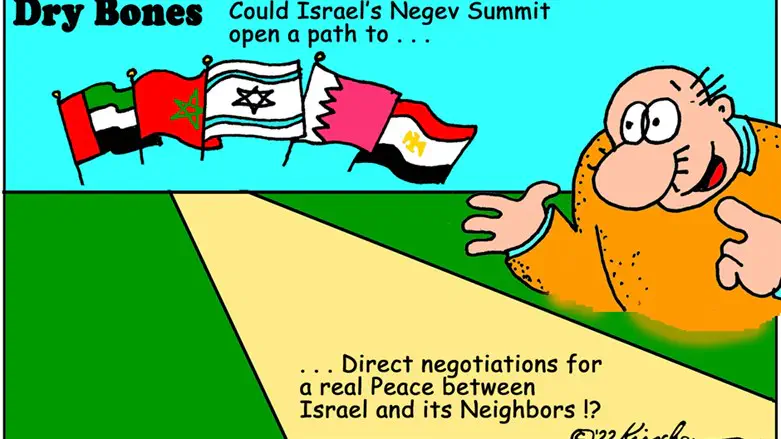
The Negev Summit (Summit) taking place on 27 and 28 March – hosted by Israel’s Foreign Minister Yair Lapid– could be the catalyst for promoting the beginning of direct negotiations - without preconditions - between Israel, Jordan, the Palestine Liberation Organisation (PLO) and Egypt - on the allocation of sovereignty in Judea and Samaria (West Bank) and Gaza.

Summit attendees will include:
US Secretary for State Antony Blinken
Minister of Foreign Affairs of the United Arab Emirates H.H. Sheikh Abdullah bin Zayed
Minister of Foreign Affairs of Bahrain Dr. Abdullatif bin Rashid Al Zayani,
Minister of Foreign Affairs of Morocco Nasser Bourita, and
Minister of Foreign Affairs of Egypt Sameh Shoukry.

Jordan’s Foreign Minister Ayman al-Safdi will be meeting PLO leader Mahmoud Abbas in Ramallah during the Summit. However - according to Israel’s Channel N12 - al-Safdi may join the Summit before the event is concluded.

On 18 March Principal Deputy Spokesperson in the US State Department – Jalina Porter – had announced Blinken’s visit to the Middle East without mentioning the Summit.

Porter articulated the Biden Administration’s views on creating a second Palestinian Arab State in former Palestine – in addition to Jordan:
... “the Biden-Harris administration believes that there should be a viable and democratic Palestinian state living in peace alongside a Jewish and democratic state. We believe that a negotiated two-state solution is the best way to resolve the Israeli-Palestinian conflict, and the administration has also made clear on numerous occasions that Israelis and Palestinians alike equally deserve to live in security, prosperity, and freedom.”

Porter’s choice of the term “Israeli-Palestinian conflict” was unfortunate. A more appropriate term would have been the “Arab-Jewish conflict” which has been raging unresolved in former Palestine for more than 100 years – long before the terms “Israelis” and “Palestinians” were created in 1948 and 1964 respectively.


By Daled Amos

The reestablishment of the State of Israel represents, in part, the creation of a place for Jews to find refuge. This is all part of a promise that Israel continues to keep, whether accepting immigrants from Ethiopia, Russia -- or the Ukraine.

Meanwhile, for his part, Turkish president Recep Tayyip Erdogan presents himself as the champion of Muslims around the world.

And then there is Iran, which has also been positioning itself as a Muslim world leader:

Since its 1979 Islamic revolution, Iran has engaged in a number of scuffles with countries over their mistreatment of Muslim minorities, diplomatic tiffs that have aimed to position Teheran as a guardian of supposed Islamic world unity.

Yet both Turkey and Iran stop short in their support of their fellow Muslims when it comes to China.

There are approximately 12 million Uyghurs, Chinese Muslims, of whom approximately 2 million have been detained in detention camps by the Chinese government.

In July 2019, a group of 22 nations addressed a letter to the president of the UN Human Rights Council and to the UN High Commissioner for Human Rights, calling on China to end its detention program in Xinjiang. The letter expressed concern about “credible reports of arbitrary detention” in Xinjiang and “widespread surveillance and restrictions” and demanded that the Chinese government “refrain from the arbitrary detention and restrictions on freedom of movement of Uighurs, and other Muslim and minority communities in Xinjiang.”

But there was a second letter -- signed by 37 countries.

In that letter, the signatories opposed “politicizing human rights” and defended what China claimed were “vocation education and training centers.” The letter went on to justify China’s actions, that: 

Faced with the grave challenge of terrorism and extremism, China has undertaken a series of counter-terrorism and deradicalization measures in Xinjiang, including setting up vocational education and training centers.

That second letter, defending China's treatment of Muslim Uyghurs included the signatures of Muslim countries such as Algeria, Bahrain, Belarus, Egypt, Kuwait, Oman, Pakistan, Qatar, Saudi Arabia, South Sudan, Sudan, Syria, and the United Arab Emirates.

For its part, Turkey did not sign that second letter, but neither did it come out in opposition to China's detention camps.

More than that, it was reported in 2020 that Turkey was actually helping China by facilitating the return of Uyghurs back to China:

Now lawyers say Beijing is manipulating extradition agreements to drag Uighurs back to the re-education camps. And, activists argue, Ankara’s growing economic dependence on Beijing is compromising its ability to withstand Chinese pressure and to protect Uighurs who have fled Xinjiang.

While Turkey refuses to send Uighurs directly back to China, campaigners say there are those willing to send them to third countries, like Tajikistan. From there, it is easier for China to secure their extradition.

The commissioner of the US Commission on International Religious Freedom, Nury Turkel condemned Turkey:


But Turkey is not the only Muslim country aiding China by deporting Uyghurs.

In a video report, the BBC noted that Saudi Arabia, Egypt and the UAE -- which signed that letter defending China -- also forcibly sent Uyghurs in their countries back to China:

The Saudi Embassy said:
The Kingdom of Saudi Arabia fully complies with international norms and Saudi law when cooperating with other countries on issues such as deportation". "Saudi Arabia considers all deportations on a case-by-case basis, taking into account the nature and seriousness of any violation and paying no heed to a person’s race or religion.
The Egyptian and Emirati embassies did not respond to our requests for comment.

The motivation driving these countries to side with China against the persecuted Muslims derives in part from economic considerations, since China is an important trade partner and investor in the region.

In addition, criticizing human rights violations in China could leave Muslim regimes open to similar criticism.

But there could be more to it than that. An analysis in The Washington Post suggests:

China has been able to align its hostility toward its Muslim population with the antipathy of these countries toward particular forms of political Islamism — ranging from mainstream political groups that want their governments to expand democracy, cut corruption and protect human rights, to more radical Islamist groups that denounce governments as apostates and puppets of the West.
  And where does Iran stand on the issue of the Uyghurs?

Iran’s support for persecuted Shiite Muslim groups reaches far and wide, from repressed Shiites in Sunni-governed Bahrain, to the Houthis waging war in Yemen, to the pro-Iranian Islamic Movement in Nigeria which seeks to establish an Islamic state and whose rebel logo includes a portrait of Ayatollah Ruhollah Khomeini, founder of Iran’s Islamic republic.

...Now, critics claim Teheran is looking the other way on the Uighurs, a clear, hard indication that its crucial trade and investment links to China outweigh its claimed guardian mission in the Muslim world.

This is not the first and only time that Iran has forgone its self-declared role as guardian of Muslims worldwide:

For instance, in the wake of Russia’s annexation of Crimea in 2014 and the ensuing crackdown on the peninsula’s Muslims, Iran failed to protest.

Nor did Tehran raise its voice against Russia’s violent repression of the Muslim Chechnya insurgency in the mid-1990s and later harsh anti-radicalization initiatives driven by President Vladimir Putin.

In addition to trade and weapons, Russia has provided political support for Iran, preventing it from being isolated at the UN, while China is helping Iran avoid the pinch of US sanctions. Another consideration is the fact that the Uyghurs are Sunni and are not a primary concern of Shiite Iran.

And what about Israel?

In the context of the current Russian invasion of the Ukraine, Israel has had to tread carefully because it needs to coordinate with Russia, which has thus far allowed Israeli jets to take action against Iran in Syria. This consideration has prevented Israel from being too outspoken against Russia.

Israel's relations with China are similarly complicated. Last year, Israel signed on to a letter in the UN Human Rights Council, condemning China's treatment of the Uyghurs -- despite China's request that it not take part, just as it recently voted for a World Health Organization investigation into the source of the COVID-19 pandemic, something which China was trying to avoid.

Israel, like much of the Middle East, has economic ties to China and has to measure its actions, taking into account that China has not let its economic interests in Israel prevent it from taking measures against it:

While cultivating economic ties between the countries, China votes against Israel in international forums and pushed for strong condemnation of Israel’s actions in Gaza during Operation Guardian of the Walls last month. In addition, Chinese state-sponsored media have taken anti-Israel and even antisemitic positions, such as a segment claiming that wealthy Jews control American finance and media and have undue influence on the US government.

Israeli diplomats already told their Chinese counterparts under Lapid’s predecessor, Gabi Ashkenazi, that they cannot have it both ways without any consequences.

If China is separating diplomacy and economics in its treatment of Israel, then the current thinking in Jerusalem is that it can do the same to Beijing.

But there could be another potential issue.

We see how there are attempts to draw parallels between Palestinian Arabs and Ukrainians on the one hand and Israel and Russia on the other.

How long before we see similar parallels of Palestinian Arabs with Uyghurs and Israel with China?

And what about the potential impact that China's persecution of Uyghurs could have on the Abraham Accords? After all, the UAE is not only not publicly coming out in defense of the Uyghurs and in condemnation of China -- they are actually deporting Uyghurs back to China, where they will be put in detention camps.

All for the sake of trade and weapons.
Kind of what the UAE is looking for from Israel.

The Saudis, who are also deporting Uyghurs, is becoming more open in its relations with Israel.

Similarly, Egypt -- which was the first Arab country to sign a peace deal with Israel -- is similarly sending Uyghurs back to China.

Turkey, which has declared a willingness to rebuild ties with Israel, deports Uyghurs as well.

It would be easy to taint these growing diplomatic ties between these Muslim countries and Israel by drawing a comparison between their relations with China and their relations with Israel.

Reliance on Russia and China makes it difficult for countries in the Middle East to balance their ties with China and Russia with their other interests and needs. If these Muslim countries do not do a better job, they may irreparably tarnish the Abraham Accords and all the good that has come from it in this short time and that will yet in the years to come.


Read all about it here!

  • Tuesday, March 29, 2022
  • Elder of Ziyon
The New Zealand Jewish Council is releasing a survey of antisemitic attitudes in that country early Wednesday morning NZT. 

As with similar surveys done over the past decade, a series of questions are asked to tease out whether the respondent has antisemitic and anti-Zionist opinions. 


The survey found a high correspondence between those who have the most anti-Zionist views and those who have the most classical antisemitic views:

Twenty one percent of New Zealanders held two or more classical antisemitic views (out of eight questions), and 25% held two or more Zionophobic views (out of seven). This survey found there is a relationship between those holding Zionophobic views and those who hold classical antisemitic views. It shows the more extreme anti-Israel sentiment someone has, the more classical antisemitic tropes they will believe in, and vice versa. For example, there is only a 25% chance that someone who holds four classical antisemitic views will hold no anti-Israel antisemitic views, and only a 29% chance that someone who holds four anti-Israel antisemitic views will hold no classical antisemitic views. This is consistent with a United Kingdom study which also showed a clear empirical link between the two forms of antisemitism.
 I had seen the high level results of the UK survey but hadn't seen that analysis of the link between  classic antisemitic attitudes and anti-Israel attitudes. 

The nexus where classic antisemitism and anti-Zionism meet is perhaps in the questions comparing Israel to Nazi Germany. In the New Zealand survey, 12% agreed that "Israeli government policies are similar to those of the Nazi regime," in the latest UK survey, 24% agreed that “Israel treats the Palestinians like the Nazis treated the Jews” - which is down from the 31% who agreed in 2019!

One other question asked in New Zealand but not asked in the UK is also another indication of where left-wing antisemitism mirrors classic antisemitism:  14% agreed that "Jews have White privilege."

(Out of partial respect for the embargo, I'm not reproducing the major results of the survey here.)


Buy the EoZ book, PROTOCOLS: Exposing Modern Antisemitism today at Amazon!

Or order from your favorite bookseller, using ISBN 9798985708424. 

Read all about it here!

  • Tuesday, March 29, 2022
  • Elder of Ziyon
People love to politicize antisemitism, saying that their political opponents don't consider this alleged dog-whistle or that possible attack to have been motivated by Jew hatred. In fact, most of the time it is just a naked attempt to paint one's opponents as antisemites - which doesn't protect Jews at all.

Yet there are undeniable cases of antisemitism out there which get little or no attention. Not hints of antisemitism, not events that can be interpreted as antisemitic by some definition. I'm talking about the real deal, no two ways about it.

Which brings us to this article in Jordan's Addustour (Constitution) newspaper by Dr. Mohamed Khairy Labada, a medical doctor and writer from Amman.

He writes:
This golden rule described by Goebbels, the well-known advocate of Nazism, I doubt that anyone in this world - except that Satan - has applied it to the fullest extent, and exploited it to the end like the Zionist movement.

Lie as much you like, for there is only a limited number of people who know the truth to oppose you, for if some of them raised their voices, the torrential propaganda torrent would cover them up. 

Palestine, and with it the Arab East, and the destinies of its people, is not the victim of a single myth, but rather a victim of a complex series of legends...

It was launched, then repeated, then established facts, and we are hard at work trying to find the way to know its dimensions, and they did not all come together, because they were local myths, for each stage of the Zionist crusade had its appropriate slogans, and its programmed lie. Six million Jews in gas furnaces, and such as that the Jews are a poor and peaceful people that the Arabs want to slaughter, and that the Jews are the only oppressed people in human history, and they are a people and loved ones that have existed for three thousand years until today, and they are God’s chosen people and the people of geniuses, and that Palestine is the promised land, and it is God Jehovah who promised them, and they are also the first owners of Palestine. The repetition of these legends, slogans, and absolute sayings, inserted between facts and axioms, are heard even among some Arabs...The status quo, power, time, and circumstances are new facts that, in turn, put forward other new myths, such as the myth of security that justified the sequential seizure of land and expansion in connected episodes, after which security always remains threatened without end, and there is no security for others. And the legend of the strong army; had it not been for the humiliating umbilical cord that links it to the American arsenal, it would never have been, and “Israel” would not exist!!
A man who literally cannot tell the difference between truth and lies is accusing Israel of the same. Projection is rarely this obvious.

And as is invariably the case, there is no pushback from the larger Arab world against this bigotry. Antisemitism is mainstream in the entire nation of Jordan but no one wants to talk about it as they accuse their political opposites of not being sufficiently outraged at a hint of antisemitism that is only visible to those with special glasses.


Read all about it here!

Monday, March 28, 2022

From Ian:

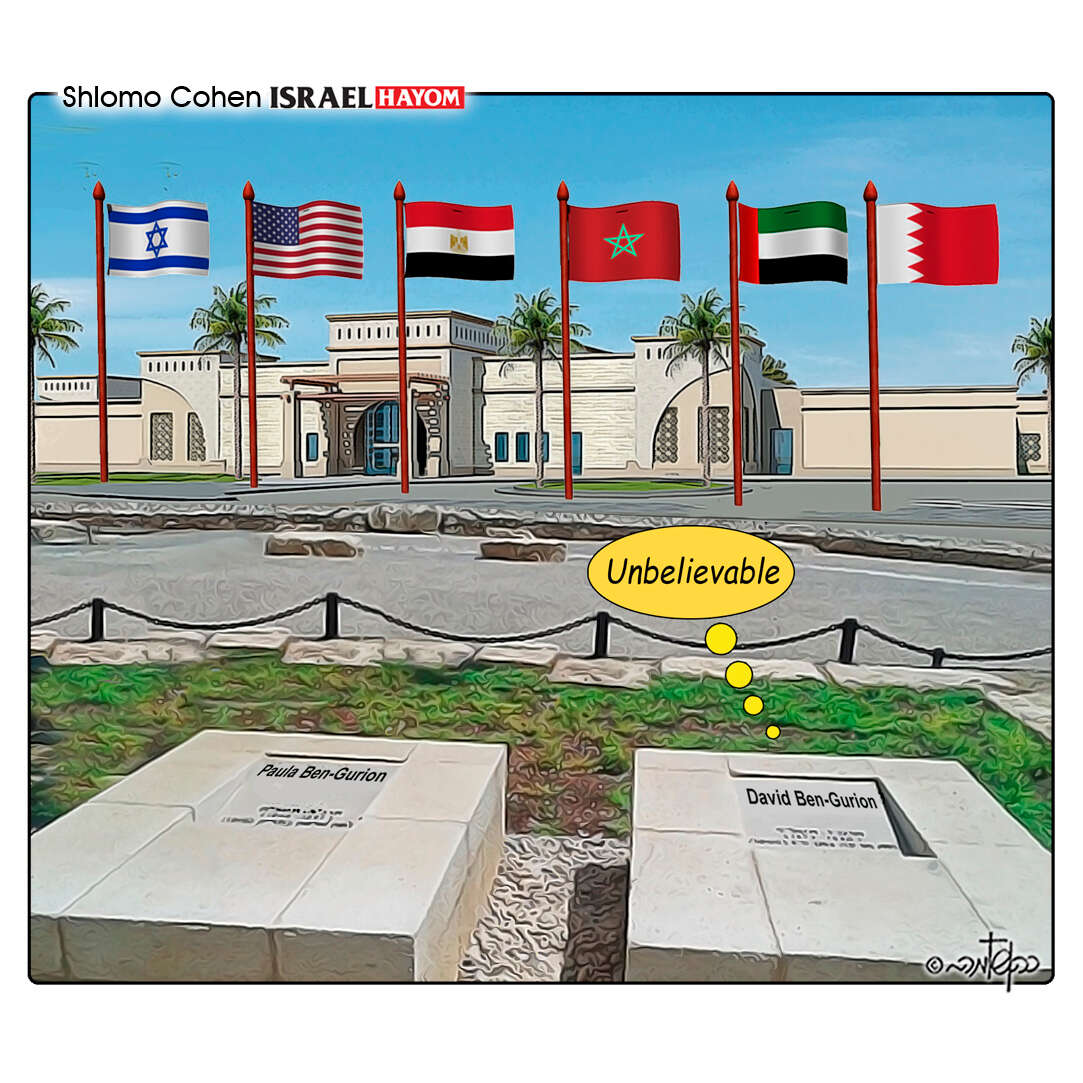
NY Sun Editorial: The Ben-Gurion Summit
The conclave of foreign ministers from the Middle East gathering for what is being dubbed, after its desert location, the “Negev Summit” would be newsworthy no matter what happens. That’s by dint of convening, as it will today and tomorrow, Arab envoys and their Israeli counterpart within the borders of the Jewish state. It’s astonishing and delightful, though, that the meeting will take place at Sde Boker.

That’s the dusty desert kibbutz where is buried the leader who, nearly 74 years ago, proclaimed the independence of the Jewish state. We speak of David Ben-Gurion, who rose from day worker to become Israel’s first prime minister. Not only that but the foreign ministers — from Bahrain, Egypt, the United Arab Emirates, Morocco, America, and Israel — will pay homage at the grave of the visionary leader.

If anyone had asked us five years ago, or two years, whether this could happen, we would have chuckled with incredulity. Not that it’s so all-fired unusual for Israeli and Arab leaders to meet, especially after the Abraham Accords. It’s that by going to the final resting place of “the Old Man,” as Israelis call Ben-Gurion, they are acknowledging the very idea, and the success, of the political Zionism that inspirits Israel.

It is worth, in respect of Sde Boker, recalling the history that this small town outside of Beersheba evokes. David Ben-Gurion — born ??David Grün — hailed from Plonsk, in what is now Poland, before making his way to the Land of Israel in 1906. Just less than a decade before, a journalist living in Vienna, Theodor Herzl, had convened, at Basel, the first Zionist Congress.
NYTs: Israel Summit Shows Ties with Arabs Moving from Ceremony to Substance
Israel's meeting with top diplomats from the U.S. and four Arab countries - Egypt, the UAE, Morocco and Bahrain - on Sunday is one of the strongest signs yet that the country is beginning to reap the dividends of normalization deals, confirming a profound realignment of Middle Eastern powers. The deals have also prompted Egypt, a longtime peace partner, to engage more meaningfully with Israel as Cairo tries to revive its role as Israel's bridge to the Arab world.

Polls suggest that many people in the Arab world do not support normalizing ties with Israel. But to Gulf leaders, the cost is outweighed by the benefits of sending a strong message to both the U.S. and their shared enemy, Iran. For Gulf countries, "the optics of sending a message about a new security alliance, pushing the relationship with Israel out in the open and then sending a message to Iran, and in a way to the U.S. - that is the main priority," said Elham Fakhro, a Bahraini political analyst. In any case, she said, "They've found that there isn't much of a price to pay domestically."

Israel and other countries in the region are also working to formalize a communication system that will allow each partner to warn one another in real time about incoming drones from Iran and its proxies, according to a senior Israeli defense official. As American attention diverts elsewhere, Arab leaders have realized that Israel is a long-term partner, said Yoel Guzansky, an expert at Israel's Institute for National Security Studies.

The meeting is being held in the Negev desert town of Sde Boker on Sunday and Monday. The decision to hold the meeting in the Negev, rather than in Jerusalem, reflects how that city is still a highly delicate issue for Arab leaders. To attend a summit in Jerusalem was considered a bridge too far for Arab ministers.


Biden’s Israel Ambassador vs. Yitzhak Rabin on Israel’s Security
Nothing has changed in the last 26 years that would diminish Israel’s need to retain the areas referred to by Rabin. The topography of the region has, of course, not changed, and threats to Israel have hardly disappeared.

In contrast to his harsh words for Rabin’s position and that of all those who share what were Rabin’s concerns for Israel’s security, Nides sees little to criticize on the Palestinian side. He did express some displeasure with the Palestinian Authority’s “pay for slay” policy — its incentivizing of the wounding and killing of Israelis by providing often lavish financial rewards to Palestinian perpetrators and their families. But the practice apparently does not infuriate him, and among his articulated grievances against it was not concern for its victims, but rather, concern that the policy gives (in his words) “the haters” an excuse to oppose the PA.

Elsewhere, Nides expressed his gratification that “lots” of funds for the Palestinians are provided in the new American budget. These include what is now $219 million in economic support. The appropriations would seem to be in violation of America’s Taylor Force Act, which prohibited subsidizing the PA as long as it continues to divert millions in foreign donations to financing “pay for slay.” Perhaps Nides reserves his fury at this state-sponsored murder for the members of Congress who voted to no longer underwrite it.

Nor is Nides infuriated — despite his fervently asserted devotion to a two-state solution — by PA leader Mahmoud Abbas’s repeatedly declared insistence that he will never recognize the legitimacy of the Jewish state; that the Jews have no history in the area and no legitimate claims to it; and that their state must be expunged. No Palestinian leader talking of two states has ever accepted that one will be the Jewish state. But that apparently doesn’t bother Nides as much as Israel wanting defensible borders. Nor does Abbas’ complaining about Jews defiling the Temple Mount with “their filthy feet” get the ambassador’s dander up.

But Nides’s twisted morality — where he is outraged and where he is indulgent vis-à-vis the Palestinian-Israeli conflict — should not be surprising. He is, after all, the appointed representative of an administration that, in negotiations overseen by Yasser Arafat apologist Robert Malley, is about to give in excess of a hundred billion dollars and a path to a nuclear bomb to a regime that has repeatedly vowed to annihilate Israel.

AddToAny

Printfriendly

EoZTV Podcast

Podcast URL

Subscribe in podnovaSubscribe with FeedlyAdd to netvibes
addtomyyahoo4Subscribe with SubToMe

search eoz

comments

Speaking

translate

E-Book

For $18 donation


Sample Text

EoZ's Most Popular Posts in recent years

Search2

Hasbys!

Elder of Ziyon - حـكـيـم صـهـيـون


This blog may be a labor of love for me, but it takes a lot of effort, time and money. For 20 years and 40,000 articles I have been providing accurate, original news that would have remained unnoticed. I've written hundreds of scoops and sometimes my reporting ends up making a real difference. I appreciate any donations you can give to keep this blog going.

Donate!

Donate to fight for Israel!

Monthly subscription:
Payment options


One time donation:

Follow EoZ on Twitter!

Interesting Blogs

Blog Archive