Tuesday, March 01, 2022

From Ian:
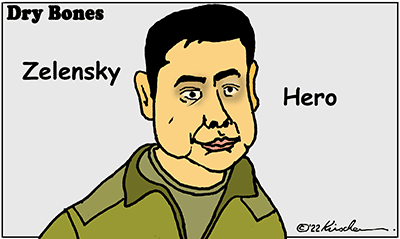
Bernard Henri Levy: Ukraine’s Hero President Z.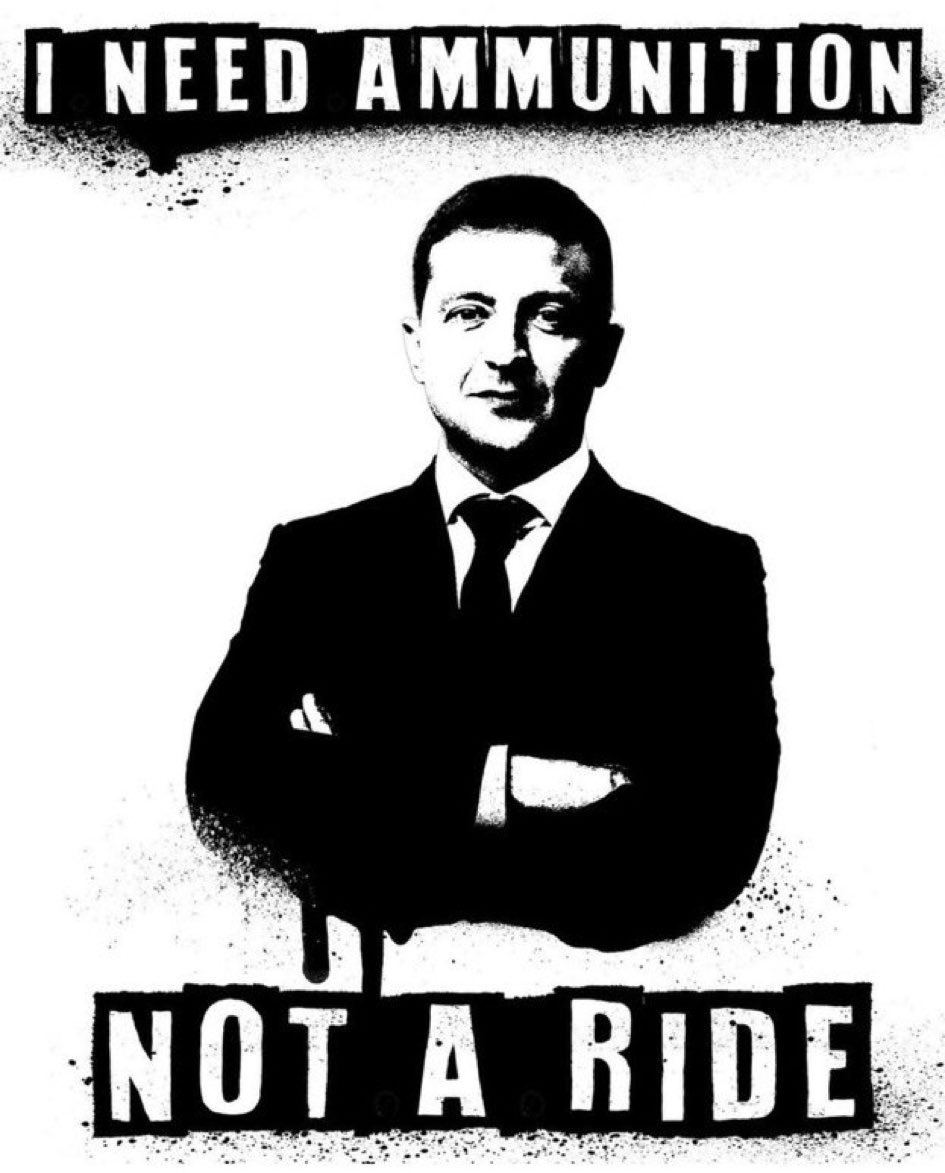
Israel takes nuanced approach to UN emergency session on Ukraine
David Singer: UN should try using its Israel-bashing model on Russia
Bernard Henri Levy: Ukraine’s Hero President Z.
I don’t know if, by the time this article appears, Volodymyr Zelensky will still be alive.
We do know that he is in Kyiv, surrounded by his generals, in a bunker that the Sukhoi fighter jets seek.
And we have just seen him in a video where he appears helmetless, outside, like a young Churchill walking in the poor neighborhoods of London during the Nazi Blitz of September 1940.
But I also know that he is at the top of the Kremlin’s kill list, according to the English-language press.
His recent farewells come to mind—on Friday, Feb. 25, to his counterparts over Zoom during a special meeting of the European Union: “This is maybe the last time that you will see me alive.”
What is greatness?
True greatness, as taught by European chivalry?
Perhaps it is that.
That heroism, calm and proud.
A touch of Allende the night before the assault of the Moneda by Pinochet’s death squads.
The way he told President Biden, who offered up an exfiltration—“I need weapons, not a taxi”—and Putin, today’s Pinochet: “You can try to kill me, I am ready for it, since I know that the idea lives in me and will survive me.”
The first time I met him was on March 30, 2019, the night before the first round of his stunning election, in a seafood restaurant near the Maidan.
I had just performed, at the Taras Shevchenko National University of Kyiv, Looking for Europe, the theatrical monologue that I was bringing then to the European capitals. My friend Vladislav Davidzon, one of the last American journalists still in Ukraine—reporting for Tablet—had arranged the meeting.
Tablet’s Vladislav Davidzon gained special access to Volodymyr Zelensky, Ukraine’s enigmatic new leader who once played the president on TV. Here, Davidzon shares his impressions of Zelensky and his predictions for Ukraine’s political future. byVladislav Davidzon
Volodymyr Zelensky was, at the time, a very young man. Looking like a paper boy in jeans, old sneakers, and a black T-shirt with a worn neckline, he had spent the night celebrating the final performance, in an old Kyiv skating rink turned café-theater, of “Servant of the People,” the one-man show that had made him famous.
Israel takes nuanced approach to UN emergency session on Ukraine
“We should take a picture together.”
Israeli Ambassador to the United Nations Gilad Erdan strolled across the General Assembly floor on Monday morning, making a direct line for his counterpart from Ukraine. Six months earlier, Sergiy Kyslytsya had visited Israel as part of a delegation invited by Erdan.
On this morning, Kyslytsya was hoping he would have a country to go back to at all.
Erdan patted the seated Kyslytsya on the back and they shook hands. After days of painful diplomatic neutrality, Jerusalem made a choice. Still sensitive to Russian control of Syrian airspace and Israel’s freedom of movement to attack Iranian and proxy forces to its north, Jerusalem said it would vote yes to a resolution condemning Russia’s invasion of Ukraine in an extraordinary emergency session of the General Assembly, not seen in decades.
“Israel was and will be on the right side of history,” Israeli Foreign Minister Yair Lapid said in a Monday statement. “We have a moral duty and historical obligation to be part of the effort.” This followed Israel’s silence on a U.N. Security Council resolution late last week demanding a halt to Russia’s hostilities, with Jerusalem, much to the disappointment of the U.S., reportedly reaching a late decision not to co-sponsor the resolution, knowing it would be vetoed by Russia, a permanent Security Council member, anyway.
Israel's UN ambassador makes a show of supporting his Ukrainian counterpart at the UN General Assembly. https://t.co/jvAgd4uguv
— Haviv Rettig Gur (@havivrettiggur) February 28, 2022
David Singer: UN should try using its Israel-bashing model on Russia
Reversing Russia’s flagrant violation of the UN Charter justifies the General Assembly adopting its Israel-bashing model to establish the following Ukrainian-dedicated agencies to humiliate and bash Russia into withdrawing from Ukraine: - Committee on the Exercise of the Inalienable Rights of the Ukrainian People (CEIRUP):
To institute a programme that will enable the Ukrainian people to exercise their inalienable rights to self-determination, national independence and sovereignty without external interference; to return to their homes and property from which they have been displaced.
- Department for Political and Peacebuilding Affairs' (DPPA) Division for Ukrainian Rights: To serve as the Secretariat of CEIRUP and provide the following core functions:
-Organising the meetings of CEIRUP and its Bureau at UN Headquarters;
-Monitoring political and other relevant developments;
-Organising programmes of international meetings, conferences and CEIRUP delegation visits;
-Implementing a publications programme;
-Developing and maintaining the United Nations Information System on the Question of Ukraine (UNISUKR) and managing CEIRUP’s outreach efforts including via social media;
-Cooperating with civil society organizations active on the Russia-Ukraine issue; -Organising an annual observance of the International Day of Solidarity with the Ukrainian People;
Armenia has broken with Russia and abstained in a vote at the UN Human Rights Council over whether to hold an urgent debate on Russia’s invasion of Ukraine.
— OC Media (@OCMediaorg) February 28, 2022
Armenia has previously offered muted support for Russia’s actions internationally. pic.twitter.com/lujlcaKJOq