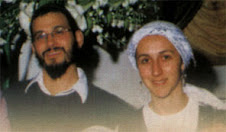
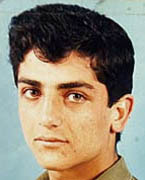
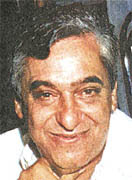
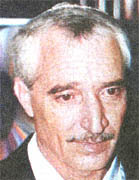
| Binyamin Ze'ev and Talia Kahane |
| Eliahu Cohen of Modi'in |
| Gadi Rajwan |
| Salim Barakat |
| Yosef Habi |
| Eli Dahan |
Elder of Ziyon| Binyamin Ze'ev and Talia Kahane |
| Eliahu Cohen of Modi'in |
| Gadi Rajwan |
| Salim Barakat |
| Yosef Habi |
| Eli Dahan |
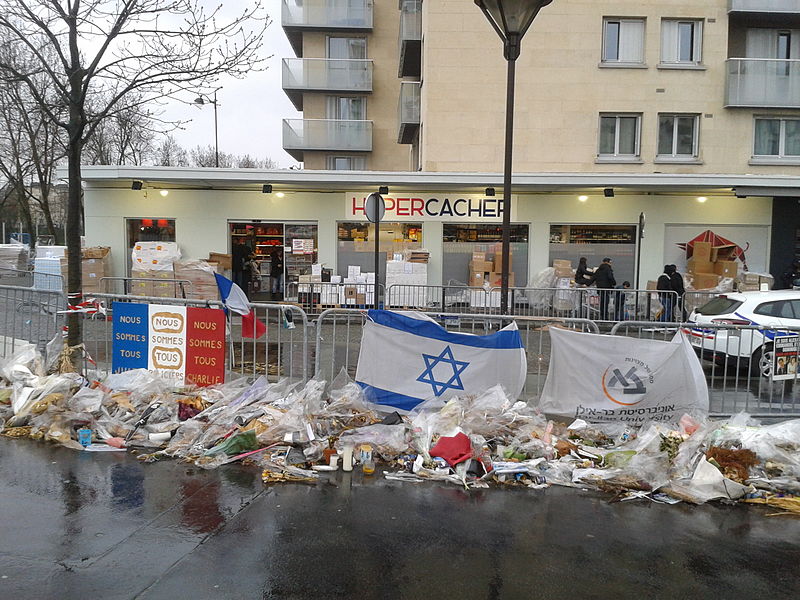
Elder of ZiyonJewish community leaders and French officials gathered on Sunday to mark the seventh anniversary of a terrorist attack on a kosher supermarket in Paris, paying tribute and expressing solidarity against antisemitic violence.
Organized by the Representative Council of French Jewish Institutions (CRIF), the main communal body of French Jewry, the ceremony took place in front of the Hyper Cacher where an Islamist gunman shot dead four Jewish hostages on Jan. 9, 2015 — Yohan Cohen, 20; Yoav Hattab, 21; Philippe Braham, 45; and François-Michel Saada, 63. A couple of days before the attack, two Islamist gunmen killed a dozen people at the satirical magazine Charlie Hebdo.
Multiple French politicians were present at the commemoration, among them former French Prime Minister Manuel Valls, who described it on social media as a “necessary tribute” to the “victims of Islamist terrorism.” Also in attendance were Marlène Schiappa, minister for citizenship; Sophie Cluzel, secretary of state for people with disabilities; Jean-Michel Blanquer, minister of education, youth, and sports; and Aurore Bergé, a lawmaker from French President Emmanuel Macron’s party.
“Murdered because they were Jews,” wrote Equality Minister Élisabeth Moreno. “Remember, always.”
Remembrance candles were also lit during the ceremony for other French Jews killed in antisemitic violence, including Sarah Halimi, a retired doctor who was beaten and thrown from her third-story Paris apartment in 2017, and Mireille Knoll, an elderly Holocaust survivor who was stabbed and set ablaze in her Paris apartment in 2018.
Some American Jews have given this kind of support a mixed reception. On the positive side, the American Jewish Committee (AJC) has welcomed and encouraged the support of Hispanic evangelicals. In 2019, the AJC accepted an invitation to address the General Assembly of the Alianza Evangelica Latina (AEL, Latin Evangelical Alliance). It was the first Jewish organization to do so. At the Assembly’s opening service, Rabbi Noam Marans, the AJC Director of Interreligious and Intergroup Relations, said, “At a time of rising racism, xenophobia, and antisemitism, Jews and Latino Evangelicals must be brothers and sisters who will together battle the hate that demonizes both our communities.”Matti Friedman: Chinese Itzik Comes to Haifa
Similarly, the American Jewish International Relations Institute (AJIRI) allies itself with faith-based leaders, including Hispanic evangelicals, to help further its mission of reversing discrimination against Israel at the UN. Indeed, the AJIRI recently appointed Pastor Ortiz to its board of directors (I serve with him on that board.) There, he works internationally to combat UN efforts to delegitimize the Jewish state.
But unfortunately, many moderate and left-leaning American Jews tend to discount the support of evangelicals because they don’t like the brand of Christian theology it’s based on. New Israel Fund CEO Daniel Sokatch provides a good example of this in his recent book, “Can We Talk About Israel?” There, he devotes a whole chapter to a dismissive take on evangelical support for the Jewish state.
This attitude is all too common among some American Jews. Writing in the Winter 2008 issue of City Journal, James Q. Wilson noted that, “in one Pew survey, 42 percent of Jewish respondents expressed hostility to evangelicals and fundamentalists.”
Jews with this mindset ignore an important rule of coalition building: Coalition partners don’t have to agree on everything. They just need to agree on one thing: in this case, the legitimacy of Israel as the sovereign nation state of the Jewish people. Jewish rejection of evangelical support is shortsighted and self-defeating. And that is especially true of support from Hispanic evangelical leaders, whose political influence and work on behalf of Israel are international in scope.
As Wilson said, “Whatever the reason for Jewish distrust of evangelicals, it may be a high price to pay when Israel’s future, its very existence, is in question.” Thus, he concluded: “When it comes to helping secure Israel’s survival, the tiny Jewish minority in America should not reject the help offered by a group that is ten times larger and whose views on the central propositions of a democratic society are much like everybody else’s.”
Jewish leaders would do well to keep that in mind.
Last week I drove up to Haifa to see with my own eyes a sight that, for most Israelis, has yet to sink in: the country’s brand new port, our third, which is beautiful, automated, efficient, and operated by the same Chinese company that runs the megaport at Shanghai. The first full container ship dropped anchor the day after my visit. Chinese characters adorn the soaring ship-to-shore cranes, freshly painted red and white; Israeli workers man joysticks opposite computer arrays running Chinese software; and in the managerial offices sit Chinese executives. To get to the port, I paid a toll and drove through the Carmel Tunnels, which were dug a few years ago by the China Civil Engineering Construction Corporation. At a gas station on the way I bought a pineapple yogurt made by the iconic dairy-products giant Tnuva, founded as a cooperative by Labor Zionists and now controlled by Bright Food—263 Huashan Road, Jing’an District, Shanghai. China was far, far away, until suddenly it was right here.
The most prominent face of China in Israel belongs to a guy named Itzik. His real name is Xi Xiaoqi, and he’s a 35-year-old resident of Beijing, but here he’s known as Itzik ha-Sini, or “Chinese Itzik.” He gets recognized on the street. He stars in hundreds of internet videos about life in Israel from a Chinese perspective, and about life in China made accessible for Israelis. Some of these appear on his own YouTube channel, but sometimes he appears on Israeli outlets like Channel 12 or KAN 11, the public broadcaster, where journalists are delighted to have a Chinese figure—the first—who speaks perfect, slangy Hebrew and has an acute grasp of the Israeli audience. He’s impossible not to like.
A good introduction to the Itzik genre is the video where he lists his top 10 reasons for loving Israel, including malawah, Jewish holidays, and the Pride Parade in Tel Aviv. Or the one where he introduces his grandfather Xi Rennan, 87, an energetic veteran of the Korean War (on the side of the communist North, of course), gives him a Hebrew name (Ronen), and teaches him to sum up his philosophy with the Hebrew workaholic expression nanuach bakever, “We’ll rest in the grave.” In Itzik’s world, China is a great place, but one that can learn from us Israelis about openness, creativity, and fun. He has much respect for who we are and what we’ve accomplished. The “top 10” video actually includes only nine things, but he ends by saying, “It’s OK, these are Israelis, they’re good people, not small-minded—they won’t make a big deal about it.” He snaps his fingers. “That’s the 10th thing.”
I caught Itzik on Zoom from Beijing. He was born in the city of Jiangyin, he said, son of a traffic cop and a real estate agent. He’d never met a Jew or heard a word of Hebrew before arriving at university at age 18. The school offered Japanese, Nepali, Dutch, and a few other languages, but his grandfather told him that Jews were smart—people of the book. Everyone thinks this in China, he said. If his years communicating with real Jews in Israel has disabused him of this notion, he was too polite to say so. During his Hebrew studies, first in Beijing with an Israeli teacher and then at Tel Aviv University, he adopted his Hebrew name, a diminutive of Yitzhak, or Isaac.
In 2009, with China taking a greater interest in Israel, he was selected to run the Hebrew desk at China Radio International, a state outfit that might uncharitably be called a propaganda arm or, more generously, a showcase for China’s best self. (The Hebrew desk doesn’t actually broadcast radio, only videos.) The CRI website has a lot of upbeat content about, for example, the many plusses of life in Xinjiang. In Itzik’s rise from an obscure city to an elite college, then to studies abroad, and then to an official media job, it’s possible to sense the hand of the state identifying and promoting a gifted young person.
Elder of ZiyonIsraeli occupation began importing aluminium from Bahrain, Manama-based newspaper al-Ayam reported on Sunday, citing an interview with Eitan Na’eh, the Zionist ambassador to Bahrain.“We have already started buying aluminium from Bahrain, and I am sure this aspect will see growth in purchasing rates,” he added.Bahrain Aluminium is one the largest smelters in the Middle East region. However, the ambassador did not specify the quantities or the value of Israel’s aluminium imports from BahrainIsrael’s airline El Al should start flights to Manama soon, Na’eh said, according to the newspaper. Bahrain’s Gulf Air in September announced the launch of direct flights to Tel Aviv, according to the newspaper.The occupation ambassador also said that in the near future, An air transport agreement will be launched that will allow the transport of goods from ships docked in Bahrain to aircraft bound for occupied Palestine.
Eliezer Tauber’s fascinating book reveals, therefore, the critical details of what did and did not happen in Deir Yassin on that fateful day, details that should (but undoubtedly will not) put to rest claims of massacre. There was killing, but not a massacre.Hamas lauds Sydney Festival boycotters
No less important, though, is Tauber’s illustration of how exaggerations of the carnage—intentionally concocted by the Palestinian press and others—led to widespread Palestinian flight and thus contributed to the Palestinian refugee problem. That is almost never discussed. Does that lessen the moral urgency of addressing the Palestinian problem? Probably not. But it should, at least, add nuance to the conversation about how to do so by highlighting that the causes of the problem are far more complex than many would like to acknowledge.
Other “massacres” that probably didn’t happen
Finally, it bears mention that Tauber’s book is part of a wider trend among some Israeli scholars who are upending long-held assumptions about massacres during the War of Independence and beyond. Another example is Martin Kramer’s masterful re-evaluation of the question of “What Happened at Lydda?”
You may recall that years ago, when Ari Shavit published a chapter of his (in many ways excellent and lyrical) book, My Promised Land, in the New Yorker, the chapter published was the one about the “massacre” at Lydda, also during the War of Independence, about which he wrote,
“In thirty minutes, two hundred and fifty Palestinians were killed. Zionism had carried out a massacre in the city of Lydda.”
That latter sentence infuriated many, since even if there was a massacre in Lydda, what did it meant to say that “Zionism” (rather than bad soldiers, for example) had committed the massacre?
That controversy festered for years, but it was only when Martin Kramer, the noted Israeli historian, began to look into the sources, that he, too, raised many doubts about whether there had been a massacre. Many deaths? Without question. An intentional massacre? In this case, very likely not.
With the publication of Tauber’s The Massacre that Never Happened, Tauber’s account of Deir Yassin and Kramer’s work on Lydda are now both available to the English speaking public. With the evidence so accessible, are those who accuse Israel of massacres going to read and re-think, or will they continue full steam ahead in accusing Israel of crimes that may well never have been committed?
That’s not the sort of question that Tauber nor Kramer address.
But then, again, we already know the answer.
THE terrorist group Hamas has praised the artists who have chosen to boycott the Sydney Festival.The Critical Role of Demography in the Middle East
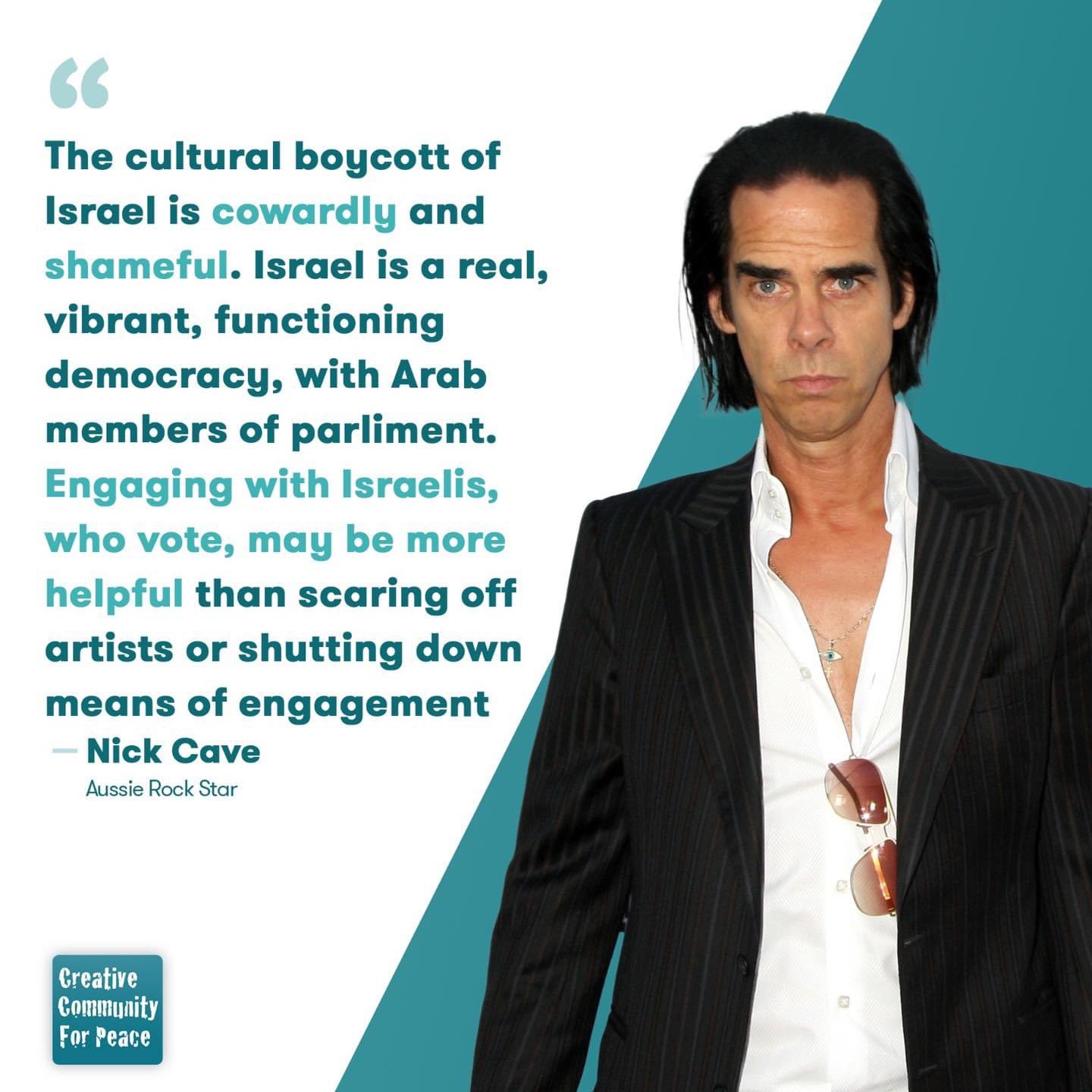
Comedians Judith Lucy, Tom Ballard and Nazeem Hussein, the Darlinghurst and Belvoir Street theatre companies and First Nations dance company Marrugeku are among more than 20 artists who have pulled out of the festival due to the Israeli Embassy providing $20,000 in sponsorship for the dance performance Decadance – created by Israeli choreographer Ohad Naharin – which opened at the Opera House to rave reviews.
According to the Palestinian Information Center, Hamas said in a statement late last week, “We commend and appreciate this decision that came in solidarity with the Palestinians’ legitimate rights, and in opposition to the Israeli crimes against our Palestinian people.
“We declare our solidarity with the participants who have withdrawn from the festival, and we call on all participants to raise their voices in face of oppression and injustice.”
Executive Council of Australian Jewry co-CEO Peter Wertheim said it was “now plain” that the boycotters have “unwittingly furthered the cause of the misogynists and homophobes of Hamas in seeking the obliteration of Israel”.
“A more accurate description of the ends their actions are serving would be ‘Artists for Genocide’,” he said.
Hamas perpetuated dozens of suicide bombings against Israeli civilians during the second intifada and since taking over Gaza in 2006 has fired thousands of rockets at Israeli population centres.
The Jewish majority between the Jordan River and the Mediterranean Sea is stronger than ever, among other factors because of immigration from Russia and Ethiopia, and rising birth rates in the Jewish sector.
In Syria, Sunnis represented 60% of the population on the eve of the civil war, compared to President Assad's Alawite sect, which comprised 12%. The Assad regime and its allies, Russia and Iran, carried out an ethnic cleansing during which nearly 1/3 of the population - 8 million people, the vast majority of whom were Sunnis - were either expelled or fled. 10 million Syrians currently reside under Assad's control, and the percentage of Alawites has doubled to 25%, if not more.
In Iraq, the percentage of Shiites who rule the country has grown to 65%, with the remainder comprising Kurds and Sunni Arabs who have been relegated to secondary status and many of whom have fled to Jordan and even Syria.
In Lebanon, the Shiites have become the largest sect in the country, nearly 1/3 of the population, while the Christians represent 1/4,and the Sunnis and the Druze represent 1/3 of the population. One in every three Lebanese (2 million out of a population of 6 million) is a Syrian or Palestinian.
In Jordan, 1/3 (4 million out of a population of 11 million) are refugees from Iraq or Syria.
The Fertile Crescent is no longer as Sunni as it was for a thousand years. This serves the hegemonic interests of Iran.
Elder of ZiyonDespite the strength and tyranny of the World Zionist Party and its control over many means of propaganda and media, and its control over the political and economic machine in many capitals of Western Europe, there is a group of Jews who have had enough courage to challenge it and challenge its domination.
Some people think that the war between Arabs and Jews is: the war of Arab nationalism on one side and Jewish nationalism on the other, and that the cause of the sinful Zionist aggression is: the love of Jewish national expansion at the expense of the Arab countries, as they are Arab countries only!So...some people think. But the truth is: The Jews’ motive for recurring aggression is the mean religious hatred that their innate nature - since their first day - has been imprinted on, and which they inherited from their ancient forefathers.The present war is: a war between Islam and Judaism, frankly and without the veil, and if the Arab countries embraced a religion other than Islam, they would not see aggression.
The Jews traditionally hate other religions, and from this hatred arose in them a greed to plot against all humankind. From this plot they come to work for the demise of every non-Israeli entity and its replacement by a Zionist international rule. This is their plan that they followed.
Elder of ZiyonThe Netherlands stopped its funding of the Union of Agricultural Work Committees (UAWC), one of six Palestinian NGOs Israel banned last year due to ties to the Popular Front for the Liberation of Palestine (PFLP) terrorist organization.The Dutch government had donated €21.5 million to UAWC, but suspended funding in 2020 after two senior UAWC officials were indicted for taking part in a bombing that killed Rina Shnerb, 17, in August 2019.In a letter to the Dutch parliament released on Wednesday, two ministers wrote that the investigation found that 34 UAWC employees were active in the PFLP in 2007-2020, some at the same time as holding leadership positions in the terrorist group."The large number of board members of UAWC with a dual mandate is particularly worrying," Development Cooperation Minister Tom de Bruijn and Foreign Affairs Minister Ben Knapen wrote.However, contrary to what Israel has said, the Dutch investigation did not find that UAWC itself was linked to the PFLP, organizationally or financially.Still, the Dutch government criticized the UAWC board, saying that its behavior was a betrayal of trust. The ministers pointed out that the NGO’s own guidelines say employees may not be politically active and said the board should have been more transparent about those ties, and as such, they have decided to permanently stop funding UAWC.The report also finds that several other Palestinian organizations could be viewed as "the social branch of the PFLP,” and De Bruijn wrote that the Dutch cabinet will look at its donations to other Palestinian NGOs, as well.
Muhanna worked as a doctor at Shifa Hospital in Gaza in 1972, and as a consultant in endocrinology and diabetes. Muhanna belonged to the Popular Front for the Liberation of Palestine in 1979. He participated in founding the Union of Health Work Committees in 1985, the Union of Agricultural Work Committees in 1986, the Addameer Foundation for Prisoner Care and Human Rights in 1991, and the Return Hospital of the Health Work Committees in Jabalia in 1997. Muhanna was a deputy President of the Medical Society between 1981-1991, Vice-President of the Palestinian Red Crescent Society in the Gaza Strip and member of its board of directors, and member of the Palestinian Higher Health Council between (1993-1996). In 2000, he participated in the Sixth Conference of the Popular Front for the Liberation of Palestine and was elected A member of its political bureau, he became its official in the Gaza Strip. He ran for the Palestinian legislative elections in 2006 for the Gaza district, but he did not win.
Elder of Ziyon
Elder of ZiyonWilf said that no matter what the Americans seek to achieve with their funding, the Palestinian perception is more important.Will UN go ahead with plan to blacklist companies operating in Judea and Samaria?
“The way that American and all Western funding of UNRWA is perceived by Palestinians—and again we have ample evidence of that in the book—is perceived as Western legitimacy for the idea that they are refugees, that the war of 1948 is not over and that it could one day be won to their cause of no Israel,” she said.
The money, she said, will serve as fuel for another generation of conflict despite America’s good intentions.
“I think one of the biggest problems of U.S. foreign policy and Western foreign policy is that they prioritize feeling good over doing good,” said Wilf. “And that this is a classic case in point. They feel good about giving money, but they’re actually doing something very bad. They’re literally pouring money that translates into many more years of conflict.”
Yet Israeli governments, with the exception of former Prime Minister Benjamin Netanyahu, have not prominently opposed the funding of UNRWA. Wilf said that this is due to a mistaken notion among the Israeli security establishment that UNRWA is a stabilizing force. Yet, she pointed out, it’s not a coincidence that the places where UNRWA is most active, such as Gaza and southern Lebanon, are also the areas where Israel has found itself involved in wars combatting terrorism.
Romirowsky pointed out that Israel doesn’t contribute to UNRWA; rather, it’s American taxpayers that do, making it an American issue where the United States should ask what exactly it is funding.
Wilf noted that is especially true in Gaza, where 80 percent of the population is registered as refugees by UNRWA, despite being born there. The funding of UNRWA by the United States and Western nations has convinced the Palestinians that their place in Gaza is temporary.
“This means that they have exactly zero incentive to turn Gaza into the Singapore of the Middle East or the Dubai of the Mediterranean,” she said. “Because Gaza, in their view, is not their home and every dollar that goes to UNRWA merely sustains and fuels the Palestinians in their view that Gaza is a temporary station. They can have it until they take back … ‘Palestine from the river to the sea.’ ”
Instead, Wilf said that the Biden administration would be better served by defunding UNRWA, making it clear to the Palestinians that they’re not refugees, that the 1948 war is over, and that Israel is here to stay.
The Biden administration, according to Wilf, should demonstrate that they would be “thrilled” to fund Palestinians with a goal of living next to Israel, rather than instead of Israel, but that it has no intention of underwriting a worldview that seeks to “eradicate, annihilate and erase an ally of the United States.”
A spokesperson for the Israeli Ministry of Foreign Affairs told JNS that despite an Israeli government transition back in June, "There is no change in the way Israel sees the UN human-rights office and there won't be until there will be a fundamental change on its side and the way it treats Israel."
OHCHR spokesperson Rupert Colville told JNS, "Unfortunately, we have not received any indication from the Israeli authorities that our requests for visas will be answered in the near future. Nor have we received any specific requests from the Israeli authorities in relation to the possible granting of visas. As a result, none of the 18 international staff are currently able to return … which is deeply regrettable," adding that his office has reached out to the Israeli government on numerous occasions, without any substantive response.
"We are continuing to engage with concerned UN member states and continue to reach out to Israel in order to sort out this unsatisfactory situation. But so far, these efforts have not borne fruit. We sincerely hope the visa issue will finally be resolved soon and that we will be able to revert to our normal working conditions … as mandated by the international community," said Colville.
Among the 112 blacklisted businesses, 94 are domiciled in Israel with the remaining 18 scattered in the United States, Great Britain, France, Luxembourg, the Netherlands and Thailand. The American companies include international food conglomerate General Mills – known for products such as Cheerios cereal and Häagen-Dazs ice-cream – along with communications company Motorola Solutions and travel lodging website Airbnb, which delisted rental properties in Jewish communities in Judea and Samaria in 2018 before reversing course under legal pressure.
The BDS movement has had no noticeable impact on Airbnb's current operations in Judea and Samaria or elsewhere, and none of the companies on the OHCHR blacklist have made any public indication that their inclusion has harmed their bottom line or that they plan to decrease their activities in any territory tied to the Israeli-Palestinian conflict.
The OHCHR said it had examined another 76 companies that were ultimately not included in the original list. It has given no indication yet whether it intends to follow through with an updated blacklist this winter.
An Israeli government source told JNS that none of the foreign members of the record 24 full-time staff expected to be hired for the current Commission of Inquiry should expect to receive a visa to conduct its work either. The commission's findings could potentially be used by organs like the International Criminal Court to bring charges against current and former Israeli government officials and military leaders – a process that current Israeli Defense Minister Benny Gantz reportedly personally requested that Palestinian Authority leader Mahmoud Abbas put a halt to.
"In my experience, the Palestinians do promise not to continue with their diplomatic terrorism to use international organizations as a platform to carry out their war against Israel, but they always retract their commitment," said Danon
Amid calls to boycott #Israel at #SydneyFestival, @joshrfeldman writes: “There’s no excuse in isolating and vilifying Jews.”
— Arsen Ostrovsky (@Ostrov_A) January 9, 2022
Op-Ed in The @australian:https://t.co/LHHEMaHE9m pic.twitter.com/um1PTFQHpt
Elder of ZiyonAfter being kept in prison for more than five years, Dr. Shmuel Yeheskel Haim, who was the Jewish representative in the (Medjlis) Persian Parliament, (The Jews are entitled under the Persian Constitution to have one Deputy in Parliament) has been executed this week, it is learned to-day, on a charge of having been implicated in a conspiracy against the life of the Shah.Deputy Haim was first arrested in May 1926; he was soon after released, but he was rearrested in October of the same year, and had been kept in prison till his execution now, in spite of repeated intervention made on his behalf by the Zionist Executive, who had in May 1926 appointed him on the nomination of the Zionists of Teheran as the representative of the Zionist Organisation in Persia in matters relating to Jewish immigration to Palestine.It was explained by competent Jewish personages in these places who had been in touch with Mr. Haim that he was an ardent Jewish politician, who had been constantly protecting as a Jew against the Government’s persecution of the Persian Jews, and that he was also an active Zionist, and it was argued that it was probably more on account of his activities in these directions that he had been arrested. The Persian Jews contended that he was innocent of the crime with which he was charged, and that the Government was only anxious to get him out of the way because of his stand on behalf of the Jews of the country.It has been stated that Mr. Haim’s real offence was that as a member of the Persian Parliament he had addressed a letter to the League of Nations complaining bitterly of the treatment of the Jews in Persia. The League of Nations, it was said, had addressed an enquiry on the subject to the Persian Government, whereupon the Shah sent for Deputy Haim and demanded that he should write to the League of Nations and state that everything had been put right. Deputy Haim agreed to do this on two conditions. The first was that the Chief of Police should be dismissed, and the second that the oppression of the Jews in Persia should really be stopped. The Shah resented these demands, especially, it was stated, as the Chief of Police is a close relative of His Majesty, and Deputy Haim was thrown into prison and sentenced to death for conspiracy.
He was put into Parliament by the Jews of Persia in place of Dr. Loghman, a Teheran physiclan, who was the first Jewish representative in the Medjlis, after the proclamation of the Constituion. One Jew among 120 Moslem Deputies, it was complained, he sat down and made no attempt to raise the Jewish question, to protest against the unlawful taxation imposed upon the Jews in the Provinces, to demand that murderers of Jews who are time and again allowed to go free should be punished, that the laws which have at various times been passed in favour of Jews should not be allowed to remain a dead letters. Finally, the Jews deposed him and put Deputy Haim into his place, and Deputy Haim started a vigorous reorganisation campaign of the Jewish Communities, school committees, relief committees and the Zionist Committee.After his arrest, a prominent Persian Jew wrote of the position of his fellow-Jews in Persia – “oppressed, persecuted, treated with contempt and ignored in their own country, the Jews of Persia have been almost forgotten by the Jewries of the world, and left to their fate. No one knows of them, or cares for them, and they themselves have lost the power and the energy to do anything for themselves. Pensian Jewry has become a backwater in Jewish life”.Numbering all told about 60,000 souls, the Jewish community in Persia leads a life of continual harassment and affliction, he wrote. Surrounded by a vast ocean of Mohamedanism, the Jews are looked down upon as something inferior and second rate.The standard of Jewish education is low. There are no Jewish religious schools and no Medrashim in Persia. The only Jewish religious knowledge is what is taught in the elementary schools – a little reading of the Torah and the study of Rashi for a few hours in the week, including oral translation into Persian, he continued.
Elder of Ziyon
Elder of ZiyonGlobal Judaism is a demonic force with a secret organization, which likens itself to a snake, and this snake has a 9-stage scheme.This plan started from the time of the Babylonian captivity 24-25 centuries ago, and the end of the last phase was at the end of this twentieth century, and in Palestine.“Strength” in global Judaism is its ability to conceal its attributes from the world, and spread the mist around itself so that the world remains confused about the Jewish truth.The most skilled thieves in the world, and if they mastered the technical trick of stealing, piercing walls, manipulating iron locks, acrobatic climbing in the dark, speed of movement, surprising with the barrel of a pistol, using drugs and covering their palms with gloves and paint.
In that conference, which included the most notorious demons and heads of demons, its members and sects competed, individually or in collaborators, in devising the most dangerous plan to destroy and exclude the world. The conferees studied a criminal plan to enable the Jews to control the world.
Potential models for enhanced Abraham Accords regional economic cooperation can be found particularly in Asia, where organizations such as the Asia-Pacific Economic Cooperation (APEC) and the Association of Southeast Asian Nations (ASEAN) have contributed to the growth and an increase in intra-regional trade.Meet the Arab Zionists: a new generation of online pioneers
The new Regional Comprehensive Economic Partnership (RCEP), linking 15 Asia-Pacific nations of different sizes, levels of development, and systems of government, could serve as an initial model for economic partnership among Avraham Accords countries.
As the enormous benefits of this win-win regional cooperation become increasingly clear, more countries will likely join the Abraham Accords, thereby creating a virtuous circle of peace and growth.
While the Abraham Accords have the potential to transform the region, such a transformation will not happen on its own. Decision makers must focus time, energy and effort on those actions that serve to liberate the economic potential of the Avraham Accords, adopt a strategic approach which utilizes the unique contributions of each member, cut through bureaucratic red-tape, and help with integration with global markets.
Concluding government-to-government financial and investment agreements must be given top priority, and ongoing high-level forums of officials empowered to overcome remaining barriers should be established.
It is critical that such processes make substantial progress in 2022, otherwise we risk losing the positive momentum begun with the signing of the original accords in September 2020.
Realizing the full potential of the Abraham Accords will undoubtedly require great vision and investment. Fortunately, the region has shown tremendous capacity for both. Leveraging the historic agreements today will provide returns of prosperity, opportunity and stability for generations to come.
“The Golan Heights is the only area in Syria that hasn’t been destroyed and had its people killed.”
With these words, a Syrian blogger began a video begging the Israeli government to “occupy” the entire country of Syria to save more lives.
In another video, an Arab academic dressed in a long white kandura is moved to tears by visiting Yad Vashem, promising: “Today, together, Muslims Jews and Christians, we promise you, it will never happen again.”
The huge growth of social media has in recent years allowed the world to see a different Middle East — one where individuals have been able to directly communicate their honest views on Jews and Israel to the world.
But in 2020, something changed again. The signing of the Abraham Accords in September that year was a watershed moment: it allowed many Arabs to speak out openly about Israel without fear of a backlash — while opening the door to positive experiences of Israel, whether via the news or trips to the Jewish state.
Now, in a growing trend, pioneering Arab Zionists and pro-Israel influencers — who once would have been labelled traitors — are promoting Israel to their hundreds and thousands of followers.
Loay Al-Shareef, 39, is an Abu Dhabi-based social-media influencer and a self-declared Zionist. He has 180,000 followers on Twitter, and more than 80,000 on Instagram, thanks largely to his regular posts about languages and etymology.
True, Israel has a unique relationship with the Jewish diaspora. Famously, all Jews have the “right of return” to Israel. It is the unequivocal refuge for a people who were persecuted and made to wander across the world for almost two millennia until their ancient homeland was restored to them.Hen Mazzig: It’s Not the Antisemitism Your Grandparents Warned You About
But unless they make aliyah, diaspora Jews are not citizens of Israel. The entitlement of shared peoplehood does not negate the particular compact of citizenship made between Israel’s government and its citizens alone.
This compact — common to all democratic nations — confers reciprocal duties and responsibilities on each party. The most important duty of any government is to keep its citizens safe.
And although the strategy of keeping foreign nationals out was always open to criticism, Israeli Prime Minister Naftali Bennett was entitled to take the measures he believed to be essential to keep Israelis safe from the virus.
With this strategy having now fallen apart under the huge wave of Omicron infections, these travel restrictions have just been lifted. But the tensions brought to the fore by Daroff’s remarks go deeper.
In a thoughtful post on his Substack blog, Daniel Gordis writes that there has never been an honest conversation between Israel and the diaspora about the obligations and prerogatives of each side.
What has been obscured as a result is something that many Jews outside of Israel find unpalatable — the absolute centrality to Israel of aliyah. The country’s founders, writes Gordis, had called for nothing other than an end to the diaspora altogether.
Gordis is undoubtedly correct to identify this issue as important, ignored and still unresolved.
Hebron, Ramallah, and eastern Jerusalem are tough neighborhoods. I know, because I served there as a soldier in the Israel Defense Forces (IDF). I was stationed on a front line where Israel fought for both its existence and its reputation as a humane, decent neighbor. I was a humanitarian officer overseeing the building of infrastructure, education, health, and housing projects for Palestinian communities — but many saw me as an enemy combatant.1,000 Reasons Why Not to Fight Anti-Semitism But are they legitimate?
After completing my service in the IDF, I began to advocate for the safety, empowerment, and appreciation of Israel and Jews worldwide. I toured Europe, Australia, and North America, addressing diverse audiences about our history and heritage. Today, a decade later, I’ve realized that the real battlefield for the future of Israel and Jews worldwide isn’t in Jerusalem, Gaza, Iran, or on the hundreds of college campuses where I have lectured.
The frontline is online.
Today’s social media digital pen is mightier than any sword that has ever existed.
What do the assailants in the lethal attacks on Jews in Monsey, Jersey City, and Pittsburgh have in common? They all posted their hatred of Jews before acting on it. It is through social media where today’s hatred of Jews and Israel finds its voice, and where it gains its lethal force. In many cases, it is on Twitter, Instagram, Facebook, TikTok, and in the dark underbelly of hundreds of discussion groups, where antisemites are radicalized and called to action.
Every bigot, demagogue, and hate monger knows the power of social media. These extremists post jokes and graphics geared toward impressionable teens. As purveyors of hate, they devote themselves to indoctrinating the naïve and vulnerable. “Extremists are able to reach, research and radicalize in ways that they haven’t had to, or could do, in human history,” Oren Segal, the ADL’s Vice President of the Center on Extremism, told NBC News, noting how they target isolated teens who turn to online for community, and can recruit them into hate “without ever leaving their couch.”
Anti-Semitism helps Jewish unity.
I’ve heard that anti-Semitism is like death and taxes. It’s inevitable. It’s just an unfortunate byproduct of humanity and of the Jewish experience but it prompted the survival of the Jewish people for thousands of years. Anti-Semitism creates Jewish unity; it has been the only point of unity among increasingly divergent Jewish communities. When Jews feel safe and prosper, they are more at risk of assimilation and intermarriage, so we need anti-Semitism to bring them back to their roots. So why fight it? Instead, we should be thanking Hashem and our lucky stars for this Jew-hatred. It’s all part of a divine plan that’s above our pay grade to understand.
Anti-Zionism is not anti-Semitism.
Jew-hatred and the violence stemming from anti-Semitism seem like a growing problem only because we label the expanding but justified condemnation of Israel as “anti-Semitic.” Many told me that if we create a wedge between the diaspora Jews and their homeland, being the State of Israel, and welcome criticism of Israel, it can only lead to greater love, understanding and appreciation for Jews everywhere. Those with an unbridled love for the Jewish people but deep hatred toward Israel such as supporters of the BDS movement will accept us as respected members of society. Considering our long history of oppression, we’re rarely given a choice in anything. So, let’s be good Jews and become champions of the anti-Israel movement.
Anti-Semitism: A cost-benefit analysis.
In theory, it would be great to eradicate anti-Semitism, but we simply don’t have enough people and sufficient resources to do so. Even if every single Jew in America donated to the cause, it will never be enough to counter the billions being poured into anti-Semitic campaigns. So, if our numbers and resources are limited, is it really worth dedicating so much time and money to a fight that we’ll inevitably lose? Many prefer to dedicate their limited resource to existing Jewish institutions such as schools, synagogues and social services, as well as hiring armed security services to protect our Jewish institutions and their communities.
Valuable advice rather than financial commitments.
Jews are known to be smart. They are excellent in providing opinions and ideas, including on how to fight anti-Semitism and how to raise the necessary funds to fight it. But, when it’s time to put money where their mouth is, most prefer to stick with giving priceless advice. Most claim that they don’t have the necessary resources to help financially and those who do have such resources claim that there are many more important undertakings than to fight Jew-hatred.
Although there are many excuses and good reasons why not to fight anti-Semitism, there are also great advantages in doing so and now. Anti-Semitism is a universal problem; the enemies of the Jewish people are first and utmost the enemies of America. Hatred against Jews and/or any other minority groups in America is cancerous to our society. Thus, for the first time in several thousands of years, it’s in the best interest of Western civilization and all Americans to join together and combat this evil.
Second, we now have a strong Jewish state, the State of Israel, on our side. The people of Israel view anti-Semitism as a serious threat and are willing to lead the fight against it, not just observe from safety, by providing courage, resources and innovation.
Despite the convincing excuses I’ve heard, I stay optimistic and hope that some, like me, will stop downplaying the threat, move past the fear, paranoia, and inaction, and join me in standing up and fighting anti-Semitism.
Buy EoZ's books!
PROTOCOLS: EXPOSING MODERN ANTISEMITISM
If you want real peace, don't insist on a divided Jerusalem, @USAmbIsrael
The Apartheid charge, the Abraham Accords and the "right side of history"
With Palestinians, there is no need to exaggerate: they really support murdering random Jews
Great news for Yom HaShoah! There are no antisemites!