Tuesday, May 04, 2021

From Ian:
Ruthie Blum: Mt. Meron and Israel's paradoxical nature
Ruthie Blum: Mt. Meron and Israel's paradoxical nature
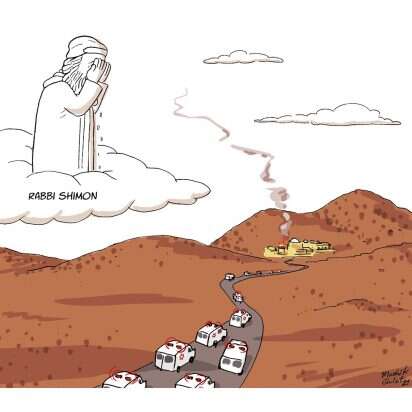
On Saturday night, as Tel Aviv's City Hall lit up with the image of the Israeli flag to commemorate the dozens killed and 150 injured in the crowd-crush two nights earlier on Mount Meron, Israelis of all backgrounds came together to light yahrzeit (memorial) candles.Jpost Editorial: After Meron, violence, Israel needs a government now - editorial
Some of the people present at Rabin Square that evening, like others around the country, configurated tea lights in the shape of the numeral 45 – the number of people trampled to death during the Lag B'Omer celebrations.
The outpouring of nationwide grief over the victims and empathy with their families was not unusual in a state sadly accustomed to burying citizens who are, by all measures, too young to die. Nor was it novel for Israel's Kan Radio to play sad music, out of respect for the gravity of the hour.
The same can be said of the public's lining up in droves, and for hours on end in sweltering heat, to donate blood for the treatment of those still in the hospital. Though less frequent an occurrence, the offer by Israel's national carrier, El Al, of free passage for anyone from abroad needing to pay their last respects or provide bedside comfort to loved ones was also not surprising.
Even the fact that Arab villagers from the Meron area in the north rallied to help their Jewish brethren in distress – distributing free food and drink to survivors – wasn't totally out of the ordinary.
But all of the above has been noteworthy nevertheless, due to the identity of the casualties. All were ultra-Orthodox Jews who had made a pilgrimage to the gravesite of second-century sage Rabbi Shimon bar Yochai to dance around the holiday's traditional bonfire – hosted, as it happened, by the Jerusalem-based, anti-Zionist sect, Toldot Aharon.
Throughout the past year, since the onset of the coronavirus pandemic, already strained relations between the Haredim and secular Israeli society have been particularly fraught. Indeed, COVID-19 is one force majeure that hasn't been a unifying factor in the way that other shared traumatic experiences have been, due in large part to its dragged-out duration.
If anyone still harbors any lingering doubts about why Israel must not go to a fifth election, but rather form a stable, workable government as soon as possible, the events of the last two weeks should put those doubts to rest.From Israel: Are We “Judaizing” Jerusalem??
What happened two weeks ago? Clashes began in Jerusalem between Arabs and Jews, exacerbated by a protest by a group of racist Jews, that then led to terrorists from Gaza firing rockets into Israel.
That was followed by Thursday night’s horror in Meron, and no less than three terror attacks on Sunday, including a shooting attack at the Tapuah Junction that left one yeshiva student in life-threatening condition, another in serious condition, and a third with light injuries.
Why should any of that convince people of the need for a strong government and not spin the wheel on a fifth election? Because these incidents show that while Israeli politicians are fiddling around, things out there in the real world are happening.
The world continues to spin. But while it spins, Israel is unable to prepare or respond as it should because its leaders are otherwise engaged. The recent uptick in violence and Palestinian terror came as no great surprise. First, the Muslim month of Ramadan has for years been a period of increased violence in Israel.
The amusement is fleeting, however, for there is nothing funny about the Arabs’ motivation in making this charge: They are seeking to delegitimize the Jewish claim to Jerusalem, and, more extensively, to Israel.
When I wrote my last posting, I said I would return to consider other reasons why Israel needs a strong right-wing government without delay. And this, my friends, is one significant reason. We need leaders who are clear on our rights and ready to stand on them. For, just as anti-Semitism is increasing world-wide, so is anti-Zionism, the flip side of the same ugly coin.
The Palestinian Arabs and their supporters may be virulently hostile, but they are not stupid. They know that Jerusalem and Har Habayit (the Temple Mount) are an essential element of our claim to the Land.
Our claim is based on international law.
We have just celebrated the 101st anniversary of the San Remo Conference: At the end of WWI, Great Britain, France, Italy, and Japan – with the United States as a neutral observer, came together for the Conference in San Remo, Italy, under the auspices of the League of Nations. They met to determine the allocation of Middle Eastern lands that had been part of the defeated Ottoman Empire. Borders were drawn that defined Mandate territories. These were to be governed temporarily by either Great Britain or France, and would receive independence within a relatively short period of time.
The Mandate for Palestine was given to Great Britain, which was charged with establishing it as a Jewish homeland.
The decision made at San Remo was then officially confirmed in a unanimous vote of the League of Nations (51 nations) on June 24, 1922. Thus was the Jewish right to the land established in international law; that law still stands. Jerusalem, it should be noted, was within the area defined by the Mandate as a Jewish homeland.
Our claim is also based on heritage and history.
Incorporated into the San Remo Resolution regarding the Mandate for Palestine was the Balfour Declaration – a 1917 letter from the British Foreign Secretary declaring the government’s sympathy with Zionist aspirations and endorsing establishment of a Jewish homeland in Palestine.
The text of the Mandate for Palestine as passed by the League of Nations additionally said this:
“…recognition has thereby been given to the historical connection of the Jewish people with Palestine and to the grounds for reconstituting their national home in that country.”
This is huge. The fifty-one nations of the world belonging to the League of Nations all signed on to a document recognizing the Jewish historical connection to Palestine. (See the full list here: https://en.wikipedia.org/wiki/Member_states_of_the_League_of_Nations)
The US was not a member of the League of Nations, but the Lodge-Fish Resolution, passed by both houses of Congress on June 22, 1922 (before the League of Nations voted), endorsed the Mandate for Palestine; it was then signed by President Warren Harding.