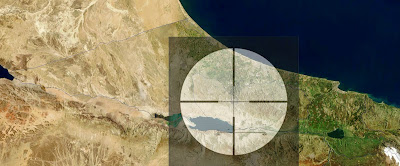
AUSTRALIA Post has pulled a world globe from sale at its outlets and issued an apology after The AJN alerted it to the fact that Israel was labelled as “Palestine”.The globe, produced by the Discovery company, was bought at Australia Post’s Bentleigh East branch in Melbourne last Friday by a Jewish man as a birthday present for his grandson.After noticing the error, he contacted the Anti-Defamation Commission (ADC) to express his shock and anger and has vowed to return the product.In another blunder, the name Israel did appear on the globe but it was in Lebanon, above the region identified as Palestine. It was also printed across a border line, so all that is visible is “Isra”.Speaking to The AJN on Tuesday, an Australia Post spokesperson said, “We are aware of this issue and have suspended the sale of this product and apologise for any offence caused.”The spokesperson added that Australia Post “stocks a range of Discovery products in our stores, including this one, which was purchased in good faith”.Stating, “Accuracy is of the utmost importance across all areas of the Discovery business,” a Discovery Australia spokesperson told The AJN, “We have immediately consulted our production partner of the 2-in-1 World Globe Light to rectify the geographical error relating to Israel. We apologise for any offence caused to our customers.”Meanwhile, ThreeSixty Group, Discovery’s production partner for the product, blamed “a factory misprint error” for the mistake.“As such we will be working with the factory to immediately correct this and to ensure that our teams more closely check this item for accuracy going forward,” a spokesperson said.“We are currently working with our retail partners to immediately remove this item from shelves. We deeply regret that this mistake was not caught sooner.”
Friday, April 23, 2021
Elder of Ziyon
Thursday, April 22, 2021
Bernard-Henri Levy: Sarah Halimi’s Law
Everything about this case is heartbreaking.
The fate of a retired kindergarten teacher, beaten and then thrown from a window.
The evasiveness about whether a murder committed to cries of “I’ve killed the devil!” was or was not an anti-Semitic act.
The silence of the feminist groups that typically do such remarkable work in support of battered women and victims of domestic abuse, but who had nothing to say about this case.
The December 2020 decision of the court of appeals, confirmed by the high court on April 17, that Kobili Traoré, the killer, whose criminal record contains 20-odd convictions, was, in this instance, overcome with a delirious episode and thus could not be held criminally responsible.
Not to mention the good souls who, clearly perceiving that the courts have spoken but justice not done, keep repeating that they “understand the feelings of the Jewish community,” as if it were the latter alone, and not the French nation as a whole, that had reason to feel cheated by a trial that was whisked away, making it impossible to reach closure.
In the face of this legal and moral defeat, I offer three observations.
First, since judges are ordinary mortals, subject to prejudice, errors of judgment, and even emotion, it is not inappropriate, contrary to ubiquitous assertions to the contrary, to “comment on a court decision.”
Indeed, the derailment inflicted by the high court is revolting.
Indeed, we live in a country, France, where a man who throws his dog from his fourth floor is sentenced to a year in prison, whereas if he murders an old Jewish woman, he may face no consequences whatsoever.
Indeed, it is worrisome to know that the murderer, who had no history of psychiatric problems, who suffered and suffers from no pathology, and who, since his hospitalization, has received no medication, will soon regain his freedom.
And, no, it is not inappropriate to worry about the state of a legal system that is too often the prisoner of the culture of excuses: In Sarcelles, we witnessed the inability to call by its proper name the act of an individual armed with a knife who attacked three people leaving a synagogue wearing yarmulkes.
JPost Editorial: Sarah Halimi murder: No excuse for killing, hating Jews - editorial
The fact that the man shouted religious slogans during the killing provides evidence that this was not just a random drug-fueled murder. Throughout history Jews have been murdered for blood libels, hacked to death by Crusaders, and stuffed into gas chambers and crematoriums. In recent years, France’s Jews have often been targeted by Islamist extremists. For instance, in 2012 a Jewish school in Toulouse was targeted by a murderer who filmed the killing of a teacher and children. Mohammed Merah, the murderer, shouted “Allahu akhbar” while killing others during his campaign of terror.
Then, in 2015, four people were killed at a kosher supermarket in Paris. That attack was also mistakenly dismissed as “randomly shoot[ing] a bunch of folks in a deli” by former US president Barack Obama. One wonders again whether, had they not been Jews but another minority group, and had they been targeted in a unique traditional food store, it would have been labeled “random.”
It was not random when France’s “Gang of Barbarians” murdered Ilan Halimi in 2006. He was targeted for being Jewish, and during the trial the ringleader of the murderers claimed “all the Jews in the world are enemies,” a statement we Jews have heard before.
Unfortunately, in France there is a long list of wannabe Hitlers who have targeted our people, from Ilan Halimi, to Sarah Halimi. The difference is that the law has now decided in France that so long as people have taken a bit of drugs, they are no longer responsible for their murderous actions. Any “angry” person can now murder a Jew in France and claim he took drugs beforehand and have a reasonable chance of walking free.
While it is a positive step that Macron has called for the law to change, it is years too late. Macron has said that he wants to assure the family and relatives of the victim and all fellow citizens of the Jewish faith that they have his support. Then why do they keep getting murdered in France?
Jews make up a small, historic minority in France. Many have left the country over the years for Israel, the United States or Canada, seeking to build a new life. They shouldn’t have to flee for safety or put up more bars and walls around their synagogues to feel safe. It’s not enough to change a failed law that enables people to murder so long as they are “high.” Society in France should have been educated long ago not to hate Jews and not to call Jews “Satan.” Crimes of people shouting “God is great” while killing members of another faith should be prosecuted as religious-inspired hate crimes. The excuses have to stop.
Many ppl joined me at the French consulate to demand justice for Sarah Halimi because if this judgment is allowed to stand, then murder has become legal in France so long as a murderer gets high on marijuana first and their victim is Jewish!
— Dov Hikind (@HikindDov) April 21, 2021
READ LETTER:https://t.co/Y5PQDn5c7e pic.twitter.com/kJ0m6P7Y46
Sarah Halimi's family to seek Israeli trial, lawyers say
Sarah Halimi’s sister is set to file a legal complaint in Israel against her killer who was recently found criminally not responsible by a French court.France's Jews Outraged After Sarah Halimi Murderer Acquitted
Ms Halimi died in 2017 aged 65 after being pushed from her Parisian apartment window by her neighbour Kobili Traoré, who has since remained in psychiatric care.
He had shouted ‘Allahu Akbar’ before the attack.
Lawyers representing the victim’s Israeli sister, Esther Lekover, said they will lodge a complaint in Israel where some antisemitic offences committed abroad may also be prosecuted.
Gilles-William Goldnadel and Francis Szpiner said they “deplored” having to take the step but “could not accept a denial of justice which offends reason and fairness far beyond France’s Jewish community.”
They also expressed their “consternation” at the cour de Cassation’s recent ruling.
Just HOW bad is Jew hatred in France?
— StopAntisemitism.org (@StopAntisemites) April 21, 2021
SO bad that Uber needs to advertise in public subway platforms there's no antisemitism allowed in their cars.
Is it any wonder Jews are fleeing France in records numbers for Israel? pic.twitter.com/pkkCnwtwMv
Thursday, April 22, 2021
Elder of Ziyon
"pro-Palestinian", cartoon of the day, humor
Thursday, April 22, 2021
Elder of Ziyon
humor, Preoccupied
Our weekly column from the humor site PreOccupied Territory.
Check out their Facebook page.
Chagrin Falls, OH, April 22 - A spokesman for the local chapter of the Get Rid Of Slimy girlS club (G.R.O.S.S.) announced today that the group had voted down a proposal to boycott Israeli cultural, political, commercial, and academic entities to put pressure on the Jewish State to alter its policies toward the Palestinians. Witnesses put the margin of votes at a mere two.
"G.R.O.S.S. has voted not to adopt the Boycott, Divest, Sanctions motion," stated Dictator-for-Life Calvin at a post-vote press conference. "A majority of the voters decided against it. Our club invited input from numerous sources and engaged in its customary lively debate, followed by a show of hands. Two votes against the measure made the difference."
"Now I hope G.R.O.S.S. can return to its core activities," added El Tigre Numero Uno Hobbes. "Whatever the merits of BDS - I happened to have voted against - the Israeli-Palestinian conflict has little or no bearing on the business of this organization. We focus on combating the pernicious influence of girls, chief among them our arch-nemesis Susie Derkins. Now THAT is an entity to boycott."
"Oh, some boycott," sneered Chief Strategist Calvin. "Is that what you were doing in Susie's arms yesterday? 'Boycotting' indeed! I move to censure Hobbes for canoodling with the enemy!"
"I did no such thing!" insisted G.R.O.S.S. Cartographer Hobbes. "It was an infiltration mission to map the hideout of our main opponent! In fact you knew that, because you sent me on that mission in the first place, you chowderhead! This is a naked attempt by Head Scout Calvin to frame me for his own dismal failures, such as when he saved a winter snowball in the freezer to throw at Susie during the summer, when she would least expect it - and he missed! And then, while he was focused all on himself, loudly lamenting his catastrophic failure, she simply gathered up the pieces, pressed them together, and pelted him! Right in the kisser! Which is what he probably wants to do right now! He planned this all. Treason!"
"I'll give YOU treason!" bellowed King and Tyrant Calvin, taking a swing at Special Agent in charge of munitions Hobbes. A dusty mêlée ensued, featuring further mutual recriminations, half-a-dozen scratches, one bruise, and some pulled hair and fur. All parties to the fracas agreed to a truce, whereupon Most Highest, Grandest, Exalted Supreme Dictator-For-Life Calvin proposed to Club Secretary Hobbes that the minutes show a dignified discussion of the pros and cons of adopting a BDS motion, and Hobbes observed that no coherent case for BDS had ever been offered, in G.R.O.S.S. or anywhere else.
Amb. Alan Baker: What Does the Return of the “Two-State Solution” Mean?
With the advent of the new Biden administration in the United States, the phrase “two-state solution” appears to have returned to the forefront in the new U.S. administration’s “reset” of its policy priorities regarding the Palestinian-Israeli dispute.2
The phrase is repeated daily by administration officials as well as by international leaders and organizations, as it was during the Obama and previous administrations.
However, as in the past, the phrase is again being bandied about as a form of collective and generalized “wishful thinking,” as the only panacea to the Palestinian-Israeli dispute, but without a full awareness of its history, its practical implications, and the feasibility of its implementation amidst the realities of that dispute.
It is repeated despite the fact that the “two-state solution” has never been accepted by the parties to the dispute as the agreed solution, and despite the fact that the permanent status of the territories, as agreed in the Oslo Accords, remains an open negotiating issue between the parties. As such, repetition of the call for a “two-state solution” would appear to be an attempt to prejudge the outcome of that negotiating process.
Clearly, any concept of a “two-state solution” that would include the establishment of a Palestinian state alongside Israel could only emanate from direct negotiations between Israel and a unified Palestinian leadership. This would not be a result of a partisan political resolution issued by the UN or any other source, or from vague and generalized calls from international leaders for a “two-state solution” as a form of collective wishful thinking.
Any such outcome must include the recognition of Israel as the nation-state of the Jewish people by a Palestinian state, in the same manner in which Israel would recognize a Palestinian state as the nation-state of the Palestinian people.
Amb. Dore Gold: Defensible Borders for Israel: An Updated Response to Advocates and Skeptics
Despite intense efforts in Western capitals to second-guess Israel's security requirements, the top Israeli leadership has been remarkably consistent about what Israel requires to protect its vulnerable borders. The architects of Israel's national security have insisted on retaining "defensible borders" for assuring a stable peace.Caroline Glick: The Thomas-Greenfield Doctrine of U.S. Foreign Policy
In the aftermath of the Six-Day War in 1967, Gen. Earle Wheeler, Chairman of the U.S. Joint Chiefs of Staff, noted: "From a strictly military point of view, Israel would require the retention of some captured Arab territory in order to provide militarily defensible borders."
In 2004, President George W. Bush wrote to Prime Minister Ariel Sharon: "The United States reiterates its steadfast commitment to Israel's security, including secure and defensible borders to preserve and strengthen Israel's capability to deter and defend itself, by itself."
IDF Maj.-Gen. Shlomo Yanai published a study on Israel's "Core Security Requirements" in 2005 and concluded: "Despite the technological advances of modern defense systems and warfare, controlling the high ground remains an essential part of basic security doctrine." Similarly, former IDF Chief of Staff Lt.-Gen. (res.) Gadi Eisenkot wrote Guidelines for Israel's National Security Strategy in 2019 and included "defensible borders" among the seven principles for the military security of Israel.
The West Bank mountain ridge, together with the Jordan Valley, constitutes a strategic barrier reaching more than 4,600 feet in some places to protect Israel against threats from the east on its longest land border.
In the face of threats from Iran and Muslim terror armies equipped with state-of-the-art conventional weapons systems, terrain, topography, and strategic depth remain critical, as does Israel's need for defensible borders.
Taken at face value, U.S. Ambassador to the UN Linda Thomas-Greenfield's condemnation of the United States in a speech last week before Al Sharpton's National Action Network was one of the most bizarre statements made by a diplomat—from the U.S. or, indeed, from anywhere—in recent years.
In her remarks, Thomas-Greenfield castigated the U.S. as inherently, irredeemably evil. "I have seen for myself how the original sin of slavery weaved white supremacy into our founding documents and principles," America's woman at the United Nations said.
While bizarre to the uninformed, it turns out Thomas-Greenfield's remarks were simply her stump speech. She gave the same one—nearly verbatim—at the UN last month.
Speaking at the UN General Assembly's meeting marking the International Day for the Elimination of Racial Discrimination, Thomas-Greenfield insisted that America's "original sin" of slavery has not been expunged from American life. It has simply morphed into a new form.
There is "a direct line from slavery to lynchings to segregation to mass incarceration," she alleged. So as far as Thomas-Greenfield is concerned, slavery didn't end when hundreds of thousands of Union soldiers gave their lives to end slavery in the Civil War. It didn't end through constitutional amendments, or even during the civil rights movement. America's "original sin of slavery" continues to have a terrible impact "on our people today," she insisted.
The most basic job of a diplomat—for any country—is to put a good face on his or her country before the nations of the world. At the UN, an institution dominated by tyrannies, the U.S faces isolation as a matter of course. For the most part, the only U.S. initiatives at the UN that have succeeded have been those that directly support rogue actors—like then-President Barack Obama's decision to rejoin the dictator-controlled, anti-American and anti-Semitic Human Rights Council, as well as his decision to legitimize Iran's nuclear program.
Thursday, April 22, 2021
Elder of Ziyon
This activity originated in the West Bank and focused on the Palestinian territories and Syria, and to a lesser extent Turkey, Iraq, Lebanon and Libya. It relied on social engineering to trick people into clicking on malicious links and installing malware on their devices. Our investigation found links to the Preventive Security Service — the Palestinian Authority’s internal intelligence organization.This persistent threat actor focused on a wide range of targets, including journalists, people opposing the Fatah-led government, human rights activists and military groups including the Syrian opposition and Iraqi military. They used their own low-sophistication malware disguised as secure chat applications, in addition to malware tools openly available on the internet.
Thursday, April 22, 2021
Elder of Ziyon
Signatories include House Majority Leader Steny Hoyer (D-MD), Democratic Caucus Chair Hakeem Jeffries (D-NY), Minority Leader Kevin McCarthy (R-CA) and GOP Whip Steve Scalise (R-LA), and run the ideological gamut from progressive Rep. Ro Khanna (D-CA) to arch-conservative Rep. Marjorie Taylor Greene (R-GA).
J-Street's support for the McCollum bill shows that the organization is not at all in the mainstream of even Democratic party thinking, but is just as much a far-Left group as Jewish Voice for Peace. Its claims to support a secure Israel are a fig leaf for its extreme anti-Israel positions. Which explains why Mahmoud Abbas was a featured speaker at their conference - he shares their desire for a defenseless Israel while pretending to support a two state solution that he has opposed every time it was presented as a plan.
Dear Chair DeLauro and Ranking Member Granger,As you begin your consideration of the Fiscal Year 2022 appropriations bills, we know you face many conflicting demands on this year’s budget. As the United States meets pressing global challenges, we strongly believe that robust U.S. foreign assistance is vital to ensuring our national security interests abroad.One program that enjoys particularly strong bipartisan backing and for which we, Democrats and Republicans, urge your continued strong support is the full funding of security assistance to Israel as authorized in the 2016 U.S. - Israel Memorandum of Understanding (MOU). Foreign military financing and security assistance are provided by appropriations and are subject to Congressional oversight. In addition, our assistance to Israel is governed by the terms of the U.S.-Israel MOU. The expected Fiscal Year 2022 Budget Request of $3.8 billion in security assistance for Israel - $3.3 billion in foreign military financing and $500 million for cooperative missile defense programs - constitutes the fourth year of the ten-year 2016 MOU. This assistance was approved overwhelmingly by Congress in 2020 in the U.S. - Israel Security Assistance Authorization Act (UISAAA), which became law as part of the National Defense Authorization Act. The Act codified the levels of funding set forth in the 2016 MOU. In that spirit, we urge you to support foreign assistance funding, including full funding for Israel’s security needs.Israel continues to face direct threats from Iran and its terrorist proxies. In February, an Israeli-owned ship in the Gulf of Oman was hit by a mysterious explosion that Israel has attributed as an attack by Iran. In 2019, Hizballah launched three anti-tank missiles at an Israeli Defense Forces vehicle in Israel. Hizballah is estimated to have an arsenal of over 130,000 rockets and missiles, and is believed to be developing new precision-guided munitions to be deployed in Lebanon. American security assistance to Israel helps counter these threats, and our rock-solid security partnership serves as a deterrent against even more significant attacks on our shared interests.Congress is committed to maintaining Israel’s qualitative military edge and its ability to defend itself, by itself, against persistent threats. Our aid to Israel is a vital and cost-effective expenditure which advances important U.S. national security interests in a highly challenging region. For decades, Presidents of both parties have understood the strategic importance of providing Israel with security assistance.As America’s closest Mideast ally, Israel regularly provides the United States with unique intelligence information and advanced defensive weapons systems. Israel is also actively engaged in supporting security partners like Jordan and Egypt, and its recent normalization agreements with the UAE, Bahrain, Sudan, and Morocco will help promote regional stability and deal with common challenges from Iran and its terrorist proxies.We recognize that not every Member of Congress will agree with every policy decision of every Israeli government. However as President Biden has stated, “I’m not going to place conditions for the security assistance given the serious threats that Israel is facing, and this would be, I think, irresponsible.” Reducing funding or adding conditions on security assistance would be detrimental to Israel’s ability to defend itself against all threats. We urge you to fulfill our commitments as agreed to in the 2016 MOU as codified by the UISAAA, and in accordance with all U.S. laws.Just as foreign assistance is an investment in advancing our values and furthering our global interests, security aid to Israel is a specific investment in the peace and prosperity of the entire Middle East. U.S. support for Israel makes the region a safer place and bolsters diplomatic efforts aimed at achieving a negotiated two-state solution, resulting in peace and prosperity for both Israelis and Palestinians. We appreciate your leadership on this issue, and we urge your full support for this continued critical investment.
Thursday, April 22, 2021
Elder of Ziyon
The first aerial dogfight between Syrian and Israeli planes took place this afternoon when a Syrian fighter appeared over Israeli territory wear the frontier. He was driven back into Syria after an exchange of fire with an Israeli fighter.Earlier, five Syrian planes flew over the defense zone, violating the provisions of the armistice agreement. Israeli authorities lodged a protest with United Nations officials against the newest Syrian violation of the pact.
A list of new charges against Syria were last night submitted by Israel to Col. Bennet de Ridder, acting chief of the United Nations truce commission, with the request that these complaints be included in the agenda of the next meeting of the Israeli-Syrian mixed armistice commission. The charges are:1. Arab para-military forces supported and commanded by members of the Syrian regular army have entered the Nuqeib area, in the demilitarized zone, and have been attacking for the past two weeks all civilians and police in the vicinity.2. During the last five days, Syrian troops again attacked and murdered Jews in the demilitarized zone, including one policeman who was on a routine police patrol–such patrols having been sent to Nuquieb almost daily for many months.3. Syria has recruited several hundred Palestine Arab refugees who are being trained and armed by Syrian formations along the Israeli border.4. About 60 armed khaki-clad Arabs entered last Friday and Saturday a number of villages in Israeli territory, violating the provisions of the armistice agreement.5. Arab forces entering the demilitarized zone in the Nuqeib area from Syria have constructed military positions and fortifications inside and around the village of Nuqeib.
Wednesday, April 21, 2021
Elder of Ziyon
Opinion, Vic Rosenthal
Earlier this week I wrote about what Yoram Hazony calls “The Virtue of Nationalism,” the idea that independent nation-states with ethnically homogeneous populations and limited borders provide a better opportunity to maximize individual freedom and satisfaction than large imperial conglomerations that try to meld diverse groups into an ethnically neutral state of all its citizens.
I noted that nationalism is a natural extension of the inherent human tendency to like and trust others that resemble them, beginning with family members and expanding outward to include clans, tribes, and nations. I argued that this tendency was probably developed as a result of evolutionary forces over hundreds of thousands of years, and is now essentially hardwired into humans.
Zionism, Jewish nationalism, is naturally based on these human feelings.
But it’s not simple. As Jonathan Haidt notes in his fascinating book “The Righteous Mind: Why Good People Are Divided by Politics and Religion,” the “wiring” is not the same in every culture, and even within cultures there are individual differences. Haidt identifies five or six different “moral foundations” which give rise to our intuitive feelings about right and wrong, and good and evil. Individuals seem to possess these foundations in different proportions, and that causes divergent moral judgments about the same factual situations. For example, most people feel quite strongly that, other things being equal, human pain and suffering should be minimized. And most people have a conception of fairness or justice as morally good. But there are other moral foundations that are not as widespread: those for loyalty, for deference to authority, or for sanctity (the opposite of degradation or contamination).
Haidt suggests (I’m oversimplifying) that liberals tend to emphasize minimizing harm and realizing fairness, while conservatives add concerns about loyalty, authority, and sanctity. He also notes that in WEIRD (Western, Educated, Industrial, Rich, and Democratic) cultures, the last three seem to have atrophied. Many WEIRD people do not go past the “harm” criterion – they will say “no behavior is immoral unless someone is harmed by it.” Here is a link to an excerpt from the book which contains some examples. It’s entertaining to think about the examples given and ask yourself “how WEIRD am I?”
The pursuit of a Jewish nation-state is more than just a search for a way to protect ourselves against the antisemitism that is rife in the diaspora. Zionists feel a strong pull to make common cause with their fellow Jews, a feeling related to the moral foundation of Loyalty. And most of them, even the secular ones, feel that it ought to be located in the Jewish people’s historical homeland, which is related to the moral foundation of Sanctity. Zionism, in other words, is less likely to appeal to WEIRD people, who are less likely to be strongly influenced by Loyalty and Sanctity. And this is borne out in several ways.
Here in Israel, there is a controversy about the Nation-State Law, a strongly Zionist explication of the Jewishness of our state, which says (among other things) that “[t]he exercise of the right to national self-determination in the State of Israel is unique to the Jewish People.” In general, the Right supports it, while the Left believes that it should be weakened in the name of democracy and equality. The breakdown according to Haidt’s categories is almost perfect, with non-WEIRD people of Mizrachi and Russian backgrounds supporting it, and upper-class people and academics opposing it.
In the US, too, we see the same phenomenon. Most American Jews are descended from working-class immigrants, but since then they have done very well. Today, they tend to be well-educated and well off. Perhaps this is part of the reason that younger Jews, far from the culture of their struggling ancestors, seem to feel the connection to the Jewish people and to Zionism much less strongly than their grandparents did.
An individual’s set of moral foundations can change throughout life. Education, experience, and introspection can change it, albeit slowly. Most people seem to move toward the right with age, although there are notable exceptions. But at any given time, a person’s moral perceptions come through a fixed lens. This is why it’s so hard to change someone’s mind about these kinds of issues, as the subtitle of Haidt’s book implies.
And we can see why there seems to be a growing gap between American and Israeli Jews. Of course there are obvious differences in our experience – Israelis are much closer to the security situation and have more immediate personal concerns. But in addition, American Jews have been wealthier and well-educated for a much longer time, so the strength of their Loyalty and Sanctity foundations is less. And American culture in general deprecates the idea of peoplehood, although recently it has begun to try to develop it for specific groups (but not Jews).
This relates to the question that many of us ask: why are there so many Jewish anti-Zionists? Why do so many Jews take the side of their enemies, compared to Arabs who – while they may fight amongst themselves – more or less all agree to fight Israel as well?
The answer is that Jewish culture, because of its long exposure to the West, has lost some of the moral foundations that are still powerful in Arab cultures. It has become WEIRD. And that doesn’t serve us well in the Middle East.
Holocaust Memorials Are Monuments Against Civilization’s Enemies
Now, Americans who believe in civil rights, black and white, want to remove Confederate statues, not to dishonor Southern soldiers who died during the Civil War, but because they refuse any longer to accept the white South’s racist mythologizing of its past.Who’s Afraid of the IHRA Working Definition of Antisemitism?
It is important to remember that attacks on Holocaust memorialization are not really about history. Holocaust monuments and museums, as Neiman argues, are “values made visible.”
Holocaust deniers and desecrators are not the only ones who want to destroy these universal values of justice and equality. So too do the white supremacists who marched in Charlottesville in 2017 carrying swastiska-emblazoned banners and shouting “Blood and Soil. Jews will not replace us” — and also the violent occupiers of the US Capitol in January 2021, who wore antisemitic insignias while unfurling Confederate flags.
Over a century ago, philosopher William James gave a speech dedicating a monument to Black soldiers and the white officers who died fighting for freedom in 1864. But he also delivered a warning to future generations about where the greatest threats to civilization might come from: “The deadliest enemies of nations are not their foreign foes … [From] internal enemies civilization is always in need of being saved. The nation blessed above all is [the nation where] the civic genius of the people does the saving day by day … by speaking, writing, voting reasonably … by good temper between parties.”
The “internal enemies” James was warning against were bigots wearing the masks of false patriotism — a sight that is becoming all too common today in America and across the world.
The International Holocaust Remembrance Alliance (IHRA) includes 34 member states and numerous experts who work together to strengthen, advance, and promote Holocaust education, research, and remembrance. To effectively combat the rise in antisemitism world-wide, IHRA experts determined that the definition of antisemitism must be clarified.Walter Mondale, a liberal icon who championed Israel
The IHRA’s Committee on Antisemitism and Holocaust Denial built an unprecedented international consensus around the IHRA Working Definition of Antisemitism, which was formally adopted at a Plenary in Bucharest in May 2016. The definition has since been adopted by numerous countries, government agencies, and organizations around the world, including the US State Department.
The idea embodied in the IHRA definition is that to fight Jew hatred, we must first define it.
Many people recognize antisemitism only in its classical form; i.e., the public portrayal of Jews as greedy, demonic creatures who constantly conspire to control the world. However, in the past few decades, as the memory of the Holocaust has faded and social media became a primary channel of communication and source of news, antisemitism has mutated into a new form — anti-Zionism.
By masking one’s Jew hatred as an allegedly legitimate criticism of the State of Israel, the delegitimization campaign against the State of Israel, led by the terror-linked Boycott, Divestment, and Sanctions (BDS) movement, has openly promoted and fostered the new antisemitism.
Walter Mondale, the former vice president, represented a time in American history when being pro-Israel and progressive were often synonymous.
He passed away Monday at his home in Minneapolis aged 93.
From the launch of his national political career, Mondale was close to the national Jewish and pro-Israel communities. He found in those organizations willing partners in his endeavors to expand civil rights, and they found in him an avid advocate of Israel.
Mondale acted as a buffer between President Jimmy Carter, under whom he served as vice president, and Israeli Prime Minister Menachem Begin and when the talks that culminated in an Israel-Egypt peace deal turned tense. Begin was said to favor the company of the affable Mondale over Carter, who was standoffish.
Mondale was one of three US lawmakers present at the dedication of Israel’s Knesset building in 1966 — he was a Minnesota senator at the time — and he led a delegation to Israel in 1978 to mark the country’s 30th anniversary.
Vice President Walter Mondale, left foreground, and Israeli Prime Minister Menachem Begin, right, strain to hear the questions of reporters above the chants of anti-American demonstrators who were nearby in Jerusalem, July 2, 1978. Mondale and Begin had just completed a round of talks in the prime minister’s Jerusalem office. (AP Photo)
Israel policy was one of the few areas where Carter and Mondale differed. (The other was Mondale’s impatience with what he believed was Carter’s tendency to scold the American public.) In 2007, appearing with Carter on CNN in an interview marking 30 years since they assumed office, he gently pushed back at his friend’s book published not long before, “Palestine: Peace not Apartheid,” in an exchange that was otherwise all mutual admiration.
“I have read the book,” Mondale said. “I think there’s a lot of good materials in there. I do have a few problems with it, but if I might, I’d like to talk to the president about it first.”
Wednesday, April 21, 2021
Varda Meyers Epstein (Judean Rose)
book review, Judean Rose, Terrorism, Varda
Reaching for
Comfort: What I Saw, What I Learned, & How I Blew it Training as a Pastoral
Counselor, is the third of three books by Sherri Mandell on dealing
with the loss of her son Koby Mandell, to terror. But know that Mandell is a
writer by profession, and not by circumstance. She writes because that’s her
gift: it’s what she does. The fact that she can not only write but has a
heartbreaking story to tell, makes it all the more poignant to read her
story, and hear her “voice.”
It’s difficult—even gut-wrenching—to read these works, but some
would say, necessary. This is a human rights issue. Jews, like all other people, should
have the right to live productive lives in peace, in particular in their
indigenous territory. Jewish children, like all other children, should have the
right to grow up unmolested by terror, no matter where they live.
In this new book, in which Mandell speaks of her experiences
training as a pastoral counselor, we hear the voice of a mother who longs for
comfort, who is seeking something to give her relief or at least a small
respite from the feelings she goes to bed with at night, and wakes up to every
morning. It is obvious to all who witness this sort of pain, even from the
outside looking in: the pain of losing a child to terror never, ever leaves
you. This book helps us see what this might be like, God forbid, even if only
to the smallest degree (may we never need to understand it fully).
Mandell takes us along as she begins to visit hospitalized patients as part of her training. This takes place at a time when pastoral counseling is new to the scene of Israeli patient care. Many of the patients fail to understand the purpose of her visits and are reluctant to avail themselves of what she attempts to offer them. One understands that Mandell thought she'd be good at pastoral counseling by dint of her experiences as the mother of a terror victim. Her efforts at comforting patients and their families, on the other hand, tend not to have the desired effect.
Interspersed with Mandell's visits to patients (whom she describes as "fictional composites, drawn broadly from real stories") are her training sessions and meetings with Michael, her mentor and co-teacher of the pastoral counseling course. Michael leads the group through prayers and exercises, during which Mandell always seems to fall short in comparison with her classmates. Mandell's self-described inadequacies as a pastoral counselor are as puzzling to the reader as they are to Mandell. Her descriptions of her visits to patients, meanwhile, are compelling, and we know something they do not: that she is Sherri Mandell, mother of Koby Mandell, who was murdered in a brutal attack when he was only 13.
An Added Dimension
For this writer, there is an added dimension to this story of an effort to comfort others in the midst of grief. Having lived in Gush Etzion for a long time,
through both intifadas, I remember when Koby Mandell and Yosef Ishran
were murdered. There was a media blackout at first, but we understood that children had been murdered in Tekoa, a settlement in our
area. And of course, the Gush was a much smaller community in those days than
it is now, and everyone knew everyone in the Gush.
We wanted to know what had happened, so we began making calls to people we knew in Tekoa. We
wanted to be there for the parents, to mourn alongside them. We wanted to learn
from what happened in order to understand what measures we needed to take in our attempts to protect our own children
going forward. It took only two phone calls to learn the identity of the two
boys who had been murdered, and the terrible details of the attack. It was, in
fact, a child who told me—the child of a friend—what had happened and to whom.
It was Sherri and Seth Mandell’s story. It was Koby’s story,
and it was Yosef’s story. And yet, in a sense, it was everyone’s story, in that it
affected us all, as residents of the Gush, as Jews. The knowledge of what happened
turned me into a hyper-vigilant mother. I told the daycare workers that under
no circumstances were they allowed to let my children walk home alone, though
it was a very short walk from the daycare center to our caravan. And yet, years
later, reading Sherri Mandell’s books, you realize it’s not your story, but her
story, and hers alone to tell.
Our responsibility, it seems, is to read every word of her elegant prose.
![]() |
| Koby Mandell (H"YD) with his parents Seth and Sherri, at his bar mitzvah, the last birthday he lived to see. |
I spoke with Sherri to learn more about her new book:
Varda Epstein: Your
first book, “The Blessings of a Broken Heart,” was the story of what happened
to your son and the blessings you recognized in the face of tragedy. Your
second book, “The Road to Resilience: From Chaos to Celebration” was about how
to find a way forward after tragedy. This third book you’ve “birthed” is more
difficult to define. How would you summarize “Reaching for Comfort?”
Sherri Mandell: “Reaching for Comfort” is the story of a
year training to be a pastoral counselor, being taught how to be present in
the face of suffering.
Varda Epstein: When
did you first hear about the pastoral counseling course? What did you imagine
you would get out of your training?
Sherri Mandell: A friend told me about the course. I thought
that I would learn to be comfortable with prayer and become a more serene,
centered person. I thought that I would also confront death and illness and see
how people coped. I think my main goal was to find a lamed vavnik [one of the 36 righteous people in every generation
who wander among us in secret. V.E.] who would tell me the secret of suffering.
Of course, I also wanted to be able to have the therapeutic skills to lead the
foundation where we worked with so many bereaved children and families.
Varda Epstein: Your
book is about pastoral counseling for those with serious or terminal illness
and their families. You’ve lost family in the natural way, to age and illness,
and you’ve lost a child to terror. How are these experiences different and how
are they the same?
Sherri Mandell: Loss is a common denominator for all people,
because everybody dies. But there is a difference when somebody is murdered by
terrorists, because the family is left with a need to seek justice. Also trauma
leaves scars that the loss of a parent in old age does not.
![]() |
| Koby at his bar mitzvah with his father, Rabbi Seth Mandell |
Varda Epstein: What
would you like people to understand about what it is like to lose a child to
terror?
Sherri Mandell: That the pain never goes away.
Varda Epstein: In
“Reaching for Comfort” you offer a vivid description of your grief as a sort of
underworld: “Even though you have the ability to exit the underworld, you are
not sure you want to. In fact, you no longer no which world you belong in or
which world you prefer. The ordinary world is no longer hospitable in some
ways: it’s too light, too trivial. The underworld has the gravity, the shock,
the darkness, the weight of being you crave.”
Do you think your
children feel the same way? Have you tried to keep them out of this
“underworld?” Tried to give them normalcy? How do you find the balance between
giving them a normal childhood, and letting them grieve?
Sherri Mandell: I think that all children who experience
tragedy touch the underworld and are changed by the experience.
![]() |
| Koby, laughing with his younger siblings, long before the brutal murder that robbed them of their big brother. |
Varda Epstein: Arnold
Roth, father of Malki Roth, murdered in the Sbarro massacre, related that
people crossed the street to avoid him and his wife after the tragedy. Did you
experience anything like this? Do you sometimes feel like you’re wearing a
sign?
Sherri Mandell: No, I did not feel that at all. I think
because I live in a Yishuv
[settlement, V.E.], everybody was involved and everybody cared. I had a feeling
of being cocooned by my neighbors and also supported.
Varda Epstein: The
website for Koby Mandell Foundation
speaks of healing and rebuilding. Is it really possible to heal and rebuild
after losing a family member to a terror attack? How would you define healing
and rebuilding in this context?
Sherri Mandell: One must rebuild after a tragedy. I realized
that when you undergo a tragedy it’s like your vessel is broken. The way you
looked at the world, the way you thought, the things you did. They’re no longer
sufficient to keep you afloat. You need to build a new vessel somehow, you need
to recreate yourself in the light of what you have suffered.
![]() |
| Like most boys born in the U.S., Koby loved baseball. |
Varda Epstein:
Pastoral counseling may not have been the right path for you, but what is the
right path for us to take in order to comfort the family members of terror
victims? Is there anything we can say or do that can help?
Sherri Mandell: Pastoral counseling was the right path for me
at the time. I think that anytime anyone remembers Koby, it is a good feeling.
I think that others can try to be there at important times like the azkara [annual memorial service, V.E.],
for example. Or just leave a message that you’re thinking about the person and
you remember and you care. The best is when somebody does something to
memorialize Koby.
Varda Epstein: What
will you write about next?
Sherri Mandell: Good question. I’m working on a novel!
***
Sherri Mandell won the 2004 National Jewish Book Award for The Blessings of a Broken Heart. Her newest book, Reaching for Comfort, is available at the Ben Yehuda Press and on Amazon.
Wednesday, April 21, 2021
Elder of Ziyon
Dutch government inspectors fined a store for labelling wine made in an Israeli settlement as “a product from an Israeli village in Judea and Samaria.”The Israel Products Center near Amsterdam received the $2,514 fine last week following its refusal to replace the label with one acceptable to the Netherlands Food and Consumer Product Safety Authority, which requires such labels read “Product from the West Bank (Israeli settlement).”The Israel Products Center, a shop and importer run by the pro-Israel group Christians for Israel, has had legal problems over labelling since 2019. The center’s director, Pieter van Oordt, wrote in a statement that he was “shocked” by the government’s actions, which he said were discriminatory.At least four Dutch political parties have accused the Netherlands Food and Consumer Product Safety Authority of singling out Israeli products and ignoring controversial labels on products from other disputed areas, including Western Sahara and Northern Cyprus.Medical Care Minister Tamara van Ark has rejected the claim, saying last year that the policy of enforcing EU regulations on labels is being applied across the board. However, the Center for Information on Documentation on Israel, a Jewish community watchdog, said Wednesday that it had no information on any action taken on country-of-origins labels on products that were not made by Israelis.
If you examine the actual EU regulations, you can see that it is political and inconsistent (autotranslated):
Since the Golan Heights and the West Bank (including East Jerusalem) are not part of Israeli territory under international law, the statement 'product from Israel' is considered incorrect under the said legislation. and considered misleading.
If the indication of origin is mandatory, another expression must be used, taking into account the way in which these areas are usually known.
For non-settlement products from Palestine, a possible indication that is not misleading as to geographic origin and in line with international practice is' West Bank product (Palestinian product) ' ' product from Gaza ”or “product from Palestine ”.
For products originating from settlements in the West Bank or the Golan Heights, indications limited to 'Golan Heights product' or 'West Bank product' are not sufficient. Even if the larger area or territory from which the product originates is stated, omitting the additional geographic information that the product originates from Israeli settlements would mislead the consumer as to the true origin of the product. In such cases, the expression “Israeli settlement” or equivalent should be added, for example, in parentheses. Thus expressions such as 'Golan Heights product (Israeli settlement)' or 'West Bank product (Israeli settlement)' could be used.
According to the regulations, one must be accurate in saying where the products come from. There is no nation called "Palestine" - yet Palestinian products may say that, instead of "Palestinian territories."
The areas where Jews live in the territories could be very accurately described as "Judea and Samaria," which is what even the UN called it before Jordan's illegal annexation of the territory. But instead, the Dutch regulations insist on a pejorative term, "Israeli settlement," whose only purpose is to help people boycott the products.
Israel blasts French ruling keeping Sarah Halimi’s killer from trial
Israel blasted on Tuesday the ruling by France’s highest court that the murderer of Sarah Halimi was not criminally responsible because he had smoked marijuana before the crime.Anger Outside French Consulate, NY Activists Hold Bigil for #SarahHalimi
“Sarah Halimi was murdered for clearly anti-Semitic motivations, for the sole reason that she was a Jew, ” said Foreign Ministry spokesman Lior Hayat to the Times of Israel. “This was a despicable murder that harmed not only the victim herself and her family, but also the entire Jewish community’s sense of security.”
“The way to confront anti-Semitism is through education, zero tolerance, and heavy punishment,” Hayat continued. “This is not the message that the court’s ruling conveys.”
Halimi, an Orthodox Jewish woman in her sixties, died in 2017 after being pushed out of the window of her Paris flat by neighbor Kobili Traore, who shouted “Allahu Akbar” (“God is great” in Arabic).
But in a decision last Wednesday, the Court of Cassation’s Supreme Court of Appeals upheld rulings by lower tribunals that Traore cannot stand trial because he was too high on marijuana to be criminally responsible for his actions.
Traore, a heavy pot smoker, has been in psychiatric care since Halimi’s death. The court said he committed the killing after succumbing to a “delirious fit” and was thus not responsible for his actions.
French President Emanuel Macron expressed support on Sunday for the country’s Jewish community and its efforts to bring Halimi’s killer to trial. He said he would seek a change to laws to prevent such a case from happening again.
In a rare and controversial critique of France’s justice system, Macron said that taking drugs and “going crazy” should not take away criminal responsibility.
Thankful to everyone who came out to send a loud message to the French government:
— Dov Hikind (@HikindDov) April 20, 2021
J’ACCUSE!
We demand #justiceforSarahHalimi pic.twitter.com/E0gVVo6VzI
Biden’s anti-Israel ‘point man’ is behind plan to fund Palestinians
“I was inspired by the Palestinian intifada,” Hady Amr wrote a year after September 11 while working with an anti-Israel group.
A few years later, the Beirut-born Amr had become an adviser on Muslim relations to the World Economic Forum, before heading up Brookings’ Doha Center for Qatar. The tiny Islamic tyranny is allied with Iran, Al-Qaeda and the Muslim Brotherhood. It’s a backer of Hamas.
The Obama administration appointed Amr deputy head of USAID’s Middle East Bureau, which put him in a key position to direct taxpayer money via an organization already notorious for funding pro-terrorist and anti-Israel groups.
A decade after Amr had responded to the death of a Hamas leader by ranting that “there will be thousands who will seek to avenge these brutal murders of innocents,” the Obama administration made him a deputy to its Special Envoy for Israeli-Palestinian negotiations.
Amr decamped back to Brookings during the Trump administration, becoming one of Biden’s big bundlers, joining his transition team and getting picked as Deputy Assistant Secretary of State for Near Eastern Affairs. Within two decades of praising the intifada against Israel and a decade of working for a think-tank deeply compromised by its pro-Hamas regime sponsor, the foreign radical had climbed to a pole position in setting the Biden administration’s policy on Israel.
Politico described Amr as “the key U.S. official dealing with the Israeli-Palestinian issue.” The Times of Israel called him “Biden’s point-man on the Israeli-Palestinian conflict.”
Biden’s point man didn’t waste much time.
Wednesday, April 21, 2021
Elder of Ziyon
Wednesday, April 21, 2021
Elder of Ziyon
PLAYBOY: What was life like in the immediate aftermath as millions started viewing the video on YouTube?THOMAS: I went into self-imposed house arrest for two weeks. It was a case of “know thyself.” Isn’t that what Socrates said? I wanted to see if I was remorseful—and I wasn’t.... I also heard from Jimmy Carter. He called a few weeks later.PLAYBOY: He did? What did he say?THOMAS: Basically he was sympathetic. He talked about the Israelis in the Middle East, the violations. It was very nice of him to call, but I don’t want to get him into trouble.
It is imperative that the general Arab community and all significant Palestinian groups make it clear that they will end the suicide bombings and other acts of terrorism when international laws and the ultimate goals of the Roadmap for Peace are accepted by Israel.
But worst of all was something that happened in 1987, an episode that shows beyond a doubt that Carter's vaunted support for human rights and justice ends when Jews are involved.
Bartesch had volunteered for the Waffen SS and served in the SS Death's Head Division. He was a guard at the Mauthausen, where 38,000 Jews died. German records from the camp record that he personally shot dead Max Oschorn, a French Jew.
Bartesch's family had written to many US senators asking for help. They would contact the Justice Department's Office of Special Investigation and ask for details, and the OSI told them that Bartesch was a murderer, and the senators would drop the matter.
Not Jimmy Carter.
Without even asking the OSI to verify what the family claimed (like their claim that Bartesch was forced to serve for the Nazis,) Carter wrote a note at the top of the letter and forwarded it to the OSI:
To Director, O.S.I.
I hope that, in cases like this, that special consideration can be given to affected families for humanitarian reasons. Jimmy Carter.
That's the person that J-Street honors - someone who spits on the graves of Holocaust victims in favor of supporting their murderers, while claiming "humanitarian reasons."
Elder of Ziyon