Thursday, November 12, 2020

From Ian:
Arabs states draw closer to Israel to counter non-Arab powers Turkey and Iran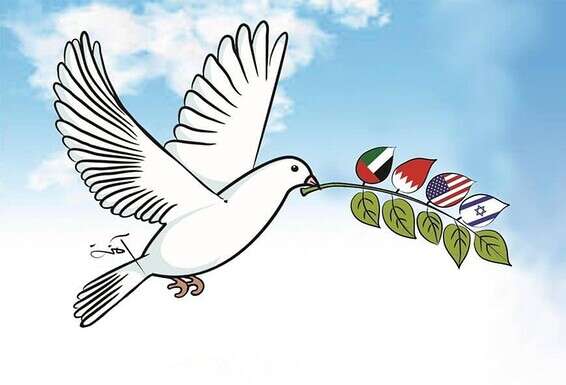
JCPA: Arab Normalization and Palestinian Radicalization: The Tug of War over the Middle East Peace Process
Arabs states draw closer to Israel to counter non-Arab powers Turkey and Iran
The decision by three Arab states to make peace with Israel can be credited both to efforts by the Trump administration and the recognition by these Sunni states that their security would improve against the ongoing threats they face from Turkey and Iran.
Iran and its proxies interfere with Arab states while promoting their Shi’ite revolutionary ideology; likewise, Turkey pushes its Sunni revolutionary ideology of the Muslim Brotherhood throughout the region.
Turkey and Iran look to overthrow the Sunni Arab states that do not align with them, such as Saudi Arabia and other Gulf states. The normalization deals between the United Arab Emirates, Bahrain and Sudan have greatly upset Turkey and Iran, which ideologically view Israel as the enemy.
“Iran is a tactical enemy for the Gulf states because the regime is controlled by Shi’ite fanatics who want to destroy the Sunni regimes in the Gulf,” Harold Rhode, a longtime former adviser on Islamic affairs in the U.S. Defense Department of Defense who was in Iran during the early months of the Iranian Islamic Revolution, told JNS.
Israel’s burgeoning alliance with the Gulf Arab states reverses the situation the Jewish state had found itself in during the first few decades of its existence. In its early years during the successive Arab-Israeli conflicts, it relied on an alliance of non-Arab states, such as Turkey and Iran, as its only regional allies. However, this all began to change when the pro-Western Shah of Iran was overthrown in the Islamic Revolution in 1979 and has increased under the Islamist anti-Israeli policies of Turkey’s President Recep Tayyip Erdoğan.
Rhode predicts that if the Iranian people successfully toppled the current regime, it would most likely be transformed into a country focused on rebuilding and re-establishing its connections with the world.
JCPA: Arab Normalization and Palestinian Radicalization: The Tug of War over the Middle East Peace Process
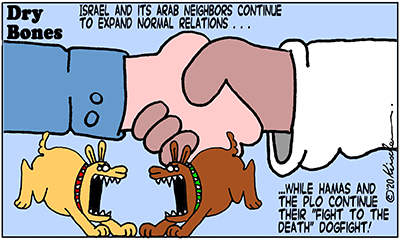
The Palestinian leadership has denounced the Abraham Accords signed by its longtime Arab allies and financial donors; they are now pivoting toward the radical, terror-sponsoring Iranian and Turkish regimes. Palestinians in eastern Jerusalem burned UAE flags and pictures of Crown Prince Mohammed Bin Zayed.Message to US President-elect Biden: On Israel and the region, first, do no harm
The Palestinian Authority’s Mufti of Jerusalem even issued a fatwa banning the citizens of Sudan, the UAE, Bahrain, or any Arab country that may normalize relations with Israel from praying at the Al‑Aqsa Mosque in the future.
Turkish President Erdoğan’s hosting of Fatah, Hamas, and other Palestinian factions has ratcheted up longtime tensions with Egypt, Jordan, and the Gulf states. Istanbul has also served as a headquarters for Hamas leaders to mobilize West Bank terror cells and carry out cyberwarfare and counter-intelligence operations against Israel.
The Arab powers have grown tired of Palestinian intransigence, corruption, and rejectionism. Saudi Arabia has criticized the Palestinian rejection of Israeli peace offers and the Palestinian boycott of any cooperation with Israel.
The Palestinian leadership should honor the Abraham Accords’ call for unconditional mutual recognition and normalization of relations with Israel as the keys to opening a viable political and diplomatic agreement that can provide enormous benefits to the Palestinian people.
A Palestinian realignment with peaceful Arab states will enable the PA to sit at the negotiating table with its Israeli neighbor without pre-conditions, accepting the Abraham Accords’ principle of normalization, mutual acceptance, and goodwill in order to maximize the prospects for a successfully negotiated compromise.
The US under Obama clashed heavily and relentlessly with Israel under Netanyahu in two central areas — the Palestinian conflict and Iran’s nuclear weapons ambitions.The Palestinian Leadership Keeps Standing in the Way of Peace with Israel
On the Palestinians, the administration criticized any and all Israeli building over the Green Line, including in Jewish neighborhoods in East Jerusalem such as Ramat Shlomo, rather than focusing on preventing the expansion of settlements in West Bank areas Israel would ultimately need to relinquish in order to separate from the Palestinians and maintain a Jewish, democratic state.
More significantly still, Obama and his (second) secretary of state John Kerry insistently underestimated the devastating impact on Israel, physically and psychologically, of the Second Intifada — the strategic onslaught of suicide bombings that killed 1,000 Israelis and were launched from the major West Bank cities that Israel had relinquished under the Oslo process.
Everybody recalls Netanyahu going to the US Congress in 2015 to lobby against Obama’s Iran deal; most people have forgotten Obama coming to Jerusalem’s International Conference Center (Binyanei Ha’Uma) in 2013 to lobby against Netanyahu’s ultra-skeptical approach to negotiating with the Palestinians: “Peace is possible,” the US president assured a carefully chosen audience of young Israelis. “I know it doesn’t seem that way. There will always be a reason to avoid risk, and there’s a cost for failure. There will always be extremists who provide an excuse to not act. And there is something exhausting about endless talks about talks; the daily controversies, and grinding status quo.”
On Iran, meanwhile, Obama and Kerry wanted to believe that the promise of international rehabilitation, rejoining the family of nations, would help deter the Islamist regime from pursuing the bomb. They thus negotiated and approved an agreement, many of whose core provisions apply for a limited period only, that neither fully dismantled nor even completely froze the Iranian program. The ayatollahs were allowed to improve their uranium enrichment process and refine their missile delivery systems within the terms of the 2015 deal, which they were also handsomely financially rewarded for signing.
Rapacious ideologically and territorially, the Islamists in Tehran are playing the long game. They don’t want to rejoin the family of nations. They want to sit at the head of the table, set the agenda, and bend the rest of the world to their will. This harsh truth seemed lost on the Obama presidency.
A Washington Post front-page article on Nov. 1 noted a "promised peace" between Israelis and Palestinians "seems further away than ever." But it's not that peace is elusive.
Palestinian leaders have rejected numerous offers for Palestinian statehood in exchange for peace with the Jewish state. They refused U.S. and Israeli proposals for statehood in 2000 at Camp David, 2001 at Taba and 2008 after the Annapolis Conference.
The 2008 offer included 93.7% of the West Bank, with land swaps for the remainder, a capital in eastern Jerusalem and a state. Palestinians rejected Obama administration efforts to restart negotiations in 2014 and 2016.
Instead, Palestinian Authority President Mahmoud Abbas has incited anti-Jewish violence and refused to quit paying salaries to imprisoned Palestinian terrorists and their families. This is a violation of the Oslo accords that created the Palestinian Authority more than a quarter of a century ago.
Palestinian leadership could have chosen the path of peace, as the United Arab Emirates and Bahrain have recently done. They've chosen otherwise.