Friday, October 09, 2020

From Ian:
President Reuven Rivlin: The people of Israel will defeat coronavirus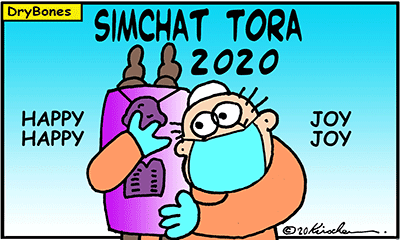
Defining Antisemitism as a Jewish Problem Is a Lose-Lose Proposition
President Reuven Rivlin: The people of Israel will defeat coronavirus
On Friday, everything starts fresh. Will we also be able to? Yes, yes, my dear ladies and gentlemen, completely anew. On the morning of Simchat Torah, we will read the 54th and final weekly Torah portion, V'Zot HaBerachah ("and this is the blessing"), immediately after which we will read the beginning of the Torah -- Bereshit ("Genesis").
We must also take the deepest of breaths, inhale the new air, and try starting fresh. To shake off the fatigue of the recent period, the lockdown, and rally together in the common cause of fighting the pandemic. We are well aware that our existence, as a nation and culture, also hinges on the deep-rooted ties to our traditions, historical heritage, the path of our forefathers, and the vision of the prophets.
The Simchat Torah holiday is a reminder that the bond between the people of Israel and the Torah -- the simple yet profound, honest joy of a people's connection to their most fundamental values – cannot be broken. This year, we cannot rejoice with the Torah as in years past. Instead of dancing in our crowded, happy circles, with our children on our shoulders, we will have to pray in limited gatherings in accordance with the directives meant to save our lives. It is very sad, but to ensure that next year we can return to dancing with our loved ones and Torah scrolls, I know we have no other choice.
If we don't fight together, shoulder to shoulder, in the battle for the public's wellbeing, we will fail. We must celebrate the holiday in adherence to the safety protocols, in the spirit of mutual guarantee for our fellow man, in solemn prayer that this scourge will be driven from our land.
Defining Antisemitism as a Jewish Problem Is a Lose-Lose Proposition
Radical groups — the radical left, the radical right, radical Muslims, and the radical African-Americans who champion Louis Farrakhan — are spearheading efforts to erode the core principles that make our country exceptional. The Islamo-leftist alliance, in particular, is gaining momentum. While many Jewish and other civil rights organizations singularly focus on far-right white nationalists as the main generators of extremism, the Islamo-leftist alliance parades in public as a social justice cause while infiltrating and undermining our communities and institutions. Collectively, these radical groups reject the Judeo-Christian values that have supported the foundation of our country and protected all minority communities in America, including Jews.Who First Said Anti-Zionism Isn’t Antisemitism?
Proponents of the Islamo-leftist alliance seek to undermine the structures and institutions that keep our country open, democratic, and healthy, including the family unit, businesses, communities, religious institutions, impartial media, law enforcement, the military, and the courts. Increasing antisemitic attacks and the public display of hatred are trial runs for what is to come from these radical movements. For years, Jews have been at the receiving end of this hatred. If we are truly ready to overcome it, we must stop playing the victim and start fighting this head-on together with other Americans.
We will lose as Jews and as Americans if we continue accepting our prescribed role as the sacrificial canary in the coal mine, hoping that others may recognize the danger after it has already consumed us whole. Instead, we need to be eagles looking to the horizon, detecting threats far before they grievously harm us and our country. There are practical actions we must take to go on the offensive against antisemitism. They include (1) investigating and exposing the radical movements that fuel the spread of this hatred by identifying their networks, money trails, and agendas; (2) increasing knowledge-sharing capabilities that inform the American people about the threats and empower them to act; (3) holding the media accountable to the standards of a fair and free press; and (4) supporting legislation that curbs the influence of the hate movements in our institutions.
Presenting antisemitism as a Jewish problem has been a lose-lose proposition because it has not spurred anyone to take meaningful action against it. Rather than griping about the problem, it is now time for all Americans to fight against this hatred and racism and for Jews to stand at the forefront of this fight. Our history and increasingly dangerous reality show that the inalienable rights afforded by the Constitution cannot be taken for granted. We need to fight for our safety and security today so that tomorrow we and future generations can continue living freely and proudly. We must fly into the future as brave eagles and free America from the dangers of antisemitism and the extremism it represents.
Roosevelt noted the Arabs underestimated the Jews and overestimated their own capabilities. “They thought they could do a job on Israel in a very short time with comparatively little effort, and they told their peoples that too, which was about the worst mistake of all.”
Fighting was still going on when he spoke, so he concluded by arguing that the only way to bring peace to Palestine was for the United States “to declare that any further fighting or any further infringement of a truce or an armistice in Palestine would result in a firm embargo by the United States on any kind of shipments, including specifically dollars, to whichever side started the violation.” Though he said this should apply to both sides, his chief concern was what the Arabists saw as Israeli aggression.
During the Q&A, Roosevelt argued the press had a pro-Zionist bias because newspapers were dependent on advertising from department stores, which “are in the hands of people who may not be Zionists themselves, but they are subject to very strong pressure from the Zionists.” He added that some publishers were susceptible to “a kind of friendly insistence that they not allow anything to appear in their papers which could encourage antisemitism.”
Ironically, he followed up this antisemitic trope about Jewish control of the media with the conclusion that “one of the most dangerous elements in this situation … has been the way in which the Zionists have identified antisemitism with anti-Zionism.” Roosevelt argued, “Sooner or later there is bound to develop in this country strong anti-Zionism. There is no strong reason why that should mean antisemitism, but the Zionists are making it all the more likely by their insistence that if you are an anti-Zionist you are an antisemitist.”
According to Roosevelt, not only is it unreasonable to suggest that anti-Zionism is antisemitism, but doing so provokes antisemitism.
Roosevelt may not have been the first to make the argument, but he certainly was not the last. Today, a universal dodge employed by antisemites is their insistence that they have nothing against Jews, only the state of the Jews, and that seeking the destruction of that state — anti-Zionism — is not antisemitism.