Friday, July 26, 2019

From Ian:
Noah Rothman: Democrats Throw BDS and the ‘Squad’ Under the Bus
What one US sailor did when a German ocean liner flew the Nazi flag in 1935 NYC
Noah Rothman: Democrats Throw BDS and the ‘Squad’ Under the Bus
Omar tried to drum up support for her competing resolution in support of BDS by likening Israel to Nazi Germany and comparing the Hamas-linked movement to the Boston Tea Party. Tlaib, too, echoed these themes. The anti-BDS resolution, she said, “attempts to delegitimize a certain people’s political speech and to send a message that our government can and will take action against speech it doesn’t like” (a federal judge in Arkansas has already dismissed Tlaib’s constitutional objections). “My concern with being overly punitive on nonviolent forms of protest is that it forces people into other channels,” said squad member Alexandria Ocasio-Cortez. The congresswoman has a habit of speaking in vague terms so that she can plausibly deny the obvious implication, but her meaning is clear enough; if boycotting Israeli goods isn’t an option, opponents of the Jewish state will be forced to take more drastic measures.Progressives Discard the Truth to Demonize Israel
These arguments were not enough to sway an overwhelming majority of the Democratic Caucus. They weren’t even sufficient to convince squad member Rep. Ayanna Pressley, who voted with the majority.
Though a vote in support of Israel’s right to produce and export goods abroad was not a tough one, the decision to hold the vote was. Progressives lobbied leadership against holding such a vote, noting that it would be construed as an attack on the Democratic Caucus’s progressive members just days after Donald Trump had attacked them. Even moderate Democrats expressed concerns about the prospect of exposing the ideological fissures within the party’s House majority. But whereas a union between the Congressional Black Caucus and the Progressive Caucus forced Democrats to scuttle a resolution condemning Omar’s repeated anti-Semitic remarks, that alliance has been strained in recent weeks. The squad climbed out on a limb, and House Democrats sawed it off.
Say what you will about Donald Trump’s sloppy and counterproductive execution, the president knows how to pick his targets. Trump’s effort to elevate the most progressive members of the Democratic Caucus beyond their relative statures in Congress is a clever and calculated strategy. The vote on this resolution betrays how discomfited Democrats are by the views of their most impetuous members (as if more confirmation was needed). Democrats are happy to wrap their arms around the “squad” so long as they don’t have to talk about what its members actually believe. The GOP’s job will be to make that balancing act untenable. If this vote is any indication, the GOP’s job won’t be all that difficult.
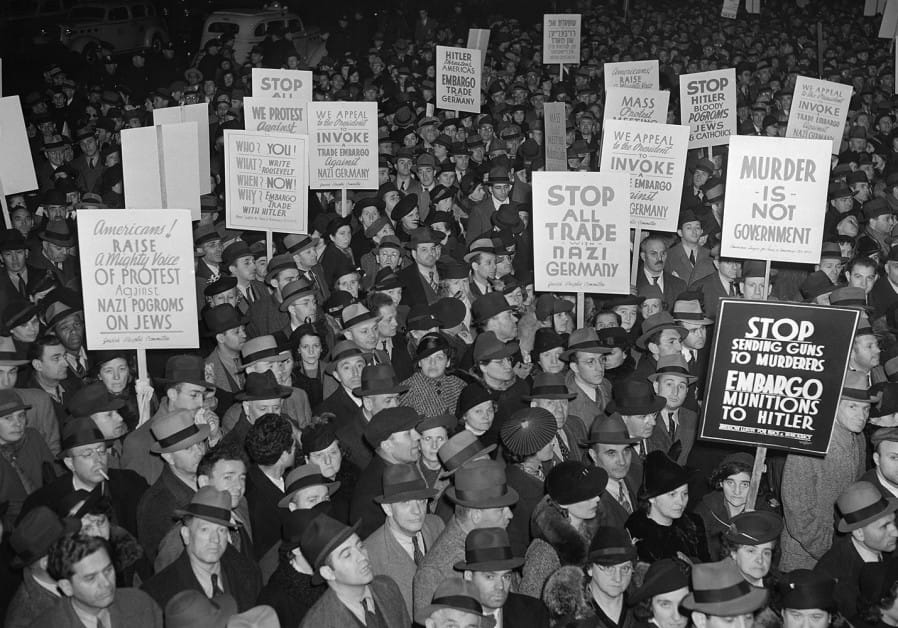
It is shameful to liken Nazi Germany to a country full of survivors, and descendants of survivors, of the Holocaust. One reason why so many Jews were slaughtered in Europe is because they could not flee to Israel, then known as Mandatory Palestine, where Arabs actually revolted to prevent Jews from coming there.Who boycotted the Nazis and who didn’t?
Unfortunately, attacks like Rhodes and Tlaib's are now typical of far-left progressives, who have made hatred of the world's only Jewish state part of their moral and political doctrines. Such attacks reveal a creepy obsession with Israel, a country about the size of New Jersey that, in the progressive worldview, is somehow behind much of the world's evils.
Progressives are not just affecting Israel; they are inspiring hatred everywhere, including in the United States. Just look at Sam Zahr, a Lebanese-American who lives in Dearborn, Mich. Zahr recently delayed the scheduled opening of a franchise of Burgerim, a restaurant chain founded in Israel, after the Arab-American community lashed out at him. His kids were bullied, and he even received threatening messages, all because the burger company started in Israel. Progressives like Rhodes and Tlaib inspire—one could even argue encourage—such hatred by demonizing and delegitimizing Israel, making it seem perfectly fine to terrorize a man to crush his dreams. Zahr is a victim of the BDS movement, which Rhodes may not explicitly support but certainly helps with his rhetoric and actions.
This kind of behavior will inevitably target Jews, who are already the main victims of hate crimes, even without such pervasive assaults on Jewish sovereignty. There have been numerous examples of hatred toward Israel manifesting as attacks on Jews. The line is so blurred, in part because Israel and the Jewish people are inexorably linked. Criticizing Israel is fine, but demonizing and delegitimizing the Jewish state crosses a clear, red line, into the realm of something much worse. When progressives discard the truth to demonize Israel, they also demonize the Jewish community, whether they know it or not. They are creating an environment hostile toward Jews—an environment that, one day, may make Jews in the West that much more grateful for having Israel as a refuge.
SOME LIBERAL academics supported the boycott. Others not only opposed the boycott, but personally violated it by visiting Germany in the 1930s and maintaining student exchange programs with German universities that were totally controlled by the Hitler regime. The sordid details are recounted in Prof. Stephen Norwood’s study, The Third Reich and the Ivory Tower.
Smith College president William Neilson, a longtime NAACP board member, visited Nazi Germany in 1933 and found “no cases of mistreatment” of Jewish citizens. Barnard College dean Virginia Gildersleeve, a staunch Roosevelt supporter, announced after touring Germany in 1935 that Hitler’s desire to acquire “new land” was “legitimate,” and that the sharp reduction in the admission of Jews and women to German universities was justified.
Pacifists such as Vassar College president Henry MacCraken saw the boycott as a step toward war, and in 1934, organized a tour of Nazi Germany for college students and professors. Footage of the trip was used for a Nazi propaganda film called Germany Today, which was shown in the United States in an effort to soften Hitler’s image.
Another prominent pacifist, Bryn Mawr professor Henry Cadbury, denounced the boycott as “simply war without bloodshed.” He admonished American Jews to “display good will instead of hatred” toward Hitler, claiming, “By hating him and trying to fight him, you will only help make him worse in his attack on the Jews.”
The boycott controversy roiled the Women’s International League for Peace and Freedom, a leading left-of-center activist group. Its mostly-Jewish Brooklyn chapter asked the group’s national leadership to endorse the boycott. The request was rebuffed. WILPF leaders said they resented the notion of “separating the Jewish question from the larger minority problems.” One WILPF leader confided to a colleague, “For the first time in my life I am beginning to feel a little antisemitic.” Many members of the Brooklyn branch, and nearly the entire Bronx chapter, resigned in protest over the boycott issue.
Although the boycott fell short of its goal of driving Hitler from power, its impact was evident from the significant decline in German exports and the repeated complaints by German officials to the US ambassador in Berlin about the damage the boycott was doing to their economy.
What one US sailor did when a German ocean liner flew the Nazi flag in 1935 NYC
A symbol of hate over the Hudson River, the swastika flag fluttered from the bowsprit of the German luxury liner S.S. Bremen in the summer of 1935. At the time, the Bremen made regular visits to New York, and many Americans ventured on board to marvel at this floating symbol of the Reich’s technology.
Others, however, looked beyond the gleaming decks and Oompah bands, and focused on what was happening across the Atlantic, as the Nazis assaulted Jews in bloody riots.
On July 26, 1935, a group of Americans took action. Led by 20-year-old merchant seaman William “Bill” Bailey, they snuck into the ship’s going-away gala, determined to remove the Nazi flag waving in public view. Pursued by the crew and New York policemen, Bailey succeeded in sending Hitler’s emblem plummeting into the Hudson.
The incident made worldwide headlines. The United States government repeatedly apologized to the outraged Nazi regime. Bailey and five co-participants, collectively nicknamed the Bremen Six, were put on trial and eventually acquitted by Judge Louis B. Brodsky.
But despite the celebrated nature of the event, Bailey was soon forgotten by history.