Monday, July 31, 2017

From Ian:
What victory looks like

Anti-Semitism is still alive — even on the left
What victory looks like
I once heard Bill Maher say that: “Israel has won every war she ever had to fight because she has to, she has no choice. If she loses she will be wiped off the map.”
So true.
In 2006, Israel was attacked by Hezbollah and was forced to go to war in Lebanon. The war had no frontline, it was Israelis in their home who were under attack by terrorists shooting missiles from the neighboring country, Lebanon. For 34 days Israelis in northern Israel (me included) hunkered down in bomb shelters while missiles slammed into our towns, our homes. We waited patiently while our soldiers took the battle to the terrorists who were attacking us, doing everything possible to make it stop.
We waited, never knowing when the next missile would come, never knowing where it would hit. Sometimes the air-raid siren worked. Sometimes it didn’t. I will never forget stepping outside after a missile slammed down behind my home and hearing the neighbor across the street screaming: “Why didn’t the siren go off??” That was the only warning we had to race to the bomb shelter, the only hope of protection. There was no Iron Dome then.
While our soldiers were battling for their lives and ours, we waited. Scary and difficult, we would wait however long it took. We didn’t mind.
Because we knew our soldiers would win.
The war ended with a UN brokered ceasefire on August 14, 2006. Israeli news commentators and security analysts told the people that while there was no visual that showed our decisive victory, Israel had won the war, Lebanon had been bombed back into the stone age (poor Lebanon that was being used as a launching pad for Hezbollah to wage a war) and that the IDF had destroyed much of Hezbollah’s missile arsenal.
Victory is similar to pornography. You might not know how to define what it is but you recognize it when you see it. Victory is not something that necessitates interpretation.
Since then, the Israeli government has carefully defined wars as “military operations.” Part of this is for financial reasons (the government is obligated to compensate citizens for financial loss due to war). I believe that this definition also has something to do with the idea that wars have to be won.
Anti-Semitism is still alive — even on the left
In late June, thousands from across the Midwest congregated in Chicago to demonstrate their support for legal rights, recognition and cultural heritage of LGBT communities in the city’s annual Pride Parade. The event, which typically emphasizes inclusion regardless of ethnic or religious background, left Laurel Grauer feeling discriminated against after being removed from the parade for carrying a rainbow flag adorning the Jewish Star of David. Organizers of the program, justifying her removal, claimed that the flag was deemed unacceptable due to its association with the State of Israel.Jewish Summer Camp Flies Palestinian Flag, Teaches Kids Bad Lesson in Politics
Unfortunately, this incident signals a trend of increasing anti-Semitism masquerading under the guise of anti-Zionism in the United States and abroad. Although not every rejection of the Zionist movement stems from racially-motivated sentiments, the lack of adequate justification for much of the anti-Zionist movement and an active unwillingness to dissect the complexities of the Israeli-Palestinian conflict reflect a malignant underlying reason for opposition to the Jewish state.
Perhaps one of the worst perpetrators of anti-Zionist bias is the United Nations. The international organization has dealt disproportional criticism to Israel in relation to other, arguably far-more-guilty member nations. In its 2015 session, the U.N. passed a whopping total of 20 resolutions condemning Israel, while only passing 3 condemning resolutions against other member nations. In June, U.S. Ambassadors threatened to pull out of the U.N. Human Rights Council for its consistent discrimination against Israel. The 78 resolutions and decisions passed against Israel dwarf the 29 passed against the next biggest offender, Syria. Meanwhile, Russia, China and Saudi Arabia have faced no condemnations at all.
In the words of Israeli Prime Minister Benjamin Netanyahu, Israel is a country where “women fly fighter jets, lead major corporations, head universities, preside over the Supreme Court, and have served as Speaker of the Knesset and as Prime Minister.” Contrast these conditions to Saudi Arabia’s, where women are not only denied their autonomy, but also (quite literally) enslaved into arranged marriages.
Camp Solomon Schechter, one of the Pacific Northwest’s longest-serving and best-loved Jewish summer camps, caused a bit of a stir this weekend after it hosted a group of 14 children, including Christian and Muslim Palestinians, and flew the Palestinian flag in their honor. This upset some campers, parents, and alumni, who wailed that the black-white-green-and-red had no place among the blue-and-white, and that a camp committed to Zionism and Israel shouldn’t kowtow to the enemy.IsraellyCool: Jewish Camp Doubles Down on Palestinian Flag Fiasco
Those outraged—and I say this as an uncompromising supporter of Israel’s right to defend itself against Palestinian terrorism and incitement—are missing the point. The problem here isn’t that the camp chose to welcome its Palestinian guests by flying their colors; that alone is a sweet gesture, especially when the Palestinians in question are prepubescents, not armed members of the Tanzim. The problem is that the camp chose to address the Israeli-Palestinian conflict in a mindless, morally preening way, treating it not as something concrete but as a collection of grand symbolic gestures.
Here, for example, is the email the camp sent out in the aftermath of the controversy:
“For the sake of a teachable moment, we did raise the Palestinian flag as a sign of friendship and acceptance. It was met with uncertainty by some campers and staff, especially the Israeli’s [sic], but all understood that the message of hope for peace by flying the Israeli flag alongside helped develop empathy. Still we plan to take down all the flags for Shabbat since there is no peace and also to relieve the sadness and anger that some feel by the site of the flag. It was so fun to watch the kids from Jerusalem play soccer with our chanichim and madrichim!”
Ignore, if you can, the writer’s tenuous grasp on grammar, or the jarring shifts in tone between talk of sadness and anger and peppy reports of a spirited soccer game. But consider the logic at play here: we flew the flag because we hope for peace, then we took it down because there is no peace, and also because some people were upset.
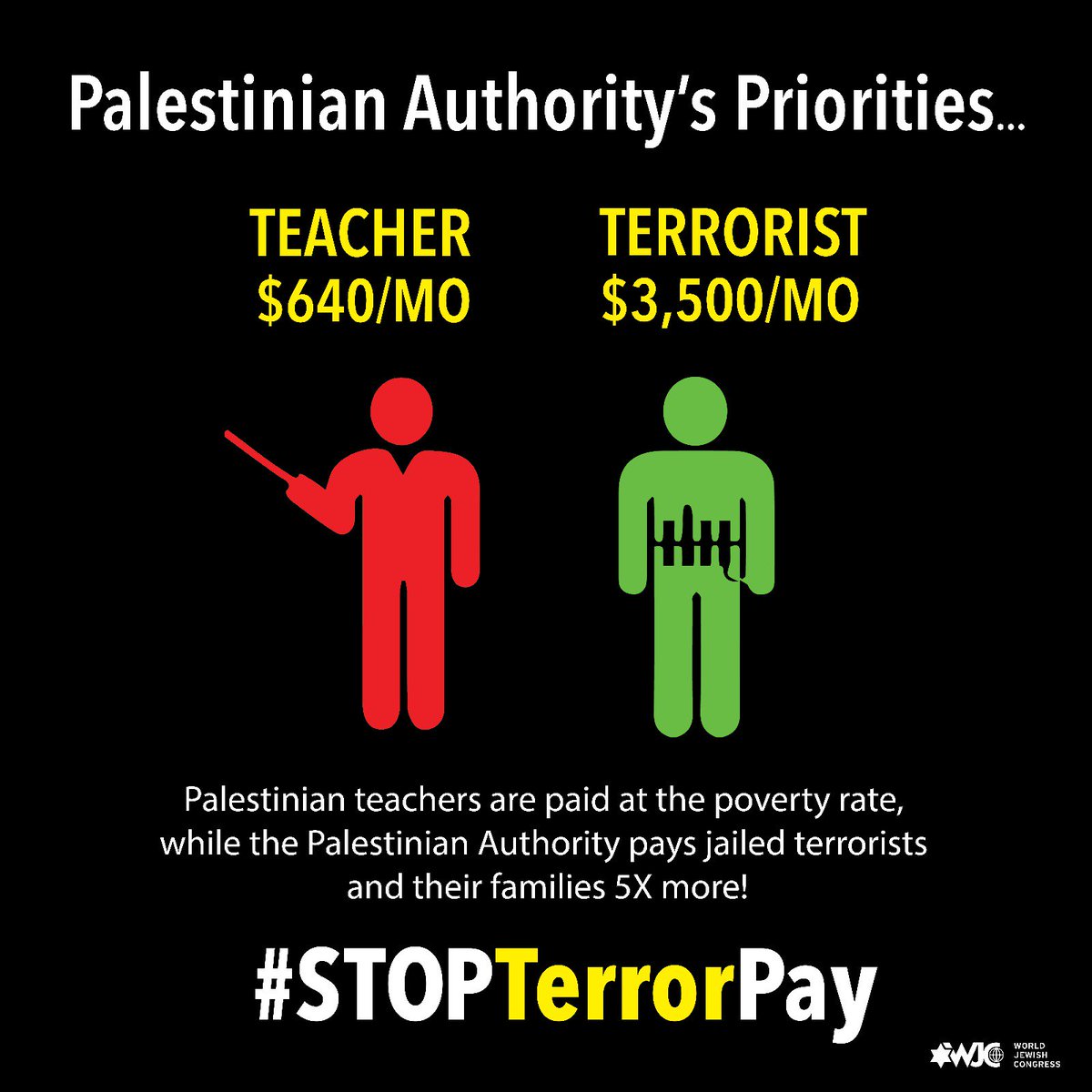
You hardly have to be a great educator to realize just how profoundly idiotic this sentiment truly is, and how likely it is to raise a generation of children who are thoroughly confused. First, it reduces a thorny issue with real complexities and uncomfortable truths to one easy empty gesture. Why bother with facts and figures and nuance when you can just wave a piece of colorful cloth? And then, rather than use this gesture responsibly and invite the campers and staffers to talk about why the flag makes them uncomfortable—maybe, say, because the authority it represents spends a considerable portion of its budget promoting and rewarding the systemic murder of Jews—the camp opted to double down on the symbolism and take the flag down as a way to bemoan the elusiveness of peace. This is how you do bad performance art; it’s not how you educate children.
The clumsily worded statement in fact doubled down on the offending act, elevating the raising of the Palestinian flag as a demonstration of “the Jewish value of Hachnasat Orchim (welcoming guests)”, the guests being a Palestinian delegation spending several days with the Jewish camp under the auspices of Kids4Peace. Adding insult to insult, the Schechter administration further justified the Palestinian flag raising as an attempt to create a “safe space for all”, disregarding the emotional impact the flying of the Palestinian flag would have on their young Jewish campers. Despite the jumbled messaging the camp firmly maintains their Zionist bona fides.
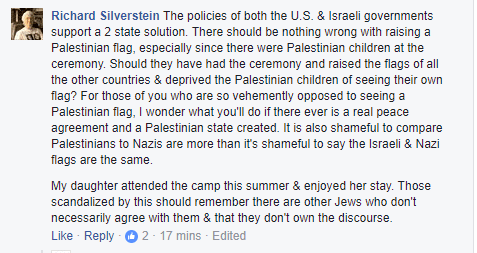
While many in the tight-knit Pacific Northwest Jewish community expressed indignation at the flying of the Palestinian flag at the legacy Jewish camp, radical anti-Israel blogger, BDS supporter and terror apologist Richard Silverstein endorsed the camp, adding that “there should be nothing wrong with raising a Palestinian flag”.
Terror apologist Silverstein declared his support of the Palestinian flag raising.
Rabbi Yohanna Kinberg, who recently marched alongside anti-Israel group IfNotNow, posted a broadside attack against me (I broke the story on my own blog before posting here):
“This blog [The Mike Report] is a vile piece of trash it is truly anti-Jewish and anti-Israel in promoting hate. Camp Solomon Schechter is a very very Zionist camp and bringing kids 4 peace into their community was Jewish leadership at the highest level shame on all of you for reading this man’s blog.
Which leads us to ask the question, with endorsements like these, who needs endorsements?