Saturday, April 02, 2016

From Ian:
Hamas finally acknowledges holding 4 Israelis, including bodies of 2 soldiers

What’s Palestinian Peace Education?
Hamas finally acknowledges holding 4 Israelis, including bodies of 2 soldiers
Hamas on Friday publicly acknowledged for the first time that it was holding four Israelis: two Israeli citizens who crossed into Gaza on their own accord and the bodies of two soldiers killed in 2014’s Gaza war.
The group published photos of the four: slain soldiers Oron Shaul and Hadar Goldin, 29-year-old Avraham Mengistu, and a Bedouin-Israeli citizen whose name has not been released for publication.
Hamas denied reports in recent days that Israel and Hamas may be nearing a prisoner swap for the four, with a spokesman for the group claimed the reports were misdirection by the Israeli government and Prime Minister Benjamin Netanyahu.
“Netanyahu is lying to his people” and “deceiving the families of the captive soldiers,” spokesman Abu Obeida said in a statement.
“There are no talks or negotiations relating to the prisoners. The enemy will not get information about the four without paying a clear price before and after the negotiations,” he added.
On Monday the London-based daily Asharq al-Awsat quoted a source in the Gaza-based Islamist group as saying that though there were currently no direct negotiations between Hamas and Israel, international mediators were trying to broker a prisoner swap.

What’s Palestinian Peace Education?
Hroub is also part of the narrative of his wife’s motivation for teaching peace since she conceived it as a reaction to seeing her husband shot by Israelis and experiencing the terror of her children. But I haven’t seen her mentioning the terror felt by her husband’s victims and their families in any account of her receiving the prize.
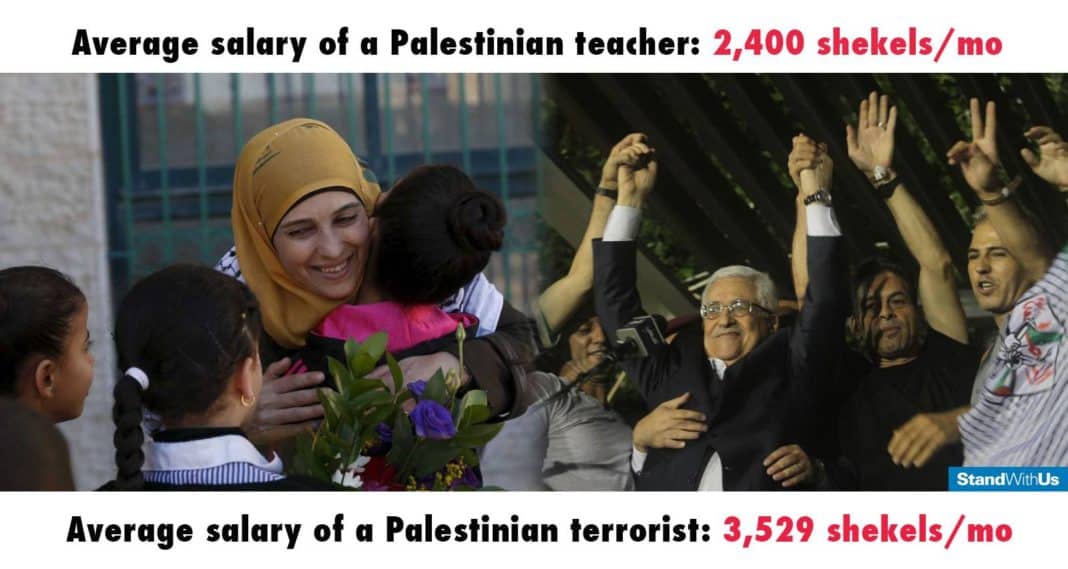
Today, Omar Hroub is an official with the Palestinian Authority and, according to most of the coverage of his wife’s honor, supports PA President’s policies. If so, he is no supporter of peace since the PA has spent the last year supporting the “stabbing intifada” and fomenting exactly the kind of religious-based hatred against Jews that his wife’s curriculum is supposed to be combating.
But even if we leave the husband out of the discussion, a New York Times feature published today that includes an account of a visit to Hroub’s classroom gives us a taste of what Palestinian peace education means.
When most observers think of Middle East peace education, the assumption is that the students are taught the sorts of things that are a routine element of most Israeli schools: respect for the other side and their culture and language, the importance of non-violence and recognizing the rights of all ethnicities and faiths even in the midst of a struggle between two peoples for their own separate national identity and sovereignty in one land. It’s a difficult thing to teach in a country where violence and hatred against Jews is being promoted by the other side and there are those that resist the message. But despite the claim that Israel is becoming more intolerant, the rarity of incidents of anti-Arab violence, and the generally tolerant nature of Israeli society at a time when their nation is under assault from a wave of terror testifies to the success of its peace education curriculum.
But, in the Hroub classroom, peace education isn’t about how to get along with Israelis and Jews. It’s about teaching the children how to peacefully disagree with each other and their teacher. That’s a good thing for them to learn, especially at a time when so much of Palestinian popular culture and official media encourages violence. But it is not the same thing as promoting peace between Israelis and Palestinians.