
 Tuesday, December 27, 2011
 Elder of Ziyon
Tuesday, December 27, 2011
 Tuesday, December 27, 2011
 Elder of Ziyon
Palestinian Arab nationalism effectively sprung out of thin air in 1920. Up until then, with very little exception, it was subsumed under the desire to be a part of "Greater Syria" which would include all of Palestine - and leave no room for a Jewish state.
As soon as the ink dried on the San Remo resolution, Palestinian Arab leaders changed their tune, and embraced the idea of an Arab Palestine that would, again, ensure that no Jewish state would ever exist.
After 1948, the desire for a Palestinian Arab state disappeared again. Palestinian Arabs in the west bank of the Jordan became citizens of that country; those in Gaza saw their land occupied by Egypt. Neither of them showed the slightest interest in their own state - the desire just disappeared.
What replaced it was a return to 1919's Syrian-style pan-Arabism, and the person they believed could help them was Egypt's Gamal Abdel Nasser.
Here is an interesting AP story from 1957:

The 1968 version of the document, in contrast, is called "Al-Mithaq Al-Watanee Al-Philisteeni" which more explicitly means "The Palestinian National Covenant." Which means that only after 1967, when hopes for an Arab military victory over Israel faded, did Palestinian Arab nationalism become reincarnated.
We see that the Palestinian Arab leadership went from Greater Syrian nationalism to Palestinian Arab nationalism to pan-Arab Nasserite nationalism and then back to Palestinian Arab nationalism, all in the course of fifty years.
All of those political movements boasted wonderfully written documents and passionate speeches explaining why their cause was the only logical, moral and legal means to justly deal with Palestinian Arabs. There were no apparent cases of whiplash as people moved from one to the next, contradictory political position. The reason is clear: all those disparate movements had one thing in common, the eradication of Jewish nationalism. Everything else was window dressing to put a polite face on what is really a philosophy of hate.
And it continues today, as Palestinian Arabs are seemingly torn between what appears to be completely different paths - the PLO's stated methods of declarations and popular resistance, or Hamas' newly stated method of embracing a strategy of stages that mimics Arafat's 1974 Phased Plan to destroy Israel, to Islamic Jihad's dedication to nothing but armed resistance, to Hezbollah's single-minded goal of utterly destroying Israel by any means possible. But in the end, they are all paper-thin veneers on top of the same underlying goal - to destroy Israel by whatever means makes the most sense at the moment.
Westerners cannot wrap their heads around the idea that an entire national movement is really not interested in liberty and freedom for their people, but rather is meant solely to destroy another people. It is literally unbelievable that Arab leaders would hold millions of people hostage simply to use them as human weapons against Israel. But like it or not, it is the truth, and it is what needs to be understood before any real progress can be made.
As soon as the ink dried on the San Remo resolution, Palestinian Arab leaders changed their tune, and embraced the idea of an Arab Palestine that would, again, ensure that no Jewish state would ever exist.
After 1948, the desire for a Palestinian Arab state disappeared again. Palestinian Arabs in the west bank of the Jordan became citizens of that country; those in Gaza saw their land occupied by Egypt. Neither of them showed the slightest interest in their own state - the desire just disappeared.
What replaced it was a return to 1919's Syrian-style pan-Arabism, and the person they believed could help them was Egypt's Gamal Abdel Nasser.
Here is an interesting AP story from 1957:

Yes, Palestinians in Gaza in 1957 wanted to be under the administration of Egypt - not to have their own country!
In fact, Jordan's King Hussein's major problem during that time was the threat from Nasser, who incited Jordanian Palestinians to revolt against him and even to assassinate him, so the entire Arab world could be Nasserist.
What happened to their vaunted nationalism? Where was their desire for an independent state that their leaders spoke about so eloquently during the 1940s?
It is apparent that the desire for a state was far less than the desire to destroy Israel, which was Nasser's selling point to them. "Liberating Palestine" meant liberating it - from Jews.
The 1964 PLO Covenant is a very interesting document. Its Arabic name is "Al-Mithaq Al-Kawmee Al-Philisteeni," which roughly means The Palestinian Pan-Arabist Covenant. It is mostly wedded to the Nasserist vision, insisting on how the Palestinian cause is a pan-Arab cause, and it is replete with references to Arab unity and the Arab nation. (It also specifically excludes Gaza and the West Bank from areas wanted for "Palestine" - since those areas were considered "liberated!" Significantly, it also refers to Israel's pre-1967 existence as "occupation.")
The 1968 version of the document, in contrast, is called "Al-Mithaq Al-Watanee Al-Philisteeni" which more explicitly means "The Palestinian National Covenant." Which means that only after 1967, when hopes for an Arab military victory over Israel faded, did Palestinian Arab nationalism become reincarnated.
We see that the Palestinian Arab leadership went from Greater Syrian nationalism to Palestinian Arab nationalism to pan-Arab Nasserite nationalism and then back to Palestinian Arab nationalism, all in the course of fifty years.
All of those political movements boasted wonderfully written documents and passionate speeches explaining why their cause was the only logical, moral and legal means to justly deal with Palestinian Arabs. There were no apparent cases of whiplash as people moved from one to the next, contradictory political position. The reason is clear: all those disparate movements had one thing in common, the eradication of Jewish nationalism. Everything else was window dressing to put a polite face on what is really a philosophy of hate.
And it continues today, as Palestinian Arabs are seemingly torn between what appears to be completely different paths - the PLO's stated methods of declarations and popular resistance, or Hamas' newly stated method of embracing a strategy of stages that mimics Arafat's 1974 Phased Plan to destroy Israel, to Islamic Jihad's dedication to nothing but armed resistance, to Hezbollah's single-minded goal of utterly destroying Israel by any means possible. But in the end, they are all paper-thin veneers on top of the same underlying goal - to destroy Israel by whatever means makes the most sense at the moment.
Westerners cannot wrap their heads around the idea that an entire national movement is really not interested in liberty and freedom for their people, but rather is meant solely to destroy another people. It is literally unbelievable that Arab leaders would hold millions of people hostage simply to use them as human weapons against Israel. But like it or not, it is the truth, and it is what needs to be understood before any real progress can be made.
- Tuesday, December 27, 2011
- Elder of Ziyon
Here are the five most popular EoZ posts of 2011, according to Google Analytics.
#5: (4762 pageviews)
Nivea website excludes Israel, includes "Palestine Territories"

#4: (5747 pageviews)
Anti-semitic comic book: "Foreskin Man"

#3: (6323 pageviews)
One reason Shalit looked so ill at ease in his interview

#2: (6836 pageviews)
This Is Zionism (poster series)

And the top post on EoZ for 2011 (and, indeed, for all time) is...
#1 (16,180 pageviews)
EoZ Posters for "Apartheid Week"

#5: (4762 pageviews)
Nivea website excludes Israel, includes "Palestine Territories"
#4: (5747 pageviews)
Anti-semitic comic book: "Foreskin Man"
#3: (6323 pageviews)
One reason Shalit looked so ill at ease in his interview
#2: (6836 pageviews)
This Is Zionism (poster series)
And the top post on EoZ for 2011 (and, indeed, for all time) is...
#1 (16,180 pageviews)
EoZ Posters for "Apartheid Week"
- Tuesday, December 27, 2011
- Elder of Ziyon
 honor killing

From PCHR:
At approximately 02:30 on Friday 23 December 2011, the body of M. A., 45, from Sheikh Radwan neighborhood, who was killed by strangulation, was brought to Shifa Hospital in Gaza City. According to the Forensic Medicine Department, M. A. was killed by strangulation using hands. According to Chief Ayman al-Batniji, Spokesman of the Palestinian Police, the victim's nephew, who is accused of committing the crime, turned himself in to the police. During interrogation, he said that he killed M. A. to "maintain his family’s honor." Investigations are still ongoing.The good news is that the number of such crimes in the territories has decreased this year.
- Tuesday, December 27, 2011
- Elder of Ziyon
I noted yesterday that, even though releasing political prisoners has been the major concrete issue brought up in all the "unity" talks between Fatah and Hamas, each side continues to accuse the other of imprisoning people based on political affiliation.
Yesterday Hamas arrested 9 Fatah members - and today it detained 19 more.
According to Palestine Press Agency, Hamas is forcing those arrested yesterday to stand on one leg for long periods of time and to wear smelly bags over their heads.
So far, the vaunted unity talks have produced exactly nothing.
The next big test will be to see if Hamas and Fatah set up a temporary unified government, as they said they would in late January.
Yesterday Hamas arrested 9 Fatah members - and today it detained 19 more.
According to Palestine Press Agency, Hamas is forcing those arrested yesterday to stand on one leg for long periods of time and to wear smelly bags over their heads.
So far, the vaunted unity talks have produced exactly nothing.
The next big test will be to see if Hamas and Fatah set up a temporary unified government, as they said they would in late January.
- Tuesday, December 27, 2011
- Elder of Ziyon

News from Israel you may have missed during 2011 (Aish)
US criticizes Palestinian Authority double-talk (IMRA)
Harvard's Middle East Outreach Center headed by BDS supporter (CAMERA)
8 incredible technologies used by the IDF (IDF)
Gingrich comments supported by the Quran (Hamid)
Jesus would have been shot by Palestinians (Honest Reporting)
100,000 Christians fled Egypt from March to September (AINA)
Here is a menorah in Sderot - made out of Qassam rockets!

(h/t Daled Amos, Josh, Yoel)
- Tuesday, December 27, 2011
- Elder of Ziyon
There have been scattered reports on bits and pieces of Hamas leader Ismail Haniyeh's speech at Hamas' 24th anniversary rally on December 14th, but Palestinian Media Watch put it all together. It is a must-read for every Western politician and Middle East pundit - who will of course ignore and/or excuse what he says as just rhetoric.
This would-be genocidal terrorist has just left Gaza for the first time in years, and his first stop is in Egypt, where he was greeted with street banners and crowds of adoring Muslim Brotherhood fans:


We say today, explicitly, so it cannot be explained otherwise, that the armed resistance and the armed struggle are the path and the strategic choice for liberating the Palestinian land, from the [Mediterranean] sea to the [Jordan] river, and for the expulsion of the invaders and usurpers [Israel] from the blessed land of Palestine. The Hamas movement will lead Intifada after Intifada until we liberate Palestine - all of Palestine, Allah willing. Allah Akbar and praise Allah. We say with transparency and in a clear manner, that Palestinian reconciliation - and all sides must know this - cannot come at the expense of [our] principles, at the expense of the resistance. These principles are absolute and cannot be disputed: Palestine - all of Palestine - is from the sea to the river. We won't relinquish one inch of the land of Palestine. The involvement of Hamas at any stage with the interim objective of liberation of [only[ Gaza, the West Bank, or Jerusalem, does not replace its strategic view concerning Palestine and the land of Palestine.
This would-be genocidal terrorist has just left Gaza for the first time in years, and his first stop is in Egypt, where he was greeted with street banners and crowds of adoring Muslim Brotherhood fans:


- Tuesday, December 27, 2011
- Elder of Ziyon
 A Hamas terrorist blew himself up in his own home last night at the Jabalia camp in Gaza.
Imad Washa was 37 when he was performing his accidentally self-sacrificing act of Jihad.
The Al Qassam Brigades says that Washa had a great career as a jihadist.
I don't know if that is true, but it certainly ended with a bang.
- Tuesday, December 27, 2011
- Elder of Ziyon
As analysts remain transfixed over the idea of Hamas supposedly renouncing terror, Hamas keeps saying the exact opposite in Arabic.
The latest from Palestine Today:
Khaled Abu Toameh sums up Hamas' position nicely:
The latest from Palestine Today:
The Islamic Resistance Movement Hamas confirmed today on its adherence to the right of resistance in all forms, especially armed resistance. Defeating the occupation has proven this path of resistance, and jihad and martyrdom are the only way to extract our rights and liberate our land and our Jerusalem and our holy places.
Khaled Abu Toameh sums up Hamas' position nicely:
Hamas is joining the PLO not because it has changed, but out of a desire to make the Fatah-dominated organization stick to its true mission: the liberation of Palestine from Jordan River to the Mediterranean Sea -- in other words, all the land that is currently Israel -- and to achieve the "right of return" for Palestinian refugees to their original villages and homes inside Israel.
Once Hamas takes control over the PLO, it will seek to cancel all agreements and understandings reached between the organization and Israel, above all the 1993 Oslo Accords. Hamas also wants the PLO to withdraw its recognition of Israel.
Hamas leaders and spokesmen are openly saying that joining the PLO does not mean that they would recognize Israel's right to exist or abandon the "armed struggle" against the Jewish state.
"Anyone who thinks that Hamas has, or will, change is living under an illusion," declared Hamas representative Osama Hamdan.
Hamdan is one of several Hamas officials who have been trying in the past few days to explain to the world that his movement has not abandoned its radical ideology and will in fact continue to fight for the "liberation of all Palestine."
But all these clarifications from the Hamas leaders regarding their true intentions seem to be falling on deaf ears in the West.
Some Western analysts have begun talking about the "new Hamas," one which is about to accept the two state solution and abandon the "armed struggle" in favor of a peaceful and popular uprising against Israel.
Some European government officials are also ignoring the Hamas clarifications, insisting that the movement's decision to join the PLO is an indication that it has abandoned its dream of replacing Israel with an Islamist state.
Those who think that Abbas's invitation to Hamas to join the PLO is a positive step for the peace process are deluding themselves. Hamas, according to its leaders, is joining the PLO because it wants to "liberate Palestine from the river to the sea," and not because it is interested in becoming part of the peace process.
But in the West, most analysts do not want to hear what Hamas says in Arabic.
- Tuesday, December 27, 2011
- Elder of Ziyon
Here is an orchestral version of a mash-up of "I Have a Little Dreidel" and "Hava Nagila" , performed by the Marine Force Band in Okinawa, Japan this year, entitled "Dreidel Dance:"
Considering that it is a combination of two overused, cliched tunes, it is actually quite good.
It was arranged by Master Sgt. Robert Thurston and first performed by the US Air Force Band in 2006, available on this album.
Considering that it is a combination of two overused, cliched tunes, it is actually quite good.
It was arranged by Master Sgt. Robert Thurston and first performed by the US Air Force Band in 2006, available on this album.
- Tuesday, December 27, 2011
- Elder of Ziyon
From Ma'an:
Only one problem. PCHR also counts all of the people arrested by Israel, and their numbers don't come close. According to PCHR, since October only around 249 have been arrested; Ferwana claims nearly 700 in that time period.
PCHR documents each arrest; Ferwana does not.
But the Ma'an article gets even more ridiculous:
Now, let's look at Addameer's claim that Israel has imprisoned as many people as it released since October 18th and see if its record of lies continues.
B'Tselem keeps track of the number of prisoners in Israeli prisons. At the end of September there were 5,269, after the October prisoner release it was 4,772, and on November 30 it was at 4,803 - a lot less than 5,269.
Has Israel gone on a mad rush of arrests since December 1? PCHR counts 105 arrests since then, so even if every single one of those went to prison - which never happens - Addameer's numbers are again shown to be complete fabrications.
A report published on Monday has found that over 3,000 Palestinians were arrested by Israel's military in 2011.Sounds authoritative, doesn't it? Such specific numbers! And Ferwaneh even has an entire website dedicated to his passion of documenting prisoners with the very impartial name of "Palestine Behind Bars."
Researcher on prisoner affairs Abdul Nasser Ferwaneh said that the average number of arrests in 2011 numbered 276 per month, or around nine a day.
A total of 3,312 Palestinians were arrested by Israeli authorities in 2011, 113 of whom were prisoners released in the October exchange deal between Hamas and Israel.
The detainees represented a cross section of Palestinian society, Ferwaneh said.
The number of annual arrests has actually decreased, Ferwaneh added, noting that in 2007 a total of 7,612 people were arrested by Israel military forces.
Only one problem. PCHR also counts all of the people arrested by Israel, and their numbers don't come close. According to PCHR, since October only around 249 have been arrested; Ferwana claims nearly 700 in that time period.
PCHR documents each arrest; Ferwana does not.
But the Ma'an article gets even more ridiculous:
Ramallah based prisoner group Addameer said in early December that Israel had detained nearly the same number of Palestinians they had freed in the first stage of a prisoner exchange deal.As I have documented, Addameer literally makes things up. According to Addammeer, Israel has arrested over 800,000 Palestinian Arabs since 1967 - and some have said even 900,000. These numbers are absurd and yet they grow by about 100,000 every year. Yet even Goldstone believed them.
Israeli forces detained nearly 470 Palestinians since the Oct. 18 release of 477 prisoners from Israeli jail in exchange for captured Israeli soldier Gilad Shalit, Ramallah-based rights group Addameer said.
"This wave of arrests reveals that the exchange deal has not deterred Israel’s policy of detention of Palestinians; rather, Israeli prisons are being refilled with almost the exact number of Palestinians that were released in October," the prisoners group had said.
Now, let's look at Addameer's claim that Israel has imprisoned as many people as it released since October 18th and see if its record of lies continues.
B'Tselem keeps track of the number of prisoners in Israeli prisons. At the end of September there were 5,269, after the October prisoner release it was 4,772, and on November 30 it was at 4,803 - a lot less than 5,269.
Has Israel gone on a mad rush of arrests since December 1? PCHR counts 105 arrests since then, so even if every single one of those went to prison - which never happens - Addameer's numbers are again shown to be complete fabrications.
Monday, December 26, 2011
- Monday, December 26, 2011
- Elder of Ziyon
From WAFA:
When Fayyad says "there will never be a solution unless..." he is implicitly saying that "there will never be peace unless..." What he is saying is that without Palestinian Arab control of the historic parts of Jerusalem, there will continue to be fighting, terror, war and whatever else the Arab world wants to serve up.
Palestinian Arab leaders can make such threats with impunity, and without any fear that any Western leaders or the UN will criticize the fact that they are essentially acting like the mob, saying that if you don't want to get hurt, do what they say.
An interesting subtext to his statement is that Fayyad is tacitly admitting that Israel wants peace and that Palestinian Arabs consider peace to be of secondary importance - not as important as getting their demands met. After all, there is no legal, logical or moral reason a solution must include Jerusalem as part of "Palestine." A solution can certainly be found - and reached quite quickly - if Palestinian Arabs would compromise on their demands. But if we take Fayyad's words at face value, he is saying that his people are less interested in a solution to the conflict as they are in gaining all of the land they claim exclusively.
The funny thing is that everyone knows this. Arabs know it, the UN knows it, the EU knows it: Israel craves peace and is willing to compromise to reach an agreement. Palestinian Arabs are more interested in getting 100% of their demands met - to them, it is more important than peace, or independence, or gaining a land that could be a refuge for the descendants of 1948 Arab refugees.
The relative priorities of both sides are neatly encapsulated by Fayyad's demand.
(h/t CHA)
There is a contradiction between the two statements. Fayyad is not saying that "no one has the right" to determine the future of the parts of Jerusalem across the Green Line, he is saying that only Palestinian Arabs have the right to determine it.Prime Minister Salam Fayyad Monday condemned the Israeli deliberations on a bill submitted to the Knesset for declaring Jerusalem, including West and the East Jerusalem, to be the capital of Israel and the Jewish people.
Fayyad, in a press conference while signing a cooperation agreement between the Palestinian Investment Promotion Agency and Jordan Investment Board in Ramallah, stressed that no one has the right to decide the future of occupied East Jerusalem.
“There will never be a solution unless Jerusalem becomes the eternal capital of the Palestinian state,” said Fayyad, adding that the Israeli government, Knesset or any Israeli political party cannot deliberate on the Palestinian inalienable right to self-determination.

When Fayyad says "there will never be a solution unless..." he is implicitly saying that "there will never be peace unless..." What he is saying is that without Palestinian Arab control of the historic parts of Jerusalem, there will continue to be fighting, terror, war and whatever else the Arab world wants to serve up.
Palestinian Arab leaders can make such threats with impunity, and without any fear that any Western leaders or the UN will criticize the fact that they are essentially acting like the mob, saying that if you don't want to get hurt, do what they say.
An interesting subtext to his statement is that Fayyad is tacitly admitting that Israel wants peace and that Palestinian Arabs consider peace to be of secondary importance - not as important as getting their demands met. After all, there is no legal, logical or moral reason a solution must include Jerusalem as part of "Palestine." A solution can certainly be found - and reached quite quickly - if Palestinian Arabs would compromise on their demands. But if we take Fayyad's words at face value, he is saying that his people are less interested in a solution to the conflict as they are in gaining all of the land they claim exclusively.
The funny thing is that everyone knows this. Arabs know it, the UN knows it, the EU knows it: Israel craves peace and is willing to compromise to reach an agreement. Palestinian Arabs are more interested in getting 100% of their demands met - to them, it is more important than peace, or independence, or gaining a land that could be a refuge for the descendants of 1948 Arab refugees.
The relative priorities of both sides are neatly encapsulated by Fayyad's demand.
(h/t CHA)
- Monday, December 26, 2011
- Elder of Ziyon
Palestine Times has a photo essay showing a torrid pace of construction in Gaza, saying it has reached a peak since the 2009 war. This is something that you will not read anywhere in English.


As always, the message depends on who your audience is.
When speaking to the West, cry about how you cannot get hold of concrete and iron. But to your own people, brag about how much you are building.


As always, the message depends on who your audience is.
When speaking to the West, cry about how you cannot get hold of concrete and iron. But to your own people, brag about how much you are building.
- Monday, December 26, 2011
- Elder of Ziyon
From Ma'an:
One fact about the 2005 local elections and the 2006 legislative elections that most people don't realize: Hamas won in the West Bank as well, not just in Gaza.
In the December 2005 local elections, Hamas won 73% of the vote in Nablus, 72% in Al Birah (Abbas' hometown), and a majority in Jenin. Only in Ramallah itself (where there are a significant number of people working, directly or indirectly, for Fatah) did Fatah manage to eke out a tie.
I don't know if that would happen today, but Hamas is much stronger in supposedly Fatah strongholds than most people know.
In the Arabic interview, Zahar said that Hamas is "delighted" by polls showing Fatah leading them, because he said the polls said the same in 2006, when Hamas rolled to a large victory over Fatah.Senior Hamas leader Mahmoud Zahhar said Sunday that his movement would win a sweeping victory in upcoming legislative elections due in May.
The Hamas leader said that Hamas would gain a better percentage than their 2006 election victory, where they won 74 of an available 132 seats in the Palestinian Legislative Council.
Hamas has not yet made a decision about a presidential candidate, he added.
Zahhar made the remarks during an interview with London based pan-Arab Asharq Al-Awsat newspaper.

One fact about the 2005 local elections and the 2006 legislative elections that most people don't realize: Hamas won in the West Bank as well, not just in Gaza.
In the December 2005 local elections, Hamas won 73% of the vote in Nablus, 72% in Al Birah (Abbas' hometown), and a majority in Jenin. Only in Ramallah itself (where there are a significant number of people working, directly or indirectly, for Fatah) did Fatah manage to eke out a tie.
I don't know if that would happen today, but Hamas is much stronger in supposedly Fatah strongholds than most people know.
- Monday, December 26, 2011
- Elder of Ziyon
Since the original "unity" discussions in May, the major demand by both Hamas and Fatah has been a very simple one: to release the political prisoners of the other party.
 And nothing has happened. For eight months.
On the contrary, both sides have continued to accuse the other of detaining and arresting their members even as soothing words continue to come from their supposed leaders in Cairo.
The latest such event happened today, as nine Fatah members were summoned to appear by Hamas security in central Gaza.
Similarly, Hamas denied a report in Asharq al-Awsat that it now allows Fatah-oriented newspapers to be distributed in Gaza as part of the unity agreements made in Cairo. In a statement, Hamas said that it was irresponsible to report lies like this, and it pointed out that Fatah has restricted Gaza reporters from working in the West Bank as well.
So while Fatah and Hamas continue to pretend that they are making great strides in Cairo, the facts on the ground in Gaza and Ramallah indicate something quite the opposite.
The impression one gets is that they are more interested in maintaining the appearance of unification - to forestall a Palestinian Arab Spring - than in actually doing anything concrete.
Their game playing will inevitably come to a head in the coming year as more promises get broken and planned unification steps get delayed. Fatah and Hamas will be quick to create committees and set up meetings, but the people will notice the paucity of actual results soon enough.
And when the two groups feel pressured to actually do something, the ideologues of Hamas will prevail over the milquetoast leaders of Fatah. After all, Hamas' red lines are a lot starker than Fatah's, and in a battle of ideologies, Fatah will blink first. Just like it collapsed in Gaza fighting with Hamas, so it will cave in the face of Hamas' intransigence.
One major reason is that in the end, Fatah's goals are congruent with Hamas'. Fatah wants to see Israel destroyed as much as Hamas does, just they want to see it done in a Western-friendly manner. For Fatah, peace was never a goal, it was a means to an end. And without a real commitment to peace - not just mouthing words in English to New York Times columnists, but a real commitment - peace doesn't stand a chance.
On the contrary, both sides have continued to accuse the other of detaining and arresting their members even as soothing words continue to come from their supposed leaders in Cairo.
The latest such event happened today, as nine Fatah members were summoned to appear by Hamas security in central Gaza.
Similarly, Hamas denied a report in Asharq al-Awsat that it now allows Fatah-oriented newspapers to be distributed in Gaza as part of the unity agreements made in Cairo. In a statement, Hamas said that it was irresponsible to report lies like this, and it pointed out that Fatah has restricted Gaza reporters from working in the West Bank as well.
So while Fatah and Hamas continue to pretend that they are making great strides in Cairo, the facts on the ground in Gaza and Ramallah indicate something quite the opposite.
The impression one gets is that they are more interested in maintaining the appearance of unification - to forestall a Palestinian Arab Spring - than in actually doing anything concrete.
Their game playing will inevitably come to a head in the coming year as more promises get broken and planned unification steps get delayed. Fatah and Hamas will be quick to create committees and set up meetings, but the people will notice the paucity of actual results soon enough.
And when the two groups feel pressured to actually do something, the ideologues of Hamas will prevail over the milquetoast leaders of Fatah. After all, Hamas' red lines are a lot starker than Fatah's, and in a battle of ideologies, Fatah will blink first. Just like it collapsed in Gaza fighting with Hamas, so it will cave in the face of Hamas' intransigence.
One major reason is that in the end, Fatah's goals are congruent with Hamas'. Fatah wants to see Israel destroyed as much as Hamas does, just they want to see it done in a Western-friendly manner. For Fatah, peace was never a goal, it was a means to an end. And without a real commitment to peace - not just mouthing words in English to New York Times columnists, but a real commitment - peace doesn't stand a chance.
- Monday, December 26, 2011
- Elder of Ziyon
From Israel HaYom:
I couldn't find the original Al Intibaha article; the Al Rakoba article is here.The Israel Air Force recently struck two vehicles in eastern Sudan that were smuggling Iranian weapons to Gaza, according to Sudanese media reports published on Sunday.
Sudanese government and army officials have denied that any such attack occurred, and Israeli officials were remaining mum on the reports.
According to Sudanese newspaper Al-Intibaha on Sunday, quoting sources from local tribes who witnessed the attacks, the first IAF strike took place about 10 days ago, targeting a convoy of six Land Cruiser SUVs. Four people were killed and two cars were completely destroyed, the report said.
The second attack, according to the newspaper, took place last Sunday, hitting a Toyota and killing everyone in it. The people in the car, however, were reported to be "gold seekers" and not arms smugglers.
Another local report on the attacks, appearing in the Sudanese Al-Rakoba newspaper, claimed that Israel Defense Force soldiers onboard two Israeli Apache helicopters disembarked on an island off the coast of Sudan, wandered around the island, and then left on the helicopters without Sudanese security forces being able to intercept them. In contrast to the Al-Intibaha report, Al-Rakoba claimed that the attacks occurred in late November.
The same report also noted that Sudanese President Omar al-Bashir remarked that his country could not protect its own soldiers and he asked Egypt to help monitor any Israeli incursions into Sudanese territory
The Sudanese newspapers said the targeted vehicles were travelling on a path known to be a Hamas smuggling route: from Port Sudan, where ships carrying weapons from Iran are unloaded, continuing along a western route heading to Egypt and into the Sinai Peninsula, and finally entering the Gaza Strip.
Despite the detailed report, Sudanese government officials were quick to deny penetration of Sudanese airspace by foreign elements. The Sudanese army spokesman also claimed that he had no information regarding such an attack, calling the reports "rumors."

- Monday, December 26, 2011
- Elder of Ziyon
More moderation from those darlings of the Western world, the PLO:
This is the same guy who sent out his Christmas card wishing to celebrate next year in "liberated Palestine."
UPDATE: Hanan Ashrawi says the same thing, so this is not just ne guy mouthing off - this is a coordinated threat by the PLO.
You mean that recognition is reversible? Come on, it can't be. Teams of Western Middle East experts have told us that the PLO's recognition of Israel is permanent and proof of their peaceful intent. If the PLO can decide in an instant that their agreements are worthless that would mean that "peace" was a tactical move to take land away from Jewish control, not a strategic move to live in peace with their neighbors. And after hearing how peaceful they are for two decades - even after they launched a terrorist war in the midst of it - how can we believe that they would change their minds?Mohammed Shtayyeh, member of the Fatah Central Committee and one of the Palestinian Authority negotiators with Israel, was quoted Sunday as saying that the Palestinians may cancel the agreements signed between the PLO and Israel.
Shtayyeh's comments were published by the London-based Asharq Al Awsat newspaper.
This was not the first time that a senior PA official had talked about the possibility of abrogating the Oslo Accords.
The comments came less than 48 hours after Hamas and Islamic Jihad agreed to join a temporary leadership of the PLO that would prepare for new elections for the organization's two key bodies - the Palestine National Council and Executive Committee.

This is the same guy who sent out his Christmas card wishing to celebrate next year in "liberated Palestine."
UPDATE: Hanan Ashrawi says the same thing, so this is not just ne guy mouthing off - this is a coordinated threat by the PLO.
- Monday, December 26, 2011
- Elder of Ziyon
YNet has a nice article about how Jews and Muslims in Detroit work together on Christmas to do volunteer work for social service agencies.
The first comment is even nicer:
The first comment is even nicer:
It amazes me how Jews and Muslims live peacefully together in Brooklyn, Detroit, and other regions outside of the Middle East. I think even in Israel and Palestine there must be good stories...Sometimes, a spark of truth turns into a flame.
the problem is we, Arabs living in Saudi Egypt or other countries only hear about the bad things going on in Israel/ Palestine.... I think the same applies for Jews living in Europe, Australia, and US... they only hear bad things...
I was personally moved when I read about the Oud concert in Jerusalem... naming a street after Om Kolthoom.... an Israeli child singing om kolthoom in Israeli idol show...
The media doesn't cover that... all we know about Israelis is that "they are European colonialists""" but at least half of Israeli Jews come from the Middle East....
I don't know what went wrong but I think the Arabs had difficult times coping with the way Israel was formed.... other than that, I think Hebrew is the closest language to Arabic.. and Judaism is the closest to true Islamic values (islam need to be reformed just like what was done to Judaism)...
Peace upon you all, and hopefully one day will live in peace....
yazeed , Saudi (12.25.11)
Sunday, December 25, 2011
- Sunday, December 25, 2011
- Elder of Ziyon
Anti-Zionist activists are at it again, freaking out over a week-old story in Arutz-7:
The author added:
So here's a quick look through the news archives from the 1950s through the 1970s.
From a National Geographic News Bulletin, from 1956:
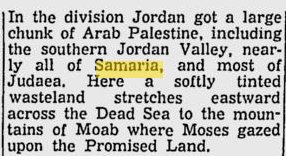
The Free Lance-Star, 1965:

The term "west bank" was used between 1948 and 1967, almost exclusively without capitalization.
Before there were any settlements, the Labor-led Israeli government called the area "Judea and Samaria" as this 1968 UPI article shows:

Soon, the anti-Israel crowd started to push the use of the term "West Bank" as a proper name. Note that happened after 1967, showing that it wasn't a Jordanian initiative, Here's an example of one of the earliest uses of the term as a proper name from an AP article written in 1971, referring to the "so-called West Bank:"


And this lie spread so quickly that only two years later AP accused Israel of trying to rename the "West Bank" to Judea and Samaria!

And that, ladies and gentlemen, is how a lie is created.
So today the use of the correct historical term for the area is considered extremist, and the use of the anomalous term created when Jordan illegally annexed the area for 19 years is considered normative.
(To their credit, most leftist commenters to the article cited noted that there is nothing political about referring to the area as Judea and Samaria. Calling it The West Bank, on the other hand, is purely political - first to make it appear as part of Jordan and later to avoid giving it any Biblical connotation.)
According to a report in Israel National News, the commander of Israel Army Radio, the national radio station in Israel operated by the Israel Defense Forces, has determined that all the station’s reporters should refer to the West Bank as “Judea and Samaria.” The report states the decision was made as a result of complaints made by Israel Media Watch that the radio station’s referral to the area as the “West Bank” gives the impression to listeners that the territory does not in fact belong to Israel.
Israel Army Radio is a popular mainstream station in Israel listened to by people from across the political spectrum. It is thus significant that it is now being directed to use the same terminology used by the settler movement when invoking the Biblical, divine notion of “Greater Israel” that is completely detached from reality, diplomacy and human rights.
The author added:
I just chose to point out this news item since it is a good example of the “zeitgeist” in Israel, the slow unraveling of rhetoric that exposes the reality on the ground.I love how these guys believe that "West Bank" is a historic term and "Judea and Samaria" are modern, rightist settler terms, a phrase daring enough to ring alarm bells in their little heads that cannot conceive of a Middle East before the 1970s.
So here's a quick look through the news archives from the 1950s through the 1970s.
From a National Geographic News Bulletin, from 1956:
The Free Lance-Star, 1965:
The term "west bank" was used between 1948 and 1967, almost exclusively without capitalization.
Before there were any settlements, the Labor-led Israeli government called the area "Judea and Samaria" as this 1968 UPI article shows:

Soon, the anti-Israel crowd started to push the use of the term "West Bank" as a proper name. Note that happened after 1967, showing that it wasn't a Jordanian initiative, Here's an example of one of the earliest uses of the term as a proper name from an AP article written in 1971, referring to the "so-called West Bank:"
Soon the "so-called" part was dropped, but the two terms were used together for a while still. Here's one from 1974, still with lower-case, from UPI:

But soon the Big Lie that only Israelis referred to the area as Judea and Samaria started to take hold. From Reuters, 1975:

And that, ladies and gentlemen, is how a lie is created.
So today the use of the correct historical term for the area is considered extremist, and the use of the anomalous term created when Jordan illegally annexed the area for 19 years is considered normative.
(To their credit, most leftist commenters to the article cited noted that there is nothing political about referring to the area as Judea and Samaria. Calling it The West Bank, on the other hand, is purely political - first to make it appear as part of Jordan and later to avoid giving it any Biblical connotation.)
Subscribe to:
Comments (Atom)


