Tuesday, March 01, 2022

From Ian:
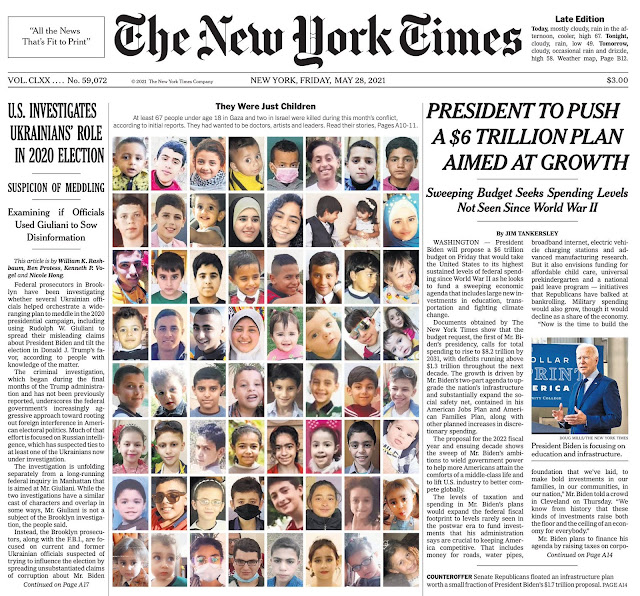
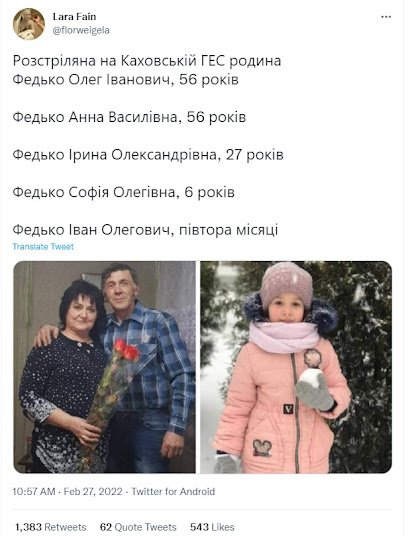
Seth Frantzman: The disingenuous attempt to link Ukraine with Palestinians
Guardian criticises Howard Jacobson's concern about left-wing antisemitism
Seth Frantzman: The disingenuous attempt to link Ukraine with Palestinians
The argument that Palestinian Molotov cocktails don’t get the same adoration in Western media is misleading. For many years, Palestinian rock-throwing during the Intifada was given positive coverage. Palestinians slinging rifles and “resisting” Israel in places like Jenin also received positive coverage.JPost Editorial: The Palestinians are not like the Ukrainians - editorial
But Palestinian groups went from “resisting” to bombing civilians and celebrating the attacks on them. That is a big difference. Ukraine hasn’t turned into a quagmire for Russia yet, and Ukrainians aren’t blowing up buses in Moscow. Russia has actually suffered terrorism in the past from Chechens and others.
In the case of Ukraine, however, there are no posters of “martyrs” massacring Russian children. There’s nothing romantic about a Palestinian or a Ukrainian throwing a Molotov cocktail onto a civilian’s car. The media are celebrating Ukrainian resistance because it is fighting the Russian military. Major media and the West in general have been sympathetic to Palestinians when they were seen to be primarily fighting Israel’s military.
Another difference is that the Palestinian narrative is backed by groups that say “From the river to the sea,” who argue that Israel should not exist. Ukraine is an independent country being brutally invaded. It does not say it wants Moscow, and it does not have maps of their country that includes all of Russia.
When people argue that Ukraine is getting unfair coverage for “resisting occupation” while Palestinians do not get the same coverage, their claims are misleading. Palestinians receive support and coverage, and Palestinian refugees are still refugees after 70 years. They receive enormous international support. Ukrainians are also getting support. And if, after 70 years, they are still resisting Russia, it will be fair to continue that support.
Many of those who back Palestinians while slamming the coverage of Ukraine are also disingenuous because they don’t back Ukrainian resistance. They claim the situations are the same, but many of them back Russia.
You can see by their social media background how some not only back Russia and the Assad regime, but are anti-Israel and anti-Kurdish. They don’t actually back the “resistance” of every group. They are primarily obsessed with Israel. This obsession is usually driven by antisemitism, and their talking points about Ukraine are merely a distraction.
All those trying to paint Israel as imperialist Russia and the Palestinians as the freedom-seeking Ukrainians should keep a couple of truths in mind:
First, the Ukrainians never tried to throw the Russians into the Black Sea, nor does the Ukrainian constitution include a clause stating that Russia has no right to exist.
Second, the Ukrainians did not arm their people with explosive vests and encourage them to ride buses in Moscow and blow themselves up along with as many innocent passengers as possible.
Third, the residents of Kharkiv in northern Ukraine have not been firing rockets for nearly two decades at apartment blocks in Belograd just across the border.
To compare Russia’s full-scale invasion of Ukraine to bring Kyiv under Russian President Vladimir Putin’s heel to Israel’s incursions into Gaza or southern Lebanon to stop Hamas or Hezbollah from randomly shelling civilian populations is to willfully distort reality.
Thankfully, most reasonable people see these lies for what they are.
Sadly, some will only see that the Russians are the far stronger side in this war, that Israel is the far stronger side when it fights Hamas in Gaza, and reflexively just sympathize with the underdog, the weaker side.
Weakness, however, does not automatically bestow virtue. In the Ukrainian-Russian conflict, it happens to be that Ukraine is both the wronged party and the weaker one. But that is not the case with the Palestinians.
Guardian criticises Howard Jacobson's concern about left-wing antisemitism
First, the “minor celebrity”/”Twitter personality” he claims has no right to speak for British Jews he’s likely referring to is the indefatigable writer, researcher and activist, David Collier, who, last year, had forty trees planted in Israel to honour those in Britain who, like Collier himself, have bravely fought antisemitism.
But, the former point in the paragraph we highlighted made by Moshenka is even more revealing.
If he would have said, prior to 2015, that the problem of left-wing antisemitism is overstated, that would be one thing.
But, to make that point after a Labour antisemitism crisis so toxic that most British Jews believed the party leader was personally antisemitic with many viewing Jeremy Corbyn as an existential threat to Jewish life, after the party was found guilty by the EHRC of violating the Equalities Act in its treatment of Jewish members, and after the worst year on record for antisemitic incidents (driven, in large measure, by the pro-Palestinian activist left), is astonishing.
Though we don’t know much about Moshenka, the fact that he’s gravely concerned about a work of fiction written 18 years ago, yet the tsunami of Jew hatred in recent years from within his own political community leaves him, as it left Sam Finkler, “stone-cold”, speaks volumes about why Guardian editors deemed him fit to review Jacobson’s book.