Sunday, February 27, 2022

From Ian:
Seth Frantzman: International law was supposed to protect Ukraine — it failed
Seth Frantzman: International law was supposed to protect Ukraine — it failed
The lessons of appeasement led to democracies being more forthright in their demands that countries adhere to these norms. The Cold War, however, brought with a litany of new abuses and because the world was divided it was hard for countries to agree on international norms and enforcement. The concepts laid down by US President George H.W Bush during the Gulf war were designed to resurrect the rules-based international order.Gerald Steinberg: What Israel Must Learn From Ukraine’s War
Although this international order has not been ideal, there have been attempts to make it work. That means the US intervened in the Balkans in the 1990s to stop ethnic cleansing. The US stumbled during the global war on terror, but the pretense of international law remained. In fact it is Russia that has often voices support for these norms in places like Syria, demanding the US leave Syria and claiming that it is Russia that stands by international norms, like soviergnn states and such concepts.
Now Russia has torn up that rule book in an unprovoked attack on Ukraine. Russia didn’t set any kind of ultimatum or red line before the attack. The excuse that Russia was concerned about NATO expansion holds no water, because Russia didn’t even try diplomacy with Ukraine. Russia simply started bombing without any warning or pretense of why it was launch an attack.
This shows that Russia didn’t feel a need to justify this attack. It didn’t distribute talking points before the war to its media and embassies. It didn’t even bother to try to explain the conflict. It doesn’t have regular press updates. This is because Russia knows it was violated international norms.
The problem for Ukraine was that these norms were supposed to protect Ukrainians. The western countries that talk tough on sanctions and US vows about “unprecedented” sanctions still continue to ring hollow. This is because the unprecedented actions are not yet being fully taken. The US especially seems keen to continue to work with Russia on energy issues and the Iran deal. That means this war casts shadows over enforcement of any issues relating to Iran. The story of “snap back” sanctions on Iran was largely a myth. Iran can keep on enriching uranium and nothing will be done.
Unfortunately for Ukraine the same letdown of relying on western democracies had led to war today, much as it did in the 1930s. Whether or not the west can step up and give Russia some real repercussions will be a key to seeing if this attack on Ukraine has a result that sends a message to others not to try the same thing.
The first lesson to be learned (or relearned) from Russia’s invasion of Ukraine is that the absence of deterrence can be fatal for any nation. The bravery and determination displayed by the leaders and citizens of Ukraine are impressive, but have not prevented Putin’s onslaught. In the West — mainly the United States and NATO — good intentions and strong words of support notwithstanding, the lack of a credible deterrent to dissuade Putin was clearly evident, including to the Kremlin.Michael Oren: Israel navigating perilous diplomatic terrain in Ukraine
Deterrence of a powerful and determined opponent is inherently complex and uncertain. During the Cold War, strategists agonized over the best means of preventing Moscow from challenging and weakening American power and the NATO alliance, including MAD — mutual assured destruction. But when the Soviet state collapsed, and the end of history was declared, deterrence was largely forgotten, allowing Putin to build up his forces without interference. By the time the United States and NATO woke up to the threat, Russia had full control.
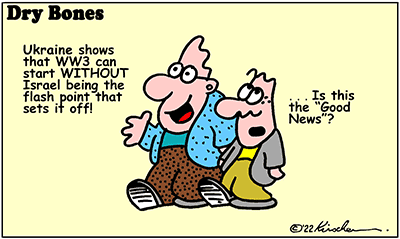
For Israel, the events in Ukraine are an important reality check. Israelis recognize that no outside power, not even the United States, can be relied on to guarantee survival in the face of a powerful threat. In 1948, after defeating the combined Arab attack at great cost, David Ben-Gurion understood the need for the tiny Jewish state to be capable of defending itself against future threats, as was demonstrated in 1967. Later, having America as an ally added to Israel’s security, but did not replace the centrality of self-reliance.
As a result, for 74 years, Ben-Gurion, his successors and Israel’s security establishment have continued to prioritize strategic deterrence. The best means of preventing an attack is by convincing enemies that the response will be swift and intolerable, and that in threatening Israel’s survival, their own existence would be at stake.
However, in recent years, lapses in deterrence have been cause for concern and require strengthening and reinforcement. Specifically, in the face of ongoing threats from the Iranian regime and its proxies, and against Hamas in Gaza, Israeli responses fall short. Against threats to wipe “the Zionist entity” off the map, a series of pinpoint and anonymous attacks attributed to the Mossad have not stopped Tehran’s efforts to acquire nuclear weapons. And in Lebanon, under the eyes of the United Nations and the so-called international community, Hezbollah acquired and deployed tens of thousands of rockets and missiles stored in civilian areas, and aimed at the Israeli population. This force is the forward arm of the Iranian threat.
Finally, perhaps it's also fitting to ask: Why is Israel so afraid of the Russian military presence in Syria? After all, this force consists of some 4,000 troops and a few dozen planes. Does our seemingly constant projection of trepidation damage our image and deterrence capabilities in the region?
It's important to note here that despite our repeated requests, Moscow has chosen to continue selling some of the most advanced weapons systems in the world to our enemies. Hezbollah in Lebanon and even Hamas in Gaza are equipped with Russian weapons, and Russia built the nuclear plant in Bushehr, Iran, and has promised to build another eight in the Islamic republic.
As stated, navigating this environment is exceedingly perilous and requires Israel to tread very lightly. On one hand, it must keep as many channels with Russian President Vladimir Putin open and must continue caring for the welfare of Ukrainian and Russian Jewry, including the possibility of a mass absorption of immigrants.
On the other hand, Israel mustn't remain silent – not in the face of the Ukrainian people's courageous fight, which could be reminiscent of the dogged resistance to Soviet occupation after World War Two; and not in the face of public opinion in the US, our most important ally. Israel should continue offering its services as a mediator and continue providing humanitarian and medical support to the Ukrainian people. We should also uphold our purpose as a strong and ethical Jewish state.