Thursday, May 20, 2021

From Ian:
The War Between Wars Heats Up
Eli Lake: A Cease-Fire Is Not Enough When It Comes to Hamas

The War Between Wars Heats Up
IN CONFLICTS PAST, senior American officials often stepped in and compelled both sides to see the wisdom of a cease-fire. Sometimes Israel wanted to keep fighting. Sometimes it was ready to quit. But it always acquiesced to Washington, in a nod to the special relationship that the two countries share.Commentary Magazine Podcast: Gaza, Commissions, and Pipelines
This time, the Biden administration dispatched Deputy Assistant Secretary of State Hady Amr in an effort to “deconflict,” as the neologism has it. This decision was a curious one. Protocol dictates that Amr, a relatively low-ranking official, would not enjoy access to Israel’s top decision-makers.
It’s also unclear how much Israel wants to talk to U.S. officials about Iranian-backed terror these days. Tensions are running high owing to the Biden administration’s ill-advised decision to reenter the flawed 2015 nuclear deal with Iran. America’s side of the deal will almost certainly include billions of dollars in cash incentives to the regime in exchange for temporary nuclear concessions. In other words, America is set to fund Hamas indirectly, given the terror group’s patron-client relationship with Iran.
Finally, there is the question of what exactly America seeks to achieve in the region. The Biden administration has repeatedly stated that it seeks to pivot away from the Middle East. But at the same time, it is investing significant time and effort to revive the nuclear deal—which will empower Iran while weakening Israel and the Gulf Arab states. Hamas knows this. And that is likely one reason the Hamas leadership felt sufficiently emboldened to launch this latest conflict.
In other words, this latest round could be an early indicator of the Biden administration’s new Middle East. It’s not a good one.
Today’s podcast goes over the latest in the ideological war of the Left against Israel, the political hijinx over the January 6 commission, and what on earth is going on with the Nord Stream 2 pipeline.David Friedman: The myth of the Al-Aqsa 'siege' continues to ignite Palestinian violence
On Aug. 24, 1929, an Arab mob massacred 69 Jews and wounded many more in Hebron, Judaism’s second holiest city which hosts the Cave of the Patriarchs, the burial place of Abraham, Isaac, Jacob, Sarah, Rebecca and Leah. The motivation for this unconscionable assault was a false rumor that Jews in Jerusalem were laying siege to the Al-Aqsa Mosque, located on the Temple Mount, the third holiest site in Islam and Judaism’s most holy location.Caroline Glick: "Media are Agents of Israel's Enemies in the War Against Israel"
Those seeking to rid the Jews from British Mandatory Palestine, as the land was then referred to, and to override the League of Nations Mandate which established within that territory a national home for the Jewish people, took notice of the extreme emotional reaction they had provoked with the rumor of an Al-Aqsa siege. It became institutionalized within their antisemitic playbook and remains a potent weapon to this day.
It’s not as if anyone really believed that the Jews were interlopers in Jerusalem, where they had lived for thousands of years. Indeed, in “A Brief Guide to the Al-Haram Al-Sharif” published by the Supreme Muslim Council in 1935, the authors, referring to the Temple Mount (“Al-Haram Al-Sharif” in Arabic), acknowledged that “its identity with the site of Solomon’s Temple is beyond dispute. This, too, is the spot according to the universal belief, on which ‘David built there an altar unto the Lord, and offered burnt offerings and peace offerings.’” But in spite of, or perhaps because of, this undisputed biblical connection of the Jewish people to the Temple Mount, Arab extremists have played upon the fear and hatred of the Arab street to cause countless acts of violence against Jews throughout the past century.
I saw this first-hand when I was U.S. ambassador to Israel. On July 14, 2017, three Arab Israeli men exited Al-Aqsa and opened fire on two Israeli border police officers, killing them both. It was the first time that weapons apparently had been stored at the Al-Aqsa Mosque, necessitating a brief closure and search of the building. Once the Israeli police had swept the premises, the Mosque was reopened and metal detectors were installed to prevent further dangerous incidents.
The mere placing of the security devices at the entry points — common now to almost all public places (including the Western Wall, where Jews come to pray) — created a huge opportunity for Mahmoud Abbas, the aging and unpopular head of the Palestinian Authority, to establish himself as the “defender” of Jerusalem. Abbas encouraged dangerous violence for nearly a week until the metal detectors were taken down for the Muslim worshippers (but not for those entering through the single gate earmarked for non-Muslims). He knew full well that the Al-Aqsa Mosque was not under attack, but he played up the false rumor to advance his own needs. Lives were lost on both sides by the violence he promoted.
Eli Lake: A Cease-Fire Is Not Enough When It Comes to Hamas
Today the Palestinians of Gaza are hostages to Hamas. Biden should devise a political strategy aimed at freeing them.The Joshua and Caleb Network: Israel & the War With Gaza (full update on the current situation)
A first step should be in the negotiations for the cease-fire. Biden should avoid the mistake of former Secretary of State John Kerry, who in 2014 tried to negotiate a cease-fire with friendlier patrons of Hamas, such as Qatar and Turkey. Biden should deal primarily with Egypt, whose leader has no love for Islamists such as Hamas and is trusted by the Israelis.
Biden should also demand that any reconstruction aid for Gaza bypass Hamas entirely. This could be done by empowering elements of the Palestinian Authority in the West Bank, for example, or by working with Arab allies that have already reached diplomatic agreements with Israel, such as the United Arab Emirates. Gazans need aid desperately — but none of that aid should go to the coffers of Hamas.
Biden should also reconsider his decision to renew U.S. funding for the U.N. Relief and Works Agency. Since 2007, when Hamas took over Gaza, the agency has acted as an unofficial arm of the local government in Gaza. At the very least, U.S. aid should be conditioned on purging Hamas members from its payroll.
In the medium term, Biden should seek to revive Palestinian civil society and electoral politics. There have been no Palestinian elections since 2006. Last month, the octogenarian leader of the Palestinian Authority, Mahmoud Abbas, canceled scheduled elections to hardly any protest from the U.S. and Europe. Abbas probably has only a few years left. Biden should begin planning now for elections once he leaves office.
2 Things to remember about the current situation in Israel. Israel is not responsible for this war with Gaza, and their response has not been disproportionate. Find out why on today’s episode.
Nearly 4,000 rockets have been fired into Israel from Gaza over the course of the last week. More than 400 of them landed back inside Gaza and on their heads of their own people.
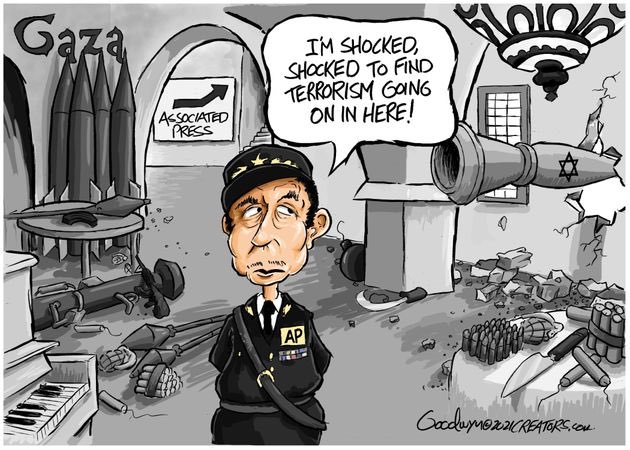
The Associated Press is upset that Israel bombed the building that they shared with Hamas. They claim that they didn’t know Hamas was there. Are they just incompetent or is the Associated Press collaborating with terrorists?
On today’s episode, we cover all of the stories, details and facts on the ground from the situation here in Israel over the last week and a half. You don’t want to miss it.