Friday, March 05, 2021
Elder of Ziyon
Friday, March 05, 2021
Elder of Ziyon
One of the major issues affecting water utilities in the State of Palestine, and developing countries, in general, is the considerable difference between the amount of water supplied into the distribution system and the amount of water billed to consumers - or Non-Revenue Water (NRW). NRW is attributed to either real losses related to water leakage during pumping, storage and transmission in network pipes or apparent losses due to theft or illegal connections, metering inaccuracies or unbilled consumption.According to the Water Sector Regulatory Council (WSRC) in the State of Palestine, the average rate of 33% NRW accounts for US$45 million of more than 85 million cubic meters of fresh water lost annually that would have been utilized to relieve part of water scarcity and insufficient supply.
If they are losing 33% of their water because of leaks and other inefficiencies, that means that fixing those problems would increase the amount of drinking water available by 50%.
If only they had some experts nearby that they could ask to help them....
In an area where water is “liquid gold”, they use high tech monitoring to discover leaks in water systems so that they can be found soon and fixed. Water system leaks can occur at any point from main feeder lines to distribution and service pipes that convey water to homes and businesses. Leaks can range from tiny (at the time) pressure leaks to large cracks and can add up quickly. For example, a one-eight inch crack in a pipe at 60 pounds of pressure can lose more than 3800 gallons per day. Because of this, water leakage rates around the world are high (In the UK, it is estimated that water losses are more than 3 billion liters per day). Israelis have invented and applied technology to find and stop leaks when they are small. This commitment accounts for Israel’s leakage rate of 7-8% on average, the lowest in the world.
Israel has a number of companies that specialize in detecting and preventing water leaks. If the Palestinians would ask, they could get eager graduate students from Israel more than willing to work with them to fix their issues.
But they won't. The reason is the same as the reason that they are not asking Israel for COVID-19 vaccines - because asking for help from the people they tell their kids are genocidal racists is shameful.
People who say that Israel is the reason there is no peace in the Middle East don't want to know the truth: the Palestinians do not want peace, they do not want "normalization," they do not want Israel to help them in any way whatsoever unless it can be painted as a concession from the Jews.
(h/t Irene)
Thursday, March 04, 2021
J Street and the Problem of Palestinian Anti-Semitism
J Street's May 2018 condemnation of Abbas was a rare and impressive criticism of a figure whom J Street had almost never previously criticized. Publicly challenging a leader whose policies you generally support is never easy. At the time, some skeptics, myself included, wondered if the condemnation was sincere, or was just a quick gesture intended to make J Street look reasonable but with no intention of actually confronting Palestinian anti-Semitism.
If J Street wants the Jewish community to believe that its opposition to Palestinian anti-Semitism is sincere, it must insist that Abbas officially recant his speech, withdraw his anti-Semitic book from circulation, and eliminate anti-Semitic statements from the PA-controlled media and schools.
When I say "recant," I don't mean a mealy mouthed statement like the one Abbas issued in 2018, following the international uproar over his anti-Semitic remarks. "If people were offended by my statement in front of the PNC, especially people of the Jewish faith, I apologize to them," Abbas said. That wasn't a genuine apology. Not even close. The problem with Abbas's speech was not that some people took offense (as if they were being thin-skinned and overreacting); the problem was that what Abbas said about Jews was wrong, vile, and bigoted. That's what Abbas has to admit, and recant.
Admitting he was wrong is vitally important, in order to send a message to the Palestinian public that the anti-Semitic lies they have been hearing all these years – in their leader's speeches and books, and in their media and schools – were wrong.
Only when the Palestinians, starting with their leaders, genuinely give up their anti-Semitism, can we take seriously claims by Dylan Williams and J Street that "moderate Palestinian leaders" exist with whom the United States should interact.
Easy way to prove that. The Democrat-controlled House should take up and pass Sen. Cruz's antisemitism resolution from the 116th Congress, which the Senate passed unanimously, that singularly condemns antisemitism as a unique manifestation of hatred. https://t.co/Bzg1nWFxkH
— Omri Ceren (@omriceren) March 4, 2021
Steven Emerson: Marc Lamont Hill’s Vile Antisemitism and Duplicitous New Book
Hill has only leaned in further to antisemitic conspiracy theories, such as repeatedly invoking the inflammatory and false accusation that a police exchange program between Israel and the United States leads to police killings of Black people in America. In 2018, he said: “But again, there’s a relationship between the two. The New York City Police — they’re killing us. But they’re being trained by Israeli security forces. [Host: “Really?”] Yes! They’re being trained — New York City Police and in other cities as well. So there’s a connection between the two.”
In October, the IPT exposed this narrative about police exchanges as a big lie, in the IPT series called “House of Lies.”
It’s also a claim that even an ideological ally of Hill — Jewish Voice for Peace — now says is antisemitic, and even admits to being inaccurate: “Suggesting that Israel is the start or source of American police violence or racism shifts the blame from the United States to Israel. … It also furthers an antisemitic ideology … Taking police exchanges out of context provides fodder for those racist and antisemitic tropes.”
All of this context makes it abundantly clear that Hill’s call for “a free Palestine, from the river to the sea” is a call to erase the Jewish state of Israel.
Hill now finds his infamous UN comments a joking matter — publicly, at least, so as to distract from the true meaning of his comments and to diminish the cause of his firing from CNN. At an April 2019 talk he gave at the University of Houston, he said: “I said, ‘we must do what justice requires.’ And justice requires ‘a free Palestine.’ Then there was like six other words. I can’t remember what they were…(laughs) ‘From the window to the wall…’ I don’t know. (laughs). And this idea of ‘from the river to the sea’ became the whole story.”
For good reason.
Hill’s record unambiguously shows that he has not stopped advocating for the destruction of Israel. He just tries to camouflage his antisemitism through a campaign of lying and denial, disguising his scandalous hatred of Jews in the form of a policy book that even “reputable reviewer” Kirkus Reviews falls for when praising his book as a “clear and evenhanded analysis.”
No.
As former US ambassador to Israel (under the Obama administration) Daniel Shapiro tweeted when he first heard Hill’s “from the river to the sea” comments in 2018: “This is disgusting. Calling for the elimination of Israel is anti-Semitic…”
Hill’s book is duplicity at its finest.
Beginning of a new era in Israeli-Arab relations?
On October 2, 1947, weeks before the partition vote that would signal the beginning of an Arab war against the Jews of Palestine, Ben Gurion wrote, “This is our native land; it is not as birds of passage that we return to it. But it is situated in an area engulfed by Arabic-speaking peoples, mainly followers of Islam. Now, if ever, we must do more than make peace with them; we must achieve collaboration and alliance on equal terms …. Talk of Arab Jewish amity sounds fantastic, for the Arabs do not wish it… they want to treat us as they do the Jews of Baghdad, Cairo and Damascus. (Nevertheless) history has … set conditions … which will compel Arab and Jew to work together…
For most of the past seven decades, Ben Gurion’s words have seemed hopelessly optimistic as one war followed another and Arab acceptance of Israel’s right to exist as a Jewish state seemed forever out of reach. But in spite of ongoing conflict, there are signs that the situation may be starting to change.
Reasons for cynicism have been many. While Israel’s cold peace with Egypt and Jordan has held, all attempts to come to terms with the Palestinian Arabs have foundered in bloodshed and mutual recrimination. For those of us who believed that a new era was at hand in 1993 as Yasser Arafat and Yitzchak Rabin shook hands on the white house lawn, the disillusionment has been particularly bitter. The murder of Yitzchak Rabin and the upsurge of terrorism emerging from the Palestinian Territories after 2000 were coupled with the Durban declaration and a renewed attempt to convince the world that Zionism was colonialist and racist and to turn Israel into an international pariah.
Now, in just a few months, we have seen dramatic and encouraging developments in Israeli Arab relations. The normalization agreement with the United Arab Emirates has led with lightning speed to booming economic and political contacts. The dissatisfaction of Israeli Arabs with the Joint List as articulated by the Mayor of Nazareth has been fuelled in part by their stand against the UAE peace agreement, which is popular with many of their Israeli Arab supporters. As the new ambassador from the United Arab Emirates takes up his post and Israelis prepare once again to go to the polls, perhaps at long last we are seeing the beginning of that era of Arab Israeli collaboration foreseen by David Ben Gurion.
Thursday, March 04, 2021
Elder of Ziyon
cartoon of the day, humor
Thursday, March 04, 2021
Elder of Ziyon
humor, Preoccupied
Our weekly column from the humor site PreOccupied Territory.
Check out their Facebook page.
Caesarea, March 4 - Israel's incumbent prime minister floated the idea today of appealing to segments beyond his traditional right-wing base by adopting some behaviors of the center-left American president, such as standing behind women on stage at public functions and immersing his nose in their coif to inhale the scent of their shampoo.
Binyamin Netanyahu of Likud hinted in an interview at his seaside home in this ancient Herodian city Wednesday that his electoral approach has shifted in this campaign, including an unprecedented effort to reach out to Arab citizens, and in the concluding weeks of the campaign he intends to expand that outside-the-box thinking to include left-wing voters by imitating Joe Biden's women's-hair-sniffing displays. The elections are scheduled for March 26, the fourth such contest in two years.
"We obviously need to avoid the paralysis and despair that come with an inconclusive election outcome," explained the premier, who has now served longer than any other in Israel's history. "That will require changing the way things are done to attract votes. My policies have actually been more or less indistinguishable from a left-wing government: I haven't confronted the growing hegemony of the courts and prosecution; I haven't made good on promises to demolish illegal villages; I haven't addressed discriminatory enforcement in different demographic sectors, favoring non-Jews over Jews; I haven't done anything about tens of thousands of illegal migrants from Africa; I've instructed the military to take a soft approach to Hamas violence; I've continued to allow the terrorism-inciting, violence-glorifying Palestinian Authority to receive tax revenues and goods."
"In short," he continued, "it's clearly not my policies these voters oppose, so maybe it's my personal behavior. But if I were to adopt some of the unmistakable affectations of, say, the current American president, a Democrat, that might resonate better with otherwise-left-wing members of the electorate, and the mandate to form a government under my leadership this time around will prove more convincing and longer-lasting. I've known Joe for a long time and been able to see him in action, in addition to all the footage available of him, and I have to say I'm leaning towards the whole sniffing-women's-hair tendency has a special hold on my imagination." No Israeli government has lasted its full term in decades.
Netanyahu revealed he has mooted other "Bidenisms" he can also adopt to serve the same purpose, such as putting illegal migrants in cramped quarters and calling them "overflow facilities" and "definitely not cages."
ICC undermines its own legitimacy
It is not justice the International Criminal Court's chief prosecutor Fatou Bensouda is after. Are there not enough real war crimes around the world? Hamas has sworn in its treaty to eradicate Israel down to the very last Jew. It launches tens of thousands of missiles at our citizens and uses its citizens as human shields, yet only Israel is barred from defending itself. The Palestinian Authority supports our killers with its budgets, a sort of family insurance for all those who want to harm us, but Israel is the problem. This is a moral disgrace under legal cover.The International Criminal Court Violates Its Statute
For months, the Foreign Ministry, including all of its emissaries and ambassadors, as well as the Prime Minister's Office have been working to blunt the outrageous determination by two justices at The Hague against the minority opinion of the head of the tribunal that played into the hands of a prosecutor overly eager to build her reputation at Israel's expense. Even when the court ruled it had the jurisdiction to open a war crimes investigation against Israel, and although we told policymakers in Italy that Bensouda had not yet decided to open an investigation, something that was true at the time, I said in deliberations at the Israeli Embassy in Italy it was clear she would announce the opening of an investigation precisely because Bensouda was nearing the end of her tenure. This was also the reason she chose not to handle other cases pertaining to Nigeria and Ukraine. Bensouda had to think of her next career move, and hatred of Israel has always been a good catalyst for advancing one's career.
The ICC drew its moral authority from the reason for its establishment following the atrocities of World War II and the genuine crimes carried out against our people. This decision harms its legitimacy and the reasons for which it was established because it is a politicization of the court and morality to be used against Israel.
The ICC's crude interference in Israel's affairs when Israel is not a member-state and Palestinian affairs when they do not have a state is an attempt to force the semblance of a solution on a yearslong conflict that has left cultural, religious, and historical scars. The cruel irony is that now, at a time when moderate Arab states have understood they cannot give in to the Palestinian refusal to move forward on the normalization of ties with Middle Eastern states when all that is needed is confidence-building steps, in walks the ICC and gives the warmongers who reject peace a prize.
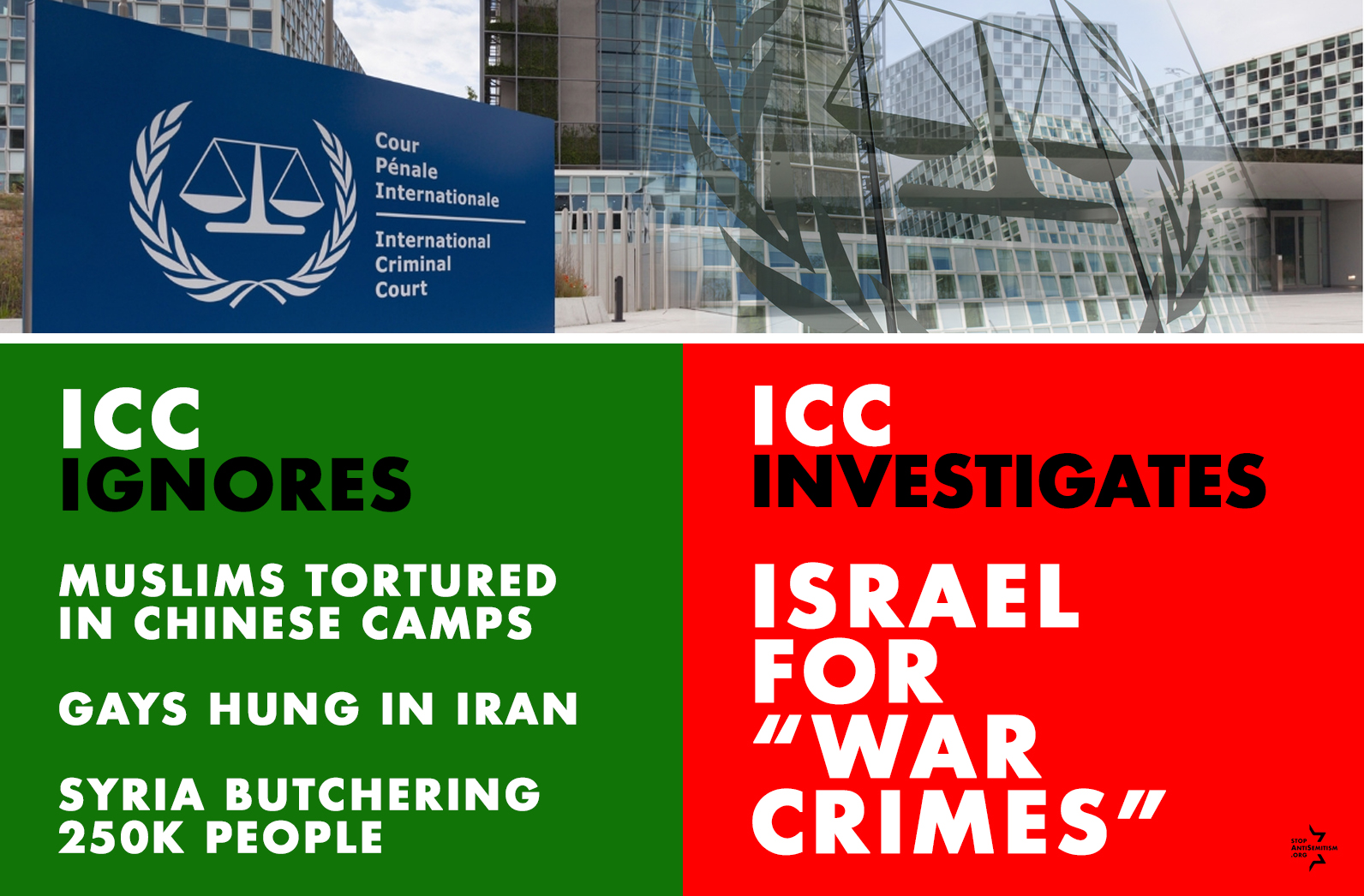
At present... the ICC renders itself irrelevant by adjudicating "national jurisdictions" perfectly capable of doing so while refusing to adjudicate or indict the world's worst violators of human rights.JINSA PodCast: The United States, Israel, and the International Criminal Court
The ICC has already provided its critics with plenty of ammunition to question the Court's legitimacy as a consequence of additional violations of its founding statute. Neither Israel nor the United States ratified the Rome Statute (the ICC's founding treaty). The Court therefore has no jurisdiction whatsoever over the state actions of either country.
State parties dissatisfied with the ICC's dismal record should be encouraged to discontinue financial support for the Court or to withdraw altogether from the Hague-based institution.
Meanwhile, at least four Gulf Arab states and other Muslim-majority countries appear far more concerned, with good reason, about Iran's drive for regional supremacy, while welcoming warming relations with Israel, which will prove a most loyal friend.
The International Criminal Court (ICC) recently made several controversial decisions regarding investigations into alleged Israeli and U.S. war crimes.
• How does a case land in the ICC?
• What are the bases of jurisdiction?
• What is the relationship between the authorization to investigate Israel and the authorization to investigate the United States?
• What does the potential politicization of the ICC mean for the realm of international law (including law of armed conflict?)?
Professor Geoffrey Corn of South Texas College of Law Houston joins host Erielle Davidson in an effort to answer these questions.
On this week's @JIPodcast, hosts @jarrodbernstein and @rich_goldberg are joined by @SenGillibrand to discuss her ties to the Jewish community, the recent allegations against Gov. Andrew Cuomo and her approach on Iran.https://t.co/HpuuNUh8pn
— Jewish Insider (@J_Insider) March 4, 2021
Thursday, March 04, 2021
Elder of Ziyon
analysis, Daled Amos
The author draws some personal conclusions of his own that seem unduly optimistic, such as that the Israeli Arabs are moving through evolving cultural values to a status of equal partners in the democratic and liberal state of Israel. [emphasis added]Is Campbell right?
In Israel, in 1948, the Arabs almost overnight became a minority in a country in which for many centuries they had been the overwhelming majority even though they did not enjoy self-rule. [p. 322]With the reestablishment of the State of Israel, not only did the Arabs become a minority -- for the first time, Arabs were exposed to the kind of non-Arab influences which few Arabs had ever experienced before.
In brief, although in no segment of Israeli Arab society had things reached a stage even in the 1980s where one could speak of the onset of Arab deculturation that is, a decline of their national Arab culture, it soon became clear that what was happening was that the Israeli Arabs were rapidly becoming bicultural...At the time of this writing (1985), this process is still in full swing. [p.323]To get an idea of how the Israeli-Arabs themselves viewed this, Patai quotes from research done by Mark A. Tessler in 1974, published as "The Identity of Religious Minorities in Non-Secular States." Tessler examines Jews in Tunisia and Morocco -- and Arabs in Israel. As a result of his research, Tessler finds Israeli Arabs to be a "non-assimilating" minority with an "unnarrowed cultural distance" between Arabs and Jews in Israel.
23% said they feel more comfortable in Israel than they would in an Arab or Palestinian state30% said it made no difference55% considered Israel's creation in 1948 to have been illegal
53% stated the term "Israeli" described them "very well" or fairly well"40% said they felt closer to Jews in Israel than to Arabs in distant lands such as Algeria or Morocco
50% rejected the statement that it was unacceptable for a married woman to go out socially in public without he husbandMost listened to Hebrew radio and television programs as often as Arabic ones.55% felt it was important for their children to study the history of Judaism65% felt it was important to study the history of Zionism78% said they would not object to their children attending a Jewish high school
The data presented do not seem to justify this conclusion.
o The Arab religion, tradition and history have conditioned them to have a disparaging view of Jews as dhimmiso Never before in Arab history have they lived under Jewish rule
o An Arab's knowledge of the Koran and Islam has taught them that for a Jew to rule over Arabs is against the will of Allah and intolerable
Arabs are also pragmatists, and, if not in thought and word, certainly in action, have always recognized and accepted the limitations of the possible. [p. 328]
Israeli Arabs will have to absorb enough of the Israeli-Hebrew culture and values to erase from their psyche that age-old Arab contempt for the Jewish dhimmis...It can come about only gradually as a result of the de facto symbiosis of Arabs and Jews. [p.328]
| Survey | as Israeli |
as Israeli- Arab |
as Israeli- Palestinian |
as Arab- Palestinian |
as Arab | as Palestinian |
as Religious (Muslim, Christian, Druze) |
|
Smooha I (2012) |
--- | 40% | 40% | 20% | --- | --- | --- |
|
Smooha II (2014) |
--- | 32% | 45% | 22% | --- | --- | --- |
|
Shaharit (2017) |
20.5% | --- | --- | --- | 28.4% | 14.6% | 35.8 |
|
+972 Magazine (2019) |
--- | 46% | 19% | --- | 22% | 14% | --- |
|
JPPI (2020) |
23% | 51% | --- | --- | 15% | 7% | --- |
The Israeli Arabs by acquiring modern Hebrew Israeli culture, are thereby transforming themselves before our very eyes into a radically new coinage in the Arab world: into an Arab people whose cultural physiognomy will have two sides, an Arab and a Hebrew. [p. 329]
The present-day Israeli Arabs' attitude to contemporary Israel has no choice but proceeds in the opposeite direction, from the tradional Arab contempt for the Jewish dhimmis to a respect for the people of Israel which will inevitably develop as a by-product of the growing Arab familiarity with and understanding of the nonmaterial aspects of Israeli-Hebrew culture. One hardly maintains a contemptuous attitude to a people whose culture one has absorbed and values internalized. [p. 329]
Thursday, March 04, 2021
Elder of Ziyon
Any investigation undertaken by the Office will be conducted independently, impartially and objectively, without fear or favour. The Rome Statute obliges the Office, in order to establish the truth, to extend its investigation to cover all facts and evidence relevant to an assessment of whether there is individual criminal responsibility under the Statute and, in doing so, to investigate incriminating and exonerating circumstances equally....Investigations take time and they must be grounded objectively in facts and law. In discharging its responsibilities, my Office will take the same principled, non-partisan, approach that it has adopted in all situations over which its jurisdiction is seized. We have no agenda other than to meet our statutory duties under the Rome Statute with professional integrity.
The Islamic Resistance Movement, Hamas, welcomed the decision of the General Prosecutor of the Criminal Court, calling on the court to resist any potential pressures that could prevent it from completing its mission.Hamas spokesman Hazem Qassem described the decision as "courageous", and that it is an important step to achieve justice and redress for the Palestinian people and to punish the occupation leadership for its crimes. "Our resistance comes within the framework of defending our people, and it is a legitimate resistance guaranteed by all the laws and international laws," Qassem stressed in a press statement received by Felesteen....Leader in the Islamic Jihad Movement, Ahmed Al-Mudallal, called on the International Criminal Court to impose the harshest penalties on the criminal occupation leaders, describing the court's decision to open an investigation into war crimes they committed in the Palestinian territories as a "positive but insufficient step."
Thursday, March 04, 2021
Elder of Ziyon
Wednesday, March 03, 2021
Elder of Ziyon
Opinion, Vic Rosenthal
Israel’s Supreme Court decided a few days ago that conversions to Judaism by the Reform and Conservative movements in Israel must be recognized by the state for the purposes of the Law of Return. Until now, the state has somewhat illogically recognized non-Orthodox conversions done outside of the country, but has not accepted those that took place here.
Despite what many of us think about the Court, it did not make this decision out of rampant leftism and desire to destroy Judaism. In fact, the justices probably would have preferred not to have to take up this issue, which is the hottest potato in Israeli politics.
At the time of the founding of the state David Ben Gurion negotiated a historic agreement with the religious Agudat Israel party in return for its support. This compromise, which is often referred to as the “status quo,” included stipulations about state observance of Shabbat and kashrut, separate streams of education, and – very significantly – that the state would “satisfy the needs of the religiously observant” in connection with “marital affairs.” This came to mean that the Haredi-dominated Chief Rabbinate (the Rabbanut) would be the sole authority concerning marriage, divorce, burial, and so on, of Israeli Jews.
Until recently, the only authority in Israel whose conversions to Judaism were recognized for any purpose was the Rabbanut. About 15 years ago, two petitions were filed with the Court by people who were denied citizenship under the law of return because they had non-Orthodox conversions to Judaism in Israel. At that time, the Court said that it was up to the Knesset to legislate the conversion issue, which was problematic for many reasons besides immigration, and set a deadline for it to do so.
One of the most pressing aspects was that a large percentage of the roughly one million Russian immigrants to Israel were not accepted as Jewish by the Rabbanut, although they had been considered Jewish by the state for the purposes of immigration. Documentation of Jewish parentage was very hard to obtain in the former Soviet Union, where records had been destroyed during the war, and where the Soviet government had discouraged the practice of Judaism. Orthodox conversion via the Rabbanut was long, difficult, and required the adoption of a Haredi lifestyle which many secular Russian Jews were not willing to adopt – although they considered themselves part of the Jewish people (and so did almost everyone else). But if they weren’t Jewish according to the Rabbanut, then they and their descendants were unable to marry, divorce, or be buried in the Jewish part of a cemetery (unless they served in the IDF!)
In order to solve this problem (and satisfy the Supreme Court), various arrangements and compromises were proposed, involving the establishment of Orthodox (but not Haredi) conversion courts outside the control of the Rabbanut. This was shut down by the political power of the religious parties. Conversions in Israel still had to be under the auspices of the Rabbanut. In 2016, the Supreme Court decided that private, Orthodox conversions in Israel would be recognized by the state – but only for the purposes of the Law of Return, and not for matters of family law.
But the old petitions of the Reform and Conservatives Jews had still not been acted upon after 15 years, and the Knesset, after the appointment of a commission and countless extensions of the Supreme Court’s deadline, still had not legislated on the matter. It became clear that the religious parties would continue to stonewall any attempts to introduce leniency into the conversion process. Former Justice Minister Moshe Nissim, who headed the legislative commission, said,
At the time I proposed establishing courts for conversion and determined that the conversion would be done according to Torah law and the judges would be certified by the Chief Rabbinate … They didn’t accept the proposal because the words “under the supervision of the Chief Rabbinate” did not appear in it.
So the Supreme Court had no choice but to rule, and in light of its prior decision to accept Orthodox conversions outside the Rabbanut and not wanting to be put in the position of deciding which branches of Judaism were legitimate, extended its recognition to Reform and Conservative conversions.
Practically speaking, the ruling has little effect. It does not include family law and other matters, which remain under the control of the Rabbanut. Very few people in Israel who are not citizens convert to Judaism via the Reform or Conservative movements; the movements say they number 30 or 40 a year.
But the decision is symbolically important, because it constitutes a form of state recognition of the Reform and Conservative movements as Jewish institutions, something that Haredim and many other Orthodox Jews do not accept any more than they accept “Jews for Jesus.” They especially object to what they see as the liberal movements’ lax standards for conversion and recognition of a person’s Judaism.
Full-time rabbis of larger congregations in Israel receive salaries from the state, but until 2014 only Orthodox rabbis were eligible. In response to a petition by a (female) Reform rabbi, the Supreme Court decided that Reform and Conservative rabbis must be included. The government had no choice but to comply, but the religious parties insisted that the payments come from the Ministry of Culture and Sport rather than the Ministry of Religious Services!
***
So now I will give my personal opinion: the Rabbanut has always been Orthodox, but it has not always been Haredi. The organization today is corrupt, slow, and intolerant, and needs to be at least reformed (not Reformed!) and possibly abolished. I believe the refusal to permit Orthodox conversions outside of the Rabbanut is harmful and should be ended, as well as the Rabbanut’s monopoly on kashrut certification. I would also like to see an option for civil marriage and divorce in addition to traditional religious marriage. It’s ridiculous that many Israelis have to jump through demeaning hoops or leave the country to get married.
What about Reform and Conservative Judaism? I think a good argument can be made that Conservative Judaism is just a less stringent form of Judaism, while the Reform Movement practices a different religion from Judaism. Here are some relevant comparisons:
Early Christianity was an offshoot of Judaism. Beginning with a significant theological divergence – the attribution of divinity to Jesus – it continued to diverge by the introduction of extreme leniency in practice and the mass incorporation of formerly pagan converts. By the time of Constantine, and probably well before then, nobody would have said that Christianity and Judaism are the “same religion.” Protestantism (which is in itself very diverse) was a later offshoot of Catholicism. There are many theological and practical differences, but the most essential part – the human need for salvation from sin that is provided by Jesus – remained. Most people agree that they are both forms of Christianity.
Now consider Unitarian Universalism, an even more recent offshoot of Protestantism. It has abandoned the doctrine of the divinity of Jesus. Today’s Unitarian Universalists do not identify as Christian, and may even be atheists. They have crossed the line and now explicitly practice a “different religion.”
Rabbinical Judaism became the primary form of Judaism after the destruction of the Temple. It added to the monotheism and narrative of the Jewish people that had previously characterized Judaism alongside the Temple ritual, an elaboration and codification of the mitzvot found in the Torah. This became the halacha, the laws for Jewish living. Halacha became an essential part of Judaism.
Jews living in Eretz Yisrael and in the various parts of the diaspora placed emphasis on different parts of the halacha or observed it more or less stringently. However, Reform Judaism, from the moment of its creation, rejected the idea that there is an obligation of any sort to follow halacha. The famous “Trefa Banquet” held in honor of the first graduating class of Hebrew Union College in 1883 was not significant because Reform rabbis ate non-kosher food, but rather because it demonstrated that they did not consider themselves bound by halacha. Their deliberate action defined them not as nonobservant or even “bad” Jews, but as Jews who had stopped observing Judaism.
Since then, the Reform Movement has replaced halacha with a different moral code, one which is very similar to that of Unitarian Universalists and other liberal and progressive people, emphasizing values like diversity, environmentalism, gender and racial equality, and so on. Indeed it is often hard to tell the difference between Reform Jews and Unitarians, and I am acquainted with numerous people that have moved from one to the other faith. But unlike the Unitarians, the Reform Movement does not admit how far it’s come from its roots.
The Conservative Movement observes halacha, although its rabbis have – especially in America – issued halachic rulings that are more lenient than Orthodox Judaism; for example that it is permissible to drive to the synagogue (but only there) on Shabbat. However, if a line must be drawn between Judaism and not-Judaism, I would place the Conservatives on the side of Judaism – and the Reform movement on the other.
***
The Supreme Court’s decision will change little. The Russian immigrants are already citizens. What they need is to be able to be married (and buried) like anyone else. It would be good for all of us if this could be achieved by making it possible for them to affirm their Jewish identity.
Israel has become a wedge issue due to progressive left - David Friedman
He said that “there was not a place to land this issue in a way that would have great consensus” during the time he served as ambassador – from May 2017 to January 2021.Dexter Van Zile: Has Ben Rhodes Made the Descent into Antisemitism?
“Had we reached out to get more buy-in from the Left, we would have lost the support of the Right,” he told the Post, referring to what he considers some of the Trump administration’s greatest accomplishments: recognizing Israel’s sovereignty over the Golan Heights and changing the State Department’s legal analysis with regards to the Jewish communities in Judea and Samaria.
While there were Democrats who supported the State of Israel, the push against by the so-called progressive Left, had stirred this controversy around support for the Jewish state. Friedman said he wished that more of an effort was undertaken to break that wedge by finding common ground - between both sides of the aisle - for Israel support among all Americans.
The Trump administration announced in November 2019 that it did not view Israeli settlements in the West Bank as illegal. The announcement by Secretary of State Mike Pompeo in Washington marked a historic reversal of US policy.
“Bipartisanship is important,” Friedman said, “but it does not mean that you are looking for the lowest common denominator. If that is the price of bipartisanship then it probably isn't worth it.” He said, “you cannot abandon principles to achieve great consensus” and “it is clear… that uniform support for Israel in the US is being challenged.”
But he said that the United States’ decision to move its embassy from Tel Aviv to Jerusalem is one of the moves the Trump administration made that enjoys greater consensus.
Ben Rhodes, the former national security aide to President Obama — who once boasted that he used non-governmental groups and the media to create an “echo chamber” to garner support for the Iran nuclear deal — can’t stand people looking over the government’s shoulder when it formulates policy regarding issues of importance to them.
Rhodes made his contempt for democratic accountability perfectly clear in a recent interview with Peter Beinart, a well-know Israel hater and a fellow at the Foundation for Middle East Peace. During the interview, which allowed Rhodes to promote his forthcoming book, “After the Fall: Being American in the World We’ve Made,” he complained about the interest that American Jews and Christians have exhibited in their concern for foreign policy in the Middle East.
“You have this incredibly organized pro-Israel community that is very accustomed to having access in the White House, in Congress, at the State Department,” Rhodes said. “It’s kind of taken as granted, as given, that that’s going to be the way things are done.”
Rhodes also complained about media oversight of American policy regarding Israel.
“The media interest is dramatically intensified,” he said, complaining of an “aggressive, kind of pro-Likud media in the United States” and of a “mainstream media that delights in Israel controversies.”
The pro-Likud media seems to be anyone who doubts the good intentions of the Iranian government, which is intent on developing nuclear weapons, and declares its desire to attack Israel and the United States on a daily basis. It’s also curious that Rhodes can’t bend the media to his will, since he once said, “The average reporter we talk to is 27 years old, and their only reporting experience consists of being around political campaigns. […] They literally know nothing.”
Elder of Ziyon