Security prisoner Marwan Barghouti, widely seen as a rival to Palestinian Authority President Mahmoud Abbas, is considering running in the scheduled Palestinian presidential elections, a close associate of his confirmed Thursday.“Our comrade Marwan is considering the possibility, but he has not yet made a decision either way,” former Palestinian legislator Qaddura Fares said in a phone call.
Friday, February 12, 2021
Elder of Ziyon
Friday, February 12, 2021
Elder of Ziyon
Project leader Dr Raya Al-Dadah, Reader in Sustainable Energy Technologies at the University of Birmingham, comments, “Just 38% of Gaza’s electricity needs currently are met. People receive less than six hours of power per day, leaving hospitals providing only critical functions such as intensive care units. Coupled with continuous conflict, the energy crisis causes high levels of stress that affect physical, mental health and well-being.”
Forbes originally kept that quote in its article as well - and then edited the highlighted part out when it was pointed out to them.
Thursday, February 11, 2021
Elder of Ziyon
cartoon of the day, humor
Natan Sharansky with Gil Troy: The Doublethinkers
It was easy enough to remind myself and them who was really free and who is a scared doublethinker. All I had to do was tell some joke about the Soviet leader, Leonid Brezhnev. Thank God, there were plenty of yarns about his arrogance, his crudeness, his senility. One kidded about him forcing Soviet cosmonauts to outdo the American astronauts who landed on the moon by rocketing to the sun, then reassuring them they wouldn’t be incinerated because they’d be launched during the night. As I’d tell my interrogators a joke, I’d laugh. And, as normal Soviet doublethinkers themselves, they would want to laugh. But they couldn’t, especially if two of them were there together. Laughter would end their careers.
So they’d covered up that temporary glint in their eyes with a tantrum. They’d pound the table, shouting, “HOW DARE YOU?”
“Look,” I’d say to them calmly, “you can’t even smile when you want to smile. And you claim that I’m in prison and you’re free?”
I did this to irritate them, because they spent so much time trying to irritate me. But, mainly, I was reminding myself that I was free, as long as I could laugh or cry in accordance with my own feelings.
Over the last three decades in freedom, I have noticed that—with apologies to Tolstoy—every dictatorship is oppressive in its own way, but the doublethinkers’ mental gymnastics are all alike. The feeling of release from the fear and giddy relief when crossing the line from doublethink to democratic dissent is also universal across cultures. This understanding prompted the Town Square Test I use to distinguish between free societies and fear societies: Can you express your individual views loudly, in public, without fear of being punished legally, formally, in any way? If yes, you live in a free society; if not, you’re in a fear society.
In the West today, the pressure to conform doesn’t come from the totalitarian top—our political leaders are not Stalinist dictators. Instead, it comes from the fanatics around us, in our neighborhoods, at school, at work, often using the prospect of Twitter-shaming to bully people into silence—or a fake, politically-correct compliance. Recent polls suggest that nearly two-thirds of Americans report self-censoring about politics at least occasionally, essentially becoming a nation of doublethinkers despite the magnificent constitutional protections for free thought and expression enshrined in the Bill of Rights
To preserve our integrity and our souls, the quality of our political debate and the creativity so essential to our cultural life, we need a Twitter Test challenging bottom-up cultural totalitarianism that is spreading throughout free societies. That test asks: In the democratic society in which you live, can you express your individual views loudly, in public and in private, on social media and at rallies, without fear of being shamed, excommunicated, or cancelled? Ultimately, whether you will live as a democratic doublethinker doesn’t depend on the authorities or on the corporations that run social media platforms: it depends on you. Each of us individually decides whether we want to submit to the crippling indignity of doublethink, or break the chains that keep us from expressing our own thoughts, and becoming whole.
#OnThisDay 1986, 'Prisoner of Zion' @NatanSharansky became a free man upon his release from Soviet gulag, where he spent 9 years!
— Arsen Ostrovsky (@Ostrov_A) February 11, 2021
As a fellow ‘Refusenik’, Natan Sharansky is a tremendous source of inspiration & personal hero of mine, the very epitome of a modern proud Zionist. pic.twitter.com/q5IZkLXNHG
Coffin Problems
Luck was a defining factor in determining the fate of many in the Soviet Union, and it is the common vein that unites the subjects of this story. Yet the stories recounted here are not representative. Such stories can never be completely told because the Soviet system intentionally left much undocumented. Critical marks on examinations were often written in erasable pencil. Written exams were eschewed in favor of oral ones. Some who lived through the period do not feel they have anything to add; others may find the experience too painful to contemplate, much less talk about. Even among the small cohort described here, there is consensus on a few things but not on many others.Eli Lake: America in the World: Sheltering in Place
Kac quit his job in 1976 and applied for an exit visa to Israel. He received permission to leave quickly. He secured a position immediately at MIT where he remains today. Zelmanov eventually secured a role at Novosibirsk State and left in 1990. For his breakthrough work on a century-old problem, he was awarded a Fields Medal in 1994—the mathematical equivalent of a Nobel Prize.
Eliashberg was less lucky. He became a refusenik after his visa request was denied in 1979. He had returned to Leningrad before applying, and was forced to support himself at various temporary jobs. This promising mathematician found himself working as a night watchman at a car garage in the city. One of his friends put his own career on the line in order to secure for Eliashberg a job in an accounting software company. He remained there until 1987, when he was finally able to leave the Soviet Union. He was not sure if he would be able to rehabilitate himself as a mathematician. But he succeeded. In the decades since, he has won many of the most prestigious awards in mathematics including the Veblen, Crafoord, and Wolf prizes. Today, he is on the mathematics faculty at Stanford.
For her part, Julia Rashba recalled a poignant moment in the elevator with the MGU examiner who had failed her on the entrance exam. In many ways, she felt unprepared for what had just happened to her. She had experienced anti-Semitism in her childhood with bullies and cruel taunts. Once, as a little girl, she ran away from a day camp where the bullying was too much. She was not aware that the sorts of anti-Semitism that lived in adult institutions would be less benign. She was raised, however, to believe that even in such a discriminatory system, where her own father had experienced nearly insurmountable travails to rise to the top of the Soviet physics establishment—that she needed only to work hard and act with integrity and things should work out.
They had not. The examination she “failed” was not even for medical school, it was for a chemistry program that offered some biomedical tracks. She had hoped that she could contribute to medicine as a scientific researcher, even if she would not be allowed to be a clinician. The system would not even allow this tenuous finger hold on her dream. She recalls that the examiner, perhaps seeking absolution for the shame of what he had just done, quietly apologized and asked for her forgiveness. She refused.
That exchange tells us a lot about the Quincy Institute. The think tank’s foreign policy agenda and arguments echo the anti-interventionism of the 1930s. Most of its scholars are more worried about the exaggeration of threats posed by America’s adversaries than the actual regimes doing the actual threatening. In May, for example, Rachel Esplin Odell, a Quincy fellow, complained that Senator Romney was overstating the threat of China’s military expansion and unfairly blaming the state for the outbreak of the coronavirus: “The great irony of China’s military modernization is that it was in large part a response to America’s own grand strategy of military domination after the Cold War.” In this, of course, it resembled most everything else.
The institute has hired staff that come out of the anti-neoconservative movement of the 2000s. Here we come to a delicate matter. The anti-neoconservatives of that era flirted with and at times embraced an IR sort of anti-Semitism: the obsession with Israel and its influence on American statecraft. Like the America Firsters, the anti-neoconservatives worry about the power of a special interest — the Jewish one — dragging the country into another war. A few examples will suffice. In 2018, Eli Clifton, the director of Quincy’s “democratizing foreign policy” program, wrote a post for the blog of Jim Lobe, the editor of the institute’s journal Responsible Statecraft, that three Jewish billionaires — Sheldon Adelson, Bernard Marcus, and Paul Singer — “paved the way” for Trump’s decision to withdraw from Obama’s Iran nuclear deal through their generous political donations. It is certainly fair to report on the influence of money in politics, but given Trump’s well-known contempt for the Iran deal, Clifton’s formulation had an odor of something darker.
Then there is Trita Parsi, the institute’s Swedish-Iranian vice president, who is best known as the founder of the National Iranian American Council, a group that purports to be a non-partisan advocacy group for Iranian-Americans but has largely focused on softening American policy towards Iran. In 2015, as the Obama administration was rushing to finish the nuclear deal with Iran, his organization took out an ad in the New York Times that asked, “Will Congress side with our president or a foreign leader?” a reference to an upcoming speech before Congress by the Israeli prime minister Benjamin Netanyahu. The National Iranian American Council’s foray into the dual loyalty canard is ironic considering that Parsi himself has been a go-between for journalists and members of Congress who seek access to Mohammad Javad Zarif, Iran’s foreign minister.
This obsession with Israeli influence in American foreign policy is a long-standing concern for a segment of foreign policy realists, who believe that states get into trouble when the national interest is distorted by domestic politics — an affliction that is particularly acute in democratic societies which respect the rights of citizens to make their arguments to the public and to petition the government and to form lobbies. The most controversial of the realists’ scapegoating of the domestic determinants of foreign policy was an essay by Stephen Walt and John J. Mearsheimer (both Quincy fellows) that appeared in the London Review of Books in 2005. It argued that American foreign policy in the Middle East has been essentially captured by groups that seek to advance Israel’s national interest at the expense of America’s. “The thrust of US policy in the region derives almost entirely from domestic politics, and especially the activities of the ‘Israel Lobby,’” they wrote. “Other special-interest groups have managed to skew foreign policy, but no lobby has managed to divert it as far from what the national interest would suggest, while simultaneously convincing Americans that US interests and those of the other country — in this case, Israel — are essentially identical.”
Walt and Mearsheimer backed away from the most toxic elements of their essay in a subsequent book. The essay sought to explain the Iraq War as an outgrowth of the Israel lobby’s distortion of American foreign policy. The book made a more modest claim about the role it plays in increasing the annual military subsidy to Israel and stoking American bellicosity to Israel’s rivals like Iran. They also took pains to denounce anti-Semitism and acknowledge how Jewish Americans are particularly sensitive to arguments that present their organized political activity as undermining the national interest. Good for them. But the really important point is that events have discredited their claims. The all-powerful “Israel Lobby” was unable to wield its political influence to win the fight against Obama’s Iran deal. It was not able to stop Obama’s public pressuring of Israel to accept a settlement freeze. Decades earlier, it had not been able to thwart Reagan’s sale of AWACs to the Saudis. Anyone who believes in an omnipotent AIPAC is looking for conspiracies.
Impeachment, Matt Duss, what’s going on at the New York Times, the UN Human Rights Council, the ICC & Jerusalem. Our guest: ?@elianayjohnson?. Our best episode yet? You decide. Subscribe to ?@JIPodcast?. https://t.co/5JJ3Gln09D
— Richard Goldberg (@rich_goldberg) February 11, 2021
Thursday, February 11, 2021
Elder of Ziyon
humor, Preoccupied
Kissufim, Southern Israel, February 11 - A resident of this pastoral community near the Islamist-controlled Gaza Strip boasted today that she maintains a stockpile of fresh cakes and pastries just to be prepared for the eventuality of being able to feed terrorists who clambered through underground passages from the neighboring coastal territory to weak mayhem.
Sophia Barnea, 60, told reporters yesterday that she takes pride in her ability to get all of her freelance and homemaking work done and still have time to bake almost every day, in case a terrorist shows up to slaughter civilians and wants a muffin and maybe a cup of tea.
"It's something I make a point of doing," she asserted, gesturing to a platter of still-warm chocolate chip cookies. "If no boys from Hamas or Islamic Jihad stop by that day, I'll eat a few, but I am watching my weight, so the rest go to the nice fellows at the guard booth and the soldiers patrolling between here and the border.
Mrs. Barnea explained that since Nimrod, her husband of 30 years, died three years ago, she has taken to finding other outlets for her nurturing instinct. "I'm allergic to cats, unfortunately," she lamented. "My friend Meira, a few doors down, she has seven or eight cats, but while I see the appeal, I just can't handle the sneezing and the teary eyes it would cause me. So I've chosen to show affection to those who might not get that kind of attention around here. I do hope they like my apple pie."
Her routine calls for a different kind of baked goodie each day. "I have a variety of things I like to make," she explained. "I cycle through them about once every ten or eleven days, but I mix it up a little, not always doing the same thing. Sometimes I switch out apples in the pie in favor of pears, or I'll make oatmeal raisin cookies on a lark if I'm running low on chocolate chips. And now and then I'll whip up a streusel-topped marble coffee cake. You never know when the bloodthirsty gang might show up!"
"If Ahmad or Mustafa or whoever prefers some chocolate chip muffins to whatever I have on hand," Mrs. Barnea continued, "I can ask them to put the massacre on hold until I whip up a batch of chocolate chip muffins real quick. Seriously, it takes more time for the oven to preheat for those than the combined preparation and baking time. And they are just heavenly right out of the oven. I hope the boys appreciate what I do for them. A simple 'thank you' will be enough when the time comes. Such nice terrorist boys."
Thursday, February 11, 2021
Elder of Ziyon
"[Jews] do not accept a person’s conversion to their religion except through very complicated and difficult procedures.And Dr. Ahmad Anwar continued, saying: “The entry of the Kuwaiti actress Basma into Judaism will be rejected by the Jews themselves, because the Jews require that whoever enters Judaism be breastfed from the breast of a Jewish woman, 10 satisfying feeds.”
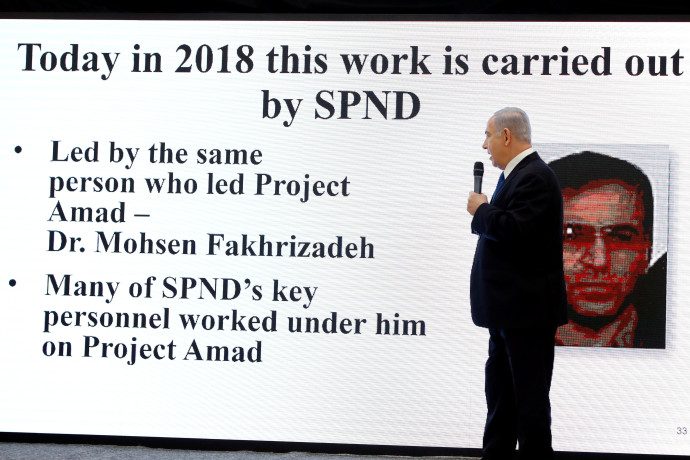
Truth behind killing of Iran nuclear scientist revealed
The Iranian nuclear scientist who was shot dead near Tehran in November was killed by a one-ton automated gun that was smuggled into the country piece-by-piece by the Mossad, the JC can reveal.
The 20-plus spy team, which comprised both Israeli and Iranian nationals, carried out the high-tech hit after eight months of painstaking surveillance, intelligence sources disclosed.
The Tehran regime has secretly assessed that it will take six years before a replacement for top scientist Mohsen Fakhrizadeh is fully operational.
Meanwhile, Israeli analysts have concluded that his death has extended the period of time it would take Iran to achieve a bomb from about three-and-a-half months to two years — with senior intelligence figures privately putting it as high as five years.
The disclosures come as the JC gives the fullest account yet of the assassination that made headlines around the world and significantly degraded Tehran’s nuclear capabilities.
Richard Kemp: The International Criminal Court Threatens Middle East Peace
The International Criminal Court (ICC) has long had its sights on what it no doubt considers an unholy trinity: Israel, the US and Britain.... First, these are the three Western democracies most active in using legitimate military force to defend their interests. This is anathema to the left-liberal doctrine of ICC officials and their soul-mates in such morally dissipated places as the UN Human Rights Council. Second, they wish to virtue signal, deflecting criticism that the court is biased against African states....
Yet by its charter, dealing with countries that lack the will or capability to bring their own to justice is the sole purpose of the ICC. This does apply to some states in Africa and elsewhere but demonstrably does not apply to Israel, the US or Britain, each of which have long-established and globally respected legal systems.
The ICC's design against Israel is the latest in a long history of endeavours to subjugate and scourge unwilling Jewish people deemed incapable of regulating themselves. When you examine the unexampled contortions the court has gone through just to get to this point, you have no choice but to question whether antisemitism is the motive.
The effects of the ICC's decision will be profound. This is only the end of the beginning. Unless halted, investigations into spurious allegations of war crimes will go on for years, perhaps decades, creating a global bonanza for all who hate Israel, including at the UN, the European Union, various governments and in universities and so-called human rights groups.
But the most detrimental effect of the ICC's decision will be felt by Palestinian Arab people who, for decades, have been abused as political pawns by their leaders and who would be the greatest beneficiaries of any peace agreement with Israel. The ICC's ruling makes such a deal even more remote today.
In an unprecedented move early last year Germany, Austria, the Czech Republic, Hungary, Australia, Canada, Uganda and Brazil petitioned the ICC, of which all are members, arguing that a formal investigation could not be launched as the Palestinian Authority does not meet the definition of a state under the Rome Statute that established and governs the court.
I had a very good conversation with my friend Australian FM @MarisePayne. I thanked her for Australia's clear & decisive stance that the decision of the ICC is fundamentally wrong. I congratulated her on Australia's success against Corona & updated her on our vaccination program. pic.twitter.com/PLztZkDKjG
— גבי אשכנזי - Gabi Ashkenazi (@Gabi_Ashkenazi) February 10, 2021
Thursday, February 11, 2021
Elder of Ziyon
The drinking water crisis has begun to present itself gradually in the Kingdom as a result of the climatic impacts on water resources in recent decades, especially in the southern and eastern regions, and this dilemma is exacerbated in the summer period with less rainfall.The crisis has appeared in the Draa-Tafilalet region, especially in the city of Zagora, which witnessed what were called “thirst protests,” prompting the state to launch projects for water treatment plants. However, the projects are too little and too late compared to the presented environmental challenges.In light of the resumption of diplomatic relations between Tel Aviv and Rabat, Moroccan officials can benefit from the Israeli experience in the field of water recycling, after it succeeded in overcoming drought, which made it a pioneer in the level of recycling and using wastewater in agriculture.A news article published in the Israel Valley newspaper, which specializes in trade relations between France and Israel, indicated that Tel Aviv recycles more than 80 percent of the wastewater that is used to irrigate nearly 20,000 hectares, which represents 16 percent of Israel's water needs.Israel, along with Kuwait and Singapore, is among the most advanced countries in the field of wastewater recycling.The international scientific journal “Water” published a recent study alerting the great water shortages afflicting the Moroccan southeast, stressing the fragility of the water balance in the region, in addition to the challenges related to the quality of groundwater used for drinking and agricultural irrigation.In this context, Abdel-Rahim Kassiri, the national coordinator of the Moroccan Coalition for Climate and Sustainable Development, said, "Israel is a world power in the development of water resources, as it invented water distillation and succeeded in greening dry desert spaces."Al-Kusiri added, in a statement to Hespress: "The return of political relations would transfer Israeli technologies to Morocco, and from there to Africa."
Thursday, February 11, 2021
Elder of Ziyon
This is of course patently offensive and false, but when Jews complained and the play was canceled, Loach whined about the "Zionist lobby" and its "extraordinary arrogance," adding that "they" want to suppress any discussion about clear lies.
During this meeting, she diminished [Jewish students'] concerns by claiming that "some Jews don't think it's offensive", said that she didn't know about his antisemitism because she hadn't read his Wikipedia page, refused to cancel the event because it would be bad for PR ("I don't want to create additional publicity [...] it would be huge to cancel an invitation at this point"), and put the burden on Jewish students to find a workable solution ("There isn't a way through this that you will be fully happy with - I'm not going to cancel it").• This meeting left Jewish students at the college feeling hurt, ignored, and deeply uncomfortable with the ignorance about antisemitism and willingness to tolerate it displayed by the most senior individual in their college's administration, who represents the college to the outside world. Jewish students across the University of Oxford feel similarly frustrated with the lack of regard shown to the welfare of Jewish students, and the manner in which PR was prioritised over their concerns.
The college defended the event:
Ken Loach, an alumnus of St Peter's College, has been invited by the College and The Oxford Research Centre in the Humanities to speak about two of his films. These films form part of a distinguished filmmaking career. This is the latest in a run of occasions on which Ken Loach has been invited to speak in College, all of which have previously been very well received by students. The event will be respected as advertised and we look forward to a good conversation about the films on this occasion.
Significant concerns about the event have been brought clearly to the College's attention and we are committed to creating further opportunities for these concerns to be properly respected and discussed within College. St Peter's stands vigorously against all forms of discrimination and always seeks to support students who are discriminated against.
In the context of the current conversation, College affirms without reservation its very strong opposition to anti-semitism. It recognises the appalling atrocities that anti-semitism has wrought and can bring. While not believing that no-platforming is the way to pursue goals of a free and open academic community, it is committed to supporting students who find such decisions painful and to finding ways to address these questions within College as part of a broader, ongoing conversation.
As we have seen so many times before, people and institutions will loudly proclaim how much they are against antisemitism - but there are always other principles that are more important than that.
"I have no wish to defend myself against having caused hurt or made mistakes. I clearly have and I am sorry for this. I say this, and mean it."And I realise that it is our Jewish students who have been most hurt by what has unfolded, and by my part in that hurt, and so to them I apologise specifically."
She explained that she was unaware of the “intense controversy” surrounding Loach at the time the invitation was issued to him.
Thursday, February 11, 2021
Elder of Ziyon
As a result, Mohamed has received death threats as well and has been forced into hiding, according to reports.
Wednesday, February 10, 2021
Elder of Ziyon
Opinion, Vic Rosenthal
Vic Rosenthal's weekly column
There is no world government based on international law, and there should not be one. That seems like something that should be understood and agreed to by everyone, but apparently it is not.
Today, Israelis, from the Prime Minister to almost any IDF soldier, are in legal jeopardy as a result of the overreach of arrogant international institutions and an overly-expansive idea of international law.
In its simplest form, international law is based on the (supposedly) universal acceptance of the principle that a nation should honor its agreements with other nations. If, for example, Iran signs the nuclear non-proliferation treaty and then develops nuclear weapons, it is in violation of international law. When a country joins the UN, it agrees to be bound by the UN Charter (which, for example, forbids the “threat or use of force against the territorial integrity or political independence of any state”), and by certain kinds of Security Council resolutions. In these contexts, international law depends on consent: a nation is not bound to follow any laws that it hasn’t agreed to.
There is also something called “customary international law.” That refers to principles that are not covered by treaties, but are unwritten rules based on the customary behavior of states and a subjective opinion of obligation. One area in which it is applicable is where non-state actors are concerned, who are not members of the UN and have not signed any treaties. So Hamas’ use of human shields can be considered a violation of customary international law even though Hamas is not a member of the UN and has not signed any of the protocols of the Geneva Conventions. Here there is no consent. But even when customary international law is applied to states the question of consent can become murky, since there are no agreed-to treaties to refer to.
The difference between the laws of states and international law is most pronounced when you consider interpretation and enforcement. States establish domestic courts that interpret their laws and determine when someone is in violation of them. They have jurisdiction over all the residents of a country and their decisions are binding. A state can use force to enforce them. For international law, jurisdiction is limited by the principle of consent and enforcement is more complicated.
There are international courts. The UN has established an International Court of Justice (ICJ), which can adjudicate disputes between nations in the framework of international law. In order for the ICJ to do so, either the nations involved must explicitly consent, or they must have signed treaties that include clauses that require such adjudication of disputes. The ICJ can also give advisory opinions to various UN agencies when asked to do so. Such opinions are not binding on the nations involved. For example, in 2004, the ICJ produced a highly politicized advisory opinion for the UN General Assembly, holding that Israel’s security barrier violated international law and construction of it should stop. Israel cooperated with the court by providing testimony, but was not required to do so or to accept its judgment.
There is also an International Criminal Court (ICC). The ICC is not a part of the UN; it was established in 2002 by a multilateral treaty called the Rome Statute and is financed by contributions from its member states. The ICC can try individuals (not states) who are accused of serious crimes like genocide, crimes against humanity, or war crimes. The ICCs jurisdiction is limited to crimes committed within the territorial area of states that have adopted the Rome Statute or declared their acceptance of its jurisdiction; or crimes committed by nationals of those states; or in special cases referred by the UN Security Council. 123 states have signed on to it and 42 (including the US and Israel) have not.
Note that the criterion for jurisdiction seriously undermines the principle of consent. The court can prosecute a citizen of a particular country whether or not that country is a member of the Rome Statute, as long as the offense was committed in a country that is a member.
The ICC can prosecute someone only if it decides that “national justice systems do not carry out proceedings or when they claim to do so but in reality are unwilling or unable to carry out such proceedings genuinely.” It can prosecute anyone, even if they are a head of state or a soldier who is required to follow orders. So far it has indicted 44 people, mostly for crimes committed in several African conflicts.
The ICC can issue arrest warrants which may be executed by member states, or any state that cooperates with it. Arrested persons can be tried at the Court’s headquarters in The Hague, Netherlands. If convicted, they can be sentenced to prison terms up to and including life imprisonment, which can be served in cooperating countries.
As you probably know, the ICC’s head prosecutor has announced that the Court would initiate a criminal investigation against Israelis and (presumably) Hamas members for war crimes committed during 2014’s Operation Protective Edge and the defense of the Gaza border, as well as Israel’s settlement policy. The prosecutor claims that the Court has jurisdiction over Gaza and Judea/Samaria, even though “Palestine” is not a sovereign state and Israel is not a party to the Rome Statute.
A pre-trial panel of judges decided that “The State of Palestine” had joined the Rome Statute in 2015, and that therefore – although the Court didn’t wish to decide the question of whether “Palestine” is a state – the very fact that it had joined the statute implies that it can be treated as a “state party” to the Statute. Once a “state party,” it would be unfair to deny it any of the rights and privileges accruing to one! (See pars. 89-113 of the decision linked above). Sometimes an argument is so bad, it’s hard to even restate it.
But since “Palestine” isn’t actually a state with borders, how do we know that the “crimes” were committed within its borders? Easy, say the ICC judges: UN General Assembly Resolution 67/19, which admitted “Palestine” to the UN as a “Non-member Observer State” in 2012 says that “Palestine” includes the Gaza Strip and the “West Bank.” QED.
Regarding the UNGA, I don’t think I have to add anything to Abba Eban’s well-known comment, “If Algeria introduced a resolution declaring that the earth was flat and that Israel had flattened it, it would pass by a vote of 164 to 13 with 26 abstentions.”
The Kafkaesque ICC decision, 60 pages of mumbo-jumbo intended to obscure the intention to pillory Israel and punish Israelis, proves that the ICC is “nothing but a pack of cards,” in the words of Lewis Carroll’s Alice.
And this illustrates how, at least in the realm of nations, politics trumps law. It illustrates why the expansion of international law beyond the principle of consent is dangerous. And – as if any more such illustrations are needed – it shows how important international institutions are viciously biased against one particular country, which just happens to be the one Jewish state.
Matti Friedman: The New Alliance Shaping the Middle East Is Against a Tiny Bug
In Mr. Ben Hamozeg’s office near Tel Aviv, the chief executive opened the sensor app on his cellphone and showed me an orchard in a Gulf country that doesn’t have open ties with Israel. He zoomed in with a finger and a thumb: A farmer there has a weevil infestation in four trees in the northwest corner of his orchard. It was even more striking to see, in a nearby Arab power that also has no official relations with Israel, 100 sensors showing a nine-tree infestation just a few miles from one of Islam’s holiest sites.Seth Frantzman: UAE’s Mars mission is a gamechanger for MidEast, Israel - analysis
Last year, a few hundred Agrint sensors sold by a third party were drilled into trees in the North African kingdom of Morocco, and a few thousand more are going in now.
Morocco’s normalization announcement is of special significance to Israeli Jews, about a sixth of whom are of Moroccan descent — including Mr. Ben Hamozeg. His parents are from the city of Fez and lived there until the Jewish population of the Arab world left or was driven out after the creation of Israel. In recent years, Morocco has allowed Israelis to visit with special permission, and when Mr. Ben Hamozeg arrived and had to request a visa, he told me, he joked with the clerk that he shouldn’t need one. He should be a citizen. The clerk, it turned out, was also from Fez, and he waved Mr. Ben Hamozeg through.
In that personal anecdote is a story of reconnection, one that’s missed if these new accords are analyzed solely through the lens of American policy and the Iranian threat. Jews have always been around this region, farming and trading like everyone else, and it’s not the past few months of renewed contact that are the anomaly, but the past seven decades of isolation.
David Ibn Maimon, brother of Maimonides, the great medieval Jewish philosopher who lived in Cairo, was on a business trip not far from Dubai when he was lost at sea in the 12th century. Some of the sixth-century Jews around Arabia in the time of Muhammad were date farmers. The capital city of another date-palm power, Iraq, was about one-third Jewish into the 1940s. Most of those people’s descendants are now Israelis.
The sensor is a feature of the present moment, as are the normalization agreements, but much about this story seems Ottoman: A Jew from the Levant with roots in North Africa is doing date business with Arabs on the Persian Gulf. They agree about some things and disagree about others. They have a complicated past.
The United Arab Emirates’ mission to Mars is a major achievement for the Gulf country and comes seven months after the country launched its first interplanetary mission.Former NBA Star Amare Stoudemire Talks to Yeshiva University Students About Judaism and Playing in Israel
The Hope spacecraft made its way to Mars amid important developments in the region. The Abraham Accords were announced and signed, and more than 100,000 Israelis traveled to Dubai. The UAE and Israel have become leaders in vaccinating their publics. Both countries also face challenges ahead, but in general they represent leading technology sectors in the region.
Back in July the Hope spacecraft took off at dawn from Japan and made its way to Mars. It was reported at the time that the concept dated back to 2014 and was intended to inspire a new generation while celebrating the country’s 50th anniversary. This was a big deal for the UAE, the Gulf and the region. Yousef al-Otaiba, the UAE ambassador to the US, praised the effort last year. He harkened back to the years of hard work and dedication it took.
Israel’s SpaceIL successfully launched the Beresheet spacecraft in February 2019 but failed when it landed on the moon in August 2019. Israel will try again. Israel is a leader in putting satellites into space, and the UAE is now the fifth country to reach Mars. Both countries are now major space powers. China and America’s NASA also have spacecraft on the way to Mars this year.
Dubai’s Burj Khalifa, the giant skyscraper, lit up in celebration when it was announced the mission was successful on Tuesday evening. The team members behind the mission have an average age of 27, and the team is 35% women, CNN reported.
Meanwhile, in Israel the satellite program also showcases Israel’s abilities. The Ofek launch in 1988 made Israel the eighth country in the world with a launch capability. Ofek-16 was launched in July 2020 from Palmahim.
Veteran NBA player Amare Stoudemire talked to students of Yeshiva University in New York about his career, his life as an observant Jew, and maintaining a close connection to God.
Stoudemire, who is the assistant player development coach for the Brooklyn Nets, participated in a virtual Q&A event on Feb. 3 in which he began by discussing the start of his basketball career, and his experiences playing for both the NBA and the Israel Premier League.
The 38-year-old played for Hapoel Jerusalem (which he now co-owns) in 2016 and 2017, then returned for the 2018-19 season. He played for Maccabi Tel Aviv in 2020 and led both teams to victory in the Israeli basketball championships.
Stoudemire was “looking forward” to moving back to Israel and playing again for Maccabi Tel Aviv after one season with the team, but when Steve Nash took over as head coach for the Nets in December 2020, “I figured this might be a nice opportunity to get back involved with the NBA,” he told YU students.
The dual American-Israeli citizen recently made headlines for announcing that he will not work on Shabbat.
Talking about his path to Judaism, Stoudemire said his interest in the Jewish religion began when he was a young teen and his mother said their family should “keep the laws of Moses.” He completed his conversion to Judaism a year ago in Israel, where he studied in a yeshiva in Jerusalem and Bnei Brak, and on the advice of his “rebbe” he took on the Hebrew name “Yehoshafat.” He also said that moving permanently to Israel is a possibility in the future.
Elder of Ziyon