Thursday, March 28, 2019

From Ian:
David Colier: The Israeli – Arab conflict in context – how you have never seen it before
David Colier: The Israeli – Arab conflict in context – how you have never seen it before
There have probably been more words written about the Israeli -Arab conflict than any other post WW2 military dispute. I have no way to highlight this in a graph, but I wouldn’t be surprised if the words written about the Israeli – Arab conflict didn’t outweigh the words written about the largest ten or so of the global conflicts that have taken place in the same time period – combined. Too many words are written and the truth becomes lost in a tsunami of distortion. One death near Bethlehem yesterday became headline news about a teenage medic being killed, despite doubts about his innocence. The Guardian ran no such headlines about the lawmaker shot whilst on a peace-making pilgrimage in Sudan – a conflict that has taken 400,000 lives in just five years. Conflicts have different values, which is what this blog is about.We’re Jews, We’re Not White, We Define Ourselves
The conflict as a refugee crisis:
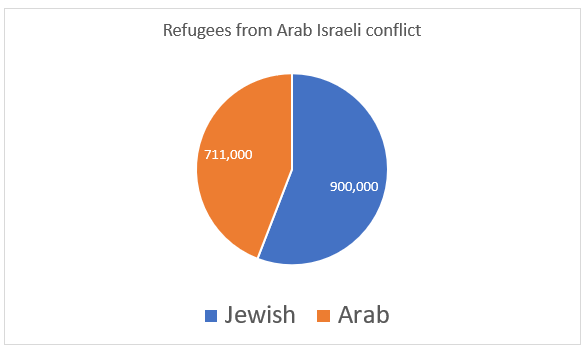
The Arab Israeli conflict created refugees. During the early civil and regional conflict of 1947-1949, many Arabs fled and some (especially those in openly hostile villages) were evicted. Some were offered rehousing inside Israel but still chose to leave (this puts paid to the ethnic cleansing accusation). After the conflict ended, some outside Israel were offered a return but refused (as it meant recognising Israel). Jewish communities also suffered throughout the region. Events in British Palestine were used as an excuse by rising national and Islamist ideologies. A trickle turned into a flood, the flood into a tsunami. Within a few short years the ancient Jewish Arab communities had been almost completely ethnically cleansed. Most of the Jewish refugees settled in Israel. These are the comparative numbers of refugees created by the Israeli/Arab conflict:
Arab Israeli conflict refugees
For the Arabs, I used the UNRWA figures even though these are without doubt exaggerated. It doesn’t matter – even when the Arab refugee numbers are artificially inflated, the conflict clearly created more Jewish refugees than Arab ones. This is what real ethnic cleansing looks like:
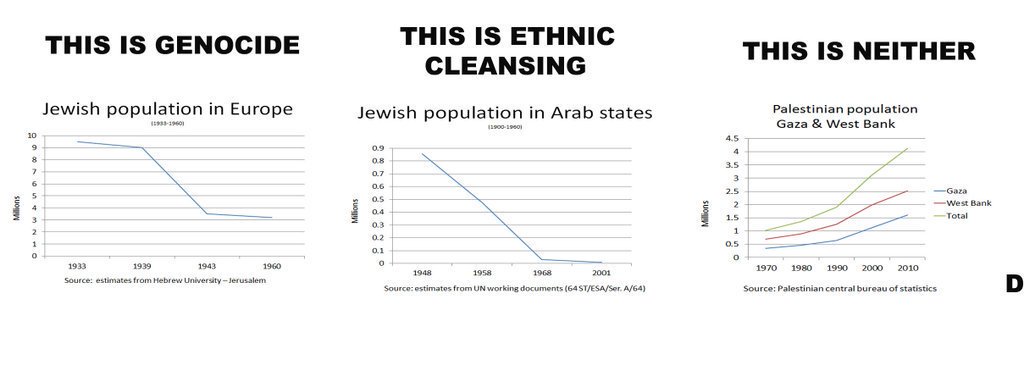
Nearly a dozen studies published in the past decade show that Jews — Ashkenazi, Sephardi Mizrahi — are more biologically related to one another than they are to their local populations. In particular, a 2009 study found that Jewish populations share a high level of genetic similarity and a common Middle Eastern ancestry, and over their history they have undergone varying degrees of admixture with non-Jewish populations.PMW: PA Ministry of Education names sports event for girls after terrorist murderer who led killing of 37
It’s time to refocus on our identity, not just because it will be good for us and our children to fully come to terms with who we are. We need to do this to firmly and definitively show that Jews are indigenous to Israel.
“It is part of a carefully managed agenda in the United States to not permit Jews to be part of the discussions about ‘people of color’ or racism,” Frantzman writes. And the goal of that agenda is to make the case that Israel is a European colonial enterprise, so that it can then be destroyed.
The bottom line: We can no longer let others define us. We need to start defining ourselves. And the only way to do that is through learning about our ancestry, our genetics and our indigenous connection to the land, culture and language of Israel.
“The designation of being a Hebrew probably meant something similar to ‘one who crossed over,’ ” Ergas told me. “The term captures the concept of language, history and experience of eternal otherness — and potentially points toward us always being in the process of transformation.”
We are the Hebrews, the Israelites, the Jews. We create, innovate and transform — ourselves and the world. This is who we are: eternally other; eternally lit.
One of the days marked fervently by the Palestinian Authority is the anniversary in March of the most lethal terror attack against Israel - the Coastal Road massacre in which Palestinian terrorists murdered 37 civilians, among them 12 children. The attack was led by female terrorist Dalal Mughrabi who the PA since has turned into a role model and hero for Palestinian children and society in general.
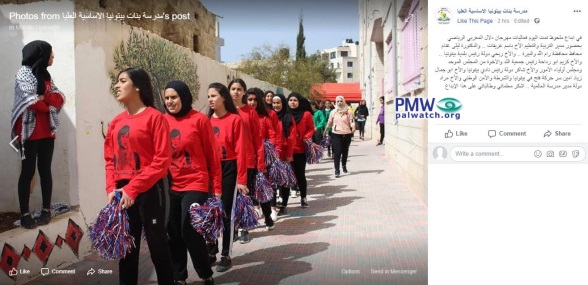
To celebrate the anniversary this year, the PA Ministry of Education arranged a sports festival for girls named after the terrorist:
"The Dalal Mughrabi Sports Festival"
The sports festival was held at the Beitunia Upper Elementary School for Girls and participating girls wore shirts featuring the image of the murderer and the text "Dalal Mughrabi Festival":
[Facebook page of the Beitunia Upper Elementary School for Girls, March 13, 2019]
PA officials were also present at the festival honoring murderer Mughrabi, among them Bassem Erekat, director of the district's Education Directorate , which is a branch of the PA Ministry of Education, and Ribhi Dawla, mayor of Beitunia, where the festival was held. In addition, the District Governor of Ramallah and El-Bireh Dr. Laila Ghannam spoke at the event, stating that Palestinian children "are determined to continue on the path." Ghannam also praised Palestinian women for having "brought children into the world, fought, and built glory that will not be erased" - indicating that murderer Mughrabi had created lasting "glory" with her attack killing 37: