Monday, July 02, 2018
Elder of Ziyon
Divest This, Opinion
This
recent story on Tablet, which laments that Israel is losing on the
important social-media battle-front, got me thinking about why a “movement”
like BDS - which has accomplished so little with regard to actual boycotts,
divestment and sanctions - seems to continue to capture headlines. How does a project that has found it
virtually impossible to win any genuinely significant victories still manage to
get its self-characterization of “unstoppable momentum” into the news?
A credulous media (including US and European papers ready to print BDS
press releases verbatim) might provide some explanation for this
phenomenon. And we shouldn’t
underestimate the power of the BDSers’ relentless inconsiderateness which
allows them to barge into anyone else’s space they like to gain attention (those
other peoples’ needs be damned).
But there is one aspect of the competition between Israel’s defenders
and detractors that needs to be highlighted, one area where Israel’s foes have
traditionally outclassed its friends: the use of the new media (including
blogs, social media and other Web 2.0 communication tools) to get their message
out.
This disparity hit home a few years back when dueling stories regarding
BDS success and failure (the latter written by me) appeared in the online
Israeli news daily Ynet. This piece
(written in an emotional frenzy by an Israeli supporter) managed to generate
over 1000 Facebook recommendations and was Tweeted close to 250 times. My rejoinder,
in contrast, barely broke the hundred mark on Facebook and never got past low
double digits on Twitter.
Assuming every connection generates another round of re-forwarding and
re-Tweeting, it’s safe to say the ten-to-one disparity between the two stories
meant the original tale of BDS success found a home in thousands of more places
than the corrective. And thus, another BDS-preferred
storyline got to travel around the world at the speed of light while the truth was
still trying to find its socks.
Given how every BDS debate attracts at least one argument about how
people truly interested in boycotting Israeli will have to give up their
computers, their cell phones and the Internet as a whole (since much of that
technology is based on Israeli inventions), I’ve often wondered why we marvelously
inventive Jews haven’t managed to use all this technology half as well as our
opponents.
Part of this might be an age issue.
While there are plenty of young people involved with pro-Israel
activism, my sense is that average age skews a bit higher on this side of the
divide vs. the other. If this is the
case, you’ve got a pro-Israel community comfortable with some aspects of online
communication (such as blogging and e-mail blasts) but not others (such as
social networks, Twitter and other technologies that are in the process of
replacing mail as the prime communication vehicle for young people).
I can sympathize since I am part of that older cohort, someone who is happy
to spend more than an hour writing a blog entry who is not ready to spend 10
minutes recommending and relinking stories (mine and others’) in order to
elevate them in Google search rankings.
Fortunately, there has been some movement in the right direction over
the last several years. Grassroots
activists and organizations have always been nimble and fierce warriors on
social media platforms, and that skill set seems to be moving up the food chain
of Jewish activist organization and even the Israeli government. For example, the IDF’s Twitter feed has
actually managed to influence some news cycles – at the expense of our enemies
- a key component of today’s InfoWar tactics that, until recently, was the
monopoly of Israel’s foes.
At the same time, attempts by BDSers to exploit the openness of new
online platforms demonstrates one additional advantage Israel’s foes have over
its friends. For just as our opponents
steadfastly demand we open every conceivable forum to them or face accusations
of “muzzling” and censorship, they will never reciprocate by opening their
online spaces up to potential critics (in the form of maintaining open or
unrestricted comments sections or any other option that would give critics the
same freedom they demand for themselves).
Thus Web 2.0 savvy combines with general BDSholiness provides the
forces of boycott, divestment and sanctions a bit of an edge. But given that we’ve been winning so many
other battles over the boycotters, there’s no reason to believe we won’t figure
out a way to win this one as well.
From Ian:
Australia ends direct aid to PA over payments to terrorists
Australia has ended direct aid to the Palestinian Authority over fears its donations will be used to pay Palestinians convicted of terrorism and their families.Prominent Jewish BDS activist denied entry to Israel
Australian Foreign Minister Julie Bishop said Monday that funding to a World Bank trust fund was cut after she wrote to the Palestinian Authority in late May seeking assurance that Australian funding was not being misspent.
In a statement, Bishop expressed concern that providing further aid would allow the PA to use the funds for activities that “Australia would never support.”
Israel has long accused the PA and its leader, Mahmoud Abbas, of encouraging terror attacks against Israelis by rewarding perpetrators and their families with monthly stipends. It has even withheld millions in tax revenues over the Palestinians’ unwillingness to change its policy. Israeli lawmakers are also advancing a law to slash funds to the PA by the same amount it uses to pay terrorists.
Palestinian Authority President Mahmoud Abbas in the West Bank city of Ramallah, June 27, 2018. (Alaa Badarneh/Pool Photo via AP)
“Any assistance provided by the Palestine Liberation Organization to those convicted of politically motivated violence is an affront to Australian values, and undermines the prospect of meaningful peace between Israel and the Palestinians,” Bishop said in a statement.
“I wrote to the Palestinian Authority on May 29, to seek clear assurance that Australian funding is not being used to assist Palestinians convicted of politically motivated violence,” she wrote.
Israeli officials barred a Jewish pro-Palestinian activist from entering the country late Sunday and began proceedings to deport her over her support for a boycott of the country.
Ariel Gold said that she had arranged her visit ahead of time with Israeli authorities, in line with a demand by Jerusalem after her last visit to the country, but was being deported anyway after landing at Ben-Gurion International Airport.
Gold is the national co-director of US left-wing activist group Code Pink and an advocate of the Boycott Divestment Sanctions (BDS) movement that seeks to isolate Israel internationally.
“I am in the Tel Aviv airport getting deported. I got a visa in advance to enter the country buy they are refusing to honor it and are deporting me now,” she wrote on Facebook early Monday.
Public Security Minister Gilad Erdan, who petitioned Interior Minister Aryeh Deri to have her visa canceled, said she had been denied entry because of her support for the BDS movement.
“Whoever acts for a boycott of Israel and comes here to cause damage, will not enter the country,” he wrote on Twitter. (h/t Yenta Press)
Monday, July 02, 2018
Elder of Ziyon
The Jerusalem Festival of Light is taking place now, where one of the features is projecting of different images on city walls.
The Felesteen newspaper is claiming that Israel is projecting "Talmudic images" on Damascus Gate and elsewhere.
I'm trying to find these Talmudic images on Damascus Gate, but here is all I found so far from this year and previous years:
We have lots of ideas, but we need more resources to be even more effective. Please donate today to help get the message out and to help defend Israel.
The Felesteen newspaper is claiming that Israel is projecting "Talmudic images" on Damascus Gate and elsewhere.
The occupation uses any Talmudic occasion to provoke all Muslims in the world by practicing its racism in the occupied city of Jerusalem by attacking the walls of Jerusalem and the Old City and practicing violations inside the Al Aqsa Mosque.
During the so-called "Festival of lights" , a few days ago, the Israeli authorities used projectors to the walls of Jerusalem in the area of Bab al-Amoud [Damascus Gate], and showed Talmudic images and drawings on the entire wall with a remarkable presence of settlers and the occupation municipality and the intensive deployment of the Israeli police.
President of the Supreme Islamic Commission and the preacher of Al-Aqsa Mosque d. Akrama Sabri told "Felesteen": "These Judaizing activities in the area of Bab al-Amud provoke all the Muslims of the world through the use of the walls of Jerusalem as a display of the symbols of the Talmud..."
Sabri called on UNESCO to intervene to curb these events of Judaization.
The head of the Al-Ammar Committee in the Al-Aqsa Mosque, Bassam Al-Hallaq, told "Palestine": "Judaizing the perimeter of the Al-Aqsa Mosque is a plan that has been followed for years and will ultimately lead to the changing of the entire area in the Talmudic way.
I'm trying to find these Talmudic images on Damascus Gate, but here is all I found so far from this year and previous years:
Monday, July 02, 2018
Elder of Ziyon
Foreign Policy had an article last week by a Palestinian that was the opposite of the clueless Atlantic article I fisked by Obama foreign policy dinosaurs Philip Gordon and Prem Kumar.
Although not pro-Israel in any sense, Dalia Hatuqa points out the reality that the Palestinians are facing in a Middle East that is sick of their complaints and infighting.
Saudi Arabia’s increasingly warm bilateral ties with Israel have not gone unnoticed by the PA, which has also noted Trump’s insistence — from the outset of his presidency — that striking an “ultimate deal” between Israel and the Palestinians would require the involvement of the broader region.
The PA watched in shock as Riyadh gave permission to Air India to fly to Tel Aviv through Saudi airspace and later as Mohammed bin Salman, in an interview with the Atlantic, acknowledged Israel’s right to its “own land.” And while the PA boycotted a White House meeting on Gaza’s humanitarian crisis in March, several Arab countries — including Egypt, the United Arab Emirates, and Saudi Arabia — attended, as did Israel.
Palestinians are no longer the focal point of the regional agenda, and PA leaders have grown increasingly uneasy as some Arab leaders have shifted their attention to Iran, fixating on Tehran’s involvement in Yemen, Iraq, and Syria.
Arab leaders frequently profess support for the Palestinian cause, but Palestinians know that these proclamations are often sanctimonious. Much of the aid pledged by Arab donors for Gaza’s post-2014 war reconstruction never materialized, and the flow of government aid to the region has all but dried up. Instead, the diplomatic focus of Arab governments has veered primarily to domestic woes and stability, regional adversaries such as Iran, inter-Arab disputes, and fighting off Islamic militancy.Notice that this is the opposite of Gordon and Kumar who claim that Arab governments are still afraid of what their people would say if they cozy up to Israel.
Without a unified government or a clear, solid succession process, the PA leadership may very well find itself having to pick one of two bad options. The PA can either participate in a rigged peace process under even less favorable terms than in the past — or forge its own path without the support of Western donor aid that the administration is dependent on to function. This would mean that the livelihoods of 145,000 civil servants in the occupied Palestinian territories would disappear.
[R]egional changes have paved the way for another opportunity for Israel to formally normalize relations with its neighbors — but this time without a peace deal.Now, regional changes have paved the way for another opportunity for Israel to formally normalize relations with its neighbors — but this time without a peace deal. Saudi Arabia and the UAE have moved from secretly courting the Israelis to overtly conveying their readiness and desire to build a relationship beyond their current clandestine links.Hatuqa seems to favor a new, unified, and more militant Palestinian leadership that can stand up to Israel, ignoring her own points that the Arab world is no longer behind them in any way close to how things were in the past.
Today, most of Israel’s traditional enemies have either been weakened or neutralized: The Palestinian leadership has been co-opted through U.S. largesse; Jordan and Egypt’s peace deals have weathered even the thorniest of diplomatic crises; and Iraq and Syria have been carved up by the campaign to oust the Islamic State.
And the main point of the slowly emerging "deal of the century" is indeed to throw the Palestinians under the bus, as the FP headline says Saudi Arabia is doing.
The reason is simple - simpler than the wishful thinking that Hatuqa has for a strong, resistant Palestinian leadership.
Up until now, the peace process has had one major, unfixable flaw: that the desire for peace in the West was stronger than anything else, and the world was willing to do anything to get the Palestinians to say "yes." As a result, the Palestinian leadership has had zero incentive to compromise for peace, because the pressure was all on Israel.
The PLO's veto power - backed by the perceived support of their Arab brethren, the seeming unified threat of the Arab street, and the backing of the EU and President Obama of always pressuring Israel - is what doomed peace. Compromise was unthinkable. Preparing the Palestinian Arabs for peace was never done. Because, as Abbas said in 2009, all they had to do was wait - things were fine in Palestinians' day to day life.
Now, the Arab world is prepared to move on towards peace with or without the Palestinians. (Really, detente, but that is all Israel has with Egypt and Jordan anyway.) The Palestinians are losing funding, political support, and the security they had that the world was behind them. They celebrate "victories' like Argentina soccer team deciding not to go to Israel while they are watching their real support go down the drain.
They can choose to cut the best deal they can while they can - or they can choose to ignore the sea change that has happened in their neighborhood. They can pretend that BDS will kill Israel while Israel keeps getting stronger and stronger.
It is apparent what path they have chosen so far. And that is exactly why they should be thrown under the bus - because the days of the automatic Palestinian veto over any peace plan are over.
Monday, July 02, 2018
Elder of Ziyon
Just some fun stuff from Iranian news agencies:
Sheikh Naim Qassem, the deputy secretary-general of Lebanon’s Hezbollah Islamic Resistance movement, ... said, “Do not forget the usurper Israel. All the calamities in the region and the world are from Israel but this regime moves and uses its mercenaries, supporters and spy services. This regime is preparing for the ‘Deal of the Century’ (an American proposal for the Palestine issue) but due to the Islamic Resistance and the nation of Palestine, who said ‘no’ to the ‘Deal of the Century,’ Israel cannot advance anything. We are certain that as long as the Islamic Resistance exists in the region, no American and Israeli project will be implemented.”
It's funny how you never hear J-Street say that Hezbollah or Iran are obstacles to peace.
Then again, J-Street agrees with Iran and its proxy terror group Hezbollah that the US proposal for peace is so hideous that all forces must be mustered to fight it.
Yes, to J-Street, Naim Qassem is an ally and the Israeli government is the enemy.
Sunday, July 01, 2018
Elder of Ziyon
From Middle East Monitor:
She seems to have touched a nerve.
Some gems from the article:
Really? Like which ones? The ones where Israel doesn't get to exist anymore as a Jewish state?
Please name one of "Palestine's own class of peace advocates." I'd love to know what the author considers to be peace.
(h/t Yoel)
We have lots of ideas, but we need more resources to be even more effective. Please donate today to help get the message out and to help defend Israel.
She seems to have touched a nerve.
Some gems from the article:
While in Israel she vocalised a personal declaration to seek peace, omitting, however, Israel’s routine sabotage of past peace initiatives.
Really? Like which ones? The ones where Israel doesn't get to exist anymore as a Jewish state?
Ah, "justice" where all Jews must go to Europe.
“Reasoning, mutual compromise and unity” – the central pillars of the “new method” the Baghdad-born model stresses – ignores Israel’s lack of compromise and self-serving rhetoric that has criminalised Palestinians for pursuing justice.
“Less blood more amity”, the line Idan concluded with, betrays the Palestinian struggle that rose in response to Israel’s selective violence against Palestinians sparing no one, neither old nor young.Yes, saying "less blood, more amity" indeed betrays the Palestinian preference for "more blood, no amity."
The reinvention of Idan’s image from model to cultural ambassador ignores Palestine’s own class of peace advocates and activists, and their struggle against Israel’s apartheid state. They may rightfully view Idan as a false prophet of peace and coexistence.
Please name one of "Palestine's own class of peace advocates." I'd love to know what the author considers to be peace.
(h/t Yoel)
From Ian:
In joint ToI op-ed, Lapid and Ya’alon urge US to back Israel’s Golan sovereignty
IDF sends reinforcements to Golan as Assad offensive picks up
In joint ToI op-ed, Lapid and Ya’alon urge US to back Israel’s Golan sovereignty
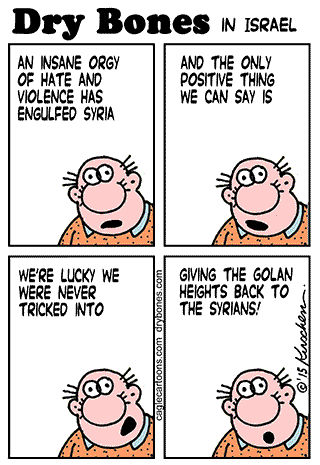
In a joint op-ed Sunday, Moshe Ya’alon and Yair Lapid urged the US to recognize Israeli sovereignty over the Golan Heights and warned against the notion of ceding the strategic ridge to President Bashar Assad.Moshe Ya'alon and Yair Lapid: Will the West cede the Golan Heights to a psychopath?
By recognizing Israeli sovereignty in the territory, the two politicians argued in an opinion piece for The Times of Israel, the US could “extract a price from Assad for his despicable behavior without putting boots on the ground in Syria.”
Lapid is the head of the centrist Yesh Atid party. Ya’alon is a former IDF chief of staff and defense minister, who is expected to seek to return to national politics in the next elections.
We live in a world full of complex diplomatic dilemmas, but for once here is a simple one: Would you take an area that is flourishing in a western democratic state, where fifty thousand people of different religions and ethnicities live in harmony, and hand it over to a violent dictatorship ruled by the worst mass murderer of our time so that he can destroy the area and murder most of the residents?
If your answer is “no” then you support recognizing Israeli sovereignty over the Golan Heights.
In 1981 Israel applied its law to the Golan Heights. The Syrians insisted it be returned to them. Most countries, including the United States, have avoided taking a clear position. We believe it’s time to get off the fence.
The Golan Heights is a unique story in the Israeli-Arab conflict. It’s a mountainous region of around 1,155 square miles (around the size of a medium-sized ranch in Texas), in the north of Israel. It’s worth noting, of course, that it is entirely unrelated to Israel’s conflict with the Palestinians. Not a single Palestinian lives in the Golan Heights.
Historically, the Golan is known as the biblical land of Bashan from the book of Deuteronomy. Just recently a major renovation of a 4th century Jewish synagogue was completed and in archaeological excavations a coin from 67 CE was discovered with an inscription which read, “For the redemption of Jerusalem the Holy.” It is an area with a long and deep Jewish connection.
The Syrians, on the other hand, ruled over the Golan Heights for only 21 years; between the years 1946 and 1967. During those years they turned the Golan into a military base, rained rocket fire on the Israeli communities which are under the Golan Heights and tried to divert Israel’s critical water sources to dry the country out.
In 1967, during the Six Day War, the Golan Heights was liberated by Israel. In the 51 years since then Israel developed the Golan Heights and turned it into an impressive center of nature reserves and tourism, with high-tech agriculture, award winning wines, a flourishing food-tech industry and in-demand boutique hotels. The Druze population of the Golan Heights, who make up about half the population, were granted all the same rights as any other citizen in Israel, as would be done in any genuine democracy.
IDF sends reinforcements to Golan as Assad offensive picks up
The Israeli military sent additional tanks and artillery cannons to the Syrian border on Sunday in light of a renewed offensive by dictator Bashar Assad and the Russian military against the remaining rebel holdouts in the country’s southwest, the army said.
The reinforcements were sent to the Israel Defense Forces’ 210th Bashan Division, which guards the Golan Heights, the army said.
“This was [done] as part of IDF preparations and preparedness in light of developments in the Syrian Golan Heights near the border,” the IDF said in a statement.
The military vowed a “determined response” to any strike — deliberate or accidental — that hits Israeli territory from Syria.
“The IDF sees great importance in maintaining the armistice agreement between Israel and Syria from 1974,” the army said.
“The IDF will continue to uphold its principle of non-involvement in what is happening in Syria, alongside a policy of delivering a determined response to violations of the sovereignty of the State of Israel and threats to its citizens,” the IDF said.
Sunday, July 01, 2018
Elder of Ziyon
From JTA, March 8, 1956:
Secretary of State [John Foster] Dulles yesterday corrected the Congressional Record to withdraw a remark he made to the effect that the Prophet Mohammed had been assassinated by a Jew, thereby explaining Saudi Arabian discrimination against Jews. The Secretary also withdrew remarks to the effect that a settlement between Israelis and Arabs was made more difficult by the “bargaining proclivities of both sides.Dulles was a prominent layman of the Presbyterian Church and active in The National Council of the Churches of Christ in the USA before becoming a diplomat. It seems obvious that when he accused Jews of killing Mohammed, he was really thinking about Jews killing the founder of his own religion.
On February 24, under questioning about American accession to Saudi Arabian refusal to admit American Jewish troops to an American air base in Saudi Arabia, Secretary Dulles told the Senate Foreign Relations Committee that the Saudi Arabians have felt for a long time–it goes back centuries–a very particular animosity toward the Jews, because they credited the assassination of Mohammed to a Jew.” When his advisers, at his elbow, told him that he was wrong about this, Mr. Dulles told the Senate committee that he had been told that he was wrong and that “I will ask leave to correct the record in that respect later on if it proves I made a mistake.” The correction yesterday deleted part of his testimony, which now reads that the Saudi Arabians feel a “very particular animosity toward the Jews, since the time of Mohammed.”
Even though his aides told him during testimony that he was mistaken about Jews killing Mohammed, it took him ten days to correct his statement.
This was hardly the only antisemitic statement Dulles made in his career. For example, on June 18, 1956, he responded to Cardinal Spellman’s comment that “Jewish activities are becoming excessively arrogant and demanding” by saying that this “was one of my problems, that I felt it very important to try to demonstrate that the Jews did not in an election year dictate the foreign policy of the United States.” On February 12, 1957, he “mentioned the terrific control the Jews had over the news media and the barrage which the Jews have built on Congressmen.”
Interestingly, Dulles had a sister who married a Jew from an Orthodox family who committed suicide, and the family convinced her to take back her maiden name rather than keep the Jewish name.
Sunday, July 01, 2018
Elder of Ziyon
Arab media has been following the fires in Israel from Gaza kites and balloons far more closely than most Israeli media.
But the photo I saw this morning to illustrate the fires was exactly the type that the Arab media loves to show:
Further research shows that the same photo was used in April for Gaza fires.
Arab media loves pictures of religious Jews. They look sort of creepy especially in silhouette.
This particular photo was taken during the catastrophic 2010 fires in Israel, many of which were Arab arson.
We have lots of ideas, but we need more resources to be even more effective. Please donate today to help get the message out and to help defend Israel.
But the photo I saw this morning to illustrate the fires was exactly the type that the Arab media loves to show:
Further research shows that the same photo was used in April for Gaza fires.
Arab media loves pictures of religious Jews. They look sort of creepy especially in silhouette.
This particular photo was taken during the catastrophic 2010 fires in Israel, many of which were Arab arson.
Sunday, July 01, 2018
Elder of Ziyon
In Egyptian paper Dostour, Said Shuaib asks if the only reason Arabs hate Israel is "occupation."
Because, he notes, no one seems to be holding rallies against the Iranian occupation of Arab islands in the Gulf since 1971.
He goes on to say that the Syrian Iskenderun Brigade has been occupied by Turkey since 1939, before the establishment of Israel. And the Arab Ahwaz region has been occupied since 1925 again by Iran.
He wonders why the Ottoman occupation of large swaths of Arab territory never elicited any anger, but the British occupation did. Why are Muslims occupying Arab lands OK?
The author even goes on to note that the Arabs expelling Jews from their countries helped strengthen Israel.
So he analyzes why Muslims are okay with some occupations - including their own in Andalusia, Spain - and against Israel's.
And he concludes that it is all religious, based on Quranic verses. "According to this understanding, a Muslim has a divine command of annihilating the Jews everywhere and at all times," he says, saying that Muslims ignore the parts of the Quran that praise Jews.
But it isn't as if he's pro-Israel. He says of course he wants to ethnically cleanse Israel of all Jews who arrived after 1917.
Saturday, June 30, 2018
From Ian:
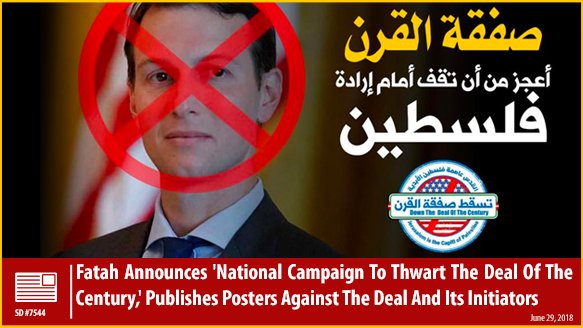
MEMRI: Fatah Announces 'National Campaign To Thwart The Deal Of The Century,' Publishes Posters Against The Deal And Its Initiators
Melanie Phillips: The hurdles in front of the Trump peace plan
MEMRI: Fatah Announces 'National Campaign To Thwart The Deal Of The Century,' Publishes Posters Against The Deal And Its Initiators
Even before its terms have been publicized, the Trump administration's Middle East peace plan, known as "the Deal of the Century," has encountered harsh opposition from the Palestinian Authority (PA), on the grounds that it does not promote peace but seeks to eliminate the Palestinian national identity and the Palestinian state and to topple the Palestinian leadership.[1]Against this backdrop, PA elements have directed personal attacks at the U.S. officials promoting the deal. For example, a statement by the PA Foreign Ministry called Trump's advisor and son-in-law Jared Kushner a "political novice who reads history through Israeli eyes."[2] An editorial of the PA daily Al-Hayat Al-Jadida likened U.S. President Donald Trump to "the last Roman emperor, Nero, who burned Rome down, so that the roads no longer led to it..."[3] Al-Hayat Al-Jadida columnist 'Omar Hilmi Al-Ghoul called Trump "a disgrace for America and its people," whose "populist policy" is "dangerous" for the U.S. and the world at large. [4]
Harsh criticism against the deal and its proponents was also voiced by Fatah, whose chairman is Palestinian President Mahmoud 'Abbas. Recently the movement announced the launching of "a national campaign to thwart the Deal of the Century."[5] An announcement on behalf of the campaign, which was also posted on Fatah's official Facebook page, stated that its objective is "to clarify the dangers posed by this deal, which is known to be a bad deal, and explain how it can destroy our national cause [by] proposing alternative solutions that circumvent the Palestinian people's eternal rights [in favor of] humanitarian gestures and economic enticements." The announcement states further that the Deal of the Century is an American attempt "to impose [on the Palestinians] the vision of the Israeli occupation state and to end the dream of the Palestinian state and of national independence."[6]
Fatah Spokesman Osama Al-Qawasmeh announced that the movement supported the campaign and called on Palestinians to join its activities "on the ground and in the media, and in every language, in order to voice [the protest of the] Palestinian people that will not accept surrender and disgrace."[7] In addition, following the launching of the campaign, Fatah Central Committee member Jamal Muhaisin met with the heads of the movement's branches in the West Bank in order to prepare "The March of Refusal of the Deal of the Century,"[8] and also announced that protests would take place in Ramallah on July 2, 2018 against "the American crime of our era."[9]
Melanie Phillips: The hurdles in front of the Trump peace plan
President Trump’s peace plan for Israel and the Palestinian Arabs, his attempt at the “deal of the century,” will apparently soon be revealed to the world.Ben-Dror Yemini: The Palestinian paradox: 70 years of perpetuating refugeeism
His envoys, Jared Kushner and Jason Greenblatt, have been making the rounds in the region to get Arab allies on board. Israel’s Prime Minister Benjamin Netanyhau has paid a visit to the King of Jordan.
No one yet knows the terms of this deal. Palestinian Authority leader Mahmoud Abbas has refused even to talk to the United States about it and has presumptively rejected it sight unseen.
The message he has received, however, is that the days of using such rejectionism to stymie progress are over. If he won’t agree to these terms, the Israelis will have U.S. backing in doing what they need to do to safeguard their security. And the Arab world has indicated that it will raise no serious objection.
Abbas and his camp are in effect being told: “You lost. Now get over it.” So will they?
As has been clear for decades, there are no terms on which the Palestinian Arab leadership can ever accept the existence of the State of Israel.
Until now, the West didn’t believe that. It thought that if only Israel would give more, and then more again, there could be a two-state solution and an end to the conflict.
This merely demonstrated the delusion born of Western hubris that the agenda of everyone in the world is negotiable. It failed to grasp two crucial aspects of the Palestinian Arab story—one dating from the 1930s, and the other going back to the seventh century.
Consider this: Strikingly, the image Palestinian Arabs present to the world systematically appropriates for themselves characteristics of the Jewish and Zionist experience.
“The Palestinian side won by a knockout,” said Lt. Col. Jonathan Conricus, the IDF’s international spokesperson.
Well, of course. That’s the result of the “wait and see” policy. Hamas knows it won’t defeat Israel in the battlefield. But it knew in advance that it would defeat Israel in the global public opinion. Hamas wasn’t the only one that knew that. Any sensible person knew that.
Israel should have made the Palestinians in Gaza, including Hamas, an offer they couldn’t refuse a long time ago. I have repeated this claim, I must say, like Cato the Elder.
Now, Hamas is proposing a hudna. The proposal’s precondition, senior Israeli officials responded, doesn’t meet Israel’s demands. Such foolishness. Not only is Israel failing to initiate anything, it is also rejecting a Hamas proposal.
When Hamas propose something, Israel should first of all say yes, and add that the hudna must be based on the international community’s terms. Does Israel have anything to lose? No.
But Israel, once again, is winning on the Gaza border and suffering a defeat in the global media. That’s what Hamas wanted. That’s what Hamas got. And the admission of senior Hamas official Salah Bardawil, that 50 of the Palestinians killed on May 14 were Hamas members, doesn’t help Israel in any way. We have lost this conflict—not because of Hamas, but because of Israeli foolishness.
Friday, June 29, 2018
From Ian:
In Menachem Begin’s Rise, Lessons for the #Resistance to Trump
Caroline Glick: The Grand Bazaar, AMIA and Lockerbie
In Menachem Begin’s Rise, Lessons for the #Resistance to Trump
No one saw him coming.Ben Shapiro: How Trump Haters End Up Helping Trump
Certainly not the nation’s entrenched political class: To them, he was one part clown and one part petty tyrant. They mocked his hyperbolic way of speaking—to him, everything, from his supporters to his family, was very, very great, the best, the most—and warned that if he somehow got elected, it would be the end of democracy. But they didn’t really think he could win, so they continued to campaign at a leisurely pace and rely on the sycophantic media to present their candidate as inevitable.
He, on the other hand, campaigned furiously. Knowing that the press had it in for him, he set up a series of mass rallies all over the country. His fans came out in droves to see him. They were working class folks, and they felt that the elites had pushed them around for too long. In him, they found an unlikely messiah: He wasn’t of them, but he seemed to understand their frustrations and, most important, offer them some sort of nostalgic promise. He could make the nation great again.
Besides, the rallies were such good fun! He was funnier than anyone ever gave him credit for, and he mocked his political rivals mercilessly, commenting on their looks and ridiculing their weaknesses. Still, no one seemed too worried: There was no way, they thought, that Menachem Begin could really win the election.
But on May 17, 1977, he did, sending Israel’s upper crust into a tailspin. Anyone who wants to understand the current American political moment would do well to study Begin, who began his political life as a boogeyman and ended it as one of the greatest leaders in the nation’s history.
Perhaps those cheering such extreme rhetoric think they’re doing a world of good. In truth, their hatred for Trump, extended to his supporters, is actually emboldening Trump and strengthening his base of support. Even those of us uncomfortable with Trump’s character aren’t likely to side with Waters or crowds shouting down Cabinet secretaries eating dinner. Nor are we likely to go along with labeling Trumpian immigration policy Nazi-like — particularly without any serious historical references, and combined with on-the-ground activism that sometimes looks like a fair bit like brownshirt thuggery. Last week, George Will called on Republicans to vote for Democrats in order to check Trump — but no self-respecting Republican is going to vote for the people who call them Nazis and who avoid making serious arguments in favor of shouting about Orange Hitler.
The great irony is that Trump is an unpopular president by any objective measure — he’s spent his entire presidency hovering around 40 percent, despite a booming economy and a dearth of foreign crises. All the left would have to do to win over independents and disenchanted Republicans is provide some semblance of stability and decency. Instead, hatred for Trump has driven the left to polarization — and that polarization is forcing the same binary choice that led to Trump’s presidency in the first place. Trump hatred has led to disproportionate, irrational responses that have pushed people into his corner. These unhinged attacks against Trump don’t defeat Trump. They strengthen him.
Caroline Glick: The Grand Bazaar, AMIA and Lockerbie
News coverage of the large and growing anti-regime protests in Iran this week has included warnings by Iran “experts” insisting that the vocal support the protesters are receiving on social media from Prime Minister Benjamin Netanyahu and US Secretary of State Mike Pompeo is counterproductive.
Israeli and US statements of support for the Iranian people and their desire to rid themselves of the regime that oppresses them will only weaken them, experts warn. But several counter-indications make clear that these warnings should be disregarded.
In 2009, when millions of Iranians took to the streets in the Green Revolution, then-US president Barack Obama refused to support them. Like today’s experts, Obama argued that it would be counterproductive for the US to support the protesters as they demanded the overthrow of the regime that had just stolen the presidential election. Obama claimed that the US is so hated that the regime would use its support of the protesters to discredit the demonstrations.
In the event, Obama’s silence demoralized the revolutionaries who asked again and again why he refused to stand with them. Perhaps more importantly, by refusing to stand for the men and women of Iran who risked death to stand up to America’s bitter enemy, Obama gave Iran’s dictator Ayatollah Ali Khamenei and his henchmen a green light to brutally repress the revolution. Which is exactly what they proceeded to do with nary a whimper of protest from the Obama White House.
Subscribe to:
Comments (Atom)
Elder of Ziyon