Saturday, May 06, 2017

From Ian:
Double standard on Holocaust denial
Double standard on Holocaust denial
A French political leader who referred sympathetically to a prominent Holocaust denier has been forced to resign in disgrace.Ben-Dror Yemini: Adding more fuel to the fire of hatred
But a Palestinian political leader who referred sympathetically to the same Holocaust denier was welcomed at the White House this week. Why the double standard? Jean-Francois Jalkh, leader of France’s National Front party, resigned in disgrace on April 28 after it was revealed that in a 2000 interview he said it was “impossible” for the Nazis to have carried out mass murder with poison gas. As his source, Jalkh cited the convicted Holocaust denier Robert Faurisson, whom he described as “trustworthy.”
Palestinian Authority leader Mahmoud Abbas has referred to Faurisson in similar terms, in a bizarre and disturbing book that Abbas wrote in 1983 called The Other Side: The Secret Relations Between Nazism and the Leadership of the Zionist Movement.
The central thesis of the book, which Abbas wrote as his doctoral dissertation at Moscow University, is that David Ben-Gurion and other Zionist leaders “collaborated with Hitler” and wanted the Nazis to kill Jews, because “having more victims meant greater rights and stronger privilege to join the negotiating table for dividing the spoils of war once it was over.”
The “real” number of Jews murdered by the Nazis was “much lower” than six million and might well have been “below one million,” Abbas wrote. “Many scholars have debated the figure of six million and reached stunning conclusions – fixing the number of Jewish victims at only a few hundred thousand.”
One of the alleged authorities whom Abbas cited was the same Holocaust denier at the center of the recent controversy in France. “In a scientific study published by the French professor Robert Faurisson, he challenges the existence of gas chambers which served the purpose of killing living Jews,” Abbas wrote. “He claims that the gas chambers were only used to burn corpses, out of fear of spreading plagues and viruses. It would not take a great effort in order to prove and document this aspect of the truth.”
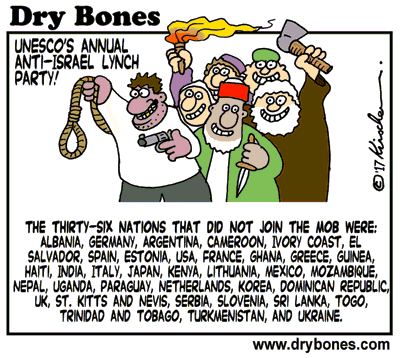
Op-ed: Resolutions like the one adopted by UNESCO on Tuesday may have no practical validity, but it’s hard to ignore their cumulative damage. Diplomatic jihad is scoring achievements, and to hell with the facts.Can Trump Survive Abbas?
There is no cause for celebration, as there was and remains an unenlightened majority in the United Nations Educational, Scientific and Cultural Organization (UNESCO), as well as in all other UN institutions. Tuesday’s vote, on Israel’s Independence Day of all days, is part of a war of attrition waged by the Muslim world against Israel. A diplomatic jihad. These may be false resolutions with no real meaning, but with one resolution after another—the attrition is working.
The problem isn’t the Muslim world, which is in a state of darkness. Between fighting against Israel and fighting for itself, it favors the battle against Israel. There is not a single point of agreement in the Muslim world, apart from the hostility toward Israel. There is no need, therefore, for resolutions against jihad, which is massacring mostly Muslims, and there is no need to settle the conflict between the Shiites and the Sunnis, and there is no need to deal with the illiteracy and improve the status of women. Nothing is important, just Israel and Israel.
This obsession is harming Israel, but it is harming the Muslims themselves much more, because there is a direct link between the hostility toward Israel and the troubles of the Muslim world. The more hostile it is, the bigger its troubles.
Donald Trump was something of a motivational speaker when he welcomed Mahmoud Abbas, the gerontocrat at the helm of the Palestinian Authority (PA) for the last 12 years, to the White House on May 3.
At their joint appearance, Trump was confident and beaming. Abbas, in turn, came across as eager and respectful. As Trump surely knows, to sell something you need to believe in it — and to look like you believe in it. In tone and body language, both leaders pulled that off in their comments on the prospects for a final Israeli-Palestinian peace deal, even if they came across as overly self-conscious in doing so.
On the face of it, there is no doubting Trump’s personal investment in securing what he sees as the ultimate deal.
“Over the course of my lifetime, I’ve always heard that perhaps the toughest deal to make is the deal between the Israelis and the Palestinians — let’s see if we can prove them wrong,” Trump declared. Yet whether his administration has the mettle and the patience to pull off a lasting agreement that will suffer many false starts along the way remains very much an open question.
For his part, as he stood alongside Trump, Abbas gave the impression of playing ball more than he ever did when President Barack Obama was in charge. During Obama’s second term, Abbas refused direct talks with Israel following the collapse of the 2013-2014 negotiations, and instead pursued a policy of sulky unilateralism that aimed to secure international recognition of a Palestinian state.
“We believe that we are capable and able to bring about success to our efforts because, Mr. President, you have the determination and you have the desire to see it come to fruition and become successful,” Abbas gushed. Perhaps he can afford to do so. In Mideast policy circles right now, there is much talk of the positive response Jason Greenblatt, Trump’s international negotiations representative, has encountered among Palestinians. This, in turn, has made the Trump administration more amenable to entreaties from Arab leaders to bring Abbas into the heart of the negotiating process.