Showing posts with label poll. Show all posts

Tuesday, September 06, 2011

  • Tuesday, September 06, 2011
  • Elder of Ziyon
In the latest PCPO poll, released yesterday, this question was asked of Palestinian Arabs:

Which, in your opinion, is the preferable option for the future of Palestine? Is it going to the United Nations for the recognition of the Palestinian state without concluding a peace agreement with Israel, or going back to the negotiation table with the Israelis for the sake of a permanent peace with them and then resort to the UN?

59.3% said it was better to go back to the negotiating table with Israel; only 35.4% said going to the UN was preferable.

Another interesting finding is that a plurality of Palestinian Arabs oppose "holding huge peaceful demonstrations in the West Bank, Gaza Strip and Jerusalem with the aim as to overrun the barriers and close the roads against the Israeli army and the settlers after the proclamation of the recognition of the State of Palestine in the coming September" - 48.8% vs. 41.5%.

And given a three way choice:

Some people say that Palestinians should hold huge peaceful demos that overrun the barriers and close the roads against the Israeli army and the settlers with the aim to force the Israelis to withdraw from the territories of the State of Palestine after the proclamation of the UN-resolution recognizing the State of Palestine, whilst others say Palestinians should carry out violent actions against the Israeli army and the settlers, and a third group of people is in favor of going back to the peaceful negotiations with the Israeli government. Which of these three opinions is the closest to yours?

25.9% support demonstrations
15.2% support violence
53.4% support negotiations

Then again, when did anyone accuse the Palestinian Arab leadership of listening to their people?

Friday, July 22, 2011

Yesterday, J-Street came out with a poll saying that Jews are still more pro-Obama than leaning towards Republican candidates, even though that support has eroded.

The general outline of that result is probably mostly true, but another of the survey questions - regarding J-Street itself - shows how the wording of a question can influence the answer.

Here is how the press release described the poll result that J-Street clearly wanted to uncover:
Efforts to prevent Jewish critics of Israeli government policy from participating in Jewish community events directly contradict the beliefs and values of most American Jews. When asked if groups like the JCC or Jewish Federations should allow Jewish organizations that publicly criticize certain Israeli government policies to participate in events sponsored by the Jewish community, 79 percent responded that they should allow these groups to participate.

This belief holds steady (77 percent) when presented with J Street’s perspective about  opposing policies like settlement expansion in the West Bank and with J Street’s critics’ perspective that J Street’s criticism undermines Israeli security and that “just calling itself pro Israel does not make J Street pro-Israel.” Notably, these results are very similar among Jews who belong to a synagogue (74 percent think J Street should be allowed to participate) and Jews who do not belong to a synagogue (79 percent think J Street should be allowed to participate).
Do 77% of Jews believe that J-Street belongs inside the "big tent" of Jewish organizations?

Here's how the general question was phrased:

Do you think Jewish community organizations such as local Jewish Federations and JCCs should allow or not allow Jewish organizations that publicly criticize some Israeli government policies to participate in events sponsored by Jewish community organizations?

Should allow 79%
Should not allow 21%
It is a generic question, designed to appeal to Jewish sense of fairness. Of course everyone supports multiple viewpoints and of course it is possible to be critical of specific Israeli policies while remaining inside the mainstream of the American Jewish community. But at some point, "criticism" goes beyond the pale - and the survey question does not attempt to identify where that line is.

On J-Street specifically, the question bias is stark:
As you may know, there is a Jewish organization called J Street which calls itself the political home for pro-Israel, pro-peace Americans.

J Street supports Israel and its right to defend itself, and believes that it is acceptable to criticize some Israeli government policies, such as expansion of Jewish settlement in the West Bank.

Opponents of J Street say that an organization which criticizes Israeli policy undermines Israeli security, and that just calling itself pro-Israel does not make J Street pro-Israel.

Do you think Jewish community organizations such as local Jewish Federations and JCCs should allow or not allow J Street to participate in events sponsored by Jewish community organizations?

Should allow 77%
Should not allow 23%
Keep in mind that most American Jews are not so involved in politics to have ever heard of J-Street, or to care too much about it. So the first sentence subconsciously defines J-Street for them by saying it is "pro-Israel, pro-peace" - concepts that everyone agrees with. That sentence frames the next two sentences.

The next sentence states, as a fact, that J-Street supports Israel and its right to defend itself - without defining what that means. They mention one specific Israeli policy they disagree with, but don't say (for example) that they support the US cutting aid to Israel based on that position.

The third sentence does not state anything as a fact - but as a claim. Opponents say something, but it is not established as fact the way the previous sentence described J-Street. So while J-Street is defined by the question itself as being pro-Israel, it says that its opponents only say that it is not.

Not only that,  the characterization of what J-Street's opponents believe is framed as a generic attack against any organization that is even mildly critical of Israel, subtly putting J-Street in a broad category of a group of organizations that criticize some specific aspects of Israeli policy while inherently being broadly supportive of Israeli policy.

Now that the question has thoroughly defined the parameters, the person being surveyed is primed to answer the way J-Street desires.

To make it clearer, here is another way the question could have been phrased:
As you may know, there is a Jewish political organization called J-Street.

J-Street claims to support Israel and its right to defend itself and says that it only criticizes some Israeli government policies. It would like the US to reduce aid to Israel unless Israel adheres to this American political organization's concept of what Israel should do.

Opponents of J-Street note that J-Street has lobbied for the US not to veto anti-Israel UN resolutions, and that both the Israeli public and government are overwhelmingly against J-Street's political positions as being dangerous to Israeli security.

Do you think Jewish community organizations such as local Jewish Federations and JCCs should allow or not allow J-Street to participate in events sponsored by Jewish community organizations?

How do you think that American Jews would answer that question?

J-Street's biased question could even be used to describe "Jewish" groups that support boycotting Israel. Which shows even more starkly how badly that question was written, and how you cannot believe survey results based on press releases by the organizations that issued the survey to begin with.

Thursday, July 21, 2011

  • Thursday, July 21, 2011
  • Elder of Ziyon
The full results from the TIP poll reported on last week have been released. 

For a lot of the questions, Palestinian Arabs show little enthusiasm. For example, while most support a unilateral declaration of statehood at the UN, most only "somewhat" support it.

They generally tend to be against sharia law as the main source for legislation, but feel Turkey is too secular.

They are not thrilled with Mahmoud Ahmadinejad or Bashar Assad, and Hamas support is tepid at best. But their nostalgia for terrorists of the past is very high, saying they have very warm feelings towards Yasir Arafat, Abu Jihad and Dalal Mughrabi. The lowest marks in that question went to Binyamin Netanyahu, Israel, Jews, Barack Obama, Hilary Clinton and Shimon Peres.

Only19% felt good about a two state solution with a Jewish state and Arab state living side by side, while 59% liked the idea of one Arab state instead.

They support unity between Hamas and Fatah, even with the opinion that it would make peace less likely.

They tend to believe that the "nakba day" incidents in the Golan were not staged by Assad, but legitimately showed Palestinian Arab desire to "return."

While they say that peace with Israel is possible, most do not believe that Israel will exist in 25 years with a Jewish majority.

As previously reported, 67% of those who expressed an opinion stated that "The real goal should be to start with two states but then move to it all being one Palestinian state."

Given the choice of these pairs of statements:

Israel has a permanent right to exist as a homeland for the Jewish people - 7%
Over time Palestinians must work to get back all the land for a Palestinian state - 84%

I can accept permanently a two-state solution with one a homeland for the Palestinian people living side-by-side with Israel, a homeland for the Jewish people. - 30%
The real goal should to start with a two state solution but then move to it all being one Palestinian state - 66%

Homosexuality should be punished by law - 82%
Homosexuality should not be punished by law - 14%

A plurality, but not a majority, thought the massacre in Itamar was wrong.

A majority agree with naming streets after suicide bombers.

A majority support teaching songs in school about hating the Jews.

79% of those who expressed an opinion say it is right to deny that Jews have a long history in Jerusalem going back thousands of years, while 90% thought it was wrong to deny that "Palestinians" have an equally long history in Jerusalem.

89% oppose a Palestinian Arab state being demilitarized.

A majority oppose releasing Gilad Shalit, and a majority support his kidnapping.

"President Obama said there should be two states: Palestine as the homeland for the
Palestinian people and Israel as the homeland of the Jewish people. Do you accept or reject
that concept?" 61% rejected it.

92% say Jerusalem should be capital of "Palestine" only;only3% say it should be capital for both states.

A plurality thought that a third intifada (which most oppose) would be violent.

73% believe this statement from the Hamas Covenant:: "The Day of Judgment will not come about until Muslims fight the Jews, when the Jew will hide behind stones and trees. The stones and trees will say O Muslims, O Abdulla, there is a Jew behind me, come and kill him. Only the Gharkad tree, would not do that because it is one of the trees of the Jews."


80% believe this statement from the Hamas Covenant: "For our struggle against the Jews is extremely wide-ranging and grave, so much so that it will need all the loyal efforts we can wield, to be followed by further steps and reinforced by successive battalions from the multifarious Arab and Islamic world, until the enemies are defeated and Allah's victory prevails. "

62% believe in this Hamas statement as well: "When our enemies usurp some Islamic lands, Jihad becomes a duty binding on all Muslims. In order to face the usurpation of Palestine by the Jews, we have no escape from raising the banner of Jihad. We must spread the spirit of Jihad among the (Islamic) Umma, clash with the enemies and join the ranks of the Jihad fighters."

Some of their other answers seem to indicate an aversion to armed attacks and a desire for peace, but this desire is only when they think that there is no choice. The answers indicate that in their ideal world, there would never be compromise and Jews should have no political rights in the Middle East.

The corollary is that as long as they believe that Israel is strong, they are more likely to seek peace (or, more accurately, detente); if they believe that Israel will not exist for long, they are more likely to keep waiting for it to weaken rather than make peace now.

While they do not come off as supporting terrorism as much as in other previous polls, they also are shown to have very little desire to accommodate living alongside Israel if they believe that there is any other option.

Which means that the best kind of peace possible is one where Israel is unquestioningly strong and understood that it will not collapse. The belief that terror, or politics, might weaken Israel is the very formula to ensure that peace will never happen. Every Israeli concession that is perceived as a defeat pushes peace that much further away.

This is an extraordinarily important poll, one that goes way beyond others in ferreting out the true feelings that Palestinian Arabs have. It should be required reading by every politician, pundit and journalist who want to know the truth about how Palestinian Arabs think, rather than believing the pre-digested lies that are presented by those with an agenda.

Monday, July 18, 2011

  • Monday, July 18, 2011
  • Elder of Ziyon
As I predicted, the mainstream media has all but ignored the poll that the Jerusalem Post reported on last week that shows that most Palestinian Arabs want to destroy Israel - using the "two state solution" as a first stage towards that goal. The poll also denies Jewish history and shows that 92% are against even sharing Jerusalem as the capital of two states.

The intransigence is hard to miss in this survey - but the few times that the non-Zionist media mentions the poll, it downplayed or ignored the major results altogether.

Ha'aretz, while it mentioned the results briefly, buried the poll in the end of a story about how the Palestinian Arabs do not want a new intifada.

The Guardian's Harriet Sherwood, also at the very end of a longer article, purposefully ignored the parts of the poll that show that everything she reports is wrong, and instead reported it this way:
A recent opinion survey carried out in Gaza and the West Bank by the respected US pollster Stanley Greenberg found that at the top of the priority list for Palestinians were jobs, healthcare, water shortages and education. Mass protests against Israel, and even pursuing peace negotiations, came way down. Asked to choose, two-thirds favoured diplomatic engagement with Israel over violence.

Time magazine's Karl Vick, in a blog entry, mentioned one of the unpalatable results but did all he could to minimize it:
But by the same 2 to 1 margin they also oppose the two-state solution that's been the stated goal of negotiations. Most prefer ending up with a single state, in which Palestinians presumably would outnumber Jewish Israelis. The poll numbers shift some (to 44 percent positive) when the question becomes whether they "will accept a two-state solution."
Which is of course still a majority against a two state solution. But that is not his focus:
The most striking finding, though, was Palestinians' focus on daily life. Job creation was cited by 83 percent of West Bank residents asked what Abbas should make his top two priorities, followed (at 36 percent) by expansion of health care services and ending chronic water shortages.
AFP also reported on the poll, although practically no news outlets reproduced their article. Their version is equally guilty of hiding the truth, however, completely ignoring the parts about destroying Israel and highlighting the economic issues.

Outside of right-wing and explicitly Zionist news media (Commentary, a New York Post blog, Hot Air) these were the only mentions of this survey I could find.

The mentions by Time and The Guardian show that the mainstream media is quite aware that the poll exists and what it says. They read the  Jerusalem Post. But it proves that years of their lazy assumptions, their self-righteous op-eds, and their insufferable smugness at pretending to be Middle East experts are all completely wrong - and they cannot abide reporting any facts that contradict their cherished beliefs.

This is more than media bias. This is a scandal.

The Israel Project should release the raw poll results tomorrow, from what I hear. It will be most interesting to see how the media reacts to, or ignores, the full findings.

(h/t Kramerica, CAMERA)

Friday, July 15, 2011

  • Friday, July 15, 2011
  • Elder of Ziyon
This poll disproves everything you read about the Middle East in the mainstream media.

From JPost:
Only one in three Palestinians (34 percent) accepts two states for two peoples as the solution to the Israeli-Palestinian conflict, according to an intensive, face-to-face survey in Arabic of 1,010 Palestinian adults in the West Bank and the Gaza Strip completed this week by American pollster Stanley Greenberg.

The poll, which has a margin of error of 3.1 percentage points, was conducted in partnership with the Beit Sahour-based Palestinian Center for Public Opinion and sponsored by the Israel Project, an international nonprofit organization that provides journalists and leaders with information about the Middle East.

Respondents were asked about US President Barack Obama’s statement that “there should be two states: Palestine as the homeland for the Palestinian people and Israel as the homeland for the Jewish people.”

Just 34% said they accepted that concept, while 61% rejected it.

Sixty-six percent said the Palestinians’ real goal should be to start with a two-state solution but then move to it all being one Palestinian state.

Asked about the fate of Jerusalem, 92% said it should be the capital of Palestine, 1% said the capital of Israel, 3% the capital of both, and 4% a neutral international city.

Seventy-two percent backed denying the thousands of years of Jewish history in Jerusalem, 62% supported kidnapping IDF soldiers and holding them hostage, and 53% were in favor or teaching songs about hating Jews in Palestinian schools.

When given a quote from the Hamas Charter about the need for battalions from the Arab and Islamic world to defeat the Jews, 80% agreed. Seventy-three percent agreed with a quote from the charter (and a hadith, or tradition ascribed to the prophet Muhammad) about the need to kill Jews hiding behind stones and trees.

But only 45% said they believed in the charter’s statement that the only solution to the Palestinian problem was jihad.

The survey’s more positive findings included that only 22% supported firing rockets at Israeli cities and citizens and that two-thirds preferred diplomatic engagement over violent “resistance.”

Among Palestinians in general 65% preferred talks and 20% violence. In the West Bank it was 69-28%, and in Gaza, 59- 32%.
This poll is completely at odds with the world's assumptions of a Palestinian Arab people who desire peace with Israel - assumptions that are shaped by media that reports what journalists want to be true rather than what actually is.

If Western leaders understood this survey, they would know that the unilateral declaration of a state planned for September is anything but a peaceful move. They would know that real peace is literally impossible and that "compromise" is not in the Palestinian Arab vocabulary. They would know that any move at the UN makes war more likely, not less.

They would know that those right-wing Israeli extremists were exactly right.

The "two state solution" that other polls seem to find PalArab support for is a Trojan horse. Yet any Zionist who points that out is marginalized as an extremist in the media, while journalists fawn over those who have rosier, and ultimately false, interpretations. Only rarely do polls frame the questions in ways that expose the true feelings of the Palestinian Arab public.

Ha'aretz, one of the worst offenders of the myth that Palestinian Arabs want peaceful coexistence, buried the poll findings at the very end of an article about how little the Palestinian Arabs want a new intifada, and spun it appropriately:

In another measure of the Palestinian mood, an opinion poll commissioned by the group The Israel Project, which dispenses information to journalists and others about Israel and the Middle East, showed that about 65 percent of Palestinians polled said they thought now was the time for diplomatic contacts, while 30 percent saw the current period as the time for violent resistance. On the other hand, only 34 percent favored a two-state solution involving a Palestinian state alongside a Jewish state. Furthermore, 66 percent favored a two-state solution as only a first step to be followed by a Palestinian state replacing Israel.
Most of the media won't bother to spin this very important poll the way Ha'aretz does. They'll just ignore it altogether. After all, it is embarrassing to admit that your entire worldview is horribly wrong, and if there is a choice of avoiding embarrassment or telling the truth, the mainstream media does not have a good track record of doing the latter.

Don't expect to see a Thomas Friedman column about this story. After all, he personally spends time with handpicked Palestinian Arabs who speak perfect English when he visits the Middle East a couple of times a year. He knows the pulse of PalArab society better than any silly old Zionist-backed survey. Which is a better story - an interview with people you choose who might be in the minority but who you already know agree with your viewpoints, or boring numbers?

(h/t Zach N)

Thursday, May 19, 2011

  • Thursday, May 19, 2011
  • Elder of Ziyon
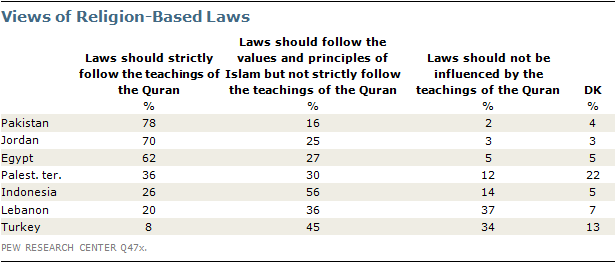
A new Pew Global attitudes poll reveals once again how those "peace loving" Palestinian Arabs really think.

If you judge how worthy people are to deserve a state by how they feel about violence and Islamism, then the Palestinian Arabs are pretty much the least deserving people in the Middle East.

Let's start off with a quick comparison of two answers:


28% of Palestinian Arabs have a favorable opinion of Al Qaeda, and only 18% of President Obama

And Hezbollah rates higher among Palestinian Arabs than any other Arabs. 


A plurality of Palestinian Arabs sympathize with Islamic fundamentalists - and a quarter of Israeli Arab (Muslims)  agree.


A new state of Palestine will, right off the bat, hate America. A whopping 80% of Palestinian Arabs have an unfavorable view towards the US. 


Over a third of PalArabs want a nation that adheres strictly to Shari'a law, and 30% more want it to be influenced by Islamic law. (Jordan's and Egypt's numbers in this question are very troubling for those who want to see a true Arab Spring.)


No surveyed people support Islamic fundamentalists more than Palestinian Arabs, except for Pakistan.

Comparing the answers from Jordan and Egypt to the previous two questions makes it clear that in those countries, people do not define "fundamentalist" as equivalent to " strict adherence to Sharia law." This is something to remember when people claim that those nations do not embrace fundamentalism. 


Hamas' popularity has gone down in the past few years, especially in Gaza, but the movement is still a major force.


No one loves Hezbollah more than PalArabs.


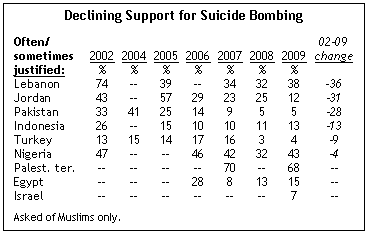
Fully two thirds of all Palestinian Arabs believe that suicide terrorism is often or sometimes justified, making them unique among all people in continuing to embrace that form of what they call "resistance." No other country showed a rate of approval of suicide bombing that was even close to that of the "moderate" Palestinian Arabs. 

And while most Muslim countries have exhibited a steep decline in approval for suicide bombs over the years, the Palestinian Arab enthusiasm for that particularly gruesome method of killing civilians has stayed relatively steady.


So when we look at whether "Palestine" is ready for statehood, should we trust the World Bank's arcane justifications or should we look at whether the country would contribute or detract from world peace?

As it stands, it is clear that "Palestine" will not make the world a more peaceful place. Quite the contrary.

Tuesday, May 17, 2011

  • Tuesday, May 17, 2011
  • Elder of Ziyon
In the latest Palestinian Center for Public Opinion poll, we learn:

A plurality of Palestinian Arabs support resumption of peace talks with Israel without preconditions - 40.2% versus 25.2% who oppose them. This is at odds with PA policy.

Also a slight plurality believe that Israelis are interested in peace - 45.5% against 44.7%.

One question revealed more the biases of the pollster than the feelings of the people:

When asked “ In case all efforts towards peace have collapsed, which of the following options are most probable to administer Palestinian affairs?” more than one-third  37.4% of Palestinians are for the dismantling the PA and holding the international community responsible for the legal vacuum that will arise, whereas 24.7% are in favor of declaring a Palestinian state and escalating resistance, 34.6% for keeping the “ status quo” with developing new strategies to run Palestinian affairs, and 3.3% say “do not know”.

To the pollster, unilateral declaration of a Palestinian Arab state is obviously going to be accompanied with increased "resistance," not with peace!

The most important result was that over 70% of the respondents expect a third intifada to break out if peace talks "stumble." Which probably means that the chances are very high for a new outbreak of violence if a Palestinian Arab state is declared unilaterally - since that shows that the peace talks have already failed.


Thursday, May 05, 2011

  • Thursday, May 05, 2011
  • Elder of Ziyon
In a new Near East Consulting survey of Palestinian Arabs (from Wafa):

57% identified themselves as Muslims first, 21% identified themselves as Palestinians first, 19% as human beings first and 5% as Arabs first.

This surprised me, as I would have swapped the "Arab" and "Muslim" categories. Certainly these numbers would have been much different before 1967. It indicates the increased Islamism of the Palestinian Arabs.

Indeed:


The increase in adherence to religious identity is also reflected in the system preferred by the Palestinian people.


About 40% of the respondents said that they believe that the Islamic caliphate is the best system for Palestinians, 24% chose a system like one of the Arab countries, and 12 % prefer a system like one of the European countries.
Again, this is in contradiction to previous polls that indicated that Palestinian Arabs admire Israel's democracy to any other system, but those polls probably didn't mention the caliphate as an option.

Put together, it looks like pan-Islamism has nearly replaced pan-Arabism in the minds of Palestinian Arabs, which does not bode well if their restless neighbors are also heading in that direction.

(h/t Challah Hu Akbar)
  • Thursday, May 05, 2011
  • Elder of Ziyon
From YNet:
A recent survey conducted by Pechter Middle East Polls, in partnership with the Council on Foreign Relations, ahead of the possible Palestinian bid for statehood in September, revealed that given a choice, the majority of east Jerusalem residents would prefer to remain Israelis.

The survey sampled 1,039 Palestinians living in all 19 neighborhoods of east Jerusalem, and was supervised by Dr. David Pollock.

Perhaps the most striking finding regarded the residents' citizenship preference, after a two-state solution is reached: When asked if they preferred to become citizens of Palestine or remain citizens of Israel, only 30% chose Palestinian citizenship. Thirty five percent chose Israeli citizenship and 35% declined to answer or said they didn’t know.

When asked if they would move to a different home inside Israel if their neighborhood became part of Palestine,40% said they were "likely to move to Israel" and 27% said they were "likely to move to Palestine" if their neighborhood became part of Israel.
What makes these numbers more amazing is that they reflect attitudes shaped by decades of media incitement against Israel and of generations being inculcated with an ethos of a fake historic Palestinian Arab nationalism.

The idea that 40% would actually pick up and move their families to live in Israel is in itself astonishing, and proves more than anything else that Israel treats its Arab citizens better than they expect to be treated in "Palestine."

(h/t Joel)

Wednesday, April 27, 2011

  • Wednesday, April 27, 2011
  • Elder of Ziyon
A new Pew Research poll of Egypt shows some worrying trends.

No dividend emerges for the United States from the political changes that have occurred in Egypt. Favorable ratings of the U.S. remain as low as they have been in recent years, and many Egyptians say they want a less close relationship with America. Israel fares even more poorly. By a 54%-to-36% margin, Egyptians want the peace treaty with that country annulled.

The military is now almost universally seen (88%) as having a good influence on the way things are going in Egypt. Fully 90% rate military chief Mohamed Tantawi favorably.

Egyptians are welcoming some forms of change more than others. While half say it is very important that religious parties be allowed to be part of the government, only 27% give a similar priority to assuring that the military falls under civilian control. Relatively few (39%) give high priority to women having the same rights as men. Women themselves are more likely to say it is very important that they are assured equal rights than are men (48% vs. 30%). Overall, just 36% think it is very important that Coptic Christians and other religious minorities are able to freely practice their religions.

Egyptians hold diverse views about religion. About six-in-ten (62%) think laws should strictly follow the teachings of the Quran. However, only 31% of Egyptian Muslims say they sympathize with Islamic fundamentalists, while nearly the same number (30%) say they sympathize with those who disagree with the fundamentalists, and 26% have mixed views on this question. Those who disagree with fundamentalists are almost evenly divided on whether the treaty with Israel should be annulled, while others favor ending the pact by a goodly margin.
If more than half of those who favor Shari'a law are not sympathetic to "fundamentalists," this means that the Arab definition of "fundamentalist" is much different than the Western definition. After all, wanting to have the nation ruled by religious law is, by definition, a fundamentalist position.

This means that Western journalists and pundits who try to paint the Muslim Brotherhood as outside the mainstream of Egypt are missing the real story.

Only 20% of Egyptians hold a favorable opinion of the United States, which is nearly identical to the 17% who rated it favorably in 2010. Better educated and younger Egyptians have a slightly more positive attitude toward the U.S. than do other Egyptians.

Looking to the future, few Egyptians (15%) want closer ties with the U.S., while 43% would prefer a more distant relationship, and 40% would like the relationship between the two countries to remain about as close as it has been in recent years.
So in what sense is Egypt considered an "ally" of the US again?

Monday, March 07, 2011

  • Monday, March 07, 2011
  • Elder of Ziyon
From YNet:
Israel is one of the least popular countries in the world, according to a survey conducted by Globescan for the BBC in 27 different states.

More than 28,000 people were polled between December of 2010 and February of this year in a survey designed to gauge attitudes towards various countries worldwide.

Just 21% of those polled expressed a positive opinion of Israel, while 49% expressed a negative attitude towards the Jewish state. However dismal, the numbers are still an improvement from last year, when just 19% were pro-Israel.

Of the 17 countries included in the survey, only three were found to be less popular than Israel – Pakistan, North Korea, and Iran – with 17% and 16% of those polled supporting them, respectively. More than 55% of those polled expressed a negative attitude towards these states.
When looking at a poll, it is critical to know the question being asked.

And the question being asked in this poll was not "how much do you like country X?" as YNet seems to imply. It was:

Please tell me if you think each of the following countries is having a mainly positive or mainly negative influence in the world:

That is a completely different question and it is not a popularity question (although some of the surveyed will of course think of it that way.)

Also, since the poll started, Israel's numbers have been generally rising! Amongthe bottom of the list, only Israel's ratings went up this year, while Pakistan, North Korea, and Iran went down.

The one troubling part is that while Americans who were positive about Israel's influence stayed the same, the number who were negative increased by 10%.

I'm not trying to say that Israel's numbers would be great if it was a popularity poll, but reporters need to learn to understand basic English.

One other thing: The poll only asks people about 17 countries. No Arab countries are on the list. How would Saudi Arabia, or Libya, or Syria, or even Egypt rank in this list? Who knows? But I would guess that the world does not have warm feelings for those countries' influence either. So when Arab news outlets trumpet this report that Israel is ranked so low, it makes one wonder how they would perform.

And how come the BBC doesn't think that they should be included.

Saturday, December 11, 2010

  • Saturday, December 11, 2010
  • Elder of Ziyon
From Ma'an:
A slim majority of the respondents to a reader poll on Ma'an's Arabic-language news site said sending Palestinian firefighters to help battle Israel's fire was "disgraceful."

Firefighters from more than 16 countries helped to extinguish the blaze, the worst in Israel's history, which broke out on Dec. 2 and spread through the Carmel forest for four days.

Of 48,870 readers who responded to the 7-day poll, 50.3 percent (24,524) described Palestinians' participation as a disgrace, but 48.7 percent (23,761) said sending Palestinian firefighters to help was civilized and a humanitarian duty.
Newspaper polls are far from scientific, but Ma'an is certainly one of the more moderate Palestinian Arabic news websites out there. My guess is that a real poll would show that far fewer PalArabs support saving Jewish lives in Israel.

Saturday, November 20, 2010

  • Saturday, November 20, 2010
  • Elder of Ziyon
Here are some more highlights from  The Israel Project poll of Palestinian Arabs that should make anyone pause before wanting to grant them a state of their won.

A Palestinian state should be run by Sharia Law. 55%
A Palestinian state should be run by civil law. 35%

The best goal is for a two state solution that keeps two states living side by side. 30%
The real goal should be to start with two states but then move to it all being one Palestinian state. 60%

Israel has a permanent right to exist as a homeland for the Jewish people. 23%
Over time Palestinians must work to get back all the land for a Palestinian state. 66%

In 2000, President Bill Clinton proposed a Palestinian-Israeli peace agreement in which the Palestinians would receive an independent state, which included Gaza and nearly all of the West Bank, using the 1967 green line, exchanging Israeli land for larger settlements. It made East Jerusalem the capital of the Palestinian state, with control over Palestinian quarters of the Old City. Yasir Arafat rejected this offer. In retrospect, do you wish Arafat had accepted this peace agreement - yes or no?
Yes: 24%
No: 71%
Some of the answers, to be sure, seemed to contradict these, as in the abstract they seem to support a two-state solution. But when specific compromises are mentioned, they reject every one.

And they make it crystal clear that a two-state solution is not a final agreement, and that they will try to take over Israel as well, signed agreement or not.
  • Saturday, November 20, 2010
  • Elder of Ziyon
The Israel Project commissioned a poll in the West Bank and Gaza last month surveying Palestinian Arab opinions about various topics.

The results are most enlightening.

This post is about one specific question:

Now, I'd like you to rate your feelings toward some people, countries, and organizations, with one hundred meaning a VERY WARM, FAVORABLE feeling; zero meaning a VERY COLD, UNFAVORABLE feeling; and fifty meaning not particularly warm or cold. You can use any number from zero to one hundred, the higher the number the more favorable your feelings are toward that person, country, or organization.

Here are the results, sorted from lowest score (coldest feelings) to the highest (warmest feelings), along with their respective mean scores:


Israelis3.3
Israel4
Benjamin Netanyahu4.4
American Jews7.8
Tony Blair9.2
Barack Obama10.7
The United States14.5
Hillary Clinton15.2
A one-state solution28.7
Two-state solution with an independent Palestinian state and Israel as a Jewish state30.2
Mahmoud Ahmadinejad40
Iran40.4
Two-state solution41.3
Hamas42.6
The peace process42.6
Ismail Haniyeh44.1
Hezbollah44.6
Palestinian Authority54.2
Salam Fayyad54.5
Mahmoud Abbas57
Fatah57.6
Marwan Bargouti64.5
Khalil Ibrahim al-Wazir ("Abu Jihad")71.2
Dalal Mughrabi74.5

By far, the winners of the popularity context (at least that were named) were three terrorists, and the top one could not credibly be called anything but a terrorist (the other two at least had some political activities outside of terrorism.)

And for some reason Barack Obama, the most pro-Palestinian Arab president in history, hasn't seemed to have gained much for his efforts at least in this part of the Arab world. Mahmoud Ahmadinejad trounces him in popularity among the moderate, pragmatic, peace-loving Palestinian Arabs.

More analysis form this poll to come.

(h/t JoeSettler)

Printfriendly

EoZTV Podcast

Podcast URL

Subscribe in podnovaSubscribe with FeedlyAdd to netvibes
addtomyyahoo4Subscribe with SubToMe

search eoz

comments

Speaking

Follow by Email

translate

E-Book

For $18 donation


Sample Text

EoZ's Most Popular Posts in recent years

Hasbys!

Elder of Ziyon - حـكـيـم صـهـيـون


This blog may be a labor of love for me, but it takes a lot of effort, time and money. For over 14 years and 30,000 articles I have been providing accurate, original news that would have remained unnoticed. I've written hundreds of scoops and sometimes my reporting ends up making a real difference. I appreciate any donations you can give to keep this blog going.

Donate!

Donate to fight for Israel!

Monthly subscription:
Payment options


One time donation:

subscribe via email

Follow EoZ on Twitter!

Interesting Blogs

Categories

#PayForSlay Abbas liar Academic fraud administrivia al-Qaeda algeria Alice Walker American Jews AmericanZionism Amnesty analysis anti-semitism anti-Zionism antisemitism apartheid Arab antisemitism arab refugees Arafat archaeology Ari Fuld art Ashrawi ASHREI B'tselem bahrain Balfour bbc BDS BDSFail Bedouin Beitunia beoz Bernie Sanders Biden history Birthright book review Brant Rosen breaking the silence Campus antisemitism Cardozo cartoon of the day Chakindas Chanukah Christians circumcision Clark Kent coexistence Community Standards conspiracy theories COVID-19 Cyprus Daled Amos Daphne Anson David Applebaum Davis report DCI-P Divest This double standards Egypt Elder gets results ElderToons Electronic Intifada Embassy EoZ Trump symposium eoz-symposium EoZNews eoztv Erekat Erekat lung transplant EU Euro-Mid Observer European antisemitism Facebook Facebook jail Fake Civilians 2014 Fake Civilians 2019 Farrakhan Fatah featured Features fisking flotilla Forest Rain Forward free gaza freedom of press palestinian style future martyr Gary Spedding gaza Gaza Platform George Galloway George Soros German Jewry Ghassan Daghlas gideon levy gilad shalit gisha Goldstone Report Good news Grapel Guardian guest post gunness Haaretz Hadassah hamas Hamas war crimes Hananya Naftali hasbara Hasby 2014 Hasby 2016 Hasby 2018 hate speech Hebron helen thomas hezbollah history Hizballah Holocaust Holocaust denial honor killing HRW Human Rights Humanitarian crisis humor huor Hypocrisy ICRC IDF IfNotNow Ilan Pappe Ilhan Omar impossible peace incitement indigenous Indonesia international law interview intransigence iran Iraq Islamic Judeophobia Islamism Israel Loves America Israeli culture Israeli high-tech J Street jabalya James Zogby jeremy bowen Jerusalem jewish fiction Jewish Voice for Peace jihad jimmy carter Joe Biden John Kerry jokes jonathan cook Jordan Joseph Massad Juan Cole Judaism Judea-Samaria Judean Rose Judith Butler Kairos Karl Vick Keith Ellison ken roth khalid amayreh Khaybar Know How to Answer Lebanon leftists Linda Sarsour Linkdump lumish mahmoud zahar Mairav Zonszein Malaysia Marc Lamont Hill max blumenthal Mazen Adi McGraw-Hill media bias Methodist Michael Lynk Michael Ross Miftah Missionaries moderate Islam Mohammed Assaf Mondoweiss moonbats Morocco Mudar Zahran music Muslim Brotherhood Naftali Bennett Nakba Nan Greer Nation of Islam Natural gas Nazi Netanyahu News nftp NGO Nick Cannon NIF Noah Phillips norpac NSU Matrix NYT Occupation offbeat olive oil Omar Barghouti Only in Israel Opinion Opinon oxfam PA corruption PalArab lies Palestine Papers pallywood pchr PCUSA Peace Now Peter Beinart Petra MB philosophy poetry Poland poll Poster Preoccupied Prisoners propaganda Proud to be Zionist Puar Purim purimshpiel Putin Qaradawi Qassam calendar Quora Rafah Ray Hanania real liberals RealJerusalemStreets reference Reuters Richard Falk Richard Landes Richard Silverstein Right of return Rivkah Lambert Adler Robert Werdine rogel alpher roger cohen roger waters Rutgers Saeb Erekat Sarah Schulman Saudi Arabia saudi vice self-death self-death palestinians Seth Rogen settlements sex crimes SFSU shechita sheikh tamimi Shelly Yachimovich Shujaiyeh Simchat Torah Simona Sharoni SodaStream South Africa Speech stamps Superman Syria Tarabin Temple Mount Terrorism This is Zionism Thomas Friedman TOI Tomer Ilan Trump Trump Lame Duck Test Tunisia Turkey UAE Accord UCI UK UN UNDP unesco unhrc UNICEF United Arab Emirates Unity unrwa UNRWA hate unrwa reports UNRWA-USA unwra Varda Vic Rosenthal Washington wikileaks work accident X-washing Y. Ben-David Yemen YMikarov zahran Ziesel zionist attack zoo Zionophobia Ziophobia Zvi

Best posts of the past 12 months


Nominated by EoZ readers

The EU's hypocritical use of "international law" that only applies to Israel

Blog Archive