Showing posts with label Academic fraud. Show all posts

Tuesday, April 21, 2026

Springer Nature has published a second edition of Islamophobia and Psychiatry, billing it as an expert clinical resource for physicians, counselors, and social workers. Chapter 24, authored by Samah Jabr (George Washington University School of Medicine), Sarah Mohr (Graduate Theological Union, Berkeley), and Elizabeth Berger (Alkaram Institute, Chicago), is titled "Islamophobia, Genocide, and Mental Health: A Palestinian Perspective on Collective Trauma." 

A reader opening a psychiatry textbook expecting clinical analysis will find something rather different: a political manifesto that treats its most contested claims as established baselines, then builds a mental health framework on top of them.

The authors say at the outset:

[T]he state of Israel has from its outset regarded the Palestinian people as a group—as Muslim people—with an overall aim of assigning to them a disenfranchised and disempowered position relative to Jewish people. This political position is known by its supporters as well as by its opponents as Zionism. 

They are saying that this is how Zionists define themselves - as having a primary aim of Jewish superiority over Palestinians.  The fact that no Zionist actually thinks this way isn't important. It's only a paper in a respected journal, why bother checking facts?

The chapter's fundamental thesis is that Palestinian mental health suffers because Israel inflicts deliberate, genocidal harm. Every psychiatric symptom, every dimension of Palestinian psychological distress, traces back to Israeli policy. This is not presented as a hypothesis to be tested — it is declared as the premise from which clinical analysis proceeds.

There is a simple empirical test for this thesis: see if Palestinians outside the territories also have mental health issues that cannot be attributed to Israel.

There are in fact plenty of studies about that. Palestinians in Lebanon and Jordan — far from Israeli military operations, outside Israeli jurisdiction, living under the governance of Arab host states — suffer severe and well-documented mental health crises. In Palestinian refugee camps in Lebanon, Médecins Sans Frontières found that depression affects nearly one-third of patients, with others presenting with anxiety (22%), psychosis (14%), and bipolar disorders (10%).  A Royal College of Psychiatrists essay examining Palestinian refugees in Jordan's Baqa'a camp — the largest Palestinian refugee camp in the world, home to 104,000 people — found that all 16 medical professionals interviewed acknowledged high prevalence of mental illness in the refugee population, with estimates ranging from 20 to 50%, and some participants placing it as high as 75%. The drivers identified were poverty, overcrowding, stigma, gender-based violence, and the grinding hopelessness of camp life without prospect of legal integration into Jordanian society. Israel does not appear in the causal chain, because Israel is not present in Jordan.

Do the authors care about the source of mental health problems for all Palestinians, or just the ones that they can claim are suffering from "apartheid"? We have the answer. 

The chapter's inventory of claims accepted as clinical fact is worth laying out directly, because the academic packaging obscures how unargued they are.

The authors declare "the genocidal conduct of Israel" as their working premise, citing Special Rapporteur Francesca Albanese's March 2024 report as the evidentiary foundation. Albanese is a political appointee of the UN Human Rights Council — the same body that has never once condemned Hamas — and her document is advocacy, not peer-reviewed research.  From there, Israel's "overall epistemic of Western European colonialism, racism, heteropatriarchy, and capitalism" is offered as description rather than contested theory. Zionism, they write, induced Jewish communities "to form a kind of fifth column within the Middle East." The Holocaust "lent surface credibility to the Zionist political position" — six million murdered Jews are reframed as useful propaganda for Jewish nationalism.

On territorial ambitions, the authors assert that Israel's 2018 Nation-State Law reflects "political ambitions of Israel for sovereignty over the whole of former Mandatory Palestine." Israel's 2005 unilateral withdrawal from Gaza — evacuating every settlement and soldier from territory the authors claim Israel seeks to hold forever — goes unmentioned. So is the withdrawal from Area A to give Palestinians, for the first time in their history, self-rule. Seems strange for the  rapacious ever-expanding state they describe.

On apartheid, the chapter describes "the massive Israeli apartheid system which denied basic human rights to Palestinians." Arab citizens of Israel vote, serve in the Knesset, sit on the Supreme Court, and practice medicine in Israeli hospitals. The comparison to South African apartheid is asserted; it is not argued.

The Islamophobia claim is the most structurally bizarre. The authors declare that "Islamophobia is both a weaponized major export of the state of Israel and a plank in the larger longstanding defense of the dehumanization and violence which typically characterize dominating oppressive systems." Israel — nine million people, a country smaller than New Jersey — is the primary global engine of anti-Muslim prejudice. The mechanism by which it exports this prejudice to Hindu nationalists in India, Serbian paramilitaries in the 1990s, or the architects of the Spanish Inquisition is never explained, because no such mechanism exists. Islamophobia long predates Israel and flourishes in regions with zero Israeli cultural footprint.

Then there is the pre-Israel history, where the revisionism becomes almost comedic. The authors describe Israel as having "rejected the previous model of religious and ethnic pluralism which had operated there for centuries." Yes, Israel defining itself as a Jewish state that gives equal rights to non-Jews is a Jewish supremacist state, while the Ottoman Empire - whose sultan was also the caliph, and which used separate legal systems for Muslims and Jews and Christians, was the model of pluralism.

Springer Nature's imprint on this chapter tells every clinician, librarian, and medical student who encounters it that what they're reading is science. The damage from that signal is harder to undo than anything in the text itself.


Buy EoZ's books  on Amazon!

"He's an Anti-Zionist Too!" cartoon book (December 2024)

PROTOCOLS: Exposing Modern Antisemitism (February 2022)


Sunday, April 19, 2026


There is nothing interesting anymore about discovering that a top-ranked sociology journal has published a one-sided polemic against Israel. Entire fields have been ideologically captured by anti-Zionist rhetoric. I've documented this many times, both in individual papers and in academia as a whole.

What is interesting is watching a respected journal abandon every substantive standard in its own rulebook to publish a blatantly anti-Israel piece— and watching it do so eagerly, in the open, with editorial solicitation on the record.

The article is Sarah Ihmoud’s “Hunger and the Palestinian Womb,” published online March 25, 2026 in Gender & Society, a SAGE journal that describes itself as “a top-ranked, peer-reviewed, sociological journal” that “publishes less than 10% of all papers submitted to it.”

Here is the abstract, in full:

This article theorizes the Palestinian womb as both a site of Zionist colonial violence and Palestinian futurity through the story of Shema, a young woman who became pregnant and gave birth during Gaza’s ongoing genocide. Drawing on decolonial Palestinian feminism and Indigenous feminist scholarship, I argue that Israel’s weaponization of starvation constitutes a gendered assault on Palestinian social reproduction, targeting pregnant and breastfeeding women to sever intergenerational continuity. Shema’s narrative — from her interrupted wedding in October 2023 through forced displacement, miscarriage, and ultimately the birth of her son Youssef amid bombardment and acute malnutrition — reveals how genocide operates not only through military violence but also through the systematic destruction of life’s conditions. Her testimony illuminates what Shalhoub-Kevorkian terms genocidal “unchilding” and what I theorize as the colonial targeting of reproductive futures. Yet Shema’s story also embodies revolutionary mothering as insurgent care work, refusing to cede the future despite engineered hunger and psychic siege. Situating her experience within genealogies of anti-colonial resistance, I argue that storytelling itself becomes decolonial praxis — a refusal of erasure and a sacred map toward collective liberation. Grounded in intimate testimony and critical analysis, this work demands feminist engagement with starvation as reproductive violence and Palestinian life-making as radical resistance.

Every sweeping factual claim in this abstract — “Zionist colonial violence,” “Gaza’s ongoing genocide,” “Israel’s weaponization of starvation,” a deliberate campaign “targeting pregnant and breastfeeding women to sever intergenerational continuity” — is stated as established fact rather than as a hypothesis to be tested. All of the evidence in the piece, by the author’s own description, is a series of WhatsApp messages from one 23-year-old woman in Gaza.

The bias is unmistakable from the abstract alone. How this got published is the real question.  Even a cursory review of both Gender & Society’s own stated standards and the standards that the journal claims to adhere to as a COPE member shows that this article doesn't just violate these rules - it tramples them.

The political content is treated as settled fact, which the journal’s standards forbid

The Gender & Society submission guidelines describe what the journal publishes: “empirical articles, which are both theoretically engaged and methodologically rigorous,” or occasionally “theoretical articles that meaningfully advance sociological theories about gender.”

An empirical article argues from evidence to a conclusion. It states its hypothesis, describes its method, presents its findings, and discusses what the findings can and cannot support. Ihmoud’s piece inverts this entirely. The conclusions — genocide, weaponized starvation, deliberate gendered targeting of Palestinian wombs — are the premises from which the analysis begins. The abstract announces them as established descriptive categories. The sections that follow do not argue for these conclusions; they illustrate them through selected excerpts of one woman’s messages.

This is backwards. If the claim is that Israel has a policy of targeting pregnant women, the claim must be defended with evidence of intent, policy, and outcome, with engagement of contrary evidence. Instead the article treats each claim as self-evident and reaches for ever more extreme restatements: “engineered hunger,” “psychic siege,” “colonial unchilding,” “the machinery of death.” No reviewer trained in empirical sociology could have permitted this as a finding rather than as an opinion. The guidelines require “methodologically rigorous” work. There is no methodology here to even test as rigorous. 

The abstract uses “Zionist colonial violence,” “Gaza’s ongoing genocide,” “Israel’s weaponization of starvation,” and “engineered hunger” as neutral analytical vocabulary - assumed fact - not as positions being argued for. 

The article could have stated an argument in a form that scholarly conventions recognize: “I argue that the conditions in Gaza are best characterized as genocide, for the following reasons…” It instead assumes the characterization as a starting premise. This is what distinguishes advocacy from scholarship. A paper published in a top-ranked sociology journal that treats the Israel-Hamas war as “Zionist colonial violence” in the abstract, without argument, has set the vocabulary of one side as the scholarly default. 

The editor invited the piece — and the journal itself could not have applied its own peer review to it

The acknowledgments reveal the mechanism. Ihmoud thanks “Sharmila Rudrappa and Patricia Richards who invited her to contribute this piece to a symposium in Gender & Society.” Sharmila Rudrappa is the current editor of the journal; Patricia Richards is a former editor. The piece was solicited by the journal’s own editorial leadership.

Invited contributions exist at many journals, but COPE Core Practice 9 requires that “all peer review processes must be transparently described and well managed.” Gender & Society does not disclose anywhere on the article page what review this piece actually received, whether it was sent to external reviewers, whether those reviewers were blinded, or whether they were asked to apply the same methodological standards the journal applies to the roughly 97% of submissions it rejects. 

One part of the ordinary process was structurally impossible. The submission guidelines require that review be anonymous, with authors cited in the third person (“As Collins (2014) has found…” and explicitly NOT “As I previously demonstrated…”). Ihmoud’s article contains exactly the forbidden first-person construction: “as Palestinian feminist analysis insists, and as I have argued elsewhere, genocide operates… (Ihmoud 2025).” She self-cites this way three times. The piece had already appeared five months earlier at Decolonial Hacker under her name, so any reviewer with a web browser would have known who wrote it.

The procedural question matters less than a deeper one: how anything calling itself peer review could have looked at this article and cleared it. A scholar competent in qualitative sociology, applying the journal’s stated methodological standards, would have returned this manuscript with comments on the n=1 sample, the absence of a methods section, the treatment of the conclusion as a premise, the lack of engagement with contrary evidence, and the circular self-citation. None of those comments made it into the published piece, which means either they were never made or they were ignored. Either way the “peer-reviewed” label at the top of the article page is doing work it cannot support.

The journal’s own rule against prior publication was waived — and the author said so in print

The journal’s submission rules are explicit: “Authors submitting manuscripts to the journal should not simultaneously submit them to another journal, nor should manuscripts have been published elsewhere in substantially similar form or with substantially similar content.”

The author’s note reads: “This piece was first published in Decolonial Hacker in October 2025… and is reprinted with permission here.” She adds that she “made the decision to stop updating data after its original publication.”

A side-by-side comparison confirms the two versions are the same article with trivial edits. Gender & Society apparently insisted that the word "Zionist" be capitalized.  Otherwise, the piece is fundamentally identical to that published in an unapologetically biased source.  

This is textbook redundant publication, which COPE Core Practice 7 requires every member journal to police. Gender & Society has the policy in its own submission guidelines. The editors simply ignored it, took a piece already running at an activist outlet, and reprinted it with a SAGE imprint.

A scholar submitting original, blinded, empirical research through the ordinary queue would be rejected immediately on this ground alone. For this piece the rule was waived. The reason, on the evidence available, was that the editors wanted its conclusions in their journal.

Worse, an article published as activism was republished verbatim as scholarship. 

The author’s political commitments are not disclosed as a competing interest

We see this often, but it is worth highlighting.

COPE Core Practice 4 requires “clear definitions of conflicts of interest and processes for handling conflicts of interest of authors, reviewers, editors, journals and publishers.”

Ihmoud is a founding member of the Palestinian Feminist Collective, an advocacy organization with an explicit political mission. She has published in activist outlets including Decolonial Hacker and Jadaliyya, where the same arguments appear without the scholarly framing. The article’s conclusions are effectively identical to the political positions of the organization she co-founded.

This affiliation appears in her biography but is not flagged as a competing interest. Scholarly norms require that the conflict of interest be disclosed and managed. The journal made no such requirement of her. 

The article’s analytical foundations are circular self-citation

The load-bearing theoretical claim — that “genocide operates not only through bombs and bullets but also through the slow, grinding destruction of life’s conditions” — is cited to Ihmoud 2025, while the claim that “decolonial Palestinian feminism refuses this futurelessness” is cited to Ihmoud 2022. The concept of the “Palestinian womb” as a theoretical object traces back to Ihmoud’s 2021 chapter.

Self-citation is normal in academic writing. Load-bearing self-citation for every core analytical move, with no serious engagement with contrary scholarship on any of these points, is not — it makes the piece a restatement of Ihmoud’s own prior positions rather than an original contribution. The journal’s guidelines are explicit that it publishes work making “original contributions to gender theory.” This article just rehashes. 

The smaller violations

Several further breaches of the journal’s own rules and of COPE Core Practices are worth listing briefly, because each would on its own justify desk-rejecting an ordinary submission:

  • No methods section. The article does not describe how the interview material was collected, verified, coded, or analyzed. The sample size is one. The journal’s guidelines require empirical articles to include “discussions of both theory and method.”
  • No data availability statement. COPE Core Practice 5 requires journals to have data-availability policies. The raw data — in this case, WhatsApp messages — cannot be examined, verified, or independently interpreted. The research design is unfalsifiable.
  • No ethics review statement. COPE Core Practice 6 requires policies on research involving human subjects, particularly vulnerable populations. The article publishes a named, identifiable 23-year-old woman in an active war zone — her full name, her child’s name, her pregnancy history, her displacement history, and private photographs. The College of the Holy Cross, Ihmoud’s employer, has an Institutional Review Board; the article is silent on whether it was consulted.
  • Abstract 35% over the word limit. The submission guidelines specify 150-200 words; the published abstract is 265. Small on its own, but telling about how carefully anyone read this.

What this adds up to

The failures here all point in the same direction: the editors wanted this piece, and each rule that stood in the way was waived. The prior-publication rule was waived. The anonymous-review requirement was, by construction, impossible to honor. The methodological-rigor standard was not applied. The requirement that theoretical articles make original contributions was waived. The conflict-of-interest norm was not enforced. The ethics-oversight expectation was not raised.

Journals do bend their rules for invited contributions. What makes this case diagnostic is how thoroughly the rules were bent, how many were bent at once, how openly the violations are documented in the article itself, and how reliably the bending ran in one political direction. Gender & Society did not publish an imperfect essay despite its standards. It published this essay by suspending its standards. 

This is how bias functions inside institutions that still think of themselves as impartial. The infrastructure of impartiality — the submission rules, the peer-review process, the COPE membership, the low acceptance rate — remains fully intact as a set of public claims. It is only when you check whether any of it was applied to a particular piece that you discover that standards can be ignored when the journal wants. 

Which means Gender & Society has no standards at all. 


Buy EoZ's books  on Amazon!

"He's an Anti-Zionist Too!" cartoon book (December 2024)

PROTOCOLS: Exposing Modern Antisemitism (February 2022)


Thursday, December 18, 2025

Here's an abstract of a brand new paper in Globalisation, Societies and Education by Jo Kelcey of American University of Beirut:

A tragedy foretold? The necropolitical foundations of the Gaza scholasticide
Jo Kelcey
Published online: 15 Dec 2025
Cite this article https://doi.org/10.1080/14767724.2025.2598276 
 
ABSTRACT
This article contextualises the scholasticide in Gaza (2023 – ) within the longer history of Israel’s treatment of Palestinian education. Using primary and secondary historical sources, it argues that the near total destruction of Gaza’s education sector is the latest iteration of a longstanding repertoire of Israeli colonial violence enacted on Palestinian education since 1948. Through the lens of necropolitics, the article identifies how this treatment coalesces around three overarching logics: indigenous erasure, political containment and the normalisation of violence. In this way, the article contributes to broader debates regarding the relationship between education and conflict and provides a framework to understand how neo/colonialism operates in and through education.
There is a lot to unpack here. You can see how social sciences take previously defined concepts that may or may not even exist and apply them willy-nilly to Israel, by citing others who did it first and pretending that they are proven fact - hence, "scholasticide" (purposeful destruction of education) and "necropolitics" (a state asserting control over who lives and who dies.) 

But it is also a shining example of how anyone can cherry pick whatever evidence they want and ignore the rest. The footnotes mention a handful of cases of Israel supposedly attacking schools, including in Lebanon  - no context is given as to whether they were terror sites. 

But what is not said is where the lies hide.

Before 1948, Arabs in Palestine were largely illiterate. Literacy rates tripled under Israeli rule as of the 1980s, no doubt they are much higher now.

Before 1967, there was not one university in the West Bank or Gaza. Not one. Under Israel's "scholasticide," 11 universities were opened as of 2005.

Before 1967, only a few hundred Palestinians went to colleges - after Israeli control, that number reached tens of thousands.

We have shown that Israel-haters are epistemologically equivalent to conspiracy theorists, and their explanations for these counterexamples show this clearly.  They say that the Palestinians flocked to higher education in spite of Israeli restrictions.  If Israeli "scholasticide" explains both why universities were built under Israeli control (and not under Egyptian/Jordanian control) but it also explains why Israel attacked universities in Gaza or Lebanon, then it doesn't explain anything. 

It is an unfalsifiable assertion - there is literally nothing Israel could do to make the haters believe anything else. 

Which makes this kind of research worse than useless. It is propaganda dressed in academic garb, which describes nearly all of the papers about Israel in many journals.  


Buy EoZ's books  on Amazon!

"He's an Anti-Zionist Too!" cartoon book (December 2024)

PROTOCOLS: Exposing Modern Antisemitism (February 2022)


Wednesday, December 03, 2025


Academics in social sciences have long championed the principle that individuals and communities should be allowed to define their own identities. This is a cornerstone of modern sociological ethics. 

In some cases, there are even legal standards. 

In 1997, the U.S. Office of Management and Budget established clear federal standards for collecting data on race and ethnicity. These standards apply to all federally-funded research and state unequivocally:

"Respect for individual dignity should guide the processes and methods for collecting data on race and ethnicity; ideally, respondent self-identification should be facilitated to the greatest extent possible."

The standards continue: "Self-reporting or self-identification using two separate questions is the preferred method for collecting data on race and ethnicity."

These aren't aspirational goals. They're mandatory for federal research and have been adopted as policy by major academic journals. The Canadian Medical Association Journal (CMAJ), following Journal of the American Medical Association (JAMA) standards, requires that researchers:

"Authors should explain whether race and ethnicity were self-identified by study participants or identified by others, providing justification if self-identification was not used."

The rationale is clear. As PLOS Global Public Health notes: "Observer classification has potential harms such as misclassification, stigmatization, and perpetuating structural racism."

Yet in academic research, there is a glaring exception to this rule: Arab citizens of Israel. In this case, academics have systematically violated their own principles.

An analysis of academic literature published in Taylor & Francis journals reveals a striking disconnect between how Arab citizens of Israel identify themselves and how academics choose to label them. Here is the breakdown of the uses of these phrases in academic papers since 2019 from my own keyword searches (1,354 results, some might be duplicates from papers using different terms in the same paper.)

  • Palestinian terminology ("Palestinian citizens of Israel"/"Palestinians in Israel"): 40.8%
  • Arab identity terminology ("Israeli Arabs"/"Arabs in Israel"): 39.2%
  • Israeli citizenship terminology ("Arab Citizens of Israel"/"Arab Israelis"): 18.0%
  • Religious terminology ("Israeli Muslims"/"Muslim Israelis"): 1.9%

But this is way out of whack with how Arab Israelis define themselves!

While there are differences in research, most show roughly what this Tel Aviv University Konrad Adenauer Program for Jewish-Arab Cooperation report said in June as how Arabs in Israel see themselves.

  • Arab identity: 36.2%
  • Israeli citizenship: 30.3%
  • Religious affiliation: 21.4%
  • Palestinian identity: 9.7%

The numbers are damning. Academics use Palestinian identity terminology at 4.2 times the rate at which the actual population self-identifies that way. Meanwhile, Israeli citizenship identity—the second-most common form of self-identification at 30.3%—is significantly underrepresented in academic literature at only 18.0%.

I've seen numbers from 3% to 15% for Arab Israelis identifying as Palestinians but no matter which statistic you choose, describing them as "Palestinians" is inaccurate and a blatant violation of social science standards. 

Even more egregiously, religious identity, which 21.4% of Arab Israelis say is their primary identity component, receives only 1.9% representation in academic terminology. This is an eleven-fold underrepresentation of how more than one-fifth of the population sees themselves.

The irony here is rich. These are the same academics who would be horrified at misgendering someone or using racial terminology that a community rejects. They are the first to say that imposing external identity categories on people is a form of epistemic violence.

Progressive academics have spent decades rightfully criticizing how marginalized communities have been labeled by outsiders rather than being allowed to define themselves. They've fought against colonial impositions of identity, against medicalization of non-conforming identities, against bureaucratic categorizations that erase people's self-understanding.

But when it comes to Arab citizens of Israel, all these principles evaporate.

Why? Because the Palestinian national identity narrative serves a particular political agenda, and that agenda takes precedence over the community's actual self-understanding.

This isn't just about word choice. It reflects a deeper academic malpractice: the construction of a Palestinian national consciousness narrative within Israel that doesn't reflect the lived reality of the majority of the population being studied.

Only 9.7% of Arab Israelis say Palestinian identity is the most important component of their personal identity. Yet 40.8% of academic articles impose this identity on the entire population. This is not description - it's prescription. It's not research - it's activism masquerading as scholarship.

The data reveals something even more troubling: academics are not just slightly misaligned with the population they study. They are systematically constructing a narrative that inverts the actual priorities of that population. Israeli citizenship, which ranks second in self-identification, is deliberately minimized in academic discourse. Palestinian identity, which ranks dead last, is elevated to be the dominant frame.

This analysis reveals a fundamental crisis in academic integrity. Scholars who have built careers on respecting self-identification, who police language usage in every other context, who understand that naming is power—these same scholars are systematically imposing an identity framework on a population that has explicitly rejected it.

The evidence is clear. The numbers don't lie. Academics are using "Palestinian" to describe Arab citizens of Israel at 4.2 times the rate those citizens use it to describe themselves.

This is not research. This is ideological construction masquerading as social science.

And it's a violation of the field's own ethical standards.


Buy EoZ's books  on Amazon!

"He's an Anti-Zionist Too!" cartoon book (December 2024)

PROTOCOLS: Exposing Modern Antisemitism (February 2022)


Tuesday, December 02, 2025

Academic papers have exploded in their use of antisemitic tropes and anti-Zionist activism language in recent years.

See for yourself:


The number of papers that accuse Israel of "Jewish supremacism" - an antisemitic trope straight out of the "Elders of Zion" and Nazi playbook" - went from 5 in 2005 to 455 last year - a 90 fold increase.

The Palestinian phrase "Talmudic Rituals," to make Jewish prayer seem sinister, has become mainstreamed in academia, from 2 in 2005  to being used 118 times in papers last year.

No other ethnic or religious group on earth has seen anything remotely like this.

Phrases popularized by BDS and other anti-Zionists that are nowhere close to neutral academic language - like referring to the Israeli army as "Israeli Occupation Forces" or referring to Gaza as an "open air prison" or even refusing to refer to Israel by name and replacing it with "Zionist regime" have similarly skyrocketed in recent years.

Altogether, the phrases listed here have gone from 40 in 2005 to 1,933 in 2024. The total, including this partial year, is over 8,000 papers using phrases that no serious academic should ever use except in scare quotes.

Here is the data:


80% of these inflammatory, biased and antisemitic phrases have been in the past five years.

It is no wonder that recent polls have found that people who have the most education are the most antisemitic - an inversion from decades past. 

It you don't think that academic "anti-Zionism" is correlated with antisemitism, you ae living in a dream world. This chart proves that they go hand in hand. 

Peer review has failed. Editorial standards have collapsed. An entire academic discipline now functions as an unapologetic propaganda mill -  and its output is already shaping policy, media, and the training data of the next generation of AIs.

The more you dig into academic papers, the more rot you find. 

(These were compiled by Grok AI using Google Scholar searches.)

The Institute for the Study of Amtizionism is enjoying these articles. Check them out on X: @InstituteCSA


Buy EoZ's books  on Amazon!

"He's an Anti-Zionist Too!" cartoon book (December 2024)

PROTOCOLS: Exposing Modern Antisemitism (February 2022)


Sunday, November 30, 2025

Andrew Pessin has launched the Institute for the Critical Study of Antizionism, and in his introductory manifesto he he quotes Adam Louis-Klein:

“We now need entire teams of researchers — serious, methodical, interdisciplinary — to mine the full archive of genocide studies, settler-colonial theory, Middle Eastern studies, and the whole academic nexus where antizionism has taken root… a vast, largely unexamined body of antizionist hate literature, treated as scholarship but functioning as ideology.”

I am not an academic, but I can certainly critique academics on their own playing field. I've quoted and mocked the most egregious examples of anti-Zionist academic literature a number of times. But what is required here is a more rigorous examination showing that the entire field is rotten at the core.. From what I could tell, anti-Zionist academic literature does not simply contain bias. It behaves like a sealed intellectual ecosystem, with its own canonical texts, circular logic, and selective evidentiary filters. The appearance of scholarly rigor is there -  citations, peer review, footnotes  - but the underlying method is adversarial rather than truth-seeking. The conclusions are rarely tested; they are assumed.

This is where AI becomes indispensable.

Taylor and Francis hosts hundreds of academic journals. While most papers there are not available in full text, they show their abstracts - and their footnotes. I realized that with a minimal effort I could have AI examine the papers and their references to see if they are following the patterns of normal academic research or if their evidence is all circular and ignoring any counter-examples.

I found that when searching for papers accusing Israel of “settler-colonialism,” “apartheid,” and “genocide,” nearly all of them fail basic academic standards required in the social sciences.

The rot is very deep. Here is what I found in only a half hour of research with Grok:

The Settler-Colonialism Frame: Theory as Template

Searching Taylor & Francis for “settler colonial* + Israel” yields about 110 papers since 2015. In this cluster:

  • Patrick Wolfe (2006) is cited ~52%

  • Ilan Pappé (2006) ~48%

  • Lorenzo Veracini (2010) ~35%

  • Gershon Shafir (1996) ~28%

These four sources account for roughly 80% of the network’s intellectual gravity. Virtually every subsequent paper refers back to them.

But here is the problem: these works are rarely challenged, only repeated. Assertions like Zionism is a settler-colonial project by definition.”are taken not as hypotheses to be investigated, but as axioms to be applied.

Primary sources,  such as Ottoman-era Jewish land ownership, pre-Mandate Jewish presence, or Mizrahi Jewish indigeneity,  almost never receive examination. The fact that Jews have always considered Israel their homeland and have prayed to return for two millennia? Not to be found, because that one fact by itself shows that Jews never considered themselves to be settling someone else's land but returning to their own. 

Even within the larger field of settler colonial studies, there are debates on whether Israel fits the definition the way the US or Australia do. Those dissenting opinions not only might but must be mentioned in serious academic papers - yet they are virtually absent in the context of Israel.

The Apartheid Frame: NGOs as Canon

The apartheid literature is even larger, about 230 papers. But here, the intellectual source code changes.

The top citations are no longer academics but NGOs: 

  • B’Tselem (2021) ~75%

  • Human Rights Watch (2021) ~68%

  • Amnesty International (2022) ~62%

These are not academic papers, but advocacy documents. They are not peer-reviewed; they were created with predetermined conclusions and PR strategies behind them. 

Yet in academic writing, they are treated as if they were definitive legal assessments. The logic often goes something like, As established by HRW and B’Tselem, Israel is an apartheid regime.

But the reports themselves have been directly challenged,  in detail, by Eugene Kontorovich,  Avi  Bell, Gerald Steinberg, CAMERA, and myself. Those critiques exist. They are public and specific. 

And yet,  in the 230 T&F apartheid papers,  they are cited in less than 2% of cases. And when they are cited, it is often dismissively, as “denialist rhetoric,” not as arguments requiring rebuttal.

This is ideological cherry-picking that excludes any contradictory evidence.. It does not reach anything close to accepted academic standards.

The “Genocide” Acceleration

Finally, the most recent wave: the “genocide” framing post-October 7. There have been so far about 150 papers since late 2023 accusing Israel of "genocide," which is astonishing for two years. 

And in these, the primary sources are:

  • Francesca Albanese’s UN Special Rapporteur reports (70%)

  • ICJ provisional ruling language (65%)

  • Amnesty’s December 2024 genocide report (already ~55%)

Again, the pattern holds. These sources are treated as if they constitute established legal conclusions rather than political and rhetorical framing.

Arguments rooted in genocide scholarship, like the specific standard of dolus specialis,  are barely discussed. The ICJ’s own high evidentiary standards (as applied in Croatia v. Serbia) are almost never mentioned.

There are virtually no counter-interpretations, no accurate readings of the Genocide Convention, no documentation of Israeli efforts to warn civilians, no discussion of Hamas embedding military assets among civilians.

Once again, NGO reports are treated not as evidence but as authority.

In other scholarly fields, like  political science, history, and sociology,  academic standards require:

  • representing opposing views fairly

  • citing dissenting scholarship

  • acknowledging uncertainties

  • engaging with primary sources

  • and above all: practicing falsifiability

What we see instead is the construction of a self-affirming discourse where counter-arguments are not refuted. They are simply not acknowledged.

This produces an illusion of consensus where none exists. It creates the appearance of “settled scholarship” when what actually exists is selective citation and methodological exclusion.

I managed to prove, in less than an hour, what I and probably the members of ICSA have long suspected: that the field of anti-Zionism is not just dismissive but contemptuous of academic standards. It is not a field at all, but an anti-Israel propaganda initiative disguised as scholarship. It does not stand up to the slightest bit of critical scrutiny.

ICSA must adhere to rigorous academic standards to make this case airtight. But I just proved it beyond any reasonable doubt. 

Ideas start in journals, get simplified into lectures, then transmitted to student activists, turned into slogans and then accepted as moral certainties which then become dogma, and dogma that cannot be questioned becomes a weapon. Entire university departments are complicit in this truly horrible hijacking of academia. Any honest researcher should be horrified and want to excise this cancer from the social sciences.

Let's hope ICSA will be the spark to burn this entire false field of study down.


Buy EoZ's books  on Amazon!

"He's an Anti-Zionist Too!" cartoon book (December 2024)

PROTOCOLS: Exposing Modern Antisemitism (February 2022)


Thursday, September 07, 2023


Here is the abstract of a paper by Walaa Alqaisiya,  published in Political Geography, a peer-reviewed academic journal published by Elsevier: 

Beyond the contours of Zionist sovereignty: Decolonisation in Palestine's Unity Intifada
This article takes the May 2021 uprising in Palestine, known as the Unity Intifada, as a prism to map old and new political geographies between coloniser and freedom-fighter, whose significance extends beyond the temporal limits of the May event. The first part of the paper investigates the role of identity and cultural geographies in re-enforcing Jewish claims to sovereignty. It shows how the Zionist production of pink (sexed/gendered), red (racializing/indigenising) and green (environmental) markers, is used to draw the contours of settler legitimacy and intensifies when faced by growing indigenous rebellion. The second part addresses the decolonising possibilities engulfing the Unity Intifada. It examines the role of youth, including women and queer collectives, and how their actions invoke new political and material taxonomies beyond the liberal peace structure to which Palestine has succumbed since the Oslo agreements. Overall, the article advances the political geographies of decolonisation by challenging the maintenance of settler colonial violence within the popular, political, and intellectual imaginary of ‘Israel/Palestine.’ It does so by tracing the spatial and epistemic value of decolonisation theories that extend from interactions across indigenous, queer feminist, critical race, and eco-materialist debates.  
That is a lot of obfuscation to give a message that Palestinian violence is wonderful and must be encouraged.

As with most such academic papers, the author "talks past the sale:" she takes lies like Israel's "colonialism" or terrorists as "freedom fighters" as being so obvious that they need no proof or citations and uses them as building blocks to selectively chose whatever evidence they claim supports their propaganda. She has no need to explain how, exactly, shooting rockets into civilian population areas or ambushing and shooting drivers on the road is "freedom fighting."

In the first paragraph, Alqaisiya asserts "Nakba is a structure not an event (Wolfe, 2006)." But the Wolfe paper says "Invasion is a structure not an event." The author redefines "nakba" for her own purposes from the standard Palestinian line that it means the (fictional) expulsion of 700,000 Arabs in 1948 - now it means the arrival of Jews to the region decades earlier, framing it as an "invasion."

Her assumption is that Jews had no right to migrate to Palestine to escape persecution in Europe or the Middle East throughout the centuries. The right for persecuted minorities to seek refuge is unchallenged - unless they are Jews returning to their ancestral homeland, the exact opposite of colonialism. 

She knows what she is doing. The peer reviewers of Political Geography are not experts in the history of the region, and they are also probably reluctant to challenge a Palestinian's narrative of her "truth." She, and many other academics, take advantage of these factors, plus the general anti-Israel atmosphere in academic circles,  to spread lies and agitprop without fear of being exposed.

And just in case a reviewer might notice Alqaisiya is not exactly objective, she says in her "Methodology" section that her hatred of Israel is a strength, not a weakness: 
[G]iven the role played by social media in circulating activist online campaigns and commentary about the Uprising, a digital ethnographic component shaped the methodological approach of the article. Not only did this method help direct the selection of primary sources that ‘capture how self-identity is formed, structured and expressed on digitally based platforms,’ (Kaur-Gill and Dutta, 2017: 3) but it also aligns with the epistemic base of decolonising research (Tuhiwai Smith, 2012), recognising the author's own positionality as Palestinian. Indeed, the majority of the discussion across the two sections emerges from the author's political and scholarly engagement within decolonial feminist and activist online spaces, in Palestine and beyond, which responded to the Unity Intifada's plight. The aim of advancing the sovereignty of indigenous knowledge, therefore, is at the heart of this article's methodological approach (Tuhiwai Smith, 2012).
In English: "I am a Palestinian, therefore my anti-Israel activism and opinions are worth more than any objective source. My obvious bias is the core of this research, and I then choose my secondary sources to fit my bias. And if you object to that methodology, you are oppressing me."

Here is a key paragraph:
It was as the bombs were dropping on besieged Gaza, devastating entire families and amounting to war crimes, that Israel took part in the annual international song competition, Eurovision. Israeli participation in such events unveils a cultural site for Zionist pinkwashing, delineating a sexed/gendered self that reifies the logic of settler colonial domination. The country's 2021 representation through the figure of a Jewish Ethiopian woman, Eden Alene, reveals how race plays a defining role in settlers' (subjects and state) efforts at indigenising colonial settlement. I read Alene's 2021 Eurovision contest participation as an attempt to neutralise Zionism's mounting crisis during times of growing confrontation with the indigene's resistance via the crafting of ‘an alternate (hi)story.’ This Zionist self-indigenising narrative, which also activates forms of cultural exchange with Indigenous nations and their plight elsewhere, further intertwines redwashing and greenwashing efforts.
It hardly needs to be mentioned that Israel didn't choose the dates of Eurovision, and that the contestants were chosen way before the May mini-war in Gaza. But Alqaisiya "reads" the two events coinciding as a Zionist response to the bad publicity of defending itself from rockets. The author then doubles down and spends several paragraphs railing against previous Israeli entries in Eurovision as symbolizing "pinkwashing."

To anti-Zionist fanatics, Israel is by definition an illiberal state. Therefore, any counter-evidence - like  transsexual, gay-friendly and Black contestants for Eurovision being fully embraced by most of Israeli society - must be interpreted as a cynical attempt by Israel to hide its hate for LGBTQ and people of color. The contestants' own Zionism is further proof of Israeli illiberalism and attempts to obscure its "apartheid." In short, any facts that decisively disprove the assertion of Israeli evil are themselves further proof of Israeli evil. 

Occam's Razor is shredded in favor of conspiracy theories. 

Again, the peer reviewers might not be expected to understand the history of the scurrilous "pinkwashing" and "redwashing" and "greenwashing" accusations throughout this paper. But they should at least click on the references to see if they say what Alqaisiya claims. In this same paragraph, the link to her saying that the Gaza war in 2021 amounts to war crimes goes to an Al Jazeera article which says "The United Nations human rights chief Michelle Bachelet has said Israel’s recent attacks on the besieged Gaza Strip that killed more than 200 Palestinians may constitute “war crimes” if they are shown to be disproportionate." This is a deliberate misquote, one of dozens, and that minor example should have been enough to raise flags for any reviewer at Political Geography. 

So many of her other footnotes link to articles that do not say what she claims. Another example: 
Predating Alene's participation was Netta Barzilai's win of the 2018 Eurovision contest with the song ‘Toy,’ whose feminist LGBTQ vibes (Cook, 2019) invoked the celebration of Israel as a place that shares the progressive liberal values of Europe. Israel has been at the core of embodying attributes of ‘European identity’ (Ayoub and Paternotte, 2014) as they link to feminist and LGBTQ issues. 
The link says that LGBT rights are emblematic of European identity, but that has nothing to do with Israel actively claiming to be European. This is Alqaisiya's way to tell readers that Israel is a foreign European outpost in the Middle East that doesn't belong, and that Jews are really European converts and not descended from the Children of Israel. 

Yet another example: A footnote about the organization StandWithUs says "The Israeli government heavily funds this US-based organisation to disseminate hasbara (public diplomacy for the Israeli government) through ‘citizen activism,’ whose goal is to mobilise young people in Israel, the US and Britain to stand up for Israel and Jewish people. (See Bazz, 2015; StandWithUs, 2022). " "Bazz" in 2015 reported that Israel planned to pay StandWithUs about $250,000 for a specific one year project, but it fell through and as far as I can tell, SWU does not get any funding from the Israeli government.

It would take a month to show the many such inaccuracies in this paper - and this is all what Political Geography should have done, and failed to do.

The entire paper is online, so you can see for yourself how Alqaisiya has little regard for truth.  Every paragraph includes lies (including the Depo-Provera slander I mentioned that are spread in multiple academic papers). 

I don't know what kind of peer review Political Geography engages in, but it is apparent that not only do they not do basic fact checking, they don't even flag a paper like this that all but brags that it is intended to be Palestinian propaganda.


Buy the EoZ book, PROTOCOLS: Exposing Modern Antisemitism  today at Amazon!

Or order from your favorite bookseller, using ISBN 9798985708424. 

Read all about it here!


Wednesday, February 01, 2023


There was a very revealing thread by academic fraud Noura Erakat, who calls herself a "human rights lawyer:"

Palestinians under siege, subject to killing by world’s 11th most powerful army & deputized settlers but news producers want me to come on air to comment on Palestinians celebrating the killing of 9 Israeli settlers? 
Why this pathology of Palestinians and apology for apartheid? Why exceptionalize this Palestinian expression when you know full well ANY human who lived under such devastating circumstances without an army or international protection would similarly respond to this operation
It's the combination of absolute removal of context, together with dehumanization of Palestinians that makes media more interested in examining Palestinians as hateful, blood thirsty rather than absolutely emblematic of humanity
Only in this context, are news media more concerned about sporadic Palestinian operations aimed at resistance to apartheid, than an Israeli government & society that has caged 2 mil Palestinians in Gaza, suffocates children with tear gas, shoots to kill over 1 Palestinian a day. 
I shared this with the producer who rushed off the phone. Shocking. 
We should be invited to comment on the situation and context, not to spend air time being a corrective and scrutinizing the segment itself. 
Erakat is angry that a TV producer wants to frame Palestinians as hateful and bloodthirsty - and then justifies Palestinians being hateful and bloodthirsty.

She is saying that Palestinian celebrations on the death of Jews targeted outside a synagogue is perfectly normal and "human." She claims that any human would act that way. 

Would they?

A Google search of "celebrate terror attack" finds that the overwhelming majority of examples refers to Palestinians. When they are filtered out, all the remaining hits are Muslims - and the only cases I can find of handing out sweets are Hezbollah supporters in Lebanon also celebrating a terror attack in Israel

Did Jews celebrate the Allied firebombing of Dresden, Germany in 1945, killing tens of thousands of civilians? No - no one did

Erakat's thesis is a lie. But it is one she clearly subscribes to herself - she is saying that she felt the same joy that other Palestinians did, and she is irritated that she has to explain to dense reporters why this bloodlust is normal and Israel targeting terrorists is the real crime. 

Notice also that she doesn't frame the Jerusalem massacre even as something distasteful. She justifies the massacre itself as a "Palestinian operation aimed at resistance to apartheid." To her, murdering Jews is not an outrage but an act of heroism, and Jewish worshippers are themselves the enemy to be killed, no different than a soldier.

This is not what a real human rights activist or human rights lawyer would ever say. Erakat is a fraud as an academic, as a lawyer and as a human being.

(And, no, the famous photos of children in Northern Israel under rocket attack in 2006 and Sderot residents watching Israeli airstrikes in 2014 are not Israelis celebrating the deaths of civilians.)


Buy the EoZ book, PROTOCOLS: Exposing Modern Antisemitism  today at Amazon!

Or order from your favorite bookseller, using ISBN 9798985708424. 

Read all about it here!


Sunday, March 20, 2022

Twelfth-rate academic Juan Cole notes that in the latest UN World Happiness Report, Israel ranks as the ninth happiest nation in the world and the Palestinian Territories ranks 122nd out of 146 rated areas.

Of course, he must explain how this happened using his own twisted Jew-hating logic. It is, he says, "happiness apartheid."

The per capita income of Palestinians is $3751 a year. The UN estimates that the Israeli Occupation of the Palestinian territories has taken out $57 billion since 2000 from their economy that would otherwise have been there, spurring growth. The Palestinian gross domestic product would be 3 times bigger today without that interference.

Israeli per capita income is $34,185 nearly 10 times greater than that of Palestine. Some of that income is produced by usurping land and resources from the Palestinians.
There you go! Jews are stealing Palestinian happiness!

But not only that: Jews are stealing Palestinian health, too!

Palestinian life expectancy in 2019 was 74 years. Because Israel declined to vaccinate most of the people living under its military occupation against COVID-19, it has likely fallen.

Live expectancy in Israel is about 83 years. Again, Prime Minister Naftali Bennett rules both people, directly administering 60% of the West Bank and using the Palestine Authority as his policeman for the other 40%. Yet some of the population he rules drop dead 9 years before the others.

There you have it. The Jews are not only stealing Palestinian land and life expectancy and freedom and money, but they are stealing Palestinian happiness!

Don't let actual facts interfere with Juan Cole's fevered hallucinations.  

The number of deaths per million from COVID-19 for the Palestinian territories is 1004 per million. For Israel, it is higher - 1117 per million. So much for that theory.

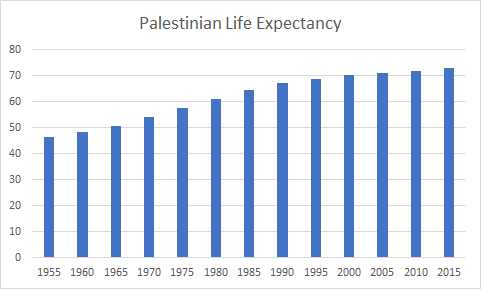
When the entire Palestinian territories were under direct Israeli rule from 1967-2000, Palestinian life expectancy increased from 54 to over 70. It has gone up since, too. 


Cole implies that somehow Israel is fully responsible for Palestinian health. But Israeli laws do not apply to the Palestinian health sector. This is international law under the Oslo accords. 

The Lancet noted in 2020:

With respect to the West Bank, the Oslo Accords state that health is under the aegis of the Palestinian Authority. As such, it is only in cooperation with the Palestinian Authority that health professionals in Israel can provide assistance to people in the West Bank. Sadly, the Palestinian Authority has decided on a general policy wherein opposing steps, which are claimed to represent so-called normalisation with Israelis, override such cooperation by forbidding Palestinian health-care personnel from working with their Israeli colleagues. We all have Palestinian associates who have privately expressed an interest in working together, but are afraid to stand out.  

Other factors that could affect life expectancy (and happiness) that elude the distinguished idiot professor is that a higher percentage of West Bank Palestinians smoke than in Israel (27% vs. 20%), Arabs tend to have more obesity and diabetes, and in recent years, the Palestinian Authority has banned its people from being treated in Israeli hospitals.

The biggest proof that Cole is an idiot comes from looking at the happiness index of other Arab countries that border Israel. 

While the Palestinian ranking is 122, it is higher than that of Egypt (129), Jordan (134) and Lebanon(145.) (Syria isn't ranked, but it certainly would also be lower than that of the Palestinians as well.)

Why would those people be unhappier than the Palestinians? None of the factors that Cole lists applies to them - yet they are worse off than the Palestinians that Cole says are practically enslaved by Israel! Apparently, "occupation" actually enhances happiness compared to Israel's non-occupied neighbors!

Cole's hate for Israel colors everything he writes about. It is rarely as clear as it is here. 

(h/t JW)


Read all about it here!

Monday, March 07, 2022

Nadia Abu El Haj is a professor of anthropology at Columbia University's Barnard College. 

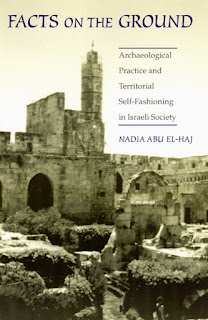
In 2002, she published "Facts on the Ground: Archaeological Practice and Territorial Self-Fashioning in Israeli Society." The book is meant to be a discussion of how Israel uses and misuses archaeology for its own political purposes.

But she asserts, in her own voice, something so shocking that it should disqualify her in her own field, in a section of her book that discusses Palestinian looting of Jewish artifacts at archaeological sites - something that is rampant.

Looting could well be analyzed as a form of resistance to the Israeli state and an archaeological project, understood by many Palestinians, to stand at the very heart of Zionist historical claims to the land. In James Scott's words, looting is perhaps a "weapon of the weak" [1985].
Here we have an anthropologist who is praising Palestinian looting of Jewish heritage - because it is "resistance." 

(James Scott's book, called "Weapons of the Weak," does not talk about looting of archaeological sites, and indeed does not appear to discuss the permanent destruction or loss of any major items. Abu El Haj is twisting his thesis.)

In Palestinian thought, any crime, including murder, is justifiable under the rubric of "resistance," so perhaps this shouldn't be considered too shocking. Yet this is an American-born professor of anthropology at an American university who is openly asserting that destroying Jewish culture is a good thing. (Her father is Palestinian.)

This is today's antisemitism, justified as a "principle."

(As I was researching this, I found an excellent critique of the entire book published here. )

(h/t Alex)


Read all about it here!

AddToAny

Printfriendly

EoZTV Podcast

Podcast URL

Subscribe in podnovaSubscribe with FeedlyAdd to netvibes
addtomyyahoo4Subscribe with SubToMe

search eoz

comments

Speaking

translate

E-Book

For $18 donation


Sample Text

EoZ's Most Popular Posts in recent years

Search2

Hasbys!

Elder of Ziyon - حـكـيـم صـهـيـون


This blog may be a labor of love for me, but it takes a lot of effort, time and money. For 20 years and 40,000 articles I have been providing accurate, original news that would have remained unnoticed. I've written hundreds of scoops and sometimes my reporting ends up making a real difference. I appreciate any donations you can give to keep this blog going.

Donate!

Donate to fight for Israel!

Monthly subscription:
Payment options


One time donation:

Follow EoZ on Twitter!

Interesting Blogs

Blog Archive