Friday, January 22, 2021

From Ian:
'We left the Middle East in good shape'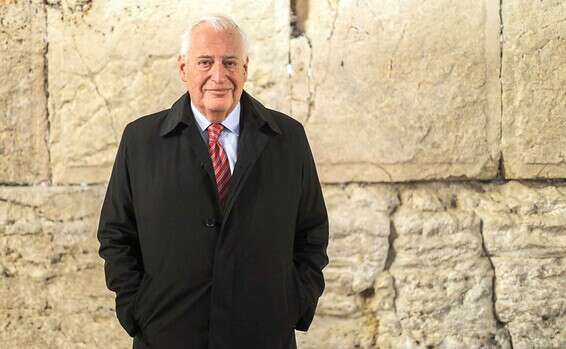
David Friedman reflects on Trump's revolutionary Middle East policies
The Palestinian Authority Is Still Paying Terrorists
'We left the Middle East in good shape'
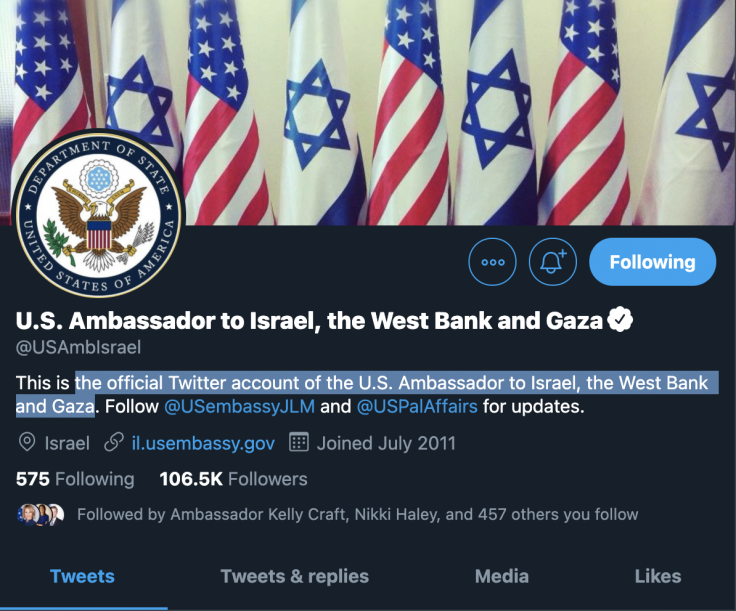
One morning in the winter of 2017 a young, unknown man arrived at the Kesher Israel synagogue in the heart of Washington. He prayed fervently, as if his heart was filled with a special request. His tallit bag bore the name "Friedman," and it was the only time he had come to the famous synagogue. That same day, his father David M. Friedman, was undergoing Senate confirmation for his appointment as US ambassador to Israel.
In the best tradition of Jewish divisiveness, powerful forces were aligned against Friedman Sr., led by the J Street lobby. But a few weeks later, in a ceremony organized by B'nai B'rith International, Friedman made his first speech as ambassador.
"If you were wondering about my middle name, Melech, it's not because my parents expected great things of me, but because my grandmother was named Malka [the feminine version of the name]," he began the speech, causing the audience to double over with laughter.
The prayers of his son and his parents had come true. Not only was the appointment approved, but David Melech Friedman became the most influential US ambassador in the history of US-Israeli relations. And not only through the steps known to everyone – stamping down Iran, recognizing Jerusalem as Israel's capital, relocating the US Embassy in Israel to Jerusalem from Tel Aviv, recognizing the Golan Heights as Israeli and shaping the Trump peace plan – but also through endless moves that never made headlines in the dramatic Trump era. For example, visits to the Golan Heights, to Ariel in Samaria, and the City of David in Jerusalem – all of which would have been inconceivable prior to Freidman's arrival.
After four intense years, Friedman sat down with Israel Hayom for an "exit interview." For decades, the American Consulate on Agron St. in Jerusalem served as a conduit through which the Palestinian Authority would spread its lies and incitement into Washington. Friedman shut down the consulate and turned it into the official residence of the American ambassador in Jerusalem.
David Friedman reflects on Trump's revolutionary Middle East policies
Friedman emphasized the extensive efforts the Trump administration took to make the agreements a reality, highlighting his senior adviser Aryeh Lightstone’s travels throughout the region to foster agreements between Israel and the other countries’ governments once normalization was announced.
“The Abraham Accords are still new; they need to be nurtured,” Friedman said. “I hope we can continue to nurture this relationship. It’s too new to leave it on its own.”
Friedman’s advice to his replacement would basically be to leave Israel be. He argued that there is a consensus that the Trump administration did a good job in the Middle East, and the next administration would do well to address other problems in the world and domestically.
“We left our relationship with Israel as strong as it has ever been, and it is reciprocal – we are getting an excellent return on investment in Israel that should be maintained. The Abraham Accords have been transformational and need to be maintained.... The issues that tend to occupy people’s attention are all in a good place,” he said.
As such, Friedman said, “the short answer [is that], oddly enough, of all places, the Middle East is pretty good. You should leave well enough alone.
“There are lots of other problems – China, Russia, domestic issues. There is plenty to work on. Leave the Middle East alone. Leave Israel alone, on the path that it is on,” he suggested.
Now that Friedman is no longer ambassador, what is next for him?
Trump’s former bankruptcy attorney said he does not plan to return to practicing law.
First, the departing ambassador plans to write a book about his experiences.
Then, Friedman says, he hopes to continue to have a positive impact in Israel.
“I’m going to find a way to be relevant in this space,” he promised.
I wish President Biden well and hope he succeeds for all Americans. No criticism for now but a simple question: Do you still support UNSC 2334 which US permitted to pass in lame duck days of your last term? If that’s still policy God help us all!
— David M Friedman (@DavidM_Friedman) January 21, 2021
The Palestinian Authority Is Still Paying Terrorists
In 2018, the United States Congress passed the Taylor Force Act, which ended U.S. aid to the PA unless the latter ceased paying stipends to terrorists and their families. The legislation is named after Taylor Force, a 28-year-old U.S. Army vet who was stabbed to death by a Palestinian terrorist while he was visiting Israel for his MBA program. Force's murder helped galvanize efforts to penalize the PA and end "pay to slay." In 2019, Israel enacted its own version of the Taylor Force Act, which deducted the amount that the PA pays to terrorists from tax revenues that the Jewish state collects and transfers to the authority.
Yet, the PA has been unbowed.
In a Sept. 26, 2019 speech before the U.N. General Assembly, PA president Mahmoud Abbas declared, "Even if I had only one penny, I would've given it to the families of the martyrs, prisoners and heroes." Abbas's boast of paying people to murder Jews was met with applause. And the PA's actions match his words. In the first five months of 2019 alone, the PA paid terrorists and their families $66 million—an 11.8 percent increase from the previous year.
Abbas has also tried to hide the "pay to slay" program. As journalist Donna Rachel Edmunds observed in May 2020, "monthly budget documents prepared by the Palestinian Authority for 2020 show that it is attempting to hide the salaries that it pays to terrorists from international donors, making a sham of its commitment to financial transparency." Edmunds cited research from Palestinian Media Watch, which found that "the PA is diverting the payments through the Palestine Liberation Organization (PLO), a trick it has used in the past."
Indeed, as AFP reported in June 2020, Abbas ordered his security services to destroy "secret documents, fearing possible Israeli raids on their offices." The Committee for Accuracy in Middle East Reporting and Analysis noted at the time that the PA might have had the past in mind. An Israeli raid in September 2000 resulted in the seizure of PA and PLO documents which showed that "senior Palestinian Authority officers were actively involved in terrorism, providing logistical and financial assistance" to other terrorist groups.
There is no evidence that the PA, facing a new U.S. administration, intends to reduce its support for terror. In January 2021, the authority announced that it was creating the "Alive and Provided For" initiative, which plants trees in honor of terrorists. Jibril Rajoub, a prominent PA official and possible successor to Abbas, declared, "these martyrs are the most sacred thing that we have."
Policymakers and press alike should take note.