Friday, October 04, 2019

From Ian:
Seth Frantzman: Israel appears strong, but there are risks ahead
Amb. Alan Baker: The EU Demonstrates a Distinct Political Bias Against Israel
Seth Frantzman: Israel appears strong, but there are risks ahead
BUT ISRAEL has some issues on the horizon that, if they would come together at the wrong time, would be a perfect storm. Among these is the increasing hostility of Turkey. Ankara has become more nationalist and religious-nationalist, a toxic mix. It is flexing its muscles, taking over swaths of northern Syria and seeking to keep on track to totally remove the Americans from the region. That would be a setback for the US – and setbacks for the US also impact Israel. Turkey is buying the S-400, not in itself a problem for Israel. Ostensibly, both Ankara and Jerusalem have an interesting relationship with Moscow today, borne of Russia’s increased role in the region, particularly in Syria.Jpost Editorial: No Third Election
Russia’s role in Turkey is strategic and also related to energy and Syria. This can impact Israel in a complex way. Turkey’s current government is seeking to take up the mantle of being the main opposition to Israel in the region. It bashes Israel over Jerusalem, and its media run hyperbolic stories about Israeli abuses. Turkey is close to the Muslim Brotherhood today and wants to see Hamas have a more prominent role in Ramallah. Yet Israel can deal with Turkey’s anger. The question is whether it can deal with the emerging Turkey-Iran relationship.
Iran has been a challenge for Israel due to a variety of reasons, but lately it is capitalizing on the weakness of its adversaries. That means it is increasingly playing a role in Iraq, Lebanon, Syria and Yemen. That means it is transferring precision missile technology to Hezbollah.
Iran’s IRGC says that it can destroy Israel. It launched an attack on Saudi Arabia on September 14 that has ramifications for Israel. That Riyadh did not respond shows that Israel’s supposed common interests with the Gulf are more problematic than in reality. Saudi Arabia won’t confront Iran. So who will confront Iran? The US? No. The US has signaled it will not. And the next US administration may be more pro-Iran than this one. That could give Tehran what it wants in Syria, which means a kind of “land bridge” that ends near the Golan and threatens Israel.
What Israel faces today is potentially two strong adversaries in Turkey and Iran, although they are quite different in how they confront Israel. Turkey uses soft power; Iran uses hard power. But Israel, appearing strong, now faces these challenges in some ways alone. It is not like the 1950s, when Israel was truly alone. Israel has made major inroads in India, China and elsewhere. But the immediate challenges are still there. It is dangerous to be too confident and arrogant today, and it is essential that Jerusalem seek to analyze and deal with these challenges in the long-term because short term planning won’t work. Iran thinks in the long term – and its role in the region is a long-term role.
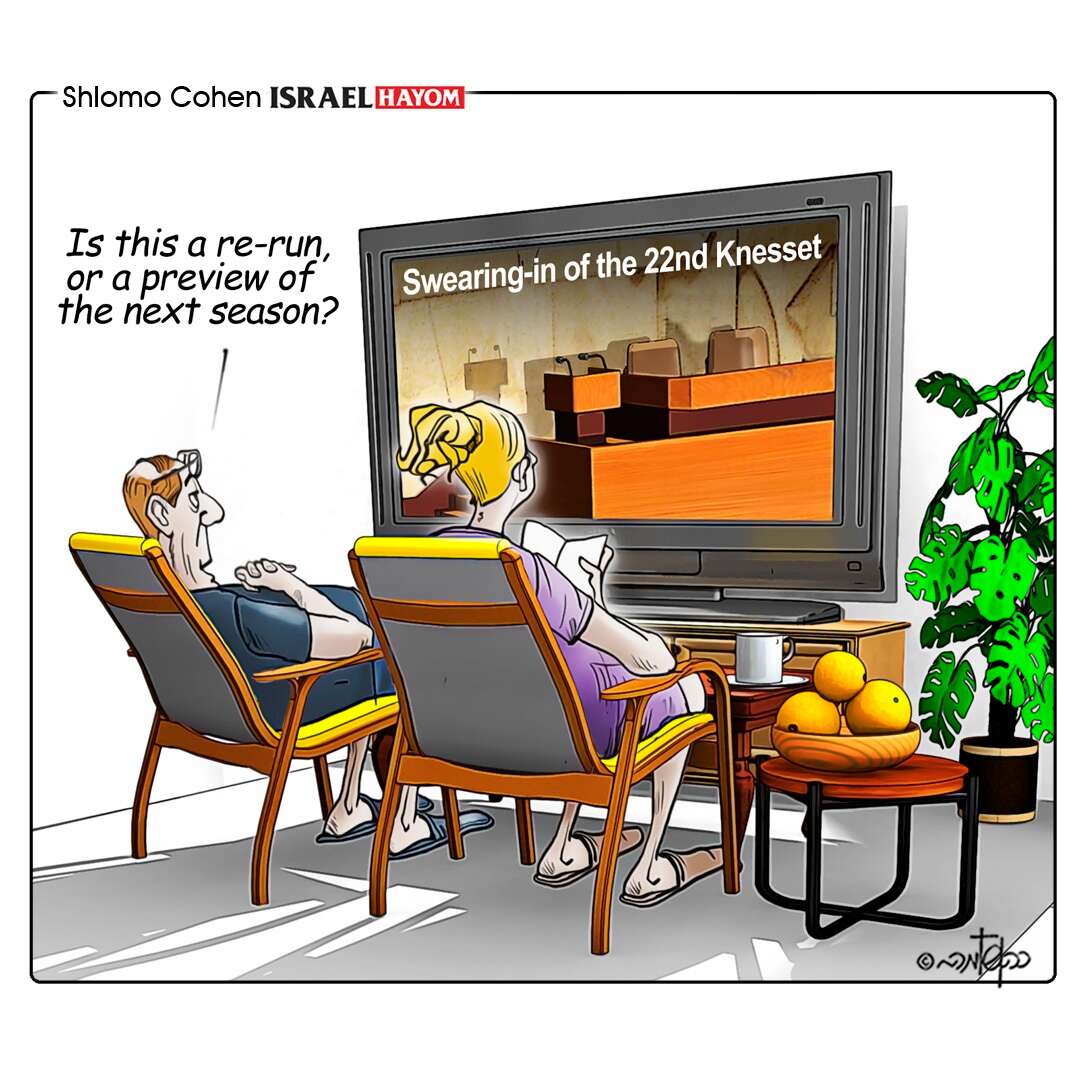
Against that backdrop, the 22nd Knesset was sworn in on Thursday in Jerusalem. Many are wondering if, like the 21st Knesset, it will also last for less than two months and perhaps become the shortest-lived legislature in Israel’s history.
As the Post’s Lahav Harkov pointed out on Wednesday, there are only eight new members of this Knesset, as well as another nine who are returning from past stints as legislators, which means that 103 members of the 22nd Knesset will be sworn in for the second time this year.
A proud institution, the Knesset is in danger of becoming a laughing stock. But it’s no joke. Israel needs a stable government and a stable Knesset. Every attempt must be made to prevent the newly sworn-in Knesset from becoming the shortest Knesset in Israeli history.
All parties should take the responsibility upon themselves as if they alone are charged with insuring that a third election is not called for. The country has survived some nine months of paralysis, but it’s only a matter of time before the string starts to unravel out of control and the situation begins to do irreparable damage to Israel and its population.
At Thursday’s ceremony, Knesset Speaker Yuli Edelstein led the MKs with “I pledge allegiance to the State of Israel and to faithfully fulfill my mission in the Knesset.” And the newly sworn-in lawmakers responded: “I pledge.”
Let’s hope they take that allegiance and mission seriously and prevent a third election.
Amb. Alan Baker: The EU Demonstrates a Distinct Political Bias Against Israel
European Union Special Representative for the Middle East Peace Process Susanna Terstal, writing in the Jerusalem Post on Sep. 21, evidently believes that incessant repetition of the phrase "two-state solution" adds some element of legitimacy and feasibility to the idea. But the two-state solution has never been agreed-upon between Israel and the Palestinians, and does not figure in any of the agreements between them. It is nothing more than an expression of wishful thinking within the UN and the EU.
To the contrary, the Oslo Accords, to which the EU itself is a signatory, clearly leaves the issue of the permanent status of the territories to be decided in negotiations. Thus, whether the outcome will be one, two or three states, or a federation or confederation, remains on the negotiating table. By incessantly plying a two-state solution, the EU is in fact prejudging an agreed negotiating issue.
Suggestions by Israeli leaders to "apply sovereignty" led EU representatives to complain that unilateral modification of the Oslo Accords "undermines the entire agreement" and "dismantles Oslo." One wonders why the EU did not view the recent declarations by the Palestinian leadership canceling the territorial division between areas A, B and C in a similar light. Did this not undermine the accords?
The EU representative also expressed support for a "Palestinian state based on the 1967 lines." Yet the issue of borders is an agreed-upon permanent-status negotiating issue, and her presumption of a Palestinian state based on the 1967 lines clearly contradicts and prejudges both the Oslo Accords and UN Security Council Resolution 242 of 1967.
The EU cannot in good faith claim that it does not take sides in the conflict. The EU has not only taken sides, but clearly demonstrates a distinct political bias against Israel in virtually all its positions, policies, statements and dealings regarding the Israeli-Palestinian negotiation process.