النشيد الوطني الإسرائيلي من جبال مدينة تطوان بالمغرب. فيديو أرسله مواطن مغربي. ما أجمل السلام 🇲🇦🇮🇱 pic.twitter.com/WzlTN5OOBN
— إسرائيل بالعربية (@IsraelArabic) January 21, 2021
Friday, January 22, 2021
Elder of Ziyon
Friday, January 22, 2021
Elder of Ziyon
Thursday, January 21, 2021
Elder of Ziyon
COVID-19
Douglas J. Feith: Why I’m a Zionist
There are negative reasons to be a Zionist - that the Jews need a state because they need a refuge. That argument launched the Zionist movement in the 19th century and it remains valid to this day.
There are also affirmative reasons that relate to Jewish civilization. They boil down to the conviction that Jewish culture is an invaluable inheritance that only in the Land of Israel, in a state with a Jewish majority, can be developed fully and perpetuated reliably. As an adult, I came to appreciate the positive reasons to be a Zionist.
To be a Zionist is to revel in the ways Israel has integrated Jewish principles and traditions into the daily life of a large, modern, democratic society. Israel is where Jewish collective interests prevail, so they enjoy the dignity of self-reliance and self-defense. Hebrew is the main language. Jewish history inspires the geographical names. Jewish subjects have a special place in the schools. The Jewish religious calendar influences the rhythm of life.
In general, the American political tradition is averse to official privileges for particular ethnicities or faiths. But the way Americans practice democracy is not the only way. Most liberal, democratic countries were founded on an ethnic basis. Most give special consideration to the majority population's cultural interests.
CAMERA Op-Ed A Historian Who Forgets History
More than 100 years ago, George Santayana famously intoned that “those who cannot remember the past are doomed to repeat it.” The Spanish philosopher’s warning has often been repeated. Regrettably, it is often ignored, including by many historians.WaPo, ABC, CBS Run with AP Piece Denouncing Israel’s Defense Against ‘Apartheid’ Smear
Avi Shlaim provides the latest example. In a Dec. 22 op-ed in Foreign Policy magazine titled, “If Biden Wants Israeli-Palestinian Peace, He Must Break with the Past,” Shlaim seeks to provide the incoming U.S. administration with advice on how to “achieve in the Middle East.” The Oxford University professor emeritus has even found the culprit for the lack of Israeli-Palestinian peace.
“The basic flaw in the U.S. approach to Middle East peacemaking since 1967,” he claims, is “the unconditional nature of its economic, military and diplomatic support for Israel.” He elaborates, saying “the United States has posed as an honest broker, but in practice, it has acted more as Israel’s lawyer. This has made its policy for resolving the Israeli-Palestinian conflict incoherent, contradictory and self-defeating.” The United States, asserts Shlaim, has held a “monopoly” over peacemaking efforts and has failed “because it was unable or unwilling to use its massive leverage to push Israel into a final-status agreement.”
The implication is clear: Israel at fault for the lack of a permanent peace agreement between Israelis and Palestinians. And America shares the blame for its supposedly uncritical support of the Jewish state.
The solution, Shlaim tells Foreign Policy readers, is for the United States to “impose penalties for Israeli intransigence.” The United States should encourage Israel to adopt the 2002 Arab Peace Initiative, and should it refuse, the Jewish state should be deprived of aid. That proposal, writes Shlaim, would have provided the Palestinians with an independent state on the Gaza Strip and a capital city in eastern Jerusalem.
But Shlaim’s recommended strategy is based on a selective reading of history.
Indeed, his commentary is replete with omissions and misrepresentations.
In fact, Palestinian leaders have been presented with numerous opportunities for statehood, and they alone are responsible for refusing them. In 1937 and 1947, Palestinian Arabs rejected British and U.N. proposals for statehood—proposals that were accepted by the Zionists.
Major news organizations, including The Washington Post, ABC News and CBS News reprinted an Associated Press (AP) article that incorrectly portrayed as undemocratic a move by Israel’s education minister to bar members of B’Tselem from giving presentations or conducting other activities in publicly-funded schools. The decision was made after the controversial group, which supports the anti-Israel Boycott, Divestment, Sanctions (BDS) movement, published a report in which it accused the Jewish state of being an “apartheid regime.”
Lost in the mix, however, is that the Israeli government has not banned B’Tselem from assuming any position; rather, Jerusalem has determined, in accordance with the law, that state-funded schools are not appropriate vehicles through which to slander Israel.
Apartheid: Not Part of the Israeli School Curriculum
When announcing the decision, Education Minister Yoav Gallant said that organizations like B’Tselem “contradict the goals of the education system, including calling Israel false disparaging names, opposing Israel as a Jewish, Zionist and democratic state, discouraging meaningful service in the IDF, or acting to harm or degrade IDF soldiers during or after their service.”
Yet, the AP story casts doubt on the legitimacy of the move by Israel’s democratically-elected government by quoting a representative of Adalah, another pro-BDS organization that is innocuously described as an “Arab legal rights group:”
Adalah said it had appealed to the country’s attorney general to cancel Galant’s directive, saying it was made without the proper authority and that it was intended to “silence legitimate voices.”
In reality, the Israeli parliament in 2018 passed legislation authorizing the education minister to prevent members of groups that “act against the goals of education and against the IDF from entering schools.” The law was intended to curb organizations from fanning flames of hatred against Israel through the promotion of the BDS movement’s annihilationist agenda.
This critical fact is, by happenstance, mentioned in the AP article — buried in the ninth paragraph below the Adalah quote — but thereafter includes this modifier: “It was not clear if Galant’s decree was rooted in the 2018 law.”
Yes, it was.
Thursday, January 21, 2021
Elder of Ziyon
analysis, B'tselem, Daled Amos
I think the word apartheid is useful for mobilizing people because of its emotional power
We do not take a unified stance on BDS, Zionism or the question of statehood.
Yet, a careful viewing of the clip (with Hebrew and Arabic dialogue) reveals that the exact opposite was the case; the policemen invited the mother to accompany her child. At 2:07 minutes into the video, one of the policemen says to the mother, “Come, come, get in.” The cop then asks one of the people standing nearby, “Is that his mother?” When the bystander answers in the affirmative, the policeman repeats, “Get in with him” (the boy). The door is opened for her and she is about to get into the vehicle, as the policemen are saying “get into the car,” but then (2:27) the mother is pulled away from the car by the Palestinian man wearing a black jacket. After the policemen closes the van’s door, a woman wearing a pink shirt pushes the mother towards the vehicle, and then the mother bangs on the door, a heartrending scene.
Responding to the piece with a statement on its Facebook page, B’Tselem said that while it opposed tortures and executions, reporting Palestinians interested in selling land to Israelis to the PA was “the only legitimate course of action.”When they defended Nasser Nawaja on their Facebook page, B'tselem added a picture describing Uvdah as "Uvdah For Hire"
Why do human rights activists turn to such immoral methods? Many of them do it because of anger and because of fear. They are angry at a country that refuses to accept their political recipe for Israel. They fear that their activity of many years will be in vain as the country moves in a direction they disagree with.Speaking of the name-calling by human rights activists -- and by B'tselem in particular -- B'tselem recently came out with a report fulfilling Montell's admiration for the usefulness of the word Apartheid "for mobilizing people because of its emotional power."
The angrier they become, the more apprehensive they become – the more they lose their inhibitions. Thus they turn to immoral methods, they turn to other countries to look for the support they cannot get among Israelis, and they turn to language that makes Israel a caricature – a fascist state, an apartheid state, a villain among nations. They say that they act out of love of Israel – and some of them certainly do – but with time and frustration some are made hateful. And hate makes them lose the ability to separate right from wrong, acceptable from unacceptable, useful from not-useful.
But CAMERA's Tamar Sternhal asks the nagging question: Is B'Tselem Israel's 'leading human rights organization'?
Progress in improving human r.ights in Israel and the West Bank is a legal battle waged in the Knesset and the courts, and in recent years B’Tselem has zero presence, activity and accomplishments in these areas. Tellingly, B’Tselem’s 2019 Activity Report mentions no action taken in the Knesset or courts...On the international level of advancing human rights, the battle is waged at the United Nations Council on Human Rights in Geneva, and B’Tselem is absent from that key venue as well.What's left?
If those foreign governments are really interested in change, they might be better served supporting the Association for Civil Rights in Israel and Worker's Hotline. Sternthal lists their activities -- and accomplishments.
Thursday, January 21, 2021
Elder of Ziyon
humor, Preoccupied
I Think The Other Hamas Fighters Trapped In This Collapsed Tunnel Are Closer Than 2 Meters
by Hussein Halabi, Hamas commando
Somewhere underground near the fence between the Gaza Strip and southern Israel, January 21 - Oh God. I think both of my legs are broken. And several ribs. And I can't feel my left arm. There's so little air in here, and it's dark. We were on our way across the border to wreak havoc among the Zionists, but then we heard a rumble and everything came tumbling down. And I think some of my comrades are half-crushed right near me in a non-socially-distanced manner!
This can't be good. No one can hear me, and it hurts to yell - I think that's my broken ribs. I don't hear anyone else, but maybe that's just my ears still malfunctioning after the loud crunch... I don't know. I'm really concerned I could get COVID my being so close to someone carrying the virus by spending all this time cooped up together with them in a confined space. If I don't suffocate or dehydrate and I end up surviving this, I could be in big trouble.
Oh, God, every part of me hurts. There's blood on my head from somewhere, probably a gash. My face feels like it's been battered in a boxing ring. I probably have dozens of cuts that will get infected from all the dirt getting in, but what concerns me most is possibly being near my buddies, one of whom might be a coronavirus vector. It can't be good to be stuck down here with that risk. My mask got torn off in the tunnel collapse and there's no way I can even dig to find it, let alone hope it's in any shape to be used; my guess is the same thing happened to the other seven guys, assuming any of them are still alive, meaning they could be breathing a viral load out into this enclosed area and I've got no choice but to inhale.
I've been so careful! I was always so considerate of the people around me. When we launched incendiary balloons at the Jews I always made sure to social distance. When we launched rockets at their school and hospitals I made sure my mask was always on. Same as when we came down this passage, both during practice runs and this, the real thing. And now, just my luck, I'm going to breathe in the pathogen and contract the disease. After all that preventive behavior. I call B.S.
Wait, is that light someone coming to rescue us? It seems to be drawing me closer... Whoever that is, keep your distance, I don't want to infect you...
Michael Oren: The Case Against the Iran Deal
The JCPOA allowed Iran to both maintain its nuclear program and revitalize its economy. Biden must make clear to Tehran that it can have one or the other, but not both. Tragically, spokespeople for the new administration are proposing to return to the JCPOA and lift sanctions, and only afterward negotiate a longer, stronger deal. Such a course has no chance of success. Even a partial lifting of sanctions would forfeit any leverage that could compel the regime to negotiate a deal that genuinely removes the danger of a nuclear Iran. At best, the regime will agree to cosmetic changes—for example, extending the sunset clauses—but not to dismantling its nuclear infrastructure. A fatally flawed deal would remain essentially intact.JINSA (PodCast): After the Abraham Accords: Relocating Israel to CENTCOM’s AOR
The Biden administration must resist pressure from members of Congress and others who are urging an unconditional return to the JCPOA. Even the deal’s fervent supporters need to recognize that its fundamental assumptions—that Iran had abandoned its quest for a military nuclear option and would moderate its behavior—have been thoroughly disproved.
At the same time, America must consult its Middle East allies about what they think a better deal would look like. Such a deal would verifiably and permanently remove Iran’s ability to develop nuclear weapons. This means not merely mothballing the nuclear infrastructure, but eliminating it. It means empowering international inspectors with unlimited and immediate access to any suspect enrichment or weaponization site. It means maintaining economic and diplomatic pressure on the regime until it truly comes clean about its undeclared nuclear activities and ceases to develop missiles capable of carrying nuclear warheads. A better deal will deny Iran the ability to commit the violations it is now committing with impunity.
Achieving these objectives will require close and candid cooperation among the United States, Israel, and concerned Arab states. Such cooperation was not possible in the negotiations leading up to the JCPOA, which America initially conducted behind the backs of its Middle Eastern partners. In the final stages, U.S. officials misled their Israeli and Arab counterparts about America’s negotiating positions. This displayed not only bad faith, but a patronizing presumption of knowing the vital security interests of the countries most threatened by Iran better than they knew those interests themselves.
The incoming administration has declared its determination to restore the trust of America’s allies, along with promoting peace and human rights. But those objectives are incompatible with renewing a deal that betrayed America’s allies, strengthened one of the world’s most repressive regimes, and empowered the Middle Eastern state most opposed to peace.
The JCPOA is also incompatible with President Biden’s long-standing commitment to Israel’s security. At a 2015 gathering celebrating Israel’s independence, then–Vice President Biden said: “Israel is absolutely essential—absolutely essential—[for the] security of Jews around the world … Imagine what it would say about humanity and the future of the 21st century if Israel were not sustained, vibrant and free.”
Reviving the JCPOA will endanger that vision, ensuring the emergence of a nuclear Iran or a desperate war to stop it. Biden is a proven friend who has shared Israel’s hopes and fears. He must prevent that nightmare.
The recent Abraham Accords have solidified a growing anti-Iran coalition in the Middle East, and the latest decision to move Israel to CENTCOM’s Area of Responsibility reflects and reinforces this changing dynamic within the region. Jonathan Ruhe, Director of Foreign Policy at JINSA’s Gemunder Center, joins Erielle to discuss the importance of this relocation, the reasoning behind the decision, and what we might expect from future administrations when it comes to Israel’s role within CENTCOM.
Khaled Abu Toameh: Palestinians: Victims of an Arab Country
Like most Arab countries, Syria denies citizenship to Palestinians. Children born in Syria to fathers who are Palestinian nationals are considered Palestinians, not Syrian nationals.PMW: American values are incompatible with funding UNRWA and the PA - watch lecture by Itamar Marcus
Palestinian leaders see no evil or wrong-doing when their people are being killed, injured, displaced, arrested and tortured in an Arab country. The attention of these leaders is solely focused on Israel, which they denounce day and night not only for what it does, but also for what it does not do.
On January 9, Abbas entered the 17th year of his four-year term. He is again talking about his desire to hold new elections. This charade is played at least once or twice a year so that people will believe that he really wants elections.
The Palestinians do not need new elections. They need new leaders who will guide them out from their longstanding morass into a future of promise and peace.
Itamar Marcus explains why funding UNRWA is the international communities’ worst investment ever: because “UNRWA is just growing refugees,” in his recent webinar/lecture to the DC-based EMET organization.
During the 12 years of the last two American administrations, Palestinian refugees have grown by a million from 4.6 million - 5.6 million, according to reports by UNWRA. Billions of American dollars during this period were invested – presumably to solve the refugee problem – but instead UNRWA used the money to literally increase the refugee problem.
Funding of UNRWA should be conditional upon saving 300,000 people a year by removing them from refugee lists and giving them a life and a future. Instead, UNRWA abuses nearly 100,000 additional people each year, by condemning them to be refugees. Funding UNRWA is supporting the abuse of human beings for political purposes.
Funding the PA likewise contradicts fundamental American values. The PA uses its money to reward terrorists, glorify terrorists, fund terror organizations, disseminate vicious Antisemitism, celebrate the murder of Israelis and Jews, and deny Israel’s right to exist.
There is no logical reason why any US administration would want to support entities so diametrically opposed to American values.
Thursday, January 21, 2021
Elder of Ziyon
Pick a Special Envoy to Monitor and Combat Antisemitism who will be committed to fighting neo-Nazis and white nationalists, not Palestinians and students.Your Special Envoy to Monitor and Combat Antisemitism must be someone who will be a true leader of this larger effort in building long-term structures that can fight and dismantle the far-right and create a multiracial democracy so that everyone in our country can move forward together.
Thursday, January 21, 2021
Elder of Ziyon
cartoon of the day, humor
Thursday, January 21, 2021
Elder of Ziyon
Opinion, Vic Rosenthal
Vic Rosenthal's weekly column
As I write this, preparations are underway for the swearing-in ceremony of a new President of the US. Nobody truly knows what this will mean for us in Israel. Caroline Glick, who can be depended on to see the dark side – often, unfortunately, correctly – finds Biden’s appointments of numerous former Obama officials, some of whom are demonstrably anti-Israel, to be evidence that the new administration will return to the almost maliciously anti-Israel policies of the Obama Administration.
On the other hand, as Bret Stephens notes (in a masterful piece that I hope will be required reading for Biden and his people), the situation has drastically changed since Obama pursued his diplomatic assault on Israel. Everything is different (except perhaps the Palestinians). Israel, Iran, the Arab nations, and the situation in the USA have all undergone significant changes. The damage to American interests from continuing Obama’s policy today would be even greater than in 2008-2016.
But not all politics is rational, as history amply demonstrates. Bad regimes sometimes follow policies dictated primarily by the misapprehensions, prejudices or even obsessions of their leadership rather than the interests of their nations. The Obama Administration was one of those.
Indeed, its interpretations of the intentions of the Palestinians and the Iranian regime – which could be determined simply by paying attention to their words – were so far from reality that I often found myself asking, “stupid or evil?” Did American officials really think that the Palestinians would be satisfied with a peaceful state alongside Israel if only the right concessions were forced out of us? Did they really believe that the agreement with the Iranians would prevent them from getting nuclear weapons, or even significantly slow them down?
There was also an ideological element, a clear affinity of Obama himself to the Muslim opponents of Israel that was demonstrated by the speech he delivered in Cairo shortly after his inauguration. There was his comparison of the Palestinians to black Americans, one of the worst possible analogies. And there was his antipathy for our Prime Minister, which he famously shared in an off-mike chat with the French president. Taking all this into account, one can be excused for thinking that one of the deliberate objectives of Obama’s policies was to weaken and hurt Israel.
While these personal characteristics of Barack Obama do not apply to Joe Biden, he does seem to believe in the traditional (and wrong) principles of American Middle East policy, such as the primacy of creating a sovereign Palestinian state in bringing normal relations to the region. He agrees with Obama that Israeli settlements in Judea and Samaria are “illegitimate and an obstacle to peace,” a position that the State Department reversed under Trump.
American policy toward the Palestinians, going back to the Clinton Administration, has always been to provide ample financial aid to them and get Israel to make concessions up front, both territorial and practical (like freeing jailed terrorists). And Obama’s Iran policy was heavily front-loaded with financial benefits to Iran. One would think that professional diplomats would understand why this strategy failed over and over. Both the Palestinians and the Iranians have objectives that they cannot be paid to give up. Giving them presents only made them ask for more, and in both cases they used the money to pay for terrorism.
The non-professionals of the Trump Administration did understand this. They reversed course and applied economic pressure to both the Palestinians and the Iranian regime, in order to create leverage for negotiations. Unfortunately, the policy hasn’t been in place long enough to tell if it will work, but the desire to be “not-Trump” may cause the new Administration to end sanctions on Iran and re-fund the PA and UNRWA – making failure a certainty. Biden has already promised to restore Trump-suspended payments to UNRWA, the Palestinian refugee agency, thus continuing the decades-long growth of a hostile population of heavily indoctrinated, stateless welfare clients.
We can also expect a resumption of objections from the US against Jewish construction in Judea/Samaria and Eastern Jerusalem, joining the chorus from Europe. It wouldn’t surprise me if another unannounced but near-total freeze on construction will soon go into effect.
In more encouraging news, recent comments by Anthony Blinken, Biden’s nominee for Secretary of State, indicate that he doesn’t intend to reactivate the Iran deal immediately. Nevertheless, we should watch for any loosening of the Trump-applied sanctions on Iran as an indication of the likely direction the administration will take.
Israel has been engaged in a “war between the wars,” against Iranian installations in Syria. The Trump Administration did not interfere. I expect that attacks against these targets will be less frequent under the new administration. A warning sign will be if they stop entirely.
I had hoped that Israel would utilize the last weeks of Trump’s term to destroy the Iranian nuclear installations, perhaps even with American help; but apparently our PM and the IDF believe that their lower-level activities are effective enough that such an ambitious project wasn’t needed. We might regret this later; I will be very surprised if it happens under Biden.
All of the above is based on the assumption that the “moderates” in Biden’s administration, including Biden himself, will be in control. And here is where the real scary stuff begins.
Biden is 78 years old, older than any other American president at the time of his inauguration (Trump was 70 and Ronald Reagan was not quite 78 at the end of his second term). He certainly does not appear to me, admittedly a non-professional, to be at the top of his game … or worse. Even if he remains as president for a full term, it’s hard to imagine that he will be calling the shots. His vice president, Kamala Harris, is an unknown quantity in the area of foreign affairs. And there are strong forces that will be trying to exert their influence on the administration – unfriendly ones.
One is the left wing of the Democratic party, which supported Bernie Sanders for the presidency, and which is strongly anti-Israel. The other is the Obama organization.
When Barack Obama left the White House, he did not retire from politics and retreat to his home state, like so many other ex-presidents. Rather, he bought a home in walking distance to the White House, and transformed his highly effective campaign fund-raising organization into a social action group, with both domestic and foreign policy goals. It’s hard to believe that he will not try to exert influence over the new administration.
I believe that Israel will be able to work with an administration that is somewhat less friendly than that of Trump, as long as it is honestly interested in regional peace. Israel will present the evidence – which is overwhelming – that Iran wants to develop nuclear weapons; indeed, is developing them now. Together with its new allies in the Arab world, it will argue that continued maximum economic and diplomatic pressure is the most effective way to stop Iran, short of war.
I believe also that Israel will be able to convince such an administration that the real reason for the lack of progress with the Palestinians is their refusal to accept the existence of a Jewish state with any borders. We will explain that the development of Israel’s relations with other Arab states means that Palestinian sovereignty can be delayed indefinitely, until the Palestinians are prepared to accept the legitimacy of the nation state of the Jewish people.
But if the American administration undergoes a sharp turn toward the left, either as a result of a takeover by the left wing of the Democratic Party or from the influence of the Obama organization, we could see a return of Obama-era pressure for concessions, restrictions on our actions, and appeasement of Iran.
We’ve made a great deal of progress in the past four years. It would be a shame if it were reversed.
We’ll find out in the next few months.
-- Victor
Wednesday, January 20, 2021
Meir Y. Soloveichik: Israel’s Vaccine Triumph
This lesson is the essence of Jewish identity. Rabbi Joseph Soloveitchik noted that “Israel,” the name given by the Bible to the chosen nation, originally belonged to the patriarch also known as Jacob. This, he argued, is no coincidence: Jacob, he pointed out, is the only biblical progenitor who is seen interacting not only with children but grandchildren. Drawing Joseph’s sons Ephraim and Menashe to him, the patriarch blesses them in the name of Abraham and Isaac, linking ancestors to descendants. We are all named for Israel because the original Israel, in joining generations, is our polestar; a nation that emulates his life cannot die.
With the coming of the vaccine, our forefather Israel was imitated in modern Israel. As Israeli seniors swarmed the vaccinations centers, one of them, Amnon Frank, expressed to the Israeli media what drew him there. “A grandchild without a hug is half a grandchild,” he reflected. “We haven’t hugged them since March.” This single succinct sentence captures the meaning of l’chayim; life is truly life when it is shared.
These two Israeli sets of statistics—the vaccination of the old and the perpetuation of the young—are two trends that are wholly connected with each other. A country that toasts l’chayim, a society that desires life, illustrates what life truly means. It ensures that grandfathers and grandmothers are written in the book of life, so that they are thereby able to embrace their grandchildren once again.
In one of the most famous of Talmudic tales, a group of rabbis beheld a Jerusalem devastated by Rome and wept, while one of their colleagues, Rabbi Akiva, laughed and stubbornly cited the prediction of the prophet Zachariah: “There shall yet old men and old women dwell in the streets of Jerusalem, and every man with his staff in his hand for very age. And the streets of the city shall be full of boys and girls playing in the streets thereof.” The story is cited as an example of profound faith, as indeed it is. But perhaps Akiva’s insight also is that the prophetic verse, joining grandparents and grandchildren, contained the secret of Jewish survival: A nation that reveres its elders and celebrates new life would outlast an empire that glorified war and death. In Israel today, Akiva’s seemingly preposterous prediction has come true, as the world discovers new meaning in the mantra am Yisrael chai—the nation of Israel lives.
I’m a so-called Palestinian.. I was born in Kuwait, now live in Israel on a permanent residency.. in this picture you see me getting my first covid shot..
— Mark Halawa - مارك حلاوه (@HalawaMark) January 19, 2021
How racist can Israel be to vaccinate a non-citizen Arab who is fraudenlantly claimed as a Palestinian refugee by PA & UNRWA https://t.co/OflSVLm4eS pic.twitter.com/ShwNmedjCU
Shumuely Boteach: Should Europe’s Jews move to Israel? - opinion
On Sunday, The Guardian reported the depressing fact that “almost half of British Jews avoid showing visible signs of their Judaism in public, such as a Star of David or a kippah, because of antisemitism,” according to a new study.Biden Changes U.S. Ambassador to Israel Twitter Name to Include West Bank and Gaza
“The Campaign Against Antisemitism and King’s College London gave 12 statements that participants in the survey were asked to agree or disagree with,” The Guardian reported. “Twelve percent showed ‘entrenched antisemitic views’ by agreeing with four or more of the statements. The one that had most backing was ‘Israel treats the Palestinians like the Nazis treated the Jews,’ affirmed by almost a quarter (23%) of respondents.” That’s pretty sobering. But it gets worse. “Among the general public, a similar proportion agreed with one or more antisemitic statements put to them, pointing to a ‘deeply troubling normalization of antisemitism.’”
Is anyone surprised? The question is what to do about growing European antisemitism. Should Jews in Britain give up and move to Israel? On the other hand, making Europe “judenrein” is exactly what the Nazis sought through the annihilation of European Jewry, and should we give Hitler that posthumous victory?
Two of the greatest Jewish leaders of the 20th century had opposing views on this question.
Theodor Herzl concluded that antisemitism was unmovable, and the only hope for Jewish survival was the establishment of an independent Jewish state. He insisted on the necessity of using diplomacy to persuade the world that Jews have a right to self-determination in their historical homeland – Israel – and helped turn the centuries-old dream of returning to Zion into a reality.
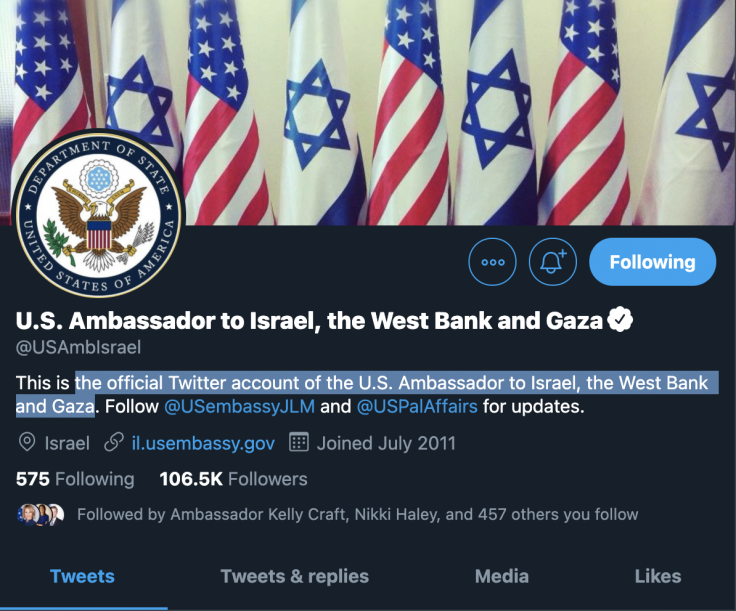
The Biden administration on Wednesday reversed a change to the U.S. ambassador to Israel's Twitter account name to read, "the official Twitter account of the U.S. Ambassador to Israel, the West Bank, and Gaza" after a Washington Free Beacon report highlighting the shift.
For a time on Wednesday, the official Twitter feed for the U.S. ambassador to Israel had its title changed to add "the West Bank and Gaza," territories the United States has for decades avoided taking a stand on due to ongoing peace talks between the Israelis and Palestinians. The title change sparked an outcry online, including among Republican lawmakers, and was quietly changed back to read only, "U.S. ambassador to Israel." The State Department would not comment on the initial change or why it was changed back to its original form.
Embassy officials have speculated that the title was inadvertently changed by Twitter due to a technical glitch when the accounts were switched from the Trump administration over to the Biden administration. The Free Beacon could not confirm the veracity of these claims.
"The U.S. doesn’t have ambassadors to any other disputed territory in the world. Singling out Israel, once again, is wrong," said Len Khodorkovsky, former deputy assistant secretary at the State Department. "Instead of building on all the progress that’s been made toward peace in the Middle East, the Biden administration seems to be reversing course toward the failed policies of the Obama years."
During the Obama administration, former ambassador Dan Shapiro was referred to in official communications as the "U.S. Ambassador to Israel."
While President Joe Biden has said he would maintain the U.S. embassy facility in Jerusalem—which former President Donald Trump moved in a historic policy shift—it is likely he will put greater emphasis on Israeli-Palestinian peace talks, which have long been stalled. Biden also will grapple with the last administration's decision to recognize the Golan Heights area along the Israel-Syria border as officially part of the Jewish state.
They switched it back pic.twitter.com/lhn8CsLHAC
— Katie Pavlich (@KatiePavlich) January 20, 2021
Elder of Ziyon