Following the news of Israel's peace agreement with the UAE and Bahrain, we
had a laugh at John Kerry's expense when we watched the 2016 video of Kerry
assuring his audience that peace between Israel and the Arab world without
first resolving the Palestinian question just wasn't possible.
And Kerry knew this because he had, even a week earlier, spoken to
"leaders of the Arab community."
It would be interesting to know just what Kerry said to those Arab leaders
-- and what exactly they said to him in response.
Did he misinterpret what they said to him?
Did those leaders intentionally mislead Kerry?
It certainly wouldn't be the first incident of an apparent 'miscommunication"
between Arab leaders and a member of the US government.
Once again, Arab officials apparently misled a US politician as to what they
were thinking about Israel.
Joe Biden (YouTube screencap)
But apparently, this is not limited to US politicians.
As a matter of fact, Arab leaders have been known to mislead other Arab
leaders as well.
In his book The Arab Mind, Raphael Patai tells a story from the eve of the 1948
Israeli War of Independence:
Musa Alami, the well-known Palestinian Arab leader, made a tour of the Arab
capitals to sound out the leaders with whom he was well acquainted. In
Damascus, the President of Syria told him:
I am happy to tell you that our Army and its equipment are of the highest
order and well able to deal with a few Jews; and I can tell you in
confidence that we even have an atomic bomb...Yes, it was made
locally; we fortunately found a very clever fellow, a tinsmith...(p. 53-54)
[emphasis added]
Patai gives another example, this one from the Six Day War, when on the first
day (June 5, 1967) the commander of the Egyptian forces in Cairo sent a
message to the Jordanian front:
that the Israeli air offensive was continuing. But at the same time,
he insisted that the Egyptians had put 75 per cent of the Israeli air
force out of action. The same message said that U.A.R. bombers had destroyed the Israeli bases
in a counter-attack, and that the ground forces of the Egyptian army had
penetrated into Israel by way of the Negev! (p. 109)
If Egypt had been honest with Jordan from day 1, Hussein might not have
entered the war, and Jordan would have retained control of Judea and Samaria
-- and the Kotel.
But behind these examples of miscommunication, there are issues of Arab
culture.
For example, the story about the tinsmith is pure exaggeration, what Patai
refers to as the "spell of (Arabic) language," namely the "prediliction for
exaggeration and overemphasis [which] is anchored in the Arabic language
itself" (p. 55)
As for Egypt's deception of Jordan, Patai describes it as wajh, or
an attempt to avoid loss of face. In fact, Patai blames King Hussein's years
in England for his failure to see this for what it was:
Had Hussein not lost, during his formative years spent in England, the ear
for catching the meaning behind the words which is an indispensable
prerequisite of true communication among Arabs, he would have understood
that a real victory over Israel would have been announced by Amer and
Nasser in a long tirade of repetitious and emphatic assertions, and that the
brief and for Arabs, totally unusual factual form of the statement betrayed
it for what it actually was: a face-saving device, a reference not to a
real, but to an entirely imaginary victory. [emphasis in original] (p.
112-3)
But what about Biden and Kerry?
Again, without knowing what each side actually said, it is impossible to know
what went on.
But their misunderstanding of their Arab hosts might be due to the Arab
concept of shame.
Patai distinguishes between shame, which is "a matter between a person and his
society," and guilt which is "a matter between a person and his conscience" --
or as he puts it: "A hermit in a desert can feel guilt; he cannot feel shame."
One of the important differences between the Arab and the Western
personality is that in the Arab culture, shame is more pronounced than
guilt...What pressures the Arab to behave in an honorable manner is not
guilt but shame, or, more precisely, the psychological drive to escape or
prevent negative judgement by others. [p. 113]
We tend to associate the Arab concept of shame/honor with of 'honor killings,'
but there are implications on a national level too.
In his preface to the 1976 edition of his book, Patai writes that although
Egypt lost the Yom Kippur War, the fact that they caught Israel by surprise
and were able to initially gain the upper hand, allowed the Egyptians to
perceive the war as a victory, and cleared the way for peace negotiations:
A manifestation of this new Arab self-confidence is the willingness to enter
into disengagement agreements with Israel. It is, in this connection,
characteristic that it is precisely Egypt, the country that won what it
considers a victory over Israel, which has embarked on the road of
negotiation with her....It is quite clear that the feeling of having demonstrated strengh is for
an Arab state a psychological prerequisite of discussing adjustments and
reaching understanding with an enemy.
[emphasis added] (xxiii - xxv)
How would shame/honor manifest itself in discussions between Arabs and
Westerners?
In his 1989 book, The Closed Circle: An Interpretation of the Arabs, David Pryce-Jones writes about
Kenneth Pendar, an American intelligence officer whose task it was to
persuade Moroccans to side with the Allies during the last war, expressed
the difficulties of conducting a negotiation in which
he expected a yes or a no from people unable to commit themselves to
either,
because they could not tell who would win the war and acquire honor or who
would lose and be shamed. [emphasis added] (p. 45)
Pryce-Jones goes on to quote Henry Kissinger, who complained of the
difficulty of negotiating with the Saudis because of their style that was
"at once oblique and persistent, reticent and assertive" based on the
allocation of honor or shame.
Based on this, one can imagine that Kerry and Biden could each have easily
misinterpreted what they heard in accordance with what they wanted to pass on
to their respective audiences.
Interestingly, when Patai writes about the confidence the Yom Kippur Was
instilled into the Arab world in 1973, he contrasts Egypt -- which considers
the Yom Kippur War a victory -- with other Arab countries that either cannot
make such a claim or have never fought Israel, and are therefore opposed to
negotiation.
That would seem to rule out Jordan and Sudan, on the one hand, and the UAE and
Bahrain on the other.
But King Hussein making peace with Israel is not surprising, considering his
tenuous control over his country, the majority of whom are Palestinian Arabs.
There was leverage the US could apply, even if the peace treaty itself could
cause trouble for Hussein at home.
Considering the leverage that the US applied to Sudan, that country also had a
lot to gain. But both Egypt and Jordan have a cold peace with Israel and the
Arabs in both countries have expressed their hatred of Jews and Israel. It's
not clear that the situation in Sudan is any better.
What about UAE and Bahrain?
Some have belittled the Abraham Accords because those 2 countries have never
actually been involved in a war with Israel.
But maybe that is the point.
Egypt and Jordan fought against Israel, and whatever the considerations on the
government level -- on a national level, Israel remains an enemy in the eyes
of the Egyptian and Jordanian people, regardless of the benefits Israel has to
offer and are nowhere near normalizing relations. There is an absence of a
state of war, but the mood of belligerence persists.
Not so with UAE and Bahrain, which has never fought Israel.
The intent of the Abraham Accords is not to bring peace in order to end a
state of war -- instead the point is to normalize relations, a goal that is
conceivable for UAE and Bahrain, but not for Egypt and Jordan, which still
cannot go beyond a 'cold peace,' let alone a full, real peace.
In November 2017, Mordechai Kedar wrote The Ten Commandments for Israeli negotiations with Saudi Arabia, which he described as "immutable principles" for negotiating with Saudi
Arabia "and any other Arab nations who wish to live in peace with the Jewish
State."
One of those principles is the need for normalizing relations as
opposed to just making peace:
10. Peace with the Saudis must entail more than just a ceasefire with an
attached document ("Salaam" in Arabic) . Israel agreed to that in the case of
Egypt and Jordan as a result of the ignorance of those running the
negotiations on Israel's side.
Israel must insist on complete normalization ("sulh" in Arabic), which
includes cultural, tourist, business, industrial, art, aeronautical,
scientific, technological, athletic and academic ties and exchanges, etc.
If Israel participates in international events taking place in Saudi Arabia,
the Israeli flag will wave along with those of other countries, and if Israel
is the victor in any sports competition in Saudi Arabia, the Hatikva anthem
will be played, as it is when other countries win medals. Israeli books will
be shown at book fairs, and Israeli products officially displayed at
international exhibitions taking place in Saudi Arabia.
An economic
document, whose details I am not in a position to elaborate, but which must be
an addendum to the agreement, is to be based on
mutual investments and acquisitions as well as a commitment to non-
participation in boycotts. [emphasis added]
This is what we are seeing now.
A foreshadowing for what is possible is in another comment by Patai, where he
addresses the "Arab street" that today we are told is supposedly ready at any
moment to rise up in protest, yet whose anger Trump has somehow been able to
avoid these past 4 years:
The volatility of Arab reaction to the October War was paralleled four years
later by the rapid evaporation of Arab wrath over President Satat's
initiative in establishing direct contact with Israel. This was observed by
Fuad Moughrabi, professor of political science and co-editor of the
Arab Studies Quarterly, in 1980:
The Arab world reacted strongly and passionately to Sadat's visit to
Jerusalem. But contrary to what many had expected, the intensity of the
reaction was not followed by any concrete, effective steps to neutralize
the conseqauences of the visit. Sadat did the unthinkable and got away
with it. (p. 339)
Moughrabi wrote this in 1980.
Sadat was assassinated in 1981 -- by the extremist Muslim Brotherhood.
Back then, Arab opposition to Sadat was not directed against the idea of
peace, but against the Camp David Accords themselves, which removed Egypt as a
participant in the war against Israel -- a war which was supposed to benefit
the cause of the Palestinian Arabs.
Today, with the Arab support for the Palestinian Arab cause at its lowest ebb,
there are genuine prospects for continuing what the Trump administration
started.
That is, assuming that this time around Biden actually listens to what the
Arab leaders are saying.
We have lots of ideas, but we need more resources to be even more effective. Please donate today to help get the message out and to help defend Israel.
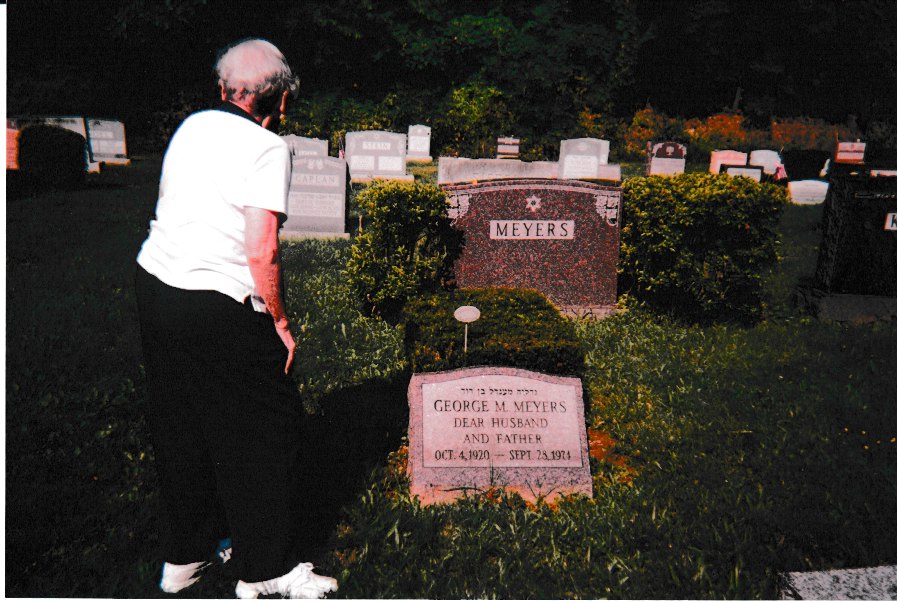
Shirley Kopelman Meyers, January 10, 1927-November 8, 2020
I like to tell people I made aliyah when I was young and stupid and that that’s the way to do it. When I made aliyah at the age of 18, I wasn’t thinking about what it would be
like to have an aging parent far away, and not be able to help. I didn’t think
about how, someday, in middle age, I would long to care for my mother, as I only
I would have cared for her had I been there. But I was not there, except in
fits and starts, two-week visits that were somehow never enough for either of
us. And now she’s gone.
In the middle of the morning, the message came: “Our mother
went to the true world this morning.”
I was not even surprised. I had seen it coming. She was 93.
She was fading. This was Sunday morning, and she had fallen asleep in the
middle of our last phone call, on Thursday night.
I watched her funeral on Zoom. Which was a blessing. I
always knew I would not be going to the States for her funeral, as she had
forbidden me to do so, some years ago.
A child of the Great Depression, my mother was practical.
She didn’t see the point of me spending all that money on a ticket when she
wouldn’t even be there to see me. Never mind that in some respects, the rituals
are for those who remain. My mother had made her wishes clear, and I was stuck
with respecting those wishes, and her.
Because of the Depression, she couldn't go to college. But at age 46, widowed with 4 children, she became a student at the University of Pittsburgh. It took her 8 years, but she got her degree in journalism.
Had there not been a pandemic, perhaps no one would have thought
to set up that Zoom funeral I got to see, so at least I had that: the beautiful
chill autumn day, some red and gold leaves still on the trees in the Beth
Shalom Cemetery, in Millvale, Pa.
We visited my dad a few years ago. Now she is next to him.
On the other hand, had there not been a pandemic, I might have been able to see her one last time. But I was terrified at the thought of picking up the virus during my travels and that I might somehow, unwittingly, bring it to her, when I loved her almost as much as life itself. The thought of making her sick was paralyzing, in its most literal meaning. That thought kept me here in place in Israel, and far away from her.
And I think that was difficult for her. Knowing that I wasn’t
going to be there that one more time. Perhaps—at least a little—she gave up
hope that I would ever come again. It was not going to happen: a thing that made life
worth living when she could no longer walk, see or hear, a visit from her baby.
It hurts that I hurt her that way. And it hurts that I
lost my mom. But in spite of the terrible pain of losing my mother—of missing
out on being able to care for her as only I would have cared for her—in spite of
depriving her of my presence at the end, and missing her funeral, I do not
regret making aliyah. “Non, je ne
regrette rien.”
I regret nothing.
Is aliyah a
selfish act? In some ways, no doubt, it is.
There’s no doubt it was excruciating for my mother not to
have me with her all these years, when she loved and needed me so. It was I who
picked up and left Pittsburgh to make aliyah
to Israel. I who made the decision, and simply did it—made aliyah—when I was young and stupid, and
unaware of what the future held. It was painful for my mother to not be close
by my children, her grandchildren, whom she loved so dearly.
I put out photos of my mother in the shiva house, and there was one photo where you could see just the
edge of her face, and she was glowing with love for a newborn grandchild she
held, and you could see it, that love, though much of the picture was in
shadow, including the object of her love, obscured. How it must have
hurt her, to be so far away from them,
her grandchildren, whom she would have loved to have cuddled and loved and
known.
As evening fell on the day my mother died, Z”L, my rabbi’s
wife came to my house to help me do kria,
to help me tear my shirt just over the heart, as one does for a mother. “This
is the price of aliyah,” I said to
her, and she knew what I meant: that I hadn’t been there to care for my mother
or be with her at the end, that I was observing the rituals from a distance: that
I wasn’t there.
It was all a part of the price: the price of aliyah.
She issued no bromides or platitudes, my rabbi’s wife. My
rabbi’s wife, who is wise, said something I’ve held onto, during the past two
weeks, through my shiva and the days that followed. “Look,” she said in her quiet voice. “That’s Lech Lecha. You did Lech Lecha.”
This was a reference to the Torah portion not long past, Lech Lecha, in which God directs Abram to leave his native land and all that he knew, for a “land that I will show thee.”
Now the LORD said unto Abram:
'Get thee out of thy country, and from thy kindred, and from thy father's
house, unto the land that I will show thee.’ Genesis 12:1
One can only imagine the depth of Abram’s faith, leaving his
father’s house like that with no second thoughts. But I was no Abram. The
repercussions of the act were not clear to me at the time of the act: It is not
an easy thing to leave a mother, or to leave all that I knew. I gave up one
life for another, yet the shock and the pain of it all, came on only over
time. It was a gradual sinking in.
And now that I’ve experienced this loss, I think that
had I known how painful this all would be—the not being there—the enormity of
this thing, I might not have made aliyah, at all.
I don’t think I could have done it, though I regret nothing, “Non, je ne regrette rien.”
It was the right thing to do, to make aliyah, and I’m glad, every day, that I did.
I didn’t know what I was doing at the time. I only longed
and yearned to be here in Israel and I made it happen. But there was a cost to aliyah that makes Israel and my living
here, all the more dear to my heart. I put my people ahead of myself, and even
my own dearest mother, z"l, by moving to Israel. And how can I regret the chance to
play a part in this noble project, the building of our national home, making
Israel stronger, just by dint of being here?
“Non, je ne regrette rien.”
I wish that things had been different. I wish that my mother
hadn’t fit into Pittsburgh the way I wished I fit Israel: like a glove. Because
then she might have come here and I could have taken care of her. She would
have had the chance to really know her Israeli grandchildren and great grandchildren, growing up under a different sun, proud and free in the Jewish State.
Instead of snatching a few weeks here, a few weeks there, for a birth or a bar mitzvah.
But it was understood: my mother was a Pittsburgher, born
and bred, and she would never live anywhere else. It was who she was.
And the truth is, it is who I was, and the last several
times I visited there, I found myself touching the trees, and the buildings,
the low walls and soaring yellow street lights, and would shed a tear or two as I said goodbye, over and over again.
The smells of that place! The sight of that curb, that hill, this tree! A
sensory experience that reached down to me, toward some primal place, an essence.
But Israel had called, had always called, that nobler cause
from afar, from when I was little. This too, was me. Perhaps the ultimate me,
the place I had to grow into. The place I had to earn.
Yes, I was young and stupid when I made aliyah. I hadn’t seen the cost. But no. From afar, from this
distance, I regret nothing.
“Non, je ne regrette rien.”
I regret nothing in part because I live in a wonderful
community that embraced me in my sorrow, came to sit with me, talk with me, cook for me. The people here know they are my family, since my family cannot be
here. And they try hard to fill the breach. They know that I gave up my real
family to be here with them in our land. And that makes them my family, in some
ways more even than the real family I knew as a girl.
But community cannot replace my mother. It is hard to lose a mother. It hurts:
another one more installment on the price of aliyah, which I continue to pay in ways and amounts I never
anticipated, back when I was 18, young, and stupid. I think I never could have
done it—made aliyah—if I’d known the
price, how much it would cost, how much it would hurt.
It’s the kind of knowledge—well, it’s better not to know, to
be young and stupid: to dare to just do
the thing without knowing what’s ahead, the repercussions of the act. Did Abram
know what was ahead, the trials and tribulations? Can anyone really make an
informed aliyah, for instance know
loss of this sort without having been in it, away from a mother they love, so far
away?
Now I can say I’ve been there. I’ve dwelt in the country of my loss and I
know the price of aliyah.
And still, I am here.
Today, and hopefully for a long time, I am here in Israel. And
I do not and will not regret that.
“Non, je ne regrette rien.”
We have lots of ideas, but we need more resources to be even more effective. Please donate today to help get the message out and to help defend Israel.
Shannon Nuszen is coming up against Jewish opposition to her
work at Beyneynu, which is all about exposing the true nature of Christian
missionaries inside Israel. These evangelical Christians are careful not to
use overt language in describing their mission to the Jewish Israelis they meet
and work with. But Nuszen captures the truth by way of videos created by the
Christians for their supporters abroad, in which their mission is stated in
explicit terms. And the truth is that these Christians are in Israel for the
express purpose of converting Jewish Israelis to Christianity.
Why would any Jew not want this truth exposed? It’s not a
mystery: money talks, nobody walks. Evangelical Christians give a lot of money
to Israel, and they’re very nice people. No one wants to believe they have any
underlying, hidden purpose in being here. The Jews don’t want to believe these
Christians are anything other than what they purport to be: nice people who
support the Jews and the Jewish State.
Jews are tired of being hated. When someone shows them a bit
of love, they drink it up. They are like Sally Fields at the Oscars gushing, “You like me! You really like me!”
They need to believe these Christians don’t have an ulterior
motive. They need it for their self-esteem. And of course, there’s the money.
Lots and lots of it. And a lot of these Christians are working the vineyards of
Samaria, for free. Which is as good as financial support, right?
So we have a situation where Shannon Nuszen, through her
organization, Beyneynu, is distributing videos to Jewish journalists in which
Christians expose their true purpose on camera. And Jews are going around
behind the scenes and sometimes, shamelessly, right in front of Nuszen, casting
aspersions on her work.
These Jews tell the journalists and anyone else who will
listen that Shannon is disturbed, that because of her past, she has a vendetta—that
these Christians are REALLY NICE PEOPLE who have told them, the Jews, that converting the Jews is the furthest thing from
their sweet little innocent minds. These Christians LOVE the Jews, say the
Jews, and only want to help and support them.
Would that all that were true. But it’s not. And Shannon is
only curating words said by these very same Christians—words which clearly have
no other context—that is, if one is being honest about this stuff. The
Christians are in Israel for one sole purpose. They want to bring the Jews to
Jesus.
They’ll swear up and down it isn’t so. But the videos say
otherwise, if you can get past all the Jews out to destroy the messenger,
Shannon. To them I say, “Methinks thou dost protest too much.”
The Jews know on which side their bread is buttered. And it’s
actually a really shameful thing to witness how they grovel to those trying to
convert them while speaking out against their own: Shannon. But you know what?
Let’s give Shannon a chance to explain it all in her own words. And then you
can decide whom to believe: Shannon, or the Jewish naysayers who benefit from
these Christians and work behind the scenes to deride their fellow Jew:
Varda Epstein: Can
you tell us a bit about your background?
Shannon Nuszen: I was born and raised in Evangelical
Christianity. My father was a minister, and for many years I was a missionary myself
with a tremendous love for Israel and a focus on the Jewish people.
In 2005 I visited Israel for the first time and returned
home more determined than ever to prove to myself and every Jew I knew that
Jesus was indeed the messiah prophesied in the bible.
However, homing in on that one issue and fully immersing
myself in learning about the fulfillment (or lack thereof) of these prophecies
did not result in any reaffirming of my faith, or in me perfecting my arguments
for bringing Jews to Jesus. The opposite happened, and through learning the
Jewish perspective, it became clear that everything I knew and believed in was
false.
Long story short, I ended up converting to Judaism and have
been living as an Orthodox Jew ever since. I now live in Israel.
Varda Epstein: Why
did you decide to focus on exposing and fighting missionaries in Israel? Is
this really a significant presence or threat to the Jews of Israel?
Shannon Nuszen: I was on the other side. I was one of those
missionaries. I understand better than most how aggressive and unyielding these
missionaries are. Most Jewish people, though they may have encountered these
missionaries, really do not understand the full scope and danger they present
to our people. We are not just dealing with Christians trying to convert Jews.
It’s worse than that and more insidious because they are playing word games.
The missionaries misappropriate Jewish symbols, icons, and
traditions in order to evangelize the Jews. They are portraying Christianity in
a Jewish way to get Jews to believe in Jesus. I know this because I was one of
those people. As a result, I feel a heavy responsibility, almost a burden, to
alert the Jewish community to the problem that confronts them.
It is shocking. It is
a stage four cancer, and there is no stage five. These missionaries have
managed to infiltrate and become a part of the highest echelons of the Israeli
government and its leadership. Because of their financial and political support
for Israel these evangelicals have managed to blind Israelis to the inherent dangers
of their mission. Evangelical support comes at an extremely high price, and I
understand why Israeli leaders and many ordinary Israelis and Israeli
businessmen turn the other way. We have many enemies, and therefore we are
willing to work with anyone, even when it comes at a very dangerous price.
Varda Epstein: Would
you tell us about some of the people and organizations you’ve worked with on
the issue of missionaries in Israel?
Shannon Nuszen: In my quest to research and supply
information about specific missionary groups that are active in Israel, I have
worked with and continue to work with every organization I know of in this
field. In an official capacity I began this work 13 years ago in Houston,
countering local missionaries in a grassroots effort with Rabbi Stuart Federow.
During this time, I also worked for Outreach Judaism for a span of a few years.
Most of my work in this field, however, has been with Jewish Israel, as their North American
liaison.
Varda Epstein: Tell
us about Beyneynu. Why did you decide to found this organization and what is
its purpose?
Shannon Nuszen: Beyneynu is a nonprofit organization that
monitors missionary activity in Israel and works with government and community
leaders to create proper boundaries in their partnerships with faith-based
organizations.
Are we against Christian support for Israel? No! We simply
draw the line at missionary efforts, and do not believe Jewish organizations should
be forming alliances or partnerships with those who have as their agenda the
desire to bring Jews to faith in Jesus.
I do not consider myself a “counter missionary,” and Beyneynu
is not another counter missionary organization. Our focus is on alerting the
Jewish community to missionary efforts, and to help the Israeli leadership to
identify those who threaten the Jewish character of the State of Israel.
Varda Epstein: You’ve
released some shocking videos of missionaries in Israel and abroad. How are
these videos created?
Shannon Nuszen: These videos are created the same way news
publications produce videos. They scour hours of videos and take the most
germane elements they find and broadcast them to the public. This is critical
to this effort.
Most videos put out by the missionaries are over an hour
long. The Jewish community needs to know about the elements in these videos
that specifically speak about their intentions in regard to the Jewish people
of Israel.
It’s important to understand that if these missionary groups—based
as they are inside of Israel—were self-sustaining, they wouldn’t take the risk
of discussing these topics in videos, but all their financial support comes
from abroad, from outside of Israel. The videos are created precisely for this audience:
evangelical Christians who live beyond the borders of Israel. Virtually nothing
comes from native Israeli missionaries, therefore they must convey to evangelical
Christians abroad the work that they are doing, and that is “winning Jewish
souls for Yeshua.”
These people all, without exception, use language that serves
as dog whistles for their followers. None of them would ever come straight out
and use the term “convert Jews to Christianity” to describe their mission. That
type of language is no longer used among the Jews because Jewish people
translate “convert to Christianity” as losing their Jewish identity (and they’re
right).
This was clear in another video Beyneynu released not long
ago where the CEO of God
TV, Ward Simpson, clearly stated “We
don’t want Jews to convert to Christianity, we simply want them to accept Jesus
as their messiah.”
Varda Epstein: There
have been some accusations that you are selectively editing these videos to
show something that isn’t really there. They say you have a vendetta, because
you were one of them, and have now converted to Judaism. What would you say to
your accusers?
Shannon Nuszen: The accusers are not bystanders. They are
the same activists who repeatedly carry water for these evangelical Christian
groups by repeating their talking points, because they work with them and
depend on them for their financial support. They have a vested interest in
protecting these missionaries.
The real question for these accusers (or perhaps “handlers”
is a better word) is: Do these Christians believe it is their obligation to carry
out “The Great Commission?” Matthew 28:19 “. . . to make disciples of all
nations, baptizing them in the name of the Father and of the Son and of the
Holy Spirit.”
In our latest video, these Christians are clearly speaking
of this obligation to their followers, if not in so many words. If the
naysayers cannot answer to the charge or prove that it’s not the case, then the
only tactic left for them is to attack the messenger: me.
As far as having a vendetta, I would say the opposite is
true. Just as much as I feel it is an obligation to warn fellow Jews of this
danger, I would love to be able to demonstrate to Christians the pain their
actions inflict on the Jewish people in order to foster some understanding.
Varda Epstein: Why
are so many Jews against your work, and speaking out against this work and even
you, personally? What do they stand to gain by allying with Christians, and
working against you, a fellow Jew?
Shannon Nuszen: I do not think even our most fierce
opposition opposes the goal of our work. This is the one issue that Jews across
the spectrum agree on. The entire Jewish world is against efforts to convert
Jews. They just refuse to believe that the Christians who give them financial
support, and who support their programs, could possibly have any missionary
agenda. It becomes for them a very personal issue.
The information we present, however, is not our opinion. We
are not quoting out of context or interpreting what these Christians are
saying. Our only aim is to inform.
Varda Epstein: Is
there anything else you would like to say to your accusers?
Shannon Nuszen: I try
not to focus on the negative attention or answer those who are aligning
themselves with missionaries. They have their reasons for what they do, and
they will have to answer for that. My focus is on the effect of these missionaries
on Jewish communities worldwide.
Varda Epstein: Can
you give us some examples of things these missionaries have said for which the
context is undeniable, and cannot possibly be explained away by selective
editing?
Shannon Nuszen: The undeniable issue that cannot be disputed
is “The Great Commission,” which you’ll find being preached in each of the
videos we have curated, and is common to all missionaries. “The Great
Commission” is the commandment given by Jesus himself “. . . to make disciples
of all nations, baptizing them in the name of the Father and of the Son and of
the Holy Spirit.” Those who teach this concept are fully committed to living by
this commandment and everything they say and do is by way of fulfilling this
obligation.
The methods and language used to explain this in ways that
won’t offend Jews are many, but the bottom line is that they do not believe
they are exempt from this commandment or that they should refuse to participate
in its fulfillment. They see this commandment, “The Great Commission,” as their
primary goal, and crucial factor in the “restoration” (you’ll hear them say
that word a lot) process that in their belief, serves as preparation for the
second coming of Jesus.
Varda Epstein: Where
are you and Beyneynu going with this work? What can we expect to see coming up
next?
Shannon Nuszen: Beyneynu’s efforts are primarily behind the
scenes working with government
and Jewish leadership to understand the dangers of partnering with
missionaries. With the tremendous outpouring of love and support coming from
the Christian world, it is important that we understand who we can and cannot
trust.
Sometimes our efforts include informing the public of
problematic events or relationships that require their help to demand action.
This was the case with God TV. Even though they had already secured a contract
with the cable provider, and had been licensed by the Israeli government to
broadcast this programming, it was public outcry that brought about the
complete reversal of this state of affairs and caught the attention of the
world.
That is the message that every organization looking to
partner with us should understand. We appreciate the support for Israel, but we
must draw the line when it comes to missionary activity.
We have lots of ideas, but we need more resources to be even more effective. Please donate today to help get the message out and to help defend Israel.
It happens every election: celebrities—and just generally
spoiled people (cough cough)—swear that if their candidate doesn’t win, they’re
leaving. But author Lauren Ariel Hoffman decided to write about leaving America
from a Jewish perspective. Hoffman describes her own Orange Man trauma and exit
plan, comparing it all to an escape from the Nazis. She then quotes a few Jewish
friends on their own plans for fleeing the country. The odd thing is, not
one of them considers Israel as a viable option for relocation, and in fact, Israel is not mentioned in this article at all.
Hoffman’s article was featured in Alma,
which—no surprise—also includes articles on such subjects as, “Why Does My
Interfaith Relationship Disqualify Me From Rabbinical School?” and “Now’s the
Perfect Time to Teach Your Non-Jewish Partner All About Judaism." So perhaps it's not quite the right place to discover love and loyalty for the one Jewish State. You'd think, nonetheless, that in an article about fleeing the country, a Yid might consider Israel.
Never heard of Lauren Ariel Hoffman and her epigenetic intergenerational trauma? Neither had I, but her byline was linked to this handy dandy author’s blurb:
Lauren Ariel Hoffman (she/her) is a photojournalist from
Royersford, Pennsylvania. Her coverage includes stories relating to chronic
illness, medical injustice, and human interest.
Well there you have it. Perhaps Israel, as a subject for liberal Jews, is somewhat beyond human interest.
But back to the article: Hoffman, it is clear, wants to celebrate her distress in a
Jewish way. But the closest thing she can get to kosher-style anguish is by
referencing the Holocaust and her family roots in the Ukraine:
It is not 1939, and yet the police are still slaughtering unarmed Black men and
women in the name of “justice,” still separating refugee families at the border
and putting their children in cages, still performing medical experiments on
female-bodied prisoners.
Sound familiar?
My recurring nightmare of Nazis breaking into my house and
capturing me is becoming more tangible, but now it’s informed and comprehensive
and absolutely terrifying. And while I’m a fan of Quentin Tarantino’s Inglorious Basterds, I don’t think
I’ll be knocking Nazi skulls anytime soon. I’m more prepared to find myself in
a police-state wherein me and my loved one’s basic liberties will be stripped
and some of our lives taken, along with members of every other oppressed group
in America.
I am not going to back down from this fight, mainly because
I have nowhere else to go — as a descendant of Ukrainian Jews, my ancestor’s
recent homeland does not exist anymore.
Which is odd, because last I looked, the Ukraine still exists.
Or so Google says:
Ukraine is a large country in Eastern Europe known for its
Orthodox churches, Black Sea coastline and forested mountains. Its capital,
Kiev, features the gold-domed St. Sophia's Cathedral, with 11th-century mosaics
and frescoes. Overlooking the Dnieper River is the Kiev Pechersk Lavra
monastery complex, a Christian pilgrimage site housing Scythian tomb relics and
catacombs containing mummified Orthodox monks.
But I don’t blame Lauren for not wanting to go back to the
Ukraine. I wouldn’t want to go back there, either. It was bad enough the first time.
Still, to say she has nowhere else to go—why not go back to the place her family came from in the first place—before they were expelled and forced to wander? Why not go back to Israel,
where today there is a flourishing Jewish State? But no, it’s not on Hoffman's radar.
Nor was it apparently on the radar of her Sephardic friend Rebecca Brier:
Rebecca Brier, 37, who asked to use an alias, feels
differently. She and her husband are in the process of getting Portuguese
citizenship for themselves and their two young children.
“If there’s one thing I’ve learned from my family, it’s that
it’s okay to be the first one to go,” she said. “It’s harder with kids. We
speak Spanish, but Spanish is not Portuguese.”
Brier said she is mainly torn between leaving her family
behind in the Bronx or figuring out how to get them all to Portugal.
“We’ve set up our lives around our support system, our
family. If we left, would we be that anchor again? At some point, flight
becomes easier, because if I fly, at least I still have my family.”
On the other hand, if she would only make Aliyah to Israel, the Briers would have
new family everywhere they turned. As new immigrants they would be embraced and surrounded by fellow Jews, living proud and free in their indigenous
territory. But no, Brier instead prefers to return to the land of the Inquisition, where
Jews were tortured for their beliefs, forced to go underground with their
observance, and slaughtered if they refused to convert. Somehow this is, to Brier, infinitely preferable to moving to the Jewish State.
“But not everyone has the luxury of leaving,” continues Hoffman:
Aviva Davis, 21, is a biracial Jew whose ancestry
is more closely linked to slavery than the Holocaust. They feel it is a luxury
that white Jews are able to consider leaving at all.
“I would love to have an escape plan, but it’s not a viable
option for me,” they said. “Where would I go? My ancestors were carted over
here as slaves — white Jews can trace citizenship back to their ancestors. It’s
very frustrating for me to feel like I have nowhere to go.”
Leaving aside the odd use of the pronoun "they," um. Where would "they" go? To ISRAEL. Where Jews of every color of
the rainbow live full, satisfying, Jewish lives.
But no. These people are stuck in a time warp of pogroms, auto-da-fé,
and slavery:
As Brier said, “Do we become Jews lighting candles in
the closet in Spain? Or do we flee to the Ottoman Empire? I’m not sure who did
it right. But the trauma is still there.”
As I write this piece, no one knows who will win the 2020
presidential election. But one thing I know for sure: Israeli Jews did it right.
They left the trauma and the ghettos behind to build a beautiful, shining new
world, where anything is possible, and dreams can come true.
We have lots of ideas, but we need more resources to be even more effective. Please donate today to help get the message out and to help defend Israel.
Khaled Abu Toameh won a victory in a small Jerusalem courtroom
this week when Ted Belman at last agreed that his defamatory articles, social
media posts, and newsletters were factually baseless. Belman is now required to
make public apology to Abu Toameh within 14 days. If Belman again defames the award-winning Israeli Arab journalist and distinguished senior Gatestone fellow, he will have
to pay 5000 shekels per defamatory item published, in compensation to Khaled.
By way of disclaimer, there was a personal victory here as
well, as Belman’s countersuit against Abu Toameh, this author and Bat-Zion
Susskind-Sacks was rejected out of hand by the court. The interesting thing about
this is that I was approached by the 86-year-old Belman in court on Monday. “Who
are you?” Ted asked me. “Are you the enemy?”
He was suing me, but didn’t even know me.
Here we must go back and explain why Ted was suing me. Ted
Belman, you see, asserted that Khaled was running a spy ring in Israel for the
Jordanian king, and that I was one of his operatives, the other being Bat-Zion
Susskind Sacks. Well goodness I’m relieved. An Israeli court has rejected a
lawsuit accusing me of working on behalf of His Majesty, King Abdullah of
Jordan. Not guilty! Acquitted.
But I digress. The main thing is that all three of us—me,
Batzi, and of course, Khaled—are victorious.
So ends this courtroom saga that began in late 2017, when
Abu Toameh had finally had enough of the defamatory campaign of words and memes
waged against him since at least 2013. Readers of this column will recall my
exposé
of self-proclaimed “putative prime minister of Jordan” Mudar Zahran (see for
instance, HERE,
HERE,
and HERE).
Zahran, banned
from entering Israel as a security risk, tried to enlist me in his smear
campaign against Khaled Abu Toameh. I refused, but Ted Belman apparently did
not.
What followed was an endless campaign of baseless defamation, an ongoing attack that lasted seven full years. Articles were published in numerous publications, all smearing Khaled. The defamation of Khaled was an ongoing theme in newsletters, Belman's personal website, and on Facebook, too. The
worst part of this defamation, of course, is that Khaled Abu Toameh is a fine
person: the only Israeli Arab journalist I know of who writes the honest truth
about Israel and the Middle East.
Khaled is one of the good guys. And everyone on our side
knows this. Which is why Khaled Abu Toameh has won plaudits and numerous awards
by distinguished bodies. From Wikipedia:
Recognition and awards
·Abu Toameh received the 2014 Daniel Pearl Award. Abu
Toameh shared Israel Media Watch's 2010 award for media criticism with the
satirical Israeli website Latma.
·On 10 May 2011, Khaled Abu Toameh won the Hudson
Institute Award for Courage in Journalism.
·Canada's Toronto
Sun columnist Salim Mansur praised Abu Toameh for his courage and
knowledge of the politics of the Arab world.
·He was chosen on the Algemeiner Journal's 2013 list of The Top
100 People Positively Influencing Jewish Life.
All during this trying time, while Khaled was being smeared,
important people came to the fore to defend the embattled journalist. People
like Caroline Glick, Lori Lowenthal Marcus, Ruthie Blum, and Harold Rhode, couldn’t
offer enough praise for Khaled. And still, this creep Zahran spread horrible
lies about Khaled to all and sundry through anyone he could rope into his web.
Well, all’s well that ends well, and in that small Jerusalem
courtroom on October 26, 2020, justice won out with victory on many counts:
1. Ted Belman finally admitted that
he has no evidence to support the libelous publications.
2. Ted Belman agreed to publish an
apology and retraction, admitting that what he published was factually
baseless.
3. Ted's main witness, the
Jordanian fraudster Mudar Zahran, who is banned from Israel for security
reasons, never got a chance to testify before the court, not even by video.
4. Ted's counterclaim against
Khaled Abu Toameh, Varda Meyers Epstein, and Bat-Zion Susskind-Sacks, was
rejected.
5. The court ruled that if Ted
republishes the same material against Khaled Abu Toameh, he will pay 5000
shekels in compensation per piece.
After three years of refusing to do so, Ted will finally apologize
and admit that what he published about Khaled Abu Toameh was factually
baseless. Assuming Ted fulfills his promise to the court, he now has 14 days to
issue the apology and retraction. This is good because Ted’s own lawyer admitted in court that Belman
had no proof to back up any of the nasty things he published about Khaled. It’s
icing on the cake that Belman’s counterclaim was rejected. And if he tries to republish
the defamatory items, he’s going to get slapped with a fine of 5000 shekels per
article. Pretty nifty.
Judge Moriah Cherka, addressing Belman, said that what
he did was unethical and against journalistic standards, because Ted never
sought Khaled's response before publication. Judge Cherka also noted that
Khaled Abu Toameh is a renowned and respected journalist, therefore it is inconceivable that his credibility should be questioned or harmed.
Nadav Haetzni, representative for the plaintiff, Khaled, said, "At long last, this grievous smear campaign against one of Israel's leading journalists is over. This was a campaign aimed at destroying this man's reputation; it caused him great damage and suffering, but in the end, this was a victory and we hope others will learn from it."
“For me,” said Khaled Abu Toameh, “The lawsuit was never
about money, but about getting Belman to publicly admit that every bit of what
he published about me was factually baseless. I initiated the lawsuit as a
matter of principle, to defend ethical standards in journalism, and to serve as a deterrent to others,”
said Khaled.
The judge made a point of rebuking Ted Belman in court, for
behaving in an unethical manner. Which is as it should be. Journalists, and bloggers like Ted Belman, need to check the facts before they publish, to
ascertain the truth, and to seek a response from the person in question, when preparing
to publish something that might be defamatory.
Let us hope that this lawsuit will underscore this point for
anyone who takes to the blogosphere to randomly and without proof, trash-talk and
damage others. This is wrong and should not be countenanced in a country ruled
by law. And on Monday, in that small Jerusalem courtroom, a judge did in fact, determine
that such baseless defamation would not be countenanced in Israel.
We have lots of ideas, but we need more resources to be even more effective. Please donate today to help get the message out and to help defend Israel.
Joe Biden had his first meeting with an Israeli leader,
Golda Meir, on the eve of the Yom Kippur war, right after meeting with
officials in Cairo. During the then junior senator’s meeting with Meir, Biden
suggested that Israel make a unilateral withdrawal from settlements for peace,
criticizing the settlement policies of the Labor Party, and suggesting they
represent a form of “creeping annexation.” Though Biden assured Meir that
Egyptian officials were convinced of Israel’s military superiority, 40 days
later, Sadat initiated a surprise attack against Israel.
This is the gist of a bombshell tweet from
Israel’s Channel 13 reporter Nadav Eyal containing excerpts from a classified
memo from an Israeli official who attended that fateful meeting. While it may
have been the first meeting between Biden and an Israeli prime minister, it was
certainly not the last. In subsequent meetings with Israeli prime ministers,
Biden threatened Menachem Begin with withholding U.S. aid, and publicly
upbraided Benyamin Netanyahu because it had been announced in a town council
meeting that 1600 homes were to be built in future in the Jewish Jerusalem
neighborhood of Ramat Shlomo (more about this here).
Here is the tweet:
1/Golda Meir and Joe Biden, the Israeli memo. By far, the story Biden most frequently tells about his relationship with Israel leadership is his first meeting with Golda as a young senator. Here's Biden describing the encounter and Golda's punch linehttps://t.co/UsroQHRwog
Here is the content of Eyal's tweet, edited for readability:
Golda Meir and Joe Biden, the Israeli memo.
By far, the story Biden most frequently tells about his
relationship with Israel leadership is his first meeting with Golda as a young
senator. Here's Biden describing the encounter and Golda's punch line:
I've published this evening a classified memo documenting
the meeting, made by a senior Israeli official present in the room. A
fascinating meeting.
Biden comes from Egypt, some 40 days before Sadat ordered a
surprise attack which will become the Yom Kippur war. He tells the Israeli PM
that all the officials he met in Cairo assured him that they accept
"Israel's military superiority.” Of course, they lied (not [Biden’s] fault,
of course. Israel was misled by its own intelligence community).
American Politics.
Biden criticizes the Nixon administration for being
"dragged by Israel" [into supporting Israeli policies]. He says,
according to this government memo, that there is no debate in the Senate about
the Middle East because the Senators are "afraid" to say things that
Jewish voters will dislike. (He SAYS THAT TO GOLDA)
He criticizes the Israeli labor platform arguing that it’s
leading to a creeping annexation of the occupied territories. Considering
Israel's military dominance, Biden suggests it will initiate a first step for
peace by unilateral withdrawals. This will be done from areas with no strategic
importance—not the Golan.
Golda responds with a long speech about the history of the
Zionist movement from its very establishment. The instability of Arab regimes,
the unfairness of Supreme Court decisions.
Golda rejects Biden comments on the Labor platform, rejects
his offers of unilateral withdrawal and continues to argue that Israel can make
no major mistakes considering the situation of the Jewish people after the
Holocaust. The official making the notes remarked that Biden was full of
respect to the PM yet his "enthusiasm as he spoke" signaled his lack
of experience in the diplomatic field.
REMARKS: Biden warning to the PM on the eve of the war that
Israel must make some concessions is
prophetic. Some historians argue that Golda's refusal to consider
Egyptian diplomatic initiatives led to war. Biden's suggestion that Israel make
unilateral concessions is interesting. The only time Israel opted for such a
move is in 2005 when Ariel Sharon as PM initiated Israel's withdrawal from the
Gaza strip. Much more to say.
Part of the original Hebrew document from the unnamed
Israeli official:
It is important to note that it was the Labor Party that
initiated the policy of settling all parts of Jewish indigenous territory,
including Judea and Samaria. From the Jewish
Virtual Library:
In the past, Labor was more hawkish on security and defense
issues than it is today. During its years in office, Israel fought the 1956
Sinai War, the Six-Day War and the Yom Kippur War. Labor agreed to UN
Resolution 242 and the notion of trading land for peace. Nevertheless,
successive Labor governments established settlements in the disputed
territories and refrained from dismantling illegal settlements, such as those
established in 1968 at Qiryat Arba in Hebron by Rabbi Moshe Levinger, and
others set up by Gush Emunim. By 1976, more than thirty settlements had been
established on the West Bank; however, their population was fewer than 10,000.
Joe Biden paints that early
meeting with Golda as something precious that cemented in his mind how
important Israel is to the Jewish people. It is clear, however, that Joe Biden has
always been against the Jewish people settling their indigenous territory. The very
thought of Jews planning to build homes in Jerusalem makes him furious. Therefore,
contrary to the love fest with Golda he has often described, Biden used the first
chance he had to meet with an Israeli prime minister to broach the subject of
unilateral concessions.
One wonders how much clout the young senator wielded at that
time. Not to mention the timing of subsequent events, with the surprise attack
on Israel by Egypt occurring just 40 days after Biden’s meeting with Meir. Is
it possible that Golda Meir incurred wider U.S. displeasure by refusing to entertain Biden's suggestion of unilateral concessions? Was Egypt perhaps emboldened by this state of affairs to attack Israel without fear of American intervention?
We have lots of ideas, but we need more resources to be even more effective. Please donate today to help get the message out and to help defend Israel.
President Donald Trump, if you believe the media spin, is
the most reviled person ever walk the earth. A search for “Trump” in Google
News overwhelmingly generates negative headlines. A more nuanced search,
however, suggests that voter enthusiasm is for Trump, while the response to the
Biden Harris ticket is somewhere between lackluster and nonexistent.
Here are the first seven results generated in a search I did
for “Trump” on October 13, 2020, all negative:
I next turned to some work-related research on the creative use
of cars during the pandemic. Here, too, the election figured large in the
search results. It seems that cars in the 2020
election cycle have been enlisted as a safe way for people to rally for their
preferred presidential candidates while adhering to social distancing
standards. But this time, when I did my search, the shoe was on the other foot.
The search results were mostly positive, and they were mostly about Trump.
The rallies with the largest, most enthusiastic turnouts
were clearly for Trump. Similar rallies held for Biden, by contrast, yielded
fewer attendees, and sometimes none,
as happened in the battleground state of Arizona.
Biden and Harris hold a campaign event in Arizona and the local news can’t believe that not one supporter showed up! pic.twitter.com/JKj0fPi6Jj
Here's a tweet from Jenna Ellis, senior legal adviser for the Trump campaign, noting that the crowds turned out to see her and other lesser Trump campaign figures, including Trump Campaign Director of Strategic Communications Marc Lotter, and Senior Trump Campaign Adviser John Pence, compared to NO people, whatsoever, turning up to see presidential candidate Joe Biden himself, in the flesh.
A drive-in event in Toledo, at which Biden spoke, appeared to have just six Biden supporters in attendance, sitting in their cars.
.@JoeBiden brings his economic message to Toledo, Ohio where how main message besides selling his “Build Back Better” plan to union members gathered at the drive-in is promising to never turn his back on them like Pres. Trump has in the last several years. pic.twitter.com/P9UrRCVcaa
There were more Trump supporters in attendance than Biden supporters.
Dozens of Trump supporters were loudly chanting a mix of “Four more years,” “Trump” and “USA” throughout the event, growing louder anytime @JoeBiden mentioned the president. pic.twitter.com/7M0iZWdmRf
Trump rallies, it is clear, generate large cheering crowds. Biden rallies, by comparison, are poorly attended. Hundreds of cars decorated with American flags, Make American Great Again signs, and Trump posters, for example, made up a rolling caravan that ran all the way from Plymouth, Massachusetts to Nashua, New Hampshire.
A Vietnamese family decking out their van with Trump posters and flags. Apparently there’s a contest to see who has the most swagged out car.
Rally goers say they’re not here to change people’s views—just to voice their support for the President. #WBZpic.twitter.com/glBGnHbNrV
In the Little Havana neighborhood of Miami, some said as
many as 30,000
cars took part in a Trump rally on October 10, waving American and Cuban
flags. There were so many cars that police officers had to come direct traffic.
Biden may think the Latino community is incredibly diverse, but they appear to have
a single-minded preference for Trump.
The same day the “incredibly diverse” were cheering for
Trump in Miami, a “Trump Train” made of cars took over an oversized parking
lot in St.
George, Utah, before setting out in support of President Trump. This time,
hundreds of people lined the streets for blocks, straining for a glimpse of the
event, already an hour before it was slated to begin. The crowds had put aside the
danger of contagion in favor of showing support for their favored presidential
candidate, Donald J. Trump. People said the “train” of cars seemed to go on
forever.
The mainstream media has left no doubt as to what it thinks
you ought to think about Trump. You should hate him with every fiber of your
being, and do everything you can to make him lose the election. For the media,
it’s not about generating love for Biden and his running mate Kamala Harris.
Especially since neither of them are especially loveable. Instead, this
election cycle has been all about hate—in particular, about hating President
Trump.
The good news is that it’s not working. People would rather
love than hate, especially when the object of that feeling is the holder of the
highest office in the land, the president of the United States. The people have
made their choice and they choose veneration over hate. So the crowds turn out
for Trump. And they turn out with enthusiasm.
This, of course, is good news for Israel, where an October
12 poll found that63.3% of Israelis
favor Trump over Joe Biden for president. Maybe this has to do with the way
Biden
upbraided two Israeli prime ministers. Or maybe it’s because Biden plans to
reinstate the JCPOA. What we know for sure: Israel won’t be naming any city
squares or neighborhoods for Joe Biden Jr., at any near point in time, and
probably not ever. Because Joe Biden hasn’t shown much love for Israel. And like
the people of America ignoring the hate-filled spin of the media in favor of
flocking to those rallies for Trump, Israelis choose love over hate.
Joe Biden is no friend to Israel, which means he’s no friend
to the Jews, which is why Israelis are glad that when it comes to presidents,
Americans would rather choose love over hate.
We have lots of ideas, but we need more resources to be even more effective. Please donate today to help get the message out and to help defend Israel.
Christian missionaries, whose explicit goal is to convert
Jews in Israel to Christianity, are entering Israel when most Jews cannot, through a
loophole in Israeli government-mandated regulations for the country’s latest
coronavirus lockdown. The lack of government sensitivity and response to this
issue, when queried, suggests that the loophole was purposefully created. It
seems someone wants these missionaries here badly, perhaps the farmers in
Samaria, whose vineyards these missionaries toil for free, as they swear up and
down that converting the Jews is the furthest thing from their minds. No doubt
they are told it is permitted to lie for this purpose. The loophole is that international
volunteers are allowed in, while thousands of Jews trying desperately to
get to Israel, are not.
The following photo shows Dean Bye’s Return
Ministries group arriving in Israel. Return Ministries shared the photo on Facebook as an announcement of the loophole for missionaries, the year-long volunteer visa, during the coronavirus lockdown:
This was shared by Tommy Waller, of HaYovel who remarked that this had opened the way for others. Such as his group of missionaries. And that of Bishop Glenn Plummer and his wife, Dr. (Ruth) Pauline Plummer.
Longer version with Hebrew subtitles:
It is the belief of Glenn and Pauline Plummer that they are "grafted" onto the Jewish people through Jesus. The two are in Israel specifically to target the Ethiopian community. Bishop Plummer believes God’s promise to bring the people out of Egypt/Africa includes those of African descent. He also believes Martin Luther King was not being at all metaphoric in his mountaintop speech when he referenced being allowed to reach the Promised Land. It wasn’t suburbia to which MLK was describing, from Plummer’s perspective, but a scenario in which African Americans belong to the actual physical land of Israel and must return.
Judy Maltz of Haaretz
has previously looked at Tommy
Waller and Hayovel, wondering who gave them visas during a lockdown when Jews
are barred. Now she has addressed the issue of Bishop and Dr. Plummer claiming
to make aliyah.
Maltz, being that she writes for Haaretz, made sure to underscore the point
that it is the settlers who benefit from the work of the Christian “volunteers.”
In August, the Interior Ministry
announced that 12,000 yeshiva students and another 5,000 foreign exchange students
and participants in Masa educational and social programs, aimed at young Jewish
adults, would also be allowed into the country.
As reported in Haaretz several
weeks ago, an exception was also made for a group of 70 volunteers from a
U.S.-based evangelical organization, known as Hayovel. The volunteers obtained
special government permission to enter the country so they could help with the
grape harvest on West Bank settlements.
Event poster announces Bishop Glenn and Dr. Pauline Plummer in Jerusalem
At the same time, Maltz made one small, incidental mention
of proselytization only at the end of her piece, as if to minimize the importance of the
issue.
Asked to address concerns that
COGIC had set up a presence in Israel in order to persuade Jews to convert to
Christianity, Plummer said: “That’s not our mission. I, as a Christian believer
and Christian leader, am fully convinced that Yeshua, Jesus, is the messiah. I
believe that with every fiber in me. But I’m not going to try to convince you
to believe that. If you ask me why I believe that, though, of course I’m going
to tell you.”
This, of course, is a lie. Let’s
look at what Bishop and Dr. Plummer themselves said in the video (earlier in this piece), regarding their purpose in coming to Israel, and in fact, their purpose in life:
What is the church called to do? In my humble opinion, it rests on two things.
One is to win souls and the second is to make disciples. Disciple-making is really
a big call.
That's exactly the call and the
mission and the goal of the church. "Go ye therefore, and teach all nations, baptizing them in the name of the father, and of the son, and of the
holy ghost.”
We lead people to the lord. The
church is commissioned. The church is called to go forth and teach, to instruct
all nations, to do as Jesus did and make disciples. We are called to tell
people everywhere about Jesus.
Facebook about page
Tweet after participating in a congressional caucus on black and Jewish relations
Mission as declared on the website of Bishop and Dr. Plummer
A colleague who lives in Samaria, where so many evangelicals are residing while working the vineyards for free, when he heard my concerns about Bishop Plummer
commented, “Just you should know, there are highly-placed individuals who have
known him for decades who will make sure he understands the situation he is in
and if you want, I can try to ask him specifically not to reach out to you.”
It is not, of course, my concern that these people will
reach out to me personally. My concern is that they are here to “win souls” and
“make disciples.” I find this sort of proselytization highly offensive. The Jewish people did
not survive the Inquisition, the Crusades, the Muslim Conquest, pogroms, terror, and the
Holocaust in order to have missionaries infiltrate the Jewish State of Israel
to rob our children of their souls, in order that the settlers of Samaria benefit from free labor to harvest their grapes.
Plummer: first "bishop of Israel in the 112 year history of the church"
The focus of the work of Bishop and Dr. Plummer in Israel: outreach to Ethiopian Jews
It sure does look as though the one sure way to get into Israel
right now is to be Christian and committed to converting the Jews. It's a definite exception to the otherwise unusually severe lockdown measures mandated by the Israeli government. And it worked great for Bishop Glenn and Dr. Pauline Plummer. But it also worked for Return Ministries, manned by Dean Bye and Chaim
Malespin. The entire group of their evangelical volunteers received
one-and-a-half-year visas.
It's important to note that evangelicals do not
qualify to live in Israel under the Law of Return,
despite the claim of Dr. Plummer that she and her husband are not in Israel to
be tourists, but have actually made aliyah.
When asked about this by Judy Maltz at Haaretz, a spokeswoman
from Israel’s Interior Ministry, responsible for issuing visas to the Plummers
and the other evangelicals, said only that she, “wasn’t at liberty to discuss
individual cases because of privacy issues.”
All we really know is that Israel is in the middle of a
pandemic lockdown in which thousands of Jews cannot get into the country, but
the government has announced this loophole that mainly serves evangelical
Christians.
It’s not a good look.
Breaking
Israel News is calling this loophole for international volunteers
the fulfillment of the prophecy that “strangers,” or “Christians,” have been
allowed into Israel to harvest:
Strangers shall stand and pasture your flocks, Aliens shall
be your plowmen and vine-trimmers; Isaiah 61:5.
This prophecy, the missionaries see as both literally and
metaphorically true. For while so many Jews cannot visit Israel during the holidays
or see family, the strangers are here for the harvest. They're here for the
grapes and the souls.
We have lots of ideas, but we need more resources to be even more effective. Please donate today to help get the message out and to help defend Israel.
This blog may be a labor of love for me, but it takes a lot of effort, time and money. For 20 years and 40,000 articles I have been providing accurate, original news that would have remained unnoticed. I've written hundreds of scoops and sometimes my reporting ends up making a real difference. I appreciate any donations you can give to keep this blog going.
Turkish blood libel display gets no condemnation
-
There has been no public condemnation from local authorities in Antalya to
an antisemitic public installation in Antalaya, Turkey. The absence of a
clear...
The BBC and the One-Sided Land Dispute
-
In the last two weeks the BBC has produced a large amount of coverage on
new Israeli legislation on land registration in Judea and...
The post The BBC an...
A Simple Truth
-
Shabbat Shalom. Here is a Dry Bones Cartoon by Yaakov Kirschen from 2015.
Shabbat Shalom!Wishes for health and happiness and prosperity and peace to
a...
Jabotinsky's 1935 'Band Wagon'
-
This is the first of a series of three articles by Vladimir Jabotinsky,
the Revisionist leader, written specially for the Jewish Daily Bulletin.
The secon...
Now What?
-
Today, Jews cannot walk down the street in North America, Europe, or even
Australia without the possibility of being spat on, beaten, or even
murdered. Cou...
Closing Jews Down Under Website
-
With a heavyish heart I am closing down the website after ten years.
It is and it isn’t an easy decision after 10 years of constant work. The
past...
‘Test & Trace’ is a mirage
-
Lockdown II thoughts: Day 1 Opposition politicians have been banging on
about the need for a ‘working’ Test & Trace system even more loudly than
the govern...