Tuesday, April 13, 2021

From Ian:
Israel set to come to standstill to remember 23,928 fallen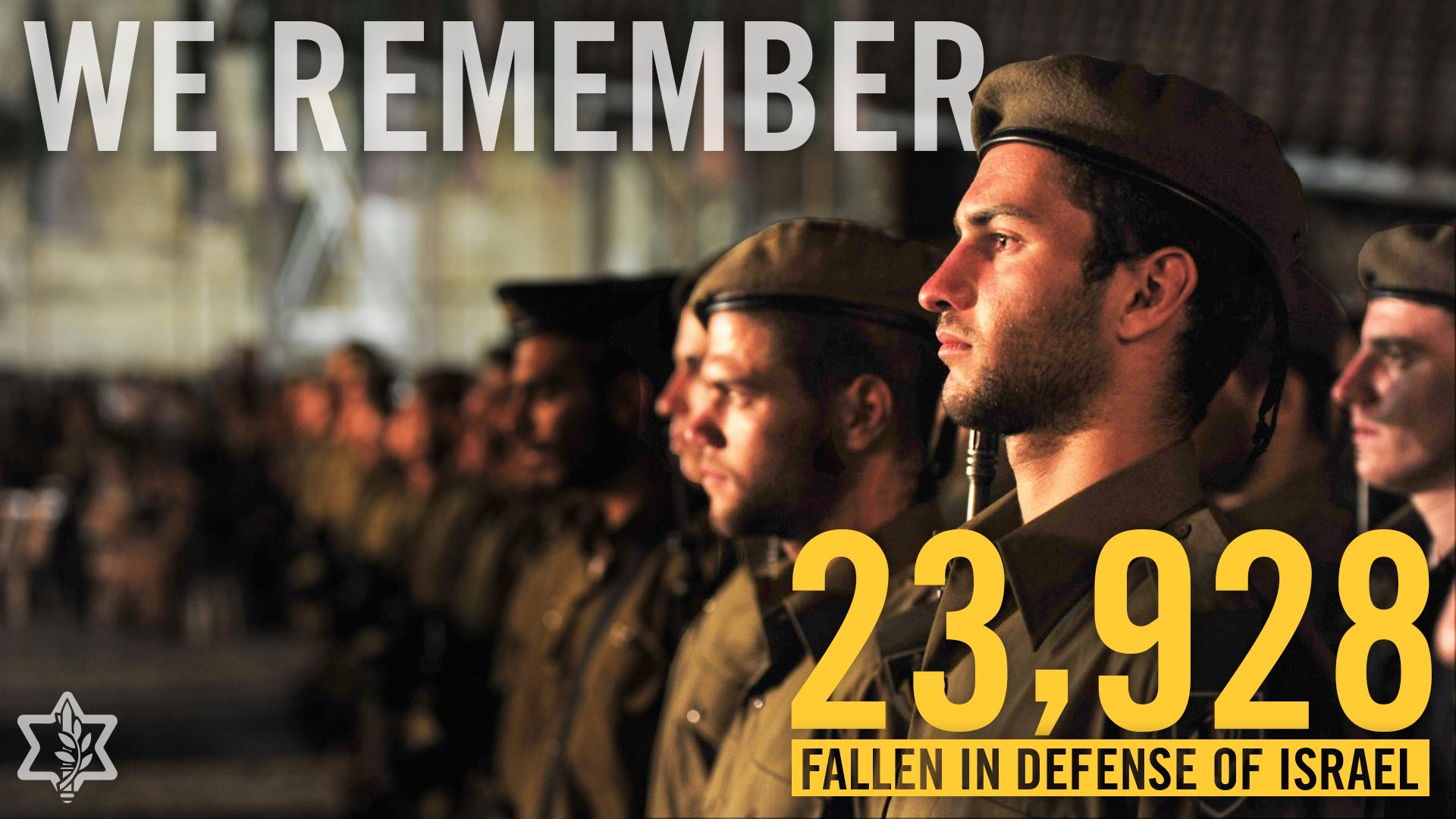
Danny Danon: The memories we are forced to imagine
My dear friend Eyal Banin, fallen IDF Medic
Israel set to come to standstill to remember 23,928 fallen
Israelis paid tribute to the country’s 23,928 fallen soldiers and terror victims starting on Tuesday evening, bowing their heads for a minute of silence as sirens sounded around the country to mark the start of Memorial Day.
The one-minute siren at 8 p.m. was immediately followed by the state ceremony at the Western Wall in Jerusalem. On Tuesday night, additional public memorials will be held, including at Tel Aviv’s Hayarkon Park and in the Knesset in Jerusalem.
During the siren, traffic around the country came to an abrupt halt, as Israelis stopped driving to stand beside their cars and people at home stood in somber silence on their balconies or in their yards.
A second, two-minute, siren will go off at 11 a.m. Wednesday, which will be followed by the main Memorial Day ceremony at Mount Herzl military cemetery in Jerusalem, and smaller events at cemeteries across the country.
The Memorial Day events officially began at the Yad LaBanim center in Jerusalem on Tuesday afternoon, with Prime Minister Benjamin Netanyahu, Knesset Speaker Yariv Levin and Chief Justice Esther Hayut in attendance.
Speaking at the ceremony, Netanyahu said Israel will make “every effort” to return its captives, which include two civilians and the bodies of two IDF soldiers believed to be held by the Hamas terror group in Gaza.
“This is a sacred mission that we’re not letting go of,” he said.
Speaking at the official state ceremony held at the Western Wall, President Reuven Rivlin said the message of the day was that citizens of the Jewish state must not take it for granted.
“From here, I want to speak to you, the commanders, the soldiers, those soon to enlist, the young generation. I grew up as a child at a time when we did not have a state. For me, for those of my generation, the State of Israel is not something to be taken for granted. This strong and powerful country you see was established by the heroism and dedication of young people of your age,” Rivlin said.
“Today, the task of protecting the State of Israel, is on your shoulders. Remember, without love of the homeland, dedication to mission, aiming for victory, comradeship, purpose, personal example and the purity of weapons, a free people will not be established here. The Israel Defense Force and the State of Israel, we, need you young, strong, united, united, united, determined to lend a hand, determined to continue to prevail, ready when necessary, to pay a price,” he entreated.
Danny Danon: The memories we are forced to imagine
On Israel's Fallen Soldiers and Victims of Terrorism Remembrance Day we will unite, as we do every year, in the memory of our heroes who sacrificed their lives for the independence and security of Israel. On this day we put all of our differences aside; there will be no right and no left – only a sense of unity and shared destiny.The fallen made us stronger
On Memorial Day, my personal grief meshes together with the national grief felt by all Israelis. As fate happened, my own father, Yosef Danon, became one of those 23,928 fallen, dying around Memorial Day. Every year, when I accompany my mother to the military cemetery in Kiryat Shaul to mark the anniversary of his death, we feel the entire country bowing its head in commemoration of our personal hero. Indeed, this is the power of every Memorial Day in Israel, where for one day, personal pain and grief are felt by the whole nation.
My father, one of the best reconnaissance navigators the IDF has known, was mortally wounded during one of his stints of reserve duty in the Jordan Valley when he sustained a severe head injury in a battle with terrorists who had infiltrated Israel. He struggled with his injuries for many painful years, until they eventually led to his death on the eve of Memorial Day, a day he revered and honored his comrades who never returned from the field of battle.
For the bereaved families, remembrance is a lifeline. Every picture, film, or story brings back to life our fallen loved ones. Because the majority of the fallen died young, the reservoir of memories is relatively limited. I carry the memory of my father with me every day, but I've carried his memory for far longer than the years I was able to be with him. Most bereaved families are in a similar situation, having had short periods of time with their loved ones to build memories and decades of coping with bereavement and clinging to those memories.
Israeli society must persevere and stand those challenges through its unique blend of multi-generational stamina and liberty, creativity, and constructive focus that give meaning to this life. Some tribal societies have learned to live in the shadow of violent conflicts by developing resolve, even if at the price of curtailing personal liberties and undermining human dignity. Their only accomplishment is survival, at the expense of the constructive and creative elements of society: Life continues but its quality declines and it has a bitter taste. It's no wonder that such societies have failed in dealing with the challenges of the modern age.Zionism: New Goals & Old Struggles - Prof. Gil Troy | OP-ED
Societies that are open, thriving and prosperous run the risk of losing their stamina. They often preserve individual liberties and economic wellbeing at the expense of their right to self-defense. They do so by capitulation to extortions. The violent tribal distortion has sealed the fate of most Arab societies, and appeasing haplessness is very common in Europe. It appears that most of those who are addicted to violence get overrun by it, and those who refuse to confront it with determination cannot properly deal with its challenges and deter his or her enemies. This is very much on display in Syria and eastern Ukraine.
Israel will be liquidated if it falls into one of those traps. If it slides toward the appeasement route it would be destroyed by its violent enemies. If it bolsters its defenses at the expense of its people's liberties and constructive elements, it would lose its raison d'etre and its finest men and women who want to live in it and defend it. Without them, it would simply disappear. It must preserve its stamina just enough so that it could remain an open and thriving society and radiate toughness. It has had to continue fighting in recent generations because it is surrounded by enemies that engage in wild violence even toward their own compatriots and coreligionists.
It appears that our regional environment is not going to see a fundamental improvement in its situation. In the future, we will have to fight and lose our finest people in doing so. The pain will feel as bad, but we will know that their fight and their sacrifice will have significantly helped mitigate the threats on Israel. The fact that the fallen have knowingly agreed to risk their lives for the protection of society and the life we enjoy in Israel offers some comfort for all of us.
In celebration of Israel’s 73rd Independence Day — Yom Ha’atzmaut — we are sharing professor Gil Troy’s essay “Why I am a Zionist.” Twenty years ago he wrote this affirmation essay sharing his reasons for being a Zionist, and how we all have a hand in fulfilling Theodor Herzl’s timeless belief that “If you will it, it is no dream.” This year, we are revisiting and updating it.
My dear friend Eyal Banin, fallen IDF Medic
On Israel’s Rememberence Day for its fallen soldiers and victims of terrorism, Wednesday, April 14, sadly, there are so many dear souls to remember. Friends, family members, neighbours, members of our community and beyond. There is almost no one in Israel untouched by this reality. Many of these unique individuals remain in my memory throughout the year but as this day approaches, one cannot help give some extra thought to who these people were, what they achieved and stood for in their too short lives and where they would be today.
One of them, is my dear friend, Eyal Banin.
On my final night of basic training in the Israeli army, June 14, 2002, I was part of an IDF unit made up of 60 soldiers who, laden with 30 kilograms (66 pounds) of equipment and ammunition on our backs, set off on a gruelling 70-kilometer (43-mile) hike along the hilly Negev desert in the southern part of Israel. This maneuver was the climax of almost five months of basic training and at the end of it we were to receive our unit’s beret.
It was the height of the Second Intifada, and due to security precautions, all army hiking routes had been redirected to the Negev desert in order to avoid proximity to the nearby Palestinian Arab villages and cities. Approximately fifteen kilometers into the hike as the sun was setting, we passed a construction site with large Caterpillar diggers parked on the side. With the exception of one soldier at the back of the group, no one noticed that one of the trucks had started its engine and was making its way in the direction we were walking.
The driver of the digger positioned his machine alongside the two rows of soldiers, lifted the vehicle’s large spade, and as he shouted, Allahu Akbar, (God is great, in Arabic,) he put his foot on the gas pedal and sped full-throttle toward us, intent on killing as many soldiers as he could. With the vehicle closing in on us, chaos ensued, with soldiers running in every direction to get out harm’s way.