Monday, April 12, 2021

From Ian:
Biden's Taylor Force Betrayal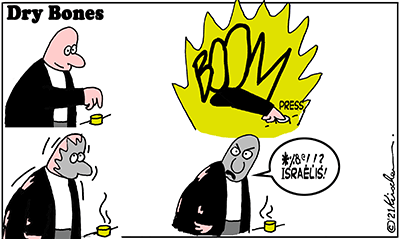
Biden's Taylor Force Betrayal
In his first 100 days in office, Biden has resumed funding of the Palestinians and UNRWA. He has rejoined the UNHRC, will probably soon rejoin UNESCO and has pledged to re-open the PLO mission. Biden's State Department has gone back to the old practice of referring to Judea and Samaria as "occupied territories."The West’s shameful Iranian capitulation
For decades, the Palestinian leadership has conducted itself as the political arm of the various terrorist organizations it controls. Whether they call themselves Fatah, PLO, PA or Hamas, Palestinian leaders invariably coordinate attacks and obstruct rapprochement with Israel. The U.S. has long endured this truth, and has often pretended it wasn't so. American presidents have looked the other way when our own citizens and diplomats were murdered by Palestinian terrorists, all in the hope of achieving the chimera of peace in the Middle East.
During his four years in office, Donald Trump changed that. De-emphasizing the Palestinian centrality of Middle East policy led to the Abraham Accords—the most notable peace in the region since 1979.
But Joe Biden likes things the old way.
As secretary of state, John Kerry acknowledged that Iran would fund terrorism with some of the money it received in the 2015 nuclear deal. It was worth the trade-off, he believed, of a grand deal that would turn the Islamic Republic of Iran into a responsible nuclear power. That was a complete fantasy.
Likewise, Joe Biden believes that the advantages to funding Palestinians outweigh the unfortunate fact that a percentage of that money will be spent on missiles, salaries of imprisoned terrorists and pensions for the families of Palestinian "martyrs."
Biden seems to have forgotten the visceral shock he felt five years ago when Taylor Force was murdered nearby. He is now blinded as he chases the fantasy of a responsible Palestinian leadership that can be persuaded to accept the legitimacy of the Jewish state of Israel.
On a sweltering day in July 2018, German police pulled over a scarlet Ford S-Max hire car that was travelling at speed towards Austria. The driver, Assadollah Assadi, the third secretary to the Iranian embassy in Vienna, was arrested at gunpoint and taken into custody.How Israel Helps Defend American Interests in the Middle East
Although unusual, there was a good reason for detaining the diplomat: Assadi had used his immunity to smuggle a bomb on a commercial airliner from Tehran to Austria, intending to carry out what would have been one of Europe’s worst atrocities in recent years.
Once in Vienna, he had handed the device — codenamed the ‘Playstation’ — to two married Belgian-Iranian agents, Amir Saadouni and Nasimeh Naami, and instructed them to blow up an anti-regime event in Paris, which was to be attended by dignitaries including Rudy Giuliani and former environment secretary Theresa Villiers.
The plot was thwarted on the day of the attack after a tip-off from Mossad, saving hundreds of lives. Assadi was arrested the following day while pursuing diplomatic refuge in Austria. But as we reported in this week’s Jewish Chronicle, the treasure trove of evidence inside the vehicle should have set off alarm bells in European corridors of power — alarm bells that should be sounding especially loudly today.
The car was effectively being used as a mobile intelligence station to run agents. It contained handwritten records of trips to 289 locations in 22 cities across Europe as well as notes on bomb handling and ideas for attacks using acid and toxic pathogenic substances. Also discovered were receipts for expense reimbursements and salary payments to spies, details of computers issued to them, numerous mobile phones and GPS devices, and more than €30,000 (£26,000) in cash. In short, it revealed an Iranian espionage network in Europe that was startling in both its scale and scope.
When seen in the light of the political context at the time, the arrest seemed almost ironic. Not eight weeks previously, Donald Trump had pulled America out of the nuclear deal with Iran, the Joint Comprehensive Plan of Action (JCPOA), reimposing ‘maximum pressure’ sanctions on the theocracy. The Europeans were appalled.
Israel plays an indispensable role in helping defend American interests in the Middle East, serving as a stabilizing bulwark in a dangerous region that remains vitally important to the U.S.
Israel's determination to prevent a nuclear Iran represents significant leverage for American diplomats in negotiations with Tehran. If wielded skillfully by American negotiators, this leverage can play an essential role in pressuring Iran to dramatically curb its nuclear ambitions.
Should talks fail and Iran's march toward the bomb continue, Israel's ability to act decisively is a unique strategic asset - one that the Biden administration should have every interest in preserving and ensuring is as effective as possible.
Israel also has taken the lead against Iran on the ground. In Iran's shadow wars across the region, Israel alone has mastered gray-zone combat, conducting more than 1,000 strikes against Iranian-related targets in Syria, Iraq and the surrounding seas, almost single-handedly crippling Tehran's master plan to turn Syria into an IRGC fortress and forward operating base.
For the U.S., it's hard to put a price on the value of having a local partner with the power and skill to operate so effectively.