Plus this music video by Office Romance:
And from Zusha:


 Tuesday, December 15, 2020
 Elder of Ziyon
Tuesday, December 15, 2020Elder of Ziyon
Elder of Ziyon
Tuesday, December 15, 2020Elder of Ziyon
In the coming days, this region looks forward to another important event: the Gulf Cooperation Council Summit, a GCC leaders summit that annually sheds light on the most important issues of the hour.Israel’s President Praises Bahrain’s King Hamad for Making Peace With Israel
The summit will wrap up December’s main achievement, the International Institute for Strategic Studies (IISS) Manama Dialogue that concluded on December 6, with the Abraham Accords getting the lion’s share of attention and participants being loud and clear about where they stand regarding threats from Iran, its nuclear program, the significance of unified international efforts to fight extremism, and how the Abraham Accords have changed the face of the Middle East.
Statements from politicians, officials, and security specialists all had one issue of common concern: Without international coordination and cooperation, the world will only be allowing extremist regimes to continue being destructive members in the international community.
If we actively investigate the most important statements made, we will clearly see that Israel has become a stronger team player in Middle East politics following the historic agreements signed with Bahrain, the United Arab Emirates, Sudan, and now Morocco. Perhaps Israeli Foreign Minister Gabi Ashkenazi’s statement regarding the negotiations with Palestinian leaders was a pivotal point in this event that needs to be further analyzed. Ashkenazi’s statement was both clear and came forward as very genuine as he emphasized: “We were born in the region. We know the challenges and it’s a question of leadership.”
Ashkenazi also was more open about directly pointing fingers at Turkey’s aggressiveness in the Eastern Mediterranean, hoping that Erdoğan’s foreign policies toward countries in the Middle East will change as he hosts Hamas’ headquarters, providing them state assistance that has over the years enabled Hamas members to move around more easily with passports provided by Turkey. This was an important clarification of where Israel stands when it comes to its relations with Turkey and its strong stance toward unacceptable Turkish foreign policies.
Israeli President Reuven Rivlin on Monday praised Bahrain’s King Hamad bin Isa Al Khalifa for his “brave and historic decision to establish a warm peace with Israel.”Trump deserves the Nobel prize for his work to forge peace in the Middle East
In a phone conversation with Al Khalifa ahead of Bahrain’s National Day, which falls on Dec. 16, Rivlin said the recent signing of the Abraham Accords was “already a model for other countries in our region,” according to a statement from his office.
“We have chosen to invest from the very beginning in cooperation in the fields of economy, innovation and health,” he said. “I am full of hope that the Palestinians will also take steps to build mutual trust, cooperation and peace.”
Earlier on Monday, Rivlin welcomed a delegation of opinion leaders and activists from Israel, Bahrain and the United Arab Emirates at the President’s Residence in Jerusalem, greeting them both in Arabic and in Hebrew.
“Peace is made between peoples and nations,” he told the delegation, led by Amit Deri of the Sharaka Project. “Your visit here is another step in the path of building warm relations between our countries.”
The Sharaka (Arabic for “cooperation”) Project “aims to lead social initiatives that bring Israel’s voice to strengthen familiarity with the State of Israel in the Arab world, and create cooperation between young people in Israel and Arab states.”
One member of the delegation, Majid Al Sarrah from the University of Dubai, said “to visit Israel for the first time as part of a delegation is a historic moment. Israel is a prime example of tolerance in the region. This is a new era of peace and stability between peoples.”
By rights, US President Donald Trump’s groundbreaking peace initiative in Israeli-Arab relations should make him a shoe-in for the Nobel Peace Prize. There is, after all, a long list of previous recipients of the award whose recognition stems from their own contribution to improving relations between Arabs and Jews. Former US President Jimmy Carter won the award for his role in the 1970s Camp David negotiations that resulted in the peace treaty between Israel and Egypt. More recently we have seen Yasser Arafat, the reformed Palestinian terrorist, and former Israeli prime ministers Yitzhak Rabin and Shimon Peres, appointed Laureates for their contribution to the 1993 Oslo Accords, even though Mr Arafat’s subsequent refusal to sign up to Bill Clinton’s Camp David agreement in 2000 consigned the region to another two decades of conflict.
And, so pronounced is the liberal bias that informs the committee’s outlook, that former President Barack Obama received the award in 2009 simply for being elected to office.
Thus, if there were any degree of consistency in the Nobel committee’s deliberations, Mr Trump – who has done more than any other president in recent history to further the cause of peace in the Middle East – would be a worthy contender for the prize.
Last week Morocco became the latest Middle Eastern country to sign up to the Abraham Accords, the Trump administration’s peace initiative that has made a significant contribution to breaking the stalemate in Israeli-Arab relations.
The bold initiative, the result of years of painstaking diplomacy by Jared Kushner, Mr Trump’s son-in-law, has already resulted in a major thawing in relations between Israel and the Gulf states, with Bahrain and the United Arab Emirates agreeing to establish diplomatic ties, and several other Gulf governments – including Saudi Arabia – said to be giving serious consideration to following suit.
 Tuesday, December 15, 2020Elder of Ziyon
The circle that was closed yesterday began last year, when Regavim’s field activities sparked a unique rescue mission: Volunteers for the “Preserving the Eternal” project discovered that the Palestinian Authority had issued permits for agricultural work resulting in the desecration of the ancient burial grounds at the Hasmonean Fortress of Jericho. They found the catacombs plundered, the sarcophagi stolen, and human remains that had been at rest there for over 2,000 years scattered around the site - which was being plowed and steam-rolled.

Regavim alerted the Civil Administration, and a rescue mission to collect the desecrated remains and reinter them at the Jewish cemetery in Kfar Adumim was set in motion.

Yesterday (Monday), in a moving and powerful stone-setting ceremony, the operation came full circle: At the special section of the Kfar Adumim Cemetery set aside for the Kohanim of Jericho by the Binyamin Regional Council, Regavim and ‘Preserving the Eternal’ marked the final resting place of the Hasmonean royal family, and reaffirmed the unbreakable bond between the Jewish People, the Land of Israel, and Jewish history and heritage – the very things for which the Maccabees, members of the Hasmonean royal family buried in the Jericho Fortress, fought over 2 millennia ago.
 Tuesday, December 15, 2020Elder of Ziyon
 gisha
gisha

 Tuesday, December 15, 2020Elder of Ziyon
In a cabinet meeting, His Highness Sheikh Mohammed bin Rashid Al Maktoum, Vice President, Prime Minister and Ruler of Dubai, approved the formation of the National Human Rights Authority that aims to establish the country’s status in persevering human rights on regional and global spheres.The meeting, which took place in Abu Dhabi’s Qasr Al Watan, involved the adoption of ministerial resolutions and new structures for federal institutions and government councils.As part of the new independent human rights authority, the UAE seeks to develop networks with individuals and institutions around the world with aims to achieve goals in empowering vulnerable segments of the society. The authority will be granted financial and administrative independence to carry out its tasks.Sheikh Mohammed bin Rashid Al Maktoum said, "Women, children, labourers, the elderly, people of determination and the vulnerable have rights that must be safeguarded. The authority will advance our country’s efforts in protecting human rights."Highlighting the country’s active role in safeguarding human rights, the authority will follow the Paris Principles for the National Human Rights Institutions adopted by the United Nations General Assembly.
Bhutan’s parliament adopted the Penal Code (Amendment) Bill of 2019 on Thursday, decriminalizing homosexual conduct between two consenting adults. The legislation was tabled before both houses, being the National Assembly and the National Council, in a joint sitting of the bicameral legislature this year.
A little less than 50 years ago, my mother, Natalia Stieglitz, walked down a flight of stairs in search of secret knowledge.Europe can’t fight anti-Semitism while ignoring threats to Israel
A few months earlier, on December 15th, 1970, a Soviet court convened in Leningrad to try a group of young Jews (and some allies) who planned (and failed) to hijack a small airplane and fly across the border. After years of learning Judaism and Hebrew in secret, after applying repeatedly for emigration visas to Israel and receiving one ‘refusal’ after another, the members of this group had decided to take matters into their own hands. They did not expect to succeed, not really (the letter they left behind was titled “Our Will”). But they had hoped to make a statement.
And they did.
Suddenly, people around the world were asking themselves why a group of promising, normative, young people would try to do something so very outlandish. Were the USSR’s assurances that they allowed Jews to emigrate actually true? Worse, from the Soviets’ perspective: people across the USSR itself were wondering the same thing.
The Six-Day War in 1967 awakened many Soviet Jews to their Jewish identity and filled them with longing to learn about the Jewish state. But most of them didn’t know what to do with what the authorities were bound to see as seditious feelings, nor that there was a movement of people like them that could support them and lend them strength. The Leningrad Trials changed all that: in their efforts to unearth and condemn the so-called-crimes of the would-be hijackers, the authorities publicized the existence of the Jewish underground that had long worked in Leningrad, Riga and Kishinev. Young Jews around the USSR had found out that hundreds of Jews just like themselves had spent years learning Hebrew, reclaiming their tradition, and seeking ways to move to Israel. Defying the USSR was no longer just a dream.
In the course of the trial, Sylva Zalmanson, the only woman to be tried, gave voice to this defiance. Her speech, copied and passed from hand to hand in secret, inspired people wherever it arrived. It did no less when it reached my mother all the way in Moscow, filling her with admiration and with awe.
But my mother could not understand the last sentence in the speech. It was written in a foreign alphabet, which at first she thought might be Sanskrit. After learning that it was actually Hebrew, and making discreet inquiries among her friends, she was on her way to meet a stranger who could decipher those mysterious words.
Dear European Union, we have to talk about a major foreign policy blind spot: your relations with Israel.Misguided American Jews hiding in plain sight
Countless times, I have heard European leaders, on commemorative anniversaries and at memorial sites, express their anguish over the Holocaust, the extermination of 6 million European Jews and the fertile European soil that nurtured anti-Semitism over centuries. I have heard them vow repeatedly, “never again.”
I don’t for a moment minimize these statements and gestures. To the contrary, they are extremely important, all the more so as anti-Semitism is again on the rise in Europe and knowledge of the Holocaust declines.
But — and it’s a big but — too many European leaders are not connecting this painful past to present policies.
I was particularly struck by this when I was invited, in 2013, to be one of six keynote speakers at a ceremony at Mauthausen, the infamous Nazi concentration camp in Austria, where my cousin, Mila Racine, was killed in the last weeks of the war.
The four speakers who preceded me — the presidents of Austria, Hungary and Poland, and the speaker of the Russian parliament — all invoked painful images of the war and the massive loss of Jewish life. They made moving statements affirming their commitment to remembrance and their opposition to any resurgence of hatred against Jews.
Yet not one mentioned the word “Israel.” Not one connected the tragedy of the Holocaust to the absence of an Israel that, had it existed, might have rescued and offered safety to countless European Jews trapped on the Continent.
And not one noted that nearly half of the world’s Jews today live in Israel, which faces both military threats to its existence and endless challenges to its legitimacy.
How can any leader speak about the lessons of the Holocaust and the menace of modern-day anti-Semitism without reference to the ongoing threats against Israel and the Jewish right to self-determination?
What happened that day at Mauthausen was not unusual. Indeed, it was all too routine.
American Progressive Jews remind me of black people who were thrilled if they could pass for white. I understand that desire. Black people were not welcome in the white world. To get ahead, to get anywhere, it was easier if one could “pass.”
It appears to me that too many Jews in America, today, feel the need to “pass,” to hide in plain sight, in order to be accepted in the Progressive New World. Perhaps because they are too comfortable in America, in Galut (exile), and do not want to move to Israel to be safe, so they cozy up to Jew haters, to blend in.
There was another time when Jews hid in plain sight. They too were comfortable, well-off, educated, sophisticated: Progressive. They were not at all like the other Jews; you know, the one’s from the shtetl. Interesting bit of history. In the end Hitler did not care because all over the world, from time immemorial, a Jew is a Jew is a Jew. This same attitude of us and them is happening in America. Liberal, Progressive Reform Jews hardly reacted when New York Governor Cuomo scapegoated Orthodox Jews, those Jews, for spreading Covid, although he said nothing about BLM protests or Shia Muslim gatherings for Ashura.
What is it, dear misguided, Progressive Jews, that frightens you about being Jewish in America that you align yourselves with the “other” Progressive groups who attack Jews and Israel? I watch as you bend the knee to the antisemitic gods of diversity, Black Lives Matter, and critical race theory.
It never goes well for Am Yisrael when Jews, trying to “pass” stand with those who attack us.
What we are witnessing now is far from the first time that Jews in America tried to diminish the assault on Am Yisrael-the Jewish people, in order to feel comfortable in America. -In 1918, liberated Jews in America said there was no need for the Balfour Declaration, calling for the formation of a Jewish state in Israel. Why bother.
On July 4, 1918, the Central Conference of American Rabbis (CCAR), the national organization of Reform rabbis shared a resolution arguing against the Declaration’s premise that the Jews were a people without a country, when in fact they were “and of right ought to be at home in all lands.”
And then came the Nazis. What a way to learn a lesson. -During WWII when FDR was asked, well begged, to take in the Jews from the St. Louis, fleeing the gas chambers, this at-the-time beloved Democrat President said, no.
It was Reform Rabbi Steven Wise, the founder of the Jewish Institute of Religion to train rabbis in Reform Judaism which later merged into the Hebrew Union College, who during WWII decided to pass on pushing FDR to take in Jews. In 2008 David Ellenson was one in a list of prominent American Jewish leaders who censured the Jewish leadership of the 1940s. He wrote:
“In the 1930s, it was Wise who led the rallies against Hitler, so why did he fail so horribly in the 1940s? Part of the explanation lies in Wise’s “absolute and complete love” for president Franklin D. Roosevelt, as well as his antipathy toward the Zionist leader Ze’ev Jabotinsky, and toward the Bergson Group, whose leaders were followers of Jabotinsky, something that “helped blind him” to the need for more activism.
 Monday, December 14, 2020Elder of Ziyon
archaeology
Monday, December 14, 2020Elder of Ziyon
Monday, December 14, 2020Elder of Ziyonarchaeology

After a week of reporting from the United Arab Emirates, I am now in Bahrain, covering the rapidly warming relations between Israel and these Gulf countries since the signing of the Abraham Accords on Sept. 15.
Today, I can report that Bahrain’s King Hamad bin Isa Al Khalifa spoke by telephone with Israeli President Reuven Rivlin.
Officially, Rivlin called to congratulate the Bahraini monarch ahead of “National Day,” marking the 49th year of the Gulf country’s independence from the British empire. Celebrations begin here on Wednesday and go through Thursday, with all national offices and most work places closed.
However, ALL ARAB NEWS can report that based on conversations with Israeli, U.S. and Gulf Arab sources, plans are being arranged for a dramatic first state visit by senior Israeli leaders to Bahrain and the United Arab Emirates.
Rivlin has been invited to visit Bahrain, and has invited Bahraini leaders to visit Jerusalem. The same is true with the UAE.
Netanyahu has also been invited to visit both countries.
It is not yet clear whether both Rivlin and Netanyahu would travel together, or whether the trips will be separate.
ALL ARAB NEWS can report that Netanyahu has requested that none of his Cabinet ministers travel to either Gulf country prior to his own visit.
I would not rule out a December visit by at least Netanyahu or Rivlin, but January is also a possibility.
National Day in the UAE was Dec. 2.
Bahrain’s National Day commemorates the day that the first emir — King Isa bin Salman Al Khalifa — ascended to the throne in 1961. Independence was formally gained from the British on Aug. 15, 1961.
These holidays slowed down the planning somewhat.
It will be a huge story in the region for either or both Israeli leaders to make their first state visits to the Gulf states.
🇲🇦 Morocco
— Israel Advocacy Movement (@israel_advocacy) December 13, 2020
🇧🇭 Bahrain
🇯🇴 Jordan
🇪🇬 Egypt
🇸🇩 Sudan
🇦🇪 UAE
🇴🇲 Oman?
🇮🇩 Indonesia?
At this rate by 2021 there’ll only be Jeremy Corbyn and Rashida Tlaib left to make peace with Israel 😂🥰
A first look at the new and different Muslim tourism expected to reach Israel following the peace treaties with the UAE and Bahrain.US special envoy: UAE, Bahrain shine a light on world during Hanukkah
The controversy that has been dividing the Muslim world for years around visits to “occupied” Jerusalem and how the normalization agreements re-shuffled the cards in this Muslim domestic debate.
What do rabbis think of Muslim tourism to what is also Jews’ holiest site?
Expectations and the potential – what did Muslim tourism look like before the peace accords, and what would it look like after them?
How should Israel prepare for the Muslim wave of tourism in order to create a success story and prevent the Palestinians from disrupting this unprecedented tourism?
Jews are receiving a warm welcome in the United Arab Emirates, US Deputy Special Envoy to Combat Antisemitism Ellie Cohanim said Monday. She recently spoke to members of the local community and Jews and Israelis who have come from all over the world to Dubai. “When you work on combating antisemitism you spend so much time fighting the darkness and this is all about shining the light and it is a model society for the region and the world,” she says.
“The amount of coexistence you see in the Emirates and the religious pluralism and tolerance you see walking the streets of the UAE is profound. The warm welcome Jews are receiving here is incredible and a historic moment for all of us to observe.” This is a sentiment many have echoed over the last two weeks as Jews and Israelis have been welcomed in the UAE in the wake of the Abraham Accords. Cohanim’s trip to the UAE was a long time coming during a difficult year with COVID travel restrictions. As part of the office led by Elan Carr, the Special Envoy for Monitoring and Combating Antisemitism, Cohanim focuses on antisemitism in the Middle East, North Africa and Latin America.
She is well-placed for this work because her family was forced to flee Iran after the Islamic Revolution of 1979. She speaks with passion about the changes that are happening now in the region and which have led to a new opening and tolerance for Jews. She met with Rabbi Elie Abadie who recently moved to Dubai to serve as the community’s rabbi. Abadie, who was born in Beirut, is a scholar and expert who is an example of the international aspect of the Jewish community of the UAE.
In contrast to Bahrain where there has been an organized Jewish community since 1860, much of the Jewish life and embrace of Hanukkah celebrations in the UAE is new. She also met Ross Kriel of the Jewish Community of the Emirates and Rabbi Levi Duchman of the Jewish Community of the UAE, the leading heads of the Jewish communities there.
 Monday, December 14, 2020Elder of Ziyon
Hackers believed to be operating on behalf of a foreign government have breached software provider SolarWinds and then deployed a malware-laced update for its Orion software to infect the networks of multiple US companies and government networks, US security firm FireEye said today.FireEye's report comes after Reuters, the Washington Post, and Wall Street Journal reported on Sunday intrusions at the US Treasury Department and the US Department of Commerce's National Telecommunications and Information Administration (NTIA).The SolarWinds supply chain attack is also how hackers gained access to FireEye's own network, which the company disclosed earlier this week.The Washington Post cited sources claiming that multiple other government agencies were also impacted.
Solarwinds is used everywhere - some 80% of the Fortune 500 companies. And by the nature of the software, it can access the entire network of every company that uses it, even if it segments networks by sensitivity of the data on each one.
That means that for six entire months, the Russians (presumably) have had full, unfettered access to even the most sensitive networks and databases for most of the major corporations and many of the governments on the planet.
The FireEye breach that was acknowledged last week shows that the hack was operational way, way beyond the US government. If a major security company can get hacked this way, that means that everyone was hacked.
Russia now has copies of every database it wants from any network, even the most heavily guarded databases. It already stole all the information it wants.
But it is even worse than that.
Once they had access to the most sensitive data in every major company, they might have, and probably did, launch similar supply side attacks against every other major software company the way they hacked Solarwinds. They may have modified the source code and programs on hundreds or thousands of other products that get downloaded as patches or updates every day. This hack was only the entree to other similar hacks that will not be easily found and eliminated.
The amount of damage that is possible from this attack is stunning. Russia could use it to turn off or destroy critical infrastructure like the electric grid or nuclear power plants. They could have infiltrated weapons systems.
They were in for six months. The amount of backdoors and time bombs that could have been inserted in both government and private systems is unfathomable. Our networks aren't just compromised - they may be fatally compromised.
The cyberwar started long ago, but Russia might have just won it.
Monday, December 14, 2020Elder of Ziyon
When Ben Lieberman first came to SF State, he wanted to bridge gaps between Jewish and Palestinian students.He introduced himself to students in the General Union of Palestine Students. However, after becoming involved with SF Hillel for a Jewish community, he felt the students from GUPS perceived him in a more negative light.“It’s been hard,” Lieberman said. “Certain Jewish students are like, ‘Ben what the fuck.’ But then some of the Palestinian students when they see me are like, ‘Oh, you’re with them, and they’re Zionist.’”“It’s hard because I end up engaging more with the Jewish students who disagree with me, then I get to with the Palestinian students who maybe don’t realize I do agree with them — and I want to engage with them but it’s hard,” he said.

Though not all Jewish students in SF Hillel identify as Zionists, those who do seek the Jewish community there often feel isolated from other student groups who are critical of Israel or oppose Zionism.“If you’re a Jewish student, you’re kind of forced into this conversation whether you want to be a part of it or not,” SF Hillel President Ocean Noah said.Noah said that while she doesn’t relate to Zionism the same way some students in SF Hillel do, as president she must account for their concerns.She also said that pressure on campus to discuss or have a strong perspective about the Israeli-Palestinian conflict creates anxiety for her as a Jew of color.“We have to think about other histories and colonization,” Noah said. “And I think that can be a very difficult conversation. Like, wow — what if my heritage is repeating some things that have been done to my other heritage? That’s very hard to think about, and I personally avoid that. It’s not fun for me.”SF Hillel employees and students involved with SF Hillel have said that other student groups frame SF Hillel as opposing these organizations’ goals and values, as they see Zionism and social justice as incompatible.Gabe Smallson, student representative of SF Hillel and president of the Jewish fraternity AEPI, said that despite knowing about the tension on campus, he has only felt directly targeted by other students for being part of SF Hillel twice.“I was just walking,” Smallson said. “And this kid is skateboarding by and yells, ‘Get the fuck out of here you fucking colonizers.’”He said SF Hillel and AEPI have had some of their lowest membership numbers this past year. He and others speculate it is because Jewish students without a strong Jewish background or opinion on the Israeli-Palestinian conflict may not want to be openly Jewish or a part of these Jewish organizations because of what he describes as an anti-Zionist campus climate.
An SF State student interviewed on the condition of anonymity said that after learning about the tensions on campus, they first became more involved in SF Hillel and aligned organizations such as the David Project. They wished to show that not all Jewish students on campus are pro-Israel, but they cut ties once they realized that SF Hillel was at its core a pro-Israel organization. This led them to ultimately disconnect from Jewish student life and hide their Jewish identity at SF State.“I definitely never felt comfortable wearing anything openly that was Jewish,” the student said. “I never wanted to have my Jewish star open when I wore one. I never felt like it was something that I would openly want to be expressing for some reason. If the topic came up, ‘Oh you’re Jewish,’ Israel would follow, and I didn’t — I don’t — have a firm stance on it ’cause it’s a complicated issue, and so I didn’t like being constantly put on the defensive for that.”“Generally with Jewish pride comes the assumption of Israeli pride. It’s like, ‘No, actually.’ So that I remember is the main thing, always needing to have an opinion on Israel, and it always being the wrong one depending on who you were talking to.”
Monday, December 14, 2020Elder of Ziyon Sunday, December 13, 2020Elder of Ziyon
Questions for the Rabbi and Jewish News I ask the Rabbi and Jewish News a simple question: Can you point me to the Nakba narrative that you consider to be true? If Hotovely cannot call it a lie, what is it specifically that she cannot question?Seth Frantzman: Will UAE be safer and more tolerant for Jews than most of Europe?
Is it the Nakba narrative of the Palestine Solidarity Campaign? The Nakba narrative of the BDS Central Committee? Or the one promoted by Fatah or the PFLP? Is it perhaps the Nakba narrative of Hamas? Ilan Pappe’s conspiracy theory? I’ve read the books and have seen the story told to students on campus. It is an antisemitic pack of lies. Is it this narrative you want us to believe?
Which one? Don’t just tell us we cannot question it – point specifically to the one you categorically believe to be true. Until you can do this – and I won’t hold my breath, nobody has a right to tell us not to call it out for what it is – a pack of lies. The Nakba narrative and Holocaust equation
The Nakba narrative was designed to equate itself to the Holocaust. You can visibly see the Holocaust denying discourse surrounding those who question the historicity of the Nakba narrative events. See these two images:
Nakba narrative denial There is nothing accidental about this equation. The Nakba is as bad as the Holocaust which makes it an untouchable historical event and Zionists are therefore as bad as the Nazis. Na’amod who won’t tell us what the Nakba even is, ethically compare questioning the event to Holocaust denial. The paper above it was the online TRT outlet – a Turkish state-owned channel. The false narrative is designed to self-protect and we are told that if we question their lies, then we are as bad as Holocaust deniers. This strategy is dangerous and sickening.
Anti Board of Deputies punchbag and the survival of the diaspora Some of this is the Jewish hard-left picking up anything to throw at the BOD. Hotovely provides a convenient punchbag and they can and will attack any community body that platforms her. It is something we will see frequently during her time of service in the UK. Hotovely is the Israeli Ambassador. Her role is to represent Israel. It is absolutely vital that the lies of the Nakba are confronted. As certain left wing groups are spreading such a false narrative within the Jewish community, it was right and proper for Hotovely to use the platform of the Board of Deputies to address this.
When I talk about the Nakba in this fashion – some in the community feel real discomfort – but there is no denial here that the Arabs suffered loss. This conflation is part of a politically correct cultural conditioning and we have to break through these walls. These ahistorical lies MUST be opposed. Zionism cannot exist within the Nakba narrative. It is a simple equation. If secular diaspora Jewry swallows the false narrative of our enemie , then secular diaspora is burning the only ship holding itself afloat. This ahistorical hard-left poison must not be allowed to filter into the mainstream.
Hanukkah celebrations in Dubai last week and the national efforts to support tolerance and coexistence in the United Arab Emirates have created a reality in which Jews are more welcomed and safe in the UAE than in Europe.A Nobel Peace Prize for President Trump and His Majesty King Mohammed VI?
Many friends and contacts I have spoken to say they were surprised by the feeling walking around the Emirates’ most populous city over the last week wearing a kippah, something they would be hesitant to do in many places in Europe.
This is a testament to the reality of most Western democracies: It’s dangerous to be a Jew in Europe. Jewish schools are attacked and Jews with a kippah are assaulted. It happens almost every day throughout Western Europe and the US, where in some places half of all religious hate crimes target Jews.
Today, Jews are safer in the UAE than in most European countries and most American states. We measure antisemitism in most Western countries by how many thousands of attacks there are – that’s the reality. In most European countries, intolerance towards Jews is widespread, and growing.
Salmi Gailani, who was born in 1991, the year of the ceasefire, "blames the U.N. for the fact that for 30 years, Western Sahara has been a frozen conflict.... '30 years is long enough to place ballot boxes,' he said." — Euronews, November 17, 2020.
The international community has been trying to broker a peace for the Western Sahara for 30 years. Some observers, however, suggest that "if the Polisario Front were to have sovereignty over the Western Sahara, it would mean that Algeria was effectively surrounding Morocco."
Along with last week's the triumph for President Trump and King Mohammed VI, there have also been charges that Morocco could have joined the Abraham Accords without the US recognizing Morocco's sovereignty over the Western Sahara. So far, however, no one has quite said how.
 Sunday, December 13, 2020Elder of Ziyoncartoon of the day
 Sunday, December 13, 2020Elder of Ziyon
Jewish history and culture in Morocco will soon be part of the school curriculum — a “first” in the region and in the North African country, where Islam is the state religion.The decision “has the impact of a tsunami,” said Serge Berdugo, secretary-general of the Council of Jewish Communities of Morocco.It “is a first in the Arab world,” he told AFP from Casablanca.The decision to add Jewish history and culture to lessons was discreetly launched before the diplomatic deal was announced.Part of an ongoing revamp of Morocco’s school curriculum since 2014, the lessons will be included from next term for children in their final year of primary school, aged 11, the education ministry said.The move aims to “highlight Morocco’s diverse identity,” according to Fouad Chafiqi, head of academic programs at the ministry.

In a first precedent in the Arab world, Zionist history will be part of the curriculum in Morocco.
Sunday, December 13, 2020Elder of Ziyon |
| Popular Struggle Front logo |
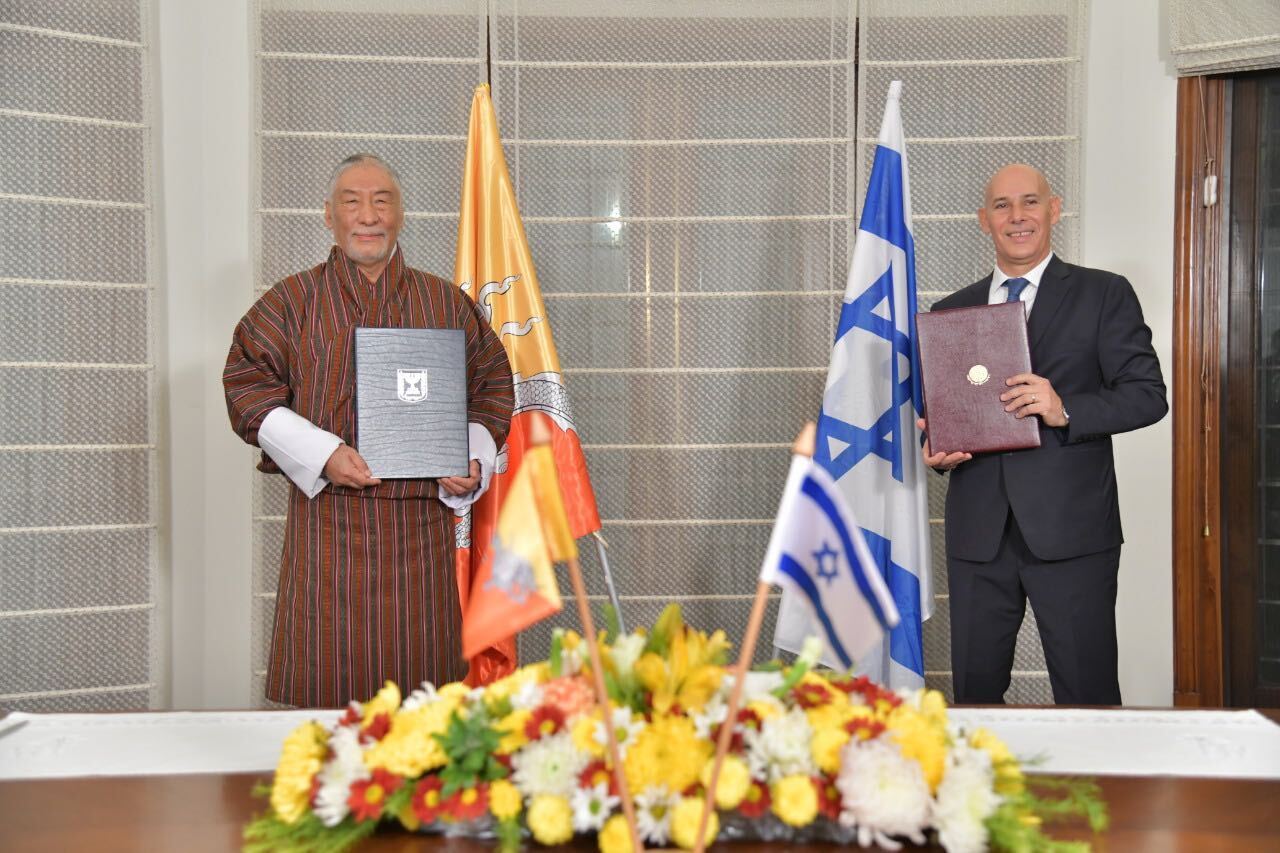
Israel established full diplomatic relations with Bhutan for the first time on Saturday night.
Ambassador to India Ron Malka and his Bhutanese counterpart Vetsop Namgyel signed the final agreement normalizing ties on Saturday night. The countries’ foreign ministries held secret talks over the past year towards the goal of forging official ties, which included delegations between the two capitals Jerusalem and Thimphu.
The effort to make relations between the two countries was not connected to the Abraham Accords, in which four Arab countries – United Arab Emirates, Bahrain, Sudan and Morocco – normalized ties with Israel in as many months, with American mediation. In fact, Bhutan does not even have official diplomatic relations with the US.
Bhutan is a Buddhist kingdom in the Himalayas, bordering on India and the Tibet Autonomous Region of China. It has gone to great lengths to keep itself isolated from the rest of the world in order to avoid outside influences and to preserve its culture and natural resources. The country limits tourism, especially from outside South Asia.
The landlocked country has formal diplomatic relations with only 53 other countries – a list that does not include the US, UK, France or Russia – and has embassies in only seven of them.
Neither does the country have ties with China, having closed its border to the country on its north after China’s 1959 invasion of Tibet.
At first glance, the State of Israel and the Kingdom of Bhutan — two small Asian countries separated by nearly 5,300 kilometers of bone-dry deserts and snow-capped mountains — appear to have little in common besides the fact they occupy the same continent.Seth Mandel: How the Trump administration banished the ghosts blocking the path to peace
Highly urbanized Israel, no bigger than New Jersey, is one of the most wired countries on Earth. Of its nine million inhabitants; 88% have smartphones and 75% are Jews. Immensely popular with tourists, Israel will receive 4.7 million foreigners of all religions this year.
Isolated Bhutan, by contrast, is nearly twice Israel’s size but has barely 800,000 people, all of them Buddhists. Fewer than 200,000 tourists annually visit this Himalayan Shangri-La, which as late as 1980 had just 1,200 phone lines in service. Television came to Bhutan only in 1999.
Despite mutual feelings of admiration, the two countries don’t have diplomatic relations … not yet. But the day that happens, Yeshey Tshogyal — who prefers to see similarities instead of differences — would make an ideal choice as the Forbidden Kingdom’s first ambassador to Israel.
“The people here are very warm and welcoming. They’re also open-minded, at least the ones I’ve met,” the 22-year-old told me in Tel Aviv just before her flight back to New York, where she’s pursuing a double major in psychology and intercultural communications at Baruch College.
Last week, Yeshey wrapped up a two-month internship at the Israel-Asia Center, a nonprofit organization based in Jerusalem.
In July 2009, President Barack Obama met with Jewish leaders at the White House. America, he told them, had been mistaken in trying to adhere to its goal of “no daylight” with Israel. During the previous eight years of the George W. Bush administration, Obama told Jewish leaders, “There was no space between us and Israel, and what did we get from that? When there is no daylight, Israel just sits on the sidelines, and that erodes our credibility with the Arab states.” Obama wanted to put some space between the U.S. and Israel, and proceeded to do exactly that. His experiment was a flop: He was the least successful president regarding the Arab-Israeli conflict since the end of the Cold War.
Trump sought to correct this. He recognized Jerusalem as Israel’s capital and moved the U.S. Embassy there. Trump also had the U.S. recognize Israeli sovereignty over its Golan Heights in the north. When Friedman was announced as the pick for ambassador to Israel, liberal figures insisted he was too pro-Israel and too supportive of what they viewed as the Israeli Right. But success followed.
Kushner, thus, began his push for peace with the wind at his back: Pundits and so-called “experts” had all promised there would be bloodshed from Trump’s Jerusalem moves, but none had materialized because they fundamentally misunderstood the region’s politics. The Palestinians rejected Kushner’s “economic peace” model out of hand, just as they have rejected every peace plan before it. But it turned out he had some surprising takers.
The Palestinians’ legitimate drive for statehood and self-determination had taken on an outsize role in the region’s affairs. Ramallah effectively was given a veto over Arab normalization with Israel. But when Trump called their bluff over Jerusalem, it shattered the myth that you had to go through the Palestinians if you wanted public cooperation and reconciliation with Israel. Trump’s decision to leave the Iran nuclear deal also showed America’s Sunni Gulf allies that he could be trusted to restore the bonds broken by Obama’s attempts to favor Iran over traditional allies.
Much like the ancient ghosts of ethnic conflict that haunt the Balkans, the Middle East was a place where the Palestinians didn’t hold the only veto; history had one too. But the Trump administration approached it with an unsentimental proposal: Don’t be ruled by inherited rivalries and the trauma of the past; if you have the chance to make your lives better right now, take it. The United Arab Emirates and Bahrain did, striking recognition deals that include trade and civil aviation plus joint efforts to combat anti-Semitism. Sudan joined the party, agreeing to normalize relations with Israel and having the U.S. remove it from a list of terror-sponsoring states. On Dec. 10, Morocco entered the normalization-with-Israel parade in return for the U.S.’s recognition of its sovereignty over Western Sahara, a former Spanish colony.
None of this is to say this tack will always work — it won’t. But in several fraught regions weighed down by the bloodshed of history, it offered a path out of the desert. Future administrations, very much including the incoming Biden White House, should study these lessons carefully, adding one more tool to America’s diplomatic arsenal.
“The Arab countries have made clear that they will not make peace with Israel without resolving the Israeli-Palestinian conflict. That’s not where their loyalties lie. That’s not where their politics are.” - @JohnKerry 12/28/2016 https://t.co/LUQzsQpasq pic.twitter.com/nCz68u2cJd
— David Shor (@DYShor) December 11, 2020
Saturday, December 12, 2020Elder of Ziyon
Buy EoZ's books!
PROTOCOLS: EXPOSING MODERN ANTISEMITISM


