Wednesday, August 05, 2020

Vic Rosenthal's weekly column

The longer I live here, the more I understand how different Israel is from my former home, the USA.

There are elements of Middle East culture, unsurprising since about half of all Jewish Israelis are descended from immigrants from the Jewish communities of the Mideast and North Africa. The more recent immigrants from the former Soviet Union and Ethiopia are beginning to have an influence. Social intercourse between Jews and Arabs is strong in some places and weak in others, but one out of every five Israeli citizens is an Arab (I suspect the Arabs are more influenced by the Jews, but that’s another story). And there are more than a few remnants of the Eastern and Central European origins of the founders of the state.

The founders were primarily socialists (and they worked very hard to keep non-socialists from gaining influence in the new state). They left us with the somewhat contrary traditions of a strong central government that tends to behave coercively – Israel still has media censorship (which is often bypassed by social media), people accused of crimes have far fewer rights than in the US, and there is no jury trial. Another tradition is excessive and self-serving bureaucracy, both in government and private businesses.

Over the years an economy dominated by government-owned enterprises has been replaced by one that is mostly private; this has greatly improved the economic performance of the country (but also has created a small class of super-rich Israelis with excessive economic and political clout).

Americans care very much – or at least they used to care – about freedom of speech. There’s less emphasis on that here. What we have as a gift from our founders, who continued to believe very strongly in the right of the proletariat to strike and demonstrate even after they became the bosses, is an obsession with the right to protest. Sometimes it seems that Israelis believe that democracy means the right to block traffic. Haredim, disabled people, Ethiopians, and others have taken to the streets and junctions in recent months to press their demands. Workers in government-subsidized or regulated industries who have a dispute with the Treasury often express their frustrations by torturing ordinary citizens who have absolutely no influence on the government.

In a way, this is understandable, because despite what seems like an excess of democracy (an election every few months), the behavior of our politicians and their bureaucracy is very little influenced by the wishes of the people. Hence demonstrations.

For at least a month there have been nightly demonstrations in front of the Prime Minister’s residence in Jerusalem; recently they started demonstrating in front of his home in Caesarea as well. Before his indictment on corruption charges, there were daily demonstrations in front of the home of the Attorney General, demanding his indictment. Recently there have been violent clashes between pro- and anti-Netanyahu demonstrators, and between demonstrators and the police.

There are several different groups involved. With the advent of Corona and the limitations that the government has placed on some industries, independent business owners and tradespeople, who are not eligible for unemployment compensation, took a big hit (my son is one of them). There are also artists and performers, also independent, whose venues have been shut down. There is the ridiculously exaggerated wedding and events industry – that’s worth another blog post – which employs many, also shut down by the limitations on the number of people who can gather in one place. There is everything to do with tourism. Their frustrations are real, and they are demanding that the government remove restrictions or compensate them in some way.
But the “independents” were joined by the radically anti-Bibi crowd, who – despite the fact that he is legally allowed to remain in his position until he is convicted of a serious crime – insist that he must step down immediately. And there are some anarchists and hard-left people for whom chaos is their bread and butter, as well as those who are non-political but enjoy the excitement and danger of borderline violence (and the possibility that a woman might take off her shirt). It’s ironic that the complaint of those who want to depose the PM by force of demonstrations is that he is “destroying democracy.”

As usual, the overheated atmosphere is fed by social media. Recently, the PM complained to the police about a Facebook post from an account named “Dana Ron” which called for his removal by a “bullet to the head.” In a country which has the murder of a Prime Minister in its recent memory, this is pouring gasoline on the flames that are already too high. Facebook responded that the profile was “fake” and removed it; the police cybercrimes unit determined that the account belonged to an Israeli woman living abroad. The anti-Netanyahu people claim that the threats were actually posted by Netanyahu’s media advisors. Interestingly, other fake profiles that posted pro-Netanyahu content were found that were connected with this one.
Would Bibi be dumb enough to fake a threat on Facebook? Certainly not. Would he hire someone dumb enough to do that? Very possible. Tune in tomorrow.

***

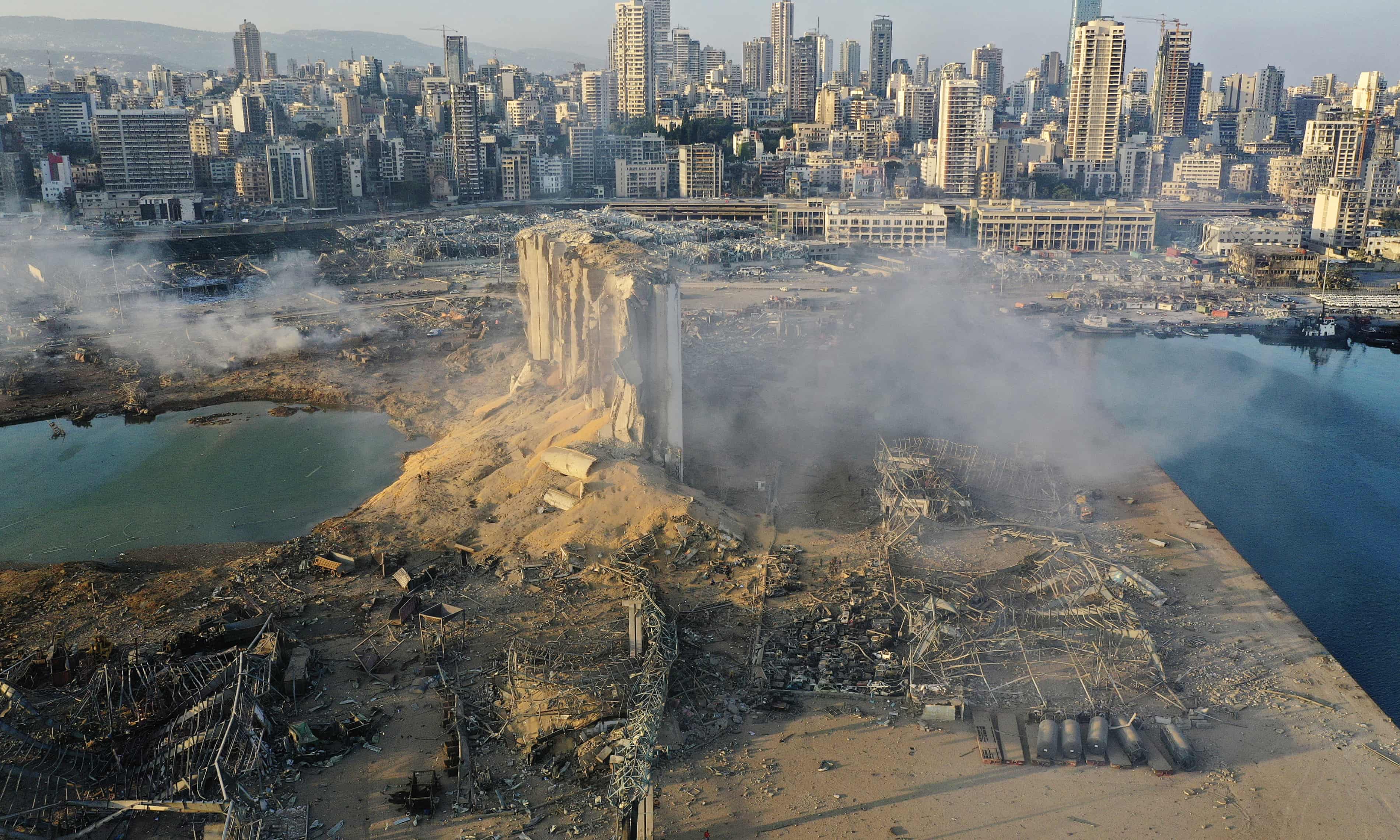
On Tuesday there was a massive explosion in the port of Beirut, Lebanon. It seems – and there will probably be more information available by the time this article is posted tomorrow – that a warehouse containing some 2750 tons of a nitrate compound exploded. Before the main blast, there were smaller explosions that may have been fireworks or small arms ammunition. There was speculation that the explosive material was some form of rocket fuel, but now it seems that the material was ammonium nitrate that had been left there by a Georgian ship that broke down in 2013 on its way to Mozambique. What set it off is still not clear. More details about this event are here.

Naturally, the usual suspects are blaming Israel. Israeli officials said that we had no connection to it. It would be very surprising if we did, because Israel bends over backwards to avoid hurting civilians (sometimes excessively, in my opinion). Really, the only thing that might tempt Israel to do that kind of damage would be the presence of a nuclear weapon – and even then, I believe the IDF would have found some other way to destroy it.

This comes after several incidents in which Hezbollah has attempted to get even for Israel’s killing one of their operatives in Syria.

Lebanon is in the worst financial condition in its history, and a good part of the reason is Hezbollah. First the Corona, and now this explosion (which, incidentally, wrecked the structure in which 80% of Lebanon’s grain was stored) may push the country completely over the edge. I don’t know what is likely to happen now, but the best option – for Lebanon, for Israel, and for world peace – would be for Hezbollah to be pushed out. It is absolutely criminal that the resources of the country are squandered on being the point of the spear for the Iranian war on Israel. But how do you get out from under the thumb of a terrorist organization that has more military capability than your official army?

If the story about the ammonium nitrate is correct, then the government officials who allowed it to sit for years in a dilapidated warehouse near a highly populated area are guilty of criminal negligence. What brought Lebanon to the state it was in before the explosion was the less dramatic, but equally criminal, failure of those in whom the inhabitants of the country placed their trust.

Now let us come back to Israel, where there hasn’t been a cataclysmic explosion, but where a bloated, selfish, childish, and venal political establishment is failing to carry out its responsibilities to the public. Can we get our house in order before we find ourselves in a place similar to that of our northern neighbor?

From Ian:

Beinart and Rogen: The Handwriting on the Wall for Diaspora Jewry?
The American-born Israeli novelist Hillel Halkin asked, “What binds American Jews together today? Most of us are secular; the religious bond is gone. Few of us speak Hebrew; the language bond is gone. What remains is the historical narrative of 80 generations and Israel, the realization of that dream and the spiritual and cultural light that radiates to the rest of the world. If we abandon Israel, we abandon our future. If Israel is gone, Jewish life will be gone in one or two generations. … If we forget that narrative, gone is our Jewishness. Throughout our history, the driving engine of survival has been the hope for returning to sovereignty in the birthplace of our history—Eretz Israel. The State of Israel is the culmination of this dream.”

Today’s young Jewish Americans don’t relate to Israel, as their cultural immersion from middle school through graduate school has painted Israel as the last illegitimate remnant of imperialism, which should be expunged for society to advance. If they care about their Judaism, it is overwhelmingly defined by tikkun olam, repairing the world—a lovely universalist concept that is an important part, but not in itself enough, to make one Jewish. If that is your primary identification with Judaism, you may be a wonderful person, but there is no compelling reason to pass your Jewish identity on. If you also see the Jewish state as anachronistic and militaristic—something that you cannot be associated with to live with your progressive ideology—then you take a step towards Beinart and Rogen.

This all sounds harsh, perhaps a little over the top. But to ignore the facts and reality of what is happening to liberal American Judaism, especially if you care about Judaism’s future in the diaspora, is to bury your head in the sand.

Since most American Jews will not become religious, much less Orthodox, and don’t identify in religious terms in the contemporary post-denominational era, the only sure way to have a continuation of Jewish identify in the Diaspora for the future is to connect to Israel in some way. If you are an atheist and a Zionist, you have a much better chance that your progeny will be meaningfully Jewish than if you are estranged or hostile to Israel and consider your Jewishness to consist of being a really nice person.

With an overwhelming intermarriage rate—and most American Jews uninterested in Judaism as a religion except for maybe a family Passover seder—then a re-engagement with Zionism may be the last hope for maintaining the Jewish census in America. This should begin by ending the false narrative of only seeing Israel through the prism of the Israeli-Palestinian conflict and defining it completely by its “occupation” of the disputed territories. Otherwise, Peter Beinart and Seth Rogan are truly the handwriting on the wall for American Judaism.

Learn to love Israel on your own terms and pass it on to your children. It will preserve your 3,000-year-old heritage and legacy for future generations, with all its beauty and complexities.
What Jews Have to Say to Seth Rogen
According to Rogen, all this stems from his experience in a Jewish summer camp, where he learned about Israel and apparently disliked his Israeli camp counselors.

To which Shany Mor, an associate fellow at the Hannah Arendt Center at Bard College and a researcher at the Israel Democracy Institute, retorted: “I understand; I get it. You were 12, you were at summer camp, and someone gave you a heroic version of Israel’s history, and now that you’re suddenly surrounded at university by theologians of the grand church of intersectionality, you feel the need to renounce. Fine. Renounce your summer camp. Renounce your parents. But leave us out.”

Mor challenged him to confront his fellow Americans with the failings of their country before deriding Israel, “then tell me if you still want to use the word ‘brave’ the next time you and your bunkmate trash talk your camp counselors.”

Refusing to let bad enough alone, Rogen shared his theory that the iconic wizards of fantasy worlds, like Tolkien’s Gandalf, are modeled on Hasidic Jews, and that this community is not doing the rest of us Jews “any favors.” Oy.

As Irene Connelly noted in The Forward, “Here, he’s just leaning into stereotypes for laughs. … It’s one thing to enjoy some self-referential humor, and another to joke at the expense of vulnerable Jewish communities they’re not part of.”

Seth Rogen’s disparagement of Orthodox Jews and Israel is particularly painful to Jews everywhere because he is so widely known as a Jewish personality and has been willing to take on others, including Twitter CEO Jack Dorsey, for tolerating white supremacists and antisemitic rhetoric.

Hopefully, Rogen will extend his Israel education past his summer-camp experience and BDS talking points. Then, I am sure, we will all be happy to hear from him again on the subject.
Jonathan S. Tobin: What to Teach (and Not Teach) Your Children About Israel
This doesn’t mean lecturing kids about what Judaism or Israel means to you. Rather, it represents an opportunity to learn together from the host of online resources available in the 21st century. Indeed, family education — the key to success in any Jewish format — has never been easier to pursue. For all of the challenges of life during COVID-19, the time and amenities to devote to Jewish learning and practice are there. All it requires is the effort and commitment.

Jewish and Zionist education has never really been the mind-control propaganda session that Rogen and Israel’s critics make it out to be.

While enthusiasm for Israel’s miraculous rebirth and survival is atypical and well-deserved, American Jews have never been shy about talking about both sides of the conflict with the Palestinians — something especially true of the Labor Zionist summer camp that Rogen attended. Empathy for the tragedy of the Palestinians is typical of most Jewish educational and even religious systems. If anything has generally been in short supply, it’s the sort of in-depth learning about Zionist history that would better define to youngsters the justice of Israel’s cause.

While misinformation about the Middle East is commonplace, the main source of falsehoods is the mainstream media, and not the overworked and underfinanced Jewish educational system. If parents don’t want the next generation to grow up both ignorant and resentful about the inadequate Jewish education they received, then the place to start is at home by demonstrating that learning is as important to the busy heads of the household as it is to children who right now have too much time on their hands. The outcome isn’t dependent on other people or institutions, as important as they may be. The impact of at-home learning activities, coupled with family trips to Israel once they become possible again, is incalculable.

Seth Rogen’s complaints about what he did or didn’t learn about Israel, the Jewish people, and the Palestinians when he was young aren’t important. Ensuring that other Jewish children in America won’t grow up without knowing the beauty of living traditions and the glories of their heritage is dependent on their families and their extended communities. If they can’t get that right, then there is no one to blame but themselves.

Isaac Herzog became a new twist in the Seth Rogen story when he decided to write a note to the clueless actor, asking him to clarify remarks questioning the existence of the State of Israel. 

Who knows? Maybe Herzog thought inserting himself into this celebrity storm in a teapot could revive his career as an Israeli politician, or perhaps lead to a plum diplomatic position, say at the UN, in New York.

Alas, Herzog was wrong.

What Jewish Agency Chairman Herzog did in the way he approached Rogen was make himself look the fool and even more irrelevant than before.

For one thing, Herzog’s approach was meant to give Rogen an “out.” This at a time of severe scrutiny and criticism for the actor’s careless and hurtful words about Israel and the Jewish people. “[As] a Jewish person I was fed a huge amount of lies about Israel my entire life,” said Rogen, during the now-infamous July 28 podcast with Marc Maron, aptly named the WTF podcast. “They never tell you that, ‘Oh, by the way, there were people there.’ They make it seem like it was just like sitting there, like the fucking door’s open.”

But no, dear Reader. Do not despair. These hurtful words about Israel will not stand! Enter Isaac Herzog, shining knight to the rescue, to make the true sentiment of Rogen's words go away—to help the comedian explain that Israel is really important to him.

From the Jerusalem Post:

“One can definitely argue about policies and positions, as I did in my political career, but for me, the red line is the imposition of doubt on the right of existence of the Jewish State and the encouragement of its delegitimization,” Herzog clarified to Rogen.

Herzog continued to explain that Rogen made it “clear... that what was missing in the published interview was what he did not say: How important Israel is to him. And that, of course, Israel must exist.”

In Herzog’s retelling of this encounter, the former head of Israel's Labor Party offers Rogen a prompt in essence saying, “Please, please, oh famous Canadian actor. Take your words back. Tell us it ain’t so—tell us you’re not saying that Israel has no right to exist!”

Failing to elicit such a disavowal, Herzog assures us instead that Rogen was only joking, giving him a pass for the things he said in that podcast, and blaming Rogen's ignorance regarding Israel, on Israel. Herzog:

"While [Rogen] was speaking in jest during the noted conversation, we cannot ignore the fact that Jews outside Israel often have to stand at the forefront and explain the State of Israel, and sometimes they do not know how nor what to explain." 

Herzog wants you to know: It's all Israel’s fault that Seth Rogen doesn’t know how to respond when people trash talk the Jewish State. Because Israel is not telling its story.

But Herzog, the chairman of the Jewish Agency (!), is wrong. 

Israel has been telling its story for thousands of years. It’s an amazing story, full of miracles and wonders. And if Rogen doesn't know that, it's because he didn’t care enough to tune in and listen. He didn’t care enough to read Jewish history, or the bible, the best-selling book of all time.

The actor didn't care to learn the facts of a story that belongs to him: that the Jews have always been in Israel, have had a continuous presence in the land for thousands of years through successive invaders, somehow managing to maintain a toehold in the Holy Land even after the destruction of the Temple, hiding out in caves. The Jews, the indigenous people of Israel, never left the land. Because the relationship between Jews and the land is symbiotic. Because when a Jew in France (or anywhere else in the world) prays for rain, he does so during Israel’s rainy season; he’s not praying for rain in France or Albuquerque. He’s praying for rain in Israel.

At Passover seders the world over, Jews conclude with the words “Next year in Jerusalem.”

Three times a day and after meals Jews pray for the speedy rebuilding of the Temple.

Jews have done these things for millennia. 

The Jewish religion is all about the Holy Land. Israel is central to Judaism.

To any normal person, the obvious conclusion must be that Jews are supposed to live in Israel. And that no other people can make that claim. That the Jews and only the Jews have earned that right by birth. 

No matter how many other people say it ain’t so.  No matter how many people malign Israel, calling the Jewish State an oppressor that occupies "Arab" land.

Now, unlike Isaac Herzog, I don’t really care about Seth Rogen or other celebrities of his ilk. I don’t care about Jews who turn their backs on their people and their land. But had I cared enough to approach Seth Rogen, it would have been a very different conversation. I wouldn't have excused him, or given him an out for his imbecilic assertions. I would have called him to task.

I would have said to him, “Seth, read a book for Chrissakes! Read O Jerusalem. Read the bible. Read some Bat Yeor and learn what really happened to the Jews under Islam—under the people you think were in Israel first. Know what’s what."

(Because how can it be that Rogen knows nothing of his own history? And cares not enough to correct his own ignorance!)

But I am not “Bougie” Herzog. Or perhaps more accurately, Bougie Herzog is not me. So instead of calling the actor out for his ignorance, Herzog gave Rogen a very public way to duck responsibility for his gross actions, as if he were saying, “Oh please, Seth. Say it isn’t so. Say you don’t really want us to be obliterated from the face of the earth just because some poor brown people say the land belongs to them and that we’re thieves and oppressors.”

And even though Rogen refused to obey that prompt or disavow his disdain for Israel, Herzog doubled down, telling us we’ve got it all horribly wrong. Rogen doesn't hate Israel and want it to disappear, the actor is merely “misunderstood.” 

The actor is just being Jewish, questioning things, and all. 
 
So Herzog clarified, explaining that in Rogen's view:
“asking questions, and arguing differing positions are fundamental in Judaism... as part of the process of casting doubt, which he says is an important motif for the Jewish people” and that “in some interviews he humorously asks questions about almost everything,” trying to explain why he thought his comments were misunderstood or taken out of context.

Rogen? He doesn’t hate Israel. He’s just oh-so-Jewish, a truth-seeker marching along on this journey of life.

How awesome that Bougie explains Rogen to us, helping him wiggle out of this slippery little spot, this conundrum with his people (and his land) without actually eliciting either an actual apology, or a disavowal for what he said.

How marvelous that Bougie managed all that with just one little letter and a follow-up call. Of course, Herzog didn’t really write that letter to Rogen. Instead he got the Vancouver Jewish community to do it:

“Herzog decided to address a letter to Rogen in order to better understand what he meant by his statements. He did so with the help of the Jewish community in Vancouver, where Rogen grew up, according to Herzog’s post.”

Now, we don't know why Herzog needed help writing a letter to Rogen. We can only guess. Perhaps Herzog lacks self-confidence. Which would explain the failed political career.

But having others write a letter to Rogen didn't really help Herzog. This story, like Herzog's career as a politician, will only fade into beige, and the only one who will remember the thing with Rogen, is Rogen, who will only use the conversation with Herzog to hurt Israel some more.

Which is exactly what Rogen did, making Herzog once more the fool when he confessed to left-leaning journalist Mairav Zonszein that his mommy made him do it: made him make that call to Herzog. Which Mairav Zonszein was happy to air in public with a tweet, which Rogen subsequently liked, an outright admission that the actor did not reach out to Herzog of his own accord. It was only filial duty that made him place that call to the Jewish Agency, to Herzog.

Because the truth of the matter is that Rogen isn't sorry. Rogen was not misunderstood. He didn’t mean any of those nice words Herzog put into his mouth. After all, how could Rogen mean those words when, according to the Times of Israel, he never actually said them? 

What did Rogen say to Herzog? We'll never know because when Rogen placed that call to Herzog, he “insisted that the conversation not be recorded.” What we do know: Rogen subsequently told Zonszein: “Read what I actually said about all this and not these secondhand telling.”

In other words: don’t listen to Herzog. Listen to Rogen. He stands by what he said in that WTF podcast with Marc Maron. You know, like when he said that the Jewish State, and having the Jews all together as one people in the Holy Land, “doesn’t make sense.”

The actor never took those words back, and is not in the least contrite. As Rogen explained to Haaretz, “I did not apologize for what I said. I offered clarity. And I think [Herzog] is misrepresenting our conversation. At no point did I give him permission to publish any part of the conversation.”

What, exactly, did Herzog accomplish here? He didn't actually approach Rogen or write to him, contrary to what Herzog suggested to the media. Instead, Herzog by way of the Vancouver Jewish community, wrote to Rogen's mother. Rogen told us so.

He said that Herzog (emphasis added), “sent a letter to my mother on very fancy letterhead. My mom implored me to call this guy and I did and told him I thought this was a private conversation... at no point did I give him permission to publish any part of the conversation.”

So there you have it. No disavowal. No apology. No retraction. Rogen meant what he said. He feels he was “fed lies about Israel” and thinks that Israel, as a concept, “doesn’t make sense.” He only made that call to Herzog because his mommy made him do it.

And so Herzog’s intervention in the Seth Rogen story is yet another gaffe for Herzog, reminding us of the election he lost and how he mistakenly said, “We will keep Netanyahu united,” instead of, "We will keep Jerusalem united," which made everyone laugh. Especially Bibi. 


We laughed and Bibi won and Herzog faded away, blending into the woodwork, tucked behind a desk at the Jewish Agency, desperately trying to remain relevant.

As Seth Rogen has the last laugh at Israel and the Jews. 


We have lots of ideas, but we need more resources to be even more effective. Please donate today to help get the message out and to help defend Israel.
toon ahava
From Ian:

Lebanese confront devastation after huge blast kills 100+, damages half Beirut
Residents of Beirut confronted a scene of utter devastation Wednesday, a day after a massive explosion at the port rippled across the Lebanese capital, killing at least 100 people, wounding thousands and leaving entire city blocks blanketed with glass and rubble.

Smoke still rose from the port, where a towering building of silos was half destroyed, spilling out grain. Hangars around it were completely toppled. The blast knocked out a crater some 200 meters (yards) across that filled with seawater — it was as if the sea had taken a bite out of the port, swallowing buildings with it.

Much of downtown was littered with damaged vehicles and debris that had rained down from the shattered facades of buildings.

An official with the Lebanese Red Cross said at least 100 people were killed and more than 4,000 were wounded. George Kettaneh said the toll could rise further.

The blast has left 300,000 people homeless and caused damage across half of the city estimated to cost more than $3 billion, Beirut’s governor said. “I think there are between 250,000 and 300,000 people who are now without homes,” says Marwan Aboud.

The blast appeared to have been triggered by a fire that touched off a cargo of ammonium nitrate that had been stored at the port for years, though it was unclear what sparked the fire. Hitting with the force of an earthquake, it was the most powerful explosion ever seen in the city, which was split in half by the 1975-1990 civil war and has endured conflicts with neighboring Israel and periodic bombings and terror attacks.

Scores of people were missing, with relatives pleading on social media for help locating loved ones. An Instagram page called “Locating Victims Beirut” sprang up with photos of missing, and radio presenters read names of missing or wounded people throughout the night. Many residents moved in with friends or relatives after their apartments were damaged and treated their own injuries because hospitals were overwhelmed.
Lebanese blame Beirut explosion on years of government corruption
In Lebanon, citizens are accustomed to fury at the government, with the crumbling economy, hours-long electricity cuts, and an armed group dominating much of the country’s politics.

But the shock and horror following Tuesday night’s explosion at the Beirut port, which has claimed over 100 lives so far and left thousands wounded, marked a new low for an already demoralized public. In the midst of one of the worst crises in Lebanon’s history, the catastrophe marked what many called a new, painful nadir.

Though the source of the blast remains unconfirmed, most of the evidence so far points to government negligence, and many Lebanese seem to agree. The official government account indicates that 2,750 metric tons (about 3,000 tons) of highly explosive ammonium nitrate ignited Tuesday night, according to Lebanese Public Security Director Abbas Ibrahim. The explosive material had been idling in the harbor since 2013.

An investigation by Al-Jazeera found repeated letters from Customs Director Badri Daher asking for the cache of ammonium nitrate to be removed. No action was ever taken by authorities.

“We knew they were there,” said Beirut customs official Hasam Quraytam, referring to the tons of ammonium nitrate, “We just didn’t know it’d be this dangerous.”

The Higher Defense Council, which has called a two-week state of emergency, has announced that it is launching an investigation. The results will be announced in five days, the HDC said in a statement.

Lebanese President Michel Aoun stumbled through a speech at a Lebanese cabinet meeting on Wednesday, barely raising his eyes from his screen as he promised that the government would uncover the truth behind the explosion and punish those responsible “with the full measure of the law.”
Seth Frantzman: Israeli aid should be on the ground in Lebanon, regional policies prevent it
Within hours of the explosion that tore apart Beirut, killing a hundred and injuring 4,000, Israel was prepared to support its victimized neighbor in its time of need. Lebanon and Israel are not just neighbors; the countries share many commonalities.

The architecture and design of their port cities are rooted in the 1940s and 1950s. The coastline is the same.

The people of Beirut, like Israel’s Tel Aviv, are open-minded and progressive. But the policies of the Lebanese government appear to have prevented immediate aid or support from reaching the tragedy-stricken country.

Israel has extensive experience in search and rescue as well as disaster relief. The Jewish state has pioneered the use of technology to aid in disasters as well, part of the overall technological innovations in the Home Front command.

These technologies and abilities have been learned from Israel’s experience assisting Haiti in the 2010 earthquake and also in Japan in 2012 after a 15-meter tsunami disabled the Fukushima Daicchi reactors. Israel has also sent aid to Nepal, the Philippines and Mexico during disasters there.

In interviews I conducted in recent years, the Home Front Command described its new technological innovations to help map and locate survivors after a disaster.

Israel has already been recognized for offering support to Lebanon. But Lebanon’s authorities have been slow to respond.

This is despite the fact that Israel’s hospitals in the North are a short trip from Beirut. They have experience working with wounded people from Syria.

  • Wednesday, August 05, 2020
  • Elder of Ziyon

Haj Amin al Husseini, the Mufti of Jerusalem, hosted a delegation of American Christian tourists exactly 90 years ago.

He was anxious to explain to them how he is not antisemitic at all, as reported in The Palestine Bulletin of August 5, 1930.

“The Moslems cannot admit that the Jews are the Chosen People. The chosen man must be the best man, as for example President Hoover in America, so the Chosen People must be the best people. This does not coincide with reality,” he told his guests.

But, he insisted, Muslims in Palestine did not dislike Jews because they are Jews, but only opposed Zionists. Apparently, Jews could never be the best people, but they are OK.

Immediately afterwards, again making sure that he was sayin what he assumed his audience wanted to hear, he described the Jews in Palestine as “a foreign people which persecute Christ and tried to crucify him.”

Today, there are still lots of people who insist that they have no problem with Jews, but only Zionists. And their arguments are just as believable as the Mufti’s.

mufti jews
  • Wednesday, August 05, 2020
  • Elder of Ziyon
5vJdQ7


Here’s a tweet from the Ayatollah Khamenei that is pretty explicit in its antisemitism.

The Quran says Prophet Moses (pbuh) was frequently persecuted by the Israelites. Our enemies too, some of whom are also descendants of the Israelites, seek to persecute our nation that follows the Prophet of Islam, Prophet Moses, Prophet Jesus, & the rest of the prophets (pbut).

Jews persecuted the prophets and now they are persecuting the followers of prophets. This is a slight watering down of popular antisemitic theme one sees in Muslim countries, where Jews are vilified as “killers of prophets” and therefore irredeemably evil.

  • Wednesday, August 05, 2020
  • Elder of Ziyon
skynews-beirut-explosion-lebanon_5058194


From AFP:

Lebanon’s Prime Minister Hassan Diab Tuesday urged “friendly countries” to send help after two massive blasts flattened Beirut’s port, killing dozens and wounding thousands.

“I am sending an urgent appeal to all countries that are friends and brothers and love Lebanon, to stand by its side and help us treat these deep wounds,” he said in a televised address.

When Lebanese officials say “friendly countries” they mean the entire world – except for Israel.

Only a few weeks ago, Makram Rabah, a professor at American University of Beirut, told Anadolu Agency, "Lebanon is punished currently due to the policies of Gebran Bassil (former foreign minister) and Hezbollah," stressing that Lebanon needs to maintain good ties with the Arab states and the international community "except for Israel."

At the same time  Lebanon’s Maronite leader said, “Lebanon was open to all countries, east and west, except Israel.”

Also last  month Hezbollah leader Hassan Nasrallah said that his party is "open to help from any country in the world except for Israel."

Lebanon recently dropped hiring forensics accounting firm Kroll because it has an office in Israel.

Lebanon’s hate for Israel, even as if allows its country to be devastated by Hezbollah and Iran, is counterproductive to the point of absurdity. In 2017, hours before its planned premiere, “Wonder Woman” was banned in Lebanon simply because its star is Israeli.

So when Diab said “friendly countries” it was very clear that he knew that Israel offered help and he was rejecting it. Given that Israeli disaster relief experts could have been on the ground in Lebanon hours before any other country, that means that he chose to let some potential survivors die rather than be put in a position where he accepts help from Israel.

This isn’t principled. In fact, it is the opposite of principled.

Tuesday, August 04, 2020

From Ian:

JCPA: The Fragility of the Liberal Democracies and the Challenge of Totalitarianism
The murder of George Floyd by a police officer in Minneapolis on May 25, 2020, triggered rioting, looting, and arson across the United States. It became evident that an underground leadership structure had been in place and set in motion a wave of violence whose destructiveness was unforeseen.

According to Marxist-Leninist doctrine, the goal of organized mob violence is to foment a state of civil war, which will lead to revolution. The would-be revolutionaries in the United States did so well that their success exceeded their expectations.

Mayors of several major cities and governors of some states where violence took place chose not to act and ordered the police and firefighters to stand down. Such inaction created a state of anarchy, leaving the public without protection.

The moral shock resulting from the outbreak of mob violence which was not put down may have been worse than the actual damage caused by the rioters.

In the United States, it has been assumed that the creation of wealth is good for society, especially if through hard work, one could achieve the “American Dream.” Nonetheless, for the past decade, life has become complicated for many young adults. The growing numbers of this increasingly dissatisfied group in society must be taken into account.

The fragility of the liberal democracies is a serious dilemma. There is a short distance between “peaceful demonstrations” and mob violence, civil war, and regime change. The dynamics of political warfare and the methods of mob violence are knowable. Because it is a matter of self-defense, we must use this knowledge to safeguard our democracies and our freedoms.
Yair Rosenberg: Why Philo-Semitism is Better Than Anti-Semitism
Why people who like Jews, even for the wrong reasons, are usually better than those who don't

Some time back, I wrote an op-ed for the Washington Post explaining my unified theory of Donald Trump’s relationship to the Jews. The purpose was to answer a simple yet confusing question: How can a man who has Jewish family, friends, and business associates, and who proudly proclaims his support for Israel, nonetheless regularly say anti-Semitic things?

In short, my explanation was that Trump accepts anti-Semitic stereotypes about Jews (they’re greedy, good with money, control lots of stuff, only look out for their own, etc.), but that he views these things as positive. “He is the human embodiment,” I wrote, “of the Onion article ‘Affable anti-Semite Thinks The Jews Are Doing Super Job With The Media.’”I situated this thinking in a broader context of historical “philo-Semitism”—people who believe traditionally anti-Semitic stereotypes about Jews, but take them as compliments and seek to befriend or emulate Jews as a result. In my piece, I explained how this sort of outlook can unfortunately be easily manipulated and used to turn people against Jews, and offered the example of South Korea, where philo-Semitic assumptions about Jews were used to galvanize the public against a Jewish businessman.

What I did not suggest in the article, however, is that philo-Semitism is the same thing as anti-Semitism. In fact, I was careful to say that it was better than the alternative. But nonetheless, thanks to the success and spread of the op-ed, I have seen commentators on both the right and left mistakenly suggest that its upshot is that philo-Semitism is simply another form of anti-Semitism, and that adherents of both should therefore be treated the same way. This is not what I believe and would actually be quite harmful in practice. I want to explain why.

1) It is a simplification to suggest that “philo-Semitism = anti-Semitism.” There are actually different types of philo-Semitism. There’s bad philo-Semitism that’s based on ignorance which typically regurgitates anti-Semitic stereotypes in a positive way, and then there’s good philo-Semitism based on actual knowledge of Jewish people and Judaism and the affinity that comes from that familiarity. Knowledge-based philo-Semitism is a wonderful thing and has produced true friends of the Jewish people! We should be striving to turn the former into the latter, whenever possible. (It is not always possible, as with ineducable individuals like the current president.)
Advice to Jewish celebs: Grow up!
I have a Jerry Seinfeld question. Why do Jewish celebrities keep whining about their parents?

Popular actor-comedian-director Seth Rogen ignited an Internet firestorm with his recent complaint that he was "fed [him] a huge amount of lies about Israel" when he grew up. His educators "never told him" that "Oh, by the way, there were people [Arabs] there." But Rogen says he now knows the truth and realizes that having a Jewish state "makes no sense."

What actually makes no sense is the notion that his educators said there were no Arabs in pre-Israel Palestine. Who in their right mind would think there were no Arabs? The 28 years of conflict leading up the creation of Israel in 1948 consisted of Palestinian Arab pogroms against the Jews there. I sincerely doubt the Rogens were so delusional as to not be aware of that.

Another Jewish pop-culture icon managed to reach from beyond the grave to peddle a similar complaint about his parents. Harvey Pekar, icon of the comic-book world, spent his final days on this earth creating a full-length graphic novel titled Not the Israel My Parents Promised Me. It was published a few years back, shortly after his passing.

His parents' apparent sin was being pro-Israel. I doubt that Mr. and Mrs. Pekar ever "promised" little Harvey that Israel was perfect. His book is a dreary regurgitation of standard anti-Israel nonsense that Pekar thinks he uncovered after shaking free of the shackles of his mother and father.

His initial "enlightenment" came via a "Jewish Trotskyist friend" who revealed that Israel is "racist." That was soon followed by some uncle at a Passover seder making remarks "against gentiles." Pekar turned that into a one-sentence summary of the Israeli-Arab conflict: "A lot of Israelis came from Eastern Europe, where they had been abused for centuries. They thought turnabout on gentiles was fair play."

The rest of the book drips with resentment at "Chauvinist Orthodox Jews" and demonic Jewish settlers. One is actually shown holding a saw and telling an equally villainous cohort, "Hold that board steady, Chaim Yankel!" I kid you not.

  • Tuesday, August 04, 2020
  • Elder of Ziyon

It looks like the neo-Nazi National Vanguard site hasn’t been too interested in Israel over the last couple of years, but before that its article about “Palestine” look exactly like articles one would see in far-Left sites.

Just more proof that the far-Left and fat-Right have a lot in common when it comes to Jews.

vanguard
  • Tuesday, August 04, 2020
  • Elder of Ziyon

While there are occasions here and there where the Protocols of the Elders of Zion are called out as a hoax in Arab media, most of the time they are accepted as fact.

At Ad Dustour,  in an article entitled “Who Rules the World?,” Rashad Abu Dawood gave an account of the Bilderberg annual meeting and says that it appears to be an annual Elders of Zion meeting.

The Saudi news agency has an article by Mai Khaled where she says, matter of factly:

The first book I read completely from cover to cover besides children's books was a book that I found in the Abi Library entitled: The Protocols of the Elders of Zion. The color of its cover is red, with a poor picture of a black hand, holding a fist on the globe, tattooed under the six-pointed star, and written in small script: the Jews are behind every crime.

I remember thinking after reading the book: Why do we also not have protocols against the Zionists, why do they plan our occupation for decades and we are not planning anything?

The most absurd article of the month goes to Ammon News’ Odeh Odeh:

odeh3Since the establishment of Israel 72 years ago, and until now, it has not negated what was stated in the Protocols of the Elders of Zion, which affirms the efforts of the world's Jews to establish a “Jewish state” between the Nile and the Euphrates ..
There are no internationally recognized borders for the Israeli enemy state, they are moving borders since its establishment in 1948 and after The 1967 war…
It makes no difference whether  the land captured is Palestinian or Arab, so here it occupies the Golan Heights, which is Arab Syrian land, and on top of that, the Israeli cabinet holds one of its meetings there…
The Israeli flag says all this: the two blue lines are the Euphrates rivers in Iraq in the east and the Nile River in Egypt in the west.

The Protocols hoax began in 19th century Russia, was enthusiastically accepted by Henry Ford and the Nazis, and now are believed by the Arabs. There are many kinds of antisemitism but they all feed off each other.

From Ian:

David Singer: Green light on Judea and Samaria is key to Trump’s re-election
American Jews merging their Jewish identity with their non-Jewish partner’s identity over the last 50 years has seen their families increasingly vote for the Democratic Party - safe in the knowledge that strong bi-partisan support for Israel existed between Democrats and Republicans.

However this bipartisan support has been fractured following President Obama’s post-election sell-out of Israel at the United Nations on 23 December 2016 - followed now by stringent criticism of Trump’s Peace Plan by:
- Senators Elizabeth Warren, Chris Van Hollen, Chris Murphy and Independent Bernie Sanders.
- 191 Democrat Members of Congress
- The Democratic Party’s Draft 2020 platform – which proclaims:

“Democrats oppose any unilateral steps by either side — including annexation — that undermine prospects for two states”

The Democratic Party now opposes Israel unilaterally reconstituting the Jewish National Home in Judea and Samaria – a legal entitlement vested in the Jewish People for the last 100 years but unattainable until now under Trump’s Peace Plan.

Many Jews who voted for the Democratic Party in 2016 would be alarmed at seeing their previous bilateral comfort zone collapsing. The choice they thought they would never have to make has now arrived.

Trump can help regain his high 2016 Evangelical Christian vote while increasing his very low 2016 Jewish vote by green-lighting Israel’s immediate application of sovereignty in Judea and Samaria -considerably boosting his prospects for re-election.

Bret Stephens: The Siren Song of ‘One State’
Anyone who demands that Israel withdraw from part or all of the West Bank needs to be equally forceful in demanding that Palestinians abandon this so-called right. One-state advocates achieve the precise opposite: They foster a crippling fantasy that the right of return need never be conceded because eventually Israel will be pressured into dissolving itself. That will never happen, but chances for peace will be missed in the future, as they were in the past, so long as the fantasy survives.

The final bit of damage is to the American Jewish community. For decades, the opinions and advice of American Jews mattered to Israel. But if the views of a significant segment of American Jewish opinion are soon to harden into a moralizing anti-Zionism, it will only persuade Israelis to reciprocate with indifference and contempt. Whatever else advocates of a one-state solution think they are doing, they are withdrawing from any meaningful dialogue with Israelis about the future of a Jewish homeland.

It used to be that Israelis depended on a secure and thriving American Jewry to help stand up their fragile state. Today it is American Jewry that is fragile, threatened by dwindling cultural influence, stagnant demographic trends, increasing alienation from the Democratic Party and abiding discomfort with the G.O.P., and rising anti-Semitism — sometimes masked as anti-Zionism — from across the political spectrum.

Should American Jews start looking for the exits — just as every other Diaspora community in history has done, and continues to do — they will be grateful to find a Jewish state that resisted the siren song of “one state.”
Beinart ignores inconvenient truth on the reality in Israel – opinion
In reality, while the commentariat class resigns itself to one state — maybe — the Palestinians have been building a state.
It is imperfect, and the path to Palestinian statehood remains fraught. It is very much a work in progress. And yes, its leaders often disappoint.

And yet, on June 22, I saw it almost coming to fruition. The Palestinian Authority’s Jericho rally against annexation bore all the markings of a classic Middle East summit — brusque security agents, rows upon rows of plastic chairs, blistering heat, lofty words and clusters of tall, besuited diplomats.

About 50 diplomats, in fact, including the Russian and Chinese ambassadors, who addressed the crowds in fluent Arabic, and the Canadian ambassador, who arrived in a Beast-like vehicle flying a gold-trimmed maple leaf flag.

One thing was missing: There was not an American or an Israeli emissary as far as the eye could see.

I asked a couple of European ambassadors what they were doing at a political event, and they replied that a rally in favor of the two-state solution was policy, not politics.

Veteran peace negotiator Saeb Erekat took to the stage and hailed what truly was “an unprecedented event.”

“Today,” he said, “the world came to us. The international community came to us, and they told us we are not alone. It is about freedom, independence, dignity and justice.”

In the past, Netanyahu has easily managed to scuttle diplomatic initiatives having a whiff of Palestinian statehood. But the June rally was, without doubt, the most momentous diplomatic event ever hosted on Palestinian land, by Palestinian leaders, and it was a slap in Netanyahu’s face.

On the ground, however haltingly, a two-state solution is coming into being. We saw a glimpse of it in Jericho, alongside a foretaste of a future regional realignment in which the United States and Israel are relegated to the status of observers.

  • Tuesday, August 04, 2020
  • Elder of Ziyon

Zena Agha, is a writer and a policy analyst at the Palestinian Policy Network Al-Shabaka, tries to fool Foreign Policy’s audience.

fp1


The upshot is that a US regulation that ensured that a 1996 law saying that high resolution satellite images of Israel are prohibited by American satellite companies has been changed to allow those better images – from 2 meters per pixel to 0.4 meters per pixel:

It is the difference between seeing the broad outline of a large building and being able to see individual vehicles parked outside. It is possible to identify substantial changes in land use (for instance, the building of city-size settlements or the bulldozing of Palestinian structures) at the two-meter limit, but subtler changes—such as the growth of outpost settlements or small military emplacements—are harder to discern. For 24 years, the legislation obfuscated the damaging effects of the Israeli occupation by literally hiding them from view.

The censorship over Israel and the occupied territories has had negative archeological, geographical, and humanitarian implications. Arguably the most glaring of these has been its effects on monitoring the decades long Israeli occupation—including documenting home demolitions, territorial disputes, and settlement growth. Lower-resolution imagery has forestalled efforts to challenge and verify human rights violations, especially in hard-to-reach areas such as the Gaza Strip, which has been under siege since 2007.

One of  smallest settlements by population, with less than 150 residents, is Mechora in the Jordan Valley. Here’s what it looks like in Google Earth:

mechora


Is it remotely possible for Israel to “hide” even one house there, let alone the entire community? And when hardline rightists put a couple of trailers on land that was never settled before against Israeli law, they brag about it – they don’t try to hide it. Anyone from Peace Now can drive there and see it for themselves in much higher resolution than any satellite.

The thesis is even more absurd than that. No one in Israel is hiding any settlement activity anyway. Every building in the territories goes through multiple stages of approval, all of which are public.

Realizing that her main argument doesn’t hold water, Agha tries to scattershot other reasons why accurate satellite photos are important that also don’t withstand ten seconds of scrutiny. For example:

When it comes to climate change, high-resolution imagery will enable the more accurate detection of changes in vegetation, crop conditions, further spread of desertification (a key impact of climate change in the region), changes to water distribution, overuse of fertilizer, and pollution dumps—changes which are substantially harder to discern and record with low-resolution satellite imagery. For disciplines such as archaeology, it will help identify sites and monitor damage.

Somehow Israel managed to reverse desertification without the rest of the world peering at it in higher resolution.

More importantly, Zena Agha is implying that Israel wouldn’t be concerned with these issues on its own – that it needs Europeans or Americans to pore over these images to find evidence of pollution or overuse of fertilizer. It clearly doesn’t – Israel is perhaps the most environmentally aware nation on the planet, and any concerned scientist or activist can simply drive anywhere in Area C or put an inexpensive drone in the air to see everything in much more detail than even the best satellite image.

The security concern, which is downplayed by Agha, is that the higher resolutions can identify targets for Hamas and Hezbollah rockets more effectively.  For example, they might be able to identify populated areas without adequate rocket shelters to target, or the higher resolution can help them discern chemical plants from other factories that would not be as damaging if bombed.

In the end, this is not that big a deal because other nations were already taking the higher res images and selling them. That’s the reason the US decided to change the regulation; it no longer made sense. It isn’t great but it was inevitable. The real problem is that this Foreign Policy article is using this story as an excuse to bash Israel gratuitously, for example:

Significantly, the reversal empowers humanitarian groups working to hold Israel accountable for its violations of international law, including unlawful killings and settlement construction (which, under the fourth Geneva Convention, constitutes a war crime).

The satellite images cannot help for forensics work when Israel kills a terrorist. But Agha wanted to publish the phrase “unlawful killings” so she pretended they could.

However, higher resolution images can help show illegal Palestinian building all over, as they place new haphazard buildings in places they have no permission for, as I once documented in Google Earth images of an illegal Palestinian “settlement” near Kedar growing from 2004 to 2016:

keidar anim (2)


This article that pretends that somehow the higher resolution images isn’t a security threat – but asserts that the new images will definitely show heretofore unknown Israeli war crimes – is a perfect example of media bias.

(It is also unethical for Foreign Policy to publish this article without noting that the author was personally involved in getting the regulation changed.)

  • Tuesday, August 04, 2020
  • Elder of Ziyon
spider


For the past week, Islamic Jihad has been saying that they will release a major film showing how they damaged the Israeli security apparatus.

The film, “The Spider’s House,”  was just released.  Here’s an excerpt:


It documents how over the course of several years, Islamic Jihad members pretended to be “collaborators” with the Shin Bet so they could see how Israel recruits and trains spies.

They seem to have taken some hidden camera videos in Israel, and the Shin Bet gave  them a cell phone that hides its apps that can be used to securely communicate with their handler.

As far as I can tell, that was it. I see no evidence that Israel acted on any of their bogus tips. It seems that Islamic Jihad used their knowledge to help them find a real collaborator in Gaza, so in that sense they gained something, but this is hardly worth a 38 minute documentary being shown on Al Mayadeen TV.

The real reason for making such a big deal over this appears to be to scare real collaborators in Gaza and convince them to become double agents. Islamic Jihad leader Daoud Shihab said, “The path of return is open and everyone who fell into the trap as a result of some weakness can turn into a mujahid and a hero who serves his religion, country and people.”

  • Tuesday, August 04, 2020
  • Elder of Ziyon

Laura Adkins writes on Twitter, “The most wild thing about the @Sethrogen controversy, to me, is not that his remarks were stripped of context or that everyone's jumping to make his words fit their own narratives (those are par for the course.) What's wild is that the organized Jewish community spends tens of millions trying to reach Jews like [Seth] Rogen (liberal, unaffiliated, under 40, no kids, upwardly mobile) who hold generally similar views about Judaism and Israel. And yet, he's been widely vilified. Quite a recruitment strategy!”

She has a point, and a discussion on how to reach out to Jews who don’t know the first thing about the reality of Israel (or Judaism) is one that needs to happen.

But IfNotNow adds: “What if - just hear us out - they stopped supporting and upholding the Occupation? Taking a strong stand for freedom and dignity for all, instead of putting our ostensibly shared progressive values through a woodchipper, would appeal to so many young Jews. “

How would left-wing anti-Zionist groups act if Israel would forcibly remove 600,000 Jews from their historic homeland? Would groups like IfNotNow wither and die?

Of course not. The “occupation” is an excuse, not a reason, for rabid anti-Israel hate. And the easiest proof is to look at the anti-Zionists of the 1950s – before “occupation.”

The most prominent anti-Zionist group then was the American Council for Judaism, led by reform Rabbi Elmer Berger.  He fought against Israel before 1948, and fought against Jewish Holocaust refugees settling in Israel. After Israel became a state he kept going, just changing his arguments. The ACJ spent much of the 1950s arguing that Israel’s Right to Return law somehow made American Jews automatically disloyal to the United States.

In a pamphlet entitled “Four Articles on the Law of Return,” Berger wrote, “The thesis of the American Council for Judaism is that the Zionist-lsrael axis imposes upon Jews outside of Israel, Americans of Jewish faith included, a status of double nationality.”

This argument is laughable and the only people who use it today are fringe Arabs. But the ACJ, like IfNotNow and other anti-Zionist Jewish groups, aren’t interested in logic – just in finding whatever arguments they can to help destroy Israel. 

418Rn3oZRWL._SY279_BO1,204,203,200_

Alfred Lilienthal was another prominent anti-Zionist. His 1953 book “What Price Israel” twists the “dual loyalty” argument not as if it is a fact but that it is a weapon that antisemites can use against American Jews – and he used his supposed concern over how antisemites would act as a reason to end Israel.

He then went on to engage in his own antisemitic tropes, as this book review in Political Research Quarterly writes:

According to Lilienthal, the creation of Israel was “executed by a strategy board of immense international influence” which resorted to intimidation and underhanded methods. The “American master minds” were Joseph Proskauer, Robert Nathan, and David Niles, assisted by Bernard Baruch, Drew Pearson, A. A. Berle, Jr., Harvey Firestone, and the late Senator Robert F. Wagner. With such an array of influence, it was no wonder, Lilienthal charges, that the American press was completely subverted to the side of Jewish nationalism and that political candidates were frightened into supporting the partition of Palestine.

We recognize this today as an antisemitic conspiracy theory, just as thinking people today realize the same about many of the arguments of today’s anti-Zionists.

And just like today’s Jewish anti-Zionists, Lilienthal blamed Israel for Arab hate:

United States policy favoring partition of Palestine and its support of Israel, Lilienthal exclaims, played squarely into the hands of the U.S.S.R. and alienated the Arab countries. Peaceful relations between Israel and the Arab countries hinge, not on both sides settling their disputes by treaty and co-operating afterwards, but solely on Israel’s changing her ways. Completely ignoring the existence of an Arab boycott of Israel, Lilienthal declares: “To assume a trusted place in a peaceful Middle East, Israel must settle down to peaceful and mutually beneficial trade with her Arab neighbors.”

Lilienthal’s ridiculous arguments didn’t end there. He stated that if US aid to Israel had instead gone to the Arab world, the Arabs would make tremendous strides in democracy. Since then, of course, the Arab world has received trillions of dollars in oil revenues – and democracy is just as distant as it was 70 years ago.

With the benefit of hindsight, we can see that IfNotNow’s and Jewish Voice for Peace and other groups’ political ancestors’ arguments were either ridiculously false or literally antisemitic. But their arguments were just excuses, hooks to hang their hate hats on.

That hasn’t changed.

Monday, August 03, 2020

From Ian:

Antisemitism on the Internet
Antisemitic tweets – European countries with the most

France (9,150) is followed by Germany, Spain, Belgium, Ireland and Austria.

Diaspora Minister Omar Yankelevich presented the EU Ambassador with data regarding antisemitism on Twitter, as collected by the Diaspora Ministry’s Internet monitoring system. Omar and the EU ambassador agreed to cooperate in order to keep Jewish communities in Europe safe and to monitor online antisemitism.

Over the last two months (June and July 2020) 14,210 antisemitic tweets have been posted in European countries. The largest number of antisemitic tweets was recorded in France – 9,150 tweets uploaded by 3,000 web “surfers;” followed by Germany – 2,470; Spain – 2,080; Belgium – 220; Ireland – 168; and Austria – 93 tweets.

This data was collected by the monitoring system of the Ministry of Diaspora Affairs. In total, the monitoring system identified 14,210 antisemitic tweets posted by 4,680 users in these six countries, out of 266,200 posts uploaded by 114,600 users.

Diaspora Minister Omar Yankelevich presented the data at a meeting held last weekend with the EU Ambassador to Israel, Emanuel Joffre, in which they agreed to cooperate in protecting Jewish communities in Europe, monitoring online antisemitism and preserving the religious freedom of European Jews. According to Yankelevich, the difference in the number of tweets between states illustrates the importance of extensive legislation and decisive enforcement against incitement to hatred.

In view of the data presented, the Minister sought to increase cooperation with the EU and streamline funding that communities receive from the EU for security measures. This is to ensure the security and safety of the Jewish communities in Europe. The ambassador expressed his willingness to work in close cooperation with Israel, against the phenomenon of increasing antisemitism on the Internet and “on the ground.” The two also discussed creative ways to connect Jewish communities in Israel with communities across Europe.

Minister Yankelevich: “European Jews are experiencing a difficult period during the Corona crisis. Over a thousand Jews have died of the virus, including rabbis and community leaders. Especially during this period we must work in full cooperation with the EU to maintain the safety and existence of Jewish communities in Europe. I thank the ambassador for his willingness to assist with this issue as well as to monitor anti-Semitism on the Internet and to preserve the religious freedom of the Jews in the EU countries. This is our shared responsibility.”


Protected hate - Arsen Ostrovsky


French Antisemitic Agitator Dieudonné Permanently Banned From Facebook for ‘Dehumanizing Jews’
A little over a month after he was booted from YouTube for consistently posting antisemitic content, the French comedian and agitator Dieudonné has been permanently banned from the Facebook and Instagram social media platforms for the same offense.

A Facebook spokesperson on Monday confirmed that Dieudonné had used “dehumanizing terms against Jews” in several of his posts.

“In line with our policy on dangerous individuals and organizations, we have permanently banned Dieudonné M’Bala M’Bala from Facebook and Instagram,” the company said in a statement. “Banning a person permanently from our services is a decision that we always weigh carefully, but individuals and organizations that attack others on the basis of what they are do not have a place on Facebook or Instagram.”

The prohibition means that Dieudonné has been cut off from his 1.3 million followers on Facebook, in addition to the 400,000 users he lost when his YouTube account was shut down on June 30.

Banned from the UK, Canada and Belgium among other countries, Dieudonné has been convicted numerous times in France for violating laws against hate speech and Holocaust denial. He often collaborates with Alain Soral, a French neo-Nazi, and was an energetic promoter of the late Holocaust denier, Robert Faurisson.

One of Dieudonné’s songs, titled “Shoananas” — a word that combines “Shoah,” the Hebrew word for “Holocaust,” with “ananas,” the French word for “pineapple” — pokes fun at the six million Jewish victims of the Nazis. The comedian is arguably best known for inventing the “quenelle” — an inverted Nazi salute that went viral in 2013.

Facebook’s decision was welcomed by politicians, anti-racist groups and Jewish organizations, some of whom called on the company to close down all similar accounts.

“I welcome Facebook’s decision and hope there will be more,” Elisabeth Moreno — France’s minister for equality — said in a statement. “All forms of speech inciting hatred and racism must be banned from social networks.”

  • Monday, August 03, 2020
  • Elder of Ziyon

Al Arabiya, quoting the Ava Today website, reports that while the Iranians are suffering from a deteriorating economic situation , and Iranians are protesting, the Revolutionary Guards are continuing to export huge amounts to terror groups that are loyal to it, especially Hezbollah in Lebanon.

While opinion polls conducted by the Iranian Student Foundation revealed that more than two million Iranian families did not eat red meat at all during the year, due to declining purchasing capabilities and high poverty rates in the country, the IRGC, in cooperation with the Central Bank, exploited the national identity number of citizens and issued forged passports in their names. Since citizens are allowed to bring a certain amount of foreign currency out of the country for travel, this is apparently how Iran is hiding its transfer of funds to Hezbollah, by pretending that the smugglers are just tourists visiting Lebanon or Syria on Mahan Airlines using names of people who have no idea they officially went out of Iran.


(h/t Ibn Boutros)

  • Monday, August 03, 2020
  • Elder of Ziyon
hdid2


From The National (UAE):

Mohamed Hadid has shared a photograph of himself wearing a face mask by Palestinian fashion designer, Noor Subeh.

The mask is made with keffiyeh fabric, the black-and-white checked cloth that is traditionally used for Arabian head dresses.

The Palestinian-American property developer tagged Subeh in the Instagram image and captioned it: "Stay safe for others to keep yourself safe from others."

If it is made from keffiyeh fabric alone it is not really a very good COVID-19 mask.

But there is another reason why people might want to think twice before buying these:

It really looks a lot like women’s genitalia.

Once you see that, you can’t unsee it.

From Ian:

International Law, Not Terrorism, Must Be the New Paradigm
What must occur to alter the course of this perpetual cycle of violence, terror and violation of law and rights is a fundamental shift in the paradigm applied. Israel and the international community must transcend and move away from terms rooted in terror, and hold the violators accountable to the language and terms of international law and human rights.

In practice, what this means is that negotiations anywhere must not take place on the terms determined by genocidal terrorist regimes and their supporters, and that the price paid must conform to agreed-upon international standards. It means a system of "monetary for humanitarian," where only when the humanitarian needs of Israel are met does the cash flow.

For example, instead of allowing Hamas to set the negotiation terms, the international community must acknowledge that holding four Israeli citizens captive is a standing violation of international law, and humanitarian aid is therefore at risk of being embargoed if the Israelis are not returned and if the law is not upheld. The fact that one of the Israelis being held captive for six years nearly to this day—Hadar Goldin—was killed during an internationally brokered humanitarian ceasefire only further strengthens the international legal and moral argument. The concept of a "prisoner swap" prescribed by terrorist thought and rhetoric as the tool to use in such a scenario must be denounced; instead, international law must be upheld.

Similarly, the financial support—known as "pay-for-slay"—that the Palestinian Authority provides to terrorists, must cease, or their humanitarian aid and the provision of international aid by United Nations agencies must be limited. Announcements that Israel is now seizing these terrorists' salaries form a necessary first step. The international community also must make difficult choices of when to restrict aid in order to uphold international laws and human rights norms. If it fails to do this, these laws and norms risk losing their very meaning.

This new paradigm of international law, human rights and norms means that Israel too must move away from the old paradigms or prisoner swaps and cease allowing the "pay-for-slay" payments to take place. The global community and Israel together have the potential of leading by example, utilizing the language of rights and expecting consistency and reciprocity from the international community in return. Only then can the cycle of violence begin to unravel, and a renewed "world order" be built on a profound commitment to uphold, promote and protect human rights.
Michael Doran and Peter Rough: China’s Emerging Middle Eastern Kingdom
If the Russian-Iranian alliance should die, or become weak and ineffectual, China will not step in directly to build it back up—because Beijing fears a direct confrontation with the United States. The first priority of American policy, therefore, is to remove the sword from China’s hand by crushing the Russian-Iranian alliance. The domestic American political climate will not permit the use of large numbers of American troops in this project, but four other tools do exist:
1) Economic sanctions. The Trump administration has been imposing these effectively. The Iranian economy is in perilous condition, and the economic situation of Iran’s allies, the Assad regime and Lebanese Hezbollah, are equally dire.
2) Clandestine operations. In recent months, Iran has experienced a wave of mysterious fires and explosions at industrial complexes and military installations. One of these events, at the nuclear fuel enrichment site at Natanz, reportedly set back the country’s nuclear program significantly. A foreign hand is suspected in at least some of these episodes, and the finger of suspicion points most often at Israel. But the sabotage could just as easily be the result of a joint American-Israeli operation.
3) Direct military action by allies. The Turks and the Israelis have both carried out very effective operations in Syria that have significantly degraded not just Iranian but also, in the case of the Turks, Russian capabilities.
4) Selective and judicious use of American military capabilities. The killing of Qassem Soleimani in December did more to shake the Iranian regime than any step the United States has taken in the last 30 years, with the possible exception of the invasion of Iraq. It not only removed from the game an indispensable player, but it boosted the morale of America’s allies and demoralized its enemies.

These tools, taken together, can effectively remove the Russo-Iranian sword from the hand of China. They are already being used. Are they the result of a conscious Trump administration strategy, or have they simply materialized as a set of ad hoc responses to the president's insistence that his national security team contain Iran aggressively, yet with an economy of force? Whatever the answer, they point the way forward. The goal of American policy should be to use them separately and in coordination so as to increase their lethality.

The greatest advantage that the United States has in its competition with China and, indeed, with any of its adversaries, is hard power. In the realm of trade and investment, Washington simply cannot compete with China and hope to win. If it is to contain China successfully, then it will win with its sledgehammers: military power and economic sanctions. In the Middle East, what America’s allies crave most is the security that comes from the might of the American military. Nothing does more to encourage allies to hedge their bets and cozy up to Beijing than the fear that the United States has decided to abandon military competition as a tool of statecraft.

As China works to make the Middle East a factor in the Western Pacific balance of power, the United States should respond by bringing the Pacific to the Middle East. China’s energy supply lines and its aspiration to become the dominant power in the Persian Gulf should become a regular and significant part of America’s discussions with its Pacific partners and India. The goal of this dialogue should be to arrive not just at a shared picture of the threat but also at strategies for assuring that China’s supply lines remain highly vulnerable. China’s partners and potential partners in its plan to become a Middle Eastern military power—Iran, Djibouti, Pakistan, Iraq, and others—should be put on notice that the days of harmonic convergence are over. Support for Chinese hard-power aspirations must come at a steep price. The U.S. must bury harmonic convergence as an organizing principle, or risk ceding control of the international system to a hostile, anti-democratic power.
Israelis have more in common than not with one another - opinion
If there is a large protest, the media will – as it must – interview the protesters and then the politicians. The protesters are protesting because they are angry, and that anger comes out in their words. The politicians are looking for someone to blame, and that anger comes out in their words.

Both Transportation Minister Miri Regev (Likud) and MK Moshe Ya’alon (Yesh Atid-Telem) – on opposite sides of this country’s pro- and anti-Netanyahu divide – sound as if they are about to blow a gasket every time they talk about the other side. Interviewee after interviewee sound angry, mad and full of hate.

But there is another Israel out there. It’s the one that quietly goes on with its life in these uncertain times, perhaps not agreeing – and perhaps even strongly disagreeing – with the political outlook of their neighbors or co-workers, but not hating them, not wanting to wage an all-out war against them. In fact, there are many who feel a great deal of sympathy for their countrymen’s suffering as a result of the pandemic.

The problem is that right now, that does not attract attention and does not get air time. What attracts attention is extreme rhetoric. What attracts attention is comparisons to dark periods of history. What attracts attention is saying that the other side are a bunch of fanatics hell-bent on destroying the country: anarchists to the left of me, fascists to the right.

And since that is what attracts attention, that is what is shouted out from the megaphones, picked up by the press and amplified on social media. So one wakes up and believes that is the reality.

Except it’s not. It might be a slice of this country’s reality, but only a slice.

There is another reality out there,reflected in that meeting of those reservists, of an Israel where not everyone hates the other side, and where – though it might sound corny – what binds really is greater than what divides.

Which is not to say that the atmosphere is not charged, and that in a charged atmosphere someone may commit an act of political violence. But civil wars – the type some are warning of now – are not made of individuals on the fringes taking extreme action, but rather, brother taking up arms against brother because the hatred in their hearts overflows.

Walk the streets of the country beyond Balfour Street during one of the nightly protests – or step away from Twitter for a day – and chances are that you won’t encounter that overwhelming hatred, but rather, a reality that, while contentious, is softer and far less toxic and hate-filled than what you come across every time you turn on a computer, radio or television set.

Most people are not inhabiting the hate-permeated reality being portrayed in the media and online. There is another Israel out there.

  • Monday, August 03, 2020
  • Elder of Ziyon
anti


Many critics of Israel (and others) say that philosemitism is just a form of antisemitism.*

I disagree. Two recent examples of seeming praise for Jews shows how to tell the difference between true admiration for Jews and fear of Jews.

Jordanian news site Ad Dustour   often has explicitly antisemitic articles. So this article by Muhammad Dawudiya seems incongruous at first glance because it appears to praise Jews.

Judaism is a closed, non-missionary religion that does not promote conversions and refuses to engage in it. Numerical abundance does not occupy a position, interest or goal in the Zionist thought and planning.

No Jewish rabbi calls anyone in the world to convert to Judaism.

The number of Jews in the world is around 14 million, but their financial, electoral, political, media, scientific, and industrial influence is increasing exponentially.

Jews in the world are closer to the party, organization, and system run by the World Jewish Council and their lobbies scattered around their places.

This organization is based on a culture of solidarity, support, and sympathy for the center of the Jews - Israel, the state of all Jews, which constitutes the first investment destination for wealthy Jews who own 10% of the world's billionaires' fortunes, which are achieved by their domination of the knowledge economy, which they manage almost entirely.

Jewish organizations strongly support youth initiatives and innovation, which has achieved fortunes that exceed all the wealth of all Arab countries combined, two to three times!

The number of Christians in the world is about 2.2 billion people, or 32% of the world's population. The number of Muslims in the world about 1.6 billion people, making up 23% of the world's population. The number of Arabs is about 370 million, making up 5% of the world's population.

The number of Jews in the world is about 14 million, making up only 0.2% of the world's population.

Despite the minuscule number of Jews, they have influence that they control in most parts of the world.

More than 80% of the top American managers are Jewish or married to Jews.

According to the Center for Arab Gulf Studies, 3 million Jews possess more than the budgets and incomes of 152 countries in the world!

The average Jewish families’ donation to Jewish students, scientific research, elections, media and other goals amounts to about 9 billion dollars annually.

The place the Jews have achieved is proof of the need to focus on quality rather than quantity. And proof that many of us will not liberate Palestine.

Here we remember Lenin's saying: "Give me a dozen men and I will change the world with them." That dozen of men really changed the world.

Is this article philosemitic? Not at all.  It is meant to teach Arabs the supposed Jewish strategy of taking over the world so the Jewish plans can be learned from.

But how can you tell when praise of Jews comes from admiration and when it comes from fear and hate?

Recently, Jonathan Hoffman’s blog reported:

In late March 2019 Stephen Lamonby, 73, a part-time lecturer at Solent University, remarked to a colleague, Dr Janet Bonar, that people from different countries had become good at certain things owing to “high exposure”.  He said that Germans are good at engineering because they are “exposed to a high level of industry from an early stage in their lives”. When Dr Bonar, a US-born engineering lecturer, mentioned her degree in physics, Mr Lamonby said that Jewish people had “a particular gift” for the subject. He used Albert Einstein as an example and asked Dr Bonar if she was Jewish. She took offence and called Mr Lamonby a racist. He replied: “I believe that the Jewish are the cleverest people in the world. They are much maligned because of it. I asked if you were Jewish because of your ability with maths/physics et cetera. Which is a speciality of theirs.”

Here is a non-Jew who said that Jews are good at physics, offending his supervisor when he asked if her skill in the field perhaps comes from her being Jewish.

What differentiates Ad Dustour’s praise of Jews from that of Dr. Lamonby  - or Donald Trump?

The answer is quite simple.

People who admire Jews would want to partner with them. They want to be friends with them. They want to hang around them.

People who view Jews as an implacable enemy want to learn their “secrets” from a distance. They want to use secondary sources to learn about Jews, but they don’t want to deal with them directly.


UPDATE: Yair Rosenberg wrote to me explaining that he definitely does not say that philosemitism is the same as antisemitism, and he has written this up as an article here.

AddToAny

Printfriendly

EoZTV Podcast

Podcast URL

Subscribe in podnovaSubscribe with FeedlyAdd to netvibes
addtomyyahoo4Subscribe with SubToMe

search eoz

comments

Speaking

translate

E-Book

For $18 donation


Sample Text

EoZ's Most Popular Posts in recent years

Search2

Hasbys!

Elder of Ziyon - حـكـيـم صـهـيـون


This blog may be a labor of love for me, but it takes a lot of effort, time and money. For 20 years and 40,000 articles I have been providing accurate, original news that would have remained unnoticed. I've written hundreds of scoops and sometimes my reporting ends up making a real difference. I appreciate any donations you can give to keep this blog going.

Donate!

Donate to fight for Israel!

Monthly subscription:
Payment options


One time donation:

Follow EoZ on Twitter!

Interesting Blogs

Blog Archive