Thursday, October 24, 2019

From Ian:
Seth Mandel: Disempowered

Book review: A respectable fig leaf
Seth Mandel: Disempowered
Review of 'The Education of an Idealist: A Memoir' by Samantha Power
It surprised no one, least of all U.S. intelligence agencies. As Joby Warrick reported in the Washington Post the following week, “U.S. spy agencies recorded each step in the alleged chemical attack, from the extensive preparations to the launching of rockets to the after-action assessments by Syrian officials.” The administration had no doubt now, and no plausible deniability either.
Obama was now convinced he had to strike Syria. But he had a problem of his own making: UN inspectors were on the ground. So the president waited. And as he waited, he got cold feet and started looking for a way out. He chose to put the matter in the hands of Congress—he needed no authorization for strikes, he said, but wouldn’t strike without congressional say-so. No real strategy to persuade even Democrats in Congress was set forth. And there was, Power writes, no Plan B.
In the end, Obama’s desperation to be bailed out of action led him to agree to a joint U.S.-Russian plan to rid Syria of the chemical weapons. It was a sham. Assad hid some weapons from inspectors and continued bombing civilians with chemicals that were left off the list. Obama rewarded Assad and Vladimir Putin by ceding them the playing field conclusively. Power looks back on one administration meeting after the August chemical attacks:
What I did not know in that Saturday meeting was that this would end up being the only time Obama would seriously contemplate using military force against the Assad regime. We would have countless meetings and debates on Syria over the next three and a half years, but he would never again consider taking the kind of risk he had been prepared to bear in the immediate aftermath of the August 21st attack.
And why wouldn’t he ever again consider it? Because he had undertaken to strike a deal with Assad’s patron in Tehran and to reorganize American alliances to allow Iran and Russia to fill the vacuum of U.S. influence in the region, a vacuum that Obama specifically aimed to create. As Frederic Hof, a U.S. envoy to Syria in 2012, put it: “To complicate the ability of Iran’s man in Syria to commit war crimes and crimes against humanity would have placed at risk nuclear negotiations aimed ultimately at dissolving American relationships of trust and confidence with key regional powers.”
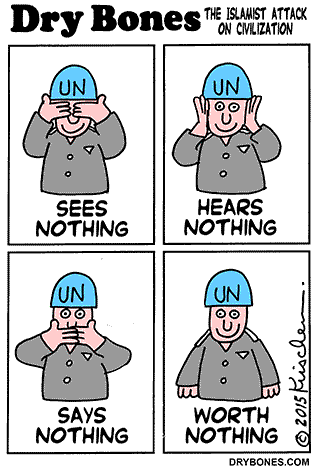
Power never realized that she wasn’t there to be heeded. Rather, she was there to be silenced. Obama’s conduct of U.S. foreign policy required the coopting of his critics. He found a way to let the world burn without running afoul of Samantha Power’s network of interventionist scolds: Make Power the public face of doing nothing.
Book review: A respectable fig leaf
A key problem is denialism. As Stellman points out, “Anti-Zionists are very sensitive when charged with antisemitism.” Anti-Zionists protest their revulsion against all forms of racism and, in an ironic twist, accuse their accusers of conspiring against them “to shut down criticism of Israel.”Talk about Anti-Semitism at a College Campus, and the Anti-Semites Will Show Up
What is astonishing is that this transparent ruse, itself utilizing an antisemitic trope, appears to have worked. At a recent Intelligence Squared debate in London, the motion that “Anti-Zionism is antisemitism” was defeated by a margin of 4-1. Those who applaud that result will be discomfited to read Kaplan and Small’s landmark 2006 study of 5,000 citizens in 10 European countries. Stellman quotes their important finding of a direct statistical correlation between anti-Israel rhetoric and antisemitism: “Even after controlling for numerous potentially confounding factors...anti-Israel sentiment consistently predicts the probability that an individual is antisemitic.”
The sickness that lies at the heart of the current assault on Israel’s legitimacy is laid out in forensic detail by Stellman’s dispassionate, methodologically rigorous approach. The result is this little volume packed with valuable – if often depressing – information presented in a way that activists and scholars alike should find compelling. The short chapters are easy to read, aided by bullet points and a comprehensive index. The final section contains a set of tools specifically designed for use by trainers and educators.
Some of Stellman’s assertions will elicit controversy: is there really any practical difference between “political” and “anti-Israel” anti-Zionism? Both have the same ultimate objective. And are statements lacking nuance, such as “Islam is basically an expansionist religion” and that “Muslims must wage a ‘Jihad’, a ‘Holy War’, until the whole world becomes “Dar al-Islam” appropriate in a text that explores (among other issues) religiously inspired hatred of one group by another?
The evidence for the central thesis of the book – that anti-Zionsim and antisemitism are closely interlinked – is overwhelming. This is an observation with major implications for the discourse around the Arab-Israeli conflict, yet it is one that is rarely discussed or even acknowledged by allegedly “expert” commentators, academics, politicians, NGOs and the media. That lacuna of awareness represents an existential threat to the future of Israel (and, by extension, the Jewish people) and, in consequence, the prospects for peace.
This handbook is an important contribution to the scant but growing literature on anti-Zionism. Stellman has formulated an important response to that vacuum of serious academic thought. In any future edition (and I gather that the Stellman is planning a follow-up book containing new material), it would be helpful to the reader if the author could add a section by tying together the disparate threads of his argument into a small number of key conclusions. Ideally, these would be linked to a series of recommendations as to how activists might develop practical and effective strategies for countering the anti-Zionist threat to Israel, Jews and civilized norms everywhere.
At a conference held at Bard College two weeks ago on the subject of “racism and anti-Semitism,” a group of protesters—organized by Students for Justice in Palestine—attempted with some success to disrupt a talk by Ruth Wisse and two (Jewish) discussants. (Wisse, known for speaking her mind forcefully against campus anti-Semitism, thanked the protestors for “providing a demonstration” of the topic at hand.) Administrators and security did little to stop the demonstrators.
While such scenes are hardly remarkable in today’s universities, more notable was the flood of indignant denials from conference participants that followed an article by one of the discussants, Batya Ungar-Sargon, describing what happened. The indignation, perhaps, stemmed from Ungar-Sargon’s willingness to label the demonstrations anti-Semitic. Shany Mor, a professor at Bard and the third participant on the panel, defends Ungar-Sargon’s account and exposes the feeble excuses for the thuggish behavior of the students:
The protest was only against Wisse, I was told repeatedly, even though flyers against all three of us were distributed. This was the reception controversial speakers should expect, I was told, even though there were many far more controversial speakers at the conference. But this is a liberal campus, I was told, and the reception was always going to be worse for controversial speakers from the right than from the left. This was doubly odd, as neither Ungar-Sargon nor I can be fairly imagined as being on the right by anyone’s imagination.
And, while many of the more provocative lectures were not terribly provocative to a left-liberal audience, [others] were. There was a panelist who argued that black underachievement was not due to racism but to fathers. There was a panelist arguing that “chosenness” had distorted Jewish political thought and as such infected later European thought on colonialism. . . . . There was a panelist who argued that certain African and Asian countries might have been better off had they remained under European colonial rule. . . . Some had difficult questions from the audience; many didn’t even have that. None was protested.
This is what makes [one Bard professor’s] claim that the demonstration was motivated by nothing more than the fact that the three panelists “espouse political opinions with which the students disagree” so outrageous. It’s understandable that this is what he might want believe, but it’s verifiably false. The three of us up there on that stage actually have radically different political views from each other, and radically different views on the issue in question at that session. This would have been apparent had a civilized discussion taken place.