Wednesday, March 27, 2019

From Ian:
Anti-Israel Lobbyists Dwarf Pro-Israel Lobbyists

Alan M. Dershowitz: Jews Must Never Be Afraid to Use Their Well-Earned Power

Anti-Israel Lobbyists Dwarf Pro-Israel Lobbyists
According to Open Secrets, AIPAC spent $3.5 million on lobbying in 2018, slightly more than the $3.4 million it spent in 2017. This is a relatively small number compared to the anti-Israel Open Society Foundation (OSF) which spent $31.5 million in 2018 – NINE TIMES what AIPAC spent. That figure is also almost four times the $16 million that OSF spent on US lobbying in 2017. This huge jump in lobbying dollars may coincide with George Soros’s transfer of $18 BILLION into OSF, making it the second largest “charity”/ largest lobbying group in the United States. (By calling itself a charity instead of a lobbying group, Soros was able to avoid paying any capital gains on the billions of investment dollars in his hedge fund.)
In addition to its work lobbying the US government, the OSF directly funds many anti-Israel organizations according to NGO Monitor, including Adalah, Breaking the Silence, Ir Amim and Al-Haq.
That’s just one giant far left-wing lobbying group countering most of AIPAC’s agenda.
The left-wing J Street has likewise repeatedly fought the current Israeli administration and lobbied aggressively against it, and spent more money lobbying Congress in 2018 than AIPAC, a total of $4 million. Not one dollar of J Street went to Republican candidates, which is not surprising as it is really an alternative to the Republic Jewish Coalition, not a broad-based bipartisan group like AIPAC.
When it comes to foreign countries lobbying the US government, the number one country was South Korea, spending $82.5 million in 2018. I do not recall hearing any of the Democratic candidates for president who ran to the defense of Rep. Ilhan Omar’s remarks about AIPAC talking about South Korea.
Perhaps that is because foreign governments and their companies are mostly lobbying about trade deals which are critical for their economies.

Alan M. Dershowitz: Jews Must Never Be Afraid to Use Their Well-Earned Power
No other group is ever accused of having too much power and influence. That false claim – dating back to times and places where Jews had little or no influence – is an anti-Semitic trope that tells us more about the anti-Semites who invoke it that it does about the Jews.Poll: Dems’ sympathies now evenly split between Israel and Palestinians, down from +19 two years ago
History has proven that Jews need more power and influence than other groups to secure their safety. During the 1930s and early 1940s Jews had morality on their side, but they lacked the power and influence to save six million of their brothers and sisters from systematic murder.
"The truth is that if Israel were to put down its arms there would be no more Israel. If the Arabs were to put down their arms there would be no more war." -- Israeli Prime Minister Benjamin Netanyahu.
When Jewish power and influence are used in the cause of peace and justice -- as it is today -- there is nothing to be ashamed of. It should be a source of pride.
Two years ago, on the eve of Trump’s inauguration, just 20 percent of Democrats thought the U.S. was too supportive of Israel versus a combined 72 percent who thought current levels of support were about right or not enough. Today they’re at 38/41. Something has changed.
What is it?
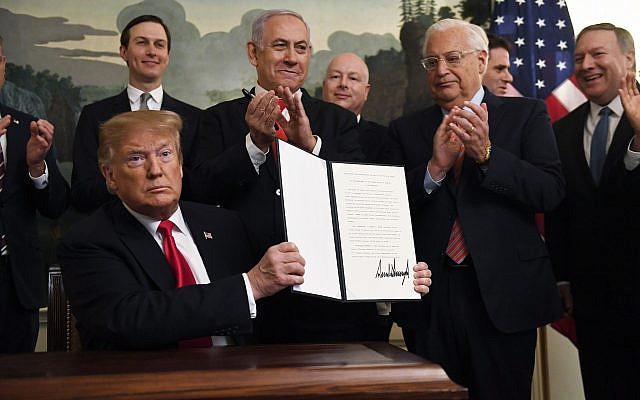
There are two obvious possibilities, not mutually exclusive. One is that partisanship has infected this issue just as it’s infected every other. Democrats are less sympathetic to Israel because they hate Trump and are letting their contempt for him alter their view of the Jewish state. Trump hasn’t done anything dramatic to affect the balance of power between Israel and the Palestinians but he’s made some bold symbolic gestures of support towards the former, ordering that the U.S. embassy be moved to Jerusalem and just a few days ago recognizing Israeli sovereignty over the Golan Heights. Democrats might be looking at that, reasoning that “the friend of my enemy is my enemy,” and deciding that Israel should bear some of the brunt of their anti-Trumpism.
If you doubt that partisanship matters here, note that two years ago 63 percent of Republicans said that the U.S. isn’t supportive enough of Israel. Two years later, with Trump having succeeded Obama in office, 67 percent of Republicans now say U.S. support of Israel is “about right.” Some of that is a reaction to the embassy and Golan Heights — and some of it is certainly approval of Trump’s decision to exit the Iran nuclear deal — but I think in the main it’s a reflection of Republicans trusting Trump more on all matters. Saying current support is “about right” is really a vote of confidence in Trump. By the same logic, Dems’ dwindling sympathies for Israel might be a vote of no confidence in him.
In fact, Yair Rosenberg makes a fair point about why Democratic views of Netanyahu really might have changed in year 10. What if they hate Trump so much that Bibi’s very chummy relationship with him has belatedly soured them on Netanyahu and, by extension, Israel?
Interesting, but I’m not sure how to square that with strong-ish Democratic support for Israel prior to 2017 despite the often hostile relationship between Obama and Netanyahu. If Bibi’s warm embrace of a president whom Dems hate is enough to sour them on Israel, why didn’t his cold shoulder towards a president whom they love do the same?