Thursday, August 29, 2019

From Ian:
Evelyn Gordon: Israel can’t treat its own destruction as a legitimate aim
Evelyn Gordon: Israel can’t treat its own destruction as a legitimate aim
When Israel barred two US congresswomen from entering the country earlier this month, I initially thought it was a stupid decision. But after hearing the reactions from both American politicians and American Jews, I’ve started to think that it may have been necessary.The Tlaib-Omar Show Was a BDS Masterstroke
This isn’t to deny the substantial damage it has caused. Pro-Israel Democrats felt betrayed and even some pro-Israel Republicans were outraged. Most of the organized Jewish community was horrified. And the boycott, divestment and sanctions movement received media exposure it could never have gained on its own.
But nobody would have felt outraged or betrayed had Israel barred, say, white-supremacist politicians. Thus the underlying message of these reactions was that unlike white supremacism, advocating Israel’s destruction is a legitimate opinion, and is entitled to the same respectful treatment as the view that Israel should continue to exist. Yet, no country can or should treat its own erasure as a legitimate option.
To understand why this was the issue at stake, a brief review of the facts is needed. When Israel originally agreed to allow a visit by Reps. Rashida Tlaib (D-Mich.) and Ilhan Omar (D-Minn.), it knew that they enthusiastically supported BDS, a movement unambiguously committed to eliminating the Jewish state. It also knew they would use the visit to tar Israel in every possible way.
However, it assumed that they would at least pay lip service to Israel’s existence by following the standard protocol for official visitors – meeting Israeli officials and visiting some Israeli sites. On that assumption, and since the law banning entry to prominent BDS supporters permits exceptions for the sake of Israel’s foreign relations, Israel decided to admit them “out of respect for the US Congress,” as Israeli Ambassador to the US Ron Dermer said at the time.
A few days before the visit, however, the proposed itinerary arrived and proved that assumption wrong. Far from paying lip service to Israel’s existence, the trip literally erased the country from the map.
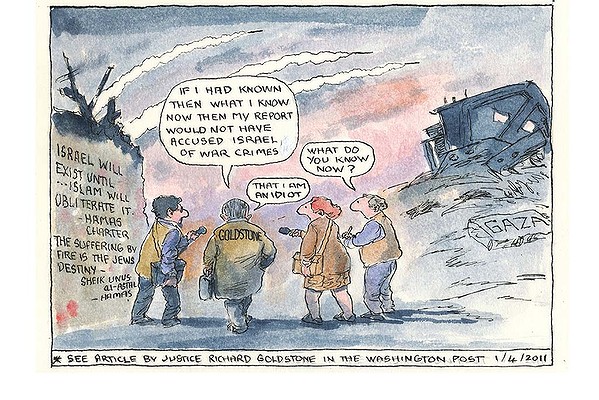
US-Israel relations have been through worse, and they will survive this too. But the incident is worth contextualizing within the US-Israel political framework. Tlaib and Omar displayed remarkable audacity in openly lying about their trip, both in advance and then again after it was canceled. They falsely claimed they were planning to meet Israeli officials when their itinerary included only ‘Palestine’, Palestinians, and supporters of Palestinians.Book review: The trials – and tribulations – of Judge Richard Goldstone
Tlaib’s actions proved that her visit was never meant to be an impartial trip to the scene of the conflict. Nor was it about seeing her grandmother. The point was to showcase the so-called “occupation.” Such manipulations, compounded by the soft power enjoyed by pro-Palestinian groups, magnify a fictitious reality. They allow those groups to hijack the narrative of peace, justice, and human rights while yearning for Israel’s destruction.
US-Israel relations do not exist in vacuum, and US opinion is neither monolithic nor frozen in time. It has undergone significant shifts since 1948, with some groups becoming more favorable toward Israel and others less so. Nevertheless, as polls illustrate, support for Israel has become an American value, even if some elected officials feel otherwise. Sustaining this requires work and perseverance.
It is a serious challenge to get past the self-delusion and zero-sum exclusion of the BDS worldview, which polarizes American politics regarding Israel, and convey the actual reality of the Middle East. The normalization of antisemitism in American politics and culture – together with our growing collective dependency on technology and the general tone of politics – reduces complex issues to sound bites and drives polarization and ignorance. (h/t IsaacStorm)
In The book, The Trials of Richard Goldstone, Daniel Terris, a friend and admirer, provides us with an in-depth account of a remarkable career.
Goldstone, 80, is a third-generation South African who was born into a Jewish family in Boksburg, near Johannesburg.
In the book, we follow, and are helped to understand, the events and circumstances that led to the emergence of Goldstone as a towering figure in international jurisprudence.
As his legal career progressed in South Africa, where he combated and helped defeat apartheid from within the system, and as chief prosecutor for the UN in bringing the Bosnian Serb political and military leaders to justice, Goldstone proved himself a dedicated advocate of human rights and an unwavering upholder of international humanitarian law.
Terris both describes and explains the challenges that Goldstone faced along the way, and the principles that informed his many decisions – principles that evolved over the course of his career, and have become his legacy.
Then late in the story, when he was already past 70, came the debacle of the Goldstone Report, a pivotal episode in his life and in his career. Terris describes the episode with scrupulous honesty.
It is well known that a couple of years later, Goldstone published an article in The Washington Post containing the key sentence: “If I had known then what I know now, the Goldstone Report would have been a different document.” His partial retraction of the report’s conclusions was condemned at the time as “too little, too late,” and in a sense this was true. Yet Terris also highlights the reactions of some in the human rights world who applauded Goldstone’s moral courage in acknowledging when mistakes had been made. “Heroism of the first order,” one editorial called it.