
 Friday, May 08, 2026
 Elder of Ziyon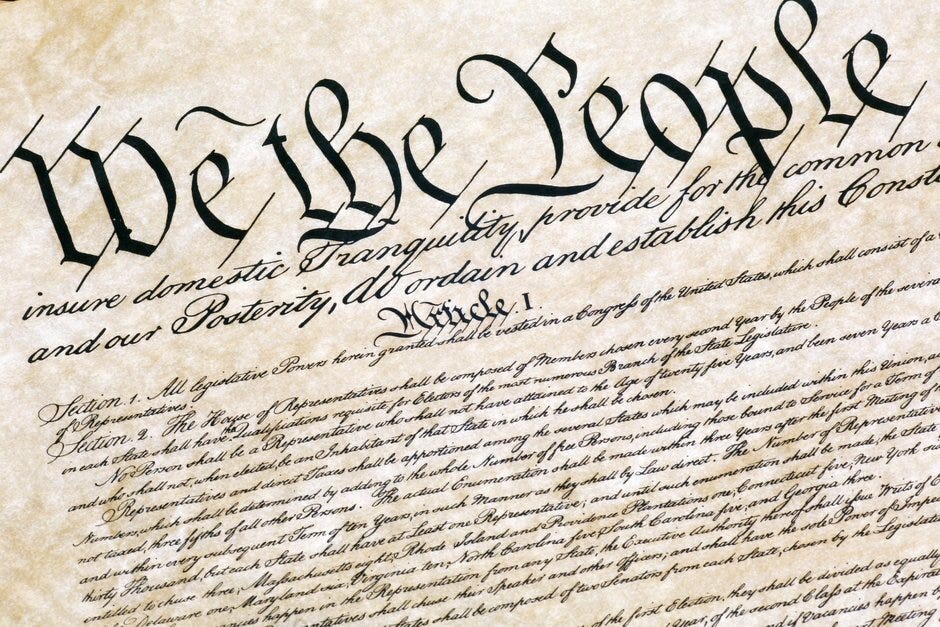
The founders were not naive about government. They had read Locke and Montesquieu, studied the Roman Republic, watched the British Parliament operate at close range, and understood the mechanics of institutional design better than any generation before them. The Constitution they produced is a masterwork of that understanding — separated powers, enumerated rights, layered sovereignties, a bill of rights added almost immediately because the first draft wasn’t cautious enough. They knew how to build governmental architecture.
What they were attempting in 1787 was something the formal architecture alone could not accomplish, and they knew it. The experiment was not merely in constitutional design. It was in whether a free people could constitute themselves as a society — hold themselves together, maintain justice, extend opportunity, honor their obligations to one another — without the binding agents that every previous civilization had relied upon, like blood, the Crown, or the Church. The founders explicitly rejected them all. What remained was a covenant and a bet: that people who had accepted common terms could treat each other as members of a common enterprise, even across distances and differences that made the bond invisible to ordinary human instinct.
The Constitution announces this in its first three words. “We the People.” The obligations the Preamble describes — a more perfect union, justice, domestic tranquility, the general welfare, the blessings of liberty — are assigned to the people collectively, and the government is the instrument they constructed to help honor them. The direction of authority in the American system runs from citizens outward to institutions, not downward from institutions to subjects. Every other government of the founders’ era ran the other direction. That reversal was the experiment.
Europe drew the opposite conclusion from the same Enlightenment premises. If reason could identify the conditions of human flourishing — and the philosophes were confident it could — then the rational state, staffed by educated administrators, was the appropriate mechanism for producing those conditions. The state would answer the social questions: how resources were distributed, what opportunities existed, and what obligations citizens owed one another. The citizens’ job was to participate in the state through their representatives, pay their taxes, and receive the protections and services the state provided. This was a coherent theory of how a modern society organizes itself, and it produced, over the following two centuries, the welfare states of Western Europe, whose citizens are by most measures well cared for.
America’s founders rejected that theory before it fully formed. “Of the people, by the people, for the people” was not poetry when Lincoln said it at Gettysburg — it was a job description, and it assigned the job to Americans, not to their government. The social questions were the people’s questions to answer: in their towns, their voluntary associations, their businesses, their daily choices about how to treat the people around them. Government could set the floor — the legal minimum below which no one could push another person — but the ceiling was built by citizens, and it was as high or as low as citizens chose to make it.
Alexis de Tocqueville arrived in America in 1831 to understand why this arrangement seemed to be working. He was thirty-one years old, a French aristocrat in a country that had recently guillotined its aristocracy, trying to comprehend a democratic republic that had already survived longer than the French Republic had managed. What he found surprised him enough that he wrote two volumes about it.
The surprise was not the Constitution or the courts or the federal structure, all of which he analyzed carefully. The surprise was what Americans did when they had a problem. In France, Tocqueville wrote, a man encountering a difficulty would look to the government; in England, to a lord; in America, to his neighbors. Americans formed associations — voluntary, spontaneous, self-organized — for everything: building roads, founding schools, running hospitals, debating public questions, organizing charity. The habit of solving problems collectively, without waiting for authority to act, was so pervasive that Tocqueville decided it was the secret of democratic self-government at scale. A people that governed its own daily life would prove capable of governing its political life; a people that waited for the state to solve every problem would lose the capacity for self-governance entirely.
The habit he observed was the covenant in daily practice. Every barn-raising, every volunteer fire company, every mutual aid society was an enactment of “We the People” at small scale — Americans treating other Americans as people they were in community with and therefore owed something to. The government had almost nothing to do with it. That was the point.
The question was whether the habit he observed was permanent or circumstantial. He was watching a country of perhaps thirteen million people, overwhelmingly concentrated along the Eastern Seaboard, sharing a common language, a broadly Protestant Christian culture, a recent revolutionary experience, and memories of the communities they or their parents had left in Europe. Mutual obligation came naturally in that context. The farmer down the road was one of you: you knew him, or knew his family, or knew someone who did. Obligation to a visible neighbor is something human beings are wired for. Every social instinct evolution gave us operates at small scale, among people we can see.
The founders were asking Americans to extend that instinct outward far beyond anything instinct naturally supports. And in 1787, they were asking it of a country that, whatever its other divisions, was composed almost entirely of white Christians. The covenant’s terms said membership was defined by acceptance rather than identity — but the actual membership was, for most of the republic’s first century, remarkably homogeneous, which made the horizontal obligations easier to feel even when the theory said they should extend further. The hard version of the experiment — the version that asks 330 million people, the most diverse nation in human history, to feel genuine obligation to strangers across a continent who share nothing with them but citizenship — is the version only now being run at full scale.
The founders bet that the covenant could carry that weight. The evidence is not yet in.
What the evidence does show is that the inner rings of the covenant are holding. AmeriCorps data from 2023 found that 75.7 million Americans — 28.3% of the population — formally volunteered through an organization, contributing nearly five billion hours of service worth $167 billion in economic value. That number had collapsed during the pandemic and rebounded to its largest recorded expansion in the survey’s history. More striking still: 54% of Americans — 137.5 million people — informally helped their neighbors in the same period, running errands, watching children, lending tools, doing the ten thousand small things that constitute a functioning community. Tocqueville’s Americans are still out there. The voluntary habit he identified nearly two centuries ago has not died. Americans are still, in large numbers, treating the people around them as people they owe something to.
The inner rings hold. The outer ring — obligation to Americans you will never meet, in places you have never been, whose lives look nothing like yours — is where the strain shows, and that strain is the subject of the next chapter. What matters here is that the foundation Tocqueville identified is intact, and that it supplies the answer to the question the experiment was always asking: can free people maintain a society without mandatory binding agents? At the level of neighbors and communities, the answer remains yes. The question is whether Americans can extend the same habit to the scale the experiment demands.
This is where the American Dream enters.
This is an excerpt from my upcoming book, "Reclaiming the Covenant." To read the entire book online, become a paid subscriber to my Substack.

|
"He's an Anti-Zionist Too!" cartoon book (December 2024) PROTOCOLS: Exposing Modern Antisemitism (February 2022) |
 |
 Buy
Buy


