
 Monday, September 28, 2026
 Elder of Ziyon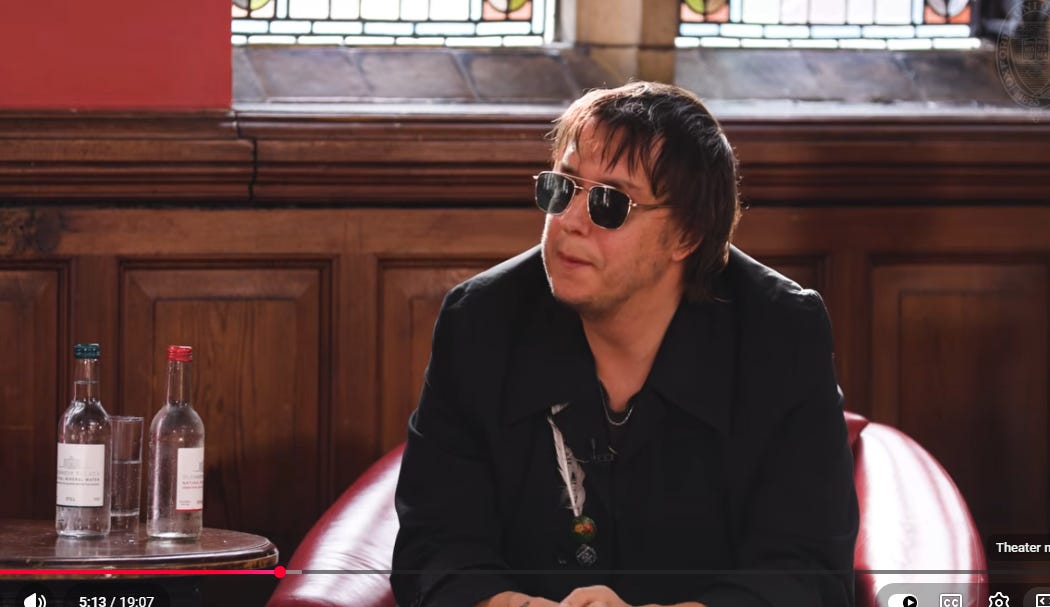
Julian Casablancas, the frontman of The Strokes, told a large YouTube audience recently that American Zionists “get the benefits of white privileged people, but talk like they are black people during slavery.” He then went to the Oxford Union and “clarified” that he only meant that Jews who support Israel’s existence as a Jewish state “If the only thing you can bring yourself to say is ‘Netanyahu is the problem’ or, ‘Well, I believe Israel has the right to exist,’ you “are perhaps accidentally signaling to some that you…are supporting Jewish supremacy and white supremacy.”
Again, his audience is Oxford students. His father was the founder of Elite Model Management and his mother a former Miss Denmark; he was educated at the Lycée Français de New York and then at Institut Le Rosey, a Swiss boarding school known as “the school of kings,” before finishing at one of the most expensive private schools in Manhattan. And he looks at Jews who support Jewish self determination, who support a nation that was literally built from nothing, as Jewish supremacists with the ultimate privilege.
Let’s talk about privilege.
The problem isn’t that Casablancas has it. Nobody chooses the family or the school they’re born into, and there’s no sin in inheriting advantage. The complaint is what he did with the word once he had it: he took a term that used to imply responsibility and used it as a slur against people with less power than he does.
Privilege is morally neutral. So is strength, so is intelligence, so is a beautiful voice — the raw material a person is handed carries no moral weight on its own. How you use these advantages - and everyone has some advantages - is what is important. A strong man who protects the weak and a strong man who bullies them have identical strength; only the use separates them, and only the use is anyone’s business to judge. The same holds for privilege, which is why the word used to travel with an obligation attached — noblesse oblige, to whom much is given much is expected, the boy who inherits the family firm and is expected to run it honestly. Privilege named a debt.
Warren Buffett still uses the word the old way. He calls it “the ovarian lottery”: born male, white and American in 1930, to parents who talked about interesting things at dinner and could afford to send him to decent schools, wired by pure genetic accident with a mind that happens to be extraordinarily good at valuing businesses in a market economy that rewards exactly that skill. None of it, he’s been clear for decades, had anything to do with merit. “I was born at the right time and place,” he told his biographer. He pledged to give away more than ninety-nine percent of his fortune, on the theory that winning the lottery obligates you to the people who didn’t. Casablancas took the word that makes a man like Buffett give away tens of billions of dollars and repurposed it as ammunition against people he’s never met.
Notice, too, what Casablancas had to do to make the accusation work: he never evaluated an individual Zionist’s conduct. He evaluated a category, and assigned the whole category his own family’s privilege. A Jew who fled persecution with nothing, whose family was murdered, who was expelled from the Arab country his family lived in for centuries, whose life has been building rather than inheriting, gets stamped with the privilege of “Zionists” as a class. That is the same move — judging a person by the group rather than by what he actually did — that identity politics is guilty of. This is no coincidence.
Everyone with privilege has a choice about what to do with it: use it as a weapon against other people who may or may not have as much of it, or show appreciation for having been given it at all. Casablancas chose the weapon. Buffett chose the gratitude, and then he chose to act on it. They each had the choice and we can determine what kind of man each is by what they did with their privilege.
Politicians have mostly chosen privilege as a weapon too, which is stranger, since nearly all of them are beneficiaries of exactly the advantages they campaign against. Imagine one who told the truth instead: “I am extraordinarily grateful for what my life gave me, and I want to use it to help others. That’s why I’m here. I want to raise everyone up, not knock anyone down.” Almost none of them say this. Instead they climb onto the anti-privilege bandwagon and rewrite their biographies as a struggle comparable to growing up in extreme poverty, because admitting to advantage now reads as disqualifying rather than as an obligation to be honored. Nearly none of them has the life story they’re selling their audience, and that gap is what leaves them open to the charge of hypocrisy — Graham Platner positioning himself as a blue-collar oysterman while his father quietly paid for his house, his mother was his only paying customer, and his boyhood included a prep school that cost more than most Mainers make in a year.
Privilege comes with two obligations, not one. Using the position to help others is the first. Showing gratitude for having the position at all is the second, and it’s the one politicians skip, because gratitude doesn’t poll as well as grievance. That is the whole difference between the false morality that treats privilege as an insult and the real morality that treats it as a debt. Wouldn’t you rather vote for the one who’s honest about what he was given than the one who divides the world into haves and have-nots and then lies about which side he’s on?
None of this requires wealth to get right, which is what makes Casablancas’s failure so complete. A kid raised by a single mother in a walk-up apartment still had a mother who loved him, and a kid who watched a friend end up in prison, or in the ground, learned something from watching, whether or not he had a word for it. Gratitude is available at every income level, because the test was never how much a person inherited. The test is whether he noticed, and what he did with it.
Sir Moses Montefiore had privilege. Baron Edmond James de Rothschild had privilege. They used it to help support Jews fleeing persecution and giving them the means to create industries and live with dignity in the land of their forefathers. That is a hell of a lot better use of privilege than spouting antisemitic tropes to the Oxford Union.
What Casablancas does with his privilege is to stoke hate and call it insight. He is entitled to the school of kings. He is not entitled to lecture Oxford about the imagined privilege of a people who have spent the last century rebuilding from ash, in a language of moral responsibility he has never once applied to himself.


