
 Thursday, February 26, 2026

How the Revolutionary Left Embraced Radical Islam
In 2006, in a public discussion of Israel’s assault on Lebanon, the feminist scholar Judith Butler characterized Hamas and Hezbollah as “part of the global left.” Butler’s remarks provoked a scandal at the time, but after the October 7 attacks, it became common to hear Western leftist protesters chanting slogans like “long live Hamas!” How did Middle Eastern terrorist groups rooted in radical Islamic ideology come to occupy such a central place in otherwise secular left-wing politics? In The Revolutionists: The Story of the Extremists Who Hijacked the 1970s, journalist Jason Burke takes up this question, exploring the historical roots of the Palestinian national movement and situating its rise within the transition from 1970s left-wing radicalism to the emergence of radical Islamism, which reshaped global politics in the 1980s.Seth Mandel: The Emotional and Intellectual Fragility of Anti-Israel Activists
Burke’s account brings to life the central figures of this transnational revolutionary movement: Leila Khaled of the Popular Front for the Liberation of Palestine (PFLP), Fusako Shigenobu of the Japanese Red Army, Ulrike Meinhof from the German Red Army Faction, and “Carlos the Jackal,” the nom de guerre of the sociopathic Venezuelan-born gun for hire Ilich Ramírez Sánchez. These leftist militants moved fluidly across borders, traveling from sympathetic regimes in the Middle East to hubs of revolutionary fervor, most notably the PLO’s refugee camps in Lebanon and Jordan. They hijacked airplanes and marched with Kalashnikovs in the desert. Inspired by the revolutionary tracts of Frantz Fanon, Régis Debray, Che Guevara, and Mao Zedong, they forged a transnational network of anti-colonial insurgency and solidarity.
These left-wing radicals took Mao’s dictum that “political power grows out of the barrel of a gun” to heart and concluded that electoral politics and peaceful protest were insufficient for taking on the global forces of capitalism, imperialism, and colonialism. But this analysis also created its own problems. The enemy these militants fought was not a single politician, national government, or corporation, but a vast, complex global political and economic system, so it was always unclear how a small number of assassinations and kidnappings could defeat it.
This is part of why Israel became their primary target. The radicals of the era viewed the Jewish state as the most egregious manifestation of capitalist decadence and settler colonialism, but also as small and weak enough to be brought down through violent direct action. By doing so, they believed they could hasten the inevitable collapse of a rotten Euro-American imperial system.
The ideological current underpinning this radical global project was internationalism. Building on Marx’s dictum that class conflict had no national boundaries, these radicals traveled the world for training, combat, and refuge. From the street cafes of Paris to the Arab communist enclave of Aden, the revolutionaries searched for hideout spots and friendly governments in far-flung parts of the world. For example, “Carlos the Jackal,” settled in the People’s Democratic Republic of Yemen after fleeing authorities in Europe.
Burke offers a compellingly detailed picture of these radicals’ delusions of grandeur and the many comical contradictions that hampered their efforts. For example, a group of British Trotskyists drank alcohol in a PLO training camp and got into a fist fight with British Maoists as well as with the Palestinian guards who tried to confiscate their bottles. The German Red Army Faction mistakenly incorporated a submachine gun used by West German security forces into their logo, instead of the Kalashnikov, the weapon most associated with anti-colonial resistance. German radicals were so repulsed by the dirtiness of a PFLP office in Yemen that they went on a blitzkrieg-style cleaning spree. These militants romanticized the life of the revolutionary and were convinced they were forging a more just world, but they were constantly undermined by their own incompetence, poor planning, bad tempers, and cultural cluelessness.
The few stills from the video presentation that have leaked focus on Islamophobia and something called “anti-Palestinian racism.” One example of anti-Palestinian racism, provided on a slide about “APR in Education,” is: “Being called Antisemitic if they are Pro-Palestinian or speak up about APR.”The Real Reason the “Pro-Pals” Did not speak out on behalf of Iranians
This is a neat trick, and it is in line with the wider speech-chilling campaign conducted by pro-Hamas propagandists: It is “racist” to call someone an anti-Semite.
Because this idea is ubiquitous among Gaza Westerners, it tells us a few things about members of this movement.
First, they exhibit a level of emotional and intellectual fragility that is, frankly, pathetic. This training reportedly showed a map of Israel replaced by the Palestinian flag, and yet “teaching students that ‘Israel is a free democratic state’ would render teachers ‘racist’ in the eyes of the board,” Hummel explains. That the “pro-Palestinian” narrative relies on such Stalinism is not unrelated to the fact that much of modern anti-Zionist propaganda was produced by the Soviet Union in the first place. Yet even by the standards of anti-freedom Hamasniks, this scale of reality-aversion in adults is frightening.
Second, the process by which this campaign is being carried out is anti-democratic in the extreme. That means the system will be anti-democratic about everything it does. Israel isn’t the exception but the rule. The ultimate target, then, is the Western system of liberty and self-government, with which strident anti-Zionism is entirely incompatible.
Third, the terminology is an assault on language. “Anti-Palestinian racism” is a ridiculous, self-contradictory phrase that ought to be laughed out of the room. If it were racism, they could just call it racism. Since it isn’t, its proponents have come up with a term that means “pretend ‘Palestinian’ is something it’s not.”
And fourth, absolutely none of the movement’s complaints about “policing anti-Israel rhetoric” are to be taken seriously. These lunatics are arguing that openly calling for genocide against the Jews is not only within the bounds of neutral argumentation but that it is fundamental to the identity of what might be called Palestinianism. But saying “Israel is a democratic state” is so “racist” that educators have to be trained not to say it around children.
As this type of “equity” training colonizes Western academia at every level of schooling, it’s easy to see why these activists want it kept secret. Any self-respecting person would be ashamed to be a part of it.
The author seems to think this is perfectly understandable under the circumstances of the Palestinians’ lives imposed on them, not by their own leaders who drag them into incessant conflict, but because of Israel’s terrible treatment of Palestinians [2](also in the West Bank- I guess the Gazans were channeling their brothers and sisters.) In point of fact, Israel had not stepped foot in Gaza since 2005. Only when Hamas was elected to lead and resumed firing rockets at Israeli towns on a near daily basis, did Israel together with Egypt impose a blockade to prevent the Gazans from bringing in more tools of destruction (it didn’t work).
Mr. QJ laments the number of deaths of Palestinians at the hands of Israelis but you know what he never mentions even once? Hamas and a good part of the Palestinian population at large, is dedicated to the destruction of Israel and killing Jews as they have threatened to do repeatedly. And we had a front row seat to how that threat has been and, if given the opportunity, will continue to be carried out, on October 7, 2023. Israel set out to destroy Hamas so that the October 7 atrocities can never be repeated — and all of its actions in Gaza were proportionate to war’s purpose. No one forced Hamas to store munitions in schools and use hospitals as a base for military operations or to shoot from people’s homes making civilian casualties unavoidable.
The author’s point is essentially this: We don’t need to stand up for Iranians because there is substantial agreement in the country that what Iran is doing is wrong. We need only protest Israel’s actions because Israel has the support of its American ally.
So notwithstanding the real genocide in Sudan, no need to support the Sudanese because we all agree that they are oppressed and the United States is not supporting Sudan,
Tell that to the people who spoke out on behalf of the Ukrainians and against the South African apartheid.
What message does silence send to the Iranian people who are risking their lives for freedom? Some suffering is more worthy than others?
In other words, instead of answering the question—why some activists ignore atrocities in Iran—the author takes the opportunity to add to the slanderous vitriol against Israel who are portrayed as uniquely evil and invents a narrative that absolves him of any moral responsibility, Iran as irrelevant, and critical thinking is nowhere in sight.
This was not an article to be taken seriously on its merits and I would not usually pay attention to this kind of drivel but the author has 18,000 followers and lots of support. Fair minded people cannot allow antisemitic voices to continue slandering the State of Israel without raising our hands.

If You’re Anti-Israel, Are You Antisemitic? Here’s What the Data Says
For more than a year now — indeed, well before October 7 2023 — American college and university campuses have been saturated with a familiar insistence: We don’t hate Jews. We just oppose Israel.New ‘respectability’ for ancient hatred
Since the Oct. 7 Hamas massacre, that claim has grown louder and more strident; but it did not originate there. What October 7 did was strip away any remaining ambiguity, transforming a rhetoric that had long circulated at the margins into something mainstream, unapologetic, and increasingly coercive.
The argument has been well-rehearsed and made nationwide. Protesters insist their calls for Israel’s elimination are purely political, rooted in moral concern for Palestinians, not hostility toward Jews.
To suggest otherwise, they argue, is to conflate critique with bigotry and to weaponize antisemitism as a shield against dissent. Jewish students, meanwhile, describe a very different reality. They experience not policy disagreement but negation: of peoplehood, of legitimacy, of belonging. They are told that the one collective expression of Jewish continuity in the modern world is uniquely immoral; that Jewish self-determination is inherently suspect; that Jews, alone among peoples, must justify their right to exist.
When Jewish students say this feels antisemitic, they are often met not with curiosity but with dismissal. They are told they are confused, hypersensitive, or acting in bad faith. Administrators, eager to avoid controversy, retreat into procedural language, insisting that what is unfolding is political speech — even when it spills into exclusion, intimidation, and collective punishment.
Until recently, this dispute has rested largely on moral intuition and lived experience. Those matter. But they are no longer all we have. New survey evidence now allows us to examine empirically whether the claim at the heart of contemporary campus activism — that opposition to Israel is distinct from hostility toward Jews — actually holds up.
It does not.
The Fall 2025 Yale Youth Poll — a nationally weighted survey of 3,426 American voters with a substantial oversample of young adults — offers one of the most comprehensive recent snapshots of attitudes toward Israel, Zionism, Jews, and antisemitism in the United States.
Unlike many polls that isolate these questions, the Yale survey (graciously shared with us) places them side by side. That design allows us to see whether views about Israel track systematically with views about Jews.
Using a secondary analysis of the dataset and excluding the small number of Jewish respondents to avoid conflating in-group and out-group attitudes, we examined the relationship between opposition to Israel’s existence and well-established measures of antisemitism (see Hersh and Royden’s research on antisemitic attitudes).
The results are not subtle. They are consistent, patterned, and deeply unsettling.
The central dividing line in our analysis is a simple question: Do you believe Israel should exist as a Jewish state?
Among non-Jewish respondents, 41 percent said yes, 24 percent said no, and 35 percent were unsure. Those who deny Israel’s right to exist are not merely critics of Israeli policy. They are rejecting the legitimacy of Jewish national self-determination itself — a position that now sits at the center of much campus activism.
The crucial question is what else accompanies that belief.
The answer, according to the data, is a dramatically higher likelihood of endorsing classic antisemitic tropes.
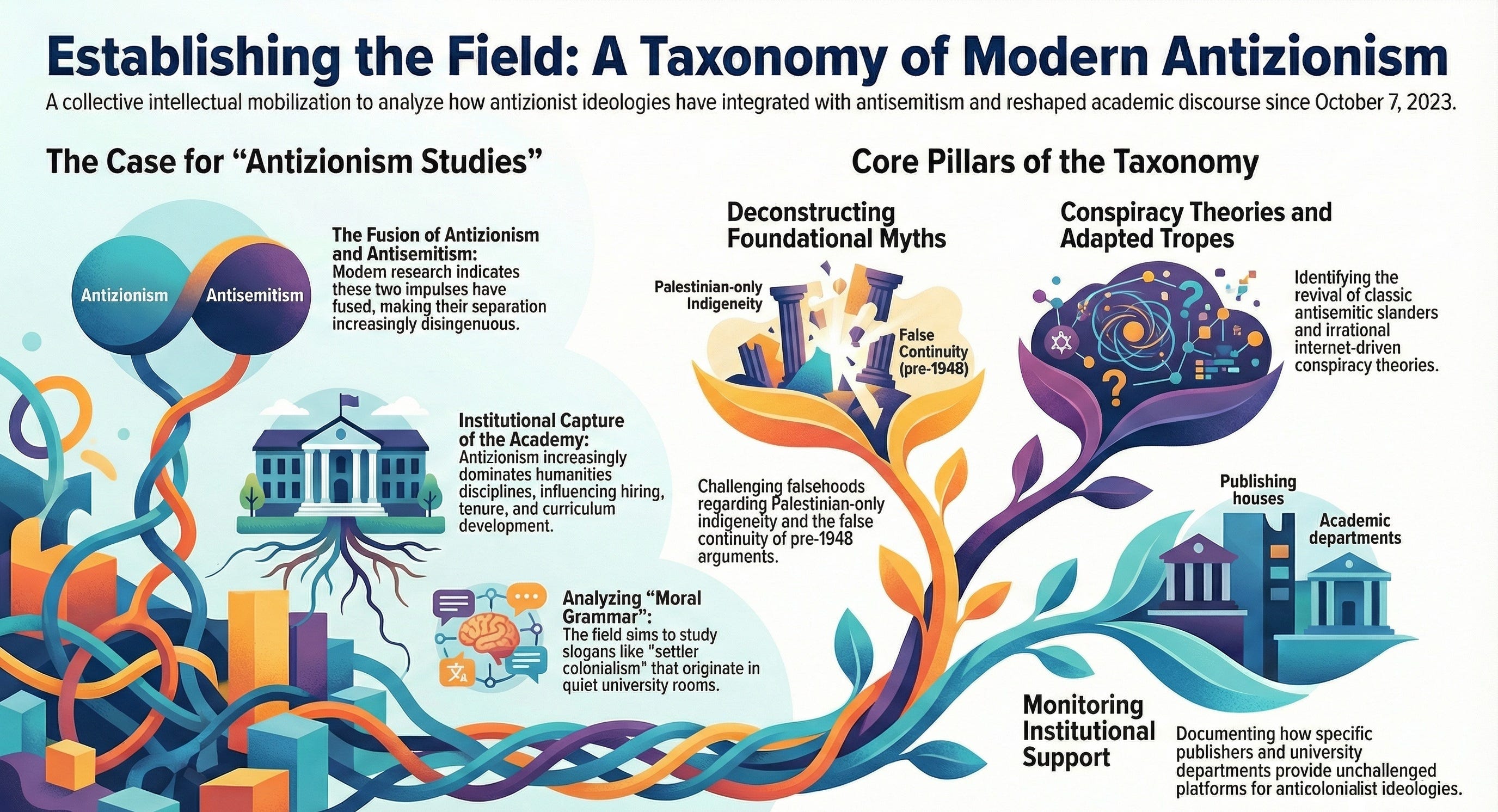
When anti-Zionism becomes a moral litmus test in activist networks, when students who identify openly as Zionist report social or academic pressure, and when parts of the arts community and sections of mainstream discourse treat the de-legitimisation of Israel as a given, hostility toward Jews is no longer confined to the fringes.A Taxonomy of Antizionism by Cary Nelson
It circulates in respectable spaces. This is what has happened in Australia and large parts of the West generally.
Social media accelerates this transformation. Platforms reward outrage and absolutism. Narratives that frame Israel as uniquely monstrous spread rapidly, reinforced by algorithmic echo chambers. What begins as activism hardens into “truth”.
There is another uncomfortable reality. In recent years, elements of progressive anti-Israel activism have converged, tactically if not philosophically, with Islamist ideological hostility toward Israel and, in some cases, toward Jews more broadly.
These traditions arise from different intellectual histories. But they meet in a shared objective, the delegitimisation of Israel as a Jewish state.
This is not an accusation against Muslim Australians, who are entitled to safety and dignity and protection from discrimination just like every other community. This is an observation about the political ideologies of Islamist movements that openly preach hatred of Jews and have found common cause, at least out of political convenience, with Western activists who frame their opposition to Israel in secular human rights language. Strange bedfellows united by a common animus.
Since October 7, Jewish communities worldwide, including in Australia, have experienced a surge in hostility. That surge has not been driven primarily by fringe neo-nazi cells. It has been energised principally by a culture in progressive circles in which anti-Zionism is treated as a moral imperative and Jewish attachment to Israel as suspect.
As the nation embarks on a year of soul searching regarding the alarming rise in anti-Semitism, it is an opportunity not just to examine the forms of anti-Semitism that are easy to understand, but also to shine a bright light on this more socially sanctioned form of anti-Semitism now circulating in respectable spaces — lecture theatres, activist networks, the arts community and sections of mainstream discourse.
If we confine our concern to the crude and explicit, we will miss the even more dangerous hostility that now carries cultural confidence.
And if we fail to push it out of the mainstream and back to the fringes where it belongs, Australia will never recover from the explosion of anti-Semitism that has afflicted it over the past two and a half years.
No one person would be expected to contribute to all the areas of concern above, but the overall study of antizionism would benefit from shared awareness of its full dimensions. That knowledge can facilitate faculty recruitment and program development. The list above advocates for a field of research; its objects of study include both discourses and contemporary political practices. There is an activist component that can follow from the knowledge the study of antizionism produces. But it should not be a requirement of participation in the academic enterprise. One can, for example, gather the evidence that a supposedly scholarly discipline is devoted to indoctrinating students but leave it to others to intervene in its operation. Antizionism tends to make activism a moral imperative for its followers, but the study of antizionism should not imitate that requirement. To coerce political compliance and activism corrupts the free and open debate an academic field must encompass.
My own original research on antizionism is represented by the books listed above. It includes a group of exceptionally detailed essays on the publications and careers of individual antizionist faculty, ranging from Judith Butler to Lsra Sheehi, along with several studies of the BDS movement and a thorough analysis of the 2024 campus encampments. I have also battled BDS resolutions in a series of academic associations, though I have never taught my students how to do so. Similarly, I was faculty advisor to the local graduate employee union for a decade, but I never advocated for the union in my graduate seminars. The fatally politicized disciplines have all erased the line that divides the classroom from the demonstration.
That said, I do wish that more Jewish faculty would passively support those Zionist advocacy projects focused on supporting community members and their academic work. Most silent Jewish faculty are not hostile. They are just afraid. They think they will be held harmless if they keep their heads down. History offer little support for that confidence. Yet many Zionist faculty would hesitate even to endorse a project merely to organize research on antizionism.
Is it possible to oppose Israeli government policies with embracing antizionism. Certainly. Israelis themselves do it every day. Is it possible to adopt a categorical anti-Israelism without taking on antizionism’s whole ideological agenda? Perhaps it once was, but that day has passed.
Finally, as the analysis above suggests, whether or not antizionism was ever comprehensively separate from antisemitism, it no longer is. The study of antizionism is entangled both with the last 150 years of antisemitism and with the longest hatred’s whole history. But one cannot successfully engage with contemporary antizionism without granting the two overlapping hostile traditions a degree of relative autonomy. For one thing a great deal of faculty research declares its commitment to antizionism alone. Deluded, disingenuous or not, we need to know what practices that commitment includes. Granting the two impulses relative autonomy also opens awareness of how explicit antizionism disguises, trivializes, discounts, and inspires antisemitism. Making antizionism a recognized field of study will help us construct the necessary body of knowledge. It certainly deserves a place within institutes and programs that study antisemitism.
Alleged Muslim Brotherhood-Linked DAWN Appoints Omar Shakir as Executive Director
Democracy for the Arab World Now (DAWN) announced on February 25, that it has appointed Omar Shakir as its new Executive Director, succeeding Sarah Leah Whitson. The appointment follows interviews conducted in late January and takes effect on March 2. Shakir, who previously served as Israel and Palestine Director at Human Rights Watch (HRW) for nearly a decade, brings to DAWN a record of activism that includes documented associations with alleged terror-linked individuals.The Activists Who Shut Down the Golden Gate
Shakir was deported from Israel in November 2019 after his work permit was revoked under Israel's anti-boycott law. He has been an active promoter of the Boycott, Divestment, and Sanctions (BDS) movement, which is illegal in Israel.
Following Hamas' October 7 attack, Shakir posted on X that "so long as there's impunity, Gaza remains an open-air prison, and Israel's apartheid isn't dismantled, bloodshed and repression will continue," language attributing the massacre to Israeli policies rather than Hamas agency.
Shakir has been photographed with Shawan Jabarin, Director of Al-Haq, who was convicted in 1985 of recruiting for the Popular Front for the Liberation of Palestine (PFLP), a designated terrorist organization.
According to Israeli Supreme Court records, Jabarin was sentenced to 24 months for his PFLP work while simultaneously operating as a human rights advocate, a pattern the court described as operating as “Dr. Jekyll and Mr. Hyde.” In 2021, Israel designated Al-Haq as a terrorist organization, classifying it as “an inseparable arm” of the PFLP that operates “on its behalf and upon its instructions.”
Shakir also spoke at an event featuring Sami Al-Arian, a convicted financier of Palestinian Islamic Jihad (PIJ), a U.S.-designated terrorist group. Al-Arian pleaded guilty in 2006 to providing support to PIJ and was deported from the United States. He later established CIGA, a Turkish-based institute, where he continues to host conferences featuring anti-Israel advocates and alleged terror-linked figures.
Additionally, Shakir appeared at an event with Wadah Khanfar as a “special guest.” Khanfar has been described as allegedly holding positions for Hamas in Sudan and South Africa, and has publicly praised Hamas’ October 7 attack. The Jerusalem Center for Public Affairs reported that Khanfar was a Muslim Brotherhood member in Jordan, where he was arrested. Former Al Jazeera colleagues who resigned from the network complained that Khanfar packed the network’s staff with Islamists, many sympathetic to the Muslim Brotherhood.
On April 15, 2024, pro-Palestine activists illegally shut down traffic in Philadelphia, Chicago, and the Bay Area during rush hour. On the I-880 in Oakland, 15 protesters sat down in the middle of the highway, chaining themselves together and holding a “STOP THE WORLD FOR GAZA” banner. Meanwhile, 26 activists blocked the Golden Gate Bridge for four hours.Fans choose Scream as favorite scary movie, despite pro-Palestine calls to boycott Scream 7
An attorney for the Golden Gate activists said they “were exercising their First Amendment rights, their dissent and their outrage over the genocide that’s taking place in Gaza.” The excesses of these actions stand in contrast to the multitude of protests across the country held by citizens exercising their First Amendment rights without crippling regional economies.
When people complain about protests like these, the “No Justice, No Peace!” crowd is quick to ask: Who was really harmed?
And, sure, the protests may not have caused injuries or trapped ambulances, but there were, according to San Francisco District Attorney Brooke Jenkins: “missed surgeries and medical appointments, a baby without water for infant formula, and people stuck without bathrooms.”
There’s also the economic impact.
The ABC News summary of Jenkins’ report mentions that 200 people called the California Highway Police to say they were stuck on the bridge that day. As Mission Local reports, “on the day of the protest, 27,921 vehicles crossed the bridge southbound, 17,352 less than the daily [southbound] average for March. Multiply the difference by $9.37, the average toll revenue per crossing, and the result is $162,554.” (That was just southbound; the bridge was blocked in both directions.)
Jenkins encouraged people who couldn’t use the Golden Gate Bridge that day to seek restitution. The city brought charges like trespassing and false imprisonment against the protesters (including felony charges against the organizers, many of which were later dropped), and the bridge’s management group filed restitution for lost tolls of $163,000.
As fearsome as this sounds, the charges were (mostly) toothless: The Golden Gate agency dropped its restitution claim a few weeks later, after apparently only nine people came forward to seek restitution. (Presumably, the rest had email jobs and dialed into work from their cars, or just didn’t care enough about a deranged mob standing in the way of their workday.)
Those nine people claimed a total of $5,300 in lost wages, which 16 of the protesters then split. This meant each of them coughed up just $331.16.
All told, the activists paid $5,300 for four hours of 17,000 people’s time — a pretty good deal at just ~$0.08 per hour, and far below minimum wage.
Those are just the direct costs.
“Paramount has a blacklist of actors who criticize Israel,” said one sign carried by a protester. Others read, “Boycott Paramount+,” the studio that financed the movie. But the movie’s stars, including Neve Campbell, Isabel May, Courteney Cox, and David Arquette, walked the red carpet despite the protests.Anti-Israel Mob Crashes ‘Scream7’ Premiere at Paramount Studios Calling for a Boycott in Support of Palestine
Campbell, Cox, and Arquette starred in the original Scream movie, which was released 30 years ago, and several of the sequels. The Scream movies popularized the catchphrase, “What’s your favorite scary movie?” which the killer asked his victims by phone, and the “ghostface” killer’s mask, inspired by the Edvard Munch painting, “The Scream.”
The boycott calls came partly because actress Melissa Barrera was fired from the film over two years ago.
In 2023, shortly after the Hamas massacre of 1,200 people, that led to the outbreak of the war between Hamas and Israel, Barrera, one of the stars of the previous two Scream films, posted on her social media accusing Israel of “genocide and ethnic cleansing,” and using “the Holocaust to boost the Israeli arms industry.”
Spyglass Media, the production company behind the film, fired Barrera, releasing a statement to Variety, saying, “Spyglass’s stance is unequivocally clear: We have zero tolerance for antisemitism or the incitement of hate in any form, including false references to genocide, ethnic cleansing, Holocaust distortion or anything that flagrantly crosses the line into hate speech.”
The sign that alleged a blacklist was apparently a reference to David Ellison, the Jewish owner of Skydance, which acquired Paramount in November. Rumors have circulated that Ellison keeps a list of those who are anti-Israel.
An angry mob of anti-Israel protesters demanded a boycott of Scream7 at the horror film’s premiere on Wednesday night while calling for a reversal of Melissa Barrera’s firing.
The In the Heights actress, who led 2022’s Scream and 2023’s Scream VI, was dismissed from the seventh instalment over her pro-Palestine social media posts in November 2023 that publicly accused Israel of committing genocide.
As Breitbart News reported, Barrera set off an avalanche of criticism when she not only referred to Gaza as a “concentration camp” but also accused Israel of “genocide and ethnic cleansing” in its war against Hamas in retaliation for the horrific October 7 terrorist attack, which claimed around 1,200 lives, most of whom were civilians.
Yahoo News notes the decision led to her co-star Jenna Ortega and director Christopher Landon quitting the project, and the film underwent a massive overhaul, with original star Neve Campbell ultimately coming back to lead the seventh chapter as Sidney Prescott.
According to Variety, about 25 demonstrators gathered around the Paramount Studios lot in Los Angeles lot with flags, drums and bullhorns and signs that read, “Stand for free speech”, “Cancel Paramount+”, and “Boycott Scream 7”.
They were also heard chanting phrases such as “Paramount, Paramount, what do you say?” and “Palestine will live forever!”
Barrera seemingly addressed the demonstration on her Instagram Stories by writing, “I see you,” with a red heart emoji.
Pro-Palestine protestors have congregated outside the #Scream7 premiere in Los Angeles. #MelissaBarrera was quietly dropped as the star of the franchise in late 2023 after publishing a series of social media posts that were deemed antisemitic. pic.twitter.com/d7IL2latHm
— Variety (@Variety) February 26, 2026
People are gathered for a “Free Palestine” protest outside of Paramount Studios at the #Scream7 LA premiere pic.twitter.com/Pviyiis2CL
— Deadline (@DEADLINE) February 26, 2026
A Blood Libel at Penn
The most serious distortion, however, was conceptual. Genocide functioned less as a legal conclusion than as a political label: a word to encompass a litany of charges against Israel while tacitly conceding that the legal threshold for genocide is certainly too difficult to meet. That is the rhetorical advantage of the term: It carries the moral authority of the Holocaust while remaining elastic enough for use in contemporary politics, especially as a charge against the choices of the current Israeli government and Netanyahu specifically.Connecticut professor sues union over transparency of dues after anti-Israel vote
That danger intensifies when genocide is accompanied by collective guilt. Bartov stated not only that Israel has committed genocide but also that Israeli society as a whole, not just the government, is responsible. Collective guilt is an ancient mechanism of hatred. It is how Jews have been targeted across centuries: not because of what a specific person did, but because “the Jews” are imagined as a single culpable body. While a scholar has every right to condemn policies, it is nevertheless unethical to smear an entire population with a criminal charge that he cannot establish at the individual level and that he knows will inflame hostility in the social world outside the lecture hall.
The talk also leaned on confident counterfactual history delivered with prophetic certainty: Israel never needed to invade Gaza, since Hamas would have been defeated by internal opposition; Israel could have avoided the 1973 war by returning Sinai. Other examples involved mind-reading: Hamas invaded Israel on Oct. 7 because it wants a better life for Palestinians, not because of any religiously motivated desire to eliminate the State of Israel and subjugate its Jews. Bartov delivered these laughable counterfactuals and speculations as certainties, all to imply that the catastrophe of the war was optional, an avoidable choice, and that the ensuing violence was gratuitous and dedicated to one purpose: the destruction of the population of Gaza. But counterfactual storytelling is only a shortcut to establishing intent without even attempting to prove it.
Even Bartov’s analogies served to close questions rather than open them. He dismissed comparisons to the Allied bombing of Germany—which killed far greater numbers of civilians without being categorized as genocide—on the grounds that the victors later initiated the Marshall Plan, thereby demonstrating no intent to destroy the population. Israel, Bartov contrasted, has shown no interest in rebuilding and continues to be a fully engaged belligerent. But the analogy fails. Germany surrendered and the war ended. The reconstruction followed the capitulation. No concrete plan to rebuild Gaza has begun because Hamas has not surrendered and continues to wage war. One can debate Israeli policy on reconstruction and what should be done. But a serious scholar does not turn a postwar failure to rebuild into a retroactive litmus test of genocidal intent while ignoring the continuing status of the conflict and the role of a belligerent actor still committed to fighting.
Finally, the structure of the event itself compounded the problem. The moderator did not challenge the speakers, and there was little time for audience questions. Professor Goda’s remarks were careful and methodologically serious, exposing the genocide allegation as not merely unproven, but fundamentally false as a legal claim. Yet even his able corrective was structurally blunted, because the program consisted of scripted statements to prearranged questions with no meaningful opportunity for direct rebuttal or response. What was advertised as an exchange functioned instead as a managed sequence of speeches, insulated from cross-examination. A university is not obligated to protect anyone from hearing arguments they dislike. But it is obligated to protect the integrity of inquiry. If you stage an event on the most morally incendiary accusation available and then design the format to minimize challenges, you are not really hosting a scholarly exchange. You are performing it.
I left that room relieved that student attendance was not large, but unsettled because students, especially undergraduates, are precisely the population most likely to mistake confident rhetoric for expertise. They are also the population most likely to carry the moral conclusions of such events into campus life, where labels have already become social sanctions and where Jews have discovered that an accusation aimed at a state quickly becomes suspicion aimed at a people.
Bartov’s genocide accusation is not merely“controversial.” It is a libel, regardless of how many academics support it with petitions or editorials. One may argue about proportionality, tactics, humanitarian failures, or political choices. Those arguments can be necessary and urgent. But to leap from the fact of civilian suffering—real, terrible, and morally shattering—to a claim of genocidal intent while downplaying Hamas’ agency as a determined fighting force, abusing statistics as moral props, and smearing an entire population with collective guilt is not scholarship. It is propaganda repackaged in an academic register.
If that is now what passes for Jewish intellectual life at elite institutions, then the crisis is not only political. It is also epistemic. And it will not be solved by more “exchanges.”
A Connecticut community college professor is suing his union after it adopted an anti-Israel resolution, arguing that members are being kept in the dark about how their dues are spent.‘Jewish Students Are Segregated’: Parents Sue California State Education System in First-of-Its-Kind Complaint Over ‘Anti-Semitic Propaganda’ and Harassment
Earl Ormond, who teaches criminal justice at Naugatuck Valley Community College in Waterbury, Conn., filed suit against the Congress of Connecticut Community Colleges, saying the union provides no meaningful way for members to review its finances.
Ormond stated that the union convened a statewide Zoom meeting to vote on a resolution accusing Israel of “genocide” and “apartheid.” He said he was “shouted down” and interrupted when he attempted to speak in opposition, according to the Fairness Center, which is representing Ormond.
Following the vote, Ormond said he began examining how much union money was being directed toward political activity and whether members could access the union’s financial records.
“It’s simple: I want to know where my money is going,” Ormond stated. “Transparency is just a word on paper if union members still can’t see the books.”
Ormond and a second public employee, corrections officer Ryan Bilodeau, filed suit on Feb. 15 in Connecticut Superior Court in the Judicial District of Hartford, against their respective unions.
In a Feb. 20 letter sent to Rob Sampson, a Republican Connecticut state senator, Anthony Holtzman, a managing attorney with the Fairness Center, argued that public-sector unions in the state have for decades failed to comply with a 1957 law requiring annual financial disclosures, while regulators have declined to enforce it.
A group of Jewish parents sued the California state education system on Thursday, alleging that the state’s public schools have become anti-Semitic cesspools in which "Jewish students are segregated and pulled out of classes so that teachers can spew anti-Israel and anti-Semitic propaganda without pushback," according to a copy of the first-of-its-kind lawsuit shared with the Washington Free Beacon.My son was abused daily by antisemitic classmates who turned on Bunsen burners and made hissing noises to echo the horrors of the gas chambers - this is the 'rife' hatred Jewish people face in Britain today
The California State Board of Education, the California Department of Education, and state superintendent Tony Thurmond fostered a hostile environment throughout all of California, ignoring numerous reports from parents whose children had been targeted solely for being Jewish, according to the complaint. In one case, a teacher punished a 12-year-old student "because he was a Jew who dared to wear Jewish and Israeli symbols." In another, a ninth-grade art teacher organized a walkout "in support of Palestine" that featured chants of "f— the Jews." When one parent spoke up about the issue during a school board meeting, faculty members mocked her and called her a "Zionist Nazi bitch."
State officials responsible for protecting students from discrimination allowed "California’s schools to indoctrinate children, from the earliest ages, to believe that Jewish Americans and Israelis—including Jewish and Israeli classmates—are racists, white supremacists, and oppressors who should be shunned," the lawsuit states.
The case documents numerous anti-Semitic incidents across the state, according to the Louis D. Brandeis Center for Human Rights Under Law, which is handling the lawsuit alongside the pro-Israel advocacy group StandWithUs. It marks the first time legal advocates have sued an entire statewide system over pervasive anti-Semitic harassment and could set a precedent for those in other states to follow suit. Anti-Semitism in California schools, though, has been particularly prevalent since Hamas’s Oct. 7, 2023, attack against Israel. The San Francisco teachers’ union, for instance, endorsed a curriculum that claimed many allegations of anti-Semitism are "fabricated" and used to silence pro-Palestinian activists. The public school system in Berkeley received a federal complaint in 2024 over its alleged failure to stem an escalating series of anti-Semitic incidents that culminated in hallway chants of "kill the Jews." Even before Oct. 7, the state’s proposed ethnic studies curriculum included a lesson that described Jews as having "experienced conditional whiteness and privilege."
What began with another child drawing a swastika before shoving it into the Jewish boy's face and laughing at him, soon became a daily barrage of antisemitic abuse inflicted on the youngster by his classmates.
Over two years, the vulnerable 14-year-old was incessantly called a 'Yid' and 'Jewish scum'. Josh was derided in science lessons by his peers, who would turn on their Bunsen burners, make hissing noises like the gas chambers of the Holocaust and shout, 'be careful, there's a Jew over there'. Sometimes they would also make Nazi salutes and shout 'Heil Hitler'.
On one occasion a younger pupil shouted 'f*** the Jews, kill the Jews' at the terrified teenager and followed him all the way home.
But despite multiple complaints made by his parents to the school in east London, the boy was advised by his headmaster to 'be more resilient'.
The one time he did just that, telling one of his racist bullies to 'f** off', it was Josh who was disciplined and given a detention.
At various points between retelling of the 'hell' her son went through at school, Kelly Kaye becomes understandably emotional.
'As a parent, you feel that you've done everything right, but yet in situations like these you feel you can't protect your child. It's really frightening.'
Kelly's story is one of several emerging as campaigners say Britain is now in the grip of an 'antisemitism crisis', with anti-Jewish sentiment now 'rife' across the country.
She and other victims shared their experiences at an 'emergency summit' held on Wednesday at the House of Commons, which was attended by MPs and peers, alongside antisemitism advocates, presenter Rachel Riley and journalist Lord Daniel Finkelstein.
What on earth are you talking about? Pro-Israel professors and students are being literally hounded off campus by violent, masked mobs. They're having their classes and clubs smashed up. https://t.co/PybLl1kCmq
— Eylon Levy (@EylonALevy) February 26, 2026
Wiley is set to appear at the @MOBOAwards next month.
— Campaign Against Antisemitism (@antisemitism) February 26, 2026
Good to know that unrepentantly engaging in antisemitic tirades does not disqualify you from appearing at a prestigious ceremony.
This is a man who compared Jews to the Ku Klux Klan, called on “black people” to go to “war”…
This is a slide on 'strangulation theory' from a second year lecture at University of Toronto school of dentistry.
— David Jacobs (@DrJacobsRad) February 26, 2026
The political messaging is both clear and clearly out of place in a lecture on tooth decay.
Whatever the motivation of the professor, the end result is that Jewish… pic.twitter.com/J4tqeK2rxX
Incredibly this antizionist conspiracist has been given awards by two universities for her work on antisemitism. pic.twitter.com/VG5BfEBTLz
— Nicole Lampert (@nicolelampert) February 26, 2026
A Houthi media center. Where do the CPJ and its friends in real media outlets like @guardian draw the line when it comes to journalists working for terrorist orgs?
— HonestReporting (@HonestReporting) February 26, 2026
If the Allies had bombed Goebbels' office during World War II, would the CPJ have considered it a crime? Probably. pic.twitter.com/Hz3bDvqex1
This BBC headline states as fact that Israeli soldiers “shot a Palestinian boy and stood around as he bled to death.”
— HonestReporting (@HonestReporting) February 26, 2026
That framing omits critical context.
As confirmed by the IDF, during an operation in Faraa camp on November 16, 2025, a suspect attempted to attack soldiers – a… https://t.co/N0ZttbUhYl
Restricted Video
Contrary to what has been reported, medical aid was in fact provided, as clearly seen in video footage that was shared directly with the reporter prior to publication.
How Hamas propaganda is laundered.
— Joo (@JoosyJew) February 26, 2026
Quds News, the Hamas-affiliated ‘news’ organisation, publish an “investigation”
Made into a pretty map, it’s shared some Gazan (standard link for “donations”)
This then gets shared as fact by the likes of Yasmin, who legitimise Hamas’ story. pic.twitter.com/qhNHmSuKeQ
Ironically, the post was made on a Facebook post in group for people in the TV industry which advocates against discrimination.
— Nicole Lampert (@nicolelampert) February 26, 2026
OK weird. I Googled that quote to find your link, and it appears in more than one BBC piece. Here it is in a piece from October:https://t.co/lw7Gja1dAE pic.twitter.com/yOKmIk9MJY
— Noam Blum (@neontaster) February 26, 2026
Update: It turns out the text describing the Chabad incident was moved to a lower section and stripped of its specific date.
— Shlomit Lir (@shlomitlir) February 26, 2026
The image captioned “Protest against the detention of Mahmoud Khalil, who was charged with antisemitism” was deleted.
Some believe it might reappear.… pic.twitter.com/WBaCmGlKCT
Hannah Hawkins has been elected to the Central Executive Committee of Your Party.
— Campaign Against Antisemitism (@antisemitism) February 26, 2026
She reportedly posted on Facebook, “I’ve been saying this for a while now. Oct 7th was done by Israel to justify this war and genocide.”
Is this the sort of opinion that @thisisyourparty…
It’s just a normal Thursday night in
— Subversive Force (@sirwg202110) February 26, 2026
Manchester. pic.twitter.com/rcZkf2AOhx
They were chanting “death, death to the IDF”. Why are we tolerating people calling for violence right outside Parliament. pic.twitter.com/SvFW0dd88I
— Heidi Bachram (@HeidiBachram) February 26, 2026
Palestine Pulse is even named as a “supporting campaign group” on the Green Party “Zionism is Racism” motion itself. The Greens have become entangled with the WORST people. pic.twitter.com/zBkRqKWGbO
— Heidi Bachram (@HeidiBachram) February 26, 2026
‼️HORRIFYING ‼️
— GAZAWOOD - the PALLYWOOD saga (@GAZAWOOD1) February 26, 2026
A Palestinian Muslim woman: "Blowing yourself up for Allah is beautiful"... pic.twitter.com/xGzXoCflBq
Refrigerated goods at Sky Mall, on al-Samer next to Dahab Sweets.
— Imshin (@imshin) February 26, 2026
Timestamp: 3 hours ago (26 Feb '26)#TheGazaYouDontSee
Link in 1st comment https://t.co/1nnr6RJq0M pic.twitter.com/S15WwUYtYq
Gazans shopping for oriental sweets at Al-Kenz ("The Treasure") Sweets on Omar al-Mukhtar St., Gaza City.
— Imshin (@imshin) February 26, 2026
Timestamps: 3-5 days ago (20-22 Feb '26; 3-5 days of Ramadan)
Al-Arabiya Sweets for 30 shekels per kg; Collage for 20.#TheGazaYouDontSee
Links in 1st comment pic.twitter.com/zuVw8jnSaI
‘Die, Jews, die!’: NYC man convicted for harassing couple who saw him rip hostage posters
A US man has been convicted of hate crimes for a series of assaults, including harassing a couple who had photographed him tearing down posters of Israeli hostages who were at the time held by terrorists in the Gaza Strip.
Skiboky Stora followed the husband and wife, shouting anti-white and antisemitic threats and insults, including “Die, Jews, die!” according to prosecutors.
A New York state court judge on Wednesday found Stora guilty of assaulting, stalking and harassing strangers in what prosecutors described as a series of anti-female, anti-white and antisemitic incidents between 2023 and 2024.
The 42-year-old Brooklyn resident, who also randomly punched a woman walking down a Manhattan street nearly two years ago, represented himself during the weeks-long trial in Manhattan court.
“I never did anything racist to anybody, and I never did anything discriminating against anybody, and I never tried to injure anybody,” he said in his closing remarks, the New York Post reported.
Prosecutors, however, showed a video of Stora harassing the Jewish couple as well as videos he recorded of himself shouting and harassing white people, according to the Post.
“The victims were met with both violence and harassment simply because of who they are,” Manhattan District Attorney Alvin Bragg said in a statement after the conviction. “Hate crimes strike at the core of our city’s values and sense of safety.”
Update: After more than two years, Skiboky Stora has been found guilty today during his trial of two counts of assault as a hate crime, one count stalking as a hate crime, aggravated harassment, and attempted assault.
— StopAntisemitism (@StopAntisemites) February 26, 2026
Sentencing will take place April 14, 2026. https://t.co/eR0HoSV4mH pic.twitter.com/AyDUK0PHMI
Vandals have left swastikas at the Drancy internment camp in France, where over 65,000 Jews, including over 5,000 children, were deported to killing camps, primarily Auschwitz.
— Hen Mazzig (@HenMazzig) February 26, 2026
What has been left standing to be a monument to the horrors of that time, a reminder of the sins… pic.twitter.com/an26rFEy0l
Maktabat Berfin, a bookstore in Paris, is selling and promoting a book praising Hamas terrorist leader Yahya Sinwar.
— Hen Mazzig (@HenMazzig) February 26, 2026
Sinwar is responsible for the October 7 massacre of innocent Jews. He then hid in tunnels while Gazans were left in the war zone, which is nothing to praise.… pic.twitter.com/55Z5e0mcLR
‘Newsweek’ ranks Israel’s Sheba Medical Center seventh-best globally
Sheba Medical Center at Tel HaShomer in Ramat Gan ranked seventh globally in Newsweek‘s “World’s Best Hospitals 2026” list released on Wednesday, the highest-ever position for an Israeli institution.
The Israeli medical center climbed one spot from last year, when Newsweek ranked it the eighth-best hospital in the world, the highest rating for an Asian or Israeli hospital.
This year, Sheba came in after world-renowned medical institutions such as the Mayo Clinic in Rochester, Minn., the Cleveland Clinic in Ohio and Johns Hopkins Hospital in Baltimore, Md., which ranked sixth.
Sheba said in a statement that the 2026 ranking marked its eighth consecutive year in the top 10 of Newsweek‘s “distinguished list.”
“The additional rise in the rankings (from 8th place last year to 7th this year) reflects Sheba’s transformation into an AI-driven medical center, integrating artificial intelligence into the core of its clinical, research and administrative operations,” according to the hospital statement.
🤭 https://t.co/HTGM5wIjhg pic.twitter.com/5GJQ3ec4pF
— Ron M. (@Jewtastic) February 27, 2026
Fox Nation to air new series on King David, hosted by actor Zachary Levi
The first episode of “David: King of Israel,” a new four-part Fox Nation docudrama, premieres on Thursday, offering a dramatic reenactment of the biblical coming-of-age story of King David that provides relevant lessons in a time of conflict, actor Zachary Levi, the series’ host, told Jewish Insider.
“It’s unfortunately an evergreen [story] in that we as mankind find ourselves in conflict and war always. The only way to truly battle darkness is to battle it with light. David is an example that no matter how much we stumble, God can still love us and we can still be redeemed. I want to apply that to everyone across the world,” said Levi, a Christian who recalls “reading all of the stories in the Bible” as a child.
“David always jumped out at me. In some ways even more than the story of Jesus. It’s full of drama, intrigue, romance, betrayal and war. It’s like ‘Lord of the Rings’ in the Bible,” continued the award-winning actor, whose credits include roles in “Shazam!,” “Chuck” and “The Marvelous Mrs. Maisel.” This latest project sees him narrate from an LED stage in Los Angeles that allows for the appearance of being transported through biblical-era caves and villages.
The majority of the production, however, was shot in South Africa due to the country’s “long history with faith-based productions,” Jonathan Towers, vice president of development for Fox Nation, told JI. “As a result, there are biblical sets and costumes already available in-country, as well as a deep acting community that’s very experienced with such productions. The most visible sign of that robust acting community is Nahum Hughes, a South African actor who plays David,” said Towers.
Created by Warm Springs Productions, the series’ executive producers are David Cunningham, Marc Pierce, Chris Richardson and Bridger Pierce. The team consulted with historians and archaeologists, as well as biblical experts, both Jewish and Christian, including Rabbi Meir Soloveitchik, Rabbi Pesach Wolicki and Ze’ev Orenstein, director of the City of David in Israel.
“Erasing our history” 😅 pic.twitter.com/NuS8i4ztwI
— Josh (@_j0sh_a_) February 25, 2026
Hollywood stars highlight link between Jews and Israel at Carnegie Hall performance
Call it a mash note to Jewish identity, and to the Jewish homeland.
Hollywood heavyweights took to New York City’s world-renowned Carnegie Hall stage on Tuesday night to highlight the link between the Jewish people and the land of Israel, spanning thousands of years, in the form of recounting historic love letters to the Jewish state.
“Letters, Light and Love” made its U.S. premiere in a one-night only performance hosted by UJA-Federation of New York as Jewish celebrities including Amy Schumer, David Schwimmer, Debra Messing, Tovah Feldshuh, Jonah Platt and Michael Aloni read excerpts of letters written about Israel across centuries. The notes came from writers such as Julius Caesar, Maimonides, Golda Meir, Sir Moses Montefiore, Albert Einstein, Harry Truman, John Adams, Winston Churchill and Leonard Bernstein.
The performance was the second-ever showing of the three-act play, which first ran in 2024 in London’s West End. Co-produced by Sarah Sultman and Michal Noé, proceeds from the $1.5 million raised on Tuesday will go towards rebuilding Kibbutz Be’eri in southern Israel, where around one in 10 residents were killed by Hamas on Oct. 7, 2023.
“I’ve always loved letters,” Sultman, who is the co-founder of the Gesher School in London, told Jewish Insider. The idea for the play came to her in early November 2023, while on a solidarity visit to Israel through a U.K. delegation weeks after the attacks.
“Whilst I was out there, visiting a number of kibbutzim, they asked us what we would do when we went home,” recalled Sultman. “I had this idea about using letters to tell our story. I suppose it was driven by the pervasive narrative that Jews are white colonizers from Poland. That our connection to Israel [began] in 1948. For me, Judaism and its connection to Israel are inextricably linked and always have been.”
“I came back from that trip and began researching letters, working with the National Library of Israel, digging through archives and accumulating hundreds of letters,” continued Sultman. “We have a 3,000-year-old history. We have letters from across time. [We created] a performance, interwoven with music, that tells our story in a way that is educational, soulful and moving. It’s also purposeful. It should be used as a project of regrowth in Israel.”
“We researched who are the actors proud of their Judaism and Zionism,” Sultman told JI, noting that most of the cast that came on board decided to “because of a personal connection” and it was easier to appeal to the actors directly rather than working through their agents. Several actors that Sultman thought would be interested turned down the opportunity, but she was surprised by others who were eager to participate.
Actress and comedian Amy Schumer participated in Carnegie Hall's "Letters, Light and Love" event an that raised funds to help rebuild Kibbutz Be’eri, one of the southern Israeli communities devastated by the Hamas terrorist massacre on October 7, 2023.
— StandWithUs (@StandWithUs) February 26, 2026
At event she read two… pic.twitter.com/BO9ScrpFBj
Gumbo and Bandit wishing everyone a happy Purim! pic.twitter.com/rdR9KqFyJF
— Ambassador Mike Huckabee (@USAmbIsrael) February 26, 2026
Departing Israel, Modi says there’s ‘no place for terrorism,’ praises Gaza peace plan
India’s Prime Minister Narendra Modi departed Israel Thursday afternoon following a packed two-day visit to Israel, during which he said Jerusalem and New Delhi agree that there is “no place for terrorism in the world.”
The trip was Modi’s second visit to Israel as prime minister since he took office in 2014. On Wednesday, he addressed the Knesset amid a series of meetings with Prime Minister Benjamin Netanyahu and other officials.
“India and Israel are clear that there is no place for terrorism in the world, in any form… We will oppose it shoulder to shoulder. We will always oppose it in the future,” Modi said at a Thursday press conference with Netanyahu in Jerusalem. “Humanity must never become a victim of conflict.”
Modi said that the US-backed “Gaza peace plan has opened a pathway to peace, and India has extended its full support to these efforts.”
He also spoke of future cooperation between Israel and India in a variety of fields, including technology and energy.
At the event, the two countries signed 16 bilateral memorandums of understanding, primarily in the fields of innovation and technology.
Speaking alongside Modi, Netanyahu described the Indian leader’s visit as “amazing” and “extraordinarily productive,” and also spoke about joint innovation between the two countries.
“We’re proud ancient civilizations, very proud of our past. But absolutely determined to seize the future, and we can do it better together,” he said.
The ever-deepening bonds between India and Israel may well represent the most important bilateral relationship for both nations over the next decades. Imagine the technology enjoyed by Israel’s 10 million citizens being extended to India’s 1.4 billion! 🇮🇳 pic.twitter.com/gEW8jxFfF0
— Saul Sadka (@Saul_Sadka) February 26, 2026
Curious what the editors at @TheEconomist think about the visit to Israel by @narendramodi https://t.co/6hnhtH9L9V pic.twitter.com/4o9BT9aLH4
— Dan Senor (@dansenor) February 27, 2026
Diplomacy with a side of Fauda: During his official visit to Israel, Prime Minister Modi met the stars of the hit Israeli series. Always fun to see Israeli TV winning fans worldwide as Modi reportedly told the actors that Fauda has fans in India too. 🇮🇱🇮🇳
— StandWithUs (@StandWithUs) February 27, 2026
Credit: Prime Minister… pic.twitter.com/tCYHA5HYdg
Thank you Israel, for the warmth and affection.
— Narendra Modi (@narendramodi) February 26, 2026
Deeply touched that Prime Minister Netanyahu and Mrs. Netanyahu personally came to the airport to see me off.
Confident that the India–Israel partnership will continue to reach new heights in the years to come.@netanyahu pic.twitter.com/TgGsIsXOJY
Modi places wreath at Yad Vashem’s Hall of Remembrance
Israeli Prime Minister Benjamin Netanyahu visited Yad Vashem together with Indian Prime Minister Narendra Modi on Thursday.
At the beginning of the visit, the two leaders toured the Hall of Names, during which Netanyahu showed Modi the names of his wife Sara’s relatives who perished in the Holocaust.
Afterward, a memorial ceremony was held in which the prime minister of India laid a wreath and a stone to commemorate the victims of the Holocaust.
Modi arrived in Israel on Wednesday for a two-day trip at the invitation of Netanyahu. Also on Wednesday, he became the first Indian premier to address the Knesset.
The trip will include the signing of a series of strategic agreements to boost security and economic cooperation between the two countries.
The Indian premier has shifted his country’s foreign policy to a pro-Israel stance from what had historically been a pro-Palestinian one.
Laid a wreath at Yad Vashem, the World Holocaust Remembrance Center. Grateful to PM Netanyahu for accompanying me during this visit.
— Narendra Modi (@narendramodi) February 26, 2026
Also visited the Hall of Names, a solemn space that preserves the memory of those who suffered and perished during the Holocaust.
The Holocaust… pic.twitter.com/fU8PrM9ZJu
One year ago today, Shiri Bibas and her sons Ariel and Kfir were laid to rest in Israel. Yarden Bibas, Shiri’s husband and the boys’ father, survived 484 days in captivity in Gaza and delivered a heartbreaking eulogy.
— StandWithUs (@StandWithUs) February 26, 2026
Shiri (32), Ariel (4), and Kfir Bibas (10 months) were… pic.twitter.com/spgwPNl9qf

|
"He's an Anti-Zionist Too!" cartoon book (December 2024) PROTOCOLS: Exposing Modern Antisemitism (February 2022) |
 |
 Buy
Buy


